Critical analysis: Why is Uber stock down November 2024

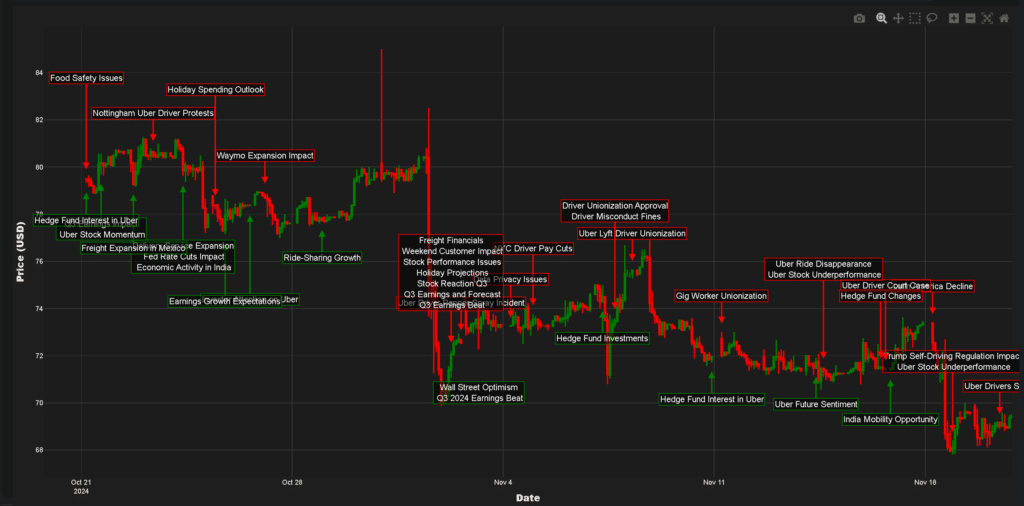
If you’re currently looking for answers to the question “Why is Uber stock down“, then our Trading Co-Pilot has highlighted a concerning pattern which has created this faltering stock performance over the past month, with shares declining significantly despite broader market resilience. The realisation that multiple factors are contributing to this downturn has sparked intense debate across the markets. As this sprawling set of events has unfolded, our AI-driven analysis has identified key drivers behind the decline, from regulatory shifts to operational challenges. What we are seeing is a complex interplay of factors, and in this article, we’ll explore the data-driven insights our Trading Co-Pilot has uncovered offering an answer to the question – why is Uber stock down? – and what it means for investors.

Why is Uber stock down

Why is Uber stock down: Market context 

The prospect of the relaxation of self-driving regulations has materialised following Trump’s recent election victory, leading to an immediate decline in Uber’s stock after Trump’s announcement regarding self-driving car regulations (while Tesla’s stock rose) . This knotty situation highlights the complex interplay between politics and market dynamics. By unhappy coincidence, this came just as the company was navigating other operational challenges.

Regulatory headwinds in the mix

Then came the Massachusetts voter approval for driver unionisation. Speaking of which, this development has created uncertainty around Uber’s labour costs and operational model. This isn’t new – the gig economy has faced ongoing regulatory challenges, but the recent unionisation victories represent a significant shift in the company’s labour relations landscape.

Why is Uber stock down: Multiple pressure points

One explanation is that Uber’s Q3 earnings, whilst beating estimates, revealed disappointing gross bookings growth. But alongside a muted holiday forecast, these factors have contributed to investor concern. Adding insult to injury, hedge funds like Third Point have begun divesting from Uber in favour of competitors, signalling a broader shift in institutional sentiment.

A look at regional challenges

Day by day, the real world consequences of driver protests are becoming apparent. Consider the recent strikes in Newcastle and Nottingham over pay transparency. Though it’s also important to keep things in perspective, these localised issues point to broader operational challenges facing the company’s workforce management strategy.

Why is Uber stock down: Competitive landscape

The question, then, is how Waymo’s rapid expansion impacts Uber’s market position. What we are seeing is intensifying competition in the autonomous vehicle space. The realisation that multiple competitors are making significant strides in self-driving technology has raised questions about Uber’s long-term competitive positioning.

Financial performance analysis

Our Trading Co-Pilot has highlighted several concerning metrics in the latest quarterly results. The Q3 earnings report revealed a peculiar dichotomy: whilst the company achieved record profits, the rate of bookings growth fell short of market expectations, triggering investor anxiety. Moreover, the weekend customer impact has shown troubling patterns in consumer behaviour, suggesting potential shifts in core market dynamics. Perhaps most worryingly, Uber Freight’s widening EBITDA losses point to ongoing challenges in the company’s logistics diversification strategy.

Why is Uber stock down: Market sentiment shift

Still this, along with hedge fund repositioning, suggests a broader shift in market sentiment. There is a case for viewing this as a temporary correction, but the realisation that multiple factors are converging has dampened investor enthusiasm. This, we suspect, could lead to continued pressure on the stock until clear catalysts emerge.

Good news and growth opportunities

The good news is that significant growth potential remains, particularly in markets like India. It has been predicted that Uber’s Auto and Moto services could generate Rs 36,000 crore in economic activity in India for 2024. Optimists like to say that these international expansion opportunities could offset domestic challenges, and our analysis suggests there’s merit to this perspective.

Why is Uber stock down: Technical analysis

Our Trading Co-Pilot paints a concerning picture of market dynamics. We’ve observed a significant breach of key support levels that previously underpinned the stock’s stability. This has coincided with notably weakening momentum indicators across multiple timeframes, suggesting diminishing buying pressure. Furthermore, our institutional flow analysis reveals increased selling pressure from large investors, potentially indicating a shift in long-term positioning strategies.

Uber stock performance: Looking ahead

What this situation requires is an appreciation of the complexity and context. As this set of events play out, several notable themes have emerged. The regulatory environment is becoming increasingly challenging. Simultaneously, competition in the autonomous driving sector has intensified dramatically, with new entrants and established players alike making significant technological advances. Then, the labour relations landscape requires novel approaches as workers increasingly demand better conditions and representation. However, emerging growth markets, particularly in Asia, offer potential counterbalance to these domestic headwinds, providing opportunities for strategic expansion.

History has shown time and again that market leaders can navigate regulatory and competitive challenges. If you think the above is worrying, remember that Uber maintains significant market share and operational advantages. These dips happen whenever there is uncertainty, but the company’s fundamental business model remains intact for the time being, despite the current headwinds.

Transform your trading strategy with AI-driven insights


Uber stock analysis

What this situation clearly demonstrates is the power of AI-driven market analysis. The question, then, is: how many similar opportunities or risks might you be missing in your portfolio right now by not accessing these insights in real-time?

Our Trading Co-Pilot doesn’t just analyse market movements – it transforms complex market dynamics into actionable intelligence, delivered in real-time to your dashboard. From detecting early warning signs to identifying hidden opportunities, our AI works tirelessly like a team of analysts 24/7 to give you the edge in today’s volatile markets. 

Experience the power of AI-driven market analysis for yourself. Email us at enquiries@permutable.ai to request a free trial or complete the form below for a personalised demo. The market isn’t waiting. Neither should you.

Request personalised demo


Explore previous articles in this series

Exploring the key factors influencing Nextera Energy stock price 2024

In this article, we’ll examine the key factors influencing Nextera Energy stock price, the leading U.S. energy company known for its focus on renewable energy sources, such as wind and solar power. Influenced by a variety of factors – both internal and external to the organisation – understanding these factors is crucial for investors, analysts, and industry stakeholders to make informed decisions about the company’s future performance.

Key factors influencing Nextera Energy stock price

Nextera Energy stock is influenced by a range of factors, which can be broadly categorised into the following groups:

  1. Economic factors
  2. Regulatory factors
  3. Environmental factors
  4. Market demand and supply dynamics
  5. Financial performance and investor sentiment
  6. Analyst recommendations

Let’s explore each of these factors in more detail.

Economic factors affecting Nextera Energy stock price

The overall state of the economy has a significant impact on Nextera Energy’s stock price. Factors such as GDP growth, inflation, interest rates, and unemployment levels can all influence the company’s financial performance and investor sentiment. During periods of economic expansion, for example, increased energy demand and higher electricity prices can boost Nextera Energy’s revenue and profitability, leading to a rise in its stock price. Conversely, economic downturns can result in reduced energy consumption and lower electricity prices, putting downward pressure on the company’s stock.

Regulatory factors impacting Nextera Energy stock price

The energy industry is heavily regulated, and changes in government policies, laws, and regulations can significantly impact Nextera Energy’s operations and financial outlook. Factors such as renewable energy mandates, emission control regulations, tax incentives, and permitting processes can all affect the company’s ability to develop and operate its renewable energy projects. Favourable regulatory environments that support the growth of renewable energy can positively impact Nextera Energy’s stock price, while unfavourable regulations can have the opposite effect.

Environmental factors and their impact on Nextera Energy stock price

As a company focused on renewable energy, Nextera Energy’s operations and financial performance are closely tied to environmental factors. The availability and reliability of natural resources, such as wind and solar, can directly affect the company’s ability to generate electricity and meet its energy production targets. Extreme weather events, such as hurricanes or droughts, can also disrupt Nextera Energy’s operations and impact its financial results, which can then influence its stock price.

Market demand and supply dynamics for Nextera energy stock

The demand and supply of Nextera Energy’s stock in the market can also affect its price. Factors such as investor sentiment, trading volume, and market liquidity all play a role in determining the stock’s price. If there is high demand for Nextera Energy’s stock, with more buyers than sellers, the stock price is likely to increase. Conversely, if there is an oversupply of the stock, with more sellers than buyers, the price may decline.

Financial performance and investor sentiment affecting Nextera Energy stock price

Nextera Energy’s financial performance, as reflected in its earnings reports, revenue growth, and profitability, is a key factor influencing its stock price. Investors closely monitor the company’s financial metrics, as they provide insights into its operational efficiency, growth potential, and ability to generate returns. Strong financial performance can boost investor confidence and lead to an increase in the stock price, while poor financial results can have the opposite effect.

Investor sentiment, i.e. the overall mood and perception of the market towards a company, can also significantly impact Nextera Energy’s stock price. Positive sentiment, driven by factors such as the company’s strategic initiatives, industry trends, and market outlook, can lead to increased demand for the stock and higher prices. Conversely, negative sentiment can result in decreased demand and lower stock prices.

Analyst recommendations and their influence on Nextera Energy stock price

Analyst recommendations can also heavily influence Nextera Energy’s stock price. In this case, positive analyst recommendations, which suggest that the stock is undervalued or has the potential for growth, can lead to increased investor interest and a rise in the stock price. On the other hand, negative recommendations, on the other hand, can result in a decline in the stock price.

A look back at recent events impacting Nextera Energy stock


Factors affecting Nextera Energy stock price

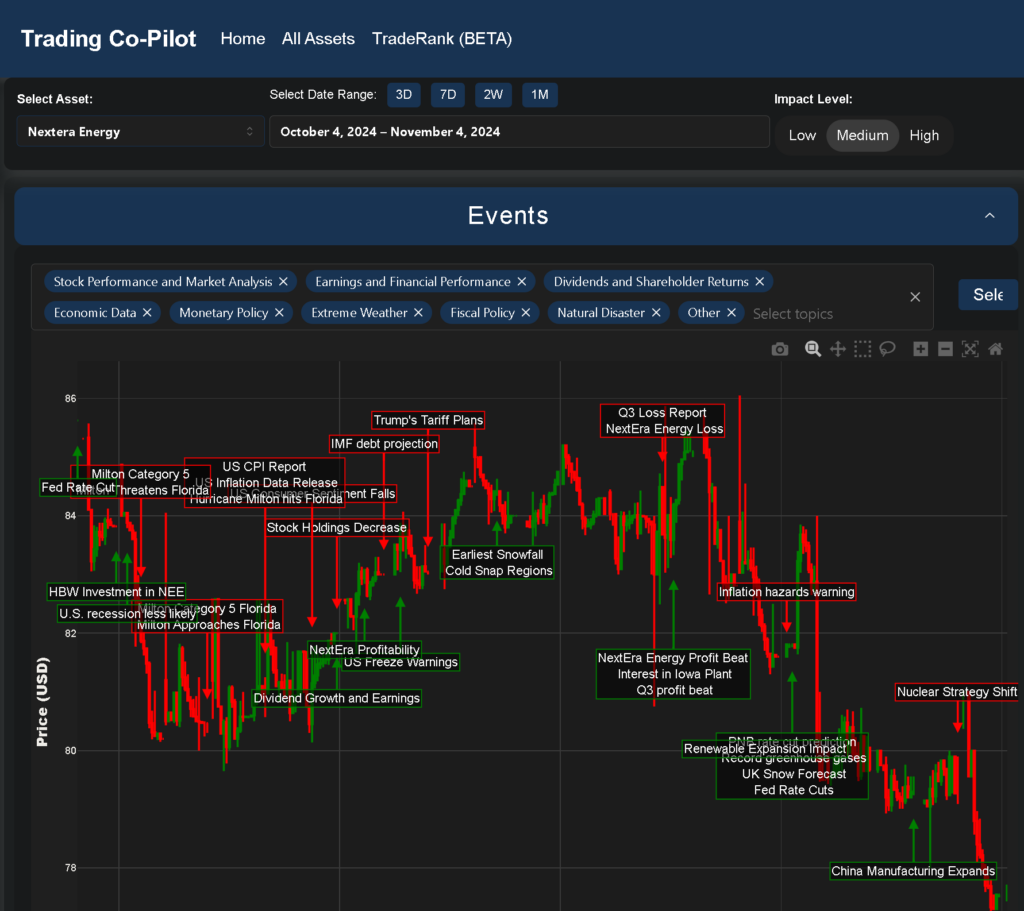
Using our Trading Co-Pilot to review NextEra Energy’s stock performance during October-November 2024 reflects a complex interplay of company-specific events, macroeconomic factors, and industry developments. The most significant impact came from the company’s Q3 loss report, though this was partially offset by positive news about Q3 beating beats in specific divisions and increased interest in their Iowa nuclear plant operations. 

Weather events played a crucial role in price volatility, with Hurricane Milton’s impact on Florida operations, early snowfall, and cold snap conditions in key regions affecting potential operational outlook and demand. The company faced additional pressure from stock holdings decreases by a significant investor (Meyer Handelman) while broader economic factors such as Federal Reserve policy developments, IMF debt projections, and Trump’s tariff plans created market uncertainty. 

The company’s dividend growth and earnings outlook provided some positive momentum during this period. External factors such as China’s manufacturing expansion and record greenhouse gas measurements influenced investor sentiment by highlighting changing global energy demand patterns and the growing importance of renewable energy solutions. 

Final thoughts on factors influencing Nextera Energy stock price

Ultimately, Nextera Energy’s stock price is influenced by a complex interplay of economic, regulatory, environmental, market, financial, and analyst-related factors. By understanding and monitoring these key factors, investors, analysts, and industry stakeholders can make more informed decisions about the company’s future performance and the potential risks and opportunities associated with its stock.


Factors affecting Nextera Energy stock price

Stay ahead of NextEra Energy stock and market movements

Don’t miss critical events affecting Nextera Energy stock prices. Our Trading Co-Pilot keeps you informed in real-time by monitoring multiple impact factors in real-time including:

✓ Stock performance & market analysis
✓ Earnings & financial Reports
✓ Weather events & natural disasters
✓ Economic d0ata & monetary Policy
✓ Regulatory changes & fiscal Policy
✓ Dividend updates & shareholder returns

Register your interest now to receive targeted alerts and never miss another market-moving event affecting your NextEra Energy investments by filling in the form below.

Register interest below


Why is Tesla stock dropping? A lookback at Q4 events

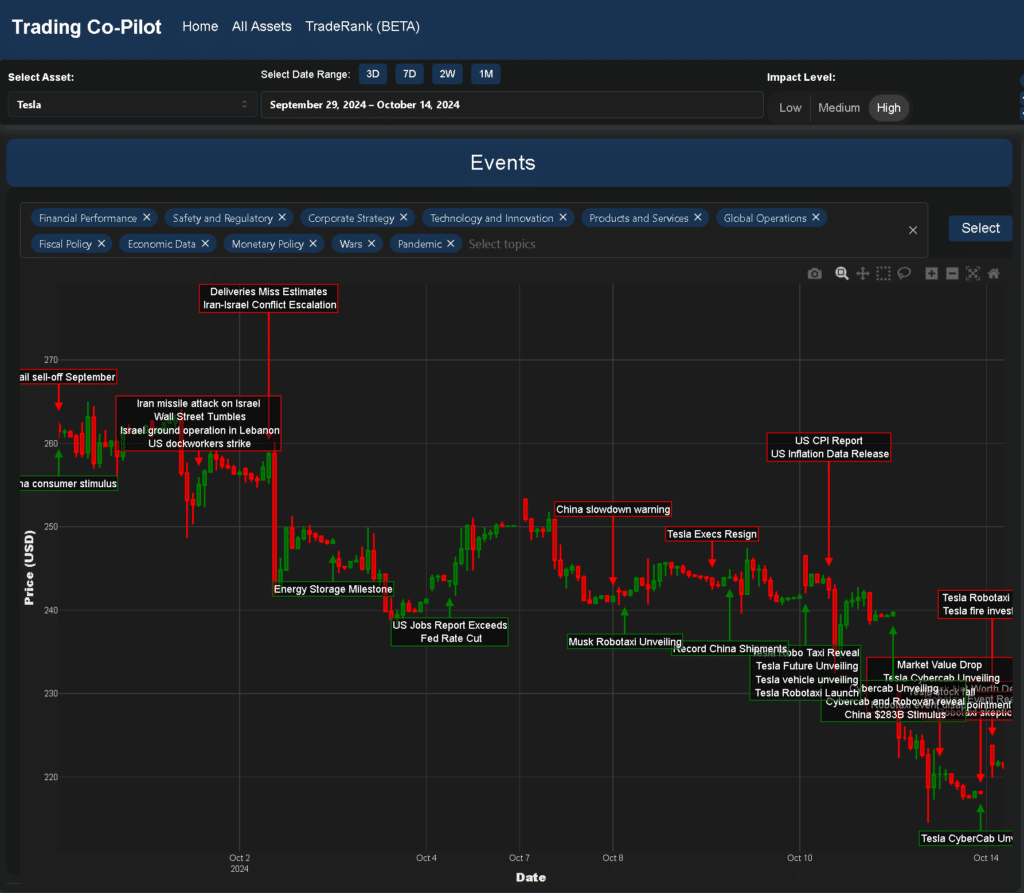
Why is Tesla stock dropping? Let’s start with the obvious: Tesla’s stock has been on a wild ride of late. Our Trading Co-Pilot chart paints a vivid picture of over the past month, with several dramatic dips and recoveries. This striking difference hints at a complex interplay of factors influencing investor sentiment. But what’s really driving these fluctuations? Get our latest thinking in this article with insights from our Trading Co-Pilot.

Why is event Tesla stock dropping – insights from our Trading Co-Pilot

Tesla stock dropping

Geopolitical tensions and market jitters

For starters, the chart highlights a significant sell-off in late September, coinciding with an escalation in geopolitical tensions. The Iran-Israel conflict escalation spooked investors, leading to a broader market tumble. You might say that Tesla, being a high-profile and volatile stock, often amplifies broader market movements. Yet here’s the rub: while geopolitical events certainly play a role, they don’t tell the whole story of Tesla stock dropping. There is also evidence that company-specific factors are at play, which we’ll get into in more detail below.

Product launches and market reception

One thing is clear, the problem isn’t a lack of innovation at Tesla including developments in energy storage and of course, the recent Robotaxi unveiling which failed to impress investors. But we must remember the bigger picture here, which is that Tesla is consistently pushing the boundaries of electric vehicle technology and energy solutions. Nonetheless, the market’s reaction to these announcements has been mixed at best with Tesla stock dropping continues to be the prevailing trend at the moment. This suggests that the market believes that these innovations may not translate into immediate revenue growth or profitability  

Corporate shake-ups and internal challenges

Another bone of contention is the recent resignation of Tesla executives – indicated on our Trading Co-Pilot chart as “Tesla Execs Resign” as a significant event. This internal turbulence could be contributing to investor unease. There is broad consensus that leadership stability is crucial for a company as innovative and disruptive as Tesla. The expectation that top talent might be leaving the company could be weighing heavily on investor confidence.

Macroeconomic factors

Again and again, you can see the same pattern: macroeconomic events having a significant impact on Tesla’s stock price. The US Jobs Report exceeding expectations and a potential Fed Rate Cut initially gave the stock a boost. However, this was followed by concerns about a China slowdown, which likely contributed to Tesla stock dropping once more.

It has now emerged that Tesla’s fortunes are closely tied to both US and Chinese economic health. The catalyst for many of the stock’s movements can be traced back to these broader economic indicators.


Permutable AI Trading Co-Pilot

Competition and market saturation

Little wonder that investors are keeping a close eye on Tesla’s market position. The present state of play in the electric vehicle market is one of increasing competition. While our Trading Co-Pilot chart doesn’t explicitly mention competitors, the overall downward trend in Tesla stock dropping could reflect growing concerns about market saturation and rivalry from both established automakers and new EV startups.

Supply chain and delivery challenges

Now look to where our Trading Co-Pilot highlights “Deliveries Miss Estimates” as a significant event. This is at the core of Tesla’s recent struggles. Achieving its ambitious production and delivery goals is crucial for maintaining investor confidence. This requires a finely tuned supply chain and manufacturing process.

By leveraging its world-class production capabilities, Tesla has historically been able to ramp up deliveries quarter after quarter. However, the recent miss suggests that the company may be facing headwinds in this area.

Investor sentiment and future outlook

So much of the past, what of the future? Insights from our Trading Co-Pilot chart shows several events related to future products and innovations, such as the Robotaxi. These announcements are clearly aimed at shaping investor perceptions of Tesla’s long-term potential, despite investors being less than impressed by the recent unveiling.

However, the continued pattern of Tesla stock dropping suggests that investors may be adopting a “show me” attitude. They’re looking for concrete results rather than future promises. In fact, some say the expectation that Tesla can maintain its astronomical growth rates indefinitely may be waning. Nonetheless, it’s important to note that the company still enjoys a significant market cap and brand loyalty that many competitors envy.

Why is Tesla stock dropping: Final thoughts 

Much has changed since Tesla’s early days as an EV pioneer. The company now faces the challenges of being an industry leader in a rapidly evolving market. The good news is there’s a big wheel moving in the right direction in terms of global EV adoption, but Tesla must navigate carefully to maintain its pole position in face of competition that is fiercely hotting up.

In a bizarre twist, the very success that Tesla has had in popularising electric vehicles has created a more competitive landscape that now challenges its market dominance. This trend has ramped up significantly in recent years with the likes of Nio and Lucid hot on Tesla’s heels.

Beyond the fanfare of product launches and ambitious goals, Tesla must grapple with the realities of production scaling, market competition, and delivering on its promises to maintain investor confidence.

Over the past month, Tesla stock dropping has been the prevailing narrative. But in the fast-paced world of tech and automotive innovation, fortunes can change quickly and it is likely this trend will reverse at any given time. For investors and industry observers alike, Tesla remains a company to watch closely, as its trajectory could well indicate the future direction of the entire electric vehicle market.


How geopolitics affects the stock market

Geopolitics and international relations are some of the biggest factors that affect the stock market. With high levels of globalization and integration of financial markets, changes in geopolitical landscapes can significantly affect financial systems and subsequently, the global economy. This article will explain how geopolitics affects the stock market, revealing the various geopolitical factors that affect financial markets.

Historical examples of geopolitical events affecting the stock market

There are several events that have happened in the world that have led to geopolitical factors affecting the stock market. For example, in 1962, during the Cuban Missile Crisis, the S&P 500 declined more than 6% due to conflicts of interest between the US and the Soviet Union. Similarly, the Gulf War in 1991 also affected the stock market because investors could not handle the situation and responded negatively to the uncertainty and risks of the disruption in the supply of oil in the global market. In the recent past, the Russian annexation of Crimea in 2014 and the sanctions by the West had a significant effect on the Russian stock market and further implications for global financial markets. Trade relations between the United States of America and China have also been another event that has had a negative impact on the stock market, especially because investors are frequently paying attention to trade negotiations between the two largest economies in the world and the impact they will have on global value chains and investment flow.

Understanding the global forces driving financial markets

The stock market is a complex structure involving numerous factors, including domestic and international. Geopolitical events are one of the many global forces that have an impact on financial markets. Other factors include macroeconomic factors like GDP, inflation rates, and interest rates, as well as corporate earnings, technology, and investor sentiments. To fully grasp this, it is expedient to understand how exactly geopolitics influences the stock market and how the world economy is interconnected. It has also become apparent that what happens in one part of the world can significantly affect other parts due to the interconnected nature of financial markets. This implies that investors need to keep abreast of any changes in the geopolitical landscape and what this would mean to their investment portfolios.

How geopolitics affects the stock market - Global elections 2024 news sentiment analysis

This chart above shows the geopolitical risk associated with elections worldwide, as analyzed by our AI-driven news sentiment analysis. The map and accompanying data offer insights into the current sentiment towards elections in various countries, with colour coding to indicate levels of risk. Countries highlighted in red indicate high-risk sentiment towards elections. This suggests significant concerns or negative sentiment in news coverage related to elections in these areas. Countries in blue signify low-risk sentiment towards elections, indicating a more stable and positive sentiment in the news.


The role of political instability in stock market volatility

Domestic and international political instabilities are some of the leading causes of fluctuations in the stock market. This may be attributed to unstable elections, the formation of new governments, or even new policies that may lead to instabilities in the market. Due to this, investors may face risks, which they attempt to avoid as much as possible, hence leading to low risk-taking and decreased stock prices. The recent political issues in some nations, such as the United Kingdom, with the Brexit crisis or Hong Kong with the pro-democracy protests, have greatly affected their respective stock markets. Hence, the political environment must be closely observed by investors, who must also be ready to bring changes to their investment decisions as the need arises.

How trade wars and international conflicts impact the stock market

Trade disputes and global conflicts directly affect the stock market as they can potentially disrupt global supply chains, raise production costs, and result in countermeasures causing further problems in the global economy. For instance, the current trade dispute between the United States of America and China has led to imposing tariffs on numerous products, which creates high risks and fluctuations in the stock market. In the same vein, geopolitical conflicts in areas like the Middle East or the South China Sea also affect the stock market, especially the energy and technology sectors, which rely on international transactions. This means that investors need to pay particular attention to changes in relations between the countries and their possible impacts on their investment portfolios.

The influence of government policies on financial markets

Another factor that has an impact on the stock market is government policies, either at the local or international level. Various principles outlined in fiscal and monetary policies, such as changes in interest rates and tax policies, have a direct influence on the performance of the stock market. Also, government policies that have direct or indirect impacts on the financial sector or any other sector influence the stock market. An example is the recent events involving governments and central banks regarding the COVID-19 pandemic, which affected the financial markets. Although huge financial and monetary policies have been proposed to support and stabilize the economy, they have affected the growth of the stock market with long-term consequences.

Geopolitical risks and their effects on specific industries

Some industries are more vulnerable to the effects of geopolitical events than others. For instance, the energy industry is particularly sensitive to fluctuations in the global oil supply, which is influenced by political upheavals in major oil-exporting countries. However, the technology sector is more exposed to the effects of trade conflicts and risks of disruption in global supply chains. Thus, investors must always assess the various geopolitical risks that are unique to certain industries and sectors and adopt the best strategies. Analyzing geopolitical risks and opportunities will ultimately help investors manage their investing portfolios by strategically mitigating the geopolitical risks of an unpredictable global environment.

Strategies for investors to navigate geopolitical risks in the stock market

Dealing with geopolitical risks and opportunities requires effective strategies in light of the constantly shifting geopolitical environment. Some of these key strategies include:

  1. Diversification: Diversification in terms of asset classes, sectors, and geographical locations reduces the effect of geopolitical events on a portfolio.
  2. Monitoring geopolitical developments: It is always important to keep abreast of the current events happening in the geopolitical space and how they impact the financial markets.
  3.  Adjusting investment strategies: The changing geopolitical situation may affect investors’ portfolios, and this may require investors to adjust their investment strategies by increasing their allocation to safe-haven assets or reducing their risk exposure to certain sectors.
  4. Seeking professional advice: People are advised to seek the services of financial experts who have adequate knowledge of how politics affects the finance market.

The importance of staying informed about geopolitical events

In the age of globalization, keeping abreast of world events and how they may affect the stock exchange is important for investors. This way, the investors can be in a better position to predict the changes in the stock market by following the current trends in politics, economy, and international relations.

Notably, our geopolitical data intelligence gives investors with access to real-time insights and analysis of global events. All of this is powered by our advanced algorithms that analyze news sentiment extensively in real-time, offering a nuanced understanding of how geopolitical factors influence financial markets.

These are the keys to keeping ahead of geopolitical developments by understanding how geopolitical events are likely to impact market trends. From insights into elections, to trade wars, or natural disasters, all of this can help you anticipate and react to market shifts effectively. What we’ve found from using our own data intelligence to inform our own in-house trading strategies is that staying informed helps mitigate unexpected risks and seize timely opportunities. With this knowledge in hand, investors can reduce the risks their portfolios are exposed to and prepare for the challenges of an unpredictable world economy.

The ongoing relationship between geopolitics and the stock market

Geopolitics is closely connected with the stock market since several global events cause fluctuations in the financial market. As such, it can be expected that geopolitical forces will continue to put more pressure on the stock market as the world becomes further integrated in the future. Those investors who can understand the interconnection between these two spheres and the impact of geopolitical factors on corresponding opportunities and risks will be able to reach their financial goals. Therefore, investors can avert the rough periods in the global financial market by getting informed, diversifying their portfolios, and employing other appropriate strategies. If you would like to have additional information on how geopolitical factors could influence your investment portfolio, you might need to speak to a financial analyst in geopolitics. They can give you some useful tips on how you can approach the dynamic relationship between global occurrences and the stock market.

Ready to see how AI-driven geopolitical risk intelligence can transform your decision-making? Contact us for a demo of our AI-driven news sentiment analysis which is available through our Trading Co-Pilot subscription, or to request a free trial. You can also access top-line geopolitical insights through our Real-Time Geopolitical Insights & AI Market Sentiment Analysis Dashboard which is publicly available to view. 

Request demo


Lucid stock price: Understanding influencing factors in 2024

Lucid Motors, the renowned American automotive company headquartered has quickly become a focal point for investors and EV enthusiasts alike. Founded in 2007 by former Tesla engineer Peter Rawlinson, Lucid Motors has positioned itself as a formidable player in the competitive EV market.

Lucid Group, the parent company, isn’t just focused on producing high-end electric vehicles. Their scope extends to developing advanced EV powertrains and battery systems, showcasing their commitment to pushing the boundaries of electric vehicle technology. This comprehensive approach has caught the attention of both the automotive and financial services sectors.

As we delve into the Lucid stock price prediction for the coming years, it’s crucial to understand the various factors that influence the company’s market performance. From retail sales figures to technological advancements, from production capacity to regulatory changes, numerous elements come into play when analyzing Lucid’s potential trajectory.

In this article, we’ll explore:

  1. Lucid’s current market position and its ambitious plans for growth
  2. Key factors affecting Lucid’s stock price, including sales performance and technological innovations
  3. The company’s financial outlook, including market cap considerations and upcoming earnings dates
  4. Competitive landscape in the EV market and Lucid’s strategies to stand out
  5. Potential challenges and opportunities that could shape Lucid’s future

Whether you’re an investor considering adding Lucid to your portfolio, an EV enthusiast curious about the latest industry developments, or simply someone interested in the future of transportation, this analysis will provide valuable insights into one of the most exciting companies in the electric vehicle space. Joi n us as we unpack the complexities of Lucid Motors’ journey and attempt to forecast where this innovative company might be headed in the years to come.


Understanding Lucid motors stock price

Before delving into the factors that impact Lucid Motors stock price, it’s important to grasp the concept of stock price itself. The stock price represents the market’s perception of a company’s value and future prospects. For Lucid Motors, this perception is influenced by a multitude of factors, both internal and external. By comprehending these factors, investors can make informed decisions regarding their investment in Lucid Motors’ stock (LCID).

Factors influencing Lucid motors stock price

Financial performance and earnings reports

One of the primary factors that significantly impact Lucid stock price is its financial performance and earnings reports. Investors closely monitor the company’s revenue growth, profitability, and cash flow to gauge its financial health and potential for future growth. Positive financial results, such as increased sales and improving margins, often lead to a rise in the stock price. Conversely, disappointing earnings or financial instability can drive the stock price down.

Lucid Motors released its Q1 2023 earnings report, narrowly missing revenue expectations and revealing lower-than-anticipated production numbers. With revenue at $149.4 million (vs. $209.9 million expected), this resulted in Lucid stock price plunging 9% in the following trading session. The disappointing results illustrate how positive and negative financial performance can directly impact Lucid Motors’ stock price, reflecting investor sentiment towards the company’s future prospects.

Lucid Motors’ partnerships and collaborations

Lucid Motors’ strategic partnerships and collaborations play a vital role in shaping its stock price. Collaborations with established companies in the EV industry or other complementary sectors can enhance the company’s credibility and market position. These partnerships can also provide access to valuable resources, technologies, and distribution networks. When Lucid Motors announces significant partnerships or collaborations, investors tend to perceive it as a positive sign, potentially driving up the stock price.

When Lucid Motors announced a strategic partnership with Mobileye, a leading provider of driver-assistance systems. This collaboration gave Lucid access to Mobileye’s advanced vision technology for its future vehicles, enhancing safety and autonomous driving capabilities.  Lucid stock price increased following the announcement. Investors perceived the partnership as a major validation of Lucid’s technology and commitment to innovation, increasing confidence in the company’s future competitiveness.

Additionally, gaining access to Mobileye’s established technology could potentially reduce development costs and time for Lucid, further boosting investor sentiment. This example highlights how a significant partnership can directly impact Lucid Motors’ stock price by demonstrating strategic growth and technological advancement, thereby bolstering investor confidence and optimism.

Product launches and innovations

Innovation is at the core of Lucid Motors’ mission, and the company’s ability to introduce groundbreaking products can have a profound impact on its stock price. The successful launch of new electric vehicle models with innovative features, impressive range, and cutting-edge technology can generate excitement among investors and consumers alike. Anticipation and positive reception of Lucid Motors’ products often translate into a surge in the stock price.

When Lucid Motors unveiled the highly anticipated Air Sapphire, a limited-edition performance variant of its flagship Air sedan. The Sapphire boasts 1,234 horsepower, a 0-60 mph time of 1.89 seconds, and a top speed of 205 mph, making it the world’s fastest electric car. 

Lucid stock price  jumped in pre-market trading following the announcement. The Sapphire’s groundbreaking performance specs generated significant buzz and excitement among investors and car enthusiasts. This positive sentiment reflected investor confidence in Lucid’s technical prowess and ability to push boundaries in the EV market. The announcement also fueled anticipation for future high-performance models, potentially expanding Lucid’s customer base and market share.

Lucid motors stock: Industry trends and market conditions

Lucid Motors operates in an industry heavily influenced by trends and market conditions. Factors such as government policies, consumer demand for electric vehicles, and competition from other automakers can significantly impact the company’s stock price. Positive industry trends, such as increasing adoption of EVs and supportive government initiatives, can create a favourable environment for Lucid Motors’ growth, resulting in a higher stock price. Conversely, adverse market conditions or fierce competition might lead to a decline in the stock price.

In 2022, global oil prices continue to climb due to geopolitical tensions and supply chain disruptions, while several countries announce new incentives for electric vehicle purchases.  Lucid stock price jumped higher over the following week. Rising gas prices make EVs a more attractive alternative, increasing consumer demand for Lucid’s premium offerings. Government incentives further sweeten the deal for prospective buyers, boosting potential sales and revenue for Lucid. The combination of these positive industry trends signals a favourable environment for EV growth, leading investors to increase their faith in Lucid’s future prospects.

Analyst recommendations and investor sentiment

Analyst recommendations and investor sentiment can greatly influence Lucid Motors’ stock price. Analysts who closely follow the company’s performance and industry trends provide insights and recommendations regarding the stock’s potential. Positive recommendations from reputable analysts can boost investor confidence and drive up the stock price. Additionally, investor sentiment, which reflects the overall perception and attitude towards Lucid Motors’ stock, can create significant fluctuations in its price. For example, in November 2023, analysts downgraded their rating of Lucid Motors’ stock from “Buy” to “Hold” causing their share price to initially drop by as much as 5%

News and events impacting Lucid stock price

News and events, both internal and external, have the power to impact Lucid Motors’ stock price. Positive news, such as favourable regulatory changes, successful fundraising rounds, or breakthrough technological advancements, can generate optimism and drive the stock price higher. Conversely, negative news, such as product recalls, legal issues, or economic downturns, can erode investor confidence and lead to a decline in the stock price.

In August 2024, Lucid shares plunge as news that it cut its production target in half circulated.  Investors react negatively to the production scale back, as it contradicted Lucid’s ability to meet its ambitious production targets previously set for the year. This demonstrates how negative news, even a temporary setback, can quickly erode investor confidence and negatively affect a company’s stock price.

Conclusion and key takeaways

Navigating the roadmap of Lucid Motors’ stock price requires a comprehensive understanding of the key factors that influence its trajectory. Financial performance, partnerships, product launches, industry trends, analyst recommendations, and news events all play crucial roles in shaping the stock price. 

The journey through Lucid Motors’ stock price is a tapestry woven from the intricate threads of financial dynamics, strategic decisions, technological innovations, industry shifts, analyst insights, and real-world events. Each factor plays a crucial role in shaping the narrative, making it imperative for stakeholders to stay attuned to this multifaceted landscape. As Lucid Motors continues its trajectory in the electric vehicle industry, the convergence of these factors will continue to sculpt the captivating story of its stock price evolution.

Looking for more stock market insights? See our articles on the factors that determine Spotify stock priceBerkshire Hathaway stock priceTencent Holdings stock price, Nvidia stock priceGoogle stock priceWalmart stock priceApple stock priceMicrosoft stock price and Amazon stock price with more added weekly.

Trading Co-Pilot exclusive access 

Are you ready to be part of the future of trading? At Permutable AI, we’re extending an exclusive opportunity to a select group of corporate partners to gain early access to our advanced Trading Co-Pilot, powered by cutting-edge machine learning for contextual understanding.

This is a rare chance to stay ahead of the competition by leveraging AI that not only processes data but also grasps the global context—analysing real-time sentiment and market-shaping events to deliver more precise and risk-aware trading strategies.

If your firm is ready to lead the way in AI-driven trading innovation, get in touch today to explore this limited opportunity and discover how our Trading Co-Pilot can transform your approach to the market by contacting us at enquiries@permutable.ai or fill in the form below.

Get in touch


Disclaimer: The information provided by Permutable AI is for informational purposes only and does not constitute financial advice, investment advice, or a recommendation to buy, sell, or hold any securities. While we strive to provide accurate and up-to-date information, we do not guarantee the completeness, accuracy, or reliability of the data. All investments involve risks, including the loss of principal. Past performance is not indicative of future results. Users are advised to conduct their own independent research and consult with a licensed financial advisor before making any investment decisions. Permutable AI, its affiliates, or its employees shall not be held liable for any losses or damages resulting from reliance on the information provided.

Investment insights: Key factors driving the performance of Berkshire Hathaway stock 2024 UPDATE

Berkshire Hathaway is a multinational conglomerate holding company based in the United States. It was founded by Warren Buffett in 1839 and has since become one of the most successful and respected companies in the world. The company is known for its long-term investment strategy and has consistently outperformed the market over the years.

Overview of Berkshire Hathaway Stock

Berkshire Hathaway stock, listed under the ticker symbol BRK.B, is a popular choice among investors. The stock is a Class B share, which provides investors with a more affordable entry point compared to the higher-priced Class A shares. Berkshire Hathaway stock has a strong track record of delivering solid returns to its shareholders.

Key Factors Influencing the Performance of Berkshire Hathaway Class A Stock Price

Financial Performance and Stability

One of the key factors driving the performance of Berkshire Hathaway stock is the company’s strong financial performance and stability. Berkshire Hathaway has a solid balance sheet and generates significant cash flows from its diverse range of businesses. This financial strength provides a level of stability that is attractive to investors, especially during times of market volatility.

Warren Buffett’s Influence on Berkshire Hathaway Stock

Warren Buffett, the legendary investor and CEO of Berkshire Hathaway, is another major factor influencing the performance of the company’s stock. Buffett has an exceptional investment track record and is widely regarded as one of the greatest investors of all time. His investment decisions and insights have a significant impact on the market’s perception of Berkshire Hathaway stock.

Buffett’s adherence to value investing principles, focusing on companies with strong fundamentals trading at undervalued prices, has guided Berkshire Hathaway’s investment strategy. This disciplined approach has consistently led to the acquisition of undervalued assets, driving stock appreciation over time. His long-term investment horizon has instilled confidence among investors. Berkshire Hathaway’s investments are typically held for years or even decades, demonstrating a commitment to building enduring value. This long-term focus has contributed to the company’s reputation for stability and growth.

Berkshire Hathaway’s Portfolio and Investments

The composition of Berkshire Hathaway’s portfolio and its investments also play a crucial role in driving the performance of its stock. The company’s diversified holdings across various industries, including insurance, utilities, consumer goods, and technology, serve as a cornerstone of stability and growth. This well-structured portfolio mitigates risk by providing investors with exposure to a diverse range of sectors, ensuring that the company’s overall performance is not overly reliant on any single industry or economic climate.

Berkshire Hathaway’s strategic investments in key industries have further enhanced the company’s success. The acquisition of BNSF Railway in 2010 exemplified this approach, diversifying the company’s holdings and providing exposure to the transportation and logistics industry. Today, BNSF Railway stands as one of Berkshire Hathaway’s most valuable and profitable subsidiaries. Similarly, the company’s investment in Apple, initiated in 2016, has been a resounding success. Apple’s remarkable growth and market dominance have significantly propelled Berkshire Hathaway Class A stock price to new heights.

Berkshire Hathaway’s willingness to back disruptive technologies further demonstrates its forward-thinking approach. Investments in BYD, a Chinese electric vehicle maker, and Nucor, an American steel producer, illustrate the company’s recognition that companies that disrupt traditional industries can offer significant growth potential. These investments reflect Warren Buffett’s belief in identifying and investing in high-quality businesses across a wide range of industries, a strategy that has consistently driven Berkshire Hathaway’s success.

Industry and Market Trends Impacting Berkshire Hathaway Class A Stock Price

Berkshire Hathaway stock is influenced by industry and market trends, just like any other stock. Factors such as changes in interest rates, global economic conditions, and regulatory developments can impact the performance of the stock. Additionally, trends specific to the industries in which Berkshire Hathaway operates, such as insurance or energy, can also influence the stock’s performance.

Berkshire Hathaway’s large insurance holdings, including Geico and Berkshire Hathaway Reinsurance Group, are sensitive to changes in the insurance industry, such as changes in interest rates and the frequency and severity of natural disasters. For example, when interest rates rise, Berkshire Hathaway’s investment income from its insurance businesses tends to increase, which can boost the company’s overall profitability and stock price. Conversely, when interest rates fall, Berkshire Hathaway’s investment income from its insurance businesses tends to decline, which can weigh on the company’s profitability and stock price.

Meanwhile, Berkshire Hathaway’s ownership of BNSF Railway, a major railroad company, exposes the company to the performance of the transportation and logistics industry. When the economy is strong and demand for transportation services is high, BNSF Railway’s profitability tends to improve, which can positively impact Berkshire Hathaway’s overall earnings and stock price. Conversely, when the economy is weak and demand for transportation services is low, BNSF Railway’s profitability tends to decline, which can put pressure on Berkshire Hathaway’s stock price.

Analyst Recommendations and Market Sentiment towards Berkshire Hathaway Stock

Analyst recommendations and market sentiment towards Berkshire Hathaway Class A stock can have a significant impact on its performance. Positive recommendations from reputable analysts and positive market sentiment can drive the stock price higher, as investors perceive it as an attractive investment opportunity. Conversely, negative recommendations or market sentiment can put downward pressure on the stock price.

Analysts and investors alike have a positive outlook on Berkshire Hathaway stock. A majority of analysts recommend buying the stock, and the average price target indicates a significant upside potential. Additionally, institutional investors hold a substantial portion of Berkshire Hathaway’s outstanding shares, reflecting their confidence in the company’s long-term prospects.

Retail investors meanwhile rank it among the most popular stocks on the Robinhood platform, and positive sentiment towards the stock is frequently expressed on social media. This suggests that retail investors also recognize the company’s value and potential for growth.

Overall, the positive analyst recommendations, strong market sentiment, and significant institutional ownership paint a bullish picture for Berkshire Hathaway stock. The company’s strong financial performance, diversified portfolio, and leadership under Warren Buffett have earned it the trust of experts and investors, making it a compelling investment for those seeking long-term growth.

Case Studies of Successful Investments by Berkshire Hathaway

Berkshire Hathaway has a remarkable track record of making successful investments across a variety of industries. These case studies highlight the company’s ability to identify and invest in high-quality businesses with strong fundamentals and sustainable competitive advantages. Berkshire Hathaway’s success is attributed to Warren Buffett’s disciplined investment philosophy, long-term investment horizon, and ability to recognize companies with the potential for long-term growth and profitability.

The investment in Coca-Cola exemplifies Berkshire Hathaway’s focus on companies with strong brands, global reach, and consistent profitability. Coca-Cola‘s enduring popularity and market dominance have generated significant returns for Berkshire Hathaway shareholders. Similarly, the investment in American Express demonstrates the company’s ability to recognize and support companies with a strong track record of innovation and leadership in their respective industries.

Apple, BNSF Railway, and Nucor represent Berkshire Hathaway’s willingness to invest in companies with disruptive technologies and the potential to transform their industries. Apple’s technological innovation and market dominance have propelled Berkshire Hathaway’s stock price to new heights, while BNSF Railway’s diversification into the transportation and logistics industry has further enhanced the company’s stability and profitability. Nucor’s adoption of newer steelmaking techniques has enabled it to remain competitive in an industry facing challenges from globalization and technological advancements, exemplifying Berkshire Hathaway’s commitment to identifying companies with long-term growth potential.

Mid-Year 2024 Update on Berkshire Hathaway Class A Stock Price

As of mid-2024, Berkshire Hathaway continues to showcase its resilience and strategic prowess in the global market. Headquartered in Omaha, Nebraska, the company’s diversified portfolio remains a cornerstone of its stability and growth. Berkshire Hathaway operates across various industries, including freight rail transportation through its ownership of BNSF Railway, a leading railroad system in North America. The company’s subsidiaries also engage in insurance and reinsurance, natural gas distribution, power generation, and the manufacturing of electronic components. Additionally, Berkshire Hathaway’s involvement in aircraft ownership programs and its investments in building products further solidify its position as a multinational conglomerate.

During the first half of 2024, Berkshire Hathaway’s stock performance reflected its robust business model and diversified investments. The company’s subsidiaries, spanning across sectors such as transportation, energy, and manufacturing, have shown strong performance, contributing to the overall financial health of the conglomerate. The consistent profitability of its railroad operations, coupled with steady growth in its insurance and utility segments, has kept investor confidence high.

However, the company also faces challenges, particularly in the context of global economic fluctuations and regulatory changes. The natural gas distribution and power generation segments, while stable, are sensitive to changes in energy policy and market dynamics. Additionally, Berkshire Hathaway’s investment strategy continues to be influenced by market trends and the evolving landscape of electronic components manufacturing, which plays a crucial role in many of its industrial subsidiaries.

Overall, the mid-year outlook for Berkshire Hathaway remains positive, driven by its diversified holdings and strategic investments in critical industries. Investors continue to view the company as a stable and long-term growth prospect, bolstered by its ability to adapt to changing market conditions and its ongoing commitment to innovation and expansion in various sectors.

Final Thoughts on Berkshire Hathaway Stock

In conclusion, several key factors drive the performance of Berkshire Hathaway stock. These include the company’s financial performance and stability, Warren Buffett’s influence, the composition of its portfolio and investments, industry and market trends, analyst recommendations, and successful case studies. By considering these factors, investors can make more informed decisions when investing in Berkshire Hathaway stock.

Looking for more stock market insights? See our articles on the factors that determine Advanced Micro Devices stock priceLucid stock priceTencent Holdings stock priceNvidia stock priceMeta stock priceApple stock priceMicrosoft stock priceTesla stock priceWalmart stock priceGoogle stock price and Amazon stock price with more added weekly.

Revolutionize Your Trading Strategy 

At Permutable AI, our expertise powers your strategy, facilitating human-to-AI knowledge transfer and offering a unique edge in discerning investor sentiment, from global macro trends to corporate happenings. With over 1.1 million companies tracked across 120 countries and natural language processing inspired by GPT-4, our real-time insights transform trading. Plus, our state-of-the-art machine learning trading platform, R2, systematically pinpoints entry points for various securities. Join us on the journey to reimagine your trading. Get in touch below to find out more.

Get In Touch


Disclaimer: The information provided by Permutable AI is for informational purposes only and does not constitute financial advice, investment advice, or a recommendation to buy, sell, or hold any securities. While we strive to provide accurate and up-to-date information, we do not guarantee the completeness, accuracy, or reliability of the data. All investments involve risks, including the loss of principal. Past performance is not indicative of future results. Users are advised to conduct their own independent research and consult with a licensed financial advisor before making any investment decisions. Permutable AI, its affiliates, or its employees shall not be held liable for any losses or damages resulting from reliance on the information provided.

Market insights: Understanding the key factors that influence Alibaba stock price 2024 UPDATE

Alibaba Group Holding Limited, a multinational conglomerate founded in 1999 by Jack Ma, has solidified its position as a dominant force in the global e-commerce industry. Leveraging an innovative business model and a broad range of product offerings, Alibaba has attracted significant investor interest worldwide. As a result, the stock market performance of Alibaba Group has become a focal point for investors, with its fluctuations reflecting various internal and external factors. The company’s continuous adaptation to market dynamics, particularly through ventures like cloud computing and digital media, has played a crucial role in sustaining investor confidence and driving stock prices. In addition, global economic conditions, including exchange rate fluctuations and geopolitical tensions, significantly impact Alibaba’s valuation, highlighting the complex interplay of factors that investors must consider when assessing the company’s stock. In this article we’ll examine these dynamics in greater detail. 

Factors That Influence Alibaba Stock Prices

Company Performance and Financials

One of the most crucial factors that drive Alibaba’s stock prices is the company’s performance and financials. Investors closely monitor metrics such as revenue growth, profit margins, and cash flow to gauge the health of the business. Alibaba’s impressive track record in generating substantial revenue growth and maintaining healthy profitability has been a major driver of its stock performance. For example, in 2020, Alibaba’s stock price rose by over 20% after the company reported strong earnings growth. Additionally, investors pay close attention to key financial ratios like price-to-earnings (P/E) ratio and return on equity (ROE) to assess the valuation and profitability of their stock stock.

Another aspect that significantly impacts Alibaba’s stock prices is its ability to adapt to changing market dynamics. The company’s success in diversifying its revenue streams beyond its core e-commerce business, through ventures such as cloud computing, digital media, and entertainment, has been instrumental in attracting investor interest. Any positive developments in these areas, such as robust revenue growth or strategic partnerships, can have a considerable impact on Alibaba’s stock prices.

Global Economic Factors

Alibaba’s stock prices are also influenced by global economic factors. As a multinational company, Alibaba’s performance is tied to the health of the global economy. Economic indicators like GDP growth, consumer spending, and inflation rates can impact Alibaba’s business operations and, consequently, its stock prices. For instance, during periods of economic downturns, consumer spending might decline, leading to reduced demand for Alibaba’s products and services. For example, in 2019, Alibaba’s stock price fell by over 20% as concerns about a global economic slowdown grew.

Moreover, fluctuations in foreign exchange rates can also impact Alibaba’s stock prices. As Alibaba generates a significant portion of its revenue from international markets, changes in exchange rates can affect the company’s profitability. For example, a strengthening of the Chinese yuan against major currencies can lead to a decrease in Alibaba’s overseas revenue when converted into the local currency, potentially impacting its stock prices.

Industry Trends and Competition

Alibaba operates in a highly competitive industry, which makes monitoring industry trends and competition essential for understanding the future prospects of its stock. Any significant developments, such as new entrants, technological advancements, or changes in consumer behavior, can impact Alibaba’s market position and, consequently, its stock prices.

Investors closely watch Alibaba’s ability to stay ahead of the competition through innovation and strategic acquisitions. For instance, the company’s investments in artificial intelligence and big data analytics have positioned it at the forefront of the e-commerce industry. Positive developments in these areas can boost investor confidence in Alibaba’s stock, leading to an increase in its stock prices.

Additionally, investor sentiment towards the overall e-commerce sector can influence Alibaba’s stock prices. If investors perceive the industry as a whole to be attractive, it can have a positive spillover effect on Alibaba’s stock prices, irrespective of the company’s individual performance.

Government Regulations and Policies

As a multinational company operating in various jurisdictions, Alibaba is subject to government regulations and policies. Changes in regulations related to e-commerce, data privacy, taxation, and intellectual property rights can significantly impact Alibaba’s business operations and, consequently, its stock prices. For example, stricter regulations on data privacy might increase compliance costs for Alibaba, affecting its profitability and stock prices.

Government policies related to international trade and geopolitical tensions can also influence Alibaba’s stock prices. Trade disputes or changes in tariffs can disrupt global supply chains and impact Alibaba’s ability to source products and services.  Alibaba is a Chinese company, and its stock price is sensitive to trade tensions between the United States and China. When trade tensions between the two countries are high, investors become more cautious about investing in Chinese companies, which can put downward pressure on Alibaba’s stock price. For example, in 2018, Alibaba’s stock price fell by over 10% after the Trump administration imposed tariffs on Chinese goods.

The Chinese government has a significant impact on Alibaba’s business. Changes in government regulations, such as new anti-monopoly laws or data privacy laws, can have a material impact on Alibaba’s stock price. For example, in 2021, Alibaba’s stock price fell by over 10% after the Chinese government ordered the company to break up its Ant Group fintech subsidiary.

Investor Sentiment and Market Psychology

Investor sentiment and market psychology play a vital role in determining the stock prices of Alibaba. The stock market is driven not only by fundamental factors but also by the perceptions and emotions of market participants. Positive news, such as strong earnings reports or strategic partnerships, can create optimism among investors, leading to increased demand for Alibaba’s stock and driving up its prices.

Conversely, negative news or market uncertainties can dampen investor sentiment, resulting in a decline in Alibaba’s stock prices. Factors such as political instability, economic uncertainty, or global events can trigger market volatility and impact investor confidence in Alibaba’s stock.

Analyst Recommendations and Target Prices

The assessments and recommendations of financial analysts also influence Alibaba’s stock prices. Analysts closely monitor the company’s financials, industry trends, and competitive landscape to provide their insights on the future prospects of Alibaba stock. Their recommendations, which include buy, hold, or sell ratings, can impact investor sentiment and, subsequently, Alibaba’s stock prices.

Investors often refer to analyst target prices, which represent the projected future value of the company’s stock. Positive revisions in target prices can generate optimism among investors and contribute to an increase in Alibaba’s stock prices. Conversely, negative revisions can create a pessimistic outlook, leading to a decline in stock prices.

Key Events and News

Key events and news related to Alibaba can have a significant impact on its stock prices. Events such as earnings releases, product launches, strategic partnerships, or regulatory developments can trigger substantial fluctuations in Alibaba’s stock prices. Investors closely follow these events to assess the implications for the company’s future prospects and make informed investment decisions.

Alibaba is constantly innovating and expanding its business through new product launches and acquisitions. When the company launches successful new products or makes strategic acquisitions, its stock price tends to rise. Conversely, when the company’s new products or acquisitions fail to meet expectations, its stock price tends to fall. For example, in 2019, Alibaba’s stock price rose by over 10% after the company launched its Lazada e-commerce platform in Southeast Asia.

Conclusion and Investment Considerations

Investing in Alibaba stock requires a comprehensive understanding of the key factors that influence its stock prices. Factors such as company performance, global economic conditions, industry trends, government regulations, investor sentiment, analyst recommendations, and key events all contribute to the dynamics of Alibaba’s stock prices.

Investors should closely monitor these factors, conduct thorough research, and seek professional advice before making investment decisions. By staying informed and considering a holistic approach, investors can navigate the complexities of the stock market and potentially benefit from the growth and success of Alibaba.

Found this article useful? Why not read our deep dives on factors that affect Advance Micro Devices stock priceLucid stock priceTencent Holdings stock price,  Berkshire Hathaway stock priceNvidia stock priceWalmart stock priceGoogle stock priceApple stock priceMicrosoft stock price and Tesla stock price with more added weekly.

Revolutionize Your Trading Strategy With Permutable AI

At Permutable AI, our expertise powers your strategy, facilitating human-to-AI knowledge transfer and offering a unique edge in discerning investor sentiment, from global macro trends to corporate happenings. With over 1.1 million companies tracked across 120 countries and natural language processing inspired by GPT-4, our real-time insights transform trading. Plus, our state-of-the-art machine learning trading platform, R2, systematically pinpoints entry points for various securities. Join us on the journey to reimagine your trading. Get in touch below to find out more.

Get In Touch


Disclaimer: The information provided by Permutable AI is for informational purposes only and does not constitute financial advice, investment advice, or a recommendation to buy, sell, or hold any securities. While we strive to provide accurate and up-to-date information, we do not guarantee the completeness, accuracy, or reliability of the data. All investments involve risks, including the loss of principal. Past performance is not indicative of future results. Users are advised to conduct their own independent research and consult with a licensed financial advisor before making any investment decisions. Permutable AI, its affiliates, or its employees shall not be held liable for any losses or damages resulting from reliance on the information provided.

From algorithms to acquisitions: Unraveling the complexities of Google stock price fluctuations 2024 UPDATE

From algorithms that power its search engine to strategic acquisitions that reshape the tech landscape, Google is a company that never fails to captivate investors and analysts. The stock price of this tech giant is a reflection of the complexities that drive the market. In this article, we delve into the intricacies of Google stock price fluctuations, uncovering the factors that influence its rise and fall.

Understanding the factors that influence Google stock price (goog stocks)

Google’s stock price is influenced by a multitude of factors, ranging from algorithm changes to acquisitions and market trends. Understanding these factors is crucial for investors looking to navigate the complexities of Google’s stock performance.

Google’s algorithm changes and their impact on stock prices (goo stocks)

Google’s algorithms are at the heart of its business, constantly adapting and evolving to deliver the most relevant search results to users. These algorithm changes can have a significant impact on the company’s stock price.

When Google announces algorithm updates, it often leads to speculation and anticipation among investors. Major changes, such as the introduction of the Panda and Penguin updates, have been known to cause fluctuations in Google’s stock price. For example, when the Panda algorithm was first rolled out in 2011, Google’s stock price initially dropped, reflecting concerns about the potential impact on the company’s search engine dominance. However, as the algorithm changes proved successful in improving search quality, investor confidence was restored, and the stock price eventually recovered.

Algorithm changes can also have indirect effects on Google’s stock price. For instance, updates that prioritize mobile-friendly websites can impact revenue from mobile advertising, which in turn can affect investor sentiment and the stock price. It is essential for investors to closely monitor algorithm changes and understand their potential implications on Google’s business and financials.

New product launches and how they affect Google stock price

Google’s prowess in introducing innovative products and services holds a significant sway over its stock performance. Successful launches often propel the stock price upwards, reflecting investors’ confidence in the company’s ability to stay at the forefront of technological advancements. 

However, the flip side is equally true—failed launches can exert downward pressure on the stock, signaling potential challenges or missteps in Google’s strategic initiatives. The market closely watches the outcome of each launch, as it serves as a barometer of Google’s resilience and adaptability in the ever-evolving tech landscape.

How competition affects Google stock price and Google stock projections

In the highly competitive realm of technology, Google contends with formidable rivals, including Microsoft, Amazon, and Apple. The dynamics of this competition are crucial factors influencing Google’s stock performance. Any indications or developments hinting at Google ceding market share to its counterparts can exert substantial pressure on the stock price.

The stock market is sensitive to shifts in market share, viewing them as potential indicators of a company’s standing in the industry. If there are signs that Google is losing ground to competitors, investors may interpret it as a potential erosion of the company’s dominance, raising concerns about its ability to innovate or adapt to evolving market trends.

The role of acquisitions on Google stock price movements

Google’s strategic acquisitions have played a significant role in shaping its stock performance. The company has a history of acquiring both established tech companies and promising startups to expand its product offerings and strengthen its market position.

Notable acquisitions like YouTube and Nest have had a transformative impact on Google’s business. When Google acquired YouTube in 2006, it solidified its position as a dominant player in online video. This acquisition not only contributed to revenue growth but also enhanced Google’s overall brand value. Similarly, the acquisition of Nest, a smart home technology company, positioned Google at the forefront of the emerging Internet of Things market.

Investors closely monitor Google’s acquisition strategy as it can provide insights into the company’s future growth prospects. Successful acquisitions can boost investor confidence and lead to upward trends in the stock price. On the other hand, failed acquisitions or concerns about overpaying for acquisitions can negatively impact the stock price.

Analyzing market trends and investor sentiment

In addition to algorithm changes and acquisitions, market trends and investor sentiment also influence Google’s stock price fluctuations. Market trends, such as overall market conditions, industry performance, and macroeconomic factors, can have a significant impact on the stock price.

During periods of economic uncertainty or market volatility, investors may become more cautious and sell off their shares, leading to a decline in Google’s stock price. On the other hand, positive market trends and strong investor sentiment can drive the stock price higher.

Investor sentiment, which reflects the overall perception and confidence in the company, can be influenced by various factors such as news, analyst reports, and earnings announcements. Positive news, such as strong financial results or innovative product launches, can boost investor sentiment and drive the stock price up. Conversely, negative news or concerns about regulatory issues, privacy concerns, or competition can lead to a decline in investor confidence and a subsequent drop in the stock price.

Expert opinions and forecasts on Google stock prices

Investors often rely on expert opinions and forecasts to make informed investment decisions. Analysts and financial institutions closely follow Google’s stock performance and provide their insights on its future prospects.

Analyst reports and forecasts can provide valuable information about the expected trajectory of Google’s stock price. These reports often analyze various factors, such as revenue growth, market share, competitive landscape, and industry trends, to project the company’s future performance. Investors should consider a range of expert opinions and forecasts to get a comprehensive view of Google’s stock potential.

However, it’s important to note that no forecast can guarantee accurate predictions of stock price movements. Investors should use expert opinions as one of many tools in their investment decision-making process and conduct their own thorough analysis.

Examples of significant Google stock price fluctuations

To understand the complexities of Google stock price fluctuations, let’s examine a few notable case studies:

  1. The 2008 financial crisis: Like many other companies, Google experienced a significant drop in its stock price during the 2008 financial crisis. The global economic downturn and investor concerns about advertising revenues led to a decline in the stock price. However, Google’s strong fundamentals and ability to weather the storm allowed it to recover and reach new highs in subsequent years.

  2. The Google and Alphabet restructuring: In 2015, Google announced a major restructuring, creating a new holding company called Alphabet. This move aimed to separate Google’s core businesses from its other ventures and provide more transparency to investors. The announcement initially led to a surge in the stock price, reflecting positive investor sentiment and confidence in the company’s strategic direction.

  3. Antitrust investigations and regulatory concerns: In recent years, Google has faced increased scrutiny from regulators regarding its market dominance and potential antitrust violations. News of antitrust investigations or regulatory actions can negatively impact investor sentiment and lead to stock price declines. Investors should closely monitor regulatory developments and assess their potential implications on Google’s business

Google ticker 2024 update: Key factors influencing Google stock price in 2024

As we approach the earnings date on October 22, 2024, it’s crucial to reflect on the key developments impacting Google’s stock performance this year. The first half of 2024 has been marked by significant movements in Google’s stock price, driven by a combination of short-term and long-term factors. Investors should pay close attention to the following elements as they assess Google’s prospects for the remainder of the year:

Dividend yield and stock price forecasts

Google’s decision to maintain a conservative dividend yield has continued to shape investor sentiment. While the company’s dividend policy remains a topic of debate among shareholders, many analysts are focusing on the stock price forecast for the coming quarters. The outlook remains cautiously optimistic, with forecasts suggesting potential growth driven by robust net income and strategic initiatives. However, these projections are tempered by broader market uncertainties and the impact of ongoing macroeconomic trends.

Impact of net income on long-term prospects

Google’s strong net income figures have been a key driver of its stock performance in 2024. The company’s ability to consistently generate high levels of profitability, even amidst a challenging economic environment, underscores its resilience and long-term potential. Investors are closely monitoring these financial metrics as they consider Google’s position in their portfolios over the long term.

Short-term volatility and earnings date significance

With the earnings date set for October 22, 2024, short-term volatility is expected as the market anticipates Google’s financial results. Historically, earnings reports have been pivotal in driving stock price fluctuations, and this upcoming date is likely to be no different. Investors should be prepared for potential swings in the stock price as new information becomes available, particularly in relation to Google’s performance in its core business segments and any updates on strategic acquisitions.

Navigating the second half of 2024

As we move into the latter half of the year, investors should continue to monitor key factors such as dividend yield trends, net income performance, and stock price forecasts. Understanding the interplay between these elements and how they influence Google’s stock price will be essential for making informed investment decisions.

In conclusion, navigating the complexities of Google stock price fluctuations requires a deep understanding of the factors that influence its rise and fall. Algorithm changes, acquisitions, market trends, and investor sentiment all play a role in shaping Google’s stock performance. By closely monitoring these factors, considering expert opinions, and employing sound investment strategies, investors can make informed decisions when it comes to investing in Google stock.

Google Stock Price FAQ

The main factors influencing Google’s stock price include:

  • Algorithm changes and their impact on search quality
  • New product launches and their success or failure
  • Competition from other tech giants
  • Strategic acquisitions
  • Market trends and overall economic conditions
  • Investor sentiment
  • Regulatory developments and antitrust concerns
  • Financial performance, including net income and revenue growth

Google’s algorithm changes can have significant impacts on its stock price. Major updates can cause short-term fluctuations due to investor speculation. Successful updates that improve search quality often lead to positive long-term effects on the stock price, while unsuccessful changes can negatively impact investor confidence.

Competition from companies like Microsoft, Amazon, and Apple can significantly influence Google’s stock price. Any signs of Google losing market share or falling behind in innovation can lead to downward pressure on the stock price. Conversely, when Google outperforms its competitors, it often results in positive stock price movements.

Acquisitions play a crucial role in Google’s stock price movements. Successful acquisitions that expand Google’s product offerings or strengthen its market position often lead to increases in stock price. However, overpaying for acquisitions or integrating them poorly can negatively impact the stock price.

Market trends and investor sentiment can cause significant fluctuations in Google’s stock price. Positive market conditions and strong investor confidence can drive the stock price up, while economic uncertainty or negative sentiment can lead to declines.

While expert forecasts can provide valuable insights, they should not be considered guarantees. These forecasts are based on analysis of various factors, but unexpected events or market shifts can always occur. Investors should use expert opinions as one of many tools in their decision-making process.

Google’s dividend yield policy can influence investor sentiment and stock price. While Google maintains a conservative dividend yield, changes to this policy or comparisons with other tech companies’ dividend yields can impact investor perceptions and the stock price.

When reviewing Google’s earnings reports, investors should pay attention to:

  • Revenue growth, especially in key areas like advertising
  • Net income and profitability metrics
  • User engagement statistics
  • Updates on new products or services
  • Information about strategic acquisitions
  • Guidance for future quarters
  • Any comments on regulatory challenges or market competition

Trading Co-Pilot exclusive access 

Are you ready to be part of the future of trading? At Permutable AI, we’re extending an exclusive opportunity to a select group of corporate partners to gain early access to our advanced Trading Co-Pilot, powered by cutting-edge machine learning for contextual understanding.

This is a rare chance to stay ahead of the competition by leveraging AI that not only processes data but also grasps the global context—analysing real-time sentiment and market-shaping events to deliver more precise and risk-aware trading strategies.

If your firm is ready to lead the way in AI-driven trading innovation, get in touch today to explore this limited opportunity and discover how our Trading Co-Pilot can transform your approach to the market by contacting us at enquiries@permutable.ai or fill in the form below.

Your trading is about to take off

Schedule a free enterprise demo to see how our Trading Co-Pilot can help you make smarter trading decisions, faster. 


contact us
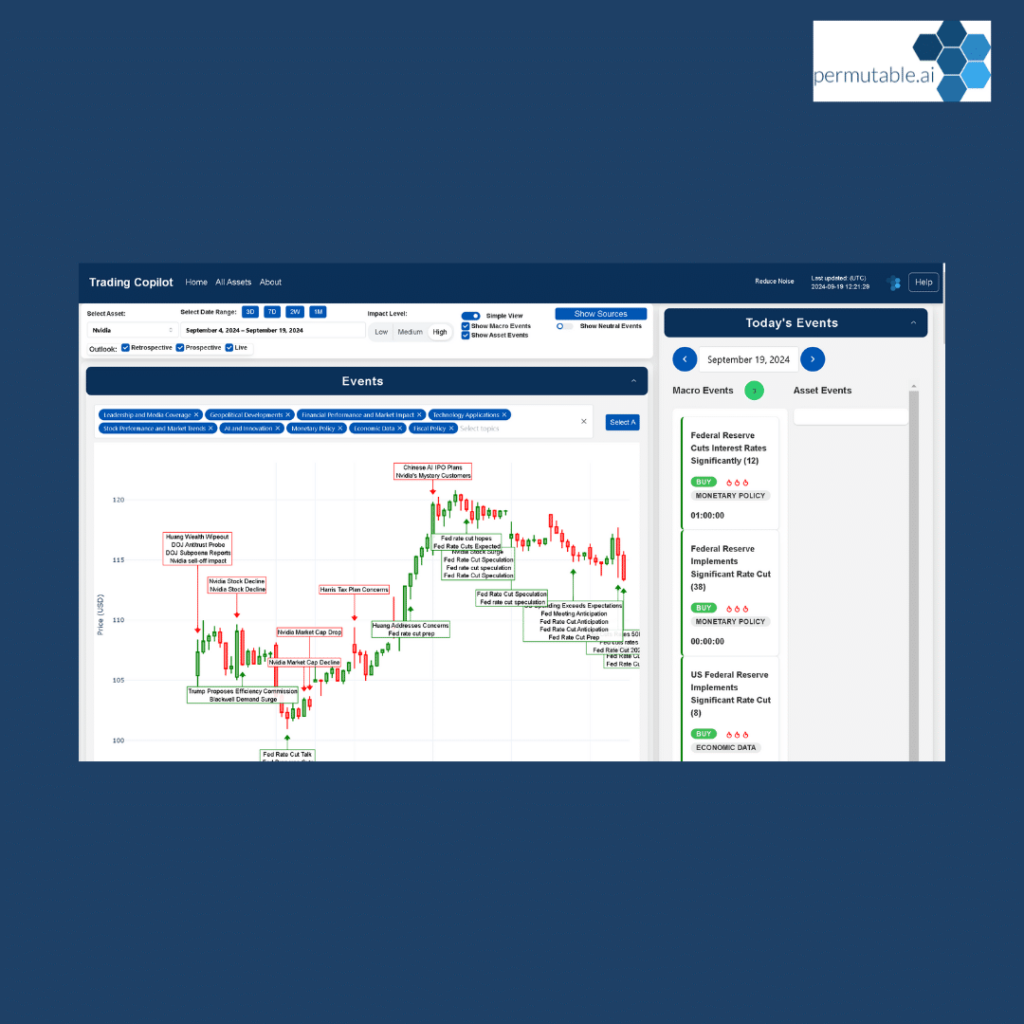
Deciphering stock market dynamics with AI

The world of stock markets is a complex and dynamic one, shaped by a myriad of factors, from economic indicators and corporate performance to geopolitical events and investor sentiment. Understanding the forces that drive stock prices has long been a quest for investors, analysts, and financial institutions. While traditional methods of analysis have their merits, the advent of artificial intelligence has ushered in a new era of insights and understanding. In this article, we delve into how AI is transforming the way we decipher stock market dynamics, shedding light on previously elusive factors that influence stock prices.

The Traditional vs. AI Approach

Traditional stock market analysis has relied on a range of tools and methodologies, including fundamental analysis, technical analysis, and market sentiment analysis. While these methods have proven effective to some extent, they often fall short in capturing the intricate nuances of the modern stock market.

AI, on the other hand, has emerged as a game-changer in the world of stock market analysis. It has the ability to process vast amounts of data, identify patterns, and make predictions with a level of precision and speed that humans cannot match. Here are some key ways in which AI is transforming the understanding of stock market dynamics:

Data Processing and Pattern Recognition

One of the fundamental strengths of AI lies in its data processing capabilities. It can sift through enormous volumes of structured and unstructured data, including financial reports, news articles, social media sentiment, and economic indicators. By processing this data, AI can identify hidden patterns and correlations that human analysts might overlook.

For example, AI can analyze the social media chatter surrounding a particular company and detect emerging trends or sentiments that may impact its stock price. It can also process historical financial data to identify recurring patterns or anomalies that can inform investment decisions.

Real-Time Analysis

The stock market operates in real-time, and events unfold rapidly. Traditional analysis methods often rely on historical data, which may not capture the most up-to-date information. AI, however, can analyze data in real-time, providing investors and traders with insights into market movements as they happen.

AI algorithms can monitor news sources, financial reports, and social media feeds in real-time to detect news events or trends that could influence stock prices. This real-time analysis enables investors to make more timely and informed decisions, helping them stay ahead of market shifts.

Sentiment Analysis

Investor sentiment plays a significant role in stock market dynamics. Positive or negative sentiment can drive buying or selling decisions, impacting stock prices. AI excels at sentiment analysis by analyzing language and context in news articles, social media posts, and investor communications.

By gauging sentiment, AI can provide insights into market sentiment trends, helping investors anticipate market movements. For instance, if AI detects a surge in negative sentiment towards a particular industry, it may signal a potential downturn in stock prices within that sector.

Predictive Analytics

AI’s predictive capabilities are a game-changer in stock market analysis. Machine learning algorithms can learn from historical data to make predictions about future stock price movements. These predictions can inform investment strategies and risk management.

For instance, AI can build models that predict the likelihood of a stock experiencing a significant price increase or decrease based on historical patterns and current market conditions. Investors can use these predictions to make informed decisions about when to buy or sell stocks.

Unveiling Hidden Factors

One of the most compelling aspects of AI in stock market analysis is its ability to unveil hidden factors that influence stock prices. These factors may not be immediately apparent to human analysts but can have a significant impact on market dynamics. Here are some examples:

Supply Chain Analysis

AI can analyze a company’s supply chain data to uncover vulnerabilities or inefficiencies that may affect its stock price. For instance, disruptions in the supply chain due to natural disasters or geopolitical events can impact a company’s ability to meet demand and affect its stock price.

By monitoring a company’s supply chain in real-time and identifying potential risks, AI can provide valuable insights to investors. This enables them to make informed decisions about the stocks they hold in their portfolios.

Regulatory Changes

Changes in regulations can have a profound impact on certain industries and companies. AI can continuously monitor regulatory developments and assess their potential impact on stocks. For example, if there is news of impending changes in healthcare regulations, AI can analyze which healthcare companies are most likely to be affected and how it may impact their stock prices.

Market Microstructure Analysis

The dynamics of stock markets themselves are complex, with factors such as order flow, liquidity, and market depth influencing stock prices. AI can analyze market microstructure data to understand how these factors interact and impact stock prices.

For instance, by analyzing order book data, AI can identify patterns in order flow and detect unusual trading activity that may signal a forthcoming price movement. This level of granular analysis can be invaluable for traders and investors looking to capitalize on short-term market movements.

The Future of Stock Market Analysis

As AI continues to evolve, its role in deciphering stock market dynamics is likely to become even more prominent. With the ability to process vast amounts of data, analyze real-time information, and uncover hidden factors, AI has the potential to provide investors with a deeper understanding of the forces that drive stock prices.

However, it’s important to note that AI is not a crystal ball, and there are inherent challenges, including the need for robust data, the risk of overfitting models, and the potential for algorithmic biases. Human expertise remains essential in interpreting AI-generated insights and making informed investment decisions.

In conclusion, AI is revolutionizing the way we decipher stock market dynamics by providing unparalleled insights into factors that influence stock prices. Its data processing capabilities, real-time analysis, sentiment analysis, and predictive analytics are reshaping the investment landscape. As AI continues to advance, investors and analysts who harness its power are poised to gain a competitive edge in navigating the complexities of the stock market.

At Permutable AI, we are at the forefront of this AI-driven revolution in stock market analysis. Our cutting-edge technology and expertise empower investors and financial institutions to gain deeper insights into stock market dynamics and make more informed decisions. The future of stock market analysis is data-driven, and AI is the key to unlocking its full potential.

Looking for more stock market insights? See our articles on the factors that determine Advanced Micro Devices stock priceTencent Holdings stock price, Berkshire Hathaway stock price, Nvidia stock priceGoogle stock priceWalmart stock price, Apple stock priceMicrosoft stock price, Tesla stock price and Amazon stock price with more added weekly.

Ready to Harness the Power of AI in Stock Market Analysis? 

If you’re intrigued by the possibilities that AI can offer in deciphering stock market dynamics and gaining a competitive edge in your investment strategies, Permutable AI is here to help. Our team of AI experts and cutting-edge technology can provide you with the insights and tools you need to navigate the complexities of the stock market with confidence.

Contact us today to discover how Permutable AI can empower your investment decisions, uncover hidden factors affecting stock prices, and revolutionize your approach to stock market analysis. Reach out to us at enquiries@permutable.ai or request a demo below to see our AI in action. Let’s embark on a journey towards data-driven excellence together. The future of stock market analysis is here, and it’s powered by AI.