GMSI methodology & evaluation

Permutable’s Global Macro Sentiment Indices turn local and international reporting into structured measures of economic direction and reporting tone.

Explore changing inflation, growth and policy narratives across more than 95 economies, with hourly updates and more than 11 years of point-in-time history. Investigate the evidence behind a reading and evaluate its contribution to your research, trading or risk framework.
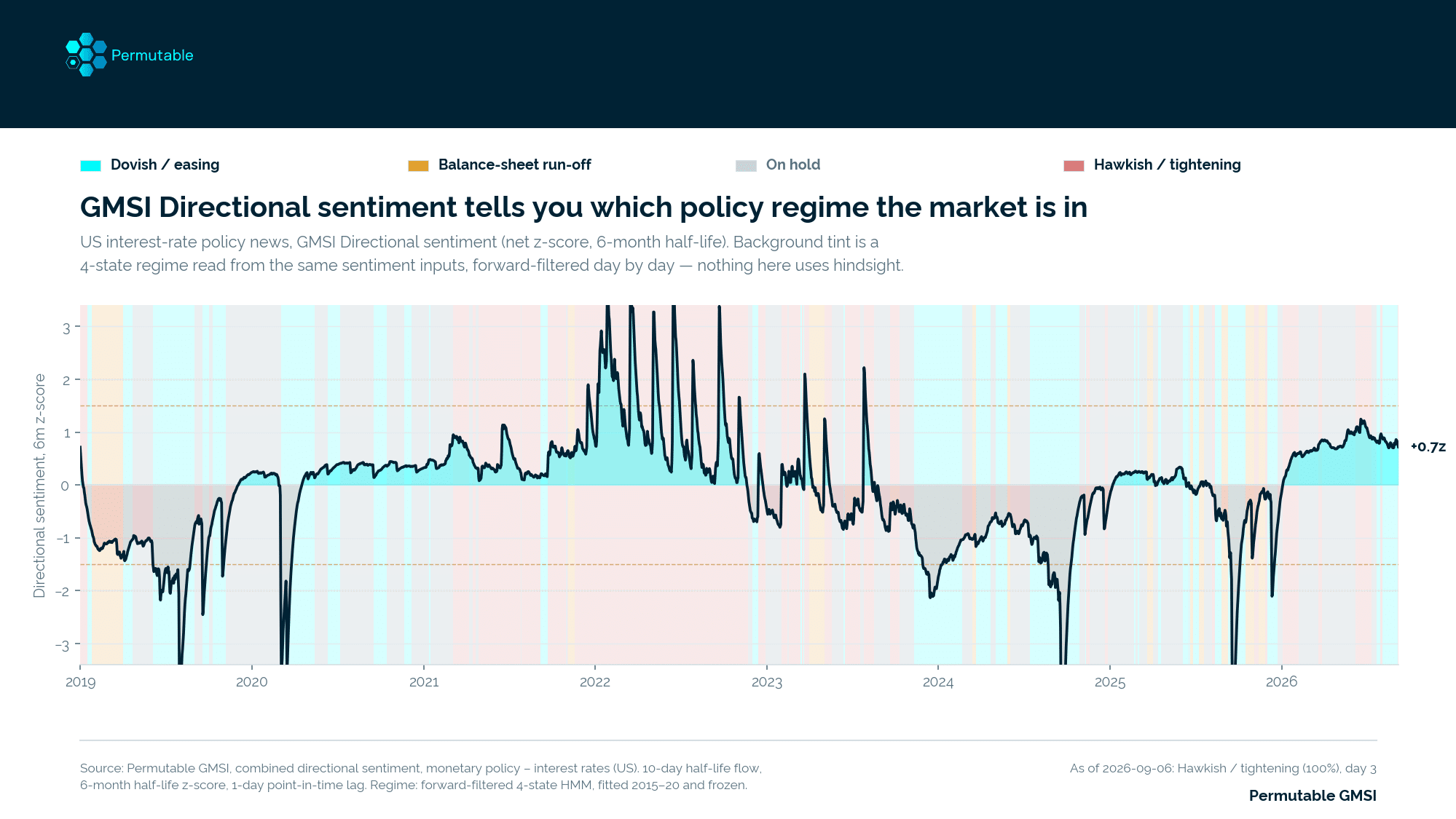

Graph showing market sentiment policy trends from Permutable data
View GMSI coverage and sample data

How GMSI is constructed

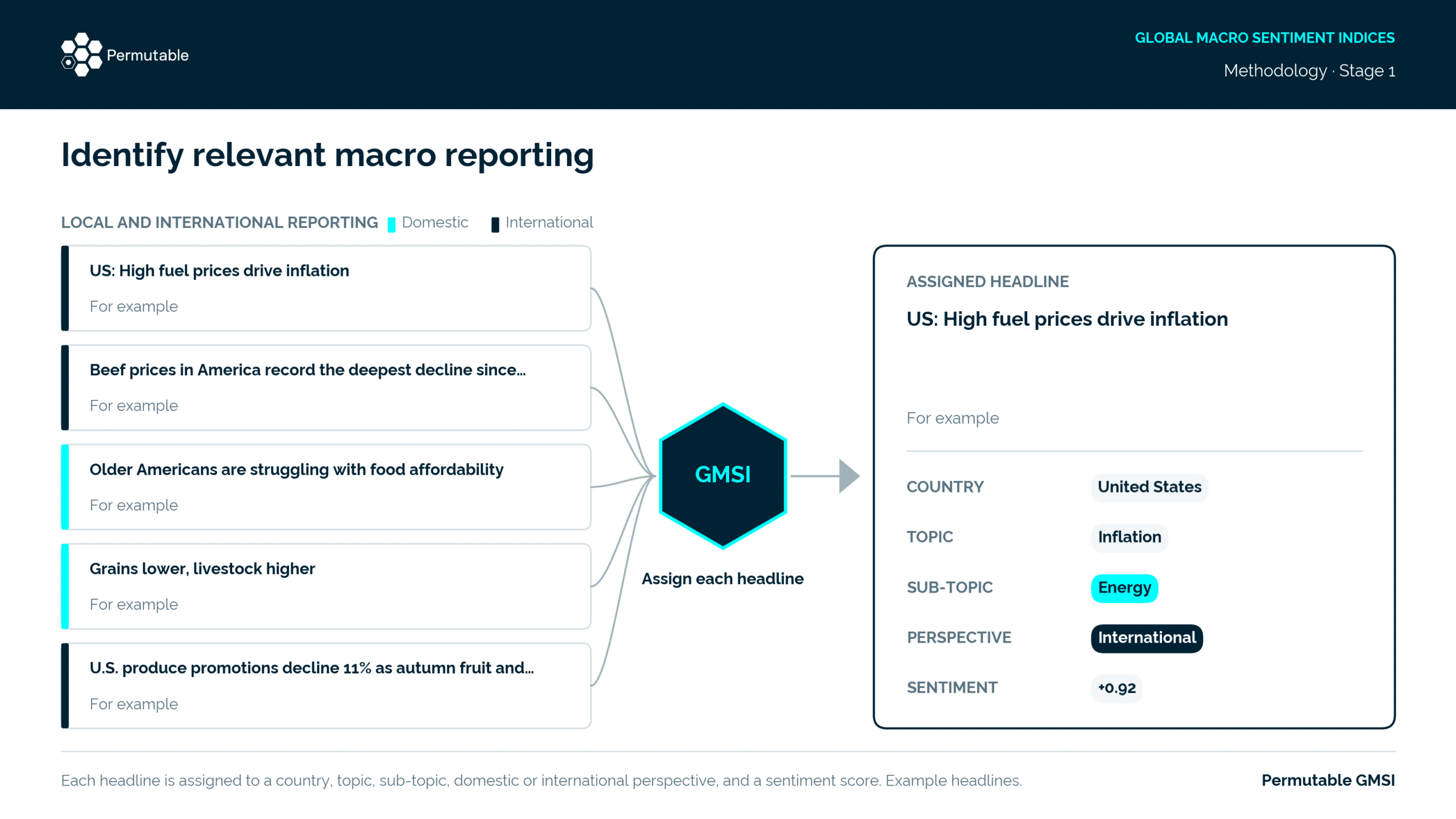
Identify relevant macro reporting

Stage 1: Identify relevant macro reporting

We process local and international reporting, identifying the economies, events and macroeconomic topics relevant to each observation.

  • Stage 1: Identify relevant macro reporting

  • Stage 2: Classify and score observations

  • Stage 3: Construct point-in-time indices

  • Stage 4: Examine the contributing drivers

Understand what each reading measures

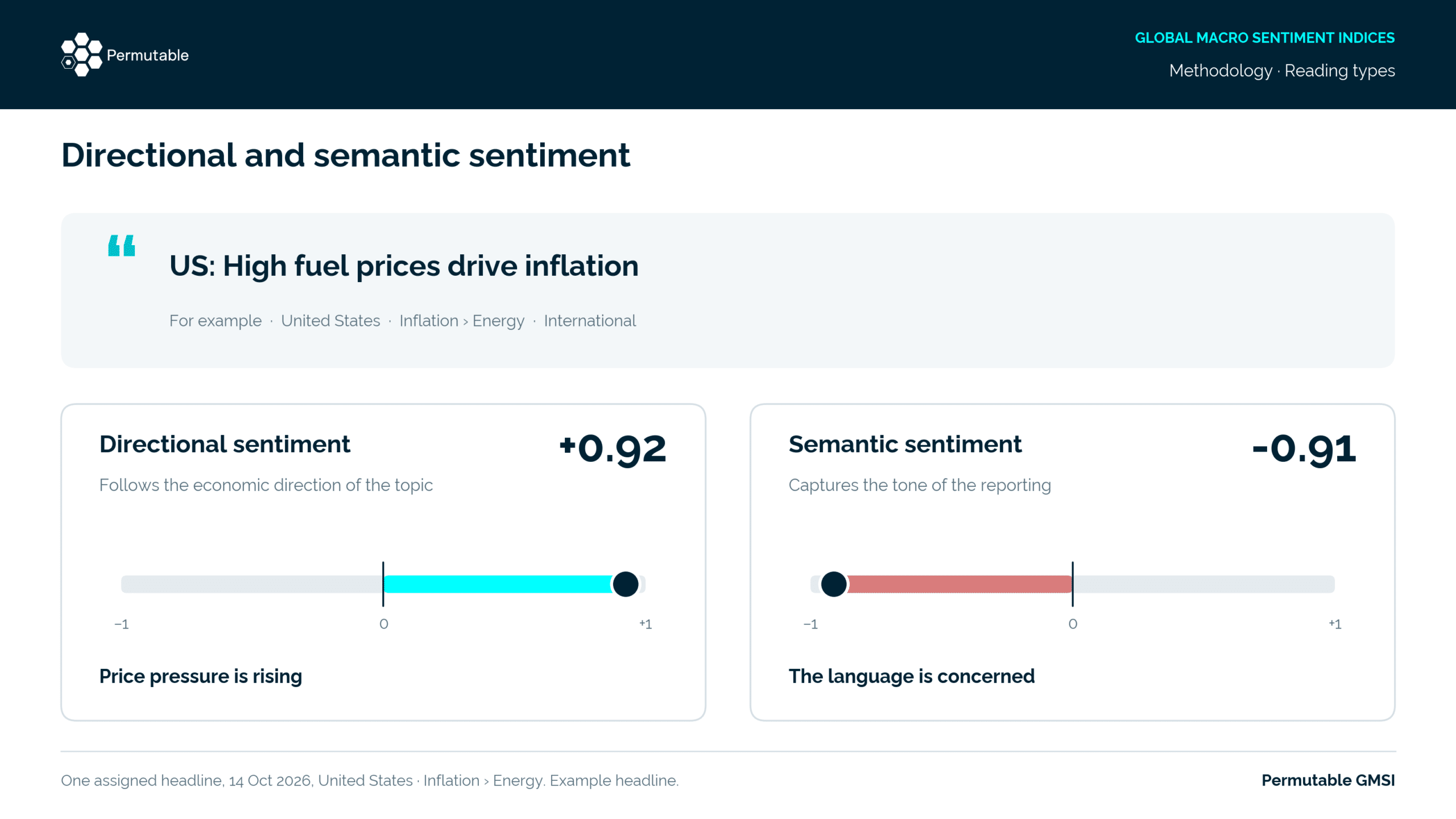
  • Directional sentiment

    Directional measures follow the economic direction of the topic being analysed. For inflation, a positive directional reading indicates rising price pressure. For growth, it indicates strengthening activity. The sign must be interpreted against the topic definition; ‘positive’ does not necessarily mean favourable economic news.

  • Semantic sentiment

    Semantic measures capture the tone and meaning of reporting. They allow researchers to distinguish the direction of a development from the language used to describe it. A report about rising inflation can therefore register a positive directional score and a negative semantic score: price pressure is increasing while the reporting is alarming.

See how policy sentiment was tested in short-end rates

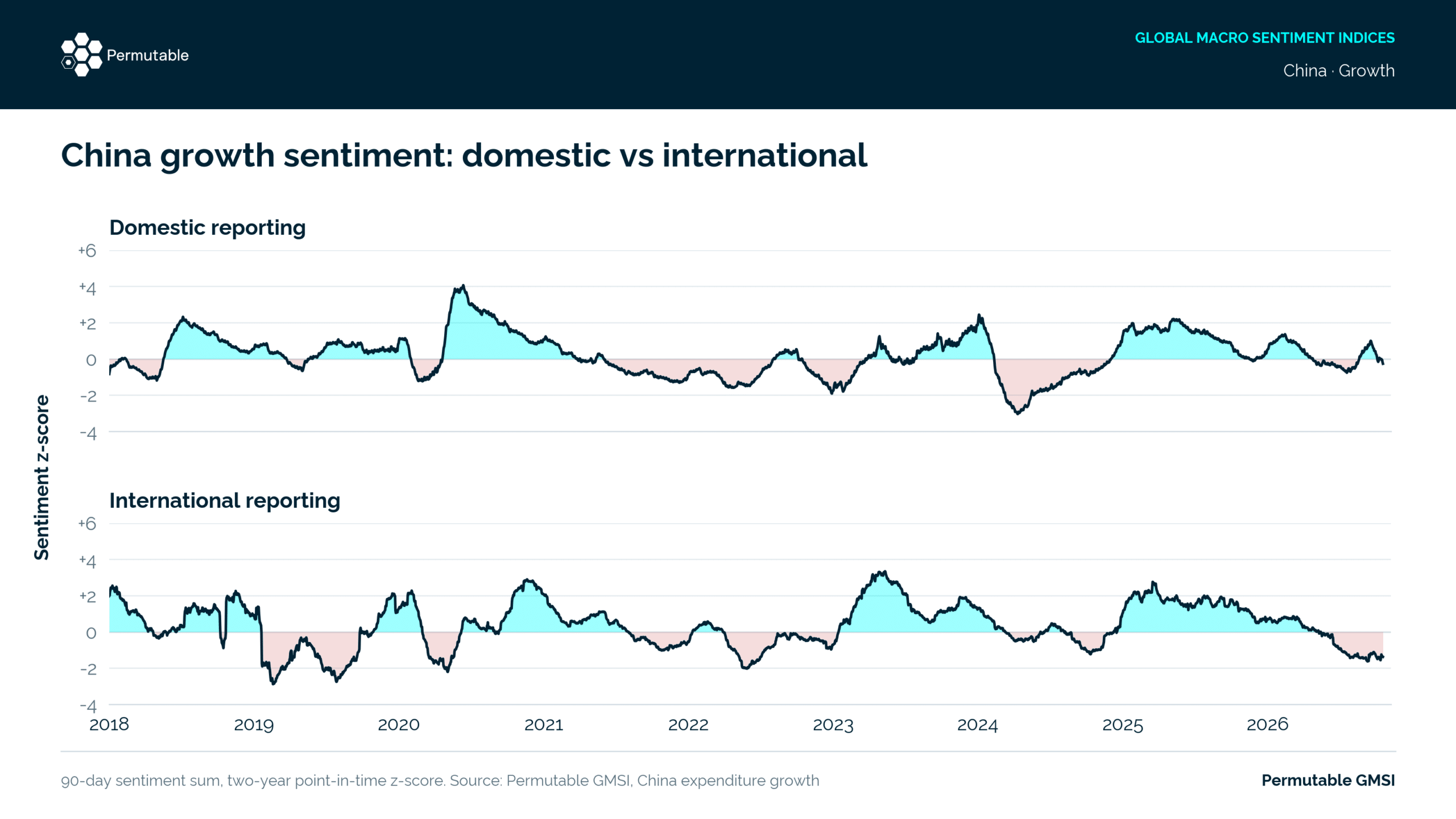
Domestic and international perspectives

Comparing these perspectives allows researchers to investigate differences between local narratives and external perceptions across inflation, policy, growth and sovereign conditions.


  • Domestic perspective

    Tracks reporting from within the economy being analysed, capturing local narratives around inflation, policy, growth and sovereign conditions.

  • International perspective

    Tracks reporting about that economy from sources outside it, capturing external perceptions. Researchers can compare the two perspectives or use a combined view.

See how domestic and international coverage of UK growth diverged

Historical research without hindsight

  • Historical coverage

    Core GMSI series extend from 2015. Exact availability varies by economy, topic and configuration.

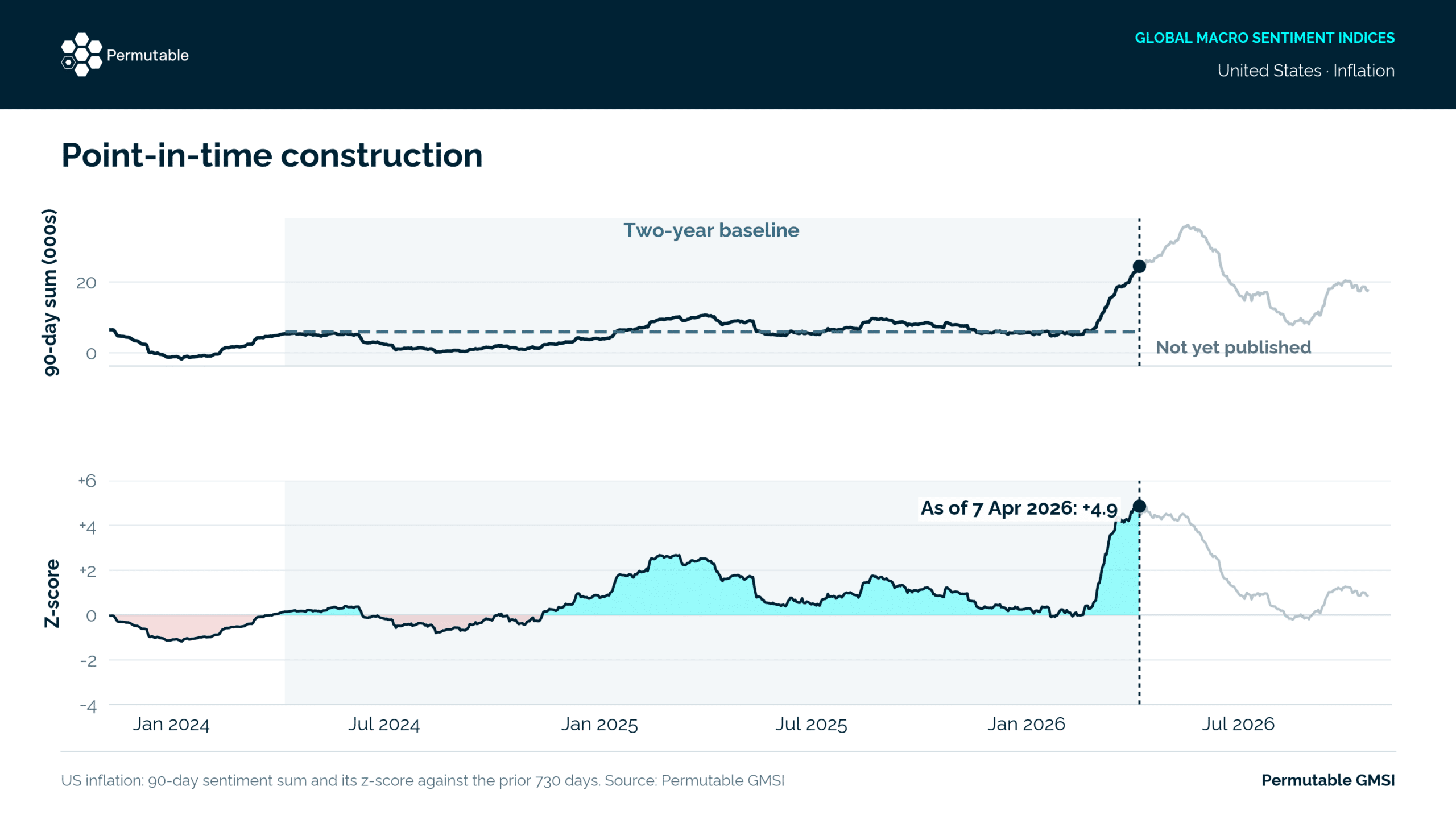
  • Point-in-time construction

    Historical observations use information available at the relevant timestamp, without later reporting or knowledge of subsequent outcomes.


  • Consistent historical and live outputs

    Historical and live outputs use consistent structures, supporting the transition from backtesting to monitoring.

  • Research design

    Valid historical testing must also account for signal availability, appropriate lags, market-data revisions and any transformations applied to the series.

See how we preserve point-in-time data

Model development and out-of-sample evaluation

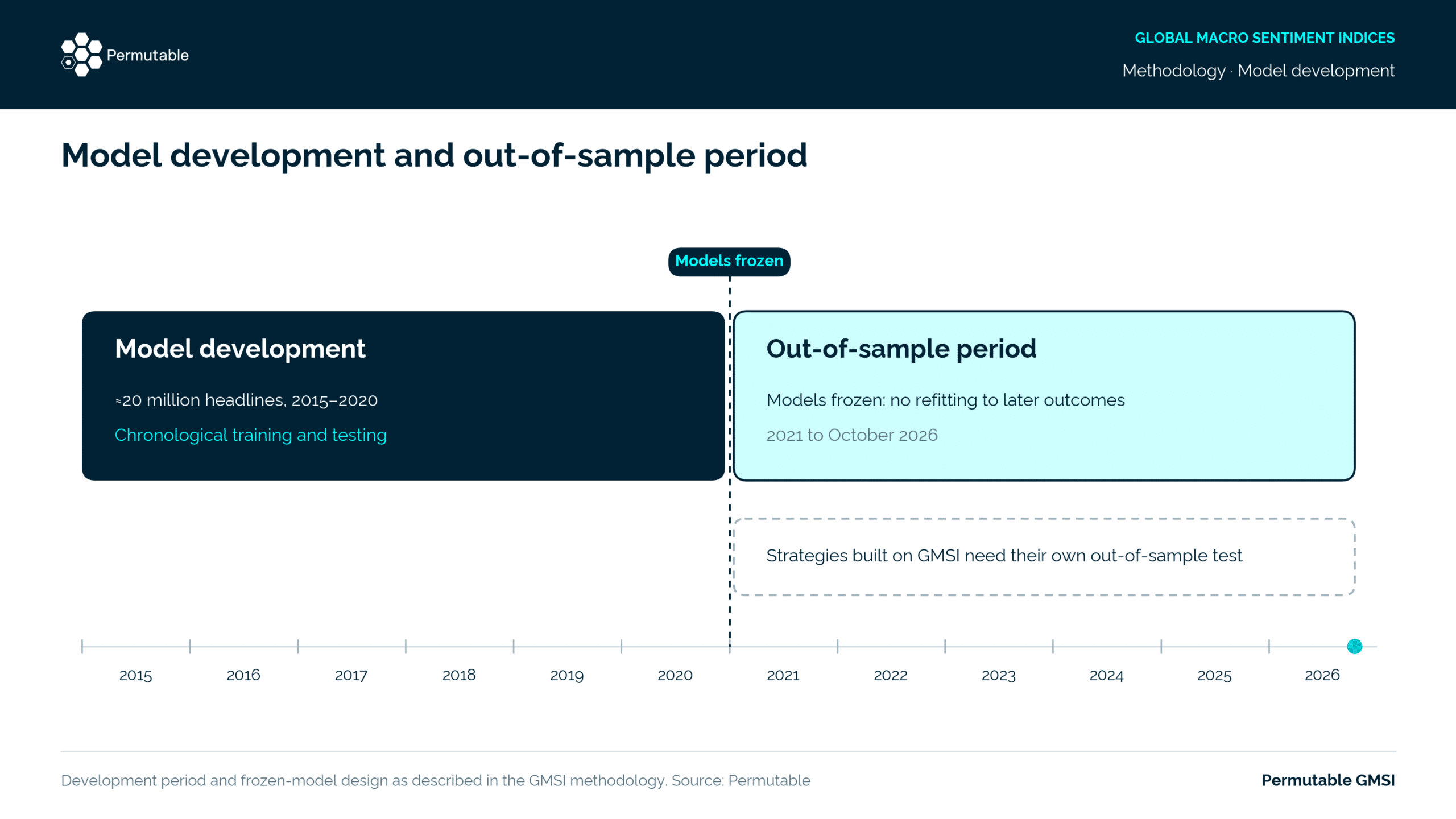
GMSI models were developed using millions of headlines from 2015–2020, with chronological training and testing, then frozen without refitting to subsequent macroeconomic outcomes. Later observations support evaluation beyond the development period. Strategies built using GMSI require separate out-of-sample testing, as topic selection, thresholds, smoothing, holding periods and exposure rules introduce additional research choices.


Evaluate GMSI against your existing process

  • Track inflation
  • Analyse monetary policy
  • Compare FX narratives
  • Monitor sovereign risk
  • Define your research scope

    Select economies, topics, historical periods and benchmarks. Agree what would constitute a useful result.

  • Inspect the dataset

    Review definitions, timestamps, coverage and source-linked examples to understand the readings.

  • Test incremental information

    Assess what GMSI adds to existing inputs, using appropriate lags, out-of-sample testing and realistic trading assumptions.

  • Assess live integration

    Confirm update frequency, delivery requirements and consistency between historical testing and live monitoring.

  • API
  • Excel
  • Structured files
  • Institutional feeds
Explore API access for macro sentiment data

What an evaluation can include

Depending on agreed scope, an evaluation can include:

  • Representative country and topic-level historical samples

    Review historical samples for selected economies and topics to assess coverage and relevance to your research.

  • Directional and semantic measures

    Examine both measures, their definitions and interpretation to determine how each could support your analysis.


  • Domestic, international and combined views

    Compare reporting from within an economy with external coverage, or examine the combined view.

  • A data dictionary and relevant methodology notes

    Review field definitions, timestamps and construction methods to support consistent interpretation and testing.

  • Source-linked observations and worked examples

    Trace selected readings to the underlying reporting and follow examples showing how to interpret the data.

  • Published research relevant to your application

    Review relevant studies, including their methods, findings and limitations, to inform your evaluation.

  • A discussion of delivery and integration requirements

    Discuss update frequency, data formats and access options against your team’s research and production requirements.


See what GMSI can add to your research and strategies

Bring us a country, a macro theme or a research question. Explore the relevant signals, historical coverage and evidence through an institutional evaluation.

Request institutional evaluation