
AI for hedge funds: Considerations for success in 2025 and beyond
26 Aug 2025
26 Aug 2025
The landscape of AI for hedge funds has evolved dramatically, and at Permutable, we’ve witnessed firsthand how transformative – and of course challenging – this technology can be for investment management. Through our work, we’ve identified seven critical considerations that determine whether AI implementations deliver genuine alpha or become expensive disappointments.
In our experience, we’ve learned that sophisticated models are meaningless without exceptional data. Hedge funds have always thrived on differentiated information, and while generative AI amplifies this reality exponentially – it’s only as robust as the data it’s trained on.
The challenges we encounter most frequently involve noise, bias, and limited coverage that can generate false signals. This can result in funds make costly decisions based on AI recommendations that seemed compelling but were built on fundamentally flawed datasets. Our approach at Permutable combines traditional market feeds with carefully curated alternative datasets – all subjected to rigorous data hygiene processes.
This isn’t merely about having more data; it’s about having better data. We find that the most successful implementations focus on quality over quantity, with robust validation frameworks that continuously monitor data integrity.
Regulatory and risk teams consistently demand transparency in how hedge funds systems arrive at their conclusions, particularly when these insights influence trading decisions. Here, GenAI’s “black box” nature presents genuine challenges. We’ve addressed this by incorporating explainable AI (XAI) layers and confidence scoring mechanisms that provide clear reasoning pathways. Our clients need to understand not just what the AI recommends, but why – and they need this information in real-time.
For trading applications, we’ve learned that even milliseconds can determine success or failure. AI for hedge funds must be optimised for low-latency inference, deployed as close to data sources as possible through edge-cloud hybrid architectures.
We’ve seen promising AI models fail in production simply because they couldn’t deliver insights fast enough. Our infrastructure at Permutable prioritises speed without sacrificing accuracy, recognising that in financial markets, timing is everything.
The most successful AI deployments seamlessly integrate with existing OMS/EMS systems, analytics platforms, and research dashboards. In our experience, tools that exist in isolation rarely achieve meaningful adoption amongst traders and analysts.
Our integration philosophy at Permutable centres on enhancing existing workflows with Plug and Play solutions rather than replacing them. We’ve learned that even the most sophisticated AI becomes worthless if it doesn’t fit naturally into how investment professionals actually work.
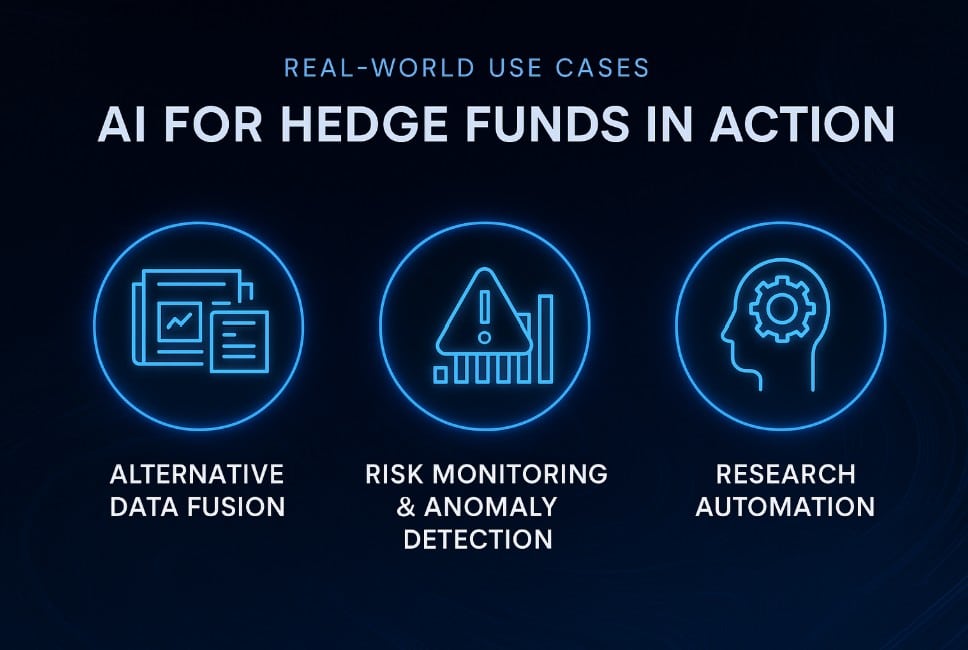
Through our work at Permutable, we’re implementing AI for hedge funds across several high-impact use cases. Alternative data fusion has proven particularly valuable – our plug and play market events feeds predict market shifts often days before traditional analysis would catch them.
Risk monitoring and anomaly detection represents another area where our AI-driven systems excel. We’ve deployed AI-driven feeds that continuously scan sector trends, correlations, and market conditions, alerting risk managers to potential issues before they materialise by surfacing unusual correlation patterns in market positions.
Additionally, research automation has transformed how our hedge fund clients process information. Rather than analysts spending hours reading through earnings transcripts and regulatory filings, our Auto Analyst AI agents extract key insights, identify thematic trends, and surface actionable intelligence. This frees up senior talent to focus on strategy and decision-making rather than data processing.
At Permutable, we know that successful AI for hedge funds implementations must follow consistent patterns. Our key pieces of advice are as follows:
Ultimately, the most effective implementations position technology as an amplifier of human expertise rather than a replacement. We’re seeing the best results when AI handles the heavy lifting of data processing whilst experienced professionals make the ultimate investment decisions.
At Permutable, we monitor tens of thousands of news sources in real time, enabling our clients to spot market-moving events before traditional news wires catch them. This capability has allowed us to identify disruptions minutes ahead of mainstream coverage. Acting on these insights can give hedge funds a decisive timing advantage, whether adjusting wheat positions or anticipating moves in related markets.

Above: Our Trading Co-Pilot pinpointed the bullish regime shift in EUR/USD as macroeconomic sentiment turned and forecast signals aligned. The rally was underpinned by strong Eurozone data and softening U.S. macro indicators, providing an early signal for euro strength and sustained positioning through consolidation.
Our proprietary multi-entity sentiment code allows us to analyse the relationships between companies, commodities and sectors in context, rather than in isolation. This means we can measure how negative coverage of a major oil producer might affect not just crude oil futures, but also tanker companies and related currencies. By seeing the full picture, our clients gain a deeper understanding of sentiment-driven correlations and potential market movements.
We combine shipping updates, local news and weather related news to map potential supply chain choke points and forecast their likely impact on pricing. For example, our systems detected port congestion in Singapore affecting LNG shipments before it became widely known, allowing our clients to reposition their futures strategies with an informational advantage.
Our Trading Co-Pilot delivers real-time, multi-asset AI insights with structured sentiment and forecast data across commodities, currencies, macro with equities and fixed income coming soon. Built on our proprietary multi-agent AI framework to decode geopolitical risks, economic releases and market sentiment as they happen. Combining live market event tracking, analyst-style summaries, AI-driven price forecasts, thematic asset insights and sector analysis, the Co-Pilot provides not just clarity on what’s moving markets – but why – so that our clients can stay ahead and capture opportunities before they emerge.
At Permutable, we’ve learned that attempting to deploy AI for hedge funds across all strategies simultaneously often leads to suboptimal outcomes. We recommend a three-phase approach: proof of concept with non-critical applications, scaled pilot with measurable KPIs, and full deployment with continuous monitoring.
The most successful implementations include systematic collection of trader and analyst feedback. We’ve seen AI models improve dramatically when they incorporate user preferences and decision patterns into their learning algorithms.
Financial markets evolve constantly, and AI models that performed well historically may degrade over time. We’ve implemented continuous monitoring and automated retraining pipelines to ensure our hedge fund clients’ AI systems adapt to changing market conditions.
Regulatory scrutiny of AI for hedge funds continues to intensify. We maintain comprehensive documentation of model development, training data sources, validation procedures, and decision audit trails. This isn’t just about compliance – it’s about building institutional knowledge that persists beyond individual team members.
The question we’re asked most frequently is whether funds should build AI capabilities in-house or partner with providers like Permutable. Our honest assessment is that this depends entirely on where a fund’s competitive advantage lies.
Building in-house offers complete control but typically requires 12-24 months for a production-ready system, significant talent acquisition costs, and ongoing maintenance responsibilities. The talent market for AI specialists with financial domain expertise remains highly competitive and expensive.
Partnering with established providers can deliver results within weeks or months, providing access to curated datasets, proven models, and compliance-ready infrastructure. At Permutable, we’ve designed our systems with the flexibility to accommodate high levels of customisation whilst maintaining the benefits of shared R&D costs across our client base.
| Factor | Indicators for Building In-House | Indicators for Partnering (e.g., Permutable AI) | Weight |
|---|---|---|---|
| 1. Strategic Importance | AI/ML models are core to competitive edge and must remain proprietary. | AI enables workflow speed and decision quality, but isn’t the primary differentiator. | High |
| 2. Data Strategy | Exclusive datasets with strong internal capability for ingestion, cleaning, labelling. | Need curated, ready-to-use market + alternative datasets and managed pipelines. | High |
| 3. Talent Availability | Established ML engineers, quants, and data engineers; AI is an internal strength. | Hard to attract/retain top AI talent; prefer leveraging a specialised provider team. | High |
| 4. Time to Market | 18–24 months is acceptable for full production readiness. | Need production-ready tools within weeks/months to capture a window. | Medium |
| 5. Budget & OPEX | Significant R&D/MLOps/infrastructure budget and appetite for ongoing maintenance. | Prefer predictable subscription/licensing over variable R&D spend. | Medium |
| 6. Compliance & Risk | Strong internal model validation, explainability, audit trails, and governance. | Need pre-built explainability, provenance, and audit logging aligned to SEC/FCA/ESMA. | High |
Our recommendation, based on our experience, is straightforward: partner to prove value quickly. The future of AI for hedge funds isn’t about choosing between human expertise and artificial intelligence – it’s about creating synergies that generate genuine alpha. At Permutable, we’re committed to helping hedge funds navigate this complex landscape with the humility to acknowledge challenges, the confidence to deliver results, and the approachability to be true partners in success.
The technology is ready. The question is whether your implementation strategy matches the sophistication of your investment approach.
Reach out to our team to set up a call today at enquiries@permutable.ai or come and see us at Eagle Alpha’s New York Alternative Data Conference in September.

Analysis
14 Oct 2026
Beneath US headline inflation: tracking pressure across energy, food, services and housing
Read more >
Analysis
13 Oct 2026
France’s debt alarm hits a decade high and drowns out the rest of the G20
Read more >
Guide
07 Oct 2026
Commodity signal evaluation: from information flow to portfolio evidence
Read more >