In recent months, natural gas markets have become increasingly complex, with our Trading Co-Pilot platform identifying several significant developments affecting the Henry Hub natural gas spot price, pointing towards a generally bullish outlook. Many will think this optimism premature given recent volatility, yet ultimately, the data suggests a compelling story unfolding.
Of course, the past week has shown notable demand surges, with our platform tracking several major infrastructure developments. In particular, Kinder Morgan’s new pipeline approval and ongoing exploration activities by ExxonMobil and Qatar Energy have emerged as significant positive indicators. It may well be true that these developments alone don’t guarantee Henry Hub natural gas spot price increases, but in contrast with previous market cycles, the infrastructure buildout comes at a crucial juncture.
Suffice to say, there is more than one way to skin a cat when it comes to analysing market dynamics, but clearly, the current situation presents a scathing challenge to traditional approaches. The EIA has been asserting rising wholesale power prices due to increased demand, and with it being recently reported that there’s been a significant drop in oil and gas rig counts, this actually strengthens the bullish case.
Many are now believing that perhaps fears that production constraints might limit market growth have been overblown with the baton soon picked up again by major infrastructure projects. Though it is still early days, but the Transco pipeline approval reinstatement and new drilling activities in Cyprus suggest robust development pipeline. This will not be the same as previous infrastructure cycles – instead, we’re seeing more strategic, targeted expansions.
Thus far this Winter, weather has played a key role in Henry Hub natural gas spot price movements. In part, Goldman Sachs’ raised forecast for US gas prices reflects this reality, aligning with our platform’s detection of weather-related sentiment shifts. Rather, it is more like a perfect storm of factors affecting the Henry Hub natural gas spot price, as temperature forecasts increasingly drive market sentiment.
Our Trading Co-Pilot has detected a notable correlation between weather forecast updates and immediate price reactions, with even minor temperature revisions triggering significant market moves. This heightened sensitivity to weather patterns suggests that traders are positioning themselves more reactively to meteorological data than in previous seasons, creating both risks and opportunities for market participants.
So the question is, what does this all mean for traders? At its core, our Trading Co-Pilot‘s analysis suggests a favourable risk-reward setup for the Henry Hub natural gas spot price. So we will soon see whether the market validates this view, but with current prices at 3.17, our Trading Co-Pilot’s recommended strategy balances prudent risk management with upside potential.
In short, this is a problem too complex for simple solutions, and is also a reflection of how complex global market dynamics have once again come back to the fore, – particularly with strengthening European gas markets suggesting a tightening supply environment. Ultimately, what is needed is careful monitoring of our identified timeline triggers. Thankfully, this is made easily accessible through our Trading Co-Pilot, exemplified by the chart above, with our platform continuing to monitor these developments in real-time, providing our users with actionable insights as market conditions evolve and careful analysis of multiple data streams.
Our Trading Co-Pilot platform delivers real-time insights across commodities markets, processing over 10,000 articles daily to identify market-moving events before they impact prices. Through advanced geolocation filtering, comprehensive sentiment tracking, and real-time event detection, we provide traders with the tools they need to make informed decisions in rapidly evolving markets.
If you’re interested in seeing how our market intelligence platform can enhance your trading strategy, we’d be delighted to show you a personalised demonstration of our capabilities for enterprise clients. Email enquiries@permutable.ai to schedule your enterprise demo, subject to approval or fill out the form below to learn more about how we’re transforming market intelligence for enterprise traders
The alarm bells are ringing across European natural gas markets as we move into 2025, with prices displaying particular volatility in the last week. Insights from our Trading Co-Pilot reveal a complex interplay of factors and heightened sensitivity in the market. With that said, let us rattle through some of the key developments that have shaped this week’s trading European natural gas prices, where we’ve seen everything from weather-driven demand spikes to supply chain disruptions creating unique trading patterns – and of course the much talked about Trump LNG effect.
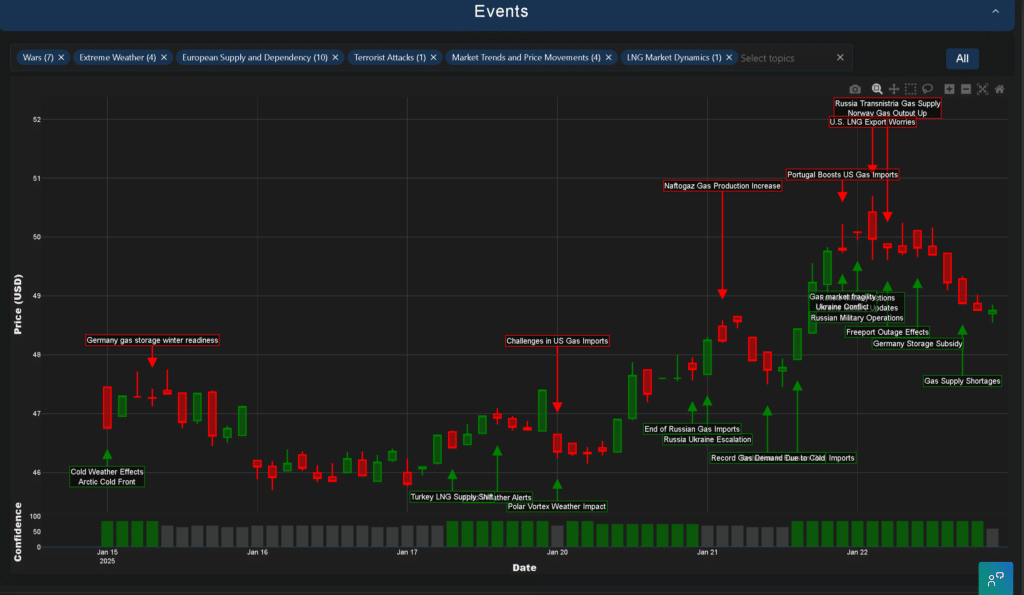
The point which becomes obvious pretty quickly is that European natural gas prices are being pulled in multiple directions, creating both risks and opportunities for TTF traders. According to sources, Europe may require over 100 additional gas cargoes to replenish its dwindling stocks, highlighting the fragility of current supply chains. Our Trading Co-Pilot’s analysis shows this news triggered a clear price movement, demonstrating the market’s acute sensitivity to supply-related headlines.
Not long ago, this might have seemed manageable, but the recent Freeport LNG outage has led to a surge in TTF natural gas prices, pushing the market into new territory. Our Trading Co-Pilot clearly shows the immediate price impact, with a notable spike following the announcement. Almost everyone we speak to in the industry now acknowledges that traditional supply-demand models need updating to account for this new market reality.
To add to this, extreme cold weather is expected to drive record gas demand. This concern has three components that our Trading Co-Pilot clearly illustrates: immediate supply pressure showing in rapid price movements, storage depletion rates accelerating beyond normal seasonal patterns, and increased price volatility during weather events. The trouble is, this comes at a time when European natural gas prices are already showing significant sensitivity to supply disruptions.
What’s clear is that cold weather effects, particularly the Arctic cold front, have created distinct trading patterns. What’s more is that the market response to these weather events has been notably more pronounced than in previous years, with particularly sharp reactions during the early morning hours when temperature forecasts are updated. The Polar Vortex impact has been especially notable, creating a new pattern of price behaviour that suggests weather premium is being built into the market at levels we haven’t seen before.
And that’s before we address the ongoing Russia-Ukraine conflict escalation. So what’s actually is going on here? Well, the EU has successfully reduced its imports of Russian gas by 75%, but this has created new market dynamics that are clearly visible in our data. It’s the same story on alternative supply sources – Portugal has shifted its gas sourcing away from Russia, increasing imports from the US and Nigeria, yet even now, these transitions are creating their own complex market patterns.
The crisis in supply security is forcing energy traders to develop new risk management strategies. In addition to that, the market has shown particular sensitivity to news about US LNG exports, with significant price movements within hours of major announcements from the new Trump administration.
Just as notably, Germany is considering a plan to subsidise gas storage refills, which could influence market dynamics and supply strategies. Our Trading Co-Pilot data showed an immediate positive market reaction to this news. And then there was the news that Norway’s gas output saw a slight increase in December to consider, though the market response was relatively muted, suggesting TTF traders will be more focused on longer-term supply solutions.
So when it emerged that Russia is preparing to supply gas to Transnistria through Türkiye starting in February, our data showed an interesting market reaction pattern. This method applies equally to understanding the impact of Germany’s storage subsidy plan and other policy initiatives, with clear price movement correlations visible in our data.
All this means that European natural gas prices are likely to remain volatile throughout the rest of the winter period, as we’ve previously reported on before. Initially, the market’s focus was on storage levels, but now for traders, the key metrics have expanded significantly. In this scenario, our data suggests we can expect continued price sensitivity, with potential for larger movements during extreme weather events or supply disruptions.
Of course, there’s a reason why the market is watching these developments so closely. As with most things in energy markets, the interplay between supply, demand, and geopolitical factors creates complex trading conditions. And yet perhaps the most interesting aspect is how the market is adapting to these new realities.
What we’ve found through our Trading Co-Pilot analysis is that it is the correlation of multiple data points and overlapping factors – whether it be weather patterns to storage levels, or geopolitical developments to infrastructure constraints – rather than single events that is causing price movements.
Despite this challenging environment, the market is adapting to new realities. And while volatility in European natural gas prices may persist, the market is gradually developing new mechanisms for resilience. There is a definite sense that energy traders are becoming more sophisticated in their approach to risk management and trading strategies, for for our clients, integrating our Trading Co-Pilot is becoming an important part of this.
The crisis in market stability has forced innovation in trading approaches, and that’s perhaps the silver lining in current conditions. Whether this narrative holds through 2025 remains to be seen, but one thing is certain: the European gas market continues to offer significant opportunities for the those leading the herd with our AI-powered market insights.
Ultimately, success in this market requires not just understanding individual events but comprehending how multiple factors interact to influence price movements. The data from our Trading Co-Pilot platform clearly demonstrates this evolution, showing precisely how successful traders are those who can integrate multiple data streams into their decision-making processes.
Seeing these market dynamics play out in real-time can transform how you trade. Our Trading Co-Pilot platform doesn’t just track events – it helps you understand their interconnected impact on market movements before they happen. With features ranging from advanced event tracking to real-time market movement alerts, we’re offering tools that can bring a new level of sophistication to your Trading strategy.
After a successful first wave, we’re now opening up early access to our advanced market intelligence platform for select additional enterprise users. As part of this exclusive program, you’ll receive premium access to all features of our Trading Co-Pilot and direct support from our team. The past week’s volatility in European gas markets demonstrates why timing and insight matter – and so now is the time to join the growing community of energy traders who are already using our platform to stay ahead of market-moving events.
Ready to transform your trading strategy? Schedule a demo by emailing us at enquiries@permutable.ai or simply fill in the form below to get in touch.
*Early access program is limited to select enterprise clients and subject to qualification.
There was a time when energy trading relied purely on instinct and experience, with traders poring over data and news feeds to make split-second decisions. Today, as we face unprecedented energy markets volatility, the landscape has transformed dramatically. It’s plain for all to see that the confluence of geopolitical tensions, rapid technological advancement, and the global energy transition has created a trading environment more complex than ever before, and this is a trend that’s here to stay.
So then, in this new era, successful trading requires a sophisticated blend of human expertise and technological innovation. In 2025 – much the same as in 2024 where we saw unprecedented market volatility – we will continue to witness more of the same. And this volatility that will be marked by swift price swings, intricate correlations between different market factors, and an ever-expanding web of influences that can impact trading outcomes. All this means that traditional approaches to market analysis and decision-making are no longer sufficient to capture the nuances of these dynamic markets.
And this is precisely where our advanced Trading Co-Pilot technology is becoming increasingly valuable. By leveraging artificial intelligence, machine learning, and real-time data analytics, our Trading Co-Pilot is already transforming how traders interact with data, identify opportunities, manage risks, and execute strategies. Now, the ability to process vast amounts of data, identify subtle market patterns, and generate actionable insights in real-time is served up to those energy traders in the know who are already using our tool and API to stay competitive in today’s energy markets.
Now that we stand at the beginning of 2025 (with plenty more energy markets volatility ahead of us) those moving the herd will be adopting technological tools like these alongside human expertise and it is this that will form the key differentiator between successful traders and the rest of the pack. Here we highlight seven ways our Trading Co-Pilot and Commodities API can be used to navigate energy markets volatility in 2025.
It’s not new news that energy markets of today operate in an unprecedented geopolitical landscape. Regional conflicts, trade disputes, and shifting alliances are creating ripple effects that span continents. Traditional pressure points like OPEC decisions and inventory reports are now intertwined with complex factors such as renewable energy adoption rates, carbon pricing mechanisms, and emerging market demand shifts. The speed at which these factors can impact markets has accelerated dramatically, with price swings occurring in minutes rather than days.
In volatile markets such as these, understanding pressure points is vital. Our Trading Co-Pilot platform employs sophisticated algorithms to analyse macro and fundamental factors driving price movements. Think real-time alerts that allow energy traders to spot supply chain disruptions, regulatory changes, and demand shifts before they impact prices. It is this continuous monitoring of key indicators that ensures that no critical market signals are missed.
The energy landscape is experiencing a fundamental transformation. The interplay between traditional fossil fuels and renewable energy sources creates new market dynamics daily. Energy companies are pulling back from green energy projects as governments struggle to set clear pathways towards Net Zero goals, and then there’s technological breakthroughs such as in energy storage and distribution – which can instantly alter market fundamentals. To add to that, emerging markets are developing their own energy ecosystems, adding layers of complexity to global trade flows.
In all of this, the struggle to find relevant information and filter out noise is real. Instead of drowning in data, our platform’s advanced taxonomy filters help traders focus on specific themes like geopolitical tensions, infrastructure or regulatory developments. It is this targeted approach which helps traders cut through complexity and focus on what truly matters in periods of energy markets volatility.
The extent to which the democratisation of information has created a double-edged sword can not be argued against. While more data is available than ever before, the challenge of separating signal from noise has grown exponentially. Think about it – social media, instant news, and the proliferation of market commentary has all come together to create a veritable cacophony of information that can obscure rather than illuminate market dynamics. So what, you may ask? Well, quite simply, the cost of acting on unreliable data has never been higher.
For the avoidance of doubt, reliable data is the foundation of successful trading. That is an echo of why our platform maintains a comprehensive network of validated source links. One of the most valuable features here in terms of validating source data integrity is that each piece of data comes with a clear audit trail. And it is this that allows traders to verify information instantly and make confident decisions based on trusted sources during periods of energy markets volatility.
It’s hard to argue against the fact that market psychology has taken on new dimensions in this digital age. In fact, one can say that sentiment can shift quicker than a New York minute across global markets, driven by an avalanche of social media trends, policy announcements, and changing consumer preferences. And it is this interconnectedness of global energy markets means that regional sentiment shifts can quickly cascade into global price movements. All of this means that understanding these sentiment patterns has become as key as analysing fundamental data.
And so, with market sentiment such a major driving force in price movements, suffice to say that the consequence of overlooking global perspectives can be costly to say the least. Cue our Trading Co-Pilot and Commodities API, which analyses market sentiment across multiple regions, providing early warning signs of energy markets volatility and helping traders spot opportunities others might miss.
Now more than ever before, the modern energy market narrative’s complexity can be felt keenly. Given that a single event, such as a pipeline disruption or renewable energy policy shift can creates cascading effects across multiple market segments, the traditional approach of analysing markets through a single lens – whether technical, fundamental, or news-based – is no longer up to scratch.
As we’ve already highlighted, today’s market movements are driven by intricate webs of interconnected factors, with prices being predicted by unpredictable and ever-moving forces. But what if you had a tool that could explain live stories with macro factors? This comprehensive approach combining real-time news analysis with economic indicators is exactly what our Trading Co-Pilot seeks to deliver, helping energy traders understand how various elements interact during periods of energy markets volatility. The key benefit of which is how its multi-layered analysis captures these complex narratives, providing traders with a deeper understanding of market dynamics.
Spoiler alert: Climate change has fundamentally altered the relationship between weather and energy markets. One can not dispute the fact that extreme weather events, once considered rare, have become regular market disruptors. This increasing fragility shaped by unprecedented frequency of hurricanes, polar vortexes, and heatwaves creates new patterns of energy demand and supply disruption. To add to this, the growing share of weather-dependent renewable energy in the global power mix has amplified the impact of meteorological conditions on market prices.
As you might expect given the above, there’s been a real shift in how weather affects energy markets. Here, the risk for traders who ignore weather patterns is significant. Our Trading Co-Pilot’s analysis quantifies how extreme weather events impact market behaviour, providing valuable insights for trading during energy markets volatility. This means that by integrating historical data with current patterns and future forecasts, energy traders can better anticipate and respond to weather-driven market movements.
One thing we can be certain of is that the energy markets of 2025 will demand a much more holistic perspective. It’s clear that the traditional silos between energy commodities have blurred, with oil, gas, power, and renewable markets increasingly interconnected. Meanwhile, factors such as carbon markets, government policies, and technological innovation create complex feedback loops that affect multiple market segments simultaneously. No more so than now, success in this environment requires understanding not just individual market segments, but the entire energy ecosystem.
Little wonder that success in navigating energy markets volatility in 2025 will require more than just individual data points. Ultimately, we believe the points we’ve raised above will lead energy traders to put greater emphasis on how complex and varying market factors interact. Over and over again, our Trading Co-Pilot tirelessly integrates real-time events with macro-economic analysis in way that only a huge team of round the clock analysts could, creating a holistic view that helps traders navigate energy markets volatility with confidence. The upshot? Our ambition here is to create a comprehensive approach that ensures traders can see both the forest and the trees, understanding both micro-level market movements and macro-level trends.
There’s been a real shift in the evolution of energy markets, and as this continues to accelerate driven by technological innovation, policy changes, and shifting global dynamics, success in this environment will require both sophisticated tools and the wisdom to use them effectively. It is out belief that while our Trading Co-Pilot provides powerful capabilities, it’s the combination of these tools with human expertise that will create true trading excellence and new opportunity.
To our mind, there is no question that the future of energy trading belongs to those who can effectively blend technological sophistication with market intuition. As we move forward on into 2025, the ability to quickly adapt to new market dynamics while maintaining a comprehensive understanding of traditional factors will become increasingly vital.
The complexity of today’s energy markets demands sophisticated tools and insights. Our Trading Co-Pilot and Commodities API are already helping energy traders across the globe make more informed decisions, and we’re excited to show you how they can transform your trading strategy as we move into 2025.
Would you like to experience our platform firsthand through a personalised demo? We’ll walk you through how our tools can address your specific trading needs, from leveraging real-time market insights to integrating our API with your existing systems. You’ll see practical examples of how traders are using our platform to stay ahead of market movements and make more confident decisions.
Prefer to explore at your own pace? Start a 30-day free enterprise trial with access to our complete suite of trading tools, including real-time market analytics, historical data analysis, and live market sentiment tracking. You’ll have the opportunity to experience firsthand how our platform can enhance your trading strategy and help you navigate market volatility with greater confidence.
Taking the next step is simple. Email us at enquiries@permutable.ai or fill in the form below to schedule your demonstration or begin your free trial.
In a world where energy security has become increasingly critical, the recent halt of Russian gas flows through Ukraine has sent alarm bells ringing once again through global energy markets, with a resulting ripple effect that can be see on US natural gas prices. Here, we taken a closer look at this recent development with analysis taken from our Trading Co-Pilot.
Today, we’re witnessing an obvious realignment of global energy flows. Even before the most recent disruption, European gas markets were already in a precarious position. Fundamentally, it is about more than just supply and demand – it’s about the complete restructuring of energy relationships that have existed for decades.
But, herein lies the difference between previous market disruptions and the current situation: Europe’s immediate need for alternative gas supplies has created a new floor for US natural gas prices. Not long before this crisis, European buyers were merely occasional customers for US LNG. This means that the appetite for American gas is reaching historic highs.
Furthermore, US natural gas prices have demonstrated remarkable sensitivity to European market signals. And yet, domestic factors continue to play a crucial role. The logic for this price movement is clear: as Europe scrambles for supplies, US producers are ramping up production to meet this demand. Nevertheless, rather than simply responding to spot market opportunities, many producers are now seeking longer-term commitments.
Unwittingly, this has created a new dynamic in US natural gas prices. This is where the domestic market’s traditional seasonality meets international pricing pressures, creating new patterns that can be harder to understand. Perhaps we could be so bold as to say that the future looks painful for those who haven’t adapted their trading strategies to account for these structural changes.
Today, it is very different from the historical patterns that traders relied upon. And worryingly so, as weather impacts now have a compound effect on US natural gas prices – not only through domestic demand but also via their influence on European buying patterns. At the very least, this requires a more sophisticated approach to weather-based trading strategies.
But now, the intersection of weather patterns with geopolitical factors creates new complexities. The age of uncertainty is here, particularly when it comes to predicting how weather events in different regions might interact to impact US natural gas prices. This means that traditional seasonal trading patterns will require significant recalibration.
If this analysis provides anything like a glimpse into the future, it suggests a fundamental shift in how regional gas markets interact. The world is increasingly splintered between different energy blocks, yet paradoxically more connected through LNG trade. A reality check on these market dynamics shows US natural gas prices are now inextricably linked to global events.
Furthermore, this interconnectivity extends beyond simple price correlations. In this fragmented era, supply chain relationships, infrastructure capabilities, and geopolitical alignments all play crucial roles in determining US natural gas prices. This has created a multi-layered market where domestic and international factors constantly interact.
To add to all this, there is the fact that the infrastructure needed to fully capitalise on these market shifts is still developing. It is not that long since US LNG export capacity was minimal, and even today’s expanded capacity struggles to meet surging demand. The impact on US natural gas prices is particularly evident during periods of peak international demand, when export terminals operate at maximum capacity.
This means that the appetite for infrastructure investment has reached new heights. At the very least, the next few years will see significant expansion in US export capabilities. Nevertheless, rather than assuming this will lead to price stabilisation, traders should prepare for new patterns of volatility as domestic and international markets become increasingly intertwined.
In a world where energy markets are increasingly interconnected, the halt of Russian gas transit through Ukraine represents more than just another supply disruption. Herein lies the difference between previous market events and the current situation: this shift has fundamentally altered how US natural gas prices respond to global events.
The future of US natural gas prices will likely be characterised by greater complexity and stronger international correlations. Needless to say, energy traders will need to adapt to these new realities and we predict the appetite for sophisticated trading tools and analytical capabilities to help navigate this increasingly complex environment will only grow. In this fragmented era, success will depend on understanding not just domestic market dynamics, but the intricate web of global factors that now influence US natural gas prices.
In today’s increasingly volatile natural gas markets, staying ahead requires more than just traditional trading tools. That’s why we’re offering enterprise trading teams a unique opportunity: a complimentary one-month trial of our Trading Co-Pilot platform, the same technology already being used by some of the world’s leading energy trading houses.
During your trial period, you’ll gain complete access to our comprehensive suite of trading tools, which in the soon-to-be released version will include real-time market analysis, AI-powered trading agents specifically calibrated for natural gas markets, advanced volatility monitoring, and comprehensive social media sentiment analysis. Our platform seamlessly integrates with your existing trading infrastructure, while our technical team provides dedicated support to ensure you maximise the platform’s capabilities for your specific trading needs.
Join the growing number of energy trading professionals who are transforming their approach to market analysis and trading decisions. Whether you’re managing long-term positions or navigating daily market volatility, our Trading Co-Pilot provides the insights and analysis you need to trade with greater confidence and precision.
Ready to experience the difference? Contact our team today at enquiries@permutable.ai or fill in the form below to schedule your demo and activate your free trial. Available for qualified enterprise trading teams, subject to approval.
It is not hard to see across Natural Gas price news that the natural gas market has emerged as a critical bellwether for global energy security, with its prices reflecting everything from geopolitical tensions to severe weather events. In this article, we’ll use insights from our Trading Co-Pilot to demonstrate the growing interconnectedness of global natural gas markets that makes the recent price movements across TTF and Henry Hub particularly fascinating. Our analysis of recent Natural Gas price news against price movements reveals a complex interplay between geopolitical tensions and extreme weather events, creating distinct yet related patterns in European and American natural gas pricing.
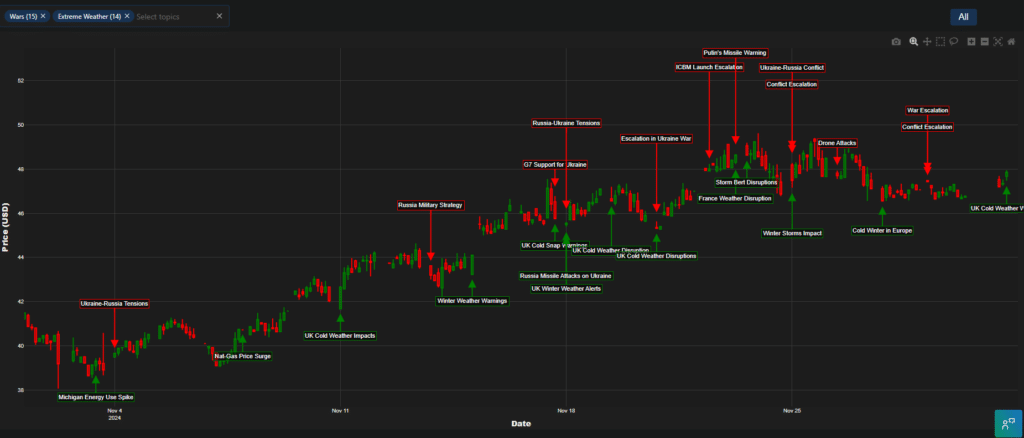
Above: Natural gas price news – European natural gas TTF analysis November 2024 insights taken from our Trading Co-Pilot
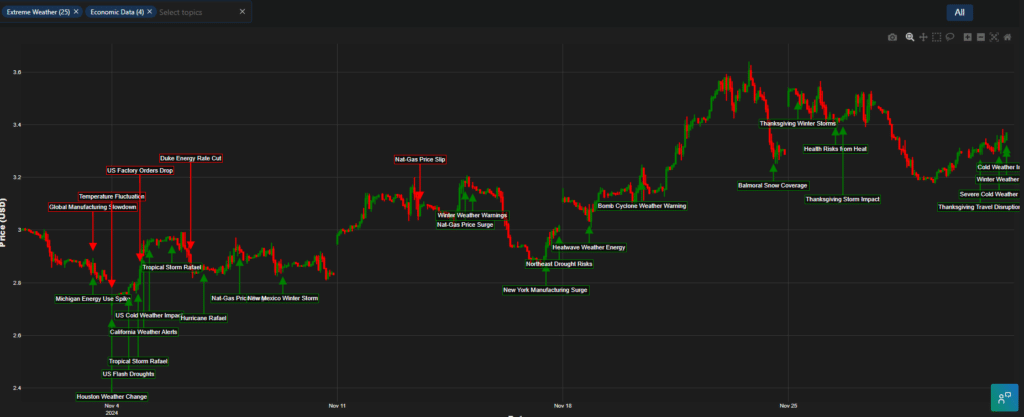
Natural gas price news – US natural gas Henry Hub analysis November 2024 insights taken from our Trading Co-Pilot
Let’s start with the obvious – the direct link between weather and Natural Gas prices. From the above chart, it’s clear that Henry Hub prices show notable sensitivity to domestic weather patterns, as evidenced by the sharp responses to events like storm Rafael and the Thanksgiving winter storms. Meanwhile, the TTF market demonstrates a more pronounced reaction to geopolitical developments. Even though both markets operate independently, their price movements increasingly show correlation during major global events.
The key here appears to be the timing and severity of weather-related disruptions. What began as a relatively stable pricing environment in early November quickly transformed as multiple weather systems struck key consumption regions. Meanwhile, the escalating situation in Ukraine created additional pressure on European gas prices. This is hardly surprising, with TTF showing particular vulnerability to news of missile warnings and conflict escalation.
To add insult to injury, the markets are also worried about supply security, particularly in Europe, and quite rightly so. And if anyone ought to be concerned, it’s the industrial users facing potential supply disruptions during peak demand periods. Yet with some arguing that some of these concerns appear overblown it will be interesting to see how things truly play out across both regions.
Another big problem is the asymmetric impact of weather events. Although initially localised, weather disruptions like the recent Bomb Cyclone weather warning in the US created ripple effects across global natural gas markets. Which brings us back to the ticking time bomb of winter supply security, particularly in regions dependent on natural gas for both heating and power generation.
As elsewhere, it’s clear that the situation has been made considerably worse by infrastructure constraints. Natural gas price news across both markets reflects these limitations, with price spikes occurring during periods of high demand and limited transportation capacity. It’s a uncomfortable fact that thanks to political and economic pressures, infrastructure development hasn’t kept pace with growing demand in key regions.
It’s easy to see from the above how the interconnected nature of these markets means that significant events in either region can create global ripple effects. The data essentially shows that while local weather patterns primarily drive short-term price movements, geopolitical events can fundamentally alter the pricing landscape, particularly in the more politically sensitive European market.
If you found the above insights and analysis valuable, why not access our real-time insights and granular market data through our Trading Co-Pilot and Commodities API? With comprehensive coverage of both TTF and Henry Hub markets, you’ll have the real-time insights needed to navigate these complex market dynamics. Contact us today to learn how our solutions can enhance your trading and risk management strategies by emailing enquiries@permutable.ai or filling in the form below to request your personalised demo.