CEIC analysis uses Permutable Inflation Sentiment data to track developed and emerging market divergence
25 Aug 2026
25 Aug 2026
New CEIC analysis uses Permutable’s inflation sentiment data across 95 countries to examine why inflation concerns are rising more sharply across developed markets than emerging economies. The findings show how high-frequency inflation data can provide an earlier view of changing price pressures alongside official CPI and conventional macroeconomic indicators.
New analysis from CEIC has used Permutable’s inflation sentiment data to identify a growing divergence in inflation concerns between developed and emerging markets.
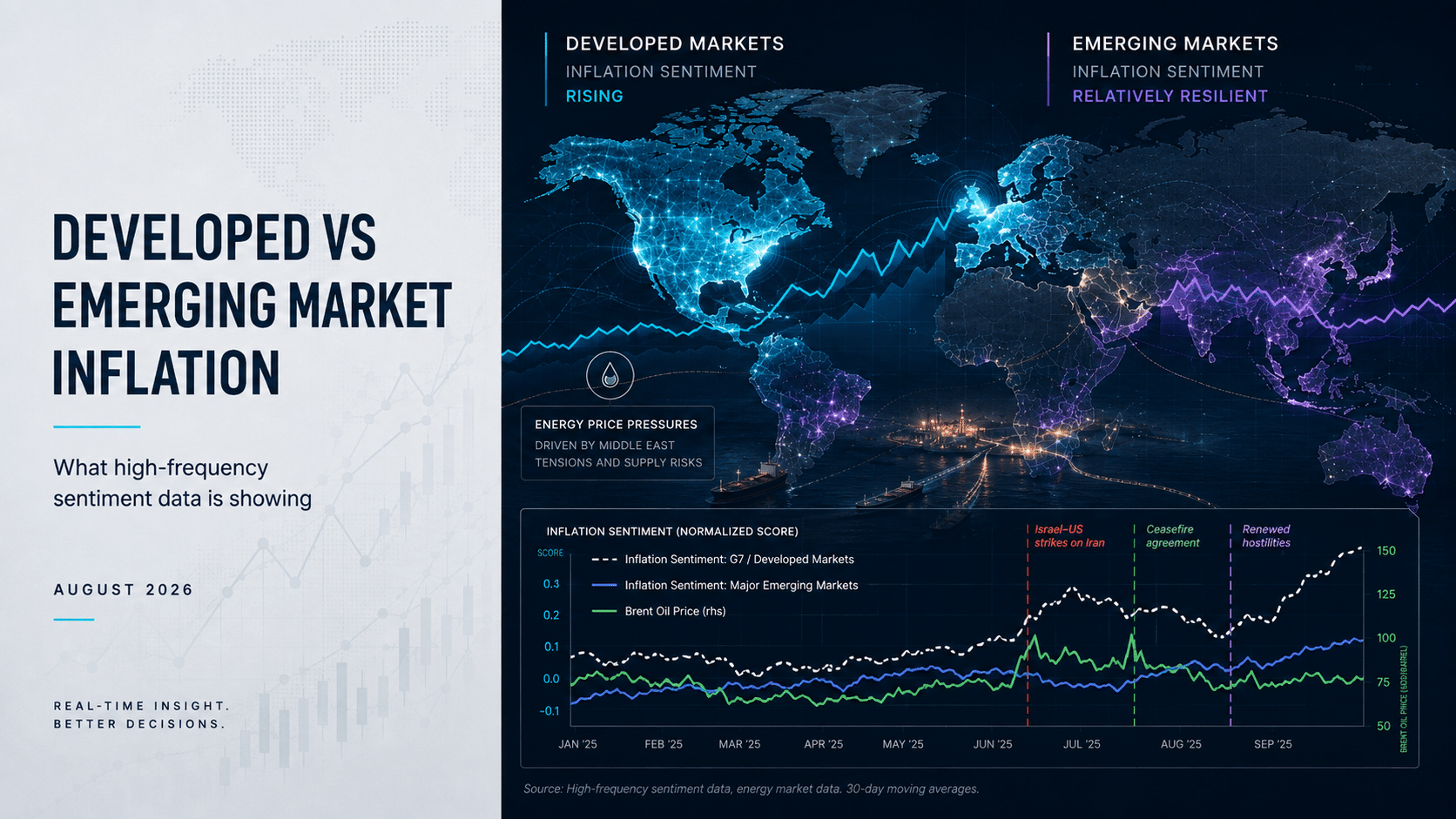
The research examines how inflation expectations and underlying price-pressure narratives have shifted as renewed hostilities in the Middle East have increased uncertainty around global energy markets.
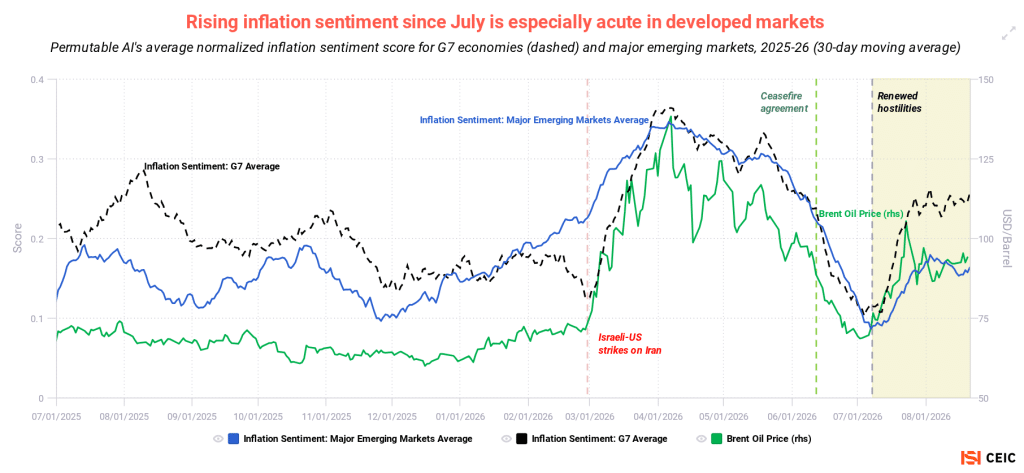
Using Permutable’s high-frequency Sentiment Score derived from our Global Macro Sentiment Indices across 95 countries, the analysis shows that inflation concerns have risen particularly sharply across developed economies.
Inflation sentiment increased significantly during July, with concerns across much of the G7 returning towards levels last seen in April and May. Japan and Canada were notable exceptions. Emerging markets, by contrast, have shown greater resilience.
CEIC points to several factors behind the divergence. In some economies, fuel-subsidy programmes have limited the extent to which higher energy costs have been passed directly to consumers. More broadly, stronger macroeconomic fundamentals, lower relative post-pandemic debt pressures and the compression of inflation and interest-rate differentials between emerging and developed markets have left some EM economies better positioned to absorb external price shocks than during previous cycles.
Permutable’s inflation sentiment data is designed to capture changes in the underlying information environment around prices in real time, rather than waiting for backward-looking official releases.
The dataset forms part of Permutable’s Global Macro Sentiment Indices, which track changes in macroeconomic narratives across 95 countries using multilingual, point-in-time data.
For investors, the value is seeing when the transmission of a global shock is uneven. A rise in oil prices, for example, does not necessarily imply the same inflation trajectory across economies. Fiscal policy, subsidies, currency moves, domestic demand and the credibility of monetary policy can all affect how quickly – and how strongly – external price pressures feed into the domestic economy.
High-frequency sentiment measures can therefore provide an additional layer alongside CPI, market-implied inflation expectations and conventional economic indicators when assessing where inflation risks are beginning to build.
The latest CEIC research follows earlier analysis incorporating Permutable data into its assessment of global macroeconomic conditions – see Alternative Inflation Metrics Raise Concerns Even As Central Banks Stand Pat.
For Permutable, the continued use of the dataset by external research providers demonstrates how high-frequency, point-in-time alternative data can complement established economic datasets when analysing changes in inflation, growth and monetary-policy expectations.
The full CEIC analysis is available through ISI Markets.