
Japan Inflation Outlook 2026: Stubborn inflation, a stalling economy and a BoJ set to hiketlook 2026: A stalling economy won’t stop the BoJ
18 Nov 2026
18 Nov 2026
The Bank of Japan has declared victory on inflation, and the market is pricing another rate rise in December. The possible paths for inflation run from settling near 2% to rising towards 4%. Japan inflation sentiment, measured by Permutable’s Global Macro Sentiment Indices, adds a third view. It turned months before prices did, and it has cooled since June.
On 30 October the Bank of Japan held its policy rate at 1.25% and declared that underlying inflation had reached its 2% target. Governor Kazuo Ueda has since called wage growth quite strong, and on 18 November he said it would be appropriate to keep raising rates. The market prices the chance of a December rise at around 80%. Japan policy sentiment was there first. It turned hawkish on 3 June, two weeks before the first of this year’s two rate rises, and has stayed firmly in hawkish territory every day since.
How far inflation runs is the open question. In one scenario, energy costs and the end of governments gasoline subsidies take inflation towards 3.5%-4%, followed by rates heading towards 2%-2.5% territory in the second half of 2027. In another, the energy shock fades, inflation settles near 2% and rates peak at 1.75%.
Japan’s inflation sentiment and policy sentiment offer a real-time read on the economic backdrop. The GMSI reads reporting on Japan’s economy every hour and scores whether it points to higher or lower prices, stronger or weaker demand, and tighter or looser policy. Each index is compared with its own history, so zero is normal and +2σ means two standard deviations above normal.
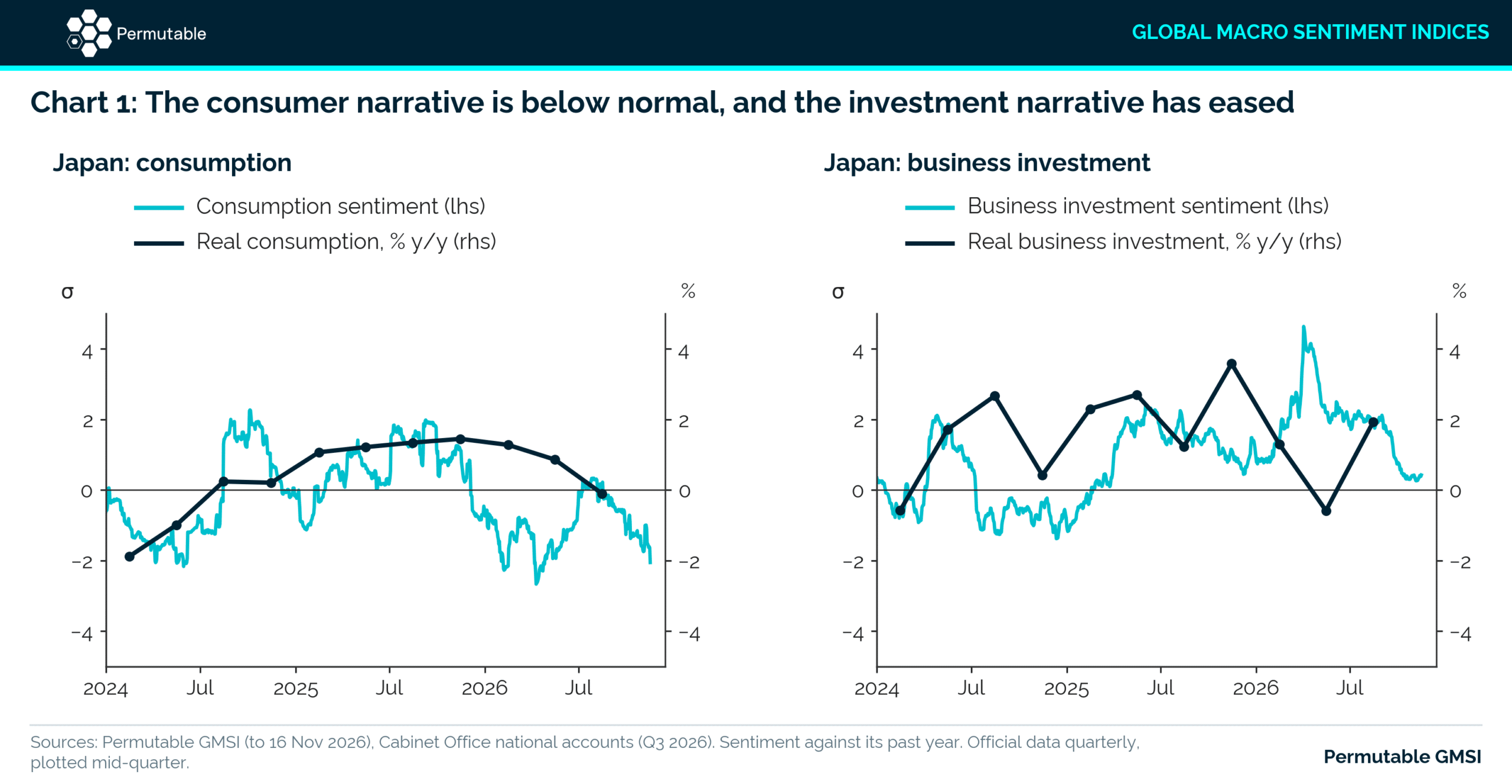
Japan’s economy stalled in the third quarter. Real GDP slipped 0.1% at an annualised rate, its first contraction in four quarters, though output was still 1.2% higher than a year earlier.
Beneath the flat line, the economy split in two. Business investment jumped 1.6% in the quarter on spending tied to AI and semiconductors. Households pulled back, with consumption down 0.3% for a second quarter as spending on durable goods fell 3.5%. Net trade took 0.6 points off growth as imports surged, and government stockbuilding added back 0.5pp, leaving private demand barely in the green at 0.1pp.
Those figures describe the summer. The first look at fourth-quarter output is not due until February, and GMSI fills the gap with daily data (Chart 1). The consumer narrative is still subdued, with Private Consumption sentiment at −2.1σ on November, its lowest since April. If wage gains come through, it should steady. Investment sentiment has eased from +4.6σ in April to +0.4σ, still above normal. A fall below zero would be the earliest sign that the AI-led investment cycle is slowing, a risk that has grown considerably since worries about AI investment unsettled markets in November.
We read Japan inflation sentiment from domestic sources, which follow price changes and wage talks as they are reported at home on the ground. In 2026 it turned well before prices (Chart 2). Energy led after conflict in the Middle East lifted the oil price, swinging from −0.5σ in January to +1.0σ in May. Food and goods joined in June, when the narrative peaked at +3.1σ. Core inflation was still 1.4% in April and May, and crossed 2% three months after the peak.
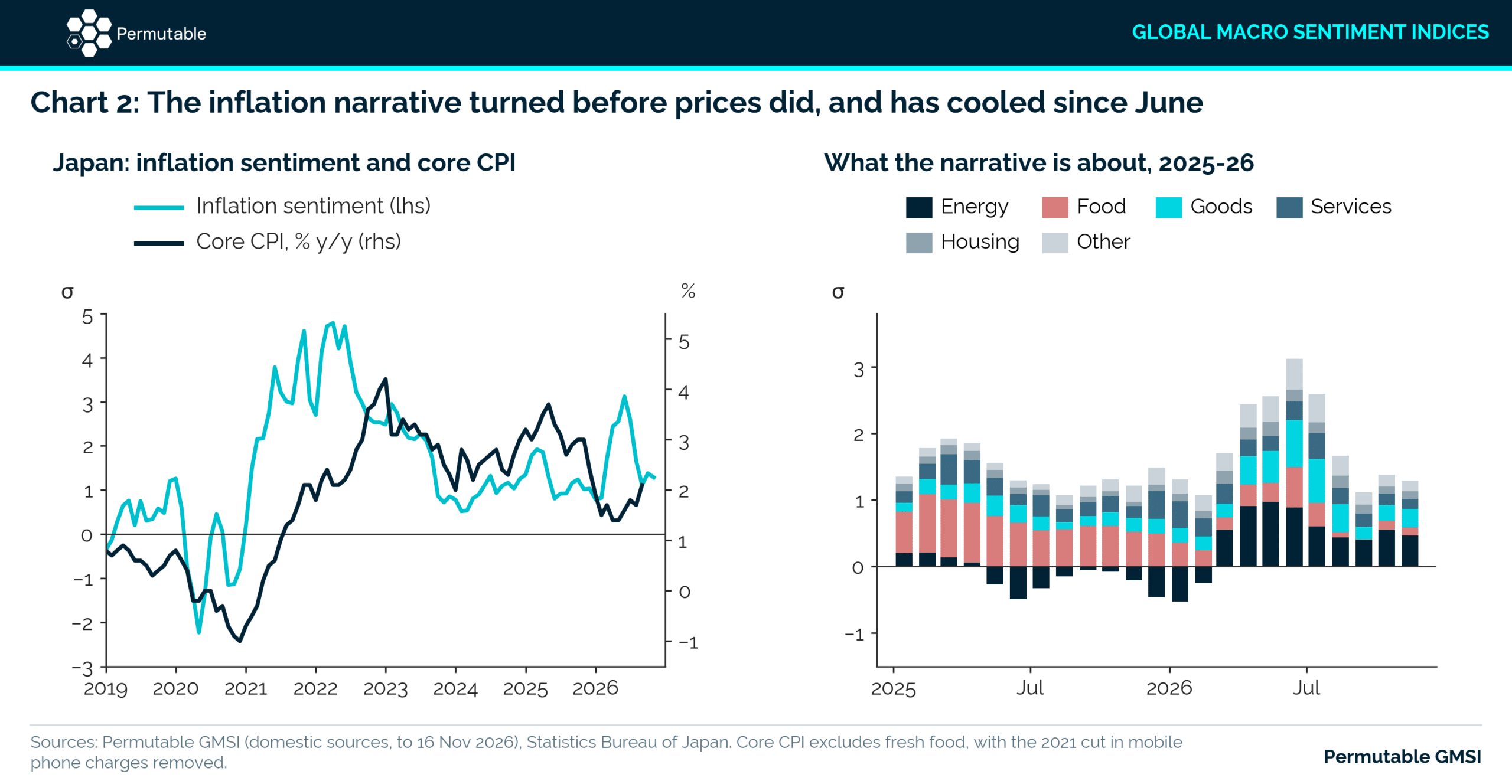
It was not the first time this has happened. In 2021 the narrative swung from −0.8σ in December 2020 to above +2σ by March, almost entirely on energy, while core inflation was still negative. Core inflation turned positive in April and passed 2% in November. Every reading is point in time. Each is built only from reporting available on the day, and rebuilding the series with later data removed leaves earlier values unchanged.
At present the narrative has come off its peak but refuses to fade. At +1.3σ in mid-November, down from +3.1σ in June, it still sits well above its long-run average, consistent with inflation holding above target. Energy remains the biggest driver. Services, where wage costs show up, add only +0.15σ, so the pressure is still coming from abroad rather than from pay at home. On past form, a narrative this elevated points to price pressure lingering through the coming months rather than fading.
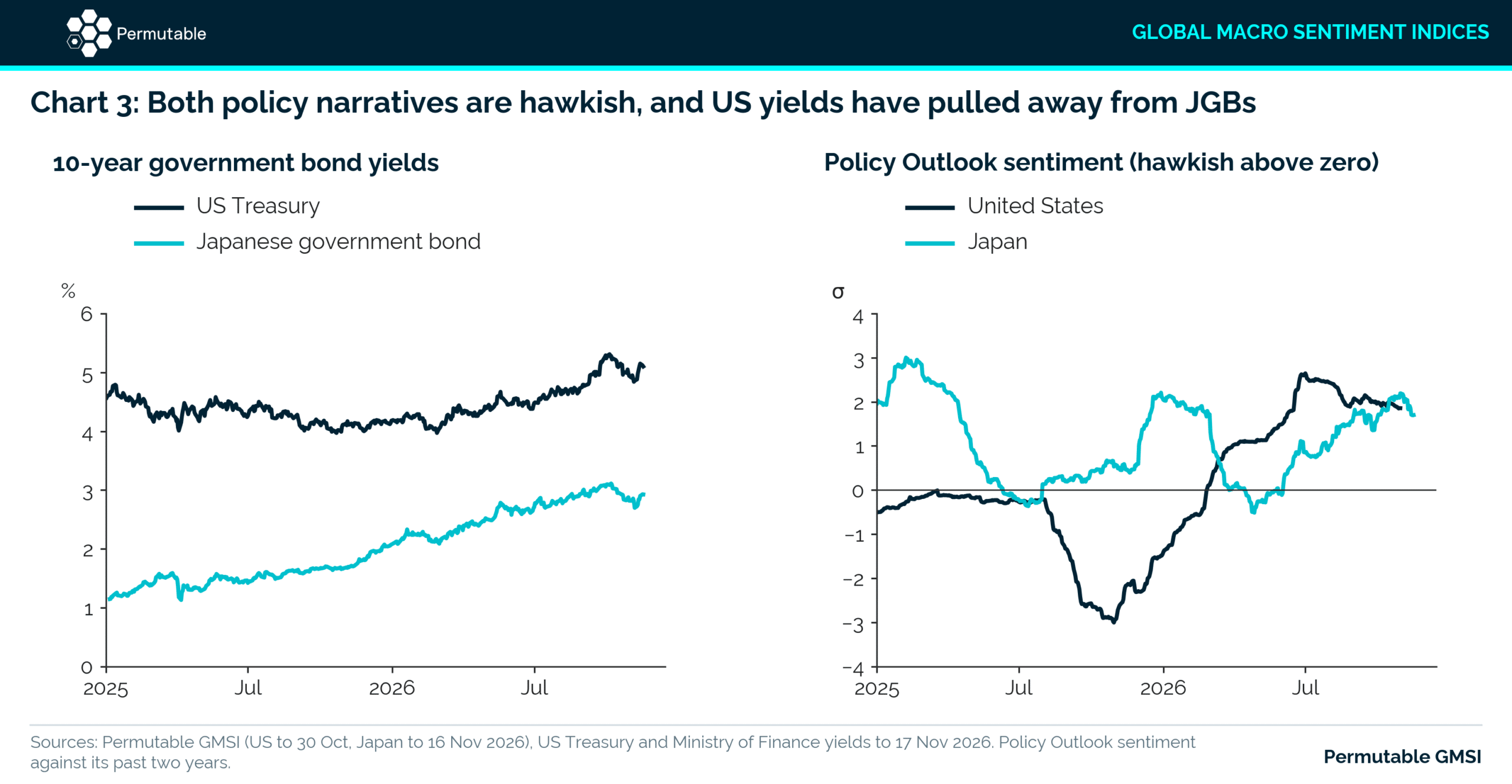
Japan policy sentiment, our Policy Outlook index, reads positive when expectations turn more hawkish. Measured against its past two years, it has been hawkish since 3 June. It reached +2.2σ on 30 October, the day the Bank declared victory, and stood at +1.7σ on 16 November.
The US narrative leans hawkish too, and both have pointed to tighter policy since 3 June, the longest joint stretch since 2020-22 (Chart 3). The gap between US and Japanese 10-year yields narrowed to 1.66 percentage points on 6 July. Since then the US yield has risen 0.62 points and the JGB yield 0.10, taking the gap to about 2.2 points. On 17 November the US 10-year stood at 5.10% and the JGB at 2.925%. While the gap stays this wide, the path of the yen depends as much on US policy as on the Bank of Japan.
Official data tells you where an economy was. Permutable’s Global Macro Sentiment Indices show where its narrative is in real time, updated hourly for 95 economies across the themes that move rates and currencies, from inflation and its drivers to growth, policy and fiscal stance. Each index splits into domestic and international views, runs back to 2015 and is built point in time, so it can be tested against your own models without look-ahead. For Japan this year, inflation sentiment turned three months before core inflation crossed 2%, and Japan policy sentiment followed the policy and yen story in daily data between releases.
Want to monitor where the next turn in Japan’s inflation or policy outlook appears next? Explore Permutable’s Global Macro Sentiment Indices in our Data Discovery catalogue to find datasets for tracking the UK policy outlook, housing activity and inflation by subtopic in your own research.
Analysis
11 Nov 2026
UK housing market: how sentiment saw Britain’s housing slowdown coming
Read more >
Analysis
04 Nov 2026
Macro sentiment in rates research: Can macro sentiment add information to front-end rates research?
Read more >
Analysis
27 Oct 2026
Brazil bonds: The fiscal premium casts its vote
Read more >