
In this article, we use our Global Macro Sentiment Indices (GMSI) to trace how fiscal concerns have overtaken expectations of further rate cuts in Brazil’s bond market. As October’s post-first-round election rally unwinds and sentiment around food inflation remains above normal, the prospects for a recovery increasingly depend on the newly re-elected Lula government’s fiscal roadmap, alongside the path of interest rates.
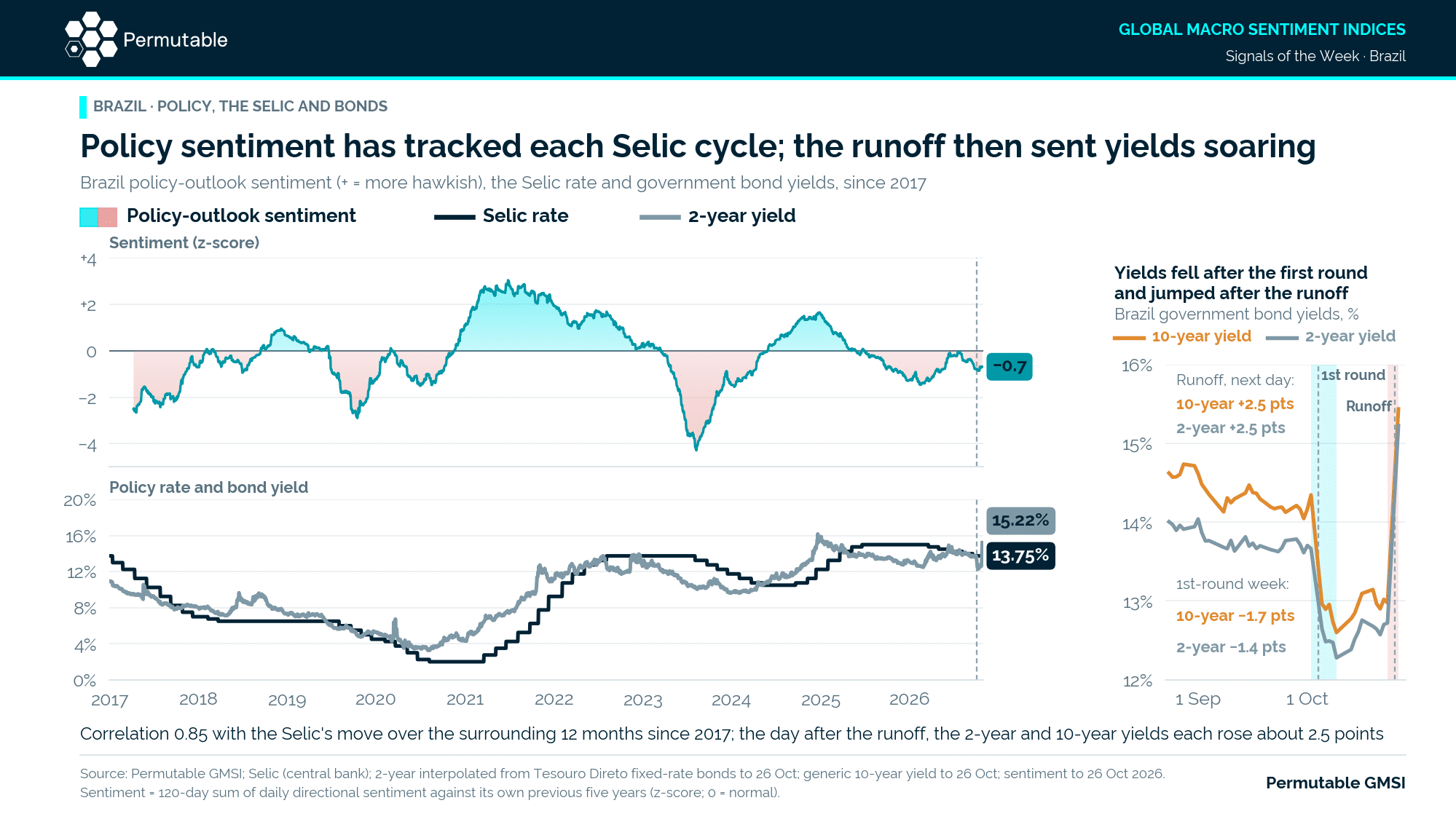
Brazil’s bond rally rested on dual hopes: that interest rates would continue to fall, and that the election would bring a tighter grip on public finances. Lula’s re-election on 25 October reversed investors’ bet on a change in fiscal policy, laying bare how much of the rally had depended on that outcome.
Between the two rounds of voting, Flávio Bolsonaro’s narrow first-round lead and promises of budget restraint helped pull the 10-year yield down from about 14.35% before the first round to 12.60% by 9 October. Much of that optimism unwound in a single session after Lula won the runoff with 51.79% of valid votes. On 26 October, the 10-year yield rose from about 12.98% to 15.45%, an increase of nearly 250 basis points.
The repricing extended across Brazilian assets as the real weakened, equities fell and the cost of insuring sovereign debt rose. To support market functioning, the Treasury cancelled its scheduled fixed-rate and inflation-linked bond auctions and carried out extraordinary buybacks, while retaining its Selic-linked auction. The intervention sought to contain the immediate disruption, but restoring confidence will require a more convincing account of how the public finances will improve.
The Selic has been cut five times since March, from 15% to 13.75%. Our policy-outlook sentiment remains below its five-year norm, having briefly approached neutral before turning lower again. Yet long-dated yields also reflect inflation expectations and the compensation investors demand for holding Brazilian debt, allowing borrowing costs to rise even as the central bank eases.
The government has responded by promising a higher effective primary surplus in 2027, without specifying its size. The formal target is 0.5% of GDP, but the government’s August forecast put the effective surplus at just 0.1%. With gross general government debt at 82.9% of GDP in August, investors will want to see how spending restraint and revenue measures can produce a lasting improvement in the underlying budget.
A fiscal roadmap that commands support in Congress would help reduce the premium on longer-dated debt. Without that support, further Selic cuts could provide only limited relief as concern over the debt trajectory keeps longer-term financing costs elevated.
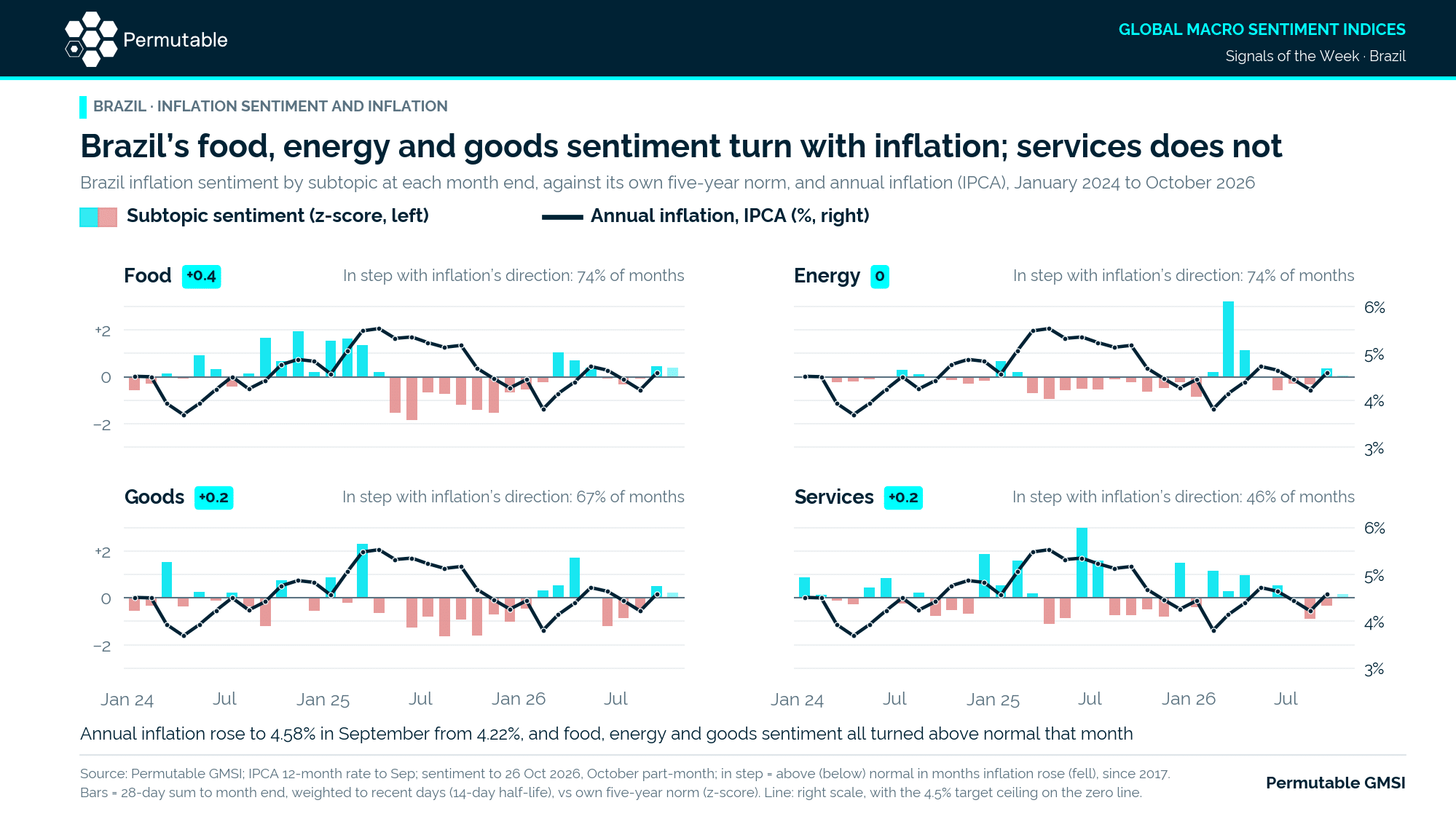
Inflation adds a further constraint on the easing cycle. Food-inflation sentiment rose above its five-year norm in September and remained above it in October through 26 October, while services sentiment stayed close to normal. This suggests that food prices remain a source of pressure even as the broader policy backdrop has become less hawkish.
The official data present a mixed outlook. Annual IPCA inflation rose from 4.22% in August to 4.58% in September, exceeding the 4.5% upper tolerance limit. October’s preliminary IPCA-15 reading then slowed to 0.32% month on month from 0.70%, although food and beverage inflation accelerated to 0.88% and the annual preliminary rate increased to 4.62%.
The monthly slowdown leaves some room for further easing, but stronger food-price pressures and the post-election depreciation of the real complicate the decision at the central bank’s 3-4 November meeting. A more stable real and an easing of those inflationary pressures would give policymakers greater confidence that further cuts are consistent with bringing inflation back towards target.
With October’s rally unwinding, higher yields offer greater prospective income alongside greater fiscal and inflation risk. The scope for a sustained recovery will depend on whether the government can turn its promise of a stronger primary balance into measures that Congress will support.
GMSI provides a way to follow how that balance changes between official releases: policy-outlook sentiment tracks shifts in the monetary policy backdrop, inflation subtopics help identify where price pressures are building, and public-debt sentiment tracks concerns around the fiscal outlook. A credible budget plan, accompanied by easing food-price pressures, would give falling policy rates a firmer basis for supporting the wider bond market.
Where could Brazil’s fiscal premium move next? Explore Permutable’s Global Macro Sentiment Indices in our Data Discovery catalogue to find datasets for tracking the policy outlook, public-debt stress and inflation by subtopic in your own research.