In this article, we use our Global Macro Sentiment Indices (GMSI) to trace where higher borrowing costs are starting to bite in US credit markets, for corporate borrowers and households alike. Corporate credit-stress sentiment has risen in tandem with investment sentiment, while housing activity sentiment has slipped to its weakest since 2022 as mortgage rates climb. The AI build-out is still finding finance, but households and homebuilders are already feeling the bite.
AI capex remains the dominant theme in terms of economic activity and the US investment cycle, but the focus is moving from the size of spending plans to whether their financing is sustainable. Construction, equipment and grid connections are paid for up front, while the lease and compute revenue that repays them builds over several years. Higher rates raise the cost of funding that gap and reduce the present value of the cash flows at the end of it.
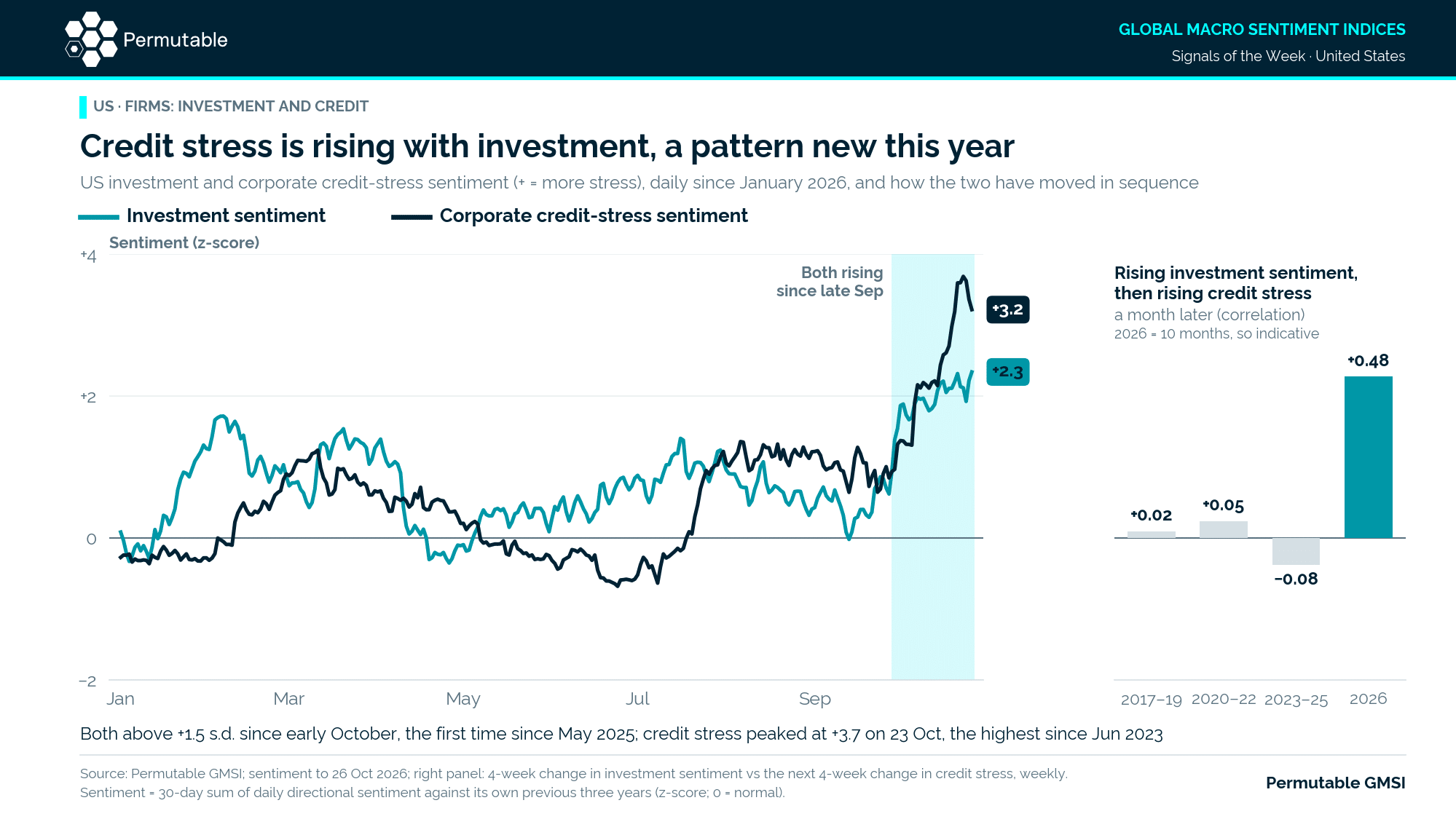
The AI build-out is still gathering pace. Investment sentiment is more than two standard deviations above its three-year norm, and credit-stress sentiment has climbed with it to its highest since June 2023.
The money is flowing; the question is whether it will pay off. Most of the cost comes up front, while revenue depends on demand that is still forming. Chips lose value quickly, and the AI race may reward only a few winners. If costs outrun income, the build-out becomes harder to finance.
For now, the concern is returns, not failure. Sentiment on bankruptcies, market stress and banking stress is at or below normal. Large technology groups can absorb a miss from their own cash flow. Debt-funded developers cannot.
Lenders are still willing, but cautious. In the $63 billion package announced on 26 October to finance Broadcom hardware for Anthropic, Broadcom is protecting senior lenders if the equipment loses value. Lenders want to know who takes the loss.
Tighter terms are more likely to slow the build-out than stop it, starting with the most indebted developers. If credit stress eases and spending holds, the concern will pass. If stress stays high and projects slip, doubts over returns may start to bite.
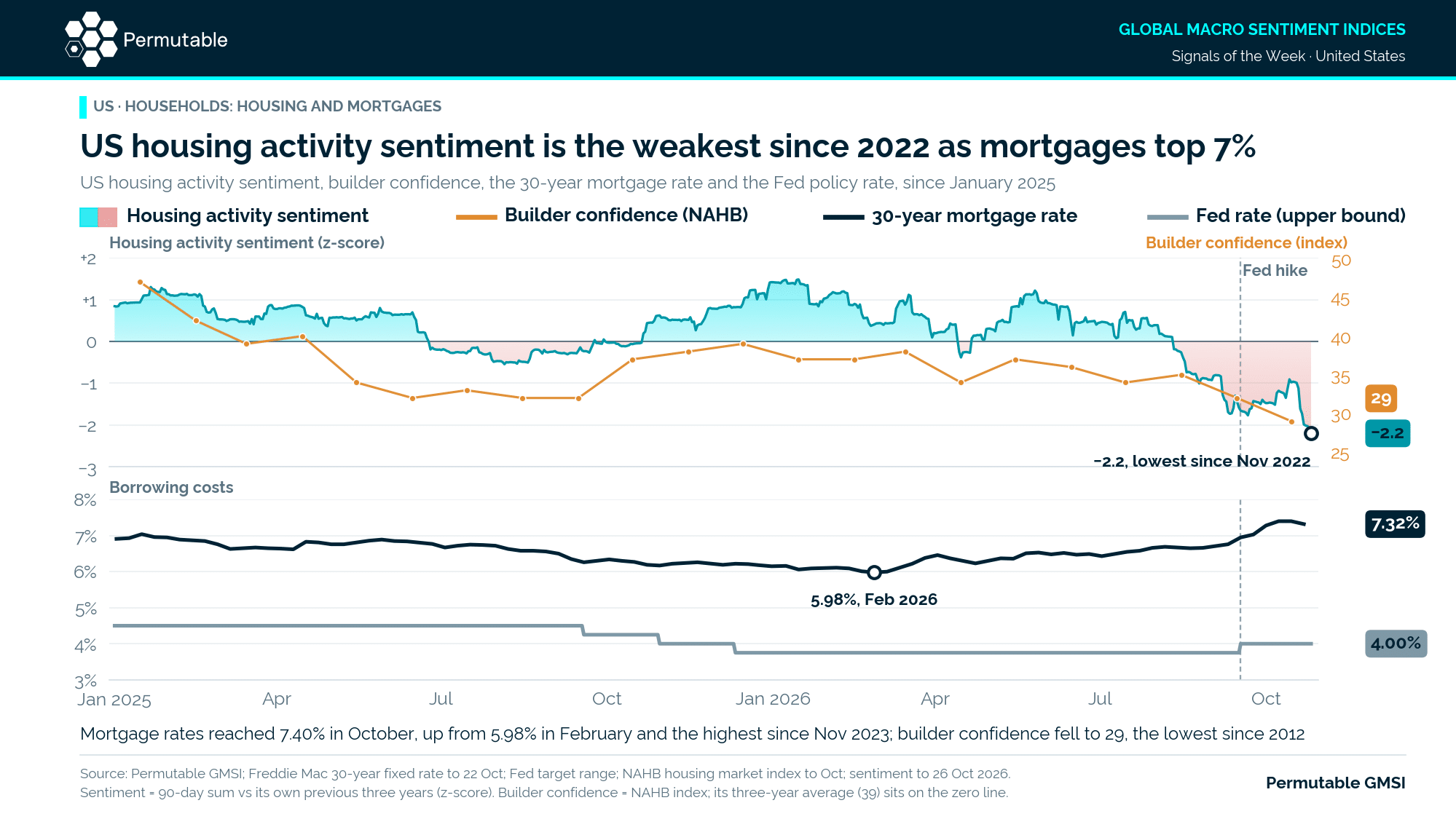
Households feel higher borrowing costs more directly, especially those taking out a new mortgage. The average 30-year fixed rate climbed from 5.98% in late February to 7.40% in mid-October, its highest since November 2023, before easing to 7.32% on 22 October. The Federal Reserve’s September rate rise, its first since July 2023, added to the pressure. Owners on cheap fixed-rate loans are largely insulated, but that insulation has a cost of its own. With little reason to give up a low rate, fewer owners sell. Resale supply stays thin, and new buyers absorb today’s rates in full.
The pinch has now reached builders. Their confidence fell to 29 in October, the lowest since June 2012, and price cuts and sales incentives have become common. Mortgages are not the only problem. Land, materials, labour and construction finance have all eaten into margins. But higher rates are now thinning demand too. With few existing owners willing to give up cheap loans and sell, buyers have leaned on new homes. Each rise in mortgage rates shrinks that pool. Builders are being squeezed from both sides: costs are rising just as demand wanes.
Our housing activity sentiment, which tracks construction and home sales, had recovered to about −1 by mid-October from a September low of −1.8 before falling back sharply to -2.2 on 26 October, its weakest since November 2022. Builder confidence shows no sign of turning either. A recovery in construction needs more buyers able and willing to proceed at current mortgage rates, and on present readings that point has not been reached.
Higher rates have found their first biting point in housing. Buyers are being priced out, builders are cutting prices, and housing sentiment is at its weakest since 2022. In corporate credit, the bark is still louder than the bite. Credit-stress sentiment has climbed to its highest since June 2023, yet sentiment on bankruptcies and banking stress remains at or below normal. The AI build-out is still being funded, just on tougher terms.
That gap is where sentiment earns its place in a desk’s toolkit. Hard data confirms a bite only once it has landed: in defaults, cancelled projects or weaker capex prints. Sentiment captures the narrative as it builds, giving a real-time read on where the next squeeze is forming. If credit stress eases while spending holds, the warning will have passed. If it persists and spreads into bankruptcy and banking sentiment, higher rates will have found their second biting point.
Where could higher borrowing costs bite next? Explore Permutable’s Global Macro Sentiment Indices in our Data Discovery catalogue to find datasets for tracking credit stress, investment and housing activity in your own research.

Analysis
16 Oct 2026
Gold outlook 2026: Why US rates outweigh geopolitical risk
Read more >
Analysis
14 Oct 2026
Beneath US headline inflation: tracking pressure across energy, food, services and housing
Read more >
Analysis
13 Oct 2026
France’s debt alarm hits a decade high and drowns out the rest of the G20
Read more >