
In this article, we unpack how the September Fed cut reshaped market dynamics, why sentiment around the US dollar swung so sharply, and how our Trading Co-Pilot captured the bearish build-up, the post-Fed plunge, and the recovery that followed.
The Federal Reserve’s long-awaited cut has landed with a softer thud than markets had braced for. The FOMC lowered the funds rate by 25 bps to 4.00-4.25%, the first easing since December 2024. The Fed’s updated economic projections, the SEP, pointed to two further cuts before year-end, marginally more dovish than June’s outlook, but shy of the aggressive easing cycle investors had begun to sketch in.
The dollar’s reaction was swift and telling. The US Dollar Index (DXY) plunged to 96.25, a three year low, as traders treated the dot plot as confirmation that the gates to the easing cycle had opened. Yet by Thursday morning the greenback had managed to reclaim some ground, trading back near 97.00. This rebound owed much to Powell’s measured tone and firmer inflation projections, which together dampened expectations of a rapid cutting cycle.
Table of Contents
TogglePowell’s Balancing Act
Powell framed the policy stance as risk mitigation in the face of weakening labour data, while stressing there was no urgency to accelerate easing. The press conference emphasised the Fed’s positioning to retain optionality, even as employment risks mount.
The vote itself echoed that balance. Stephen Miran, newly sworn in governor, favoured a deeper 50 bps fed cut, but the lone outlier was overwhelmed by an 11-1 majority. Against the backdrop of political pressure over Fed independence, the solidarity was evident, a board closing ranks, perhaps to buy some breathing space in the face of political pressure.
Still, the shift in stance is clear-cut. Job creation has reined in notably, unemployment has climbed to 4.3%, and benchmark revisions erased nearly a million jobs, cancelling out a large chunk of earlier gains and amplifying fears of a faltering labour market. Inflation lingers at 2.9%, but stabilising the labour market has once again become the priority.
Trading Co-Pilot: Bearish Build-Up, Fragile Rebound
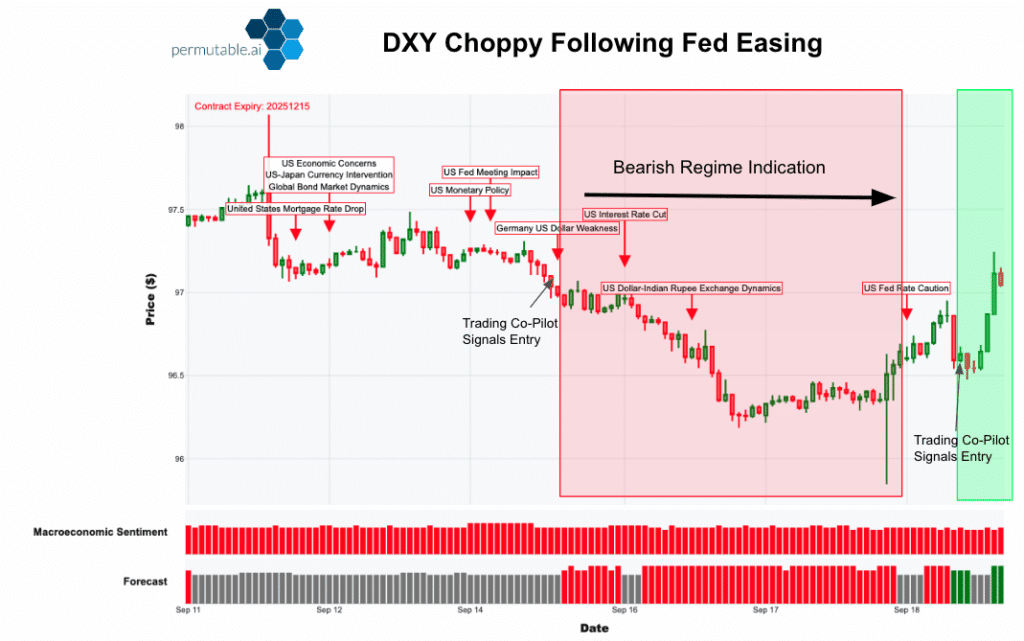
Our Trading Co-Pilot mapped the dollar’s September path with precision. What began as a gradual erosion of confidence early in the month hardened into a structural shift in positioning. Rising jobless claims and anaemic payroll growth fed directly into our macroeconomic layers, revealing a market increasingly unwilling to treat the greenback as a safe harbour.
By mid-September, the divergence was clear. Equities climbed on liquidity hopes while the dollar wilted. Our Trading Co-Pilot’s heatmaps showed sentiment locking into a decisive downside skew, bearishness was no longer episodic but entrenched.
On the morning of the Fed’s decision, the dollar staged a tentative rally. Yet the move stalled, a sign in our signals of limited resilience. The post-Fed collapse through to 96.30 verified the bearish stance. At the same time, our Trading Co-Pilot flagged a tactical rebound, as Treasury yields firmed in response to Powell’s careful rhetoric. Structurally, the dollar remains under pressure, rebounds may occur but lack the force to alter the structural trend.
Gauging Market Sentiment
Market sentiment is caught between relief and frustration. Relief that the Fed cut has finally come, frustration that Powell has not endorsed the sweeping easing cycle markets had hoped for. The message was one of caution and optionality, neither fully dovish nor convincingly defensive, leaving investors with little to cling on to regarding the policy path.
That ambivalence showed in positioning. Equities spiked before surrendering gains. Gold held near record highs, its demand fuelled by doubts over Fed credibility. Treasuries saw real yields creep higher, a move that underpinned the dollar’s modest rebound. Futures markets now assign a much higher chance of another 25 bp cut in October, than pre-meeting, but conviction moving forward wears thin.
Fresh data on the 18th added another twist. With jobless claims dropping to 231,000 and continuing claims easing to 1.92 million, the labour market ushers signs of fortitude. That resilience spurred a modest lift in the dollar further, with the DXY mounting a comeback back to 97.5. This is not a reversal of the broader bearish trend, but a tactical rebound driven by labour market strength, firmer yields, and technical support. Structurally, the forward-looking easing cycle still weighs heavily on the dollar, but near-term data prints will determine whether rebounds persist or dissipate.
The weight of momentum continues to press against the dollar. The Fed cut has reduced the dollar’s yield advantage, making rebounds look like short-lived bounces rather than sustainable recoveries. For the moment, the DXY is confined to a narrow 97.00-97.50 band, with upticks best read as corrections rather than the beginnings of a comeback in the making. Without a decisive turn in US data or a renewed flare in inflation, the broader trajectory still tilts lower.
FX Sentiment Signals and Policy Transmission in Action
The Fed has eased, and the dollar is transmitting that shift across global markets. The DXY has become the gauge through which a softer labour market, realigning yield spreads, and doubts over policy credibility are being priced.
Our Trading Co-Pilot caught the bearish build-up ahead of the Fed, the collapse through 96.25, and the tentative rebound that followed. At present, the greenback’s pivot rests on a sustained break. In this cycle, the dollar is not simply reflecting Fed policy, it is the mechanism through which that policy is being absorbed by the markets.
Strategic Takeaway
Our Trading Co-Pilot captured the US Dollar move with clarity. Its layered sentiment intelligence provided an early, clean, and risk-aware bearish call. This enabled clients to position with confidence and respond strategically in a dynamic FX environment.
Unlock the Edge
Contact enquiries@permutable.ai to access our real-time, sentiment-led FX intelligence and strengthen your trading strategy.