
This analysis examines the key factors affecting the pound during the week of May 6-13, 2025, focusing on how currency movements, trade negotiations, and labour market challenges shaped GBP market sentiment. It is written for professional forex traders, institutional investors, and financial analysts seeking data-driven insights into the critical factors affecting the pound and their impact on weekly GBP market sentiment.
As we enter mid-May 2025, multiple factors affecting the pound have converged to create a particularly complex trading environment for sterling. The past week has presented a challenging landscape where traditional market correlations have been tested by conflicting economic forces. Against the backdrop of evolving US-UK relations and persistent labour market uncertainties, understanding the key factors affecting the pound has become essential for navigating GBP market sentiment in this pivotal year.
These insights into the factors affecting the pound and their impact on GBP market sentiment are derived from our Trading Co-Pilot feeds, the culmination of vast amounts of headlines and data sources which have been processed by our advanced proprietary LLMs to deliver institutional-grade forex intelligence, providing traders with real-time sentiment analysis and predictive market indicators.
Our data-driven approach combines natural language processing and sentiment analysis to identify the primary factors affecting the pound. This week’s analysis showcases how our technology tracked the intricate balance between positive trade developments and concerning employment data, offering actionable insights for currency traders and financial professionals navigating GBP market sentiment.
Table of Contents
ToggleSterling’s balancing act
The factors affecting the pound have displayed complexity throughout the trading week, as revealed by our Trading Co-Pilot’s continuous monitoring of market dynamics. For starters, the British Pound demonstrated stability despite mounting pressures from the UK labour market, with unemployment rising to 4.5% – its highest level in nearly four years – a critical factor affecting the pound.
Last week, the currency maintained its position primarily within the 1.32-1.34 range against the US dollar, showcasing how multiple factors affecting the pound balanced each other out. The results was particularly interesting as our sentiment analysis tracked traders weighing optimistic trade negotiations against deteriorating employment conditions, both significant factors shaping GBP market sentiment.
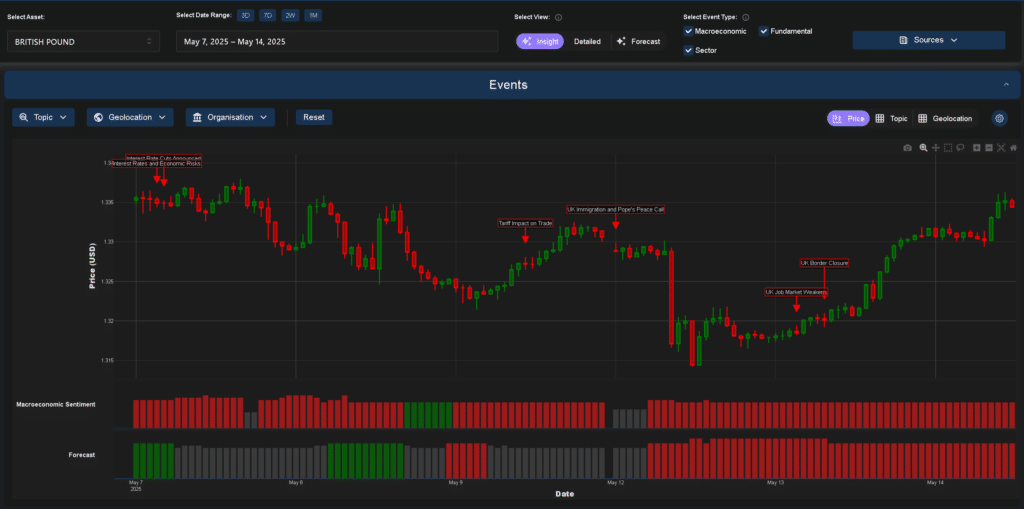
Above: GBP/USD weekly performance captured by Permutable AI’s Trading Co-Pilot data feeds showing the pound’s complex trajectory from May 7-14, 2025. The chart highlights key market events including interest rate cuts, UK immigration announcements, and pivotal US-UK trade negotiations.
Trade breakthrough
Our Trading Co-Pilot data feeds identified the announcement of a breakthrough US-UK trade agreement as one of the most positive factors affecting the pound this week. This development temporarily lifted GBP market sentiment, with sterling reaching 1.34 on Tuesday according to our price tracking data. More recently, however, our analysis reveals that concerns about the domestic employment situation have tempered initial enthusiasm, demonstrating how competing factors affecting the pound can offset each other.
So, the week began with trade negotiations emerging as a key factor affecting the pound, detected by our sentiment indicators. On Tuesday, May 6, progress in US-UK trade negotiations sparked hopes for a beneficial trade pact, pushing sterling slightly higher. And then came the formal announcement on Thursday, May 8, of a significant trade agreement between the two nations, including tariff reductions for UK goods – a development our Co-Pilot flagged as a major factor affecting GBP market sentiment.
Monetary policy pressures
Of course, not all factors affecting the pound supported positive GBP market sentiment. Much of this is due to persistent concerns about monetary policy direction, identified by our algorithmic tracking as a crucial factor affecting the pound. The Bank of England faces mounting pressure to consider further rate cuts in response to economic challenges, particularly those stemming from international trade tensions.
And this is why the pound’s trading pattern throughout the week reflected these competing factors, as our insights demonstrates. In other words, while trade developments emerged as positive factors affecting the pound, employment data created resistance at higher levels. Indeed, our Trading Co-Pilot’s analysis confirms that the unemployment rate’s rise to 4.5% represents one of the most significant negative factors affecting GBP market sentiment.
Employment challenges
This dynamic among factors affecting the pound could change, however, as market participants await further clarity on the implementation of the new trade agreement – a factor our predictive models are closely monitoring. The tariff situation remains a particular bête noire for UK businesses when selling British goods – another negative factor affecting the pound.
Assuming that the Bank of England maintains its current stance, the interplay of factors affecting the pound may stabilise GBP market sentiment according to our forward-looking indicators. For instance, the central bank must carefully balance supporting economic growth whilst managing inflationary pressures. But, in reality, our analysis suggests the multiple factors affecting the pound have made the decision-making process increasingly complex.
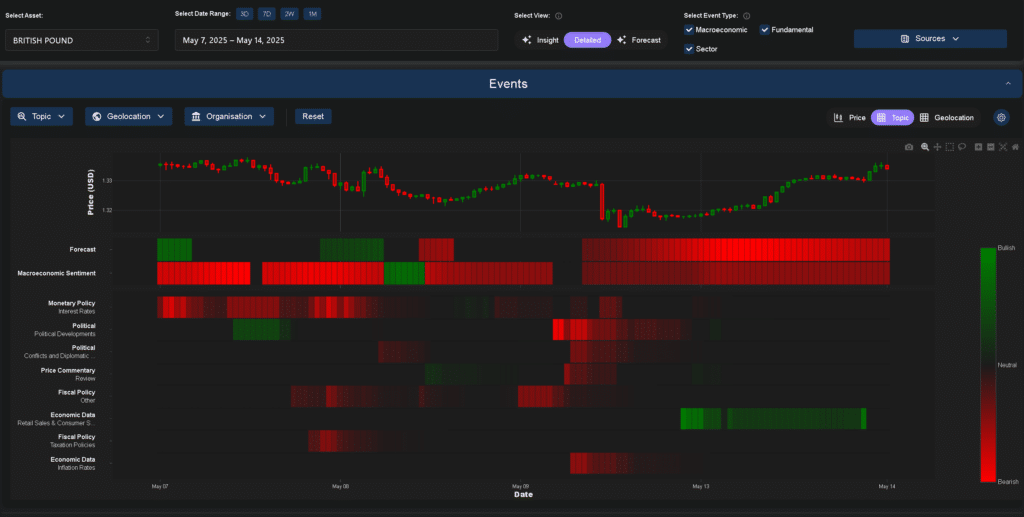
Above: Comprehensive breakdown of factors affecting the pound captured by our Trading Co-Pilot data feeds from May 7-14, 2025. Our detailed analysis reveals how macroeconomic sentiment and key policy areas influenced GBP market sentiment throughout the week. The chart displays sterling’s price action alongside our proprietary sentiment indicators across multiple domains including monetary policy, political developments, fiscal policy, and economic data. Red signals indicate negative pressure on the pound, whilst green shows supportive factors. This multi-dimensional view demonstrates how our market sentiment engine analyses the complex interplay of forces shaping forex markets, providing traders with institutional-grade insights into what’s driving currency movements.
Technical levels supporting market psychology
Most important, our Trading Co-Pilot’s correlation analysis shows how technical factors affecting the pound interact with fundamental drivers to shape sterling’s trajectory. That’s what’s made this week particularly significant for currency traders monitoring GBP market sentiment. It may be that positive factors affecting the pound from trade negotiations provide sufficient support to offset labour market concerns.
In other words, our sentiment analysis indicates the market appears to be weighing various factors affecting the pound differently. This assumption is being tested as new economic data emerges through our real-time feeds. Interestingly, our technical analysis shows the pound’s resilience at the 1.32 level suggests strong technical support – itself a factor affecting GBP market sentiment.
Policy changes and emerging factors
There is also the question of how UK businesses will adapt to the new trade environment, an evolving factor affecting the pound. And that’s what seems to be happening as companies reassess their strategies in light of both opportunities and challenges, according to our corporate sentiment analysis. This is all the more relevant given the UK government’s announcement of significant immigration policy changes, which our system flagged as an emerging factor affecting GBP market sentiment.
This pattern identified in our data highlights how traders must closely monitoring how these various factors affecting the pound interact. Similarly, our analysis shows attention remains focused on Bank of England communications regarding future monetary policy direction. Meanwhile, the broader implications of the UK’s border closure announcement continue to unfold as a developing factor affecting the pound in our newsflow tracking.
Market expectations
The idea that GBP market sentiment can remain positive despite negative factors affecting the pound reflects the complex nature of currency valuation, as our multi-factor models demonstrate. For example, whilst employment concerns represent a significant negative factor affecting the pound – with one in four employers planning redundancies over the next three months according to our data aggregation – the trade agreement’s benefits may offset these concerns.
Of course, the relative importance of factors affecting the pound can shift rapidly. But it is expected to be more likely that sterling will continue trading within its established range over the next few weeks, unless new factors affecting the pound emerge that are detected by our early warning systems. That said, our analysis recommends traders remain vigilant for changes in how the market weights different factors affecting GBP market sentiment.
Understanding the factors through data
In short, this week’s analysis of factors affecting the pound, as captured by our Trading Co-Pilot data feeds, demonstrate sterling’s ability to balance multiple economic forces. The various factors affecting GBP market sentiment have created a complex but navigable trading environment, with our comprehensive data analysis providing the clarity needed to understand and indeed, delayer, how trade negotiations, labour market developments, and policy considerations shaped the pound’s performance.
Stay ahead with our Trading Co-Pilot data feeds
Stay ahead of factors affecting the pound with our Trading Co-Pilot data feeds. Access institutional-grade analysis of GBP market sentiment powered by real-time data processing and advanced analytics direct through out API and integration services. Simply reach out to our team at enquiries@permutable.ai or fill in the form below to discuss a trial or integration opportunities.