You would be hard-pressed to find a more intricate market situation than current natural gas markets signaling complex winter ahead. Let’s examine how our Trading Co-Pilot’s AI analysis of natural gas market news has uncovered several important patterns suggesting we are entering a new market interesting and potentially volatile phase in the natural gas market.
Some time ago, traditional analysis might have focused solely on temperature forecasts. Instead, our Trading Co-Pilot has detected a more nuanced picture. While mild autumn temperatures initially exerted downward pressure, Hurricane Rafael’s Category 3 impact on the Gulf Coast created unexpected supply disruptions. More broadly, when over 16% of US Gulf natural gas production remained offline, the market faced immediate supply constraints.
The aforementioned isn’t the only example of complex market forces at play. The problem is that Gulf disruptions are coinciding with infrastructure constraints. More to the point, with the reports of supply disruptions, this caused cascading effects across energy markets, with combined factors creating a supply squeeze that perhaps many traders hadn’t factored into their analyses.
For those looking for the answer to why it’s likely to be a complex Winter ahead for global natural gas markets, the answer to this can be found in recent developments in European natural gas markets. Few now believe that European energy dependence on Russian gas will return to previous levels. Indeed, from looking at the new EU energy commissioner’s commitment to eliminating Russian gas reliance, coupled with ADNOC’s new LNG supply deal with Germany, this means that new demand patterns are emerging.
Let’s examine what else our Trading Co-Pilot has highlighted. There is also the question of price action, which has shown recovery signs while remaining below key resistance levels. Meanwhile, the daily and weekly charts present mixed signals that require careful interpretation. Above all, though, what sets our Trading Co-Pilot’s analysis apart is the ability to synthesize these multiple factors simultaneously.
Sure, some people think that individual market factors can be analysed in isolation, but to us, this is a fool’s game. Case in point – Australia’s East coast facing a gas crisis and Nigeria reporting low funding for domestic gas projects, the global supply picture becomes increasingly complex. Talk about a perfect storm of factors converging.
Before we look ahead, we invite you to think back to previous market shifts. Not only do current conditions mirror historical patterns, but they also present unique characteristics that our Trading Co-Pilot has identified. Think of that in the context of approaching upcoming winter demands, geopolitical pressures, and the fact that 2024 is projected to be the hottest year on record. Some might say it’s hard to get a handle on how these factors might play out without comprehensive AI analysis.
In short, while traditional analysts might focus on individual factors, we believe it’s crucial to take a holistic view of market dynamics. Our Trading Co-Pilot suggests watching natural gas market news in real-time for specific trigger points that could shift market sentiment. The key problem is that traditional analysis often misses these longer-term structural shifts or delivers it too late, which is precisely where our real-time AI-powered analysis proves invaluable.
What you’ve just read is just a snapshot of our Trading Co-Pilot‘s analytical capabilities. Whilst others are still catching up on the headlines, our AI is already analysing the next market-moving signals in natural gas in real-time. In an environment where every minute counts, having real-time intelligence can make the difference between profitable trading decisions and missed opportunities.
Our Trading Co-Pilot delivers instant analysis of breaking news impact, clear buy/sell signals backed by AI, and an early warning system for market shifts. From technical breakdowns to weather pattern impact assessment and real-time supply-demand dynamics, our AI processes it all instantly, giving you a clear edge in these volatile markets.
We’re opening limited places for our next cohort of enterprise trial users. Join leading energy traders who are already using our AI to cut through market noise, spot opportunities early, manage risk effectively, and make truly data-driven decisions. This winter’s natural gas markets are signalling complexity ahead – don’t trade them blind – get in touch to request a 2-week free trial for qualified corporate traders by getting in touch with us at enquiries@permutable.ai or filling in the form below.
The impact of the Middle East crisis on oil prices continues to be a dominant force in global energy markets. This year has seen a series of events that have sent tremors through the industry, with Brent Crude oil prices responding to geopolitical twists and turns. In this article we’ll track recent escalations in the region and the impact of the Middle East crisis on oil prices using insights from our proprietary Trading Co-Pilot.
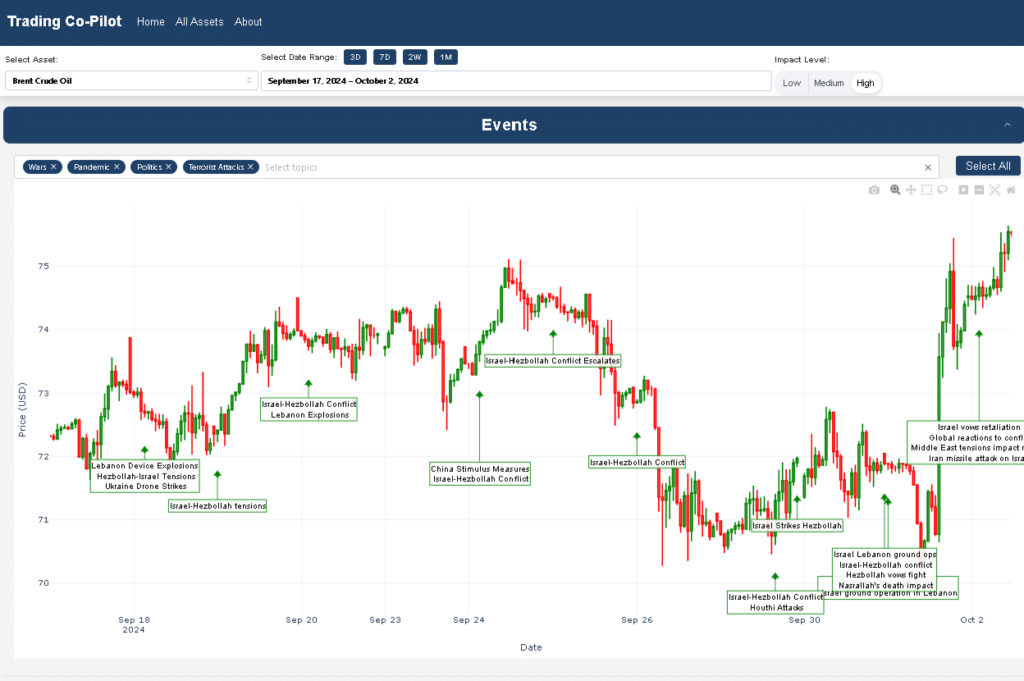
Cast your mind back to mid-September, when the price of oil hovered around the $71 mark. The trail of blood between Israel and Hezbollah was already evident, with tensions simmering beneath the surface. Then, like a spark to kindling, Lebanon device explosions ignited, coinciding with Ukraine drone strikes. This marked a turning point, as the impact of Middle East crisis on oil prices began to manifest in an upward trajectory.
Above: Impact of the Middle East crisis on oil prices: Insights from our Trading Co-Pilot
For the initiated in the oil markets, such events are not unfamiliar. The rivalry between regional powers has long been a factor in price fluctuations. And yet, the rapid succession of incidents in this period stands out. No matter the degree of preparedness, sometimes the problem lies in the unpredictability of these conflicts, amplifying the impact of Middle East crisis on oil prices.
Looming over the entire situation is the spectre of wider regional instability. As we write, the Israel-Hezbollah conflict has escalated, with each new development sending ripples through the market. The narrative picked up momentum with Lebanon explosions, pushing prices above $74. Around the same time, China announced stimulus measures, adding another layer of complexity to the global economic picture and the impact of Middle East crisis on oil prices.
Why does this matter so much for oil prices? For some, this might seem like an overreaction. However, the Middle East remains a crucial oil-producing region, and any hint of supply disruption can send prices soaring. It is an experience that has been repeated countless times over the decades, highlighting the enduring impact of Middle East crisis on oil prices.
Our chart clearly shows a correlation between these events and price movements. Whether it is these factors alone driving the market is always up for debate, but their influence is undeniable. There is also debate about whether such price volatility is justified, given the global shift towards renewable energy. And yet, oil remains a critical resource, particularly in times of geopolitical uncertainty.
Sentiment around the conflict appears to be an obvious ad significant driver in the impact of Middle East crisis on oil prices. As tensions escalated, we saw prices spike 5%. It is viewed as a potential harbinger of wider regional instability, which could threaten oil supplies. In contrast, moments of relative calm saw prices stabilise or even dip slightly.
However what everyone is currently mulling over is – will the current situation last? That’s the million-dollar question as Israel vows retaliation at time of writing and oil prices continue to jump. Then there is the issue of how other global events might intersect with this regional conflict. Our Trading Co-Pilot gives an indication of the complexity of factors at play,
There is the good, the bad, and the ugly about how markets respond to such events. On one hand, price increases can spur investment in alternative energy sources. On the other, they can cause economic hardship for oil-dependent nations and consumers alike. Then there is what some would regard as opportunistic price gouging, taking advantage of market fears.
So, you say, all of this is not a new revelation, and indeed you would be correct. In the past few years, we have had a real-life experiment in how geopolitical events can impact oil prices, from the pandemic to the Ukraine war – not to mention everything else in-between. And this is the other thing about oil markets – they don’t exist in isolation but are part of a complex global economic ecosystem.
Despite all this, it’s important not to lose sight of the broader trends. These important factors should not obscure the long-term shift towards renewable energy and the gradual decoupling of economic growth from oil consumption in some regions, even as the impact of Middle East crisis on oil prices continues to be felt in the short term.
Our Trading Co-Pilot insights provides a fascinating glimpse into the complex relationship between Middle East conflicts and oil prices. It serves as a reminder of the interconnectedness of global events and markets, and the challenges faced by investors, policymakers and citizens alike in navigating these increasingly turbulent waters. As we move forward, keeping a close eye on both the headlines and the price charts will be essential for anyone seeking to understand the true cost of conflict in our oil-dependent world and the ongoing impact of Middle East crisis on oil prices. Thankfully though, at Permutable, we do all of that for you easily in one seamless solution with our Trading Co-Pilot.
As an oil trader, you know that staying ahead of market-moving events is crucial. Our Trading Co-Pilot gives you the edge you need, providing real-time insights into how geopolitical events impact oil prices.
Don’t let another market-moving event catch you off guard. Try out Trading Co-Pilot free for 14 days and experience:
Get the AI edge by using event-driven news and price insights in your trading. Click here to start your free trial now.
Russia stands as one of the most powerful countries in the world, and its choices have a big impact on global politics, money matters, and conflicts. But how does the world see Russia? To answer this question, we analysed global news sources to discover the prevailing news sentiment around the country, looking at data from June to August 2024 in three key areas: war, politics, and the economy.
Using advanced AI, our analysis breaks down the amount and tone of media stories about Russia. This gives us a fact-based grasp of how people see the country in various fields. This article digs into these results and gives a full picture, giving us an answer to the question – how does the world see Russia.
Let’s start with the issue of Russia’s role in war and armed conflict, one of the most divisive topics in today’s global politics. Since it took over Crimea in 2014 and the ongoing strife with Ukraine and Western nations that followed, Russia’s military moves keep casting a dark cloud over how the world sees it.
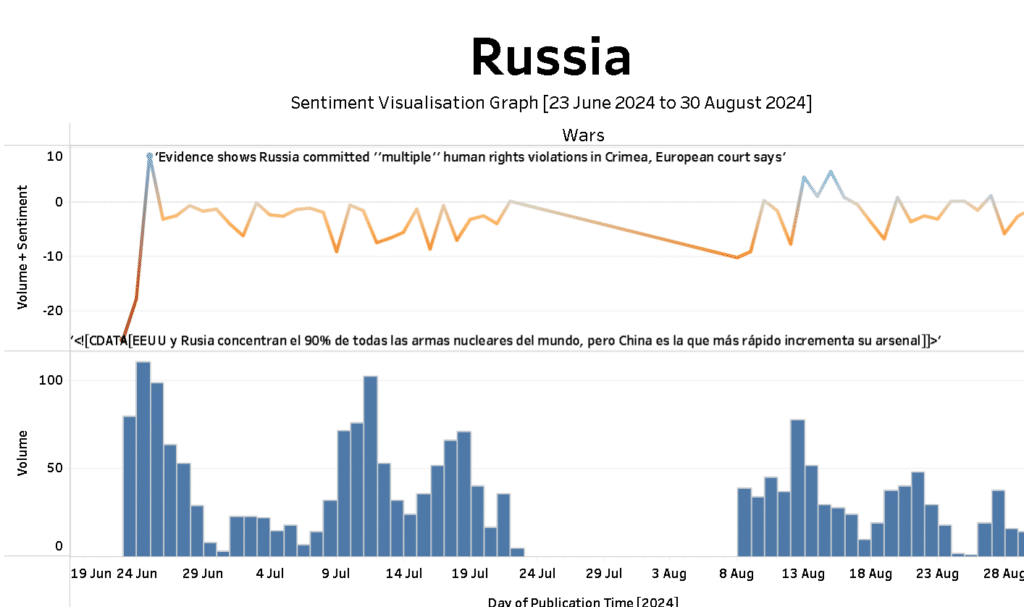
From June to August 2024, our sentiment analysis unsurprisingly revealed a negative view of Russia in news related to the war. This period was marked by big swings in sentiment due to major events related to military operations and human rights abuses.
Sentiment was markedly negative around Russia after a European court made a decision in late June. The court said Russia had broken a string of human rights laws in Crimea. This news further damaged Russia’s image in Europe and North America, where human rights violations is regarded as an extreme violation of justice.
Another major source of negative sentiment bubbled up in July, this time regarding discussions around Russia’s nuclear posture which caused global concern. Russia’s part in this story increased fears in Western countries that its military goals could upset global peace.
Our analysis reveals that military actions unsurprisingly shape Russia’s image worldwide as depicted in international media. News about Russia’s ongoing war with the Ukraine and claims of war crimes keep worldwide sentiment toward Russia’s involvement in conflict negative. This shows deep distrust and worry in Western free countries.
But remember, news about Russia always spikes when big military events happen and Russia’s moves will never fail to grab world news attention. This constant news focus keeps Russia in people’s minds globally, albeit for the wrong reasons.
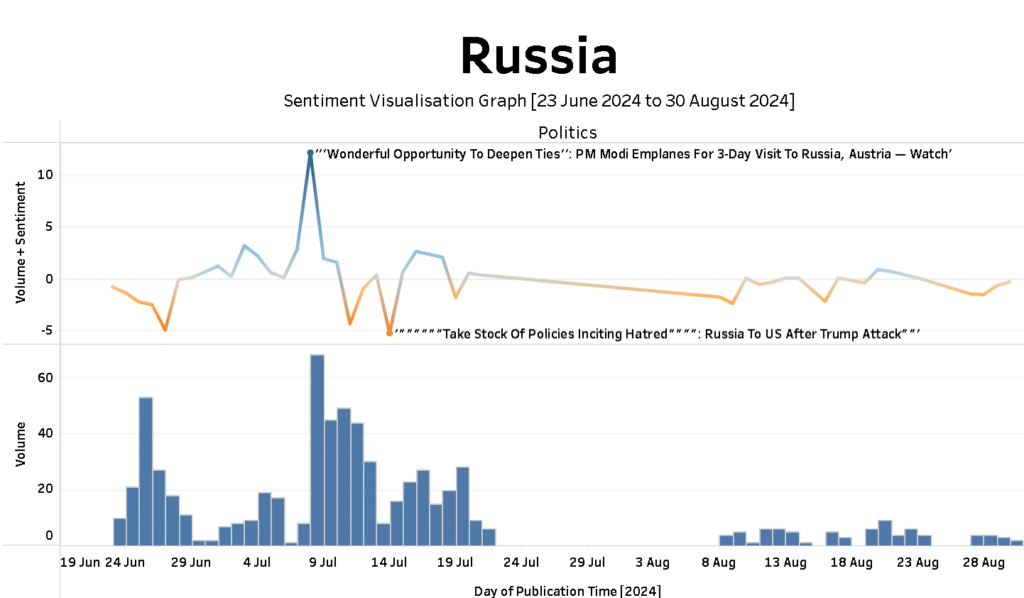
Russia’s standing on the world stage is tricky to say the least. It has rocky relationships with Western nations but has far more positive relations with non-Western countries like India and China. Our news sentiment analysis reveals the mood regarding Russia in relation to political news from June to August 2024.
At the start of July, sentiment reached its peak due to Indian Prime Minister Modi’s state visit to Russia and Austria. People saw this event as a “wonderful opportunity to deepen ties,” which highlighted how much Russia values its relationships with non-Western powers. India has kept a practical relationship with Russia, striking a balance between working together and considering wider geopolitical interests. The upbeat sentiment shows hope for diplomatic talks between Russia and countries outside the West.
In contrast to this diplomatic goodwill, the mood soured after Russia criticized U.S. policies. When Donald Trump attacked Russian policy, the Russian government fired back with harsh words. This caused a negative shift in public opinion. This incident shows how the ongoing political friction between Russia and the U.S. still shapes much of the global story, and ultimately, casts a dark cloud over Russia’s political image in Western media.
Russia’s political reputation divides opinion worldwide. Western countries view Russia negatively due to political clashes and sanctions that have damaged relationships. Yet, Russia has built good ties with non-Western powers like India and China, proving that not everyone sees the country in a bad light. These friendships give Russia other ways to boost its political power, even though its rocky relations with the U.S. and Europe often sway overall world opinion.
The world has long kept a close eye on Russia’s economy given international sanctions, changing energy prices, and its huge natural resource deposits. Even with these hurdles, Russia still plays a big role in global energy markets, and news about its economy often catches worldwide attention.
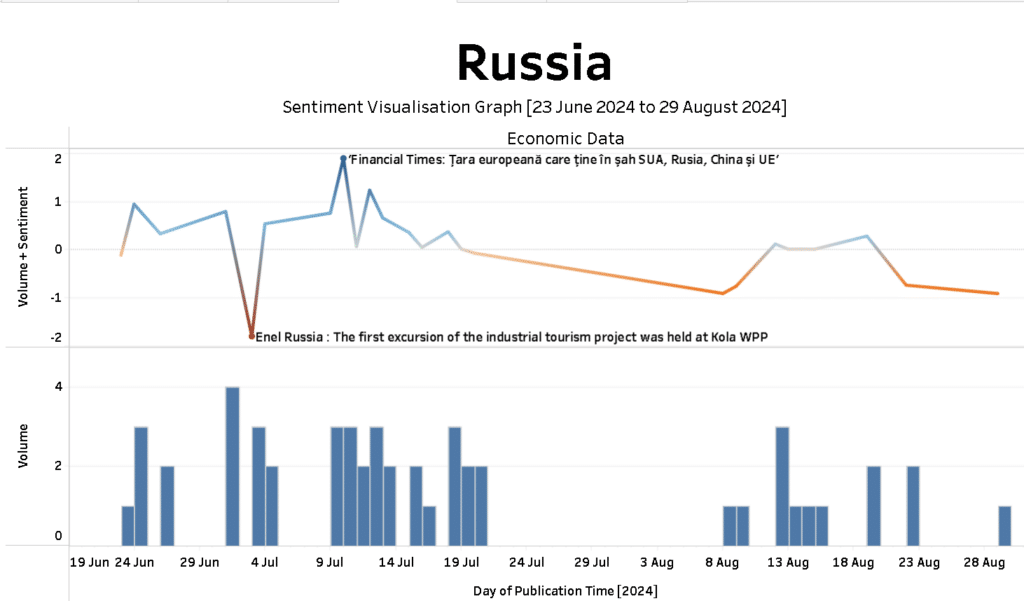
Our news sentiment analysis showed that global media views were steadier compared to war and political areas, with sentiment rising and falling in relation to specific events, but staying more balanced overall.
At the start of July, people positive was more sentiment after the Financial Times published an article about Serbia’s strategic role in international relations, influencing the United States, Russia, China, and the European Union. It examines how this country navigates geopolitical tensions, impacting the balance of power among these global players.
On the flip side, sentiment took a hit in late June after news broke about Russia’s Kola WPP (Wind Power Plant) industrial tourism project. The project might have sparked some interest, but the bigger picture includes worries about environmental and energy-related issues in Russia. These concerns echo the ongoing global discussion about Russia’s energy policies and how they affect sustainability and climate change.
The world’s view of Russia’s economy stays steady, with ups and downs tied to news stories. Even though its political and military moves often lead to bad press and negative sentiment, Russia’s key role in energy markets ensures it’s still a crucial player in world economics, despite being embroiled in political tensions and conflict.
Our news sentiment analysis shows a complex view of Russia worldwide. Russia’s military moves and political strains often lead to negative sentiment in Western news, but its economic power and friendly ties with non-Western countries paint a more detailed and surprisingly positive picture.
Of course, when it comes to war and military action, Russia is seen in a bad light, with news around the world pointing out human rights violations and concerns about nuclear weapons. In politics, Russia’s image goes fluctuates, gaining some diplomatic wins but also harsh criticism. In regards to economic matters, Russia keeps a steadier global image, thanks to its key role in energy, though it faces hurdles related to long-term growth and trade limits.
As with many complex geopolitical situations, the world’s view of Russia depends on the context — whether people see it through the lens of war, talks between countries, or economic matters. Each of these areas helps shape a bigger, ever-changing story about where Russia stands in the world right now.
Surely, then, it’s important to consider all these factors when analysing Russia’s global standing. The obvious point here is that Russia’s image is multifaceted and often contradictory. But also, we must remember that perceptions can shift rapidly in response to world events.
Separately, it’s inevitable that Russia’s actions on the world stage will continue to be scrutinised closely. In essence, the country’s global image is a reflection of its complex role in international affairs. Most importantly, understanding these perceptions is crucial for anyone engaged in global politics or business.
There are two questions that arise from this analysis: How can Russia improve its global image, particularly in the West? And how can other nations engage with Russia constructively while addressing concerns about its actions?
Take your strategic decision-making to the next level with our advanced economic and geopolitical datasets. Our in-depth, real-time analytics give you unmatched insights into worldwide market trends, political shifts, and news patterns. Our datasets use state-of-the-art AI tech to analyse sentiment in real-time, predicting economic factors, and assessing geopolitical risks in detail. Be at the forefront of data-driven strategy and get ahead in today’s fast-changing global scene. To see how our capabilities can help stay ahead, simply email us at enquiries@permutable.ai to set up a demo of our services tailored to your needs, or fill in the form below.
Looking for more global insights? Why not read our articles on:
How countries of Europe view each other’s economy according to GDP
How the UK’s economy is perceived in Europe
How France’s political situation is viewed
An analysis of sentiment around the UK property market recovery
An analysis of global perceptions towards the Germany economy