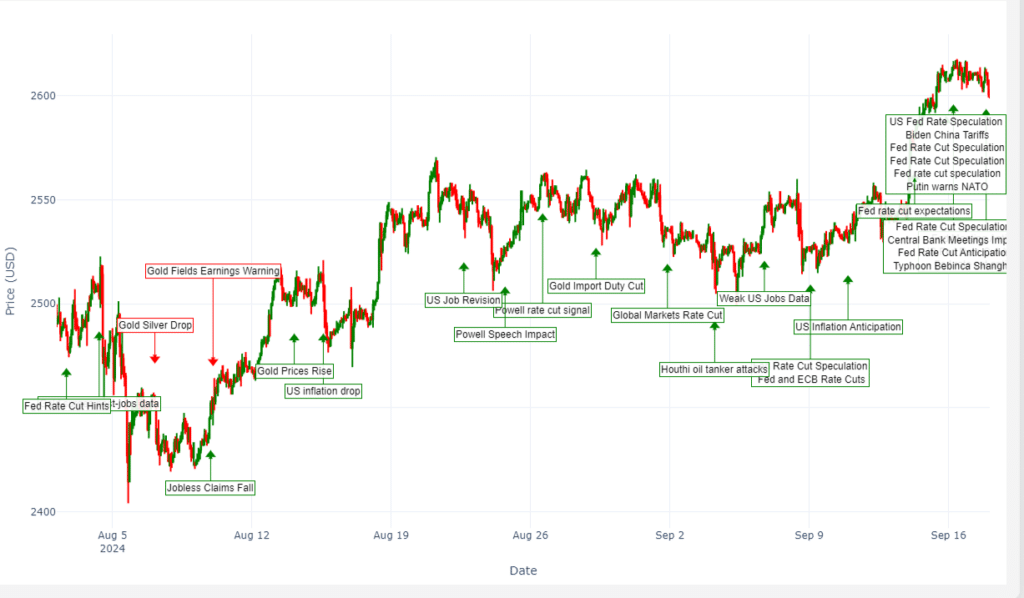
At Permutable AI, we’re constantly pushing the boundaries of what’s possible in trading technology. Today, we’re thrilled to announce a substantial upgrade to our Trading Co-Pilot platform, with a particular focus on enhanced AI market sentiment analysis capabilities that will transform how institutional traders navigate commodity markets. Our latest release introduces five key improvements designed to give traders the edge in today’s volatile markets. Most notably, our AI market sentiment analysis engine has been completely updated to deliver even more powerful insights into market movements.
The first thing users will notice is dramatically improved page loading times. In the fast-paced world of commodities trading, every minute counts, and our enhanced platform now delivers critical AI market sentiment analysis faster than ever before. But increased speed is just the beginning. The cornerstone of this update is our new signal heatmap feature (see visual above), which leverages our proprietary AI market sentiment analysis algorithms to visualise trends across multiple assets simultaneously.
This proves particularly valuable for identifying sector-wide momentum shifts, spotting divergences between correlated assets, and recognising early pattern formations before they become obvious. As a matter of fact, early users report that the combination of faster performance and comprehensive heatmap visualisation has significantly improved their ability to act decisively on emerging opportunities.
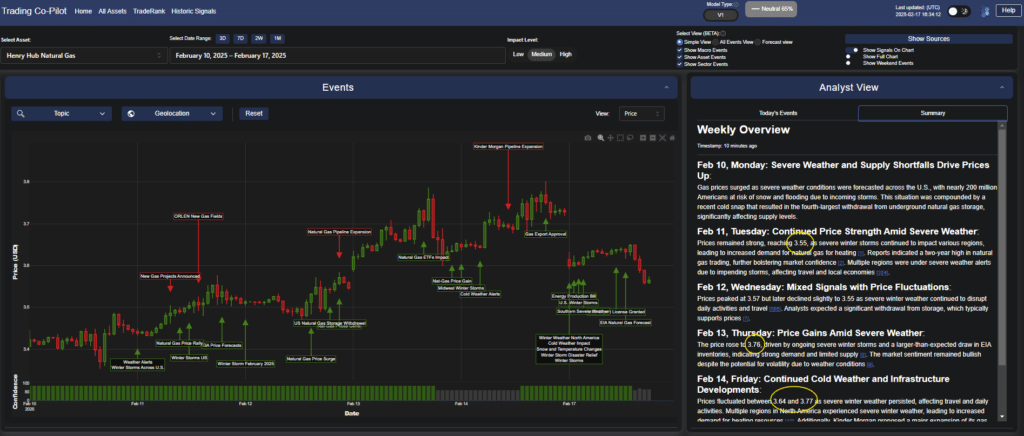
Another groundbreaking addition is our enhanced Analyst View feature. This powerful tool aggregates and interprets market events through our AI market sentiment analysis engine, enabling traders to compare market sentiment across different time frames, confirm emerging trends with relevant news updates, and anticipate regime shifts before they impact pricing. To add to this, all events are now contextualised with historical data, providing crucial perspective on how current market movements compare to previous patterns.
Above: Severe weather Henry Hub drivers
Speaking of historical perspective, we’ve introduced a powerful feature that displays the historical confidence levels of our AI market sentiment analysis model. This transparency allows traders to evaluate the historical accuracy of signals, identify market conditions where our AI market sentiment analysis excels, and make more informed decisions about position sizing based on signal strength. In essence, this feature adds a critical dimension to trading decisions by quantifying the certainty behind each recommendation.
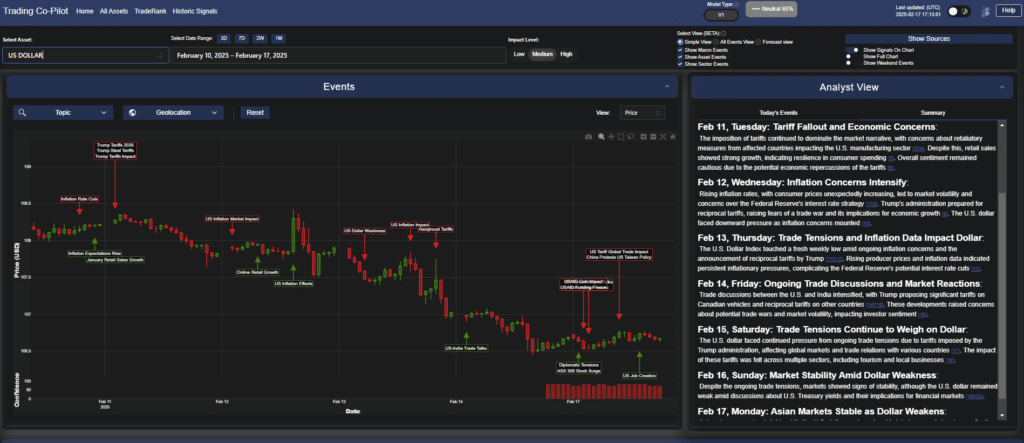
Last but certainly not least, our platform now delivers comprehensive macro sentiment views across major currencies and market segments. As part of our FX market intelligence roll out, our AI market sentiment analysis now extends to the US Dollar, Euro, British Pound, Japanese Yen, and numerous other instruments.
This holistic perspective enables commodity traders to better understand how currency movements and broader market dynamics might impact specific positions. Given the interconnected nature of global markets, this expansion of our AI market sentiment analysis capabilities represents a significant leap forward in comprehensive trading intelligence.
Above: Inflation and trade tension effecting US Dollar concern
These enhancements to our AI-powered trading insights represent an exciting step forward in our ambition to provide the most sophisticated AI market sentiment analysis tools in the industry. By combining faster performance, visual heatmaps, comprehensive analyst views, historical context, and global macro perspectives, we’re providing institutional commodity traders with an unprecedented advantage. The platform updates are available now. To experience these capabilities firsthand, schedule a demonstration with our team today by emailing enquiries@permutable.ai or filling in the form below.
FX It is perhaps fair to say that the start of 2025 has brought an unprecedented confluence of factors moving the GBP/USD FX rate. Looking back, the acceleration of UK wage growth to 5.5% has set the stage for what many hope will be the comeback year for British economic policy, and if that’s the case, there will of course be direct implications for the GBP/USD FX rate. In fact, this burgeoning trend will have left many watching anxiously for signs of how the Bank of England might respond to these inflationary pressures.
If we had to summarise the current view, pragmatism is needed more than ever. The GBP/USD FX rate’s sensitivity to central bank announcements has created some interesting trading dynamics to say the least. It remains to be seen what the Bank of England’s approach will be at their next base rate review in February and if this will achieve the desired stability in sterling markets that is so desperately needed (we say this wholeheartedly writing from our UK office). Well, like everything in FX markets, we’ll have to see how these potential outcomes play out.
There’s no doubt that political developments, particularly from across the Atlantic which we’ve all been playing out with Trump officially in office this week and, have become increasingly influential in driving the GBP/USD FX rate. Indeed so, the impact of the slew of Trump-related news has created distinct volatility windows in sterling trading. Whether this narrative holds through the year will be an interesting one to watch.
And let’s just say it’s pretty remarkable how these political events have synchronised with economic data releases to create some interesting market movements. In truth, this goes beyond simple cause and effect – it’s a reflection of the complex interplay between global political dynamics and currency valuations that we’re currently seeing play out.
All of this means that the current market environment and sentiment demands a sophisticated approach to risk management when it comes to FX trading. What our Trading Co-Pilot’s analysis shows is that there’s a clear clustering of high-impact events, and that it’s tools like this that equip traders with the market insights they need to anticipate and navigate these volatile periods which come with an overwhelming amount of market-moving event data.
As we head further on into 2025, we can expect more turbulence, particularly around key economic data releases and central bank communications. Then there is the noise from political quarters, where one could make the argument that traditional currency correlations might not hold as firmly as they once did.
Ultimately, the success of FX trading in this environment will depend largely on maintaining a balanced perspective while staying alert to rapid changes in market conditions. For traders equipped with the right tools and insights – cue our Trading Co-Pilot, these challenging conditions might actually present more opportunities than risks.
The key is understanding that volatility isn’t just noise – it’s information. And in this respect, our Trading Co-Pilot’s ability to map and analyse these complex interactions provides valuable context for making more informed trading decisions. As we progress through 2025, it will be this kind of systematic analysis that will become increasingly valuable for successful market navigation.
We’re excited to announce the launch of FX on our Trading Co-Pilot platform, and we’re looking for select enterprise users to help shape its evolution. Our Trading Co-Pilot has already proven its worth in energy and commodities, and now we’re bringing that same powerful analysis to FX markets. The platform’s unique ability to map complex market interactions and provide clear, actionable insights has already transformed how our users navigate market volatility.
We’re offering early adopters a unique opportunity to shape the future of FX market intelligence. As part of our select group of enterprise users, you’ll receive early access to our advanced FX market intelligence platform, direct influence on feature development, premium support with dedicated onboarding, and preferential early-adopter pricing. You’ll have a direct line to our development team and exclusive early access to future releases.
The launch of our FX capabilities comes at a key time. As we’ve seen in recent market movements, the interplay between political events, economic data, and central bank decisions has created unprecedented complexity in event-driven trading. Our platform uniquely maps these interactions, providing the clarity needed to make informed trading decisions in volatile markets.
To ensure we can provide the highest level of support and incorporate meaningful feedback, we’re selecting a small group of enterprise users to join this early access programme with only five spots available. This exclusive opportunity allows you to be at the forefront of FX market intelligence technology while helping shape its evolution.
Simply contact our team at enquiries@permutable.ai to find out more about our early access FX programme, or schedule a demo by filling in the form below.
The recent news story that “Trump lifts freeze on LNG export permits” is dominating headlines, and with it presents a shift in energy market dynamics that extends far beyond immediate price impacts. Using our Trading Co-Pilot, we take a look at how markets are responding to this development, revealing patterns in trading behaviour and market sentiment that we know that our readers will find interesting to say the least. Read on get out latest insights below.
The market’s reaction to Trump lifting the freeze on LNG export permits has been particularly noteworthy for its multifaceted nature. Our real-time event tracking shows multiple interconnected market movements, with sentiment indicators suggesting this could herald a fundamental shift in energy market dynamics rather than a temporary price adjustment. It is the complexity of these market movements highlights the importance of sophisticated analysis tools like our Trading Co-Pilot in understanding and anticipating market responses to major policy shifts.
The decision to lift the freeze on LNG export permits arrives at a crucial juncture in global energy markets. The result? A fascinating convergence of supply-side developments, including Exxon’s significant Mediterranean discovery and Talos’s promising findings in the Gulf of Mexico. When combined with Trump’s LNG export permit announcement, these events create a rich tapestry of supply-side factors that energy traders will be paying attention to. And it is the interplay between these various elements that suggests a potential restructuring of global gas supply chains that could persist well beyond the immediate market reaction.
Our Trading Co-Pilot‘s advanced tracking capabilities have identified substantial price movements correlating with this recent news. What’s particularly intriguing is how this development interacts with existing market pressures, including weather-driven demand fluctuations and storage level dynamics. It is our AI-driven platform‘s ability to isolate and analyse these correlations that provides valuable insights into the market’s processing of this significant policy shift, that perhaps might be harder for a human mind to piece together.
And then, let’s talk about Kinder Morgan’s ambitious $3 billion pipeline expansion proposal, which takes on enhanced significance against the backdrop as Trump lifts freeze on LNG export permits. According to our Trading Co-Pilot’s event analysis, this could represent the beginning of a broader infrastructure development cycle aimed at supporting increased export capacity. The timing and scale of such infrastructure investments could very well play a vital role in determining the long-term impact of the export permit decision.
Now let’s take a closer look at the interaction between Trump’s LNG export permit decision and broader market forces, which presents a fascinating study in market dynamics. Our AI-driven sentiment analysis reveals a nuanced picture of market impact across different temporal scales. In the immediate term, we’re observing strong directional movements as traders position themselves in response to the news. The medium-term outlook shows increased attention to infrastructure development plans, while long-term implications suggest potential structural changes in global gas trade patterns that could reshape market relationships for years to come.
As Trump lifts freeze on LNG exports permits, we will be watching as the aftermath continues to unfold. But our data analysis highlights several crucial trends that should be kept firmly in mind. First, infrastructure development is likely to accelerate as energy traders position themselves to capitalise on new export opportunities. Second, the price discovery process remains active as traders work to fully incorporate the implications of this policy shift into their strategies. And lastly – and perhaps most significantly – there’s the increasing integration between previously distinct regional gas markets, suggesting a transformation in global energy trade patterns.
For energy traders, navigating these evolving conditions will be keeping a watchful eye over several key areas. Needless to say, the importance of monitoring infrastructure development news has increased substantially, as these projects could significantly impact future supply chains. And then, there are the changes in regional price differentials which while potentially creating new trading opportunities may also introducing novel risks. Add to this that weather-related demand factors continue to play a crucial role, potentially amplified by increased export capacity. And last but not least, ongoing regulatory developments following the lifting of export permit freezes could further influence market dynamics, all making for a very interesting landscape going forward indeed.
In sum, our Trading Co-Pilot’s analysis suggests this could all serve as a catalyst for fundamental changes in global gas markets. While some uncertainty remains regarding longer-term implications, the data clearly points to increased market activity and emerging trading opportunities. As these market dynamics continue to evolve, we’ll continue to support our clients with the real-time data-driven insights they need to make better trading decisions and spot opportunities that the human eye alone might miss.
Experience how our Trading Co-Pilot LNG market intelligence feeds can transform your market analysis and trading decisions with real-time GenAI event tracking and sentiment analysis powered by AI agents. Our enterprise trial gives you full access to our market insights, showing you firsthand how market-moving events, sentiment analysis, and price movement correlations can enhance your trading strategy.
Our team will work closely with you to understand your specific needs, helping you to understand how our Trading Co-Pilot news intelligence feeds can be integrated seamlessly into your existing workflow. To get started with an enterprise trial (subject to approval), simply email us at enquiries@permutable.ai or complete the form below to schedule a personalised demo. We’re looking forward to showing you how Trading Co-Pilot data feeds can enhance your market intelligence capabilities.
As markets reopen today for the new year, many will be asking the question “is gold a good investment for 2025?“. Well, there was a time when investing in gold was straightforward – buy during uncertainty, sell during stability. However today, the landscape has fundamentally changed. It is a volatile market where prices are predicted by unpredictable and ever-moving forces, making traditional investment strategies increasingly complex. The questions around whether gold is a good investment have become more nuanced, and will be one to watch in terms of commodity trading trends for 2025.
The struggle to make sense of gold’s place in a modern portfolio has intensified as digital assets like crypto and new investment vehhttps://permutable.ai/why-is-the-price-of-gold-going-up/icles compete for safe-haven status. Ultimately, this evolution in thinking about whether gold is a good investment reflects broader changes in global financial markets. In this article, we’ll answer the questions is gold a good investment for 2025 with insights from our Trading Co-Pilot. So read on to find out whether the gold rally is set to continue.
First, we’re seeing unprecedented central bank buying that’s reshaping market fundamentals. The ambition here is clear: countries are diversifying away from traditional reserve currencies. This activity will include continued accumulation through 2025, with central banks already having purchased record amounts in recent years.
Second, retail investor interest has surged amid economic uncertainties. Together with institutional buying, this has created a robust support level for gold prices. As shown with recent market data, the correlation between economic uncertainty and gold’s appeal as a safe-haven asset remains strong, suggesting gold is a good investment for those seeking portfolio stability.
There isn’t any doubt about it: monetary policy decisions continue to influence gold prices significantly. As per our Trading Co-Pilot‘s analysis, the Federal Reserve’s stance on interest rates will remain a crucial driver through 2025. The consequence of potential rate cuts could provide substantial support for gold prices, as lower rates typically make gold a more attractive investment.
Either way, inflation concerns persist across major economies. It appears that once again, investors are turning to gold as an inflation hedge. The revelation that several major economies are struggling to meet their inflation targets provides additional support for considering whether gold is a good investment for wealth preservation.
And then there is the questions about the impact of global tensions on investment decisions. No more so than now, with multiple geopolitical hotspots creating market uncertainty. That is an echo of historical patterns where gold has traditionally performed well during periods of international tension.
And guess what, the complexity of current geopolitical relationships suggests these tensions won’t resolve quickly. This is nothing new in the gold market, but the interconnectedness of modern financial systems means that geopolitical events have more immediate and pronounced effects on whether gold is a good investment than ever before.
The risk for investors lies in timing their entry points, with technical indicators suggesting key support levels around $2,040. Which explains why professional traders are closely monitoring price action near these levels. Instead of relying solely on technical analysis, successful investors are increasingly incorporating multiple data points into their decision-making process.
Later, these technical levels may prove crucial in determining whether gold is a good investment for short-term traders. Despite recent volatility, the overall trend remains supportive, with higher lows establishing a robust price floor. Yet look at the volume patterns: they suggest institutional investors continue to accumulate during price dips.
The consequence of current market conditions suggests a balanced approach to gold investment. But the alleged risks of gold investment – such as its lack of yield – need to be weighed against its portfolio diversification benefits and historical role as a store of value.
From our point of view, gold’s trajectory in 2025 depends heavily on several key macroeconomic factors. Now that the fragility of traditional financial systems has been exposed through recent banking sector stresses, gold’s appeal as a safe-haven asset has strengthened. Little wonder that investment flows into gold-backed ETFs have remained steady.
Over and over again, market cycles have demonstrated gold’s resilience during periods of economic uncertainty. Given that historical performance patterns often rhyme, if not repeat, our analysis suggests maintaining some gold exposure could be prudent. But the alleged simplicity of gold investment decisions masks the complexity of timing and position sizing.
Despite short-term price fluctuations, the fundamental case for gold remains strong. It’s plain to see that economic uncertainties could persist through 2025, potentially supporting gold prices. However, investors should remember that position sizing and timing are the linchpin of any successful gold investment strategy.
Want to enhance your precious metals trading strategy with AI-driven insights? We’re offering qualified enterprise trading teams a complimentary one-month trial of our Trading Co-Pilot platform. Experience how leading trading houses are using our advanced AI analytics to identify opportunities and manage risk in the gold market. Our platform provides real-time market analysis, predictive insights, and comprehensive sentiment analysis specifically calibrated for precious metals trading.
Request your enterprise trial today by emailing enquiries@permutable.ai or filling in the form below. Available for qualified enterprise trading teams. Subject to approval.
DISCLAIMER
The information contained in this article is for informational purposes only and should not be considered as financial or investment advice. While the insights presented are derived from our Trading Co-Pilot platform’s analysis of market data, they represent a point-in-time assessment and should not be relied upon as the sole basis for any investment decisions. Markets are inherently risky, and past performance is not indicative of future results. The price of gold and other precious metals can be volatile and can be affected by numerous factors outside of our control.
Trading in precious metals carries significant risk, and you should carefully consider your investment objectives, level of experience, and risk appetite before making any investment decisions. We recommend consulting with qualified financial advisors who can provide guidance tailored to your specific circumstances. Permutable AI and its employees do not accept any liability for any loss or damage, including without limitation to, any loss of profit, which may arise directly or indirectly from use of or reliance on such information.
You would be hard-pressed to find a more intricate market situation than current natural gas markets signaling complex winter ahead. Let’s examine how our Trading Co-Pilot’s AI analysis of natural gas market news has uncovered several important patterns suggesting we are entering a new market interesting and potentially volatile phase in the natural gas market.
Some time ago, traditional analysis might have focused solely on temperature forecasts. Instead, our Trading Co-Pilot has detected a more nuanced picture. While mild autumn temperatures initially exerted downward pressure, Hurricane Rafael’s Category 3 impact on the Gulf Coast created unexpected supply disruptions. More broadly, when over 16% of US Gulf natural gas production remained offline, the market faced immediate supply constraints.
The aforementioned isn’t the only example of complex market forces at play. The problem is that Gulf disruptions are coinciding with infrastructure constraints. More to the point, with the reports of supply disruptions, this caused cascading effects across energy markets, with combined factors creating a supply squeeze that perhaps many traders hadn’t factored into their analyses.
For those looking for the answer to why it’s likely to be a complex Winter ahead for global natural gas markets, the answer to this can be found in recent developments in European natural gas markets. Few now believe that European energy dependence on Russian gas will return to previous levels. Indeed, from looking at the new EU energy commissioner’s commitment to eliminating Russian gas reliance, coupled with ADNOC’s new LNG supply deal with Germany, this means that new demand patterns are emerging.
Let’s examine what else our Trading Co-Pilot has highlighted. There is also the question of price action, which has shown recovery signs while remaining below key resistance levels. Meanwhile, the daily and weekly charts present mixed signals that require careful interpretation. Above all, though, what sets our Trading Co-Pilot’s analysis apart is the ability to synthesize these multiple factors simultaneously.
Sure, some people think that individual market factors can be analysed in isolation, but to us, this is a fool’s game. Case in point – Australia’s East coast facing a gas crisis and Nigeria reporting low funding for domestic gas projects, the global supply picture becomes increasingly complex. Talk about a perfect storm of factors converging.
Before we look ahead, we invite you to think back to previous market shifts. Not only do current conditions mirror historical patterns, but they also present unique characteristics that our Trading Co-Pilot has identified. Think of that in the context of approaching upcoming winter demands, geopolitical pressures, and the fact that 2024 is projected to be the hottest year on record. Some might say it’s hard to get a handle on how these factors might play out without comprehensive AI analysis.
In short, while traditional analysts might focus on individual factors, we believe it’s crucial to take a holistic view of market dynamics. Our Trading Co-Pilot suggests watching natural gas market news in real-time for specific trigger points that could shift market sentiment. The key problem is that traditional analysis often misses these longer-term structural shifts or delivers it too late, which is precisely where our real-time AI-powered analysis proves invaluable.
What you’ve just read is just a snapshot of our Trading Co-Pilot‘s analytical capabilities. Whilst others are still catching up on the headlines, our AI is already analysing the next market-moving signals in natural gas in real-time. In an environment where every minute counts, having real-time intelligence can make the difference between profitable trading decisions and missed opportunities.
Our Trading Co-Pilot delivers instant analysis of breaking news impact, clear buy/sell signals backed by AI, and an early warning system for market shifts. From technical breakdowns to weather pattern impact assessment and real-time supply-demand dynamics, our AI processes it all instantly, giving you a clear edge in these volatile markets.
We’re opening limited places for our next cohort of enterprise trial users. Join leading energy traders who are already using our AI to cut through market noise, spot opportunities early, manage risk effectively, and make truly data-driven decisions. This winter’s natural gas markets are signalling complexity ahead – don’t trade them blind – get in touch to request a 2-week free trial for qualified corporate traders by getting in touch with us at enquiries@permutable.ai or filling in the form below.
Gold has always been a barometer for the global economy, with investors traditionally turning to the precious metal during periods of uncertainty. The recent outlook for gold has been one of rising prices. But what actually is going on here? Everywhere you look, the question persists: why is the price of gold going up? And how long can this last? The truth is more complicated than a simple explanation, but through our analysis and insights from our Trading Co-Pilot, we can be reasonably confident that several key factors are contributing to this surge.
Above: Gold’s price movements: Data-driven insights from our Trading Co-Pilot
One of the most frequently cited reasons for gold’s price increase is inflation. We live in an age of highly volatile geopolitics, and the economic impact of post-pandemic recovery, supply chain disruptions, and increased government spending has fuelled inflationary pressures globally. As such, the crisis in rising inflation has seen central banks respond with aggressive monetary tightening measures, including interest rate hikes. And yet, perhaps, we can expect inflationary fears to persist for some time, given the unstable economic climate.
While core inflation numbers showed a slight decrease last week, many analysts argue that these figures can be misleading. The continued increase in government spending may be a more representative indicator of the economy’s health. This recent decrease in inflation has shifted market expectations from a 50 basis point rate cut to a more modest 25 point one. However, the underlying inflationary pressures remain a concern for many investors
Much of that is due to fears that monetary policies alone cannot temper inflation. The loss of trust in governments’ ability to manage economic volatility is driving more investors toward gold, a traditional hedge against inflation. In addition, the escalating costs of living are feeding into an ongoing uncertainty about the future. This method applies to both individual investors seeking a safe haven and institutional investors looking for stability.
You can’t argue with the fact that gold thrives in times of geopolitical unrest. This is especially true given that we live in a world of highly complex and rapidly changing global dynamics. The war in Ukraine, rising tensions in the South China Sea, and general instability across various regions all play a part in the price of gold. The hardest part is predicting how these events will unfold, but the truth is, gold provides a cushion for investors seeking refuge from volatile global markets.
As long as we rely on traditional safe havens like gold, we can expect its price to increase whenever there is uncertainty on the global stage. The present outlook for geopolitical stability is far from optimistic, which is likely to keep gold in demand for the foreseeable future.
Another key factor driving the price of gold is the decline in bond yields. With real yields (adjusted for inflation) either low or negative, investors are increasingly looking for alternative stores of value. Defining what is classed as a “good” return has shifted over the past few years, especially as central banks have kept interest rates low for an extended period. This dynamic puts gold in an attractive position since it does not pay interest or dividends, but offers long-term value preservation, making it a more appealing investment compared to bonds.
In a way, this shift reflects broader market concerns about the ability of traditional investments to deliver the kinds of returns seen in the past. The keys to gold’s appeal lie in its historical track record of retaining value, especially when other asset classes underperform.
So why is gold coming up? The next question you should be asking is what about the US dollar? Gold and the US dollar typically have an inverse relationship. When the dollar weakens, gold prices tend to rise, and vice versa. Recently, the dollar has experienced bouts of weakness due to various factors, including trade deficits and changes in monetary policy.
Recent central bank decisions have further influenced the dollar’s strength and, consequently, gold prices. The European Central Bank’s recent rate cut, coupled with the anticipated Federal Reserve rate decision, have been key factors in shaping market expectations. These expectations have been building since Federal Reserve Chairman Jerome Powell’s speech in late August, signaling a potential shift in monetary policy. Such changes in interest rate policies often lead to fluctuations in currency strengths, impacting gold prices. As the US dollar potentially weakens in response to these rate cuts, we may see a corresponding rise in gold prices
Despite this, there are things that can be done to stabilise the dollar in the long run. However, the game changer will be how investors react to continued fluctuations in global currencies. Just as notably, gold serves as an alternative when confidence in fiat currencies, like the US dollar, wanes. We must therefore be ready to reject the argument being made that gold’s rise is merely temporary—it is tied to structural concerns about global currency values.
If experience tells us anything, it’s that gold has always been viewed as a safe haven during times of economic turmoil. The present moment is no different. Increasingly, investors are turning to gold as a hedge against stock market volatility, political uncertainty, and inflationary pressures. In addition, economic instability caused by high debt levels, especially in developing countries, further supports gold’s ascent.
The keys to understanding gold’s current trajectory, therefore, is looking at both short-term market forces and long-term systemic challenges in the global economy. Ultimately, what is needed is a comprehensive view of how these elements converge to shape the price of gold.
Another often-overlooked factor to consider when mulling over the question “Why is the price of gold going up” is the supply and demand for gold itself. Imagine too the impact of reduced mining outputs or increased demand from countries like China and India. For the avoidance of doubt, gold is still viewed as a tangible store of wealth in many cultures, which supports long-term demand. While central banks across the globe continue to increase their gold reserves, retail investors and sovereign wealth funds alike are also adding gold to their portfolios.
As we move towards the end of 2025, the drivers behind gold’s price trajectory have shifted but remain anchored in the same structural themes of inflation, geopolitics, and currency volatility.
The conflicts in Ukraine, the Middle East, and across parts of Africa continue to inject uncertainty into global markets. Our Political Tension Index shows sustained high readings, with sentiment spikes closely correlated to upward moves in gold. Gold’s safe-haven role remains firmly intact, with each escalation reinforcing investor demand.
2025 has seen central banks, particularly in Asia and the Middle East, accelerate gold reserve accumulation as a hedge against dollar exposure. This institutional demand provides an additional layer of support for prices beyond speculative trading flows.
While headline inflation has eased, core measures remain elevated. Investors are increasingly sceptical that rate adjustments alone will restore price stability, fuelling continued gold buying as a hedge against systemic risk.
Our sentiment analysis shows that narratives around “currency debasement” and “rate divergence” are gaining traction, particularly following policy shifts by the Federal Reserve and European Central Bank. This has reinforced gold’s inverse correlation with the dollar, driving rallies whenever the greenback weakens.
Overall, the long-term trajectory of gold remains upwardly supported, underpinned by macro uncertainty and structural demand from central banks. Our intelligence confirms that gold remains not only a hedge but also a strategic asset class in 2025 portfolios.
Are you ready to be part of the future of trading? At Permutable AI, we’re extending an exclusive opportunity to a select group of corporate partners to gain access to our advanced Trading Co-Pilot, powered by cutting-edge machine learning for contextual understanding.
If your firm is ready to lead the way in AI-driven trading innovation, get in touch today to explore this limited opportunity and discover how our Trading Co-Pilot can transform your approach to the market by contacting us at enquiries@permutable.ai or fill in the form below.
A: Gold prices are rising due to persistent inflation concerns, geopolitical uncertainty in regions such as Ukraine and the Middle East, declining bond yields, and recent weakness in the US dollar. These combined forces are reinforcing gold’s role as a safe-haven asset.
A: Wars and political instability often drive investors toward gold as a hedge against volatility. For instance, ongoing conflicts and sanctions risk have created spikes in gold demand as investors look for protection from uncertainty in global markets.
A: Yes. Gold has historically acted as a hedge against inflation, and in today’s environment of rising government spending and persistent cost-of-living pressures, investors continue to view gold as a reliable store of value.
A: Gold typically has an inverse relationship with the US dollar. As the dollar weakens due to trade deficits or central bank policy shifts, gold becomes more attractive, pushing its price higher.
A: Gold prices are likely to fluctuate in the short term, but structural drivers such as inflationary pressures, ongoing geopolitical risks, and strong central bank demand suggest that long-term momentum remains supportive.
Gold retains value when markets are volatile, making it a preferred hedge during inflation, geopolitical tensions, or economic instability.
Key drivers include inflation rates, bond yields, currency strength (particularly the US dollar), central bank policy, and geopolitical events.
Global gold supply constraints, such as reduced mining outputs, and rising demand from countries like China and India add upward pressure on prices.
While short-term pullbacks are possible, structural drivers — from inflation to geopolitical risks — point to continued strength in gold prices through 2025.
Permutable’s Trading Co-Pilot uses real-time sentiment analysis to map news flows, inflation data, and geopolitical signals directly into trading scenarios, helping clients anticipate shifts in gold prices before markets react.