
How to choose a commodity intelligence provider: A guide for institutional investors
01 Dec 2025
01 Dec 2025
This article explains how to choose a commodity intelligence provider with rigour, transparency and practical integration in mind. It’s written for a wide business and institutional audience including commodities traders, portfolio managers, quants, strategists and risk teams who need to understand narrative momentum, validate signals and operationalise them confidently across commodity markets. First published: 1 December 2025. Last updated: July 2026
A commodity intelligence provider should help institutional teams understand not only where commodity prices are moving, but why they are moving and what may affect them next. The strongest providers combine reliable market data, broad source coverage, commodity-specific signal construction, real-time alerts, point-in-time history, explainability and workflow-ready delivery through API, dashboards or data feeds. For trading, research and risk teams, the right provider should turn global information flow into structured, auditable signals across energy, metals and agriculture.
The question of how to choose a commodity intelligence provider has moved from a qualitative debate to a strategic imperative. Commodity markets are structurally reflexive, increasingly narrative-driven, and influenced as much by expectation dynamics as by underlying fundamentals. For businesses and institutions looking to integrate sentiment analytics, macro signals, or adaptive AI into trading, hedging, risk monitoring or strategic planning, the selection framework must evolve accordingly. Intelligence systems today have to describe not just what has moved, but why, how persistently, and how the broader market is interpreting change.
At the centre of this transformation is the need for clarity in a world saturated with unstructured information. Every minute, thousands of headlines, supply-chain updates and macro drivers influence the curve. For businesses exploring how to choose a commodity intelligence provider, the goal is no longer to aggregate data, but to interpret it, cluster it, validate it and deploy it in decision windows that match live market workflows. As AI collapses information silos, the most competitive institutions seek intelligence that is explainable, adaptive and production-proven.
| Evaluation area | What to ask |
|---|---|
| Market coverage | Does the provider cover the commodities, regions and themes that matter to your book? |
| Source breadth | Does it monitor global, local-language, regulatory, logistics and market commentary sources? |
| Signal granularity | Can it distinguish between crude, gas, metals, agriculture and cross-asset macro drivers? |
| Explainability | Can every signal be traced back to source, timestamp, cluster and driver? |
| Point-in-time history | Can the data be backtested without look-ahead bias? |
| Integration | Is the data available through API, dashboard, Excel or data feeds? |
| Workflow fit | Does it support trading, research, risk, procurement or systematic workflows? |
| Validation | Can the provider show live or historical evidence of signal behaviour? |
| Support and onboarding | Can the team help translate intelligence into production workflows? |
To understand how to choose a commodity intelligence provider, a modern user must look for evidence of deep domain expertise in how markets actually behave. Providers should demonstrate not only that they marry AI with capital-markets experience, but also that their systems deliver insight that has been validated in production, not just in theory. Trust comes from systems that are transparent, auditable and traceable to raw source at every step of the signal chain. Institutions should never have to guess where a score came from or when it changed. Timestamping, version control and signal lineage are core requirements for confidence-driven decision infrastructure.
A key but often overlooked dimension of how to choose a commodity intelligence provider is understanding how article volume behaves as a signal itself. In commodities, clustering is often preceded by attention spikes, not just sentiment spikes. If an intelligence provider cannot de-duplicate global article volume effectively, identify thematic clusters, measure narrative velocity or normalise for noise, desks end up trading volatility of coverage, not volatility of conviction.
At Permutable, our market intelligence engine treats article volume build-up and clustering as a key red flag, because historical analysis shows that simultaneous increases in high-frequency narratives often lead to rapid repricing in commodity curves. A high authority commodity intelligence provider should be able to manage the signal stack so that clustering strengthens insight, rather than corrupts it.
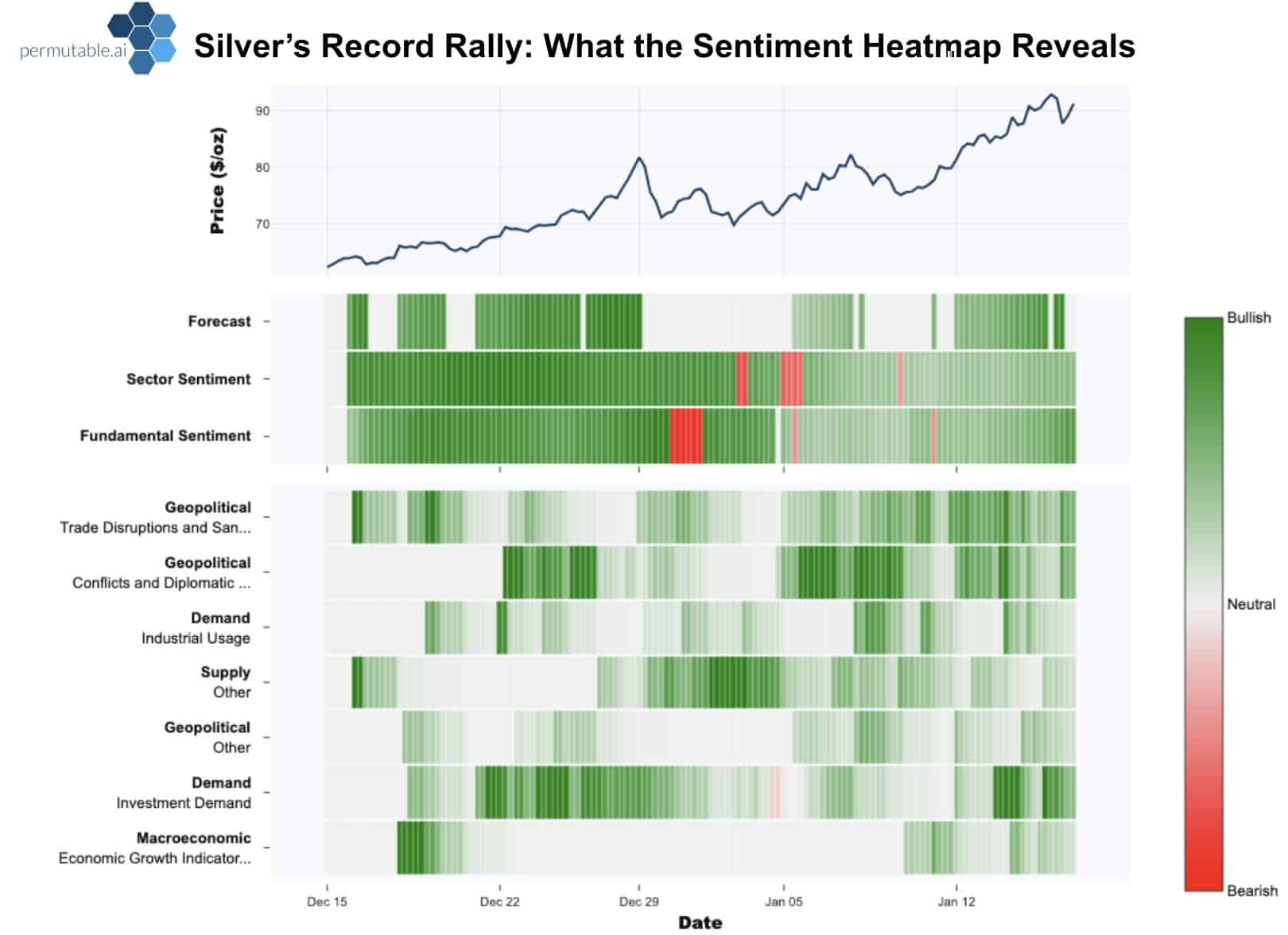
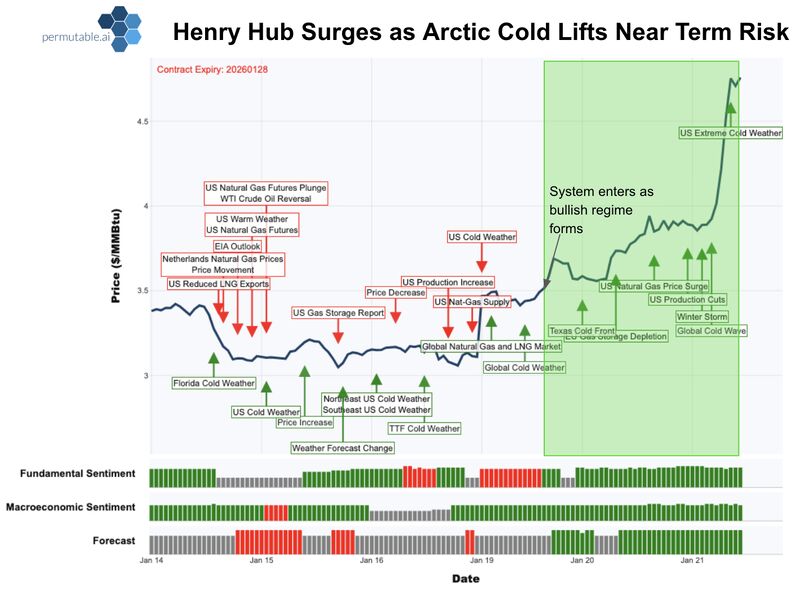
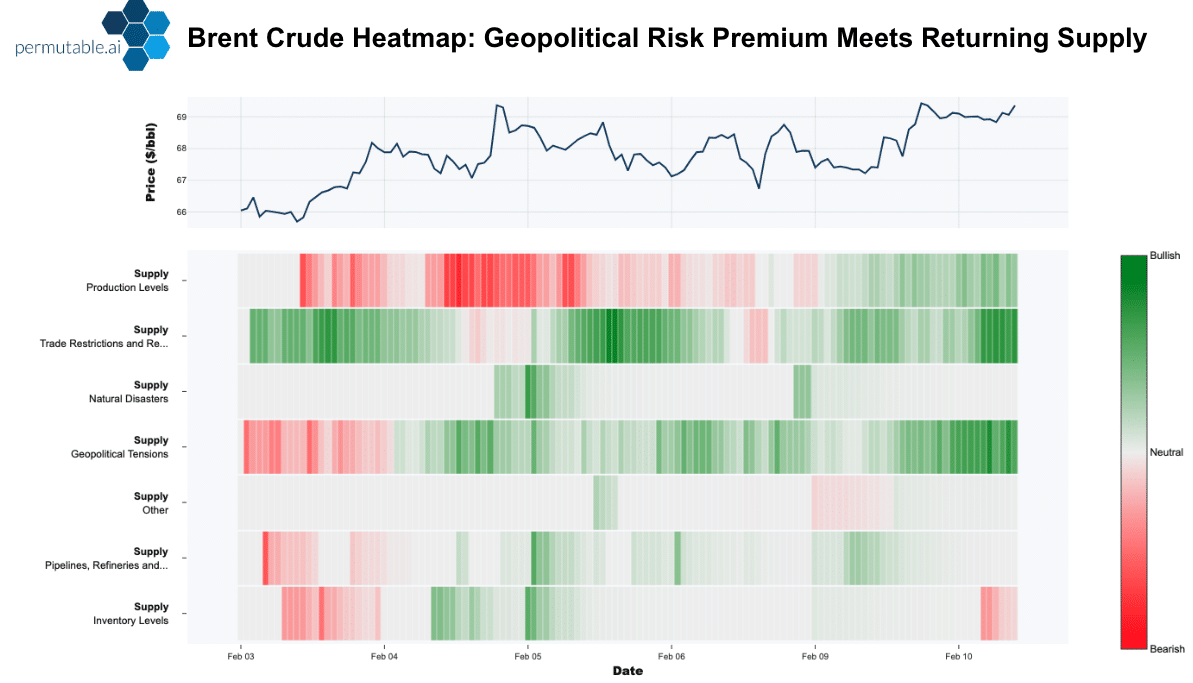
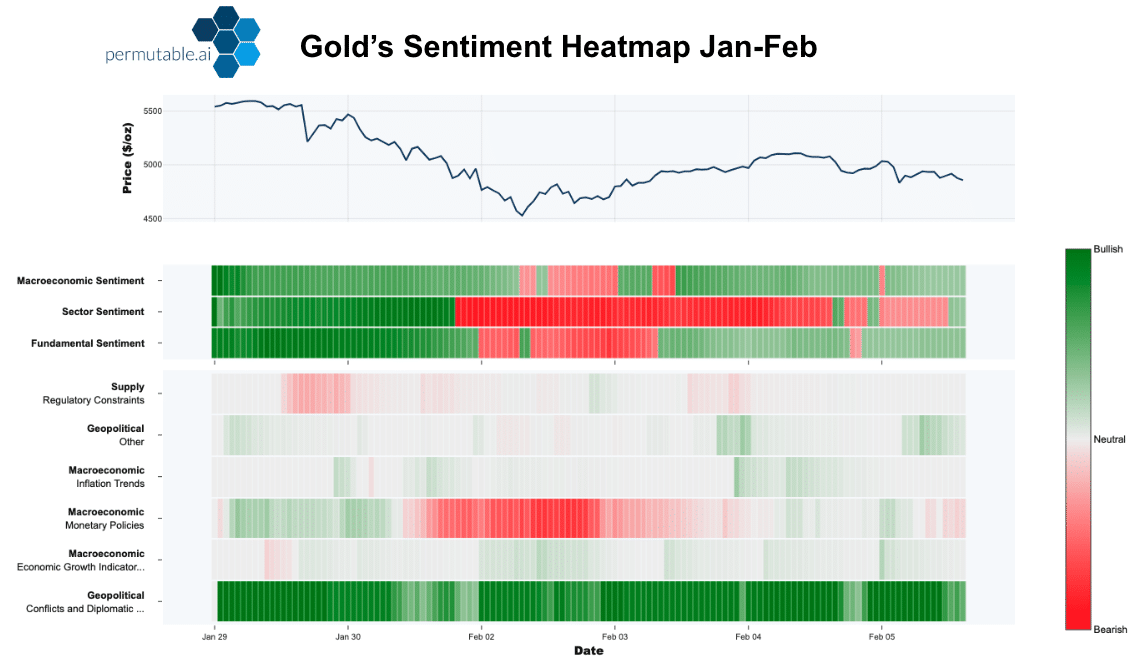
At Permutable, commodity intelligence is built as a real-time signal layer for trading, research and risk workflows. The platform monitors global information flows across energy, metals, agriculture, macroeconomic data, policy signals, geopolitical risk, logistics, weather and market commentary.
Rather than simply aggregating headlines, Permutable clusters related narratives, scores asset-specific sentiment, tracks changes in narrative velocity and maps signals back to the underlying source material. This allows institutional teams to see not only what happened, but which expectations are changing, how persistent those changes are and where the signal may matter across commodity curves, cross-asset exposures and portfolio risk.
This type of intelligence is most useful when used alongside benchmark prices, fundamentals and market data. It does not replace human judgement or core market data infrastructure; it helps teams prioritise what matters, validate signals and operationalise market intelligence through dashboards, APIs and data feeds.
| Buyer type | What they should prioritise |
|---|---|
| Discretionary traders | Real-time alerts, narrative shifts, market-moving events and source traceability |
| Systematic funds | Point-in-time history, clean time series, API delivery and backtestable signals |
| Risk teams | Early warning indicators, volatility clustering, geopolitical risk and explainable alerts |
| Macro strategists | Cross-asset links between commodities, inflation, FX, rates and policy |
| Procurement teams | Price pressure, supplier risk, logistics disruption and cost inflation signals |
| Energy desks | Crude, refined products, gas, LNG, OPEC, sanctions and refinery intelligence |
| Metals desks | Supply concentration, China demand, inventory signals and industrial activity |
| Agriculture teams | Weather, crop conditions, export flows, tenders and food price pressure |
When choosing a commodity market intelligence provider, the goal isn’t just “more data,” but better understanding of data in context. Here’s a strategic lens aligned to how we build and apply market sentiment and intelligence at scale:
Commodity markets shift on different clocks. Prompt traders live in seconds to hours, risk managers live in days, macro allocators live in weeks to quarters. An intelligence provider should deliver stability, inflection detection, and signal cadence that matches your actual trading or hedging horizon. Providers that specialise matter more than providers that generalise.
A high authority commodity intelligence system needs to monitor a diverse global footprint, not just the noisiest feeds. The best providers cluster signals from cross-border energy commentary, logistics updates, regulatory filings, and on-the-ground local news so that narrative pressure is measured before price moves. Without multi-source breadth, desks become consensus followers, not expectation leaders.
A single article can impact multiple commodities differently. Choose a provider capable of scoring asset-specific and topic-specific tone within the same content stream. Multi-entity reasoning prevents false correlations, supports curve trades, and enables hedging precision when signals split across crude, gas, grain or metals. One-score sentiment systems flatten nuance, while commodity-aware scoring surfaces asymmetry.
True real time intelligence isn’t a black box. For commodity traders, every directional signal needs lineage – mapped to its headline cluster, timestamp, and thematic driver for compliance, model validation, or discretionary conviction. Auditability and traceability should be core design principles, not add-ons.
Sentiment is a measurable feature. Select a provider whose signals have proven to lead price in commodities during supply shocks, sanctions, weather risk, and policy drift. Validate that tone inflects ahead of the curve, not after it.
Institutional adoption at scale requires seamless integration into existing workflows. Select providers offering API-first intelligence, alert-based or terminal delivery without high switching costs, long onboarding, or rigid schema. Commodity intelligence systems should plug into research, hedging, risk alerts or systematic models without dislocation.
Commodities are regime markets. Choose a provider that can capture durable narrative momentum and separate structural from episodic drivers. Good intelligence shifts exposure dynamically when geopolitical tone or demand conviction changes, then normalises when clustering fades. This responsiveness preserves Sharpe, reduces drawdown, and keeps models out-of-sample.
Not “Can this system describe what happened?”
But: “Can this system tell me what’s changing in expectations, why it’s changing, and how persistently, before markets fully reprice?”
Across these dimensions, at Permutable, we offer a clear answer to how to choose a commodity intelligence provider because we build this framework into everything we deliver: high-frequency ingestion, self-evaluating model components, multi-agent reasoning layers, and source-linked intelligence delivered directly into trading and risk workflows. We believe that real-time intelligence should feel like a co-located research team, but behave like a systematic model – numerical, backtestable and live-deployable.
Advanced commodity intelligence systems aren’t static. They have to reason, test, fail, learn, update and redeploy without service breakage. At Permutable, our architecture automatically replaces LLM components, re-weights reasoning engines, self-tunes prompts and improves signal behaviour out of sample without removing source trace chains. This is one of the biggest competitive requirements for commodity intelligence providers, especially in an environment where regulation increasingly demands explainability for every signal generated or hedge deployed.
9 things you should consider strategically when choosing a commodity intelligence provider throughout your process:
Not “how much noise?” but “how much narrative bite?”
Not “speed or fundamentals?” but “speed and context above consensus”
Not “any score?” but “asset-specific scores with lineage”
Not “simulation?” but “production-proven under capital-at-risk”
Not “English-only?” but “global + local language ingestion”
Not “raw data?” but “research-ready factors through API?”
Not “retrospective?” but “predictive inflection before price”
Not “discrete?” but “continuous, version-controlled, self-improving”
| Data layer | Examples | Main role |
|---|---|---|
| Exchange prices | CME, ICE, LME | Tradable prices, futures curves and market structure |
| Price assessments | S&P Global Commodity Insights, Argus | Benchmarks and physical market reference prices |
| Fundamentals | CRU, Rystad, Energy Aspects, Expana, Mintec | Supply, demand, inventories, costs and balances |
| Flow and logistics data | Kpler, Vortexa, shipping and freight datasets | Cargo movement, routes, storage and trade flows |
| Narrative and sentiment intelligence | Permutable | Market-moving narratives, sentiment shifts, risk signals and cross-asset interpretation |
| Workflow delivery | APIs, dashboards, Excel, alerts and data feeds | How intelligence reaches trading, research and risk teams |
The unique advantage Permutable brings to our clients at institutional desks and wider business teams sits in our engineering DNA: we were founded after recognising the vast scale of opportunity for AI to redefine market intelligence. Our vision is to build the world’s most powerful real-time AI world model for global markets. Our proprietary multi-LLM architecture and reasoning agents convert billions of data points into expert-level intelligence delivered in real time, fully sourced and traceable.
| Red flag | Why it matters |
|---|---|
| High article volume but weak structure | More content does not mean better intelligence |
| One generic sentiment score | Commodity markets need asset-specific and driver-specific signals |
| No source lineage | Institutional teams need auditability and trust |
| No point-in-time history | Signals cannot be properly backtested |
| English-only coverage | Local-language sources often move first in commodity markets |
| Manual tagging required | Adds operational friction and reduces scalability |
| No integration path | The intelligence may not reach the actual workflow |
| No evidence from live markets | Demos are not the same as production validation |
| No distinction between news and signal | Teams may receive alerts without decision value |
Ultimately, the answer to how to choose a commodity intelligence provider is this: choose one built by practitioners who trade the markets themselves, understand how narrative bite moves the curve, and treat explainability as a core design principle, not a luxury.
If you are evaluating commodity intelligence providers, Permutable can show how real-time narrative, sentiment and event signals behave across your markets of interest. Request a focused walkthrough across crude oil, natural gas, LNG, metals or agriculture, including examples of source-linked signals, API delivery and workflow integration.
Request a personalised demo or trial of our commodity intelligence feeds by emailing enquiries@permutable.ai and our team will help you explore the fit for your workflows.
Commodity news monitoring helps teams follow headlines and market updates. Commodity intelligence goes further by structuring that information into signals that can be analysed, tested and used in decisions. A commodity intelligence provider should identify relevant events, cluster related narratives, score asset-specific sentiment, track changes in narrative velocity and map each signal back to its source. This makes the information more useful for trading, research, risk management and systematic workflows.
Not inherently. The key is choosing a system that measures narrative regimes, not headlines one-by-one. Our own data feeds show that article volume surges and narrative clustering form structured patterns that meaningfully precede price shifts in crude, gas and industrial metals. A robust commodity provider should provide smoothing, entity-level scoring and source-traceability so traders can distinguish signal from chatter, not get lost in it.
Because fundamentals answer what moved, sentiment answers what moved first. Commodity markets price expectations, policy shockwaves and supply-chain risks before scheduled reports print. The right commodity intelligence provider enriches fundamentals by capturing narrative pressure build-ups that reveal shifting consensus before price or curve positioning breaks.
Ask if it behaves like a traditional time series, updates continuously, carries deterministic timestamps and maps insight back to source. A true commodity intelligence provider will enable testing inside your analytics stack without manual tagging, cleansing or reconstruction work. Template fit is more important than vendor size.
Yes – provided it captures sentiment volatility, not sentiment direction alone. Narrative shocks compress timelines for risk teams, especially in crude logistics, LNG flows, metals supply and agricultural tender windows. The best fit systematic commodity providers trigger alerts when narrative clusters spike across actors, regions and commodities simultaneously, allowing hedges to be placed before options skew or spreads adjust.
Then prioritise a system that does the heavy lifting for you. When evaluating how to choose a commodity intelligence provider, look for transparency, integration support, data lineage and self-calibrating models. The value now lies in understanding how markets interpret commodity psychology faster than your competitors, not in ingesting more raw files.
Volume without structure. If you get 10k headlines and 300 analyst hours later you still can’t explain the move, you’ve chosen the wrong commodity intelligence provider. The real edge comes from systems that detect sentiment clusters forming across energy, sanctions, supply nodes, weather catalysts and tender cycles, surfacing the theme while it still provides optionality – not after prices move.
Guide
07 Oct 2026
Commodity signal evaluation: from information flow to portfolio evidence
Read more >
Guide
14 Aug 2026
Measuring narrative momentum across global markets: A guide for institutional investors
Read more >
Analysis
27 Jul 2026
Saudi supply risk and import costs drive energy inflation sentiment higher
Read more >