UK Budget 2026: Breathing space, at a price
29 Oct 2026
29 Oct 2026
The UK budget for 2026 takes part of the energy shock off household bills. Our Global Macro Sentiment Indices alongside the macro indicators show what that relief costs: the most restrictive fiscal framing since 2022, and borrowing costs that have done the tightening the Bank of England has not.
The UK budget promised breathing space, and on energy bills it delivers some. Electricity VAT relief now runs to July 2027, the 5p fuel-duty cut is extended and a £100 payment will reach up to 20 million households in England. The fiscal room to fund it has narrowed. Higher debt interest has taken £12bn out of the government’s fiscal buffer since March, and the 2-year gilt yield has risen by 144bp since the Middle East conflict began.
Our Global Macro Sentiment Indices show how those pressures built up between official releases. Each index tracks the direction of coverage on one economic topic and compares it with that topic’s own history, as a z-score: the number of standard deviations (σ) above or below its two-year norm.
Each topic keeps its own rule, so a negative fiscal-stance reading means coverage describing a tighter stance, while a positive energy reading means rising price pressure.
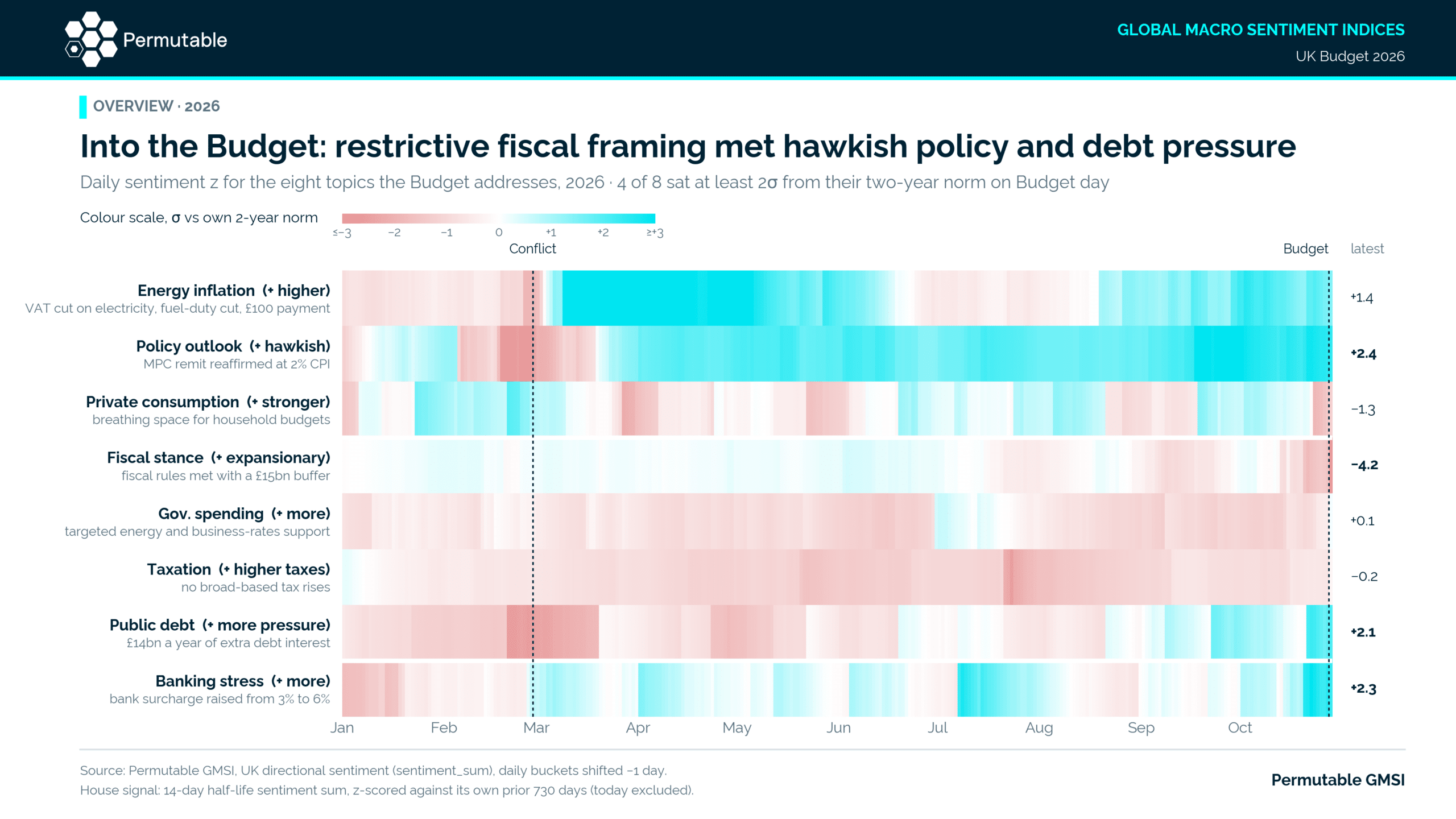
Four of the eight topics the Budget addresses were at least 2σ from their norm on the day. Fiscal stance sat on the restrictive side at −4.2σ, while policy outlook (+2.4σ), public debt (+2.1σ) and banking stress (+2.3σ) all signalled greater pressure. Energy inflation, at +1.4σ, was still above its norm seven months after the first surge.
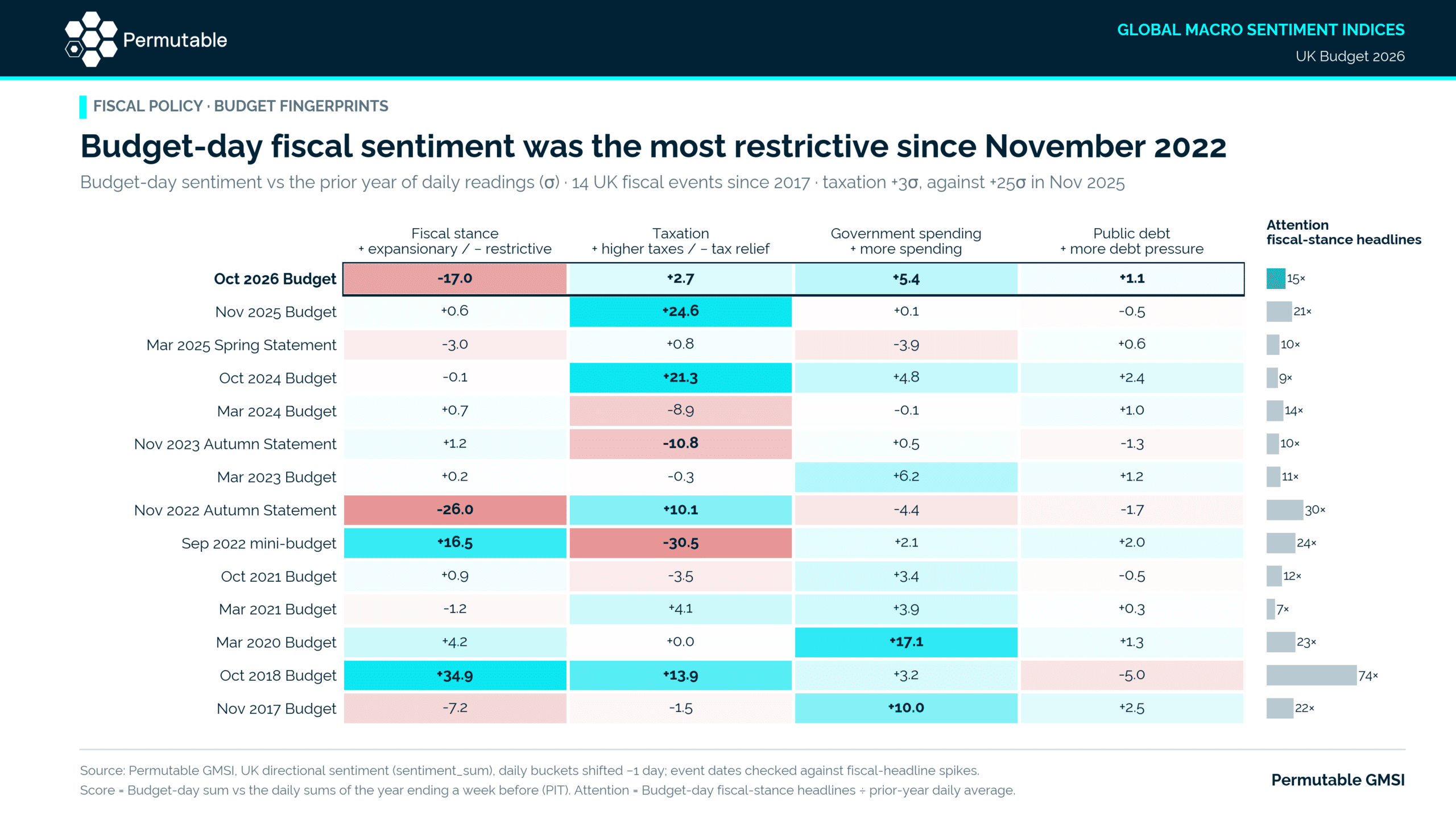
No UK fiscal event since the November 2022 Autumn Statement, when the government was repairing the damage from the mini-budget, has drawn coverage this restrictive. On Budget day fiscal-stance sentiment scored −17σ against the previous year’s daily readings, a single-day score and so larger in scale than the rolling readings above. Taxation sentiment scored only +3σ, against +21σ and +25σ at the previous two autumn Budgets, both of which argued around tax rises. Spending government sentiment scored +5σ, consistent with targeted support inside a tight overall stance.
The costings are less restrictive than the framing. Policy decisions add £6.3bn to borrowing in 2026-27 and £7.0bn in 2027-28 against previous plans, with the savings arriving later. The restraint sits in the argument and in the outer years.
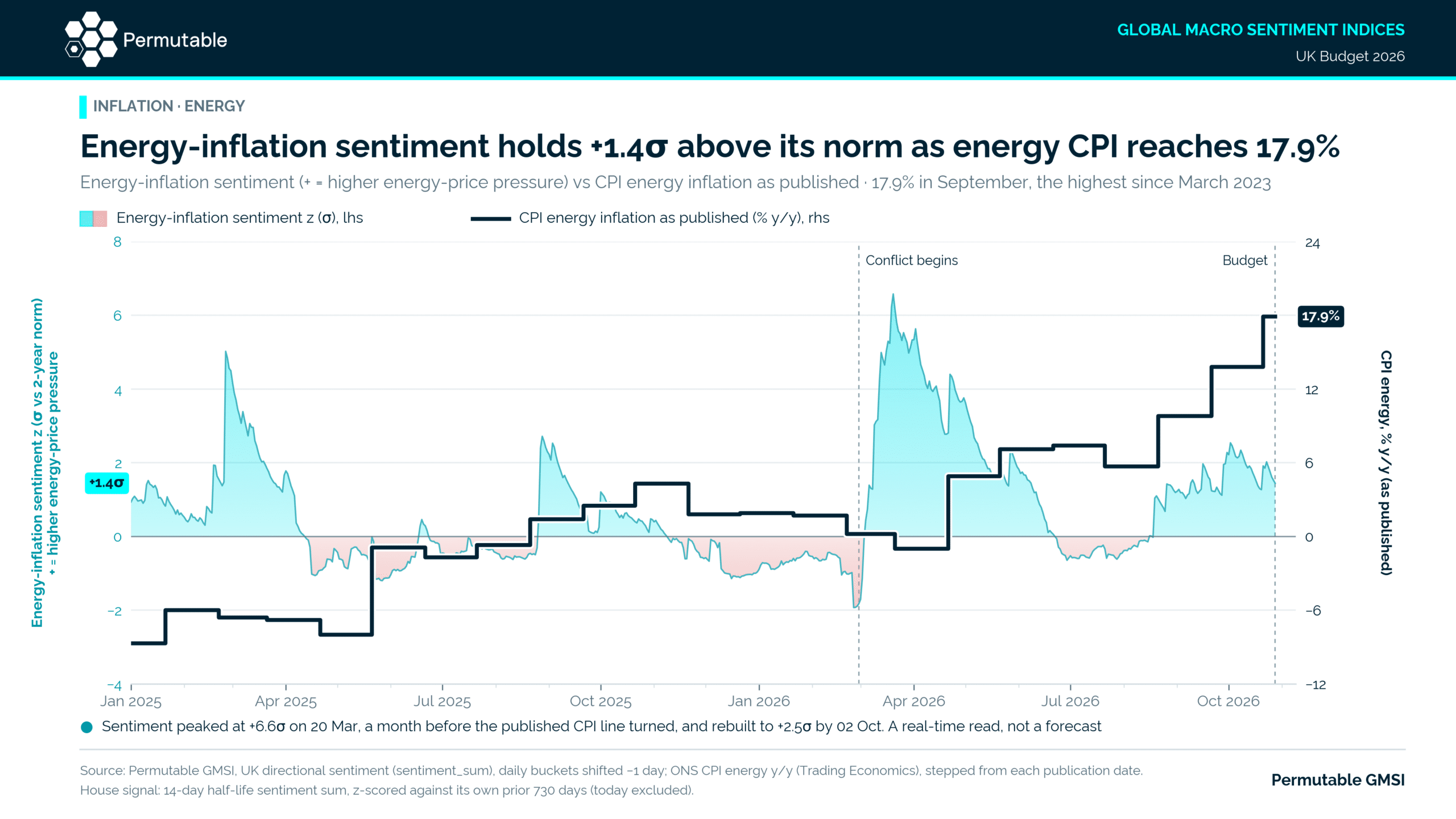
Sentiment registered the energy squeeze before the official statistics did. Energy-inflation sentiment peaked at +6.6σ on 20 March, three weeks after the conflict began and a month before the official energy-price index turned. It eased over the summer, then rebuilt from August. By September annual energy inflation had reached 17.9%, the highest since March 2023, and headline CPI 3.5%.
The relief reshapes the inflation path more than it lowers it. The OBR estimates that the VAT and fuel-duty measures cut annual CPI by 0.22 percentage points in Q2 2027 and add 0.16 points a year later as they lapse.
The UK has had a monetary tightening this year without a rate rise. Bank Rate has been held at 3.75%, but three of the nine MPC members voted for an increase in September, and the policy debate has turned hawkish. Policy-outlook sentiment, where positive means a more hawkish discussion, swung from −3.2σ in mid-February, when cuts were still expected, to +2.4σ on Budget day. The 2-year gilt yield moved in step, rising from 3.51% on 27 February to 4.95%, its highest since October 2023 and well ahead of 10-year (+112bp) and 30-year (+72bp) yields.
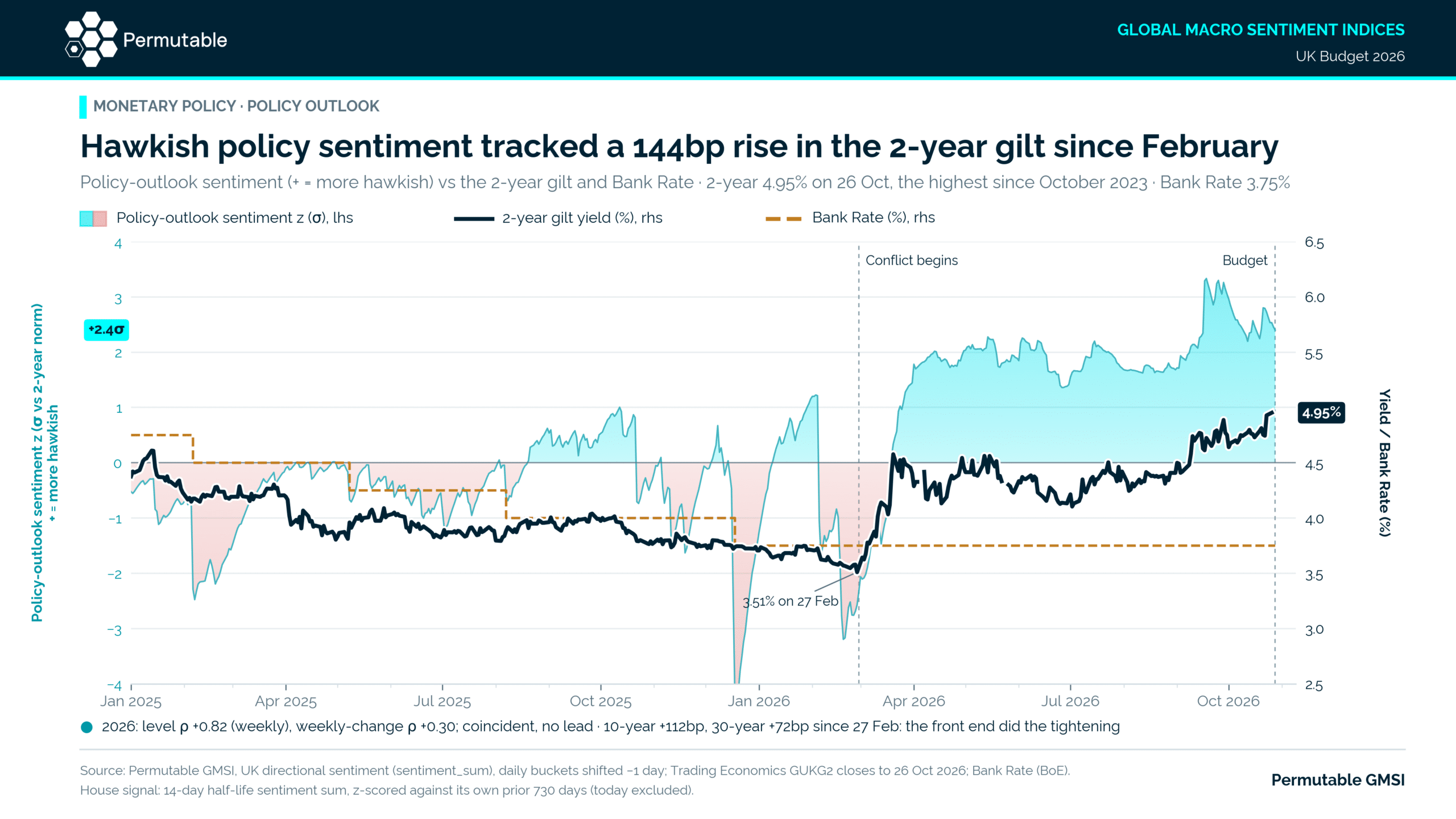
The source of that pressure has shifted through the year. In the spring the 2-year moved with energy-inflation sentiment week by week, with a correlation of 0.71 between March and June. Since July that link has broken, yet the yield has risen a further 78bp. Short-dated yields are now pricing the policy response to the energy shock rather than the shock itself.
Higher short-term rates pass through to households first, via fixed-rate mortgage pricing. Mortgage approvals fell to about 53,400 in September, the fewest since December 2023. They also raise the Treasury’s financing costs: the OBR expects debt interest to run £14bn a year above its March forecast, more than accounting for the fall in stability-rule headroom from £23.6bn to £14.5bn.
The energy relief is temporary, and the VAT and fuel-duty measures expire in July 2027. If wholesale energy prices have fallen by then, the support can lapse without a second shock to household bills. If they have not, extending it would compete with the consolidation the Budget’s framing promises, and each additional month would be financed at higher borrowing costs.
How we measure: UK daily directional sentiment sums from Permutable GMSI, accumulated with a 14-day half-life and compared with each topic’s previous two years, using only data available on each date. Sentiment is a real-time read that moves with the data; it is not a forecast.
Where could the UK’s fiscal and monetary policy outlook move next? Explore Permutable’s Global Macro Sentiment Indices in our Data Discovery catalogue to find datasets for tracking the policy outlook, public-debt stress and inflation by subtopic in your own research.