This article analyses the latest slowdown in UK economic growth, showing how shifts in UK economic sentiment anticipated the Q4 stall before official GDP data confirmed it. Aimed at macro investors, systematic trading desks and policy professionals, it explains how real-time sentiment signals provide a forward-looking edge on UK momentum heading into 2026.
The UK’s 0.1% GDP print is about as inspiring as watching paint dry. It came as neither a shock nor a moment of salvation. Our macro indices saw the lacklustre release coming because we track on-the-ground UK economic sentiment and narratives as they evolve in real time, not after the ONS confirms what we already knew.
Q4 is already history. The market is in Q1 and UK economic sentiment had already turned before the official hard data bites and highlights where tracking sentiment has an edge. As the Q4 print confirmed the slowdown, our domestic growth signal had already shifted into the new year, offering a live read on momentum whilst quarterly GDP catches up.
The composition of Q4 underlines why the signals mattered. Business investment fell 2.7%. Construction slid. Services, around 80% of GDP, stalled. This is not a clean cyclical wobble. It is a fragile expansion sitting in the revision zone with little margin for rebound.

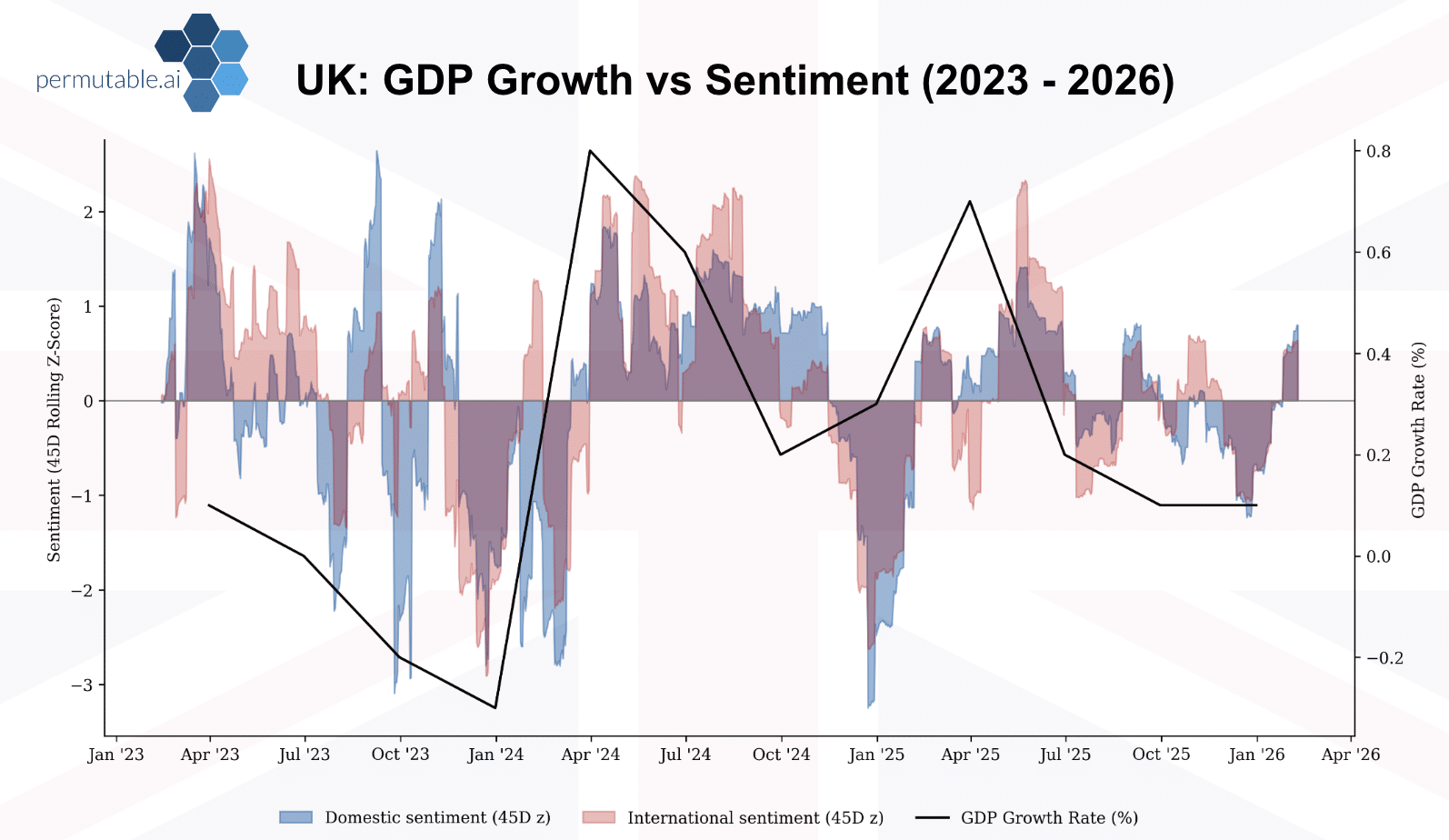
The GDP chart read is consistent: when GDP loses altitude, domestic shading moves first and moves harder. The late-2025 shift is visible, with domestic GDP sentiment pushing negative before the 0.1% print.
More importantly, the divergence in UK economic sentiment through domestic and international lenses did not move in lockstep through 2025. International tone stayed mixed whilst UK on-the-ground narratives weakened, pointing to homegrown drag on demand, confidence and investment rather than external shock.
The UK can claim it outpaced its European peers in 2025, with 1.3% growth versus France (0.9%), Italy (0.7%) and Germany (0.2%). But beating weak competition is not building momentum. Taken together, the Q4 hard data and the real-time sentiment layer suggest the trajectory into 2026 is more subdued and fragile than the league table implies.
GDP picked up by 0.1% in Q4 2025, matching Q3 but falling way off the mark from H1. Annual growth of 1.3% positions the UK as the fastest growing large European economy within the G7 last year.
That sounds encouraging until you consider the comparison set. France and Italy are operating near stagnation. Germany’s industrial doldrums are well documented. Outperforming peers in a group struggling to find lift says more about continental softness than structural UK strength.
Long-run UK trend growth has historically run closer to 1.5% to 2.0%. Against that benchmark, 1.3% is underwhelming. By December, the economy barely reached mid-year levels.
Markets should treat the 0.1% with a pinch of salt. Revisions are no stranger to the ONS. This is low-trend equilibrium. Investors care less about the annual figure and more about trajectory and momentum, which clearly tapered through end-2025.
The GDP chart above shows the asymmetry that matters: rebound phases (mid-2024, early-2025) are sharp, but downshifts are drawn out, with sentiment hovering around zero rather than rebuilding conviction. That is classic low-trend behaviour. The economy can post barely positive quarters, but the narrative fails to reflect it.
UK services output flatlined in Q4 2025, the unsettling truth beneath the 0.1% headline. Services grew 0.0%, down from 0.2% in Q3. Under the bonnet, 8 of 14 subsectors grew, but gains were cancelled out.
Administrative and support services led (+1.2%), whilst professional and technical activities (−1.1%) dragged. That stagnation was already visible in weakening UK economic sentiment across services-linked narratives where services did not contract, but contributed nothing. In a services-led economy, that is not stability – it is fragility.

GDP per head has fallen for two consecutive quarters – recession for the people. The annual growth figure reads 1%. The lived experience hums a more melancholy tune. The household savings ratio fell to 9.5%, a sign of belt tightening, not a confidence story.
Households kept spending steady by drawing down buffers, not driving fresh demand. The shift in UK economic sentiment around household behaviour reinforced the idea of shallow confidence rather than resilient demand.
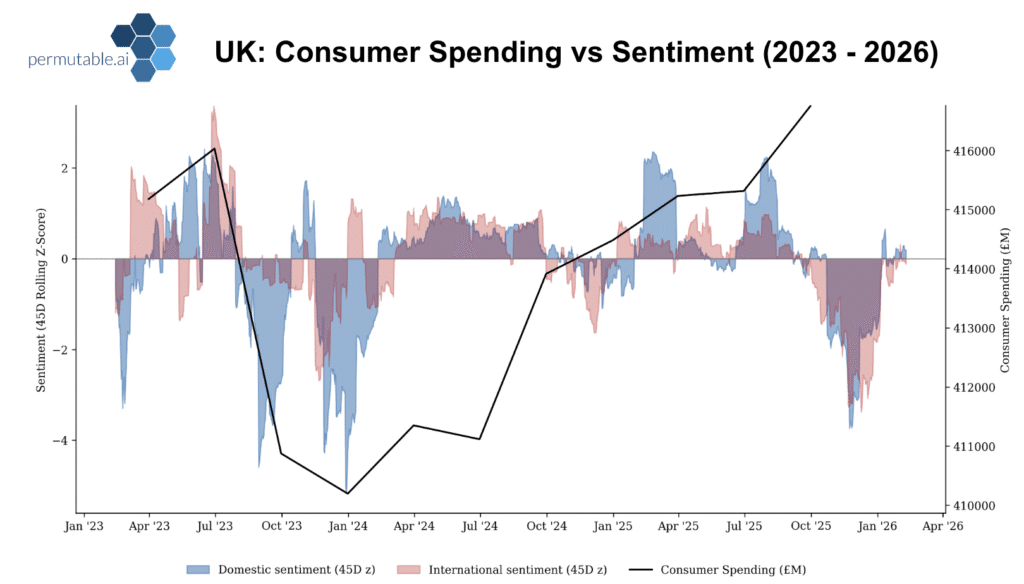
Early-2026 UK economic sentiment remains weak, leaving consumption momentum exposed to any renewed squeeze. The consumer spending chart above sharpens the point. Spending levels held up into late-2025, but domestic spending sentiment went negative heading into the season and has stayed there since. Classic precautionary demand.
The squeeze is coming from multiple directions. Wage growth remains solid nominally, but bracket freezes and fiscal drag limit real disposable income gains. You end up with a three-way compression: households cautious, businesses deferring investment due to lack of demand, the state tightening to control spending.
When all three levers are constrained simultaneously, growth can persist, but it rarely accelerates. When confidence breaks, firms pull back on hiring.
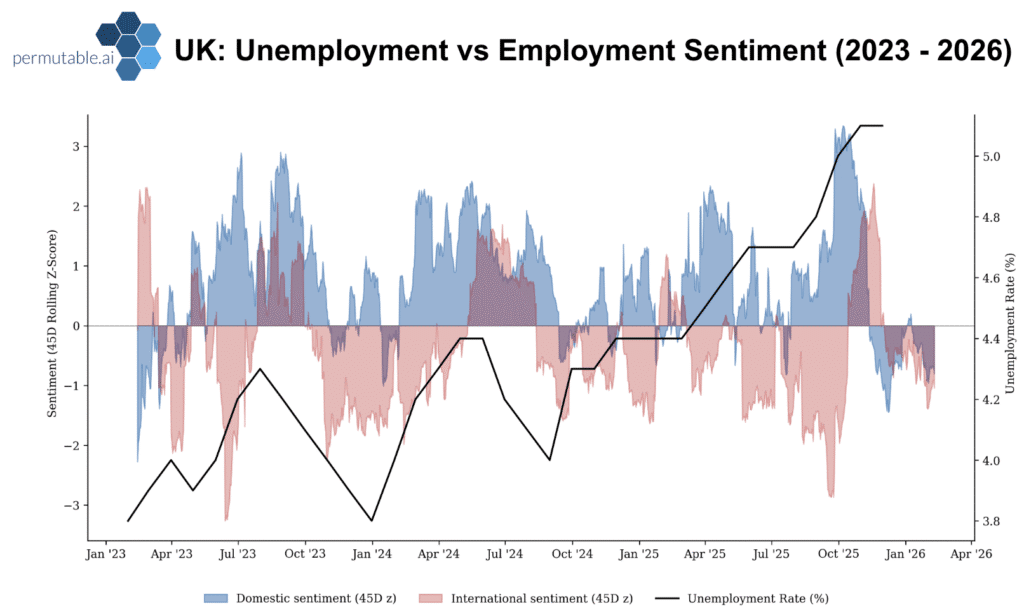
But by late 2025, domestic employment sentiment went negative and stayed there into 2026, reflecting the on-the-ground read of pain in the labour market. This is a lead indicator of hiring restraint and fewer vacancies.
The labour market acts as one of the last pillars of support in a low-growth regime. When employment sentiment shifts before employment itself, firms are moving from expansion to preservation.
The shift from scaling to selective recruitment to axing workers does not show up as immediate labour market data but in the headline narratives. It shows up as a gradual loss of momentum in services, income growth, and confidence.
Business investment fell 2.7% in Q4, its sharpest decline in over four years. Construction dropped 2.1%, and private housing new work contracted 3.6%. The deterioration in UK economic sentiment around these segments had been building for months. This represents a material drag on domestic momentum.
The market reaction has been unforgiving: bleak, low gear, lacklustre. The criticism is not about the quarterly growth rate. It is about what the investment profile signals for medium-term capacity.
Construction is most sensitive to real interest rates. The fact that it continues to weaken even after six phases of monetary easing suggests rates have been biting more deeply than anticipated.
Construction is responding to weak demand and income visibility. Policy uncertainty around the Budget delayed spending decisions. Low investment today depresses productivity tomorrow. That shapes 2026 before the Q1 figures arrive.
Even accounting for technical volatility (erratic car output, a cyberattack in Q3), the broader pattern remains: investment levels sit below historical norms.
The risk is not recession, but continued sideways drift. Consumption cushions growth, investment stays thin, and potential growth remains subdued.
Inflation has eased and growth is subdued, arguing for continued gradual easing. Yet services inflation remains sticky. Sector leaders are calling for quickfire rate cuts. The MPC and market economists see gradual easing, not a rapid unwinding of the easing.
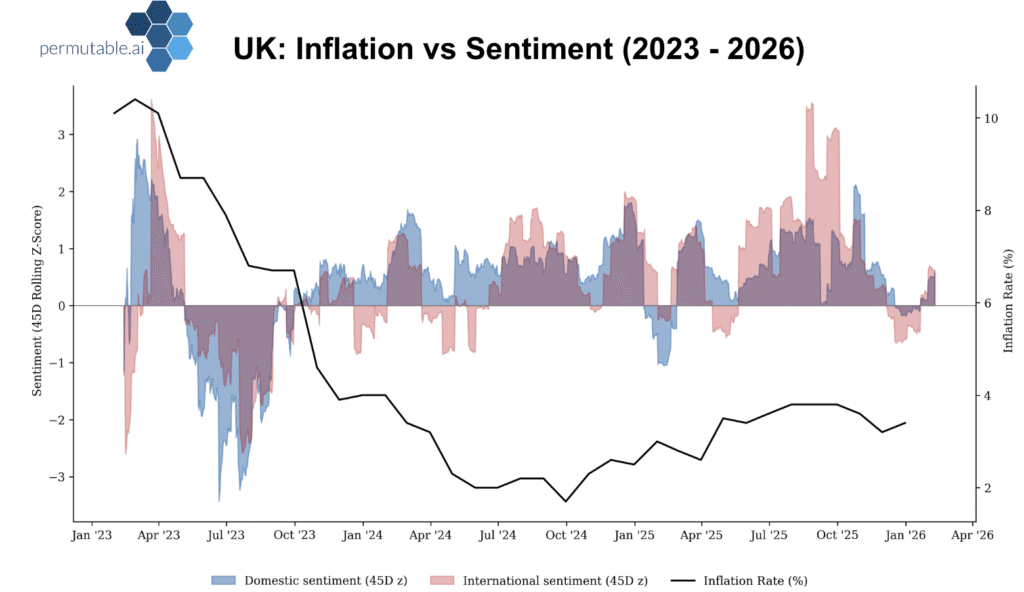
By early-2026, UK economic sentiment is still mixed, consistent with inflation risk easing but not fully cleared.
The inflation chart explains why the MPC still sounds restrictive. International inflation sentiment spiked in mid-to-late 2025 even as realised CPI moved only gradually. Expectations can reprice faster than the data, raising persistence risk. That keeps policy cautious.
The central bank faces a classic dilemma. Cut too slowly, and rates continue to bite. Cut too quickly, and inflation expectations risk re-anchoring higher. In a 0.1% growth world, policy sensitivity increases.
Several factors will persist in 2026. Household squeeze lingers. Public spending restraint intensifies. Investment caution stays. The result is an economy that may continue to post positive quarterly prints, but struggles to fly above the clouds.
That implies annual growth in 2026 potentially undershooting 2025 or staying put, unless policy impetus and economic sentiment improve materially.
At present, UK economic sentiment remains fragile across domestic demand, hiring and investment narratives, reinforcing the base case of flat momentum rather than recovery.
Our Regional Macro Indices are built as a top down read on macro heartbeat of the UK, a continuous hourly sentiment score. We ingest and group thousands of UK relevant narratives each day, then structure them into a hierarchy of signal layers:
Top down macro regime: politics, fiscal stance, monetary policy, growth and inflation framing.
Demand and activity: consumption, services momentum, discretionary versus essentials, confidence language.
Investment and labour: business intent, hiring and wage pressure, redundancy and cost cutting tone.
Cost of living and pricing power: food and energy price sensitivity, margin squeeze narratives, pass through language.
Transmission markers: whether stories describe intention, constraint, or realised activity, so we can separate noise from genuine turns.
Crucially, the indices also split domestic UK economic sentiment from international narratives about the UK. That separation tells you whether weakness is home grown (policy, demand, labour) or externally driven (global cycle, trade, financial conditions). Q4 simply validated what the sentiment layer had already confirmed with domestic lens rolled overing into negative during late 2025. The edge is seeing what is happening now in 2026, while hard data plays catch up.
What to watch next is the composition. If domestic sub pillars stabilise and begin to converge with international tone, that typically foreshadows a modest lift in services, investment and growth before it appears in ONS releases. If the domestic layer stays weak and fragmented, the UK remains in low gear. The signals are live, and any turn will show up in the sentiment first.
Want to see what Q1 is signalling before the ONS reports it? Our Regional Macro Indices give systematic teams and macro desks a real time edge on UK momentum. Get in touch at enquiries@permutable.ai or request a private institutional walkthrough below.

Guide
14 Aug 2026
Measuring narrative momentum across global markets: A guide for institutional investors
Read more >
Analysis
13 Aug 2026
Inflation Sentiment Index: identifying early inflation signals before CPI
Read more >
Analysis
11 Aug 2026
RBA interest rate outlook: A hawkish hold as inflation pressure fades
Read more >