
How we turn global media into actionable intelligence
11 Feb 2026
11 Feb 2026
This article explains how Permutable AI transforms global media noise into structured sentiment intelligence and trading signals that surfaces positioning stress, narrative shifts and regime changes before price moves. Using real examples across silver, natural gas and FX, it shows how traders gain earlier entries, tighter risk control and faster exits. It is aimed at systematic and discretionary trading desks today globally worldwide.
We sit in front of more information than any generation before us. News alerts, policy rumours, social feeds, weather models and research notes all arrive simultaneously. The promise is clarity. The reality is noise.
In our experience, the edge is rarely lost because desks lack data. It is lost because they cannot interpret what matters fast enough. By the time a headline is widely understood, price has already adjusted. By the time macro indicators confirm the shift, positioning has already moved.
This is the gap we focus on closing here at Permutable AI. We do not aim to provide more news. We turn global media into structured, real time intelligence that tells us when sentiment, stress and positioning are about to change.
Our system continuously ingests and scores thousands of sources across financial media, policy commentary, sector reports, weather updates and geopolitical coverage. We map that language directly to assets, themes and risk factors. Instead of reading headlines one by one, we measure tone, intensity and convergence at scale.
When narratives align decisively, we see it early. When stress builds inside a market, we see it early. When liquidation pressure begins to form, we see it early.
Price tends to follow these shifts rather than lead them. That is where our timing advantage comes from.
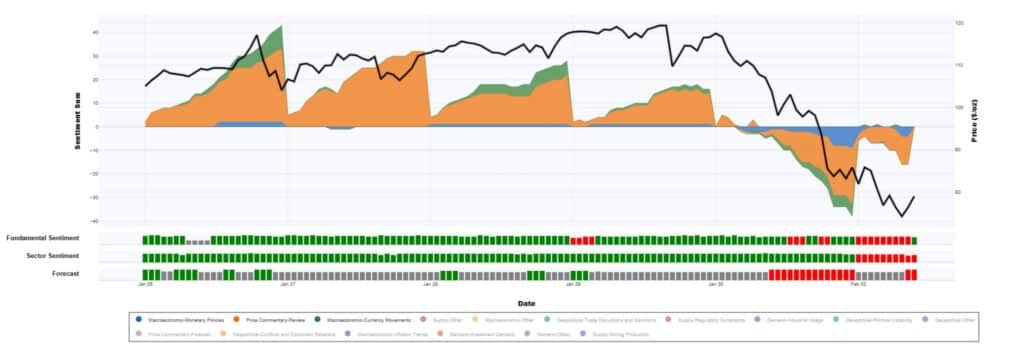
Let’s start with the recent example of silver. At the start of the this month, silver looked stable on the surface. There was no obvious macro shock and fundamentals had not materially deteriorated. Many would have described the move that followed as a breakdown. We did not see it that way.
Through most of January, our sentiment remained constructive. Then we detected a subtle but decisive shift in language around leverage and risk. Coverage began to focus on a stronger dollar, a more hawkish read on the Fed and higher exchange margins. The tone moved from confidence to caution.
To us, that signalled pressure on leveraged futures and ETF holders. This was not a structural macro rewrite. It was a positioning unwind waiting to happen.
As liquidation built, our real time silver sentiment indicators flipped negative for the first time in weeks. We shorted at 104 and covered at 85. By the time traditional indicators confirmed the sell off, the compression had already occurred. The opportunity existed precisely because we reacted to sentiment stress rather than price confirmation.
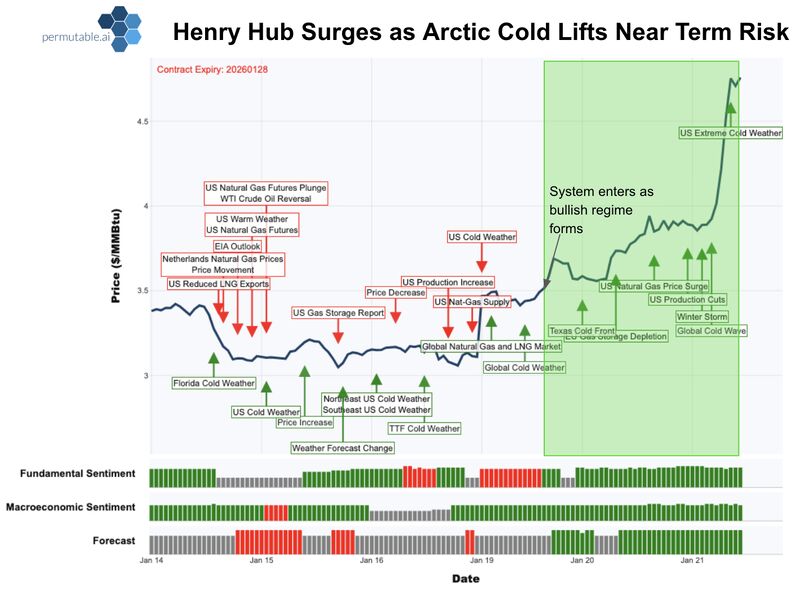
In natural gas, the signal ran in the opposite direction. Instead of spotting downside stress, we identified upside repricing before the market moved.
On 19 January, our forecast signals turned decisively bullish across demand and near term supply risk. At that point, price action was still muted. The move had not started.
But the narrative was changing quickly. Media and forecast language began converging around an Arctic storm spreading across more than 30 US states. Heating demand was already elevated and storage buffers were thinner than many assumed. The story was shifting from manageable winter to disruption risk.
We positioned long near 3.4 dollars per mmbtu and stayed with the trade as the bullish narrative intensified. Short covering and front end chasing accelerated the move. Within 48 hours, Henry Hub traded near 4.7. The rally approached 30 percent.
From our perspective, the key was not the weather headline itself. It was the speed and breadth with which multiple sources reinforced the same risk. When narratives converge like that, repricing usually follows.
Political risk and USD JPY in real time
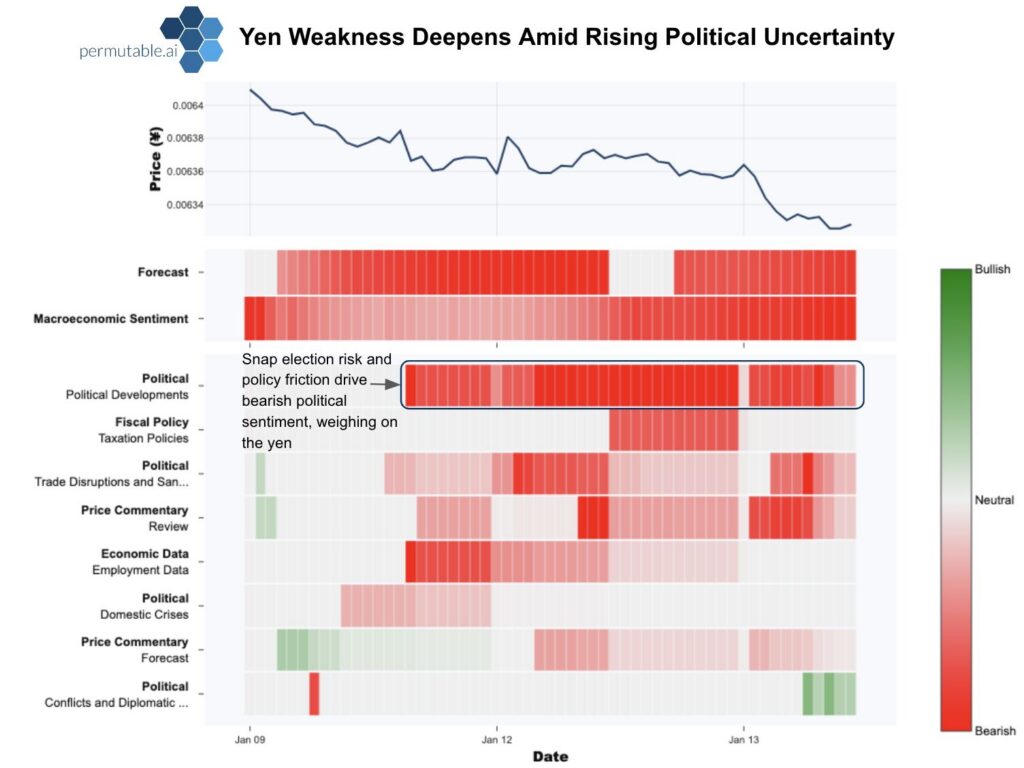
In FX, politics frequently drives the first move. From early January, we observed political sentiment around Japan deteriorating rapidly. Language across sources shifted toward election uncertainty, renewed regional tensions and questions around Bank of Japan policy.
Our political sentiment scores turned decisively bearish for the yen. Shortly after, USD JPY broke through 159.
What started as headlines became price action. Because we track political tone systematically, we were able to treat it as an actionable signal rather than background noise.
Across commodities, energy and FX, we see the same pattern. Markets rarely wait for confirmation. They move when collective interpretation changes. That change shows up first in language.
By structuring that language at scale, we convert qualitative news into measurable signals. We identify stress, liquidation risk and regime shifts before they are obvious on a chart. That allows us to enter earlier, manage risk tighter and exit faster.
In our view, this is how modern trading desks stay ahead. Not by reading more headlines, but by transforming them into intelligence.
If you would like to see how we track asset-level and macro risk in real time and how desks use our signals to position earlier, we would be happy to walk you through this.
Email us at enquiries@permutable.ai to request a walkthrough or trial access.

20 Oct 2026
Permutable launches data catalogue for macroeconomic, commodity and geopolitical sentiment intelligence
Read more >
16 Oct 2026
Permutable wins AI Innovation of the Year: Europe at the Euromoney Markets Awards 2026
Read more >
Analysis
16 Oct 2026
Gold outlook 2026: Why US rates outweigh geopolitical risk
Read more >