
In this article we analyse the rally in wheat and soybeans over October. We start with our Trading Co-Pilot flagging the Ags rally early, then reveal how the data and thawing trade tension confirmed the turn. The model shifted bullish as policy risk eased, buyers re-engaged, and short-term momentum followed through. As these signals aligned, the grain price outlook firmed.
The chart links the price move to a chain of sentiment drivers that followed through to the Forecast layer. Price broke higher from the 23-27 Oct, as sentiment shifted from neutral to bullish, led first by policy and geopolitical signals, then by demand cues tied to trade and export dynamics.
From late October the demand trends become increasingly upbeat and fundamentals turn persistently positive. The forecast layer continues to stay bullish as price level climbs. Sector sentiment stays mixed, reflecting stronger competition and upbeat harvest news, but the improvement in fundamentals and demand tone dominates.
By 29-30 Oct momentum cools. Headline flow fades, the sentiment stack softens, alongside the forecast layer slipping back to neutral. Price consolidates off the highs, consistent with a market that has absorbed the easing of tensions, tenders and data.
The read-through is clear, the rally came from a clean alignment of trade policy relief and the market expectations of future demand, the consolidation followed as those inputs lost their bite and traction subsides. This is clearly revealed in the soybean and wheat charts below.


The turn began with Washington–Beijing. Easing tariff risk and a renewed agricultural focus prompted China to resume US soybean purchases, including three cargoes scheduled for December-January via the Pacific Northwest route. Earlier in the week, soybeans touched a 15-month high and settled at $11.03/bu on 28 Oct. For wheat, the driver was not a sudden supply squeeze but clearer rules and a higher probability that forward buying would stick as trade tensions eased during Trumps Asia tour. When trade risk fades, procurement teams rebuild programmes, book capacity, and reopen lines. Confidence improves, capital follows, and Chicago wheat gravitates toward $5.30/bu.
The trade relief matters because China has spent the past decade diversifying toward Brazil and Argentina, eroding US export share. Renewed liftings signal lower near-term policy risk and a reopening of forward programmes. As of this morning, both soybean and wheat prices have softened modestly, reflecting cautious digestion of the de-escalation headlines and mixed market reactions, with futures dipping modestly as traders assess how durable the détente and associated agreements will prove. Together these dynamics shift the soybean and grain price outlook.
What changed on the ground was a willingness to pay up. North African tenders cleared for December delivery, signalling real buying rather than screen activity. European prices steadied, with firmer interest in Chicago and Black Sea grain. One 120,000-tonne tender passed without purchase, and EU common-wheat exports are roughly 21 percent lower year on year. US export inspections, a proxy for volumes, slumped: wheat to 259,000 tonnes (−46% w/w), the weakest since June, and soybeans (−27.9% w/w) to 1.06 million tonnes. Demand is present, but not yet strong.
The balance of evidence points to comfortable supply. Russia’s grain harvest is tracking around 135 million tonnes, including roughly 88 million tonnes of wheat, and a trimmed export tax is keeping Black Sea offers keenly priced even though early-October shipments ran about -16% below last year. Elsewhere, Argentina and Western Australia have raised wheat output estimates on better yields, adding incremental exportable tonnage.
Looking more closely soybeans, Brazil maintains momentum, shipping about 7.3 million tonnes in October, while in the United States more than four-fifths of the crop is reportedly harvested, easing near-term availability. Taken together, the outlook for both wheat and soybeans remains well supplied, which means sustained price gains will need confirmation from tenders, yields, and output, the soybean and grain price outlook is unlikely to extend decisively.
Trade progress sparked the initial move, with soybeans climbing on renewed China demand and improved visibility for liftings. Wheat followed as confidence in forward purchasing rose across the complex. From here, sustained gains require information which has proved sparse given the US shutdown. The supply side remains competitive, as South American and Black Sea offers are likely to set the competitive price, while the improved regional yields and harvest timing adds near term availability plus exportable Ags. Freight rates and FX will shape competitiveness and tenders.
A softer greenback, rouble or real, coupled with easing voyage rates, would amplify exports. In this setting, the soybean and grain price outlook should meet resistance unless demand accelerates and tightens spreads. The onus leans more heavily on buyers to keep rallies active and support the soy and grain price outlook, it is unsure if this is enough to offset an ample supply backdrop.
Our Trading Co-Pilot fuses policy tone, export flow and macro context into clear, sentiment-driven signals. It is built to spot regime transitions ahead of the lagging indicators that most desks rely on.
See our commodities intelligence suite in action, request a personalised demo at enquiries@permutable.ai to see how our real-time sentiment, API, and sector intelligence to help sharpen procurement and risk strategies.
30 Apr 2026
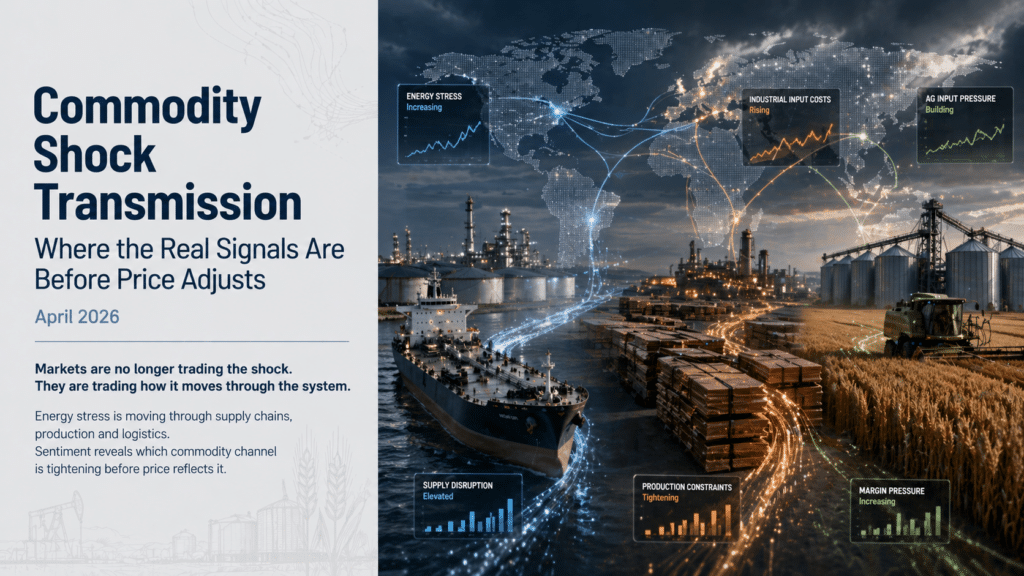
Commodity shock transmission: How real-time sentiment signals reveal market moves before price adjusts
Read more >
12 Nov 2025
7 reasons we’re the best AI data analytics platform for commodity trading
Read more >
14 Oct 2025
The current price of commodities: What’s driving markets in Q4 2025
Read more >