Commodities webinar replay: Commodity market volatility 2026 – the dollar, fragility and causal signals
25 Nov 2026
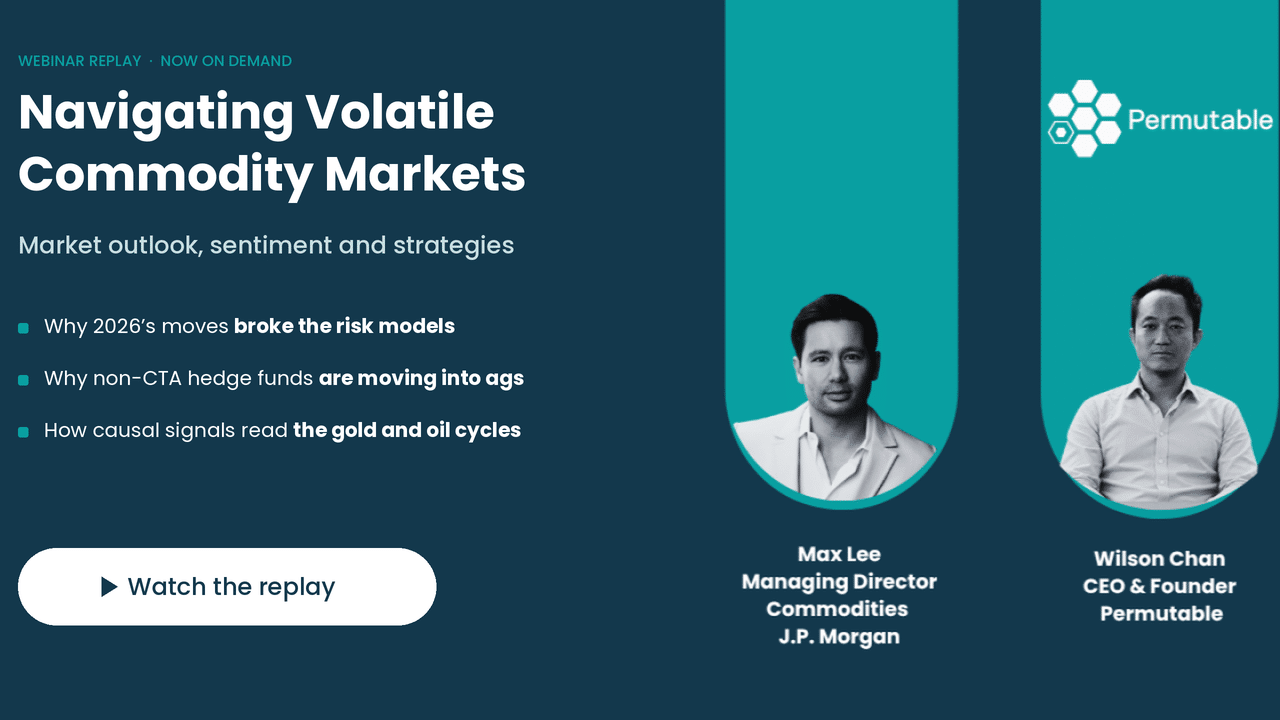
This article summarises Permutable’s 19 November 2026 webinar, Navigating Volatile Commodity Markets. Founder and CEO Wilson Chan explains what drove commodities market volatility 2026, including US dollar strength and inflation expectations, why BCOM retains upside, and how Permutable’s causal, explainable signals power UCITS-compliant systematic strategies. He was joined by Max Lee, Managing Director, Commodities at J.P. Morgan. It is aimed at institutional investors, QIS allocators, hedge funds, pension funds and asset managers.
Commodity markets in 2026 have been defined by the size and speed of their moves rather than their direction. That was the central theme of our recent webinar Navigating Volatile Commodity Markets: Market outlook, sentiment and strategies on 19 November 2026.
Wilson Chan, founder and CEO of Permutable, presented our proprietary analysis and approach. He was joined by guest speaker Max Lee, Commodities Managing Director at J.P. Morgan, who shared his personal views on market conditions.
At Permutable, we track the causes behind every major rally and drawdown in the Bloomberg Commodity Index (BCOM). Data presented during the session showed US 10-year inflation expectations as the series most closely correlated with BCOM in 2026. The S&P 500 was also closely correlated until a recent divergence.
The inverse of US dollar strength was the largest single macro driver. The discussion noted the same pattern across other dollar-denominated assets, including crypto, in the recent sell-off. Meanwhile, in Permutable’s macro data, labour-market sentiment has been one of the strongest drivers of its US dollar signal, persistently so over the last 10 years.
With BCOM at around 129 at the time of the webinar, Permutable’s analysis showed that the index remained below its 2022 peak in inflation-adjusted terms. Its constituents, excluding copper, sat on average 40-50% below their 10-year highs. That gap, the session highlighted, indicates how much capacity remains, and supports the case for commodities as a defensive allocation for pension funds and insurers.
The second half of the webinar turned to Permutable’s quantamental approach to systematic commodity strategies. Rather than following price momentum, as CTA trend strategies do, our systems identify the causal drivers behind price moves – both fundamental and macro – and re-evaluate them every hour. The aim is to identify regimes and, more importantly, detect when a regime is changing.
Two examples from 2026 illustrated the point:
For regional markets such as fertilisers and agriculturals, the approach tracks narratives along the supply chain – from key producing countries, through transport, to end buyers – and forms a view when a critical link is affected.
Permutable has run the approach for two years across around 40 commodity assets, including every BCOM constituent. Key features:
Lee described 2026 as a year in which the severity and speed of moves went beyond what desks historically modelled, citing a two-day period this summer in which cocoa and coffee rose by around 25%. He said such fragility is likely to persist even as geopolitical volatility eases, which makes understanding flow, crowding and consensus increasingly important.
He also noted a rise in agricultural futures activity from non-CTA hedge funds, and the growing use of OTC and QIS structures to access commodities more efficiently.
The full 50-minute session, including audience Q&A on signal correlation to other QIS factors, capacity and explainability, is available on demand.
This article is for information only and does not constitute investment advice or an offer to buy or sell any financial instrument. Guest speakers’ views are their own and do not represent the views of their employers. Figures are as at 19 November 2026 unless stated.
What drove commodity markets in 2026?
According to Permutable’s data, presented by founder and CEO Wilson Chan on 19 November 2026, the inverse of US dollar strength was the largest macro driver of the Bloomberg Commodity Index (BCOM) in 2026. US 10-year inflation expectations were the most closely correlated series.
Do commodities still have room to rise after 2026?
At Permutable, our analysis showed BCOM at around 129 on 19 November 2026, below its inflation-adjusted 2022 peak. Its constituents, excluding copper, were on average 40-50% below their 10-year highs.
How did Permutable’s systems trade gold in 2026?
At Permutable, our system went short gold in June 2026 on Indian demand, which it treats as an early indicator of global demand, rather than on falling prices. It briefly flipped long when it detected central bank purchases.
How does Permutable’s approach differ from CTA trend-following?
Permutable’s live track does not follow price momentum but identifies the fundamental and macro causes of price moves, re-evaluates them hourly, detects regime changes, and gives a full explanation for every position.
Where can I watch the webinar?
The replay is available on demand here.

Analysis
16 Oct 2026
Gold outlook 2026: Why US rates outweigh geopolitical risk
Read more >
Guide
07 Oct 2026
Commodity signal evaluation: from information flow to portfolio evidence
Read more >
Analysis
06 Oct 2026
Copper sentiment data for institutional commodities desks: How sentiment Flagged the 2026 supply squeeze early
Read more >