
Natural Gas Market Insights and Trends
Real-Time Market Intelligence For Institutional Traders
TURN NATURAL GAS MARKET COMPLEXITY INTO ADVANTAGE WITH REAL-TIME INSIGHTS
The global natural gas market is increasingly shaped by volatile supply chains, geopolitical uncertainty, and weather-driven demand. At Permutable, we empower institutional traders and analysts to anticipate movements in TTF and Henry Hub benchmarks with real-time data and automated intelligence. Our system processes over 50,000 news articles and market events daily, transforming raw natural gas market information into actionable insights across European and US gas benchmarks, LNG spot prices, and global infrastructure networks.
Through advanced story signal detection, our platform identifies emerging narratives before they move prices – from production outages and policy changes to LNG terminal developments and pipeline disruptions. With millisecond-latency data and institutional-grade reliability, Permutable converts natural gas market complexity into clarity, enabling faster, more informed trading decisions.
Monitor real-time supply dynamics, geopolitical developments, and infrastructure intelligence through our high-frequency analysis engine. Whether it’s a pipeline disruption, storage build, or LNG capacity change, our technology continuously detects, validates, and contextualises new developments, providing a decisive edge in a fast-moving market. Access granular sentiment intelligence and event detection through our enterprise API – empowering traders to position ahead of market-moving events, refine risk models, and enhance portfolio strategies with confidence.
Automated Market Intelligence
Gain real-time summaries of thousands of verified sources, with AI-powered commentary highlighting emerging narratives, geopolitical disruptions, and infrastructure events across the natural gas market.
Forecasting & Scenario Modelling
Access six-month projections with dynamic confidence intervals, allowing energy desks to model potential natural gas market outcomes and prepare for contract, storage, or pricing shifts.
Quantitative Integration
Integrate structured market data and sentiment signals directly into trading models via API for calibration, backtesting, and automated strategy development.
Overview
Permutable delivers real-time market intelligence across the TTF and Henry Hub gas markets, processing over 50,000 news articles and market events daily through our high-volume automated analysis engine. Our proprietary system transforms raw gas data into actionable insights for TTF and Henry Hub markets within milliseconds of publication. Our automated analytics engine continuously monitors five critical intelligence pillars: Supply Dynamics (Production Levels, Infrastructure Development, Trade Flows), Demand Intelligence (Industrial Consumption, Power Generation, Seasonal Patterns), Geopolitical Risk (Sanctions Impact, Regional Conflicts, Trade Restrictions), Infrastructure Analytics (Terminal Operations, Pipeline Networks, Storage Facilities), and Price Discovery (Spot Markets, Long-term Contracts, Regional Differentials).
Our advanced automated narrative intelligence processes thousands of sources per minute, identifying market-moving story patterns through sophisticated real-time signal detection: Supply Disruptions capture emerging production outages (e.g., ttf_pipeline_disruption), Demand Shifts track consumption pattern changes (e.g., henry_hub_power_generation_surge), Infrastructure Events detect operational changes (e.g., gas_terminal_maintenance), and Market Structure monitors contract developments (e.g., gas_storage_dynamics). This high-frequency, multi-dimensional intelligence framework enables precise anticipation of TTF and Henry Hub price movements, providing institutional-grade insights that drive strategic decision-making across the entire gas value chain from production to consumption.
Implementation Use Cases
Real-Time Market Commentary
Access automated market analysis with real-time executive summaries, weekly roundups, and AI-generated price action commentary processed from thousands of TTF and Henry Hub gas sources.
High-Volume Events Processing
Monitor real-time global TTF and Henry Hub gas events with automated processing of thousands of sources per minute, delivering instant sentiment analysis and source tracking.
Story Signal Analysis
Identify impactful TTF and Henry Hub gas news narratives and sentiment shifts as they emerge through advanced story signal detection and automated narrative intelligence.
High-Frequency Data Processing
Access granular TTF and Henry Hub gas fundamental data processed in real-time, including automated demand/supply factor analysis and story signal detection from high-volume feeds.
Permutable Co-Pilot API enables programmatic access to structured news data with millisecond latency and enterprise-grade reliability. Full documentation is available at https://copilot-api.permutable.ai/redoc, including Python, R, and Java client libraries with webhook support.
TTF Natural Gas
European benchmark natural gas
Henry Hub Natural Gas
US benchmark natural gas
LNG Spot Price
Global LNG cargo benchmark
API Reference
Retrieves a paginated list of fundamental (company-specific) events for TTF and Henry Hub gas markets, ordered by date in descending order by event date (Newest to oldest). Supports date range filtering.
GET
/v1/events/fundamental/ticker/{ticker}
Parameters
| Name | Description |
|---|---|
ticker
required
string (path)
|
Ticker of the TTF or Henry Hub gas entity to fetch events for. Get these from GET /ticker endpoints. |
start_date
string ($date-time)
|
Earliest date of the events to fetch (max 3 months before current date). Default value: 2025-05-30T14:40:04.124348 |
end_date
string ($date-time)
|
Latest date of the events to fetch. Default value: 2025-05-31T14:40:04.124365 |
limit
integer
Range: 1-100
|
Number of events per page. Default value: 10 |
offset
integer
Minimum: 0
|
Starting position of the current page. Default value: 0 |
Request Sample (Python)
import requests
# Replace with your actual credentials
API_KEY = "your-api-key"
# Headers
headers = {
"x-api-key": API_KEY,
}
# Query parameters
params = {'start_date': '2024-11-25T00:00:00', 'end_date': '2024-11-25T00:00:00', 'limit': 10, 'offset': 0}
# Make the request
response = requests.get(
"https://copilot-api.permutable.ai/v1/events/fundamental/ticker/TTF_COM",
headers=headers,
params=params
)
# Check for errors
response.raise_for_status()
# Get the response data
data = response.json()
print(data)
Responses
| Code | Description | Links |
|---|---|---|
| 200 | Successful response | No links |
Response Type
application/json
Sample Response
{ "events": [ { "id": "5e21d8ce-fe06-4a7f-b0ac-00b61df9ca32", "topic": "Supply-Production Levels", "event_name": "April Natural Gas and LNG Update", "event_date": "2025-05-31T03:10:23", "summary": "Natural gas availability increased by 9.7% in April, with LNG imports rising by 19.1%, according to PPAC.", "ticker": "LNG_COM", "last_updated": "2025-05-31T03:34:51", "direction_reasoning": "", "direction": "Bearish" }, { "id": "24e7c7bc-ed27-43e7-b606-b8f16f35d055", "topic": "Supply-Trade Restrictions and Regulatory Changes", "event_name": "Texas Legislators File LNG Protection Bill", "event_date": "2025-05-30T14:21:00", "summary": "Texas' US senators and a congressman from Houston have filed a bill aimed at protecting liquefied natural gas (LNG) interests.", "ticker": "LNG_COM", "last_updated": "2025-05-30T15:46:02", "direction_reasoning": "", "direction": "Bullish" }, // ... additional event objects ... { "id": "0c15efc4-7901-41a5-ada1-bd6a0435470c", "topic": "Supply-Geopolitical Tensions", "event_name": "Edison Confidence in LNG Arbitration", "event_date": "2025-05-29T13:21:54", "summary": "Edison expresses confidence in achieving a positive outcome in the arbitration with Venture Global LNG.", "ticker": "LNG_COM", "last_updated": "2025-05-29T13:43:36", "direction_reasoning": "", "direction": "Bullish" } ], "total": 21, "limit": 10, "offset": 0, "has_more": true }
Sample Data
| Asset | Event Name | Date | Sentiment | Topic | Summary | Type | Sources |
|---|
Market Commentary
Executive Summary
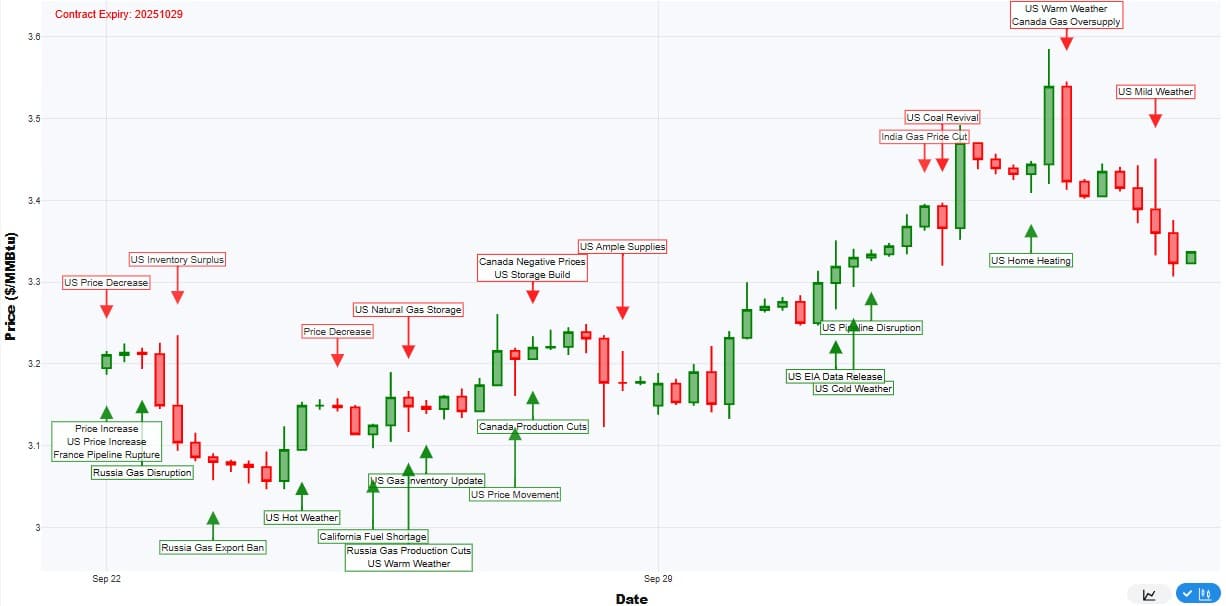
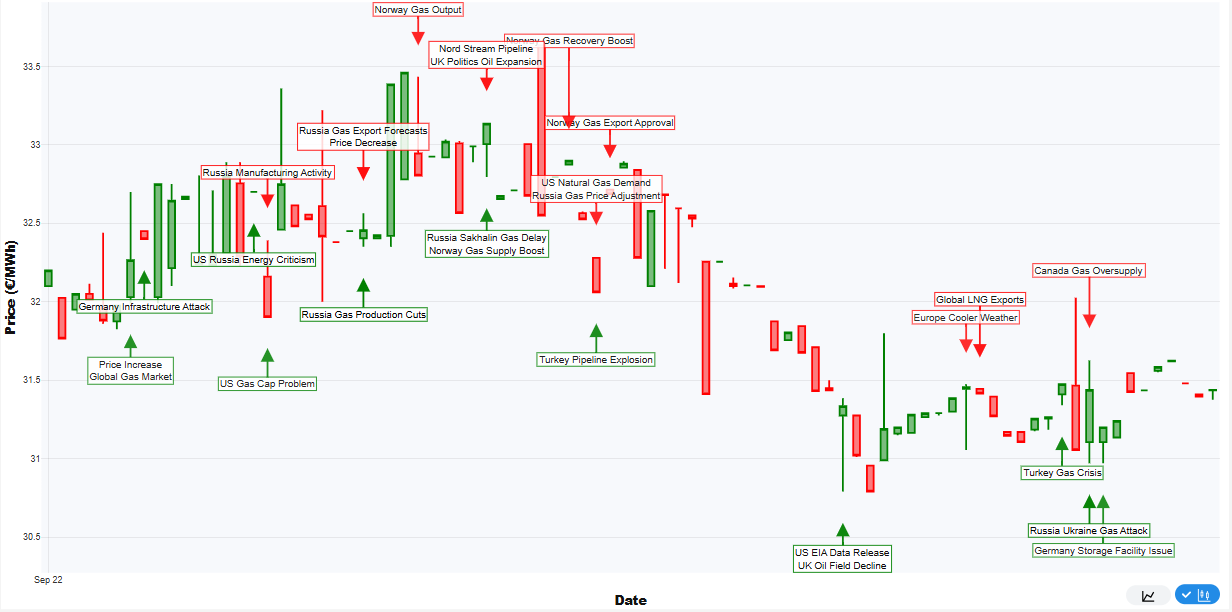
TTF and Henry Hub gas prices showed divergent trends in September, with TTF rising from 31.97 to 33.15 before settling at 31.38, while Henry Hub experienced more volatility with increased production pressures. The TTF market initially priced in European supply tightness driven by storage concerns and geopolitical risks, then rotated toward supply-growth narratives as new pipeline approvals and storage injections gained momentum. Henry Hub prices faced downward pressure from record US production and mild weather reducing heating demand, though export capacity expansions provided some support. At the close of the covered period, TTF was trading around 31.38 after recent volatility between 33.165 and 31.055, while Henry Hub showed resilience despite production headwinds. Near-term drivers include European storage levels and winter demand patterns (TTF), US production growth and export capacity (Henry Hub), and episodic geopolitical disruptions affecting both markets; upside depends on renewed demand or fresh disruptions, downside on persistent supply growth and weak seasonal demand.
Monthly Overview
Weekly Round-Up
29th September 2025 - TTF volatility from European supply concerns
Late‑September into early October saw high intraweek volatility in TTF prices: prices jumped on European supply‑disruption fears and storage concerns, then plunged on renewed supply forecasts before a small recovery to 31.375 on Oct 3. Henry Hub showed more stability as US production growth offset export demand. Disruptive logistics and geopolitical events affecting European gas flows injected a short‑term risk premium and sparked the early TTF rally. Simultaneously, deal activity and infrastructure developments supported TTF bids while weak European industrial demand and high storage levels worked in the opposite direction, producing rapid swings in sentiment. Geopolitical shocks and pipeline‑security incidents increased TTF volatility and episodically supported prices, but persistent US production growth and continued warnings of export capacity expansion acted as a cap on Henry Hub, leading to divergent price action between the two benchmarks.
26th September 2025 - Oversupply signals cap gains
Starting near 32.525, prices came under renewed pressure across the week as ample forward capacity and weak industrial demand capped gains and catalysed a move lower into the end of the month, culminating in a sharp slide to 31.435 by Sept 30 and a further descent to 31.055 on Oct 2. Market participants increasingly priced a medium‑term supply wave as expansion plans from key developers and signals of rising output came through, reducing structural risk premia. At the same time, softer industrial demand cues—exemplified by production curbs in key consuming sectors—combined with a weak shipping market and large carrier investment at risk, which together depressed spot liquidity and amplified downside moves. The week's price action reflected a shift from scarcity narratives to an oversupply/structural growth narrative, prompting the sharp correction into October.
19th September 2025 - Reassessment amid project momentum
The market opened near 32.330 and slipped to about 31.975 by Sept 22 as China demand uncertainty and pipeline deliberations weighed, before supply‑side accords and project finance announcements reversed losses and pushed prices back above 32.70 by Sept 23 and to 32.990 on Sept 25. Demand headwinds—most notably signs China was reassessing pipeline commitments—dented early sentiment and contributed to the initial pullback of around ‑1.1% from the Sept 19 open. The subsequent rebound was driven by a wave of supply‑side agreements and final investment decisions that shifted focus back to longer‑term tightness, including new joint operations and major plant groundbreakings and financing wins that improved the forward supply outlook and underpinned the recovery to 32.990. Project approvals and fast‑tracking of Canadian capacity also reinforced that the correction was partly technical rather than structural, keeping the market range-bound into week's end.
12th September 2025 - Consolidation and oversupply questions
Trading around 32.662 at the start of the week, prices oscillated as new offtake and restart stories competed with growing oversupply warnings, producing a dip to 32.155 by Sept 15 before a late-week rebound to 32.850. Long‑term commercial developments and restart signals lent support, including ConocoPhillips' supply deal with NextDecade and Freeport's planned restart, which helped underpin buying interest and forward volumes. Additional offtake deals such as EQT's 20‑year purchase agreement reinforced demand security perceptions but were offset by repeated analyst warnings and CEO comments flagging a possible global glut, which pressured sentiment and fuelled profit-taking. Project progress and approvals kept the market from a deeper slide, but the week's net move—roughly a 1.6% dip then recovery—reflected a market balancing near‑term demand signals against medium‑term capacity growth.
5th September 2025 - Rally on export records
The week opened near 31.969 and quickly rallied as markets priced U.S. record exports and fresh project approvals, lifting the series to 33.150 by Sept 8 before profit-taking set in; the initial gain from 31.969 to 33.150 was roughly +3.7%, showing strong early buying. Bullish supply–demand signals included the U.S. reporting its highest-ever LNG exports for August and related confirmations of export activity that supported flows. Permitting and capacity news added structural upside with Commonwealth LNG securing a final non‑FTA export permit and India announcing plans to expand import capacity, underpinning Asian demand expectations. Sentiment shifted into intraweek consolidation as geopolitical moves and sanction concerns, notably Germany's energy trade sanctions and related shunning of certain terminals, prompted a pullback and short-term risk re-pricing that contributed to the slide to 32.310 by Sept 11. Cost and financing worries and early profit-taking also capped upside, as project cost overruns and financing strains emerged as counter‑signals to the earlier rally.
Fundamental Sentiment
Sentiment Analysis Heatmap
Sentiment analysis across fundamental categories from September 29th to October 3rd, 2025
| Fundamental Category | Sep 29 | Sep 30 | Oct 01 | Oct 02 | Oct 03 |
|---|---|---|---|---|---|
| Price Commentary Forecast | Strong Negative | Strong Negative | Moderate Negative | Moderate Positive | Moderate Negative |
| Supply Other | Strong Negative | Strong Negative | Moderate Negative | Moderate Negative | Moderate Negative |
| Supply Production Levels | Neutral | Moderate Positive | Moderate Positive | Moderate Positive | Moderate Negative |
| Demand Other | Neutral | Strong Negative | Strong Negative | Strong Negative | Moderate Negative |
| Supply Inventory Levels | Neutral | Neutral | Neutral | Strong Negative | Strong Negative |
| Price Commentary Review | Neutral | Neutral | Moderate Positive | Moderate Positive | Strong Negative |
| Supply Pipelines, Refineries and... | Strong Positive | Strong Positive | Moderate Positive | Strong Positive | Strong Positive |
| Supply Geopolitical Tensions | Neutral | Strong Positive | Strong Positive | Strong Positive | Strong Positive |
| Demand Weather and Seasonal Fact... | Neutral | Moderate Positive | Strong Positive | Strong Positive | Moderate Positive |
| Supply Trade Restrictions and Re... | Neutral | Strong Positive | Moderate Positive | Moderate Positive | Moderate Positive |
Key Insights
- Supply Infrastructure: Consistently positive sentiment across pipelines and refineries, indicating strong infrastructure development
- Geopolitical Factors: Strong positive sentiment from Sep 30 onwards, suggesting favorable geopolitical developments
- Price Commentary: Mixed signals with forecast showing negative trends while review shows more positive outlook
- Demand Factors: Weather and seasonal factors showing positive momentum, while other demand factors remain negative
- Inventory Levels: Shifted from neutral to strongly negative sentiment by Oct 02-03
6 Month Forecast
Expected Price Projection
Summary
The past year was dominated by alternating geopolitical premia and weather-driven demand shocks that produced violent swings from an autumn risk premium and late‑2024 rally into a pronounced winter squeeze in early 2025. That winter squeeze produced an intraday regime into the low‑50s and a peak extension toward the mid‑50s before a rapid profit-taking unwind into spring as LNG re‑routing and improved forward supply prospects relieved the prompt premium. Spring and early summer saw repeated repricings as episodic pipeline outages and short infrastructure shocks created transient spikes while expanding LNG availability, storage injections and restarts capped rallies and delivered corrective moves into the low‑to‑mid 30s. Today TTF trades around €31.38, having spent the recent quarter between ~€31.03 and ~€35.6 as the market has been weighed by ample LNG supply and healthy European storage injections that have removed a sustained prompt premium. Active near‑term drivers are LNG availability and storage progress as the dominant bearish forces and Norwegian/Russian flow variability and short‑term weather the principal episodic upside catalysts. The balance of risks into the coming six months therefore rests on the seasonal winter demand shock pathway that historically lifts prompt curves into the high‑40s/50s when cold and transit risk coincide, versus the recurring pattern of LNG surplus, benign weather and policy shifts that have produced extended lower‑biased ranges and mid‑30s ceilings. My probabilistic view combines these historical relationships with current positioning and recent volatility to weight a most‑likely range close to the low‑to‑mid 30s absent a material disruption, while preserving material tail risk for transit or major supply shocks given past regime episodes.
Forecast Scenarios
4 outlooks
Range‑Bound Base
The market remains range‑bound around the low‑to‑mid 30s as intermittent infrastructure noise and modest weather variability produce short spikes that are quickly capped by LNG re‑distribution and storage, producing chop similar to late spring and summer consolidation.
Stable but not excessive LNG flows, neutral weather (no sustained cold), and continued constructive but non‑tight Norwegian/Russian flows keep prices trading in a €30–36 band.
Bear Continuation
Ample LNG supply, strong storage injections and benign weather sustain a lower‑biased regime that grinds prompt TTF down from ~€31.4 into the high‑20s as buying interest remains muted and technical momentum fades; this path echoes the post‑policy shock and surplus‑driven declines seen after the mid‑summer policy removal and August surplus period.
Persistent LNG surplus and continued strong European storage fills, weaker US‑to‑EU arbitrage flows and lack of winter cold pulses would activate this path.
Cold/Winter Rally
A sequence of colder‑than‑expected forecasts across NW Europe combined with a temporary reduction in LNG discharge or a transit disruption tightens the prompt balance and lifts TTF into the low‑to‑mid 40s, replaying the dynamics of the January/February squeeze when restocking plus transit headlines produced a rapid upside impulse.
Sustained cold over multiple NW European heating weeks, reduced Atlantic LNG arrivals or a renewed transit/pipeline incident that removes incremental supply would trigger this rally path.
Severe Disruption Spike
A material and sustained supply shock—large Russian transit cutoff, major North Sea field failure or cascading terminal outages—reintroduces a full geopolitical premium and forces prompt TTF into the high‑40s to mid‑60s as storage withdrawals accelerate and market positioning shorts cover aggressively, mirroring extreme past regime episodes.
Major transit interruption, multi‑site North Sea outages or significant LNG liquefaction delays that persist for weeks would activate this tail event.
Request Enterprise Demo
Please fill out the form below and we\'ll get back to you within 24 hours.
Natural Gas Market Insights FAQ
How is Permutable’s natural gas market intelligence different from traditional energy data providers?
Permutable delivers real-time, narrative-driven analysis across TTF, Henry Hub, and LNG benchmarks, processing over 50,000 news and market events daily. Unlike conventional data feeds or delayed market reports, our AI engine identifies emerging narratives – from pipeline disruptions to policy changes – as they happen, offering traders and analysts an immediate information edge.
What natural gas markets and products does the platform cover?
Our intelligence spans European TTF, US Henry Hub, and global LNG spot markets, with continuous coverage of infrastructure, supply and demand, and geopolitical dynamics. This comprehensive view allows institutional users to understand and anticipate cross-market correlations and regional price differentials.
How does Permutable detect and classify events in the natural gas market?
Our automated detection system scans thousands of verified sources per minute to identify market-moving signals such as supply outages, storage fluctuations, and geopolitical disruptions. Events are automatically tagged by category – Supply Dynamics, Demand Intelligence, Geopolitical Risk, Infrastructure Analytics, and Price Discovery – providing structured, timestamped insight for every detected signal.
How accurate or reliable are your natural gas market insights?
Each signal is generated through validated models and verified sources, then tested against historical price outcomes and benchmark data. Permutable’s AI continuously retrains on new data, maintaining high precision and reliability. Institutional clients can filter by signal type, source confidence, and sentiment weighting to align with their internal risk standards.
How can I integrate Permutable’s natural gas market intelligence into my existing trading systems or analytics stack?
Our Co-Pilot API offers programmatic access with millisecond latency via Python, R, or Java libraries. Institutional clients can stream structured event data, sentiment indices, and fundamental signals directly into trading platforms, data lakes, or quant models – enabling seamless integration and automation.
Does Permutable provide forecasting or predictive analytics for natural gas markets?
Yes. Our automated forecasting engine generates six-month scenario projections with probability-weighted confidence bands, helping traders and analysts model potential outcomes and stress-test market scenarios based on real-time event flow and sentiment.
How frequently is the data updated?
Data ingestion, analysis, and delivery occur in real time – typically within milliseconds of source publication. Traders have continuous access to evolving market narratives as they develop, not hours or days later.
Does the platform cover geopolitical and infrastructure risks across natural gas markets?
Yes. Our intelligence framework continuously monitors geopolitical events (sanctions, trade restrictions, regional conflicts) and infrastructure operations (pipelines, terminals, storage facilities) that affect supply stability and pricing across the natural gas market. These signals are delivered with sentiment scoring to quantify market impact.
How can I test or evaluate Permutable’s natural gas market intelligence before committing?
We offer enterprise demos and trial access of our natural gas market intelligence across TTF, Henry Hub, and LNG datasets, allowing you to experience real-time insights directly within your workflows. To request access, contact enquiries@permutable.ai or complete the demo form on this page.