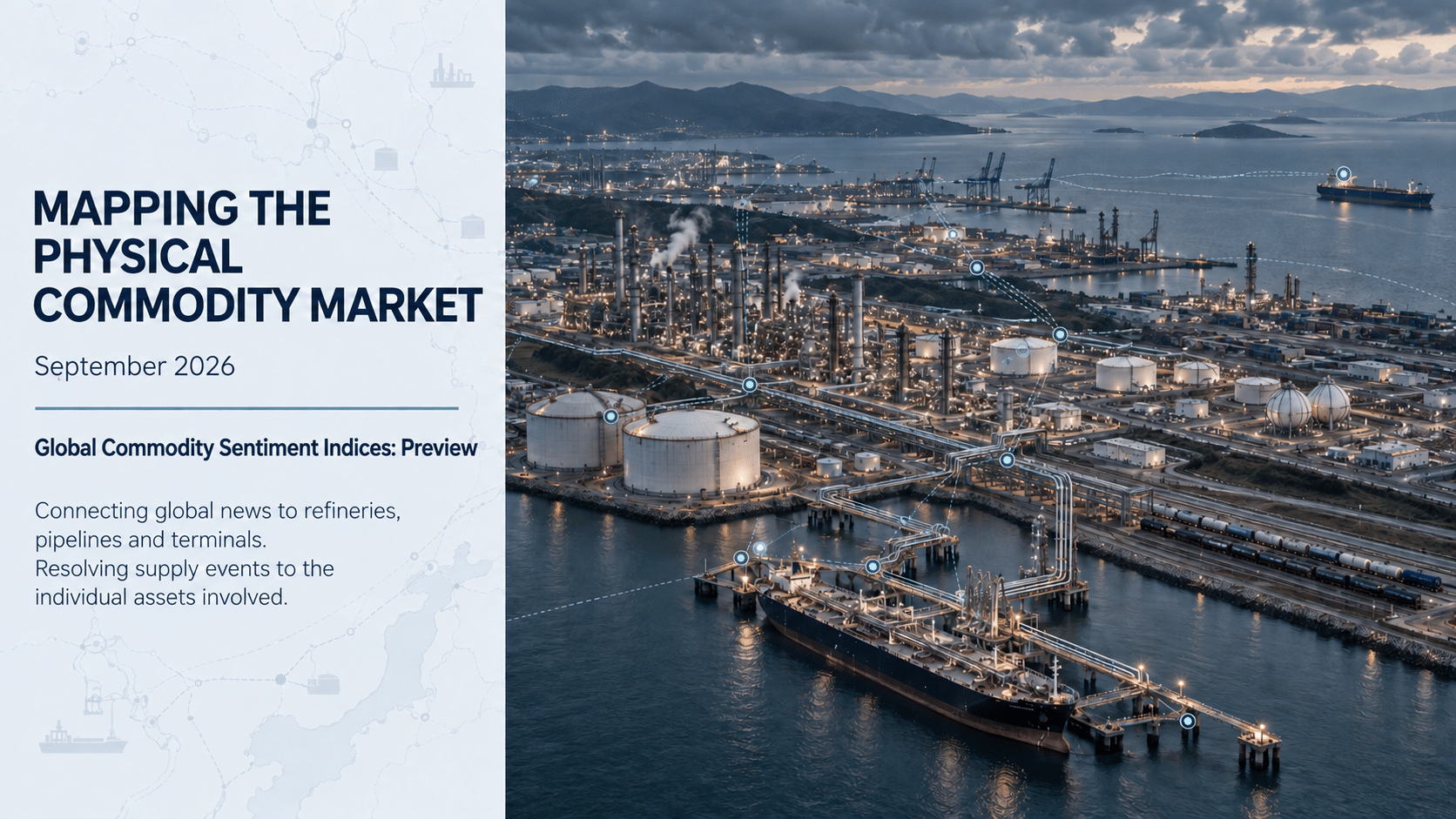
Permutable previews physical asset intelligence ahead of Global Commodity Sentiment Indices launch
08 Sep 2026
08 Sep 2026
Permutable previews the physical asset intelligence underpinning its forthcoming Global Commodity Sentiment Indices release. This article explains how mapping commodity news to individual refineries, pipelines, terminals and other infrastructure can distinguish materially different supply events. It is aimed at commodity traders, quantitative researchers, macro investors and data teams seeking more precise, traceable signals from global news across physical commodity markets.
A run of negative supply headlines will tell you that pressure is building around a commodity, however what it will not necessarily tell you is what has caused it.
A temporary outage at a small regional refinery, disruption to a major export terminal and scheduled maintenance on a pipeline can all register as negative supply events. Though from a market perspective, they are not equivalent.
The asset’s location and its role within the wider supply chain are key. News-derived context on capacity, ownership and operating status can then help assess whether an event is locally significant or may have wider implications for physical availability and pricing.
This is one of the areas we have been working on for the forthcoming release of Permutable’s Global Commodity Sentiment Indices.
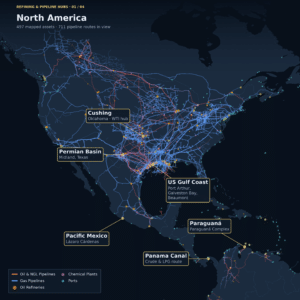
Above: North America map of refineries, chemical plants and pipeline networks tracked by Permutable’s Global Commodity Sentiment Indices
Commodity reporting does not always describe an asset consistently. For instance, a refinery might be referred to by its formal name in one article, by its operator in another and simply by its location elsewhere. A single outage can therefore appear to be several separate events unless those references are resolved to the same facility.
The physical asset layer we are building at Permutable is intended to address this. It connects reporting to named refineries, chemical plants, pipelines, ports, LNG and coal terminals, power and gas infrastructure, and extraction and storage sites.
An article can then be linked to the facility it concerns rather than being classified only under a broad topic such as crude supply, refining disruption or gas infrastructure.
The asset information is publicly sourced. Therein, the work lies in resolving different references to the same facility and connecting that facility to the commodities, companies, events and markets around it.
Consider two refinery outages. Both may be classified as negative for crude supply, but that classification leaves several questions unanswered.
How much capacity is affected? Is the outage planned or unexpected? Does the refinery serve a major trading hub? Are alternative routes or facilities available? Has the event affected production, processing, storage or transport?
Facility-level information does not answer every one of these questions on its own, but it does provide the structure needed to investigate them properly.
It also makes it easier to follow an event as it develops. The first report may describe an operational problem. Later coverage might confirm the scale of the outage, identify the units affected or provide an expected restart date. Resolving those reports to the same asset produces a more coherent picture than treating each headline as an isolated signal.
For market analysts, the useful question is not simply whether supply sentiment is positive or negative, but more so whether the change can be traced to infrastructure with enough physical significance to affect the market.
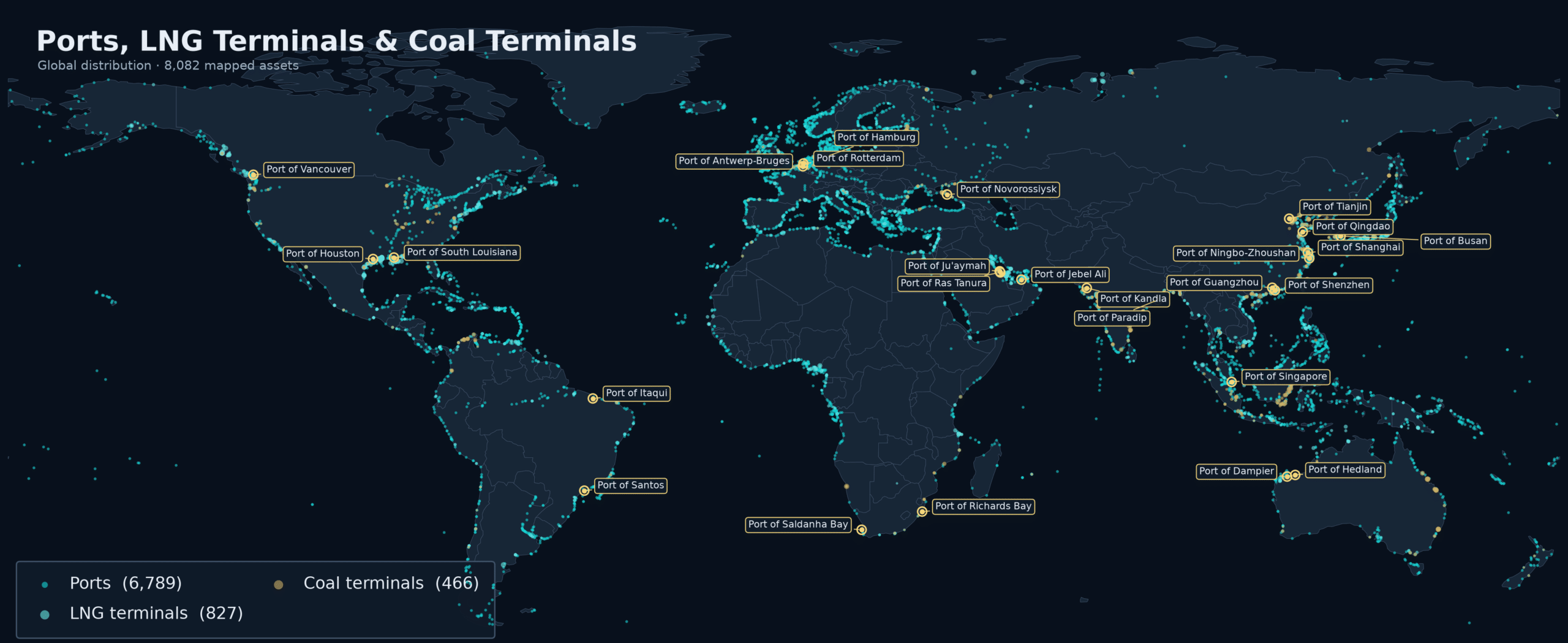
Above: Global coverage of shipping ports, LNG terminals and coal terminals, powered by Permutable’s Global Commodity Sentiment Indices
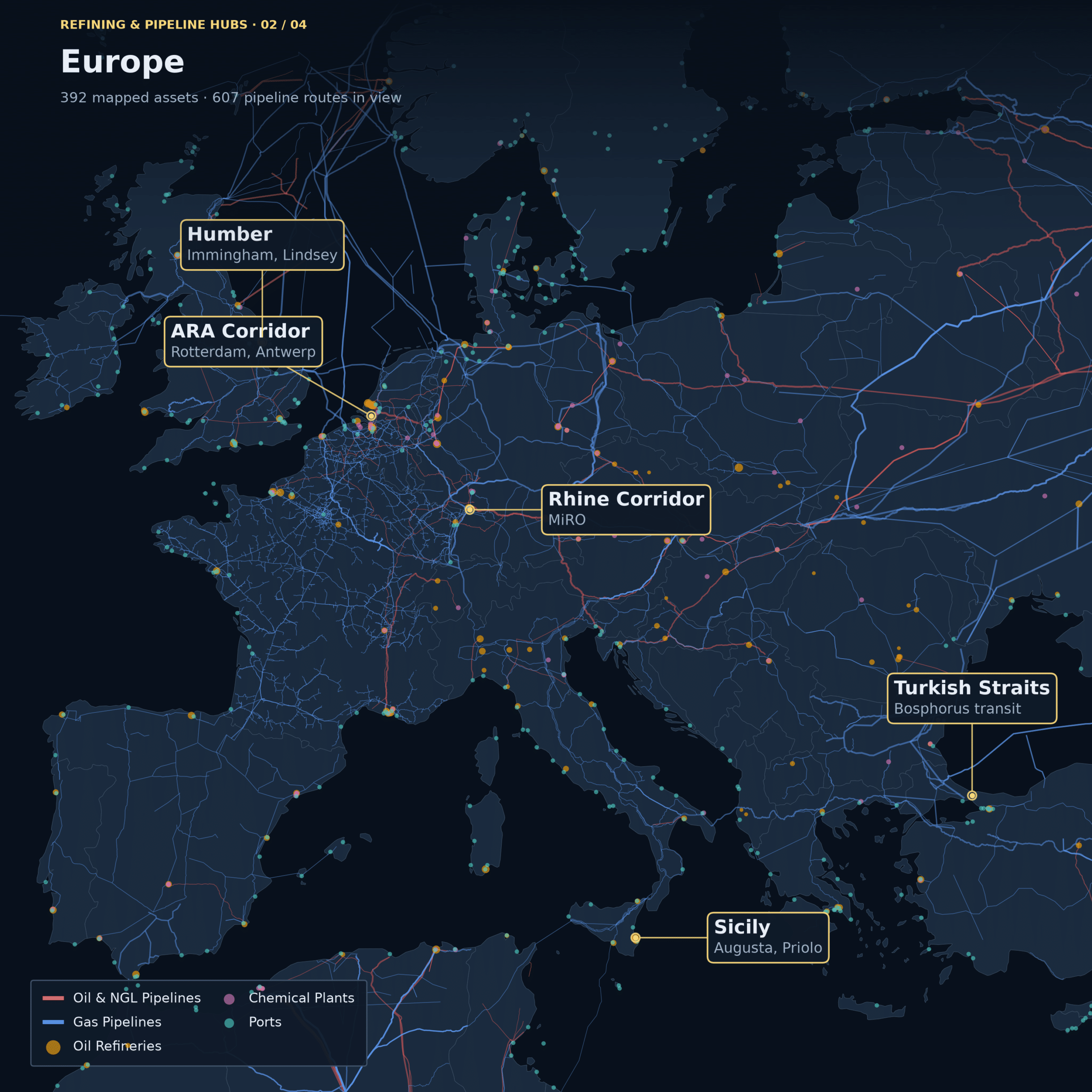
Above: European power and gas infrastructure mapped at regional detail, powered by Permutable’s Global Commodity Sentiment Indices
Physical asset intelligence is not a substitute for shipping data, satellite imagery, inventory figures, benchmark prices or fundamental market research.
It provides a different view: how events involving specific assets are being reported, how the narrative around them is changing and whether attention is spreading across sources and markets.
This can be useful when the physical consequences of an event are not yet fully known. News often develops before its complete effect appears in flow, production or inventory data. Linking that reporting to the relevant infrastructure gives researchers a more precise starting point for assessing what may follow.
It also improves the interpretation of sentiment data. A rise in negative supply sentiment becomes more informative when it can be attributed to a specific pipeline, refinery or export terminal rather than an undifferentiated group of headlines.
Permutable’s Global Commodity Sentiment Indices use a graph-backed architecture connecting sources, entities, events, commodities and markets. Physical assets fit naturally into that structure because they often sit between the reported event and the benchmark that may ultimately be affected.
The new layer is being built to connect reporting with the infrastructure involved, establish what that infrastructure produces, processes, stores or transports, and map it to the relevant part of the commodity market.
It will form part of the forthcoming Global Commodity Sentiment Indices release, alongside broader coverage of physical trade routes and supply chains and updates to our entity-resolution, relevance, topic and sentiment models.
We will be sharing more from the work ahead of the release.
At Permutable, we provide source-traceable commodity sentiment and narrative intelligence across energy, metals and agriculture, with point-in-time data designed for institutional research and systematic analysis.
Explore Permutable’s commodity intelligence or contact our team to discuss access to the Global Commodity Sentiment Indices forthcoming release.
What commodity intelligence does Permutable provide?
Permutable provides source-traceable narrative and sentiment intelligence across commodity markets, connecting reporting with entities, events and physical infrastructure.
What is being added to Global Commodity Sentiment Indices in the upcoming release?
The upcoming release will introduce wider coverage of physical assets, trade routes and supply chains, alongside updates to Permutable’s entity-resolution, relevance, topic and sentiment models.
Who is it designed for?
The platform is designed for institutional commodity teams, energy traders, macro desks, quantitative researchers and data teams examining how global events feed into physical commodity markets.

16 Oct 2026
Permutable wins AI Innovation of the Year: Europe at the Euromoney Markets Awards 2026
Read more >
Analysis
16 Oct 2026
Gold outlook 2026: Why US rates outweigh geopolitical risk
Read more >
15 Oct 2026
Permutable brings inflation sentiment data across 95 countries to Macrobond
Read more >