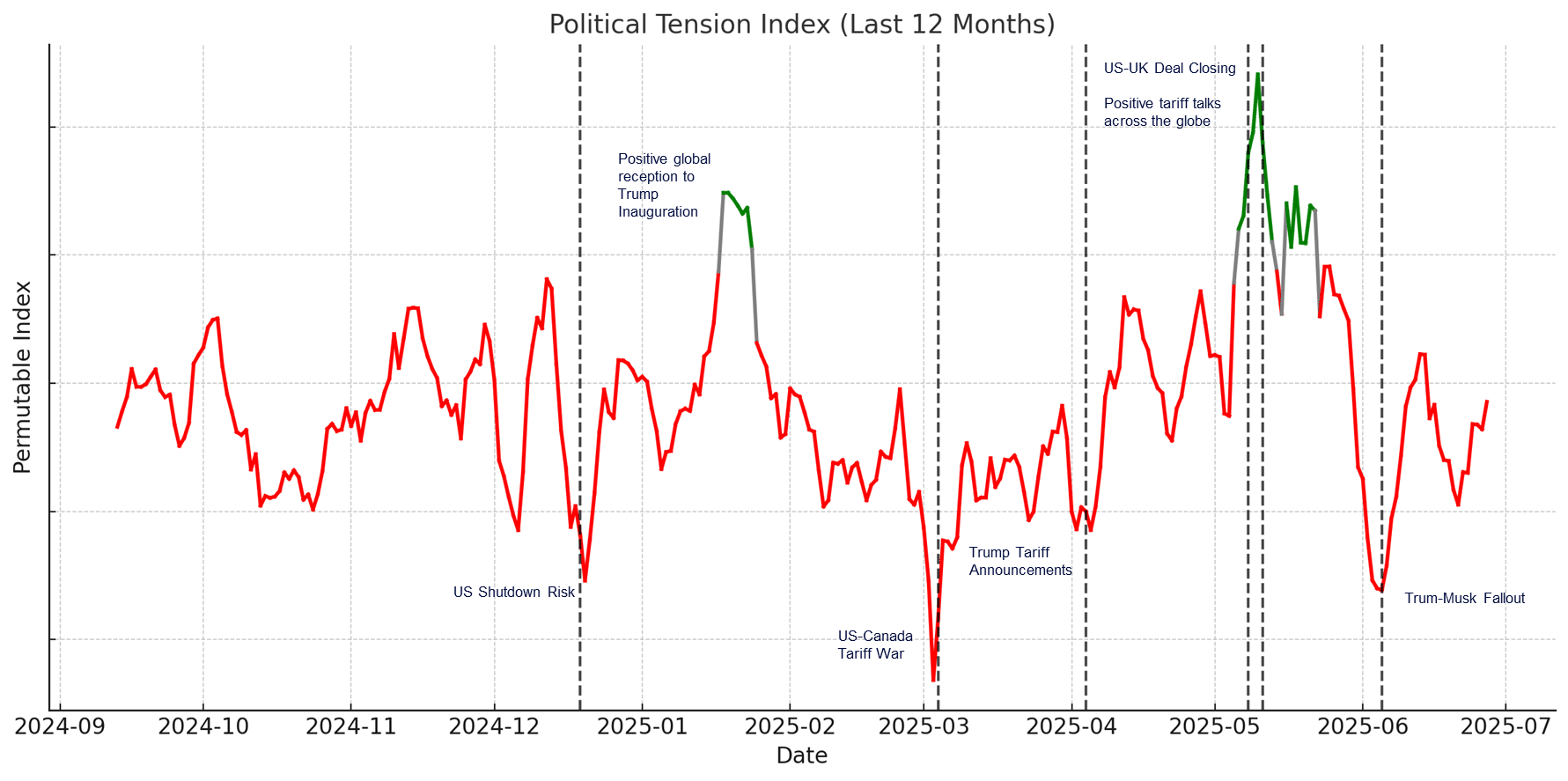
We have released our comprehensive 12-month analysis from the Political Tension Sentiment Index, revealing that global political sentiment has remained overwhelmingly negative throughout the period – driven by sustained trade conflicts, high-profile leadership events, and frequent diplomatic flashpoints.
Our Index, which leverages advanced machine learning to track sentiment across thousands of headlines in near real time, reveals a pattern of persistent volatility with minimal recovery periods. This signals heightened risk conditions for markets, institutions and policymakers alike.
Table of Contents
ToggleVolatility has become the new normal
Our data shows that political risk is no longer episodic – it has become systemic. The Index highlights continuous swings in political sentiment, reflecting embedded instability that extends well beyond one-off crises. Investors are now operating in a sentiment-driven environment where trade policy and public figures can have immediate and far-reaching impacts on market confidence.
Political risk manifests differently in global markets than it has historically. Rather than experiencing isolated periods of tension followed by stability, we are witnessing a sustained state of political volatility that has become the baseline condition for international relations. Understanding and managing political risk has therefore become crucial for modern investment strategies.
Trade tensions remain the primary catalyst
Our analysis identifies trade policy as the most significant driver of political sentiment volatility. The Index recorded substantial sentiment plunges during the US–Canada tariff dispute in February 2025 and again following Trump’s tariff policy announcements in April 2025. These events demonstrate how protectionist economic measures continue to drive global unease and create ripple effects across international markets.
The persistence of trade-related sentiment volatility suggests that global economic integration remains fragile, with markets highly sensitive to any signals of protectionist policy shifts. This finding has critical implications for commodity pricing, supply chain management, and international investment strategies. Political risk assessment must now account for the heightened sensitivity of global markets to trade policy announcements.
How to read this chart
The Political Tension Index plots daily sentiment on a normalised scale. Red segments denote elevated tension (risk-off tone), green segments mark brief improvements, and grey connectors show transitions. Dashed vertical lines highlight key event windows; annotations flag catalysts (e.g., US–Canada tariff war, Trump tariff announcements, US-UK deal closing, Trump–Musk fallout). Over the past 12 months, the line spends most time in the red, confirming persistent, systemic tension with fleeting green reprieves around May’s deal/tariff-talk headlines. The deepest troughs coincide with tariff shocks (late Feb/early Mar) and the sharp June decline tied to leadership controversy – evidence that trade policy and personality-driven events dominate the risk regime.
Diplomatic progress offers only fleeting stability
Whilst our data shows temporary sentiment rebounds linked to positive developments such as the US-UK trade deal and global tariff talks in May 2025, these improvements were quickly reversed. This pattern highlights the fragile nature of the current geopolitical outlook and suggests that markets remain sceptical about the sustainability of diplomatic progress.
The brief nature of these positive sentiment spikes indicates that investors and stakeholders are adopting a more cautious approach to geopolitical developments, requiring sustained evidence of stability before adjusting their risk assessments.
Leadership events drive immediate market impact
Our Index demonstrates how individual personalities are increasingly influencing global political sentiment. We recorded a sharp spike after Trump’s inauguration in January 2025 and a steep decline following the Trump-Musk fallout in June 2025. These events reveal the outsized influence that public figures and leadership dynamics have on market confidence.
Political risk becomes increasingly complex for risk managers and investors when individual personalities drive market sentiment, as traditional geopolitical analysis must now account for individual relationships and public controversies that can rapidly alter market sentiment. Modern political risk management requires sophisticated tools to track these personality-driven volatility patterns.
Our CEO’s perspective on systemic political risk
Our data shows that political risk is no longer episodic – it’s become systemic,” commented Wilson Chan, our Chief Executive Officer. “Investors are operating in a sentiment-driven environment where trade policy and public figures can have immediate and far-reaching impacts on market confidence. Our Political Tension Index provides an essential early indicator to help hedge funds, risk managers and policy strategists stay ahead of these shifts.”
Elevated volatility expected through 2025
Our market analyst Jack Watson anticipates that political volatility will remain elevated through the second half of 2025. “With upcoming elections, unresolved trade tensions, and continued scrutiny of political leaders, the environment remains highly reactive,” Watson explained. “Markets are likely to stay sensitive to sentiment-driven headlines, which could directly affect commodity pricing, equity markets, and broader global risk appetite into 2026.”
How our Political Tension Index works
Our Political Tension Sentiment Index uses advanced natural language processing to extract sentiment signals from thousands of global media headlines. It tracks public mood related to governance, diplomacy, trade disputes, controversies and leadership perception, offering investors a clear lens on global political instability.
Political risk monitoring through our Index serves as a real-time warning signal and a leading indicator of rising tensions, helping investors and risk professionals make timely adjustments to their exposure. It also provides quantitative insight into political sentiment, making it a valuable alternative data source for macro modelling, geopolitical forecasting and stress testing. Effective political risk monitoring requires continuous data feeds and sophisticated analytical capabilities.
With daily updates and global scope, the Index reflects sentiment across international headlines, giving users a cross-border view of evolving political pressure points.
Implications for risk management
Political risk management strategies require fundamental reassessment given the systemic nature of current political volatility. Traditional approaches that treat political risk as episodic may be insufficient in the current environment. Our data suggests that continuous monitoring and rapid response capabilities are now essential for effective risk management. Political risk has evolved from a peripheral concern to a central factor in investment decision-making.
At Permutable, we provide real-time global market data intelligence to institutional investors and risk professionals through our AI-powered tools that extract and interpret insights from news media, macroeconomic indicators and geopolitical signals – enabling faster and more informed strategic decisions through our specialist plug and play intelligence solutions.
Contact our team today to discover how our Political Tension Index can enhance your risk management strategy. Get in touch by emailing enquiries@permutable.ai to schedule a demonstration and see how our real-time sentiment intelligence can protect your portfolio from unexpected political volatility.

FAQs: Interpreting the Political Tension Index
Q1: What does the index actually measure?
It quantifies daily political-risk sentiment from thousands of headlines using NLP, scoring tone around governance, diplomacy, trade, and leadership. Higher red readings = greater perceived tension.
Q2: How should I interpret spikes and dips?
Sharp downturns (deep red) signal risk-off political pressure likely to weigh on confidence and liquidity. Green spikes are temporary sentiment improvements; in this period they faded quickly, indicating fragile relief.
Q3: What are the main drivers of moves here?
Trade actions (tariffs, sanctions) and leadership events drove the largest swings. February/March tariff episodes and June’s leadership fallout produced the steepest drops; May’s deal headlines produced only short-lived recoveries.
Q4: How often is the index updated and can it lead markets?
It updates daily (near real time). Because it reacts to narrative flow, regime shifts often appear in the index before they’re fully priced, offering an early-warning input for risk and positioning.
Q5: How can investors use this in practice?
As a risk overlay (tighten hedges as red accelerates), for scenario/stress design (pair event windows with P&L), or as a signal filter alongside price/fundamental models to detect regime changes.