Henry Hub natural gas spot price analysis: Bullish signals emerge January 2025

In recent months, natural gas markets have become increasingly complex, with our Trading Co-Pilot platform identifying several significant developments affecting the Henry Hub natural gas spot price, pointing towards a generally bullish outlook. Many will think this optimism premature given recent volatility, yet ultimately, the data suggests a compelling story unfolding.

Market evolution and current dynamics 

Of course, the past week has shown notable demand surges, with our platform tracking several major infrastructure developments. In particular, Kinder Morgan’s new pipeline approval and ongoing exploration activities by ExxonMobil and Qatar Energy have emerged as significant positive indicators. It may well be true that these developments alone don’t guarantee Henry Hub natural gas spot price increases, but in contrast with previous market cycles, the infrastructure buildout comes at a crucial juncture.

Supply-demand complexities

Suffice to say, there is more than one way to skin a cat when it comes to analysing market dynamics, but clearly, the current situation presents a scathing challenge to traditional approaches. The EIA has been asserting rising wholesale power prices due to increased demand, and with it being recently reported that there’s been a significant drop in oil and gas rig counts, this actually strengthens the bullish case. 

Many are now believing that perhaps fears that production constraints might limit market growth have been overblown with the baton soon picked up again by major infrastructure projects. Though it is still early days, but the Transco pipeline approval reinstatement and new drilling activities in Cyprus suggest robust development pipeline. This will not be the same as previous infrastructure cycles – instead, we’re seeing more strategic, targeted expansions.

Weather patterns and market response

Thus far this Winter, weather has played a key role in Henry Hub natural gas spot price movements. In part, Goldman Sachs’ raised forecast for US gas prices reflects this reality, aligning with our platform’s detection of weather-related sentiment shifts. Rather, it is more like a perfect storm of factors affecting the Henry Hub natural gas spot price, as temperature forecasts increasingly drive market sentiment.

Our Trading Co-Pilot has detected a notable correlation between weather forecast updates and immediate price reactions, with even minor temperature revisions triggering significant market moves. This heightened sensitivity to weather patterns suggests that traders are positioning themselves more reactively to meteorological data than in previous seasons, creating both risks and opportunities for market participants.

Market implications and trading strategy 

So the question is, what does this all mean for traders? At its core, our Trading Co-Pilot‘s analysis suggests a favourable risk-reward setup for the Henry Hub natural gas spot price. So we will soon see whether the market validates this view, but with current prices at 3.17, our Trading Co-Pilot’s recommended strategy balances prudent risk management with upside potential.

In short, this is a problem too complex for simple solutions, and is also a reflection of how complex global market dynamics have once again come back to the fore, – particularly with strengthening European gas markets suggesting a tightening supply environment. Ultimately, what is needed is careful monitoring of our identified timeline triggers. Thankfully, this is made easily accessible through our Trading Co-Pilot, exemplified by the chart above, with our platform continuing to monitor these developments in real-time, providing our users with actionable insights as market conditions evolve and careful analysis of multiple data streams.

We help traders navigate complex market dynamics 

Our Trading Co-Pilot platform delivers real-time insights across commodities markets, processing over 10,000 articles daily to identify market-moving events before they impact prices. Through advanced geolocation filtering, comprehensive sentiment tracking, and real-time event detection, we provide traders with the tools they need to make informed decisions in rapidly evolving markets.

If you’re interested in seeing how our market intelligence platform can enhance your trading strategy, we’d be delighted to show you a personalised demonstration of our capabilities for enterprise clients. Email enquiries@permutable.ai to schedule your enterprise demo, subject to approval or fill out the form below to learn more about how we’re transforming market intelligence for enterprise traders

Find out more


European natural gas prices: A perfect storm of supply challenges and weather impacts

The alarm bells are ringing across European natural gas markets as we move into 2025, with prices displaying particular volatility in the last week. Insights from our Trading Co-Pilot reveal a complex interplay of factors and heightened sensitivity in the market. With that said, let us rattle through some of the key developments that have shaped this week’s trading European natural gas prices, where we’ve seen everything from weather-driven demand spikes to supply chain disruptions creating unique trading patterns – and of course the much talked about Trump LNG effect.
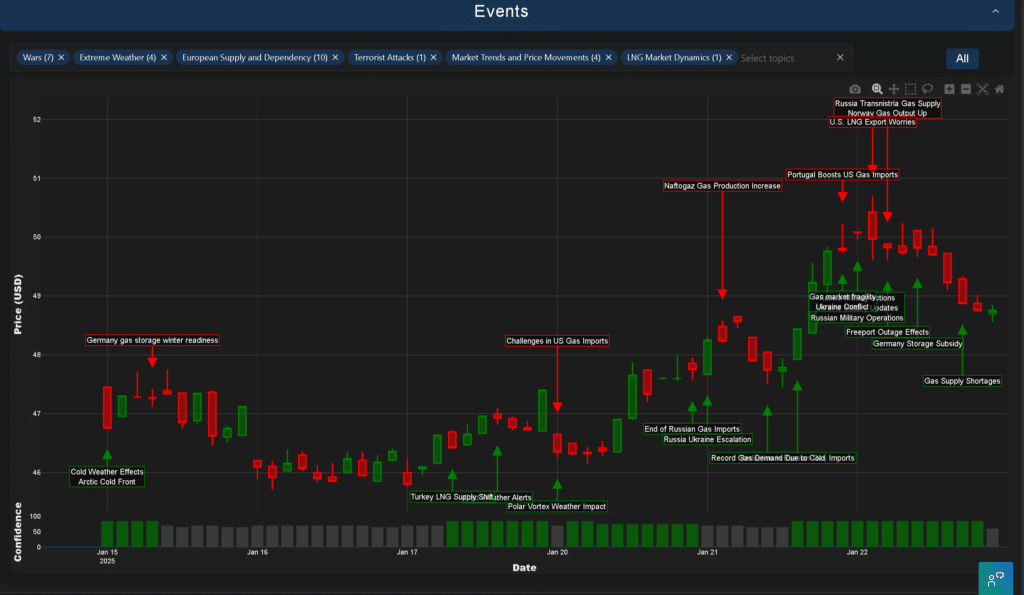
European natural gas price

Supply dynamics and market fragility

The point which becomes obvious pretty quickly is that European natural gas prices are being pulled in multiple directions, creating both risks and opportunities for TTF traders. According to sources, Europe may require over 100 additional gas cargoes to replenish its dwindling stocks, highlighting the fragility of current supply chains. Our Trading Co-Pilot’s analysis shows this news triggered a clear price movement, demonstrating the market’s acute sensitivity to supply-related headlines.

Not long ago, this might have seemed manageable, but the recent Freeport LNG outage has led to a surge in TTF natural gas prices, pushing the market into new territory. Our Trading Co-Pilot clearly shows the immediate price impact, with a notable spike following the announcement. Almost everyone we speak to in the industry now acknowledges that traditional supply-demand models need updating to account for this new market reality.

Weather and demand pressures

To add to this, extreme cold weather is expected to drive record gas demand. This concern has three components that our Trading Co-Pilot clearly illustrates: immediate supply pressure showing in rapid price movements, storage depletion rates accelerating beyond normal seasonal patterns, and increased price volatility during weather events. The trouble is, this comes at a time when European natural gas prices are already showing significant sensitivity to supply disruptions.

What’s clear is that cold weather effects, particularly the Arctic cold front, have created distinct trading patterns. What’s more is that the market response to these weather events has been notably more pronounced than in previous years, with particularly sharp reactions during the early morning hours when temperature forecasts are updated. The Polar Vortex impact has been especially notable, creating a new pattern of price behaviour that suggests weather premium is being built into the market at levels we haven’t seen before.

Geopolitical complexities and supply security

And that’s before we address the ongoing Russia-Ukraine conflict escalation. So what’s actually is going on here? Well, the EU has successfully reduced its imports of Russian gas by 75%, but this has created new market dynamics that are clearly visible in our data. It’s the same story on alternative supply sources – Portugal has shifted its gas sourcing away from Russia, increasing imports from the US and Nigeria, yet even now, these transitions are creating their own complex market patterns.

The crisis in supply security is forcing energy traders to develop new risk management strategies. In addition to that, the market has shown particular sensitivity to news about US LNG exports, with significant price movements within hours of major announcements from the new Trump administration.

Supply diversification and market innovation

Just as notably, Germany is considering a plan to subsidise gas storage refills, which could influence market dynamics and supply strategies. Our Trading Co-Pilot data showed an immediate positive market reaction to this news. And then there was the news that Norway’s gas output saw a slight increase in December to consider, though the market response was relatively muted, suggesting TTF traders will be more focused on longer-term supply solutions.

So when it emerged that Russia is preparing to supply gas to Transnistria through Türkiye starting in February, our data showed an interesting market reaction pattern. This method applies equally to understanding the impact of Germany’s storage subsidy plan and other policy initiatives, with clear price movement correlations visible in our data.

Forward-looking market implications

All this means that European natural gas prices are likely to remain volatile throughout the rest of the winter period, as we’ve previously reported on before. Initially, the market’s focus was on storage levels, but now for traders, the key metrics have expanded significantly. In this scenario, our data suggests we can expect continued price sensitivity, with potential for larger movements during extreme weather events or supply disruptions.

Of course, there’s a reason why the market is watching these developments so closely. As with most things in energy markets, the interplay between supply, demand, and geopolitical factors creates complex trading conditions. And yet perhaps the most interesting aspect is how the market is adapting to these new realities.

What we’ve found through our Trading Co-Pilot analysis is that it is the correlation of multiple data points and overlapping factors – whether it be weather patterns to storage levels, or geopolitical developments to infrastructure constraints – rather than single events that is causing price movements.  

Despite this challenging environment, the market is adapting to new realities. And while volatility in European natural gas prices may persist, the market is gradually developing new mechanisms for resilience. There is a definite sense that energy traders are becoming  more sophisticated in their approach to risk management and trading strategies, for for our clients, integrating our Trading Co-Pilot is becoming an important part of this.

The crisis in market stability has forced innovation in trading approaches, and that’s perhaps the silver lining in current conditions. Whether this narrative holds through 2025 remains to be seen, but one thing is certain: the European gas market continues to offer significant opportunities for the those leading the herd with our AI-powered market insights.

Ultimately, success in this market requires not just understanding individual events but comprehending how multiple factors interact to influence price movements. The data from our Trading Co-Pilot platform clearly demonstrates this evolution, showing precisely how successful traders are those who can integrate multiple data streams into their decision-making processes.

Experience our natural gas market intelligence first hand

Seeing these market dynamics play out in real-time can transform how you trade. Our Trading Co-Pilot platform doesn’t just track events – it helps you understand their interconnected impact on market movements before they happen. With features ranging from advanced event tracking to real-time market movement alerts, we’re offering tools that can bring a new level of sophistication to your Trading strategy.

After a successful first wave, we’re now opening up early access to our advanced market intelligence platform for select additional enterprise users. As part of this exclusive program, you’ll receive premium access to all features of our Trading Co-Pilot and direct support from our team. The past week’s volatility in European gas markets demonstrates why timing and insight matter – and so now is the time to join the growing community of energy traders who are already using our platform to stay ahead of market-moving events.

Ready to transform your trading strategy? Schedule a demo by emailing us at enquiries@permutable.ai or simply fill in the form below to get in touch.

*Early access program is limited to select enterprise clients and subject to qualification.

Enquire now


Ukraine shuts off gas supplies to Europe: Impact on US Natural Gas prices

In a world where energy security has become increasingly critical, the recent halt of Russian gas flows through Ukraine has sent alarm bells ringing once again through global energy markets, with a resulting ripple effect that can be see on US natural gas prices. Here, we taken a closer look at this recent development with analysis taken from our Trading Co-Pilot.

Fundamental market shifts 

Today, we’re witnessing an obvious realignment of global energy flows. Even before the most recent disruption, European gas markets were already in a precarious position. Fundamentally, it is about more than just supply and demand – it’s about the complete restructuring of energy relationships that have existed for decades.

But, herein lies the difference between previous market disruptions and the current situation: Europe’s immediate need for alternative gas supplies has created a new floor for US natural gas prices. Not long before this crisis, European buyers were merely occasional customers for US LNG. This means that the appetite for American gas is reaching historic highs.

US Natural Gas prices – implications and market response

Furthermore, US natural gas prices have demonstrated remarkable sensitivity to European market signals. And yet, domestic factors continue to play a crucial role. The logic for this price movement is clear: as Europe scrambles for supplies, US producers are ramping up production to meet this demand. Nevertheless, rather than simply responding to spot market opportunities, many producers are now seeking longer-term commitments.

Unwittingly, this has created a new dynamic in US natural gas prices. This is where the domestic market’s traditional seasonality meets international pricing pressures, creating new patterns that can be harder to understand. Perhaps we could be so bold as to say that the future looks painful for those who haven’t adapted their trading strategies to account for these structural changes.

Weather factors and seasonal impacts

Today, it is very different from the historical patterns that traders relied upon. And worryingly so, as weather impacts now have a compound effect on US natural gas prices – not only through domestic demand but also via their influence on European buying patterns. At the very least, this requires a more sophisticated approach to weather-based trading strategies.

But now, the intersection of weather patterns with geopolitical factors creates new complexities. The age of uncertainty is here, particularly when it comes to predicting how weather events in different regions might interact to impact US natural gas prices. This means that traditional seasonal trading patterns will require significant recalibration.

US Natural Gas prices and market interconnectivity

If this analysis provides anything like a glimpse into the future, it suggests a fundamental shift in how regional gas markets interact. The world is increasingly splintered between different energy blocks, yet paradoxically more connected through LNG trade. A reality check on these market dynamics shows US natural gas prices are now inextricably linked to global events.

Furthermore, this interconnectivity extends beyond simple price correlations. In this fragmented era, supply chain relationships, infrastructure capabilities, and geopolitical alignments all play crucial roles in determining US natural gas prices. This has created a multi-layered market where domestic and international factors constantly interact.

Supply chain adaptations

To add to all this, there is the fact that the infrastructure needed to fully capitalise on these market shifts is still developing. It is not that long since US LNG export capacity was minimal, and even today’s expanded capacity struggles to meet surging demand. The impact on US natural gas prices is particularly evident during periods of peak international demand, when export terminals operate at maximum capacity.

This means that the appetite for infrastructure investment has reached new heights. At the very least, the next few years will see significant expansion in US export capabilities. Nevertheless, rather than assuming this will lead to price stabilisation, traders should prepare for new patterns of volatility as domestic and international markets become increasingly intertwined.

Final thoughts

In a world where energy markets are increasingly interconnected, the halt of Russian gas transit through Ukraine represents more than just another supply disruption. Herein lies the difference between previous market events and the current situation: this shift has fundamentally altered how US natural gas prices respond to global events.

The future of US natural gas prices will likely be characterised by greater complexity and stronger international correlations. Needless to say, energy traders will need to adapt to these new realities and we predict the appetite for sophisticated trading tools and analytical capabilities to help navigate this increasingly complex environment will only grow. In this fragmented era, success will depend on understanding not just domestic market dynamics, but the intricate web of global factors that now influence US natural gas prices.

Navigating Natural Gas volatility with confidence 

In today’s increasingly volatile natural gas markets, staying ahead requires more than just traditional trading tools. That’s why we’re offering enterprise trading teams a unique opportunity: a complimentary one-month trial of our Trading Co-Pilot platform, the same technology already being used by some of the world’s leading energy trading houses.

During your trial period, you’ll gain complete access to our comprehensive suite of trading tools, which in the soon-to-be released version will include real-time market analysis, AI-powered trading agents specifically calibrated for natural gas markets, advanced volatility monitoring, and comprehensive social media sentiment analysis. Our platform seamlessly integrates with your existing trading infrastructure, while our technical team provides dedicated support to ensure you maximise the platform’s capabilities for your specific trading needs.

Join the growing number of energy trading professionals who are transforming their approach to market analysis and trading decisions. Whether you’re managing long-term positions or navigating daily market volatility, our Trading Co-Pilot provides the insights and analysis you need to trade with greater confidence and precision.

Ready to experience the difference? Contact our team today at enquiries@permutable.ai or fill in the form below to schedule your demo and activate your free trial. Available for qualified enterprise trading teams, subject to approval.

Request demo