This article provides a comprehensive analysis of the most critical breaking geo political issues 2025 at time of writing and their profound impact on global markets, providing institutional investors with strategic insights for navigating unprecedented political risk. It is aimed at institutional investors, portfolio and macro strategists, risk managers, commodities and energy traders, and global research teams seeking to anticipate and capitalise on geopolitical developments before they reach market consensus.
The landscape of global geopolitical risk has fundamentally shifted in 2025, presenting institutional investors with a complex web of interconnected tensions that demand sophisticated analytical capabilities and real-time intelligence. The rising wave of geo political issues are not merely isolated incidents but part of a broader realignment of global power structures that will continue to shape market dynamics for years to come. The traditional approach of reactive positioning – waiting for geopolitical events to unfold before adjusting portfolios – has proven increasingly inadequate in an environment where milliseconds can determine the difference between capturing alpha and experiencing significant losses.
For institutional investors, the challenge extends beyond simply identifying potential flashpoints to understanding their interconnected nature and cascading effects across multiple asset classes, regions, and time horizons. The sophisticated investor recognises that effective macro research in today’s environment requires not just awareness of these tensions but the ability to process vast streams of real-time intelligence, identify subtle shifts in sentiment and positioning, and translate these insights into actionable investment strategies before market consensus emerges.
The evolving trade relationship between the United States and China continues to represent one of the most significant geo political issues in 2025, with implications extending far beyond bilateral trade flows. The complexity of this relationship has deepened as both nations navigate technological competition, supply chain reorganisation, and strategic alliance building. For institutional investors, understanding these dynamics requires monitoring not only official government communications but also corporate earnings calls, supply chain disruptions, and shifting patterns in global manufacturing and technology investment.
The alliance dimension adds another layer of complexity, as US partnerships with Japan, South Korea, Australia, and European nations create ripple effects that impact everything from semiconductor markets to rare earth metal pricing. Importantly, sophisticated macro research capabilities enables investors to track sentiment shifts across multiple jurisdictions simultaneously, providing early warning signals for policy changes that may not be immediately apparent through traditional diplomatic channels. The ability to process and analyse these diverse information streams in real-time through technologies such as our provides powerful advantages for positioning in technology sector equities, emerging market currencies, and commodity futures.
The ongoing tensions between Iran and Israel have evolved into a broader regional confrontation with profound implications for global energy markets and Middle Eastern stability. The Strait of Hormuz, through which approximately 20% of global oil passes, remains a critical chokepoint that demands constant monitoring by energy traders and macro strategists. The sophistication required to analyse this situation extends beyond simple conflict monitoring to encompass complex supply chain analysis, regional alliance dynamics, and the potential for proxy conflicts across multiple theatres.
For institutional investors, the challenge lies in understanding how these regional tensions translate into global market impacts. Oil price volatility, safe-haven flows into precious metals and government bonds, and currency fluctuations in energy-dependent economies all require sophisticated analytical capabilities that can process information from diverse sources whilst identifying patterns and connections that may not be immediately apparent. It is here that real-time sentiment analysis of government communications, military positioning, and diplomatic initiatives provides distinct competitive advantage, providing crucial early warning signals for potential escalation or de-escalation scenarios.
The persistent tensions along the India-Pakistan border represent a significant source of regional instability with global implications for technology outsourcing, manufacturing supply chains, and emerging market investment flows. The nuclear dimension of this relationship adds layers of complexity that require sophisticated risk assessment capabilities beyond traditional geopolitical analysis. For institutional investors with exposure to South Asian markets, understanding these dynamics requires monitoring not only official government communications but also military movements, diplomatic initiatives, and public sentiment across both nations.
The economic implications extend far beyond the immediate region, with potential disruptions to global technology supply chains, pharmaceutical manufacturing, and textile production. Macro research capabilities that can track sentiment shifts in this context provide essential insights for investors seeking to position themselves appropriately in emerging market equities, currency markets, and sector-specific exposures that may be affected by escalating tensions.
The evolving relationship between Turkey and Israel, particularly in the context of Syrian developments, represents a complex geopolitical dynamic with implications for NATO cohesion, regional stability, and energy transit routes. The multifaceted nature of this situation requires advanced analytical capabilities that can process information from diverse sources whilst understanding the historical context and strategic implications of various policy positions.
For institutional investors, the challenge lies in understanding how these regional dynamics translate into broader market impacts. Currency volatility in the Turkish lira, implications for European energy security, and potential disruptions to trade routes all require sophisticated analytical frameworks that can identify subtle connections between seemingly unrelated developments. The ability to track sentiment across multiple stakeholders and jurisdictions provides obvious advantages for positioning in emerging market currencies, energy sector equities, and regional bond markets.
The emerging strategic coordination between China, Russia, Iran, and North Korea – otherwise known as “The Axis of Upheaval” – represents a concerning fundamental shift in global power dynamics with far-reaching implications for international trade, financial markets, and security architecture. Understanding this complex relationship requires analytical capabilities that can process information from diverse sources whilst identifying patterns and connections that may not be immediately apparent through traditional diplomatic channels.
For institutional investors, the implications extend across multiple asset classes and regions. Sanctions regimes, trade route disruptions, technology transfer restrictions, and commodity price volatility all require sophisticated risk assessment capabilities that can anticipate policy changes and market reactions before they are reflected in asset prices. Here, the ability to track sentiment and positioning across multiple jurisdictions provides essential early warning signals for potential market disruptions or investment opportunities.
The expansion of Chinese naval presence in the Tasman Sea represents a significant development with implications for regional security architecture, trade routes, and alliance dynamics between Australia, New Zealand, and their Pacific partners. Understanding the strategic implications of this development requires analytical capabilities that can process information from diverse sources whilst assessing the potential for escalation or accommodation.
For institutional investors, the implications extend beyond immediate regional concerns to encompass broader questions about global trade routes, commodity exports, and currency stability in the Pacific region. The ability to track sentiment and positioning across multiple stakeholders provides crucial insights for positioning in commodity markets, regional currencies, and sector-specific exposures that may be affected by evolving strategic dynamics.
The ongoing conflict in Ukraine continues to represent one of the most significant sources of geopolitical risk in 2025, with implications extending far beyond the immediate theatre of operations. The potential for proxy conflicts, alliance testing, and economic disruption requires sophisticated analytical capabilities that can process vast amounts of information whilst identifying patterns and connections across multiple dimensions of international relations.
For institutional investors, the challenge lies in understanding how this conflict continues to shape global markets through energy price volatility, supply chain disruptions, defence sector investment, and safe-haven flows. The ability to track sentiment and positioning across multiple stakeholders provides essential insights for positioning in energy markets, defence sector equities, and European regional investments alike that may be affected by evolving conflict dynamics.
The cumulative effect of these geo political issues in 2025 has created an environment of heightened market volatility that demands sophisticated risk management capabilities and strategic positioning. Traditional approaches to portfolio construction and risk assessment have proven inadequate in an environment where geopolitical developments can trigger rapid shifts in asset prices, currency values, and commodity markets within hours or even minutes of initial reports.
The interconnected nature of modern financial markets means that geopolitical developments in one region can quickly propagate across multiple asset classes and geographic regions. Central bank policy responses, safe-haven flows, and inflation expectations all become interconnected variables that require comprehensive analytical frameworks capable of processing vast amounts of information whilst identifying subtle patterns and relationships that may not be immediately apparent.
For institutional investors, the challenge extends beyond simply identifying potential risks to understanding their potential market impacts and developing appropriate hedging strategies. The ability to integrate real-time geopolitical intelligence into existing risk management frameworks provides crucial advantages for maintaining portfolio stability whilst identifying opportunities for alpha generation during periods of heightened volatility.
Our advanced geopolitical sentiment provides institutional investors with the sophisticated analytical capabilities required to navigate these complex dynamics effectively.
Above: Our real-time geopolitical and macro sentiment intelligence identified a bullish LNG regime before price momentum took off. From early entry post-project disruption to accurately tracking the market’s response to EU sanctions, pipeline expansions, and force majeure developments, Our system flagged the bullish shift in fundamentals and macro tone — well ahead of the crowd.
Our real-time sentiment analysis enables investors to track developments, providing early warning signals for potential escalation or de-escalation scenarios before they are reflected in market prices. Importantly, the integration of historical data spanning multiple years enables sophisticated backtesting and scenario analysis that can help investors understand how their strategies might perform under various geopolitical conditions.
Above: This chart reveals how our geopolitical sentiment data tracked a deepening negative tone surrounding Iran–Israel tensions before Brent crude broke out. With a clear sentiment trough marking the possible entry, investors using our signal analytics gained valuable early warning before the oil rally began to price in risk premium.
In terms of macro research, the ability to feed real-time sentiment data directly into trading algorithms and risk management systems represents a fundamental shift in how institutional investors can respond to evolving geopolitical conditions using our data. This integration enables dynamic adjustment of portfolio exposures based on real-time developments rather than static risk parameters or delayed market reactions.
Above: Our Political Tension Index captures 12 months of shifting geopolitical risk, from the US shutdown threat and Canada tariff war to the Trump-Musk fallout. The green zone highlights a brief diplomatic reprieve – rapidly followed by re-escalation. For institutional clients, this index offers a quantifiable edge in forecasting how political narratives translate into market volatility across FX, commodities, and safe-haven assets.
The bottom line here is that the top geo political issues 2025 weave a complex and delicate landscape of risk requiring sophisticated analytical capabilities that can process vast amounts of information whilst identifying actionable insights for institutional investors. Ultimately, the institutions that successfully leverage these advanced capabilities will find themselves with substantial competitive advantages in an increasingly complex global environment. Why? Simply because the future of geopolitical risk management lies not in replacing human expertise but in augmenting it with powerful analytical tools that can process information at scales and speeds that would be impossible through traditional methods.
As global tensions continue to evolve and intensify, the ability to anticipate and respond to geo political issues before they reach market consensus will become increasingly valuable for institutional investors seeking to maintain competitive advantages whilst managing portfolio risks effectively. The question for institutional investors is not whether to adopt these advanced capabilities but how quickly they can be integrated into existing investment processes to capture the substantial opportunities they represent.
Transform geopolitical chaos into alpha generation – discover how our real-time geopolitical intelligence turns breaking tensions into strategic advantage before they hit market consensus. Contact our enterprise team at enquiries@permutable.ai to see how institutional leaders are using our advanced analytics to navigate 2025’s most volatile geopolitical landscape.

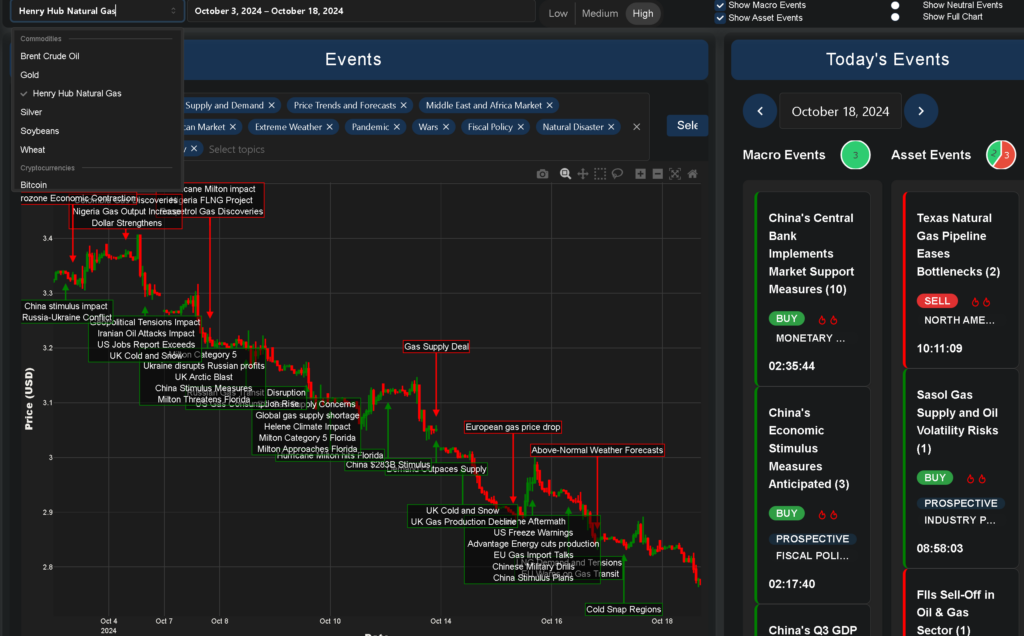
energy The global energy landscape is experiencing unprecedented transformation, with oil and gas news dominated by complex challenges that are reshaping the industry. From geopolitical tensions to environmental pressures, energy traders are facing a volatile operating environment that demands innovative solutions like our Trading Co-Pilot which can predict price changes and market movements coupled with strategic adaptation.
Recent oil and gas news highlights how geopolitical tensions continue to send shockwaves through energy markets. Sanctions on major producers and regional conflicts create significant supply uncertainties. Furthermore, OPEC‘s evolving role and decisions regarding production quotas contribute to market unpredictability, forcing traders and operators to constantly reassess their positions.
The latest oil and gas news reveals persistent supply chain fragilities. Unexpected refinery outages, shipping constraints, and infrastructure limitations create bottlenecks that ripple through global markets. These disruptions are particularly acute in key transportation corridors, where any interruption can trigger significant price movements and supply concerns.
The oil and gas traders we work with consistently cite extreme price volatility as a primary concern in oil and gas news reports. It’s fair to say that the traditional tools for managing price risk are struggling to keep pace with market dynamics. Then there’s the interplay between different crude benchmarks, such as Brent and WTI, which adds another layer of complexity to hedging strategies.
Environmental compliance has emerged as a central theme in oil and gas news coverage. Stringent carbon emissions policies and the accelerating energy transition are forcing companies to reimagine their operational strategies. Meanwhile, carbon pricing mechanisms and renewable energy mandates are creating new cost pressures and market opportunities.
The infrastructure supporting the oil and gas industry faces mounting pressures. Storage capacity constraints and logistics costs significantly impact market dynamics, particularly during periods of contango or backwardation. Recent oil and gas news highlights how these challenges affect both crude oil and natural gas markets.
While technological advancement offers solutions to many industry challenges, implementing new systems presents its own hurdles. The latest oil and gas news emphasises how companies struggle to effectively integrate artificial intelligence, machine learning, and other digital tools into their operations while maintaining cybersecurity and operational efficiency.
The fundamental structure of energy markets is evolving rapidly. Traditional trading relationships and market mechanisms are being challenged by new participants, alternative energy sources, and changing consumer preferences. Recent oil and gas news indicates that traders must adapt to these structural changes while maintaining profitability.
Looking ahead, the oil and gas industry faces a turbulent period of transformation. Success will depend on the ability to navigate these challenges while embracing innovation and sustainability. As oil and gas news continues to highlight these evolving challenges, energy traders will need to remain agile and forward-thinking in their approach to risk management and strategic planning.
In response to these complex market challenges, Permutable AI’s Trading Co-Pilot offers a cutting-edge and powerful solution to help oil and gas traders make more informed decisions and manage risks effectively.
Our Trading Co-Pilot’s AI-driven 24/7 geopolitical risk monitoring works tirelessly to detect and analyse potential market disruptions. By monitoring supply chain disruptions, sanctions impacts, and OPEC policy developments in real-time, traders can anticipate market movements before they materialise. This early warning system provides crucial lead time for position adjustments and risk mitigation strategies.
Through sophisticated LLMs, our Trading Co-Pilot predicts oil and gas price volatility with remarkable precision. This capability is particularly valuable during periods of market uncertainty, enabling traders to:
Our platform excels in identifying and analysing spreads between key benchmarks, including:
This comprehensive spread analysis enables traders to optimise their hedging strategies and identify arbitrage opportunities across different energy products.
Our Trading Co-Pilot synthesizes multiple data streams to provide actionable intelligence, enabling traders to:
By leveraging these advanced capabilities, oil and gas traders can navigate market complexities with greater confidence and precision – in fact, those currently using it already do. We know from the feedback we’re receiving that our Trading Co-Pilot is already serving as an essential tool for managing price volatility, geopolitical risks, and regulatory challenges in today’s dynamic energy markets.
We’re seeing week on week how this comprehensive approach to market intelligence and risk management has been positioning traders to capitalise on opportunities while maintaining robust risk controls. And as markets continue to evolve, our Trading Co-Pilot’s adaptive AI technology ensures that traders remain ahead of market movements and well-positioned to succeed in increasingly challenging market conditions. It’s your turn next.
Ready to improve your trading performance with our advanced AI analytics? Permutable AI’s Trading Co-Pilot is already helping leading energy firms navigate market complexity with unprecedented confidence and precision. We invite you to experience firsthand how our platform can transform your trading operations through a personalised demonstration.
Qualified organisations can access a complimentary enterprise trial, where you’ll discover how our AI-powered platform delivers real-time market intelligence, identifies emerging opportunities, and helps manage risk more effectively. Our team of energy market specialists will work alongside you to ensure you derive maximum value from our solution from day one.
Take the first step towards AI-powered trading excellence. Contact our team today at enquiries@permutable.ai or simply fill in the form below to schedule your personalised demonstration. Join the growing number of energy trading firms leveraging the power of AI to stay ahead in today’s dynamic markets.
As we step into 2025, the oil markets continue to surprise even the most seasoned of traders. Let’s briefly look at the complex web of factors driving crude oil prices with insights taken from our Trading Co-Pilot in what promises to be another volatile year for energy markets.
Recent developments in the Crude Oil trading market indicate a decidedly bullish sentiment for Brent Crude. In terms of price action, we’re seeing consistent breaks above key resistance levels. The same applies to trading volumes, which have increased significantly since the start of the year.
And this is why traders are paying particularly close attention to inventory levels. Not long ago, U.S. crude stocks reported a dramatic fall of over 4 million barrels. According to sources within major trading houses, this substantial drawdown suggests a tightening supply situation that typically supports higher prices.
Everyone we speak to in the industry acknowledges the impact of current geopolitical tensions. Needless to say, the Israeli strikes against Yemen‘s Houthis have created significant supply disruption concerns. Except that this isn’t the only geopolitical factor in play.
The other element in the mix? Russian oil production has hit a 20-year low. We need to declare that this development alone would be significant enough to move markets. So when it emerged that Chinese factory activity was simultaneously showing signs of recovery, the bullish case became even stronger.
The trouble is – as we are all now well aware of – supply chain disruptions are becoming increasingly common. The good news is that market adaptation mechanisms are improving. It is claimed that oversupply concerns for 2025 could dampen price growth, and if it is the case that demand forecasts weaken, we might see some price corrections.
In this light, the Chinese economic recovery becomes even more crucial. How this will play out remains to be seen with some analysts erring on the side of caution, but there’s still plenty of evidence that demand growth will remain robust. Ultimately, this concern has three components for crude oil trading: economic growth rates, energy transition policies, and geopolitical stability.
And the bad news is that all of this is likely to create increased volatility. To address this, traders will need robust analytical frameworks and would do well to employ trading tech like our Trading Co-Pilot to help them navigate the path ahead. We would go so far as to say that if they don’t make progress on this front, they may very well find themselves struggling to navigate price swings that 2025 will likely bring.
Technical indicators are showing strong bullish momentum but there is no doubting the complexity of current market conditions. You can make the argument that traditional technical analysis alone won’t be sufficient in today’s environment.
The hardest part in all of this is distinguishing between genuine market signals and noise. Of course, there are things that can be done to improve signal quality, but the game changer will be integrated AI-driven analysis of the kind that we are bringing to traders already using our Trading Co-Pilot . For the avoidance of doubt, this doesn’t mean removing human judgment from the equation.
Then there is the challenge of increasing market fragmentation. The question is whether traditional trading strategies can keep pace with market evolution without embracing the latest tech tools.
As for price projections, you can’t argue with the fact that supply-side constraints remain significant. Everywhere you look, there are signs of market transformation. In a way, this makes traditional forecasting models less reliable.
And while it’s true that we can be reasonably confident about certain trends with the present outlook for oil prices suggesting continued upward pressure, at least in the short term. However, if experience tells us anything it’s that markets can change rapidly and nothing is guaranteed.
And what of those who put forward the argument that oil markets have become too complex to analyse effectively? We say that quite simply, to reclaim strength in this area, traders must embrace new analytical tools – such as that of our Trading Co-Pilot. And then, we must also acknowledge that traditional trading approaches may need updating.
This is not to say that fundamental analysis has lost its value. Not at all. It’s just that the truth is more complicated, and there are several areas where traditional and modern approaches can complement each other by fusing the analytical power of AI and human-decision making capabilities.
Last but not least, we must consider the broader context. Imagine too the potential impact of unexpected geopolitical events. If narratives shape politics, then we must be prepared for anything. We live in an age of highly volatile geopolitics, and oil markets reflect this reality.
Our analysis, powered by insights from our Trading Co-Pilot, suggests maintaining a cautiously bullish stance on oil prices for early 2025, while remaining alert to rapidly changing market conditions. The combination of technical indicators, fundamental factors, and geopolitical tensions supports this position, though careful risk management remains essential.
In today’s volatile energy markets, staying ahead requires more than just traditional trading tools. That’s why we’re offering qualified enterprise trading teams a unique opportunity: a complimentary one-month trial of our Trading Co-Pilot platform, the same technology already being used by some of the world’s leading energy trading houses.
During your trial period, you’ll gain complete access to our comprehensive suite of trading tools, including real-time market analysis, AI-powered trading agents specifically calibrated for energy markets, advanced volatility monitoring, and comprehensive social media sentiment analysis. Our platform seamlessly integrates with your existing trading infrastructure, while our technical team provides dedicated support to ensure you ensure the platform’s capabilities for your specific trading needs.
Join the growing number of major energy trading houses who are transforming their approach to market analysis and trading decisions. Whether you’re managing long-term positions or navigating daily market volatility, our Trading Co-Pilot provides the insights and analysis you need to trade with greater confidence and precision. Simply email enquiries@permutable.ai to request your free enterprise trial – subject to approval – or fill in the form below to get in touch.
DISCLAIMER
The information provided in this article is for informational purposes only and should not be considered as financial or investment advice. While the market insights presented are derived from our Trading Co-Pilot platform’s analysis, they represent a point-in-time assessment and should not be relied upon as the sole basis for any trading decisions. Markets are inherently risky, and past performance is not indicative of future results. We recommend consulting with qualified financial advisors for guidance tailored to your specific circumstances.
In a world where energy security has become increasingly critical, the recent halt of Russian gas flows through Ukraine has sent alarm bells ringing once again through global energy markets, with a resulting ripple effect that can be see on US natural gas prices. Here, we taken a closer look at this recent development with analysis taken from our Trading Co-Pilot.
Today, we’re witnessing an obvious realignment of global energy flows. Even before the most recent disruption, European gas markets were already in a precarious position. Fundamentally, it is about more than just supply and demand – it’s about the complete restructuring of energy relationships that have existed for decades.
But, herein lies the difference between previous market disruptions and the current situation: Europe’s immediate need for alternative gas supplies has created a new floor for US natural gas prices. Not long before this crisis, European buyers were merely occasional customers for US LNG. This means that the appetite for American gas is reaching historic highs.
Furthermore, US natural gas prices have demonstrated remarkable sensitivity to European market signals. And yet, domestic factors continue to play a crucial role. The logic for this price movement is clear: as Europe scrambles for supplies, US producers are ramping up production to meet this demand. Nevertheless, rather than simply responding to spot market opportunities, many producers are now seeking longer-term commitments.
Unwittingly, this has created a new dynamic in US natural gas prices. This is where the domestic market’s traditional seasonality meets international pricing pressures, creating new patterns that can be harder to understand. Perhaps we could be so bold as to say that the future looks painful for those who haven’t adapted their trading strategies to account for these structural changes.
Today, it is very different from the historical patterns that traders relied upon. And worryingly so, as weather impacts now have a compound effect on US natural gas prices – not only through domestic demand but also via their influence on European buying patterns. At the very least, this requires a more sophisticated approach to weather-based trading strategies.
But now, the intersection of weather patterns with geopolitical factors creates new complexities. The age of uncertainty is here, particularly when it comes to predicting how weather events in different regions might interact to impact US natural gas prices. This means that traditional seasonal trading patterns will require significant recalibration.
If this analysis provides anything like a glimpse into the future, it suggests a fundamental shift in how regional gas markets interact. The world is increasingly splintered between different energy blocks, yet paradoxically more connected through LNG trade. A reality check on these market dynamics shows US natural gas prices are now inextricably linked to global events.
Furthermore, this interconnectivity extends beyond simple price correlations. In this fragmented era, supply chain relationships, infrastructure capabilities, and geopolitical alignments all play crucial roles in determining US natural gas prices. This has created a multi-layered market where domestic and international factors constantly interact.
To add to all this, there is the fact that the infrastructure needed to fully capitalise on these market shifts is still developing. It is not that long since US LNG export capacity was minimal, and even today’s expanded capacity struggles to meet surging demand. The impact on US natural gas prices is particularly evident during periods of peak international demand, when export terminals operate at maximum capacity.
This means that the appetite for infrastructure investment has reached new heights. At the very least, the next few years will see significant expansion in US export capabilities. Nevertheless, rather than assuming this will lead to price stabilisation, traders should prepare for new patterns of volatility as domestic and international markets become increasingly intertwined.
In a world where energy markets are increasingly interconnected, the halt of Russian gas transit through Ukraine represents more than just another supply disruption. Herein lies the difference between previous market events and the current situation: this shift has fundamentally altered how US natural gas prices respond to global events.
The future of US natural gas prices will likely be characterised by greater complexity and stronger international correlations. Needless to say, energy traders will need to adapt to these new realities and we predict the appetite for sophisticated trading tools and analytical capabilities to help navigate this increasingly complex environment will only grow. In this fragmented era, success will depend on understanding not just domestic market dynamics, but the intricate web of global factors that now influence US natural gas prices.
In today’s increasingly volatile natural gas markets, staying ahead requires more than just traditional trading tools. That’s why we’re offering enterprise trading teams a unique opportunity: a complimentary one-month trial of our Trading Co-Pilot platform, the same technology already being used by some of the world’s leading energy trading houses.
During your trial period, you’ll gain complete access to our comprehensive suite of trading tools, which in the soon-to-be released version will include real-time market analysis, AI-powered trading agents specifically calibrated for natural gas markets, advanced volatility monitoring, and comprehensive social media sentiment analysis. Our platform seamlessly integrates with your existing trading infrastructure, while our technical team provides dedicated support to ensure you maximise the platform’s capabilities for your specific trading needs.
Join the growing number of energy trading professionals who are transforming their approach to market analysis and trading decisions. Whether you’re managing long-term positions or navigating daily market volatility, our Trading Co-Pilot provides the insights and analysis you need to trade with greater confidence and precision.
Ready to experience the difference? Contact our team today at enquiries@permutable.ai or fill in the form below to schedule your demo and activate your free trial. Available for qualified enterprise trading teams, subject to approval.
The natural gas market has a big impact on the global energy scene, powering homes, industries, and transportation. However, the natural gas price forecast can change a lot, due to things like world events and environmental rules. As the world moves towards greener energy options, it’s more important than ever for businesses, investors, and policymakers to understand where natural gas prices are headed.
In this article, we’ll look at what’s driving natural gas prices and share our thoughts on what’s coming in the next ten years for this commodity. We’ll check out supply and demand patterns political tensions around the world, and how green energy is shaking things up. This will help us paint a full picture of natural gas price forecast for the future.
At its core as a commodity, the natural gas price forecast follows the basic rules of supply and demand. In the past few years, people worldwide have used more natural gas. This increase comes from both developing and developed countries. Experts think this trend will keep going in Asia. Countries like China and India are building up their energy systems to meet their growing needs.
On the supply side, the market has seen big changes. In the U.S., the shale gas boom has caused a jump in natural gas production. This has turned the U.S. into a key seller of liquefied natural gas (LNG). This extra supply has kept prices down in North America.
But in other parts of the world, like Europe, the natural gas supply hasn’t been as reliable. This is because these areas depend on imports from Russia and the Middle East. This means that natural gas price predictions in these regions are more likely to change based on political conflicts and problems with supply routes.
Geopolitical tensions have a huge impact on the natural gas price forecast making it hard to predict. Natural gas often sparks international tension as such a valuable commodity, and when supply chains are disrupted, this inevitably leads to price hikes.
Look at the ongoing tensions between Russia and the West which is a price example of this. Russia, which pumps out tons of natural gas to export a large portion of this to Europe through big pipelines like Nord Stream. Now, political fights, sanctions, and concerns about having enough energy have pushed European countries to look for natural gas sources elsewhere. As a result, we’re buying more liquefied natural gas from the U.S., Qatar, as well as looking closer to home in Norway.
Likewise, the Middle East, with its vast natural gas reserves, remains an area of political unrest. Any unrest or interruption in this region can have an impact on the natural gas price forecast in Europe and Asia, which is highly dependent on these imports.
The worldwide move to clean energy has an impact on the long-term natural gas price forecast. With countries aiming to cut down their carbon output, many of them see natural gas as a likely “stepping stone” – it’s cleaner than coal and oil, but of course still creates some emissions. This shift is likely to slow down the rise in natural gas demand over time pushing prices. However, at the same time, it opens up new opportunities for gas to serve as a back up to green energy systems like wind and solar, which means it will still have an important role to play in the foreseeable. ch wind or sun.
The ability to unlock the potential of new tech has had a big influence on the natural gas price forecast. In the past few years innovations like fracking and sideways drilling, have led to a production boom in the U.S.. Much of these new methods have kept prices around the world pretty low by making more gas available. However, it’s also important to note that advances in technology also pose risks to the natural gas market. For instance better renewable energy tech, like more productive solar panels or wind turbines, could lessen the need for natural gas having an impact on long-term price predictions.
One thing that is abundantly clear is that there are a myriad of factors shaping the natural gas price forecast for the next ten years, from supply and demand patterns to global tensions and the shift in energy sources. Increasingly, geopolitical risks will keep driving price swings in areas that rely on imports. At the same time new tech in natural gas extraction and green energy will keep shaping supply and demand patterns.
At Permutable AI, our cutting-edge data give up-to-the-minute insights into these complex factors helping companies, investors and traders handle the unpredictable natural gas market. By keeping a close eye on world news and events, climate and tech trends, we are able offer a full picture of the forces that shape the natural gas price forecast.
Are you ready to be part of the future of trading? We’ve developing an exciting Trading Co-Pilot that leverages real-time event-driven news and price insights across global natural gas and other commodities using the latest cutting-edge AI technology. Currently, this is available to corporate trading partners but we are currently gauging interest for a broader roll out so please do fill in the form below to let us know if you’d like to find out more.
You can also access top-line geopolitical insights through our Real-Time Geopolitical Insights & AI Market Sentiment Analysis Dashboard which is publicly available to view. One of the biggest developments in today’s global economy is the challenges companies face from geopolitical shifts and growing rivalry among major world powers like the US, China, and Russia. The Great Power Competition goes beyond military strength and affects key areas such as trade, tech, and investment. As these countries compete for strategic control, businesses must create strong risk management plans to handle this tricky situation. This article looks at how great power competition affects corporate strategy and how advanced analytics like our geopolitical data can help companies stay on top of these global changes.
It’s inevitable that the Great Power Competition has become a key feature of the 21st-century geopolitical scene. As countries like the US, China, and Russia fight for global influence, their actions shake up the global economy. Trade wars, tariffs, sanctions, and rule changes are just some of the ways these powers try to assert control often causing big problems in international trade and investment.
The problem is, for big companies working in many countries, these dynamics create big risks. Let’s start with the issue of tariffs between the US and China, which have raised costs for businesses that rely on cross-border supply chains. Then there is are the sanctions against Russia which have made Western companies working there rethink their plans often leading them to sell off assets or change how they operate.
In this environment, the obvious point here is that companies can’t just sit back. They need to manage the risks that come with geopolitical instability. With that in mind, they need to understand the immediate effects of policy changes and also predict future developments. As a result, a well-planned risk management strategy will help businesses reduce potential losses and, in some cases even use geopolitical shifts to gain an edge over competitors.
At Permutable, we are lucky to work with a collection of seasoned geopolitical analysts. Their advice on how to navigate the risks presented by the Great Power Competition is summarised below.
One of the best ways to handle geopolitical risk is to spread out supply chains. Companies that depend on making or buying from one country in unstable regions, face big risks. By getting supplies from different places around the world, businesses can reduce their risk of problems caused by tariffs, trade limits, or political instability.
Planning for different scenarios is a crucial tool in managing geopolitical risk. It involves coming up with several possible ways geopolitical events might unfold and figuring out how they could affect business operations. By getting ready for a range of outcomes, companies can better position themselves to respond and to unexpected events.
For companies working in high-risk areas, insurance against political risk can provide protection against losses caused by political instability such as property seizure, currency problems, or violent conflict. While this insurance can be expensive, it’s often worth it for businesses facing big geopolitical risks.
Companies can reduce geopolitical risks by taking part in public policy discussions and pushing for rules that support stable and predictable business environments. This involvement can include lobbying, joining industry groups, or teaming up with other businesses to influence policy decisions that affect the global market.
A fast-changing geopolitical scene calls for quick changes. Companies must stay nimble ready to shift their plans as new events unfold. This might mean moving investments breaking into new markets, or even changing how they do business to fit the new geopolitical reality.
In today’s digital age, companies can access seemingly infinite amounts of data to shape their risk plans. But the sheer amount of info can be too much, and finding useful insights is tough. This is where our AI-driven geopolitical data solutions step in. We use top-notch artificial intelligence to analyse geopolitical events and trends in real-time. By crunching vast amounts of data from news, social media, and government sources, we’re able to spots patterns and predicts risks with high accuracy.
Here’s how our geopolitical data is a game-changer in boosting a company’s risk management:
In a world where geopolitical changes happen fast and without warning, staying informed is key. Permutable AI keeps a constant eye on geopolitical events letting companies know right away about changes that could affect their work. Whether it’s new tariffs, a sudden flare-up in a regional conflict, or a major policy change, businesses get instant alerts and can act .
Beyond just reporting current events, our algorithms can predict future geopolitical trends. By looking at past data and current signs, the AI can forecast potential risks and chances giving businesses a leg up. For example, if the AI thinks trade tensions between two countries might get worse, companies can change their supply chains or protect themselves against possible money losses.
Our tools can also fit into a company’s planning process. By giving detailed risk checks based on many factors, from economic signs to political feelings, the AI can help businesses create more accurate and complete plans. This leads to better-informed choices and stronger strategies.
Every business has its own risk factors based on its industry where it operates, and how it works. We offers insights tailored to each company’s specific needs. This ensures the info provided is useful and actionable letting businesses focus on the risks that matter most to them.
By giving a clear, data-driven view of the geopolitical scene, we are able to support our clients to make smart decisions. This is valuable in high-stakes situations where delays or wrong calls can lead to big losses.
In a time of big power rivalries, businesses need strong risk management plans to navigate the complex and ever-changing geopolitical scene. The stakes are high, and the risks are real, but with the right tools and strategies, companies can not protect themselves from possible losses but also grab chances that come from geopolitical shifts. Our geopolitical data solutions mark a big step forward in risk management. By providing real-time monitoring, future forecasting, and custom insights, this technology gives businesses the edge they need to navigate the complexities of the Great Power Competition.
Don’t let geopolitical risks catch your business off guard. Equip your team with the tools and insights needed to navigate the complexities of the Great Power Competition. Discover how Permutable AI’s cutting-edge geopolitical data solutions can help you stay ahead of global shifts and turn risks into opportunities. Take the first step towards stronger risk management today. Simply send an email to enquiries@permutable.ai to learn more, or fill in the form below. You can also access top-line geopolitical insights through our Real-Time Geopolitical Insights & AI Market Sentiment Analysis Dashboard which is publicly available to view.
In a time when climate change keeps reshaping our world, we need to understand how people around the globe view and react to extreme weather events. At Permutable AI, we’ve used our advanced natural language processing tools to analyse news sentiment data from across the world, giving unique insights into how different areas see and report on various aspects of extreme weather events.
It all started with a simple question: How do different regions perceive and report on extreme weather events? Our analysis looks at four main types of extreme weather events: natural disasters, heat waves, droughts, and general extreme weather conditions. By looking at news sentiment across these categories, we can learn a lot about global priorities, weak points, and responses to climate-related challenges.
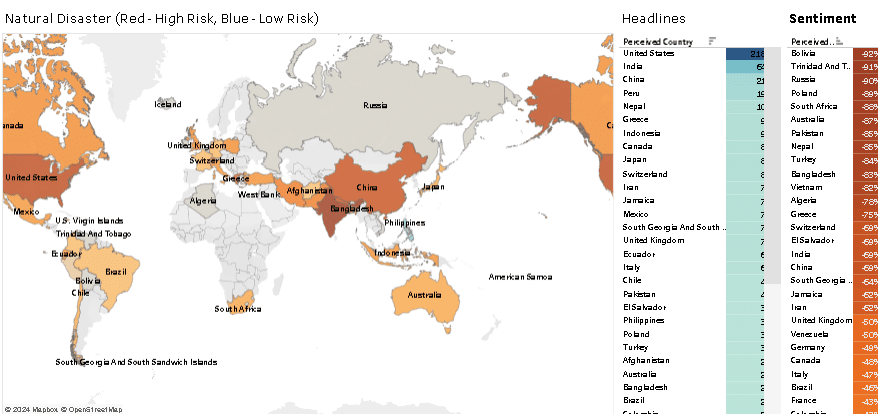
Our heatmap for natural disasters shows a complex pattern of risk perception worldwide. Negative-sentiment areas (shown in red and orange) unsurprisingly cluster in regions that often face natural disasters, like the Pacific Ring of Fire, South Asia, and parts of North America.
First, let’s consider the headline counts. The United States, India, and China often top the headlines list, which reflects their size and how natural disasters can affect them. The United States remained at the top of our list in both August and September for perceived extreme weather risk, and much of this will have been in relation to Hurricane Francine which wrecked havoc in the states of Louisiana and Mississippi. Add to this that China has just experienced the strongest storm in 75 years, and India’s monsoon expected to be prolonged then we can see a clear picture building here.
One thing to note thought is that sentiment doesn’t always align with frequency. Keep in mind that how often a country makes headlines doesn’t always match up with how people feel about it. For example, while the U.S. has the most headlines, people’s feelings about it are pretty neutral compared to other countries.
In stark contrast, a few smaller countries such as Trinidad and Tobago display very negative sentiment despite having fewer headlines. This is almost certainly because when natural disasters strike these nations, they have a harsh and deeply newsworthy effect.
As for European countries, they exhibit lower sentiment levels, which is likely largely due to a mix of geographic factors and strong disaster readiness systems. Yet, nations like Greece and Italy do show medium risk levels due to their vulnerability to earthquakes and, for Greece, wildfires as well.
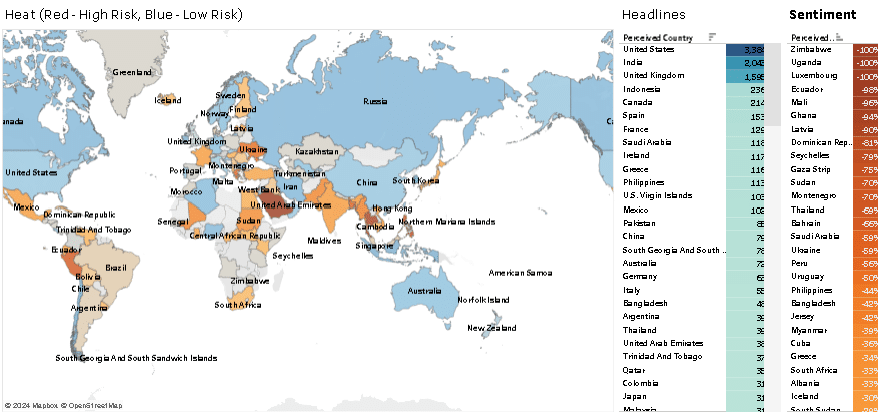
The extreme heat sentiment visualisation below shows a very different picture compared to the natural disaster map. Of course, we see obvious negative sentiment in countries which are typically linked with extreme heat, such as African and Middle Eastern countries. However, the sentiment analysis shows some interesting trends beyond this.
Take, for example, Luxembourg and Latvia have very negative sentiment even though they don’t make many headlines. In Luxembourg’s case, this is most likely in response to reports that the summer of 2024 was officially the hottest on record, surpassing last year’s temperatures as announced by the EU’s climate monitor, Copernicus. Meanwhile Latvia made the news for its Latvia experienced warmest temperatures on record in Spring, a surge in hospitalisations and drownings due its summer heatwave and most recently, record-breaking temperatures this September.
As with most things climate-related, the United States, again with the most headlines, has a more negative sentiment for heat news than for natural disasters. This might show that people are getting more worried about the heatwaves that are happening more often and getting worse across the country, which was very much illustrated by the extreme heat which hammered Southern California and the Southwest in early September.
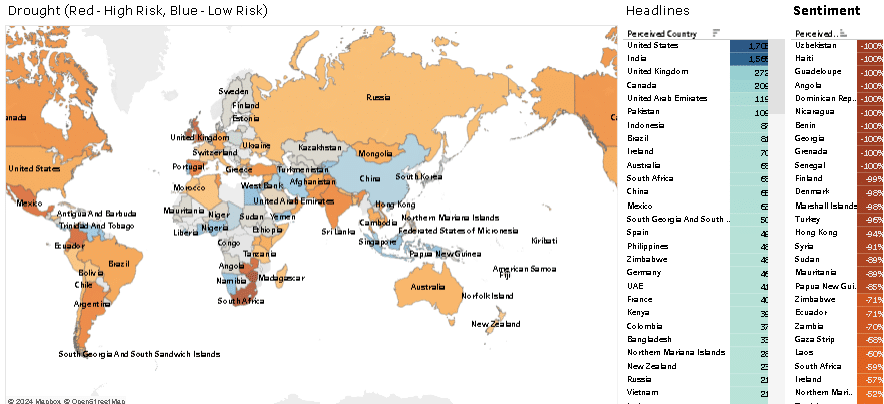
The drought sentiment map shows negative areas spread out more around the world compared to the last two categories. This wide spread highlights that drought is a global effect of climate change.
It’s worth pointing out that big chunks of Africa, Australia, and South America are at high risk of drought, which lines up with what scientists predict about these areas getting drier because of climate change. Interestingly, the negative shown for Russia, likely sparked by when the country’s southern Rostov region declared an emergency due to drought, also indicates concern around how drought could affect its huge farming areas.
Places like Haiti and Guadeloupe show negative sentiment even though we don’t hear about them much in the news. This might mean that when droughts do happen in these Caribbean countries, they are hit hard even if they don’t happen as often.
The US tops the list for news mentions again, although this is likely skewed just by the sheer volume of news sources, but the tone is perhaps surprisingly, less intense than stories about heat or perhaps – even more curiously – natural disasters. It’s the same story on many environmental issues – frequency of discussion doesn’t always correlate with perceived urgency.
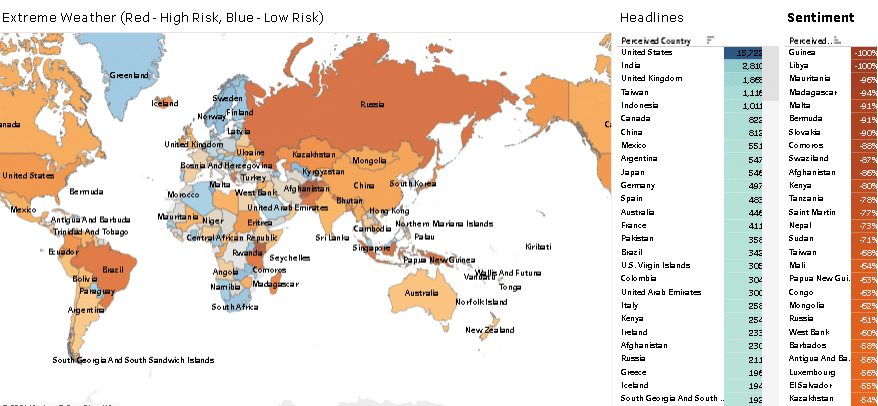
Now for the extreme weather sentiment map, which gives a full view of how people around the world see extreme weather events and climate-related dangers. This map shows high negative sentiment in a larger cross section of countries, showing how the global media perceives the impacts of extreme weather events and associated climate change affects in different ways.
Russia stands out with high negative sentiment. This might be a nod towards how extreme weather could hurt Russia, and how changes in the Arctic could affect the whole world. The sentiment analysis reveals some notable differences. Guinea displays a highly negative sentiment, as well as countries such as Libya, as it continues to deal with its vulnerability to floods, and Mauritania, which is often affected by a variety of hardships, including droughts, bushfires and heightened rainfall variability.
The United States, India, and the United Kingdom top the list in headline counts, highlighting these countries’ key roles in reporting on extreme weather events globally. Yet, their sentiment scores fall in the middle range, perhaps pointing to a more evenhanded approach to reporting on extreme weather events.
These remarkable insights show us that the perception of extreme weather events a varies greatly across the globe. It is quite obvious to see that today, the concern for people in many parts of the world is not whether climate change is happening – as signified by these extreme weather events – but how to deal with its effects. All this means that we need a nuanced, region-specific approach to addressing extreme weather events and climate change. And that’s before we address the economic and social impacts of these extreme weather events as a major geopolitical risk.
From the reporting on extreme weather events globally, you get a sense that we’re at a turning point in global climate awareness. However, the real test is turning this awareness into real steps to build a stronger, more sustainable future for everyone. There’s a reason why understanding global news sentiment is crucial – it can be a powerful tool to shape policy, drives action, and ultimately determines our collective response to the climate crisis.
All of these points highlight the importance of continued research and analysis in this field. For now, we at Permutable AI will continue to refine our tools and methodologies to provide the most accurate and useful real-time insights possible. As so often in the face of global challenges, knowledge and understanding are our most powerful tools for change.
The analysis you’ve just read offers a glimpse into the powerful insights available through our Extreme Weather Events Dataset. This comprehensive collection of global news sentiment data can transform how organisations understand and respond to climate-related risks and opportunities whether you are a financial institution, large multinational corporation or risk advisory looking to stay ahead in an increasingly complex risk environment. Whether you’re a policy maker, a business leader, or analyst our dataset offers real-time sentiment analysis from news sources worldwide, providing granular insights into perceptions of natural disasters, heat waves, droughts, and more.
To experience the full potential of this dataset and discover how our data intelligence can transform your decision-making processes, we invite you to request a free trial. Simply email us at enquiries@permutable.ai with the subject line “Extreme Weather Dataset Trial Request,” including your name, organisation, and a brief description of your data needs. Alternatively, fill in the form below.
Russia stands as one of the most powerful countries in the world, and its choices have a big impact on global politics, money matters, and conflicts. But how does the world see Russia? To answer this question, we analysed global news sources to discover the prevailing news sentiment around the country, looking at data from June to August 2024 in three key areas: war, politics, and the economy.
Using advanced AI, our analysis breaks down the amount and tone of media stories about Russia. This gives us a fact-based grasp of how people see the country in various fields. This article digs into these results and gives a full picture, giving us an answer to the question – how does the world see Russia.
Let’s start with the issue of Russia’s role in war and armed conflict, one of the most divisive topics in today’s global politics. Since it took over Crimea in 2014 and the ongoing strife with Ukraine and Western nations that followed, Russia’s military moves keep casting a dark cloud over how the world sees it.
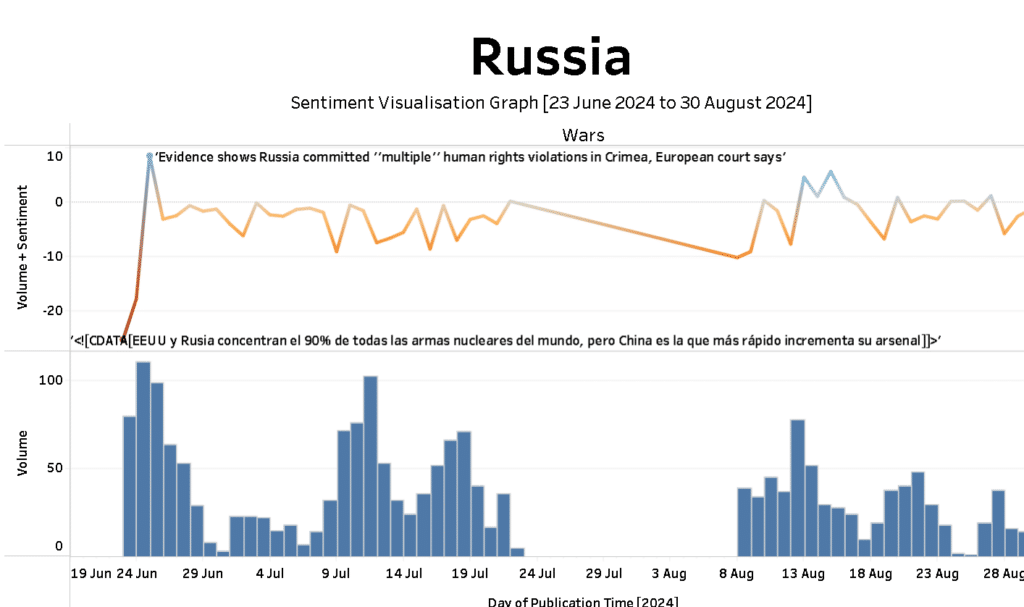
From June to August 2024, our sentiment analysis unsurprisingly revealed a negative view of Russia in news related to the war. This period was marked by big swings in sentiment due to major events related to military operations and human rights abuses.
Sentiment was markedly negative around Russia after a European court made a decision in late June. The court said Russia had broken a string of human rights laws in Crimea. This news further damaged Russia’s image in Europe and North America, where human rights violations is regarded as an extreme violation of justice.
Another major source of negative sentiment bubbled up in July, this time regarding discussions around Russia’s nuclear posture which caused global concern. Russia’s part in this story increased fears in Western countries that its military goals could upset global peace.
Our analysis reveals that military actions unsurprisingly shape Russia’s image worldwide as depicted in international media. News about Russia’s ongoing war with the Ukraine and claims of war crimes keep worldwide sentiment toward Russia’s involvement in conflict negative. This shows deep distrust and worry in Western free countries.
But remember, news about Russia always spikes when big military events happen and Russia’s moves will never fail to grab world news attention. This constant news focus keeps Russia in people’s minds globally, albeit for the wrong reasons.
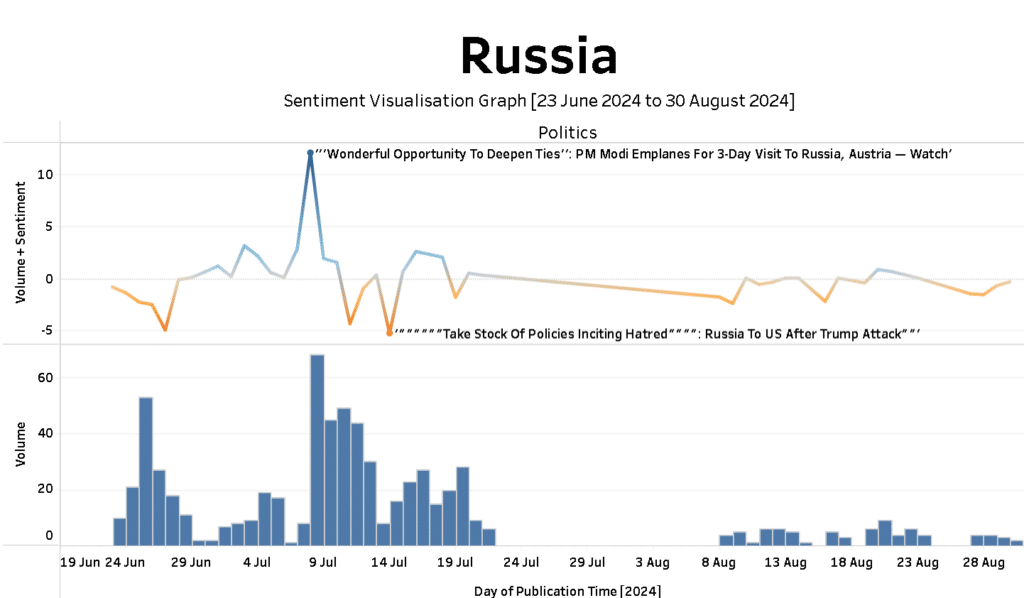
Russia’s standing on the world stage is tricky to say the least. It has rocky relationships with Western nations but has far more positive relations with non-Western countries like India and China. Our news sentiment analysis reveals the mood regarding Russia in relation to political news from June to August 2024.
At the start of July, sentiment reached its peak due to Indian Prime Minister Modi’s state visit to Russia and Austria. People saw this event as a “wonderful opportunity to deepen ties,” which highlighted how much Russia values its relationships with non-Western powers. India has kept a practical relationship with Russia, striking a balance between working together and considering wider geopolitical interests. The upbeat sentiment shows hope for diplomatic talks between Russia and countries outside the West.
In contrast to this diplomatic goodwill, the mood soured after Russia criticized U.S. policies. When Donald Trump attacked Russian policy, the Russian government fired back with harsh words. This caused a negative shift in public opinion. This incident shows how the ongoing political friction between Russia and the U.S. still shapes much of the global story, and ultimately, casts a dark cloud over Russia’s political image in Western media.
Russia’s political reputation divides opinion worldwide. Western countries view Russia negatively due to political clashes and sanctions that have damaged relationships. Yet, Russia has built good ties with non-Western powers like India and China, proving that not everyone sees the country in a bad light. These friendships give Russia other ways to boost its political power, even though its rocky relations with the U.S. and Europe often sway overall world opinion.
The world has long kept a close eye on Russia’s economy given international sanctions, changing energy prices, and its huge natural resource deposits. Even with these hurdles, Russia still plays a big role in global energy markets, and news about its economy often catches worldwide attention.
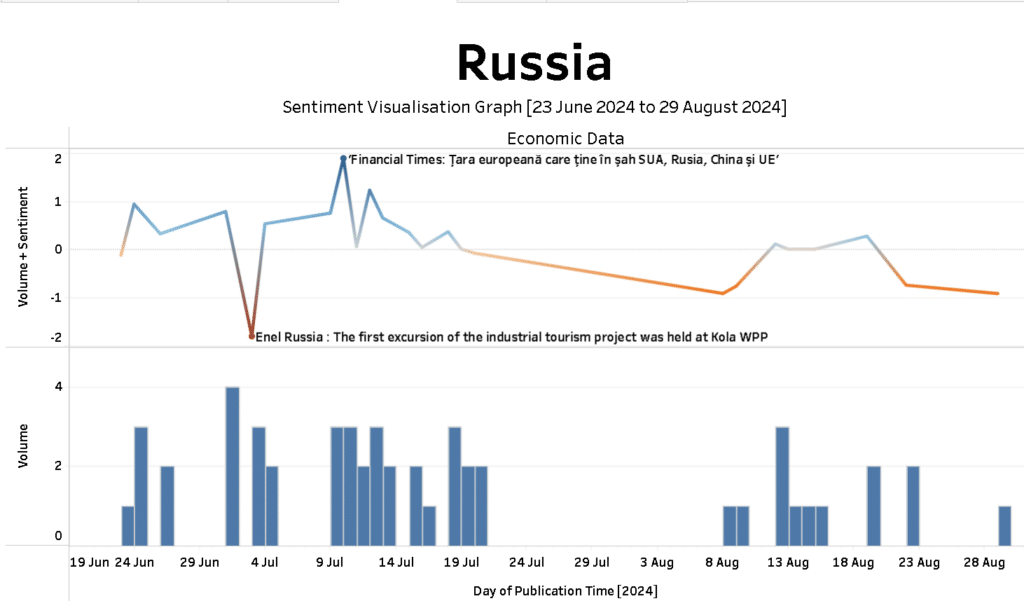
Our news sentiment analysis showed that global media views were steadier compared to war and political areas, with sentiment rising and falling in relation to specific events, but staying more balanced overall.
At the start of July, people positive was more sentiment after the Financial Times published an article about Serbia’s strategic role in international relations, influencing the United States, Russia, China, and the European Union. It examines how this country navigates geopolitical tensions, impacting the balance of power among these global players.
On the flip side, sentiment took a hit in late June after news broke about Russia’s Kola WPP (Wind Power Plant) industrial tourism project. The project might have sparked some interest, but the bigger picture includes worries about environmental and energy-related issues in Russia. These concerns echo the ongoing global discussion about Russia’s energy policies and how they affect sustainability and climate change.
The world’s view of Russia’s economy stays steady, with ups and downs tied to news stories. Even though its political and military moves often lead to bad press and negative sentiment, Russia’s key role in energy markets ensures it’s still a crucial player in world economics, despite being embroiled in political tensions and conflict.
Our news sentiment analysis shows a complex view of Russia worldwide. Russia’s military moves and political strains often lead to negative sentiment in Western news, but its economic power and friendly ties with non-Western countries paint a more detailed and surprisingly positive picture.
Of course, when it comes to war and military action, Russia is seen in a bad light, with news around the world pointing out human rights violations and concerns about nuclear weapons. In politics, Russia’s image goes fluctuates, gaining some diplomatic wins but also harsh criticism. In regards to economic matters, Russia keeps a steadier global image, thanks to its key role in energy, though it faces hurdles related to long-term growth and trade limits.
As with many complex geopolitical situations, the world’s view of Russia depends on the context — whether people see it through the lens of war, talks between countries, or economic matters. Each of these areas helps shape a bigger, ever-changing story about where Russia stands in the world right now.
Surely, then, it’s important to consider all these factors when analysing Russia’s global standing. The obvious point here is that Russia’s image is multifaceted and often contradictory. But also, we must remember that perceptions can shift rapidly in response to world events.
Separately, it’s inevitable that Russia’s actions on the world stage will continue to be scrutinised closely. In essence, the country’s global image is a reflection of its complex role in international affairs. Most importantly, understanding these perceptions is crucial for anyone engaged in global politics or business.
There are two questions that arise from this analysis: How can Russia improve its global image, particularly in the West? And how can other nations engage with Russia constructively while addressing concerns about its actions?
Take your strategic decision-making to the next level with our advanced economic and geopolitical datasets. Our in-depth, real-time analytics give you unmatched insights into worldwide market trends, political shifts, and news patterns. Our datasets use state-of-the-art AI tech to analyse sentiment in real-time, predicting economic factors, and assessing geopolitical risks in detail. Be at the forefront of data-driven strategy and get ahead in today’s fast-changing global scene. To see how our capabilities can help stay ahead, simply email us at enquiries@permutable.ai to set up a demo of our services tailored to your needs, or fill in the form below.
Looking for more global insights? Why not read our articles on:
How countries of Europe view each other’s economy according to GDP
How the UK’s economy is perceived in Europe
How France’s political situation is viewed
An analysis of sentiment around the UK property market recovery
An analysis of global perceptions towards the Germany economy
As China grows its global reach, its ties with Africa have caught the eye of political experts and economists. China-Africa teamwork has hit new highs so grasping how people across Africa view this bond matters a lot for policy shapers and business heads. Our recent sentiment analysis on how China is perceived by Africa give us key insights into African views on China in politics and business. This article digs into the main points from our data analysis, taking a close look at the feelings that shape China-Africa links and what they mean on a bigger scale, just in time for the China-Africa co-operation summit.
China’s ties with Africa have deep roots in diplomatic and economic history. In the last 20 years, these connections have grown stronger, and China now stands as Africa’s biggest trading partner. This relationship involves big infrastructure projects wide-ranging trade deals, and more political teamwork. Events like the Forum on China-Africa Cooperation taking place this week showcase this partnership, which aims to benefit both sides. China offers money and know-how, while gaining access to Africa’s rich natural resources and growing markets.
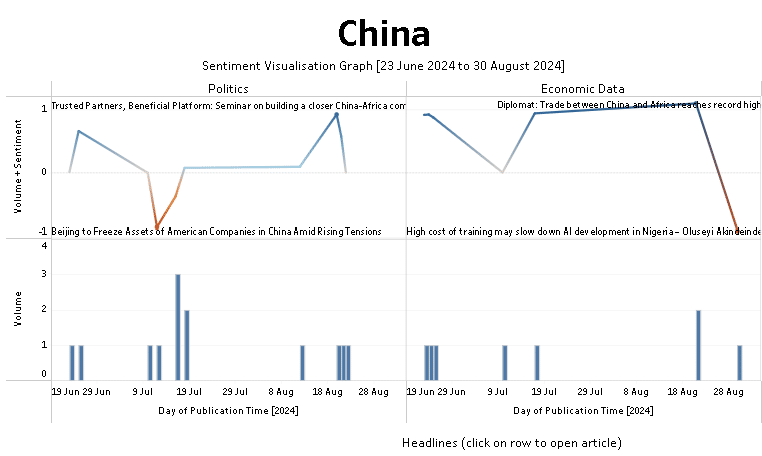
Yet, like any global partnership, views and feelings can swing based on many things such as world events, money matters, and what’s going on in each country. Our sentiment analysis, which looked at news stories and what people were saying from June 23, 2024, to August 30, 2024, gives us a peek into these views. It shows both hope and worry in African communities about their ties with China.
In terms of how China is perceived by Africa, as shown by our sentiment analysis (chart below), there seems to be a mix of trust, teamwork, and careful thinking. Our insights point to a good view of China’s political work in Africa when it comes to plans to build stronger ties between the two. News titles like “Trusted Partners, Beneficial Platform: Seminar on building a closer China-Africa connection” show that Africa sees China as a reliable and helpful friend. This view highlights how much Africa values China’s part in helping to build infrastructure giving money aid, and backing African countries in world political meetings.
China’s way of dealing with Africa gets described as teaming up rather than acting like a parent. This idea sits well with many African countries that have gone through tough times with old colonial rulers in the past. The good feelings shown in the study hint that African nations see China’s political moves as real tries to build a relationship where everyone wins, not as a new kind of colonialism.
But the analysis also reveals underlying worries linked to wider geopolitical shifts. A clear drop in mood connects to the headline “Beijing to Freeze Assets of American Companies in China Amid Rising Tensions.” While this news relates to U.S.-China ties, it echoes in Africa. Many African nations, with close bonds to both China and the United States fear getting caught between superpowers’ disputes. The negative feeling here hints at fears of possible unrest and the effect that growing global conflicts could have on African economies, which are more and more linked with China.
When it comes to the economy, the sentiment analysis shows that people see China’s part in Africa’s economic growth in a good light. The news “Diplomat: Trade between China and Africa reaches record highs” matches up with a high point in positive feelings showing the economic gains that many African countries have gotten from their ties with China. Trade between China and Africa has gone up a lot in recent years. Africa sends raw materials to China, while Chinese made goods, tech, and money flow into African markets. This business partnership has boosted GDPs across the continent. It has also helped create jobs and build infrastructure, which are key to African economic growth.
Our news sentiment data shows that there is an appreciation of the economic chances China offers in trade and investment. China’s readiness to invest in big infrastructure projects—from roads and railways to ports and power plants—has made a huge difference for many African countries. These projects have often filled important gaps left by Western investors, who might have been more careful or less keen to fund such plans. The good feeling tied to record-high trade levels suggests that at least in money matters, people see China as a key partner to help Africa grow.
The report also points out some worrying issues about whether these economic gains will last and benefit everyone. For example, sentiment takes a nosedive around the headline, “High cost of training may slow down AI development in Nigeria.” This shows wider fears about the hurdles African countries face to use the tech and money opportunities China offers. The big price tag for training and building skills in cutting-edge fields like AI, shows Africa might fall behind in the global tech race even with China’s help.
Surely then, these worries suggest the China-Africa economic ties could very well be out of balance. China builds infrastructure and brings in technology, but in some areas, locals are likely to struggle to make the most of these assets. If this doesn’t change, it could mean China’s investments don’t pay off as much as they should in cutting-edge fields that matter for staying competitive in the future.
Our sentiment analysis gives us a glimpse of how Africa sees China – it’s not simple, and it’s changing. Overall, there is positive sentiment around the relationship. This shows that working with China has helped Africa’s economy and politics and the overall impact is net positive. But there are some question marks in there too, which point to weak spots in how China is perceived by Africa.
The obvious point here is that it will be crucial for African leaders and policymakers to handle the China-Africa relationship. Ultimately, they need to fully understand its potential benefits and drawbacks to ensure long-term and inclusive impacts. This might mean working out better deals in trade agreements, building up local skills to make the most of Chinese tech, and keeping a balanced approach to foreign policy. This way, they can avoid getting caught up in tricky global politics.
How China is perceived by Africa seems to be in the most part at least. But there’s still room to address its African partners’ concerns. China could improve its involvement by concentrating on initiatives to build capacity, empowering African countries to manage and maintain the infrastructure and technology it provides on their own. Also, keeping things open and avoiding the look of too much sway in African political matters will be key to keeping the good image it has now.
Get a deeper look into what’s happening around the world with our geopolitical data. Our real-time news sentiment analysis can help you stay ahead of shifting global dynamics, helping you understand how these changes may affect your business. Don’t pass up the chance to make smart strategic choices based on AI-driven data intelligence. Start using our service for free today and see how our full set of geopolitical data can help inform your strategic decisions. Simply email us at enquiries@permutable.ai or fill in the form below to get in touch.
Looking for more global insights? Why not read our articles on:
How countries of Europe view each other’s economy according to GDP
How the UK’s economy is perceived in Europe
How France’s political situation is viewed
An analysis of sentiment around the UK property market recovery
How the world views Russia in terms of wars, politics and the economy
An analysis of global perceptions towards the Germany economy
Geopolitics, the study of how places, people and resources combine to shape political processes across the globe, has become increasingly critical in the interconnected world we live in today. Understanding the main geopolitical threats together with their possible impacts on businesses; economies and national security becomes more crucial as world changes each year. In 2024 there will be numerous complicated challenges that face the world in terms of geopolitics which will present themselves as the top geopolitical risks that will be of the greatest concern.
This article highlights some of the top geopolitical risks that are expected to dominate the global arena come 2024. It provides insights and analysis that is aimed at helping businesses, investors among others successfully steer across the uncertain terrain. We will share information on these risks, the underlying facilitators as well as the potential results that are long reaching into the far end of the world’s future.
Now let’s explore the top geopolitical risks in 2024 in our analysis below:
Ongoing rivalry between the two dominating powers of the United States and China is likely to increase due to possible conflicts in various fields from economical to technological with a high possibility of escalation into military confrontation if unresolved with tensions surfacing around trade disagreements, technological competition among others. Meanwhile, conflicts like those involving Taiwan and the South China Sea will continue to be geopolitical hot spots.
Global security and energy markets will continue to face significant challenges because of turbulence in the Middle East region courtesy of ongoing wars, power wrangles and terrorism threats, potentially leading to supply chain disruptions, price volatility, and increased geopolitical tensions. This could further destabilize the region and have far-reaching consequences for the global economy.
One other major area where tensions are running high is Russia and its foreign policy stance which continues to present an ominous thundercloud or regional consequences in Eastern Europe, affecting the global power balance negatively. The potential for further escalation in the region could have severe repercussions for global security and economic stability.
The global rise of populist and nationalist movements in different regions could result in reduced international development, thus causing lack of confidence in global institutions leading to increased protectionism and the creation of economic fragmentation. Such movements often promote nationalistic policies like protectionism which may affect international trade agreements, limiting immigration and rejecting multilateral organizations agreements. Such influences can undermine worldwide institutions like the UN or WTO leading to an erosion of trust in rules based on international order, while increasing economic and political uncertainty, and even resulting in increased potential for conflicts between countries.
The current escalating concerns around the significance of conserving resources such as water and food is a burgeoning issue which if not tackled effectively, will lead to certain parts of the world experiencing conflicts due lack of essential commodities. This resource scarcity could exacerbate existing geopolitical tensions and create new flashpoints around the globe.
Today, national digital security faces significant hurdles because of data violations, digital spying, privacy breaches or cybercrimes which may cause international trading chains and money circulating systems to collapse. The more the economy becomes globalized, the more it becomes vulnerable to hacking attacks where they can subsequently affect crucial infrastructure, such as financial systems, or even national security.
There is a new geopolitical frontier in artificial intelligence. Countries are in fierce competition over advancing AI because it has the potential to change economies, weapons, and societies forever. The drivers behind this competition are the assured economic advantages, definite military might, and clear-cut edge in technology. Many quite rightly fear that the heightened tensions may lead to an arms race, data wars, increasing geopolitical shifts, ethical dilemmas among other related issues concerning human rights and equitable distribution of benefits. These new AI developments might bring us closer to new kinds of wars that we have never experienced before, even though they might not have anything in common with what we refer to as wars nowadays. International cooperation in the field of AI governance is vital if these risks are to be managed and the benefits of the technology realized for the good of mankind.
The global economy can easily be influenced by these top geopolitical risks as outlined in this article. Consequently, any form of disruption in trade, investments flows or energy markets would result in an uncertain economic future and the resulting volatility in various sectors across the globe. 2024 and beyond will require that businesses and investors maneuver through an intricate political terrain in order to survive. Therefore factors such as tariff conflicts, disruptions in supply chain stability and so on will without doubt have a bearing upon company profitability and investments decisions too.
Investors must pay close attention to global developments if they want to remain successful. In most cases volatility seen across world markets; currency rates which are never stable; and investor moods are all influenced by geopolitical events. Diversification by investing across different assets classes; careful risk management and/or taking a view during a particular time frame should always be key considerations; alongside understanding where certain industries could be affected negatively as result of international issues. All these factors will help investors make the right moves and maximise investments during a landscape of heightened geopolitical risks.
Trade wars, conflicts, and cyber attacks are a huge threat to the international supply chain. Enterprises need to evaluate the risks present in their supply chain and come up with measures that can improve its flexibility and capacity for absorbing shocks. One option they have is spreading risks by using more than one supplier along with exploring other sources; this also calls for investment into digital technologies so that response time can be reduced while enhancing visibility across the entire network of operations. It is also worth noting that partnerships between companies and governmental agencies or NGOs can help strengthen understanding of geopolitical exposure with a view to reducing some of the negative consequences associated with it.
Geopolitical risks are vital to national security since they can danger a country’s borders, important structures and ultimately, people’s lives. As such, governments must continuously develop national security strategies that consider these novel geopolitical problems, whether by boosting surveillance abilities, improving online security systems or encouraging world collaboration aimed at dealing with cross-border problems. Collaboration between governments and businesses when it comes to coping with complicated and ever-changing geopolitical risks will increasingly become the gold standard of addressing geopolitical risks.
Our world is being fundamentally shaped by the intricate interplay of geography, politics, and power; making it harder than ever to comprehend the complexities of the 21st century for businesses, investors as well as policy makers. Climate change, natural resources scarcity and cyber threats have made issues even more complicated than before.
There are a large number of potential geopolitical challenges facing 2024 on the international scene, which are likely to only intensify as we move into 2025. All these geopolitical tensions threaten to reduce global cooperation and increase economic division. As government resources are increasingly directed at addressing these emerging threats, the capacity for partnerships between countries will depend on investment in whole-of-government approaches that draw from public diplomacy initiatives and other tools of soft and hard power.
Ready to see how AI-driven geopolitical risk intelligence can transform your decision-making? Contact us for a demo of our AI-driven news sentiment analysis which is available through our Trading Co-Pilot subscription, or to request a free trial. You can also access top-line geopolitical insights through our Real-Time Geopolitical Insights & AI Market Sentiment Analysis Dashboard which is publicly available to view.