In this insight, we explore the story surrounding the slowdown in the UK housing market through the lens of sentiment, looking at the sequence and timing of events and how the Global Macro Sentiment Indices (GMSI) could have seen it coming early. Housing is where much of Britain’s household wealth, debt and confidence is concentrated. It is also slow to report on itself. Mortgage approvals arrive after the decisions they record, and completed-sale house price indices arrive later still. By the time the evidence is formally assembled, the market may already have moved on. Point in time sentiment captures the narrative while it is forming, allowing us to get a real time read on how the story has unfolded in 2026 and where it is still running ahead of the numbers.

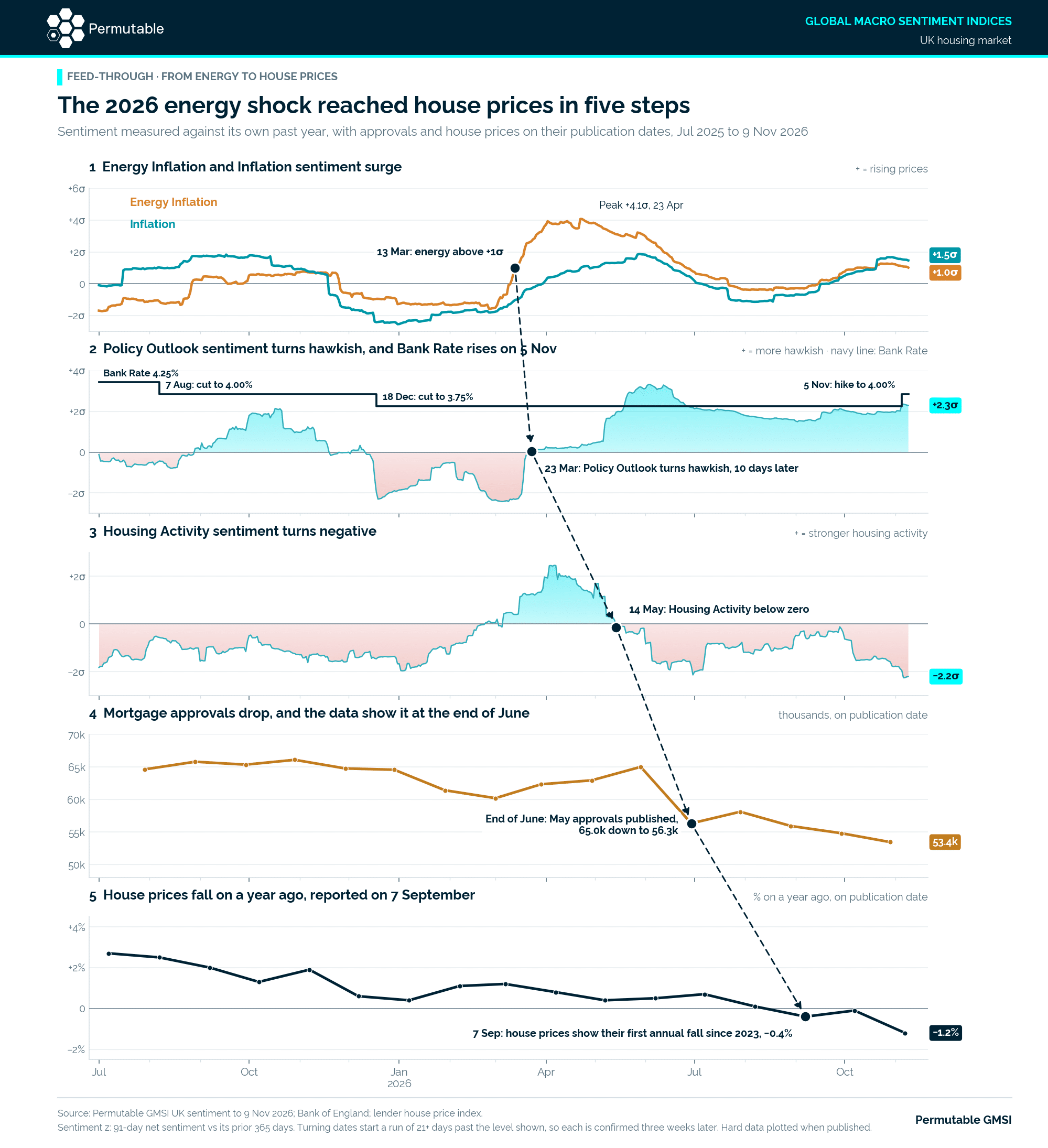
The sequence began, with the price of energy. In mid-March, Energy Inflation sentiment, which rises when the narrative points to higher energy prices, began a surge that would carry it to its strongest reading since the autumn of 2021, following the US-Iran conflict. Broader Inflation sentiment followed at a more measured pace, as the rise in energy costs worked its way into the wider price outlook.
The policy outlook responded swiftly. In early March, Policy Outlook sentiment, which reads positive when expectations turn more hawkish, was firmly negative, and the market still anticipated further easing after December’s cut. Within ten days of the energy shock it had crossed into hawkish territory, and it has stayed there ever since. Bank Rate itself did not move until November. For more than seven months, the narrative did the tightening on the Bank’s behalf.
Housing absorbed the blow for a time. Housing Activity sentiment, positive when the market points to stronger activity, enjoyed a buoyant spring before rolling over in mid-May, a turn that was confirmed in early June. At that moment the official record still looked reassuring, with the latest mortgage approvals at their strongest level of the year. The numbers then caught up in sequence what the sentiment had already seen coming. The fall in approvals was published at the end of June, around a month later, and the first annual decline in house prices since 2023 was reported in early September, roughly a quarter later. By the time the slowdown was formally on the record, the sentiment had long since confirmed the market backdrop.

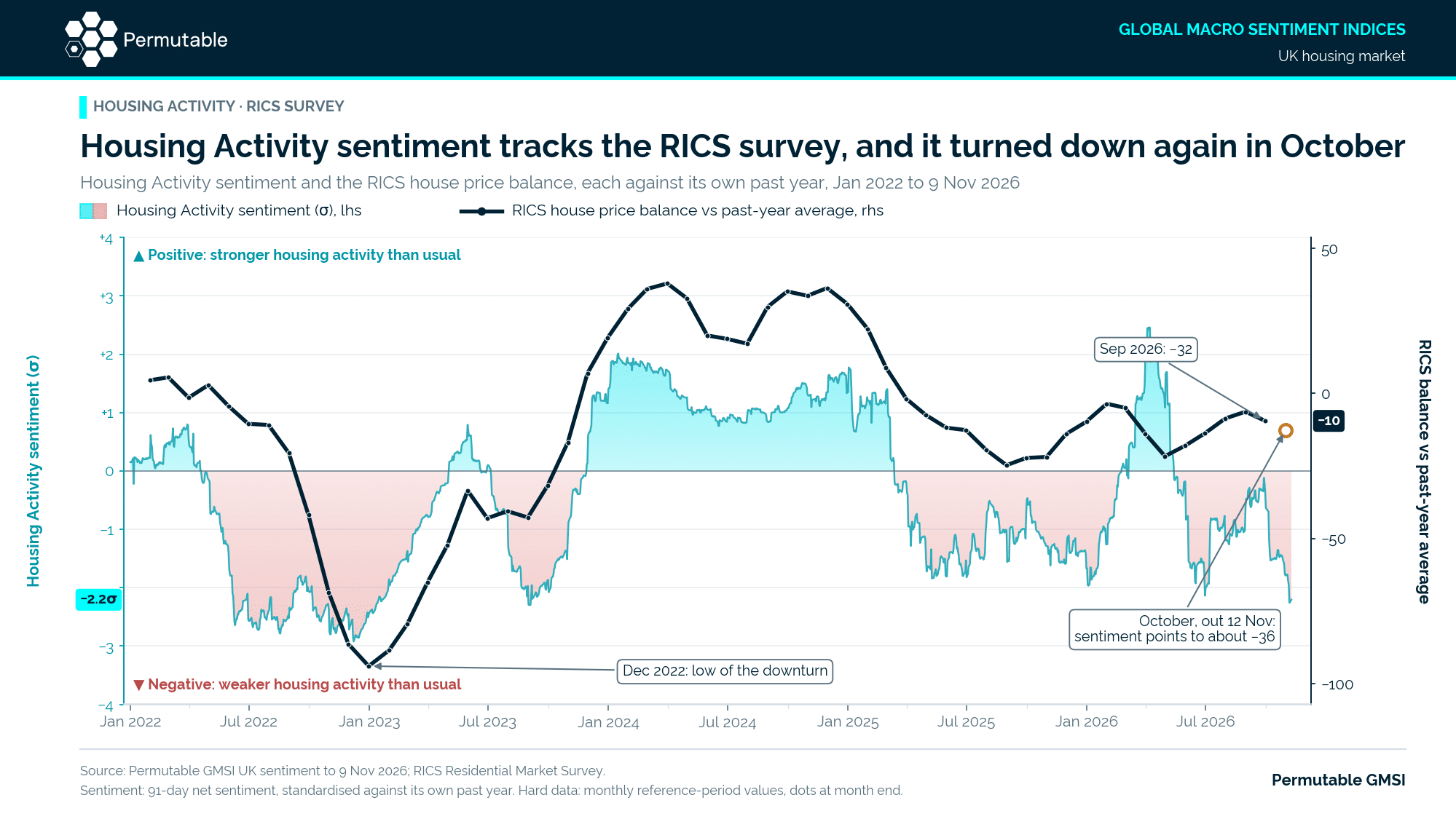
A narrative is only valuable if it measures something real, and the evidence here proves the point. Over the past decade, Housing Activity sentiment has moved in close step with the RICS monthly survey, the leading read of the market, and with Bank of England mortgage approvals. Since 2022 it has called the direction of approvals in around three months out of four, typically a month before the official figure is published.
Housing Activity sentiment fell sharply through the month and now stands at its weakest since September 2023, which points to a further deterioration in the RICS price balance, from −32 in September to around −36 when forecast using sentiment, when the survey is released on 12 November. The Budget offered no reprieve. Housing Activity sentiment continued to slide after the Chancellor’s support for first-time buyers on 28 October, while Interest Rates sentiment climbed into the Bank’s first rate rise since 2023. Help with a deposit, it seems, is of limited comfort while the cost of servicing the loan continues to rise.

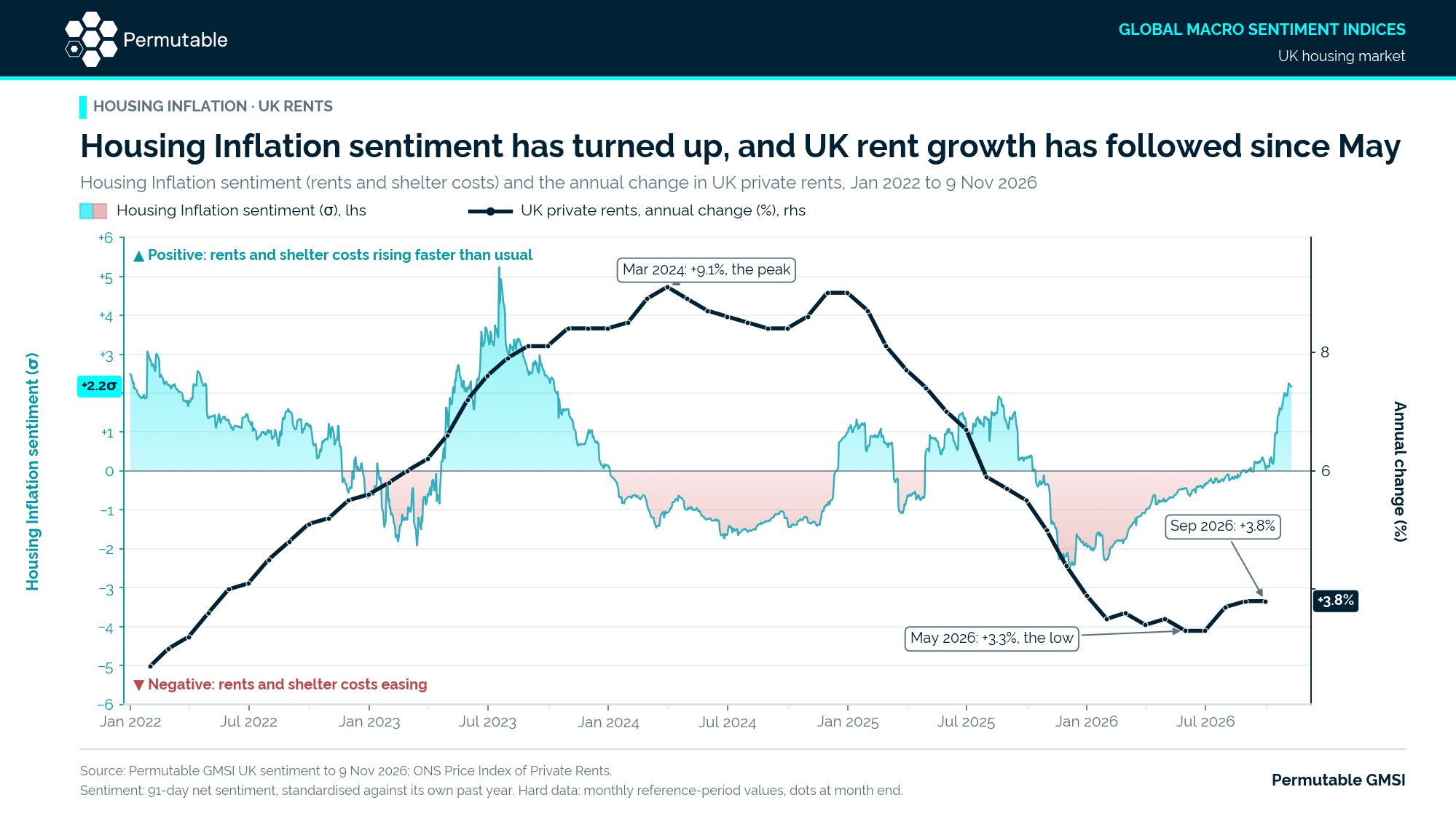
A slowdown in the UK housing market has not delivered more affordable housing options. With typical two-year fixed mortgage rates nearing 6%, and the monthly repayment on an average home rising almost entirely because of borrowing costs, many would-be buyers have chosen to remain tenants. Housing Inflation sentiment, which tracks the rents and shelter costs that households face and rises when those costs are climbing, has swung from deeply negative at the start of the year to firmly positive. Official rent growth turned in tandem in May, after more than two years of moderation.
This is the less advertised consequence of a rate-driven slowdown. Would-be buyers can wait for better terms, but tenants cannot defer the rent. With a further rise in tax on rental income due from next April, the supply of rented homes faces additional pressure just as demand for them strengthens.
The value of the GMSI in this case study lies not in a single reading, but in the ability to construct multiple indices that connect the story. Energy, policy, rates, housing and rents were measured systematically, using the same method every day, with each interpreted in its own economic direction. This produces an orthogonal view of the economy, built from the narratives shaping market expectations rather than the prices and activity eventually recorded in official statistics. It turns the noise of daily market chatter into a sequence of regime shifts that could be followed from one theme to the next, and into a signal clear enough to support conviction rather than speculation. That matters well beyond housing. The same narratives shape growth and inflation expectations, guide the path of policy rates and set the risk premium on sterling assets. Tracking them live places analysts at the forefront of the economic pulse, rather than in the queue for the next official release.
The latest GMSI readings offer little prospect of near-term relief for the UK housing market. Policy Outlook and Interest Rates sentiment remain firmly hawkish, while Housing Activity sentiment has fallen to its weakest level in more than three years. Housing Inflation sentiment, meanwhile, continues to rise, suggesting that weaker activity has yet to ease concerns over housing costs.
Want to monitor where the next turn in UK housing market appears next? Explore Permutable’s Global Macro Sentiment Indices in our Data Discovery catalogue to find datasets for tracking the UK policy outlook, housing activity and inflation by subtopic in your own research.
The pulse of news sentiment can shift rapidly, understanding these changes is crucial for policymakers, business leaders, and community advocates. Our recent comprehensive analysis of our UK data sets sheds light on the intricacies of public mood across various sectors in the United Kingdom, revealing how employment, housing, political tension, and concerns over violence influence collective sentiment. Let’s take a closer look at what we have uncovered.
Let’s start by looking at employment sentiment. The employment landscape in the UK during the selected period of late March to June 2024 has been marked by significant volatility, as indicated by our UK data sets. Over the past few months, news sentiment has experienced sharp peaks and deep troughs, reflecting the complex realities of the job market. Take late April – for example – where there was a notable spike in positive sentiment, suggesting a temporary boost in public confidence. This is likely to be due to the announcement of new legislation expanding rights for employees around flexible working, paid and unpaid leave, and protection from redundancy during parental leave around that time. Sad to say that this resulting optimism was sadly short-lived as sentiment quickly plummeted thereafter. But look how the fluctuating sentiment can be linked to a series of impactful headlines.
In contrast to the employment sector, the housing market sentiment has been relatively stable in recent months, albeit with its own set of challenges which we are all well versed on. Here, the overall trend is that of a slight positive sentiment, which suggests that despite periodic setbacks, the public maintains a generally optimistic view of the housing sector. This stability is occasionally disrupted by minor peaks and valleys, often triggered by specific news events. For example, a headline like “UK’s cheapest seaside town to buy a house where properties cost less than £83,000” in early June unsurprisingly brought a wave of positive sentiment. This would have provided a glimmer of hope for potential homeowners, reflecting affordability and accessibility in certain areas while so many continue to struggle to get a foot on the ladder. However, the housing market remains susceptible to broader economic trends and policy changes, so continuous monitoring and adaptive strategies are the order of the day, as reflected in the UK data sets.
Next, let’s look at political sentiment. Political sentiment in the UK remains predominantly negative, reflecting widespread public dissatisfaction with the current political landscape. Our UK data sets reveal significant dips in sentiment, particularly in late March and mid-April. These periods of heightened tension are often driven by contentious political developments and policy decisions, and in this case most likely linked to when speculation around a general election date began to mount. As so often happens, headlines like “Brexit betrayal: Leave voters turn against UK government over broken promises” capture the essence of public discontent. The ongoing Brexit saga, coupled with perceived governmental failures, continues to erode public trust. This sustained negativity calls for a more transparent and accountable political process to rebuild confidence and address the root causes of dissatisfaction, as suggested by the trends in the UK data sets.
Now let’s talk violence. News sentiment regarding violence has remained consistently low, highlighting a deep-seated concern among the populace. Although there are brief periods of stabilisation, the overall mood is marked by apprehension and unease. The persistent negative sentiment around violence highlights a need for comprehensive strategies to address underlying causes and improve public safety to mitigate these concerns. The reality is that this low sentiment is reflective of widespread fear and anxiety about crime and violence, which can have far-reaching impacts on community well-being and cohesion that must be addressed by policymakers and community leaders alike.
So what does this all mean? All of these points taken from our UK data sets highlight the varying sentiments across different sectors, illustrating the complexities of news sentiment. For policymakers, this data provides critical insights into areas requiring immediate attention, such as employment stability and political transparency. For businesses, understanding these trends is vital for tailoring strategies that resonate with consumer sentiment and address their concerns effectively. Ultimately, the data highlights the importance of staying connected to news sentiment. By keeping a finger on the pulse of public opinion through our UK data sets, decision makers can better navigate the challenges and opportunities that lie ahead. For community leaders and advocates, this means leveraging these insights to drive positive change and foster resilience within communities.
Now let’s get to the part where we explain how we do this. We use advanced machine learning algorithms to analyse extensive news data from various reputable sources. This comprehensive process begins with data collection, where news articles, reports, and headlines related to key sectors such as employment, housing, political tension, and violence are aggregated. Next, sentiment analysis is conducted using natural language processing (NLP) techniques to evaluate the tone of each news piece, categorising it as positive, negative, or neutral and assigning a sentiment score to quantify its intensity.
But that’s not all. The analysis also includes trend identification, tracking sentiment trends over time to detect significant fluctuations and patterns, thereby understanding how specific events and headlines influence public sentiment daily. Finally, significant sentiment changes are correlated with impactful headlines and news events, providing context and insight into the underlying factors driving public mood.
Our data-driven analysis of news sentiment in the United Kingdom, based on our UK data sets, offers a nuanced understanding of the current mood across various sectors. The fluctuating sentiments around employment, the relative stability in housing, the persistent negativity in political tensions, and the consistent concerns over violence all paint a complex picture of public opinion.
There are so many use cases for our UK data sets. If you’d like to experience firsthand how our comprehensive news sentiment analysis can inform your decisions and strategies, get in touch to request a free by emailing enquiries@permutable.ai or fill in the form below.