This report analyses escalating geopolitical tensions around Venezuela, U.S. military expansion in the Caribbean, energy security risks, and potential conflict spill-over with Guyana. It is aimed at commodities and energy traders, portfolio managers, risk and compliance teams, geopolitical analysts, investors, and strategy leaders seeking real-time narrative-driven signals to anticipate market volatility and systemic risk.
Introduction to this Venezuela crisis Risk Pulse report
This Venezuela Crisis Risk Pulse Report comes at a critical juncture for global energy and macro-strategic decision-making. Tensions across the Caribbean, shifting U.S. regional priorities, competing great-power interests, and accelerating narrative volatility have turned Venezuela into one of the most consequential risk nodes influencing commodities, logistics, sanctions frameworks, and cross-asset positioning.
This report not only maps the physical and diplomatic escalation pathways, but also layers in the behavioural forces now shaping market expectation – examining how belief clusters form, synchronise, and translate into pricing pressure before traditional indicators visibly break. In a world where markets respond to narrative velocity as rapidly as state actions, institutions require more than situational awareness – they need explainable, real-time intelligence that can be operationalised with confidence.
For energy market participants in particular, this report provides a forward-looking lens to navigate producer instability, corridor risk, sanctions friction, and supply-chain vulnerability. As Venezuela reaches an inflection point with global implications, professional decision-makers need an edge rooted in both geopolitical expertise and narrative data intelligence. This report is that edge.
What is the Venezuela crisis?
Over the past few months, the increase of US military presence in the Caribbean has been substantial. Under the direction of the Trump administration, US air, maritime, and special forces assets have increased their presence at sea and at key staging locations in places like Puerto Rico, the US Virgin Islands, El Salvador, and Trinidad and Tobago, in numbers not seen since the invasion of Panama in 1989.
While military action against the Maduro regime may or may not be imminent, the challenge of Venezuela, and the US policy response to it, appears to be at a major inflection point. Or to put it bluntly, the “business as usual” policy approach of sanctions and public diplomacy has run its course. We are on the precipice of a ‘new normal’ for not only US-Venezuela bilateral relations, but for US government policy writ large for Latin America. This new prioritization of the Western Hemisphere by the US will have massive geopolitical, diplomatic, and international trade and investment implications, and the current tensions between the US and Venezuela clearly signal this shift.
Why Venezuela matters
Venezuela, which contains the largest proven oil reserves in the world, is in the midst of an economic crisis, as it suffers from significant international debt, hyperinflation, a low price of oil globally, deteriorating oil infrastructure, and domestic political issues. Over eight million Venezuelans have fled the country in the last few years, leading to significant instability in neighboring states like Colombia and Brazil given the mass of refugees they have taken in.
Venezuela constitutes the largest humanitarian crisis in the world at present, and the weakening of what was once one of Latin America’s most thriving democracies. In short, the failings of the Maduro regime are directly exporting insecurity in the region well beyond their borders, and creating challenges for open, democratic societies near the nation.
Another reason behind Venezuela’s importance lies in regional and global geopolitics. Venezuela, with Cuba and Nicaragua, form an intricate circle of authoritarianism and political repression that is mutually reinforcing and deeply intertwined. For example, energy -starved Cuba imports Venezuelan energy in exchange for the Maduro regime’s use of Cuban counter-intelligence agents who actively help the Maduro regime chase down, incarcerate, and sometimes execute pro-democracy forces within Venezuela.
Nicaragua and Cuba closely collaborate on a range of defense and intelligence issues, and the Nicaraguan government consistently finds diplomatic means by which to undermine US sanctions efforts towards Cuba. Given the autocratic nature of these regimes, they become a natural enabler for the actions and activities of both China and Russia throughout Latin America.
Globally, the U.S. remains in a state of competition with China and Russia. Within the Western Hemisphere, this competition is manifested in different forms depending on country. While China continues to use its One Belt, One Road initiative to gain access and influence throughout the region via development loans, China has also heavily invested in critical infrastructure, to include ‘dual use’ ports, at key geostrategic choke points, to include the Panama Canal.
The government of President Maduro was hoping to renegotiate oil-for-loan deals with China agreed to nearly 15 years ago under late socialist leader Hugo Chavez, when the two nations developed an economic alliance built around oil shipments. China halted new loans several years ago as Venezuela’s economy descended into a hyperinflationary collapse, but Beijing has maintained diplomatic ties with Caracas and openly opposes Washington’s oil sanctions against Maduro, and has been fiercely critical of the Trump administration’s military buildup. In the past ten years alone, China has executed over $615 million in weapons sales to Venezuela, has funded the building of massive port facilities in the nation’s north, and has a significant IT footprint nationally.
Whereas Chinese interests in Venezuela are a blend of geoeconomics-meets-geostrategy, Russia’s interests in Venezuela are weighted towards its increased role and visibility within the military dimension of its power. Venezuela is a major fulcrum point for Russia’s approach to Latin America. Venezuela and Cuba are two of Russia’s three key allies in the Western Hemisphere, with Venezuela accounting for 80% of Russia’s Foreign Military Sales (FMS) program. Venezuela has been a frequent ‘end point’ for Russian long range bomber sorties into and out of the Western Hemisphere, host to Russian navy port visits and exercises, and is also a major platform for Russia’s ongoing information warfare campaign across Latin America.
Venezuela as a ‘failed’ petrostate
Energy geopolitics matters significantly when assessing the importance of Venezuela. Oil has been both a blessing and a curse for the Chavismo movement (which Maduro now oversees after the death of Hugo Chavez) in Venezuela. During the early 2000s and the last energy supercycle, the high cost of oil per barrel allowed Hugo Chavez to channel oil profits into unsustainable state subsidies and corruption payments amongst regime elites to offset the risk of coups and the drive loyalty to the regime.
Since the cost of oil has decreased since the end of the supercycle, Venezuela’s economy has collapsed, and the inability of the state to provide social services, coupled with crippling oil sanctions, has created the largest humanitarian crisis in the world, with millions of Venezuelans fleeing to Europe, the US, and Latin America.
While an original founding member of OPEC, Venezuela is also challenged by the fact that it’s crude oil is of the variety that requires specialized refining techniques….capabilities that are largely the domain of American owned oil companies. Given that global oil sales are denominated, inventoried, and executed while pegged to the US dollar, Venezuela must have positive bilateral relations with the US to reach its economic potential, but the actions of the regime preclude this.
Venezuela and Guyana: Potential for conflict expansion
Importantly, the promise (and potential peril) of hydrocarbon-reliant economies is not limited to Venezuela in the Caribbean; neighboring Guyana matters in understanding the “oil-meets-geopolitics” dynamics at play in the region, something that may matter even more in the case of an open conflict between the US and Venezuela.
On December 4th, 2023, at the direction of President Nicholas Maduro, Venezuela held a referendum on whether an oil-rich portion of neighboring Guyana, known as the Essequibo region, should be annexed and become a part of Venezuela.
- Venezuela argues that Guyana’s Essequibo region, also known as Guayana Esequiba, was stolen from it when the border was drawn over a century ago.
- While the political fate of the Essequibo region has been a deeply contested issue stretching back to 1899 (if not earlier), and which waxes and wanes in Venezuelan domestic politics, to date both nations have abided by international legal frameworks and third party intermediaries to address the issue of political sovereignty.
- Litigation is pending before the International Court of Justice (ICJ) in The Hague over where the region’s borders should lie, but Venezuela does not recognize the court’s jurisdiction in the matter. However, the referendum held in early December 2023 (and the threat to seize the region by military force) created an increase in tensions that soon drew the attention of regional and international actors, threatened the security of a peaceful and increasingly prosperous nation of Guyana, and raised the specter of yet another potential conflict that could impact commodities and markets globally.
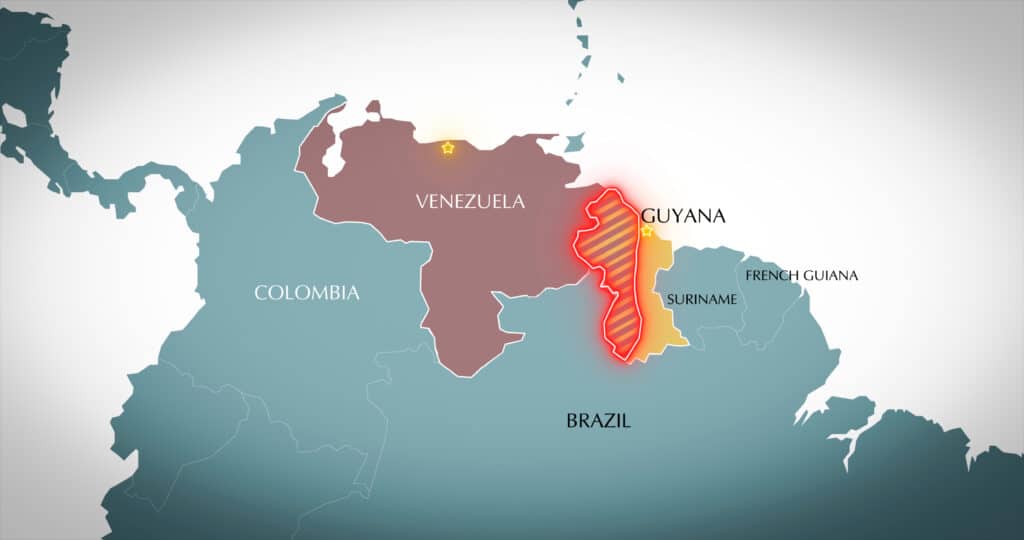
Above: Map of Guyana, highlighting the Essequibo Region in red. Official maps generated by the Venezuelan government routinely demarcate Essequibo as part of Venezuela, not Guyana
Why does Venezuela want the Essequibo region of Guyana?
The December 4th 2023 referendum, which purportedly involved nearly 10 million voters, 95% of whom “voted yes” according to Venezuelan officials, also included questions concerning granting Venezuelan citizenship to residents of Essequibo, as well as rejecting the jurisdiction of the International Court of Justice (ICJ) in settling the dispute.
These questions, coupled with Venezuelan military officials’ announcements that Venezuela was taking concrete measures to build an airstrip to serve as a logistical support point for the integral development of the Essequibo region, rattled the Guyanese government. Additionally, this approach by Venezuela (holding referendums with no legal standing in international law concerning annexation; granting citizenship to civilians in illegally annexed land, all under the veiled threat of the use of force) in many ways mirrors the approach used by Vladimir Putin to legitimate annexation of Ukrainian territory since the beginning of that conflict.
Additionally, the economic situation in each country could be no different. Consider:
- Guyana’s economy is booming largely due to offshore oil reserves, and its output is expected to triple to more than 1.2 million barrels per day by 2027.
- Guyana ranks 31st among oil-producing nations but could move up to 18th place by 2027.
- Guyana is also working with oil majors to assess the potential for natural gas exploration, in addition to all the oil exploration already taking place.
- Venezuela, which contains the largest proven oil reserves in the world, is in the midst of an economic crisis, as it suffers from significant international debt, hyperinflation, a low price of oil globally, deteriorating oil infrastructure, and domestic political issues.
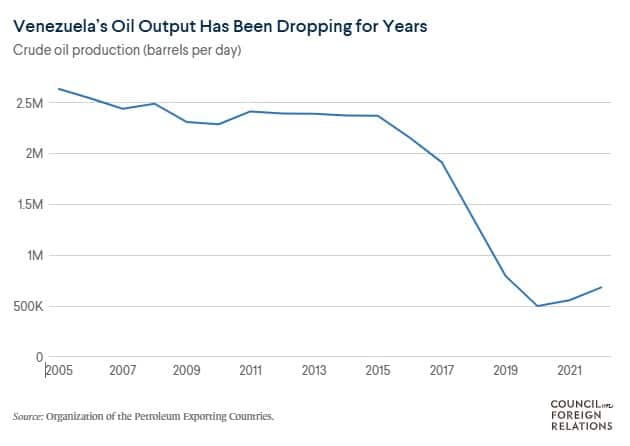
Above: Venezuela’s crude oil production decline, 2005–2021. Output fell from above 2.5 million to near 500,000 barrels per day following infrastructure degradation, sanctions pressure, and economic collapse. Source: OPEC data, via Council on Foreign Relations analysis.
The U.S. imposed harsh sanctions on Venezuela to punish Maduro’s government following his 2018 re-election, which the U.S. and other Western governments rejected as a sham. The temporary lifting of oil sanctions in October 2023 by the United States against Venezuela was done in part as an incentive for the Maduro regime to run a fair and internationally monitored election that was held in the summer 2024. However, a free and fair election did not happen, and US sanctions were quickly put back in place by the Biden administration, and now Trump has re-instituted sanctions on the regime.
Given all these factors, the question remains… why did Maduro take such an escalatory measure then, and could we see more saber rattling now given the potential conflict with the US?
There are multiple factors driving Venezuela’s drive to annex the Essequibo region, but the most important are the domestic politics within Venezuela, and the burgeoning oil market in neighboring Guyana.
In short, a manufactured foreign policy crisis may be just the thing to create a “rally around the flag” effect aimed at Guyana that ensures Maduro can retain power, especially in light of an imminent attack by the US.
How did the energy industry respond to the Venezuela crisis?
Despite the political crisis, there appears to be no slowing down the Guyanese oil sector, or the Guyanese economy in general. Guyana was the fastest growing economy in the world in both 2022 and 2023, according to the International Monetary Fund, with an estimated GDP growth of 38% in 2023 alone. Oil has been the main driver of this growth.
According to Guyanese President Irfaan Ali, oil majors operating in Guyana’s waters are “moving ahead aggressively” with production plans despite Venezuela’s threats to take over the Essequibo region.
Consider:
- The offshore oil sector of Guyana is continuing to grow, with over 11 billion barrels of oil equivalent of resources discovered so far. A consortium led by ExxonMobil is advancing what could prove to be its seventh development in the region.
- The most important area of offshore drilling is the Stabroek Block, which spans 6.6 million acres, within Guyana’s Exclusive Economic Zone (EEZ).
- ExxonMobil, the number one US oil and gas company, now operates the Stabroek Block oil field and holds a 45% interest. Chevron now also wants to profit from Guyanese oil, and is preparing to buy out Hess, a stakeholder in the oil field (30%), soon at the estimated price of $52 billion. The remaining 25% of the oil field is held by the China National Offshore Oil Corporation.
- Production is expected to reach roughly 620,000 b/d once the Payara field reaches maximum capacity and exceeds 1.2 million b/d by 2028.
- Large portions of the Stabroek Block lie directly off the coast of the contested Essequibo region of Guyana, meaning that if Venezuela was ever able to control Essequibo (through force or international legal ruling), it could theoretically gain control of the oil infrastructure in the Stabroek Block.
Despite the early December 2023 risk that Venezuela may have tried to invade Guyana, prices for oil remained at their lowest levels in the last half of 2023.
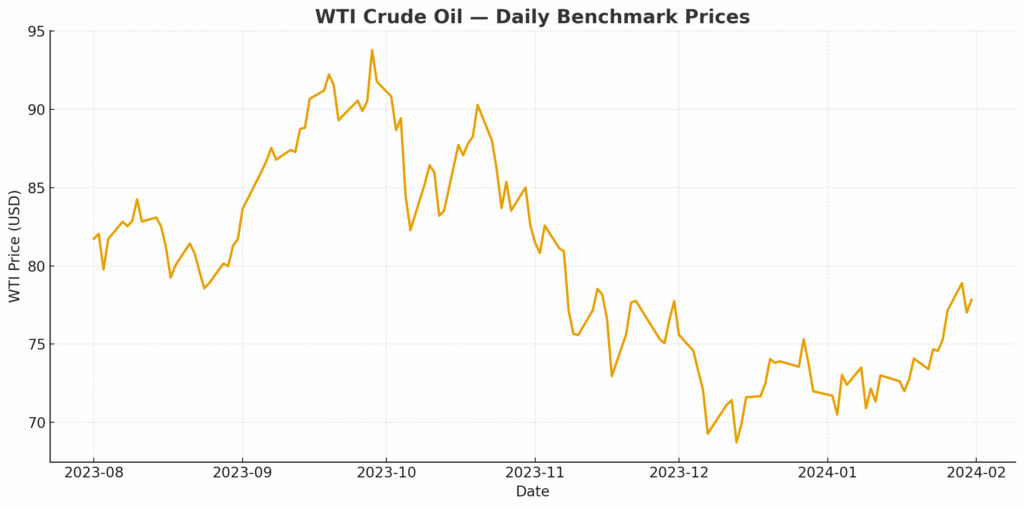
Above: WTI crude oil daily benchmark prices, Aug 2023–Feb 2024. Source: chart data via Yahoo Finance.
While there are some competing explanations for why oil markets didn’t react strongly in the immediate aftermath of the referendum on annexation in 2023, it is likely since at the time, a Venezuelan invasion of Guyana remained a “low probability” event. The terrain of the Essequibo region would be extremely difficult to traverse with heavy military equipment given rivers and jungles, which would mean that any military ground invasion of the region would need to happen through Brazil to strike at Guyana in its southern regions. However, in the event that the US attacks Venezuela, the Maduro regime may seek to expand the conflict by attacking or sabotaging Guyanese oil interests as means to rattle international markets and put the burden of de-escalation on the US.
How did the region and the US Respond to the Venezuela crisis
- Roughly two weeks after the referendum vote, Guyana and Venezuela agreed to not “use force” to settle their dispute over the Essequibo region. However, tensions remained high between the leaders of both nations, and regional powers continued to show concern.
- Brazilian President Luiz Inácio Lula da Silva has routinely signalled “growing concern” about the tension on the northern border of Brazil. He told delegations at the 2024 Mercosur regional bloc summit that “if there’s one thing we don’t want here in South America it’s war.”
- The Brazilian army reinforced its presence in the northern cities of Pacaraima and Boa Vista in 2024, both of which share a border with Venezuela, as part of efforts “to guarantee the inviolability of the territory.”
- Former U.S. Secretary of State Antony Blinken reaffirmed the United States’ “unwavering support for Guyana’s sovereignty” and called for a peaceful resolution. Guyana asked for deeper defense ties with the United States, which has continued under the Trump administration.
- United States Southern Command (SOUTHCOM), the Department of Defense entity responsible for all operations, exercises, and engagements in the region, deployed military jets in support of the Guyanese government in 2024. The United States conducted joint military flight drills in Guyana in defense of Guyanese airspace, and to deter potential aggressive activity by Venezuela against Guyanese sovereign territory.
- Additionally, the United Kingdom deployed the patrol ship HMS Trent from Barbados to Guyana as part of the United Kingdom’s support of the Guyanese government. Recall that Guyana is a member of the UK Commonwealth, was a former British colony, and maintains positive economic, security, and diplomatic ties with London.
- Lloyd’s Market Association’s Joint War Committee, one of the world’s most-influential insurance markets added Guyana to its list of the riskiest shipping zones in mid-December 2023. Guyana has since engaged the British government for assistance in getting removed from the list, but they remain with this categorization.
Potential US military operations and their impacts
1. Scope and limits of U.S. military posture
The unprecedented military build-up of U.S. assets in the Caribbean enables sustained air strikes on select military, regime, and infrastructure targets. However, it remains insufficient to support a full-scale ground invasion to depose and occupy Venezuela. U.S. Special Operations forces could conduct raids, execute reconnaissance, and pursue high-value kill/capture missions, but lack the capacity for nationwide campaign coverage. If the current posture is necessary but insufficient for military-driven regime change, the strategic intent behind it warrants examination.
2. Energy dominance and economic leverage
Pressure on Venezuela may represent an evolution of U.S. policy under Trump’s “Energy Dominance” agenda. Through mechanisms like the National Energy Dominance Council, energy, critical minerals, and rare earth access have become consistent pillars of U.S. foreign and trade negotiations. Recent agreements – including EU LNG purchasing commitments, Caspian energy corridor development, and U.S.-mandated LNG infrastructure investment in Alaska – reveal a pattern of using geopolitical pressure to secure long-term energy concessions. Within this framework, de-escalation with Venezuela could plausibly involve U.S. capture of strategic control over Venezuelan oil infrastructure or concessions of national significance.
3. Spheres of influence and authoritarian displacement
Efforts to destabilize or remove the Maduro regime reflect Trump’s broader foreign policy logic of reasserting dominant regional influence by displacing competing powers. Early priorities in office – from Greenland acquisition rhetoric to Panama Canal claims, U.S.-Mexico border militarization, and aggressive tariff applications – indicate Western Hemisphere consolidation as a priority. Regime removal would logically weaken Russian and Chinese influence in the region, while amplifying U.S. strategic consequence. Further, the removal of Maduro increases U.S. leverage against Cuba, reflecting long-standing policy ambitions of Secretary Marco Rubio.
4. Militarized counter-narcotics strategy
The report also signals a sharp shift toward combat-forward counter-narcotics enforcement symbolic enough to satisfy Trump’s core domestic political base. This includes designations of cartels as terror organizations, threats of unilateral strikes in Mexico, and media narratives linking narco-trafficking complicity to the Maduro regime. Collectively, this indicates an operational preference for military enforcement over diplomatic or sanctions-only counter-narcotics strategy.
5. Compound strategic payoff
While each of these lenses alone provides cause for heightened posture, the true strategic payoff lies in their intersection. The Maduro regime presents a compound opportunity for Trump to secure wins across energy dominance, near-abroad influence, and militarized cartel enforcement. Within this combined calculus, regime removal is less a single objective than a multiplier of strategic payoffs – a risk-reward rationale distinct from Trump’s posture toward conflicts outside the Western Hemisphere.
Using market sentiment analysis to quantify the risk
In addition to understanding the Venezuela crisis through the lens of tracking military or diplomatic developments, another helpful layer is recognising how narratives scale, cluster, and accumulate into related pricing pressure across global markets.
One of the strongest modern signals of impending regime change is not direction alone, but the velocity and density of belief formation. When article volume surges sharply and themes begin clustering – spanning geopolitical, sanctions, insurance, freight, energy and macro narratives – it creates structural narrative pressure that markets increasingly trade on. This volume build-up is a key red flag because it signals coordination in attention, expectation and positioning, not complexity itself.
At Permutable AI, we measure this narrative volatility by scoring millions of headlines, then applying clustering to identify when topics converge into coherent regimes of belief. Our Political Tension Index, War Index, and multi-entity sentiment model ingest tens of thousands of global articles daily, capturing the early formation of narrative clusters around producers, shipping routes, policy actors, and geopolitical fault lines. Each article, regardless of language or source, is decomposed into entity-aware sentiment streams, then grouped by shared narrative traits – revealing clusters, persistence, shifts in tone, and abnormal growth in topic intensity.
Crucially, this framework tracks not just sentiment direction but the build-up of narrative density itself. In 2025, we repeatedly observed spikes in article volume preceding curve events in commodity markets – where clusters formed around supply fragility, compliance risk, freight bottlenecks, export seasonality, and trade policy tone before pricing adjusted. When narratives align across crude producers, shipping corridors, sanctions rhetoric, insurance friction, procurement chatter, or policy signalling, clustering reveals what markets are beginning to believe collectively, often surfacing stress before it becomes visible in price or skew.
This approach allows us to measure not only what is moving, but when attention itself is becoming synchronised, concentrated and persistent – which can indicate a repricing catalyst is nearing threshold. When narrative clusters intensify simultaneously across Venezuela, energy logistics, macro policy, and sanctions language, our indices detect rising regime stress that professional desks can operationalise via API. This produces a behavioural risk layer that frequently precedes price convergence, spread-tightening, or major premia adjustments.
When these clusters accelerate together, the result isn’t noise – it’s structure. In 2025, clustering around geopolitical and supply-friction narratives often foreshadowed volatility expansions, skew re-alignments and curve transitions across crude benchmarks, reflecting how markets are processing narrative density into positioning well before spot or spreads visibly break.
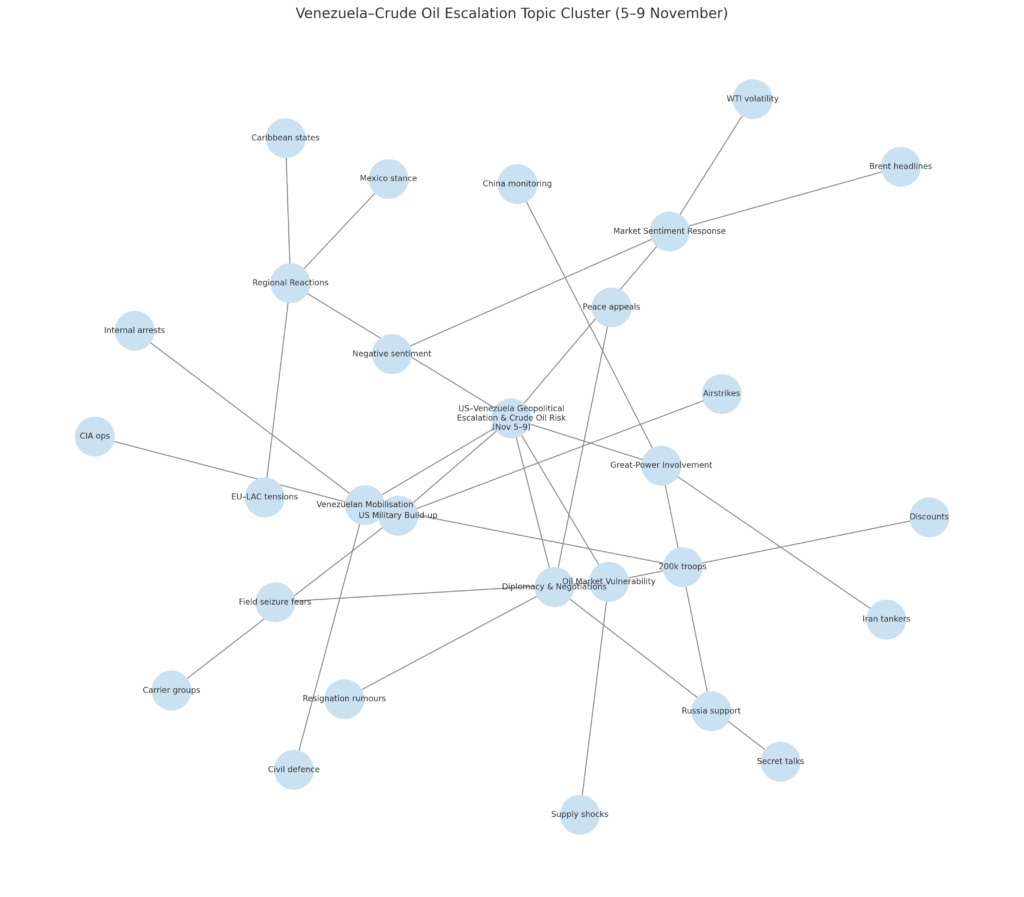
Above: Topic cluster visual illustrating how recent news cycles around Venezuela converged into seven interconnected geopolitical and energy-market narratives, shaping Brent and WTI sentiment taken from Permutable AI’s newsflow intelligence.
AI-driven sentiment analysis reveals escalating geopolitical risk around the Venezuela crisis
Using Venezuela as the primary entity, our system has detected a pronounced surge in negative macro-geopolitical sentiment in recent weeks, with sustained readings between -0.3 and -0.9. This reflects sustained concern across three converging narrative clusters:
1. U.S. military escalation and strategic signalling
A dominant cluster of signals pointed to a rapidly intensifying US military posture, including active deployments under Operation Southern Spear and the movement of carrier groups in the Caribbean. Statements from US leadership leaving “military action on the table” further amplified international concern, reflected in broad media alignment across sources.
2. Venezuelan internal mobilisation and authoritarian consolidation
The analysis also identified increasingly assertive activity within Venezuela, including reports of up to 200,000 troops mobilised, activation of territorial defence units and heightened internal repression. The contrast between official calls for peace and parallel military escalation contributed to volatile sentiment patterns.
3. Heightened vulnerability in global oil flows
Oil and energy markets featured heavily across the sentiment sweep. Signals around WTI, Brent and refined products repeatedly flagged supply fragility, with references to tankers, naval movements, sanctions and logistical choke points. This reflects market anxiety that any escalation would significantly disrupt global oil flows.
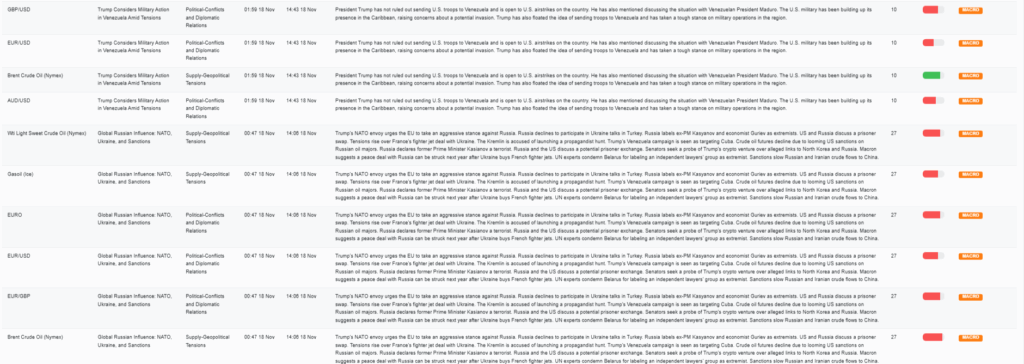
Above: Permutable AI’s real-time newsflow intelligence dashboard showing concentrated geopolitical signals related to Venezuela across currency, commodity, and macro-risk assets.
Our AI-driven sentiment model also surfaced rising involvement from global powers, including Russia, China and Iran, signalling that the Venezuela crisis is increasingly viewed as part of a broader geopolitical competition rather than a contained regional dispute.
Taken together, these sentiment patterns show consistent escalation, cross-asset contagion and convergence of diverse narratives into a single, high-risk storyline. Such convergence is a common precursor to market volatility, policy responses or geopolitical inflection points – offering early warning signals for analysts, policymakers and investors
Practical applications of this Venezuela crisis Risk Pulse Report
The true value of this Venezuela crisis Risk Pulse Report lies in its ability to translate fast-moving geopolitical developments into clear, actionable insight at the exact moment institutions need it most. In an environment where markets react as much to shifting narratives as to physical events, having a transparent, real-time view of geopolitical sentiment becomes a strategic advantage. The report provides this by combining deep geopolitical expertise with AI-driven narrative analysis, allowing organisations to understand not only what is happening, but how global markets are interpreting and pricing the risk.
For energy market participants, the report serves as an early-warning layer that highlights narrative pressure building around supply disruptions, sanctions risk or military escalation long before these dynamics are fully reflected in market prices. It helps traders and portfolio managers identify the signals that typically precede volatility, adjust their exposure with greater confidence, and anticipate market movements rather than responding after the fact. The ability to see stress accumulating across news cycles, diplomatic channels, shipping commentary and commodity narratives gives decision-makers a clearer sense of when geopolitical risk is becoming systemic.
For risk, compliance and strategy leaders, the report provides a structured, explainable framework for integrating geopolitical risk into governance and planning. Instead of relying on ad hoc assessments or scattered media monitoring, organisations gain a consistent, data-backed view of where risks are emerging, how quickly they are intensifying, and what this means for operational and strategic decision-making. This supports more robust scenario planning, strengthens oversight, and enables leadership teams to prepare for disruption before it becomes unavoidable.
Ultimately, the Risk Pulse Report delivers a level of clarity that is difficult to achieve through traditional analysis alone. By capturing the narratives that shape markets, the report empowers institutions to navigate geopolitical uncertainty with greater precision, agility and foresight – turning complex global developments into a clear competitive edge.
Strategic foresight starts now
As tensions surrounding Venezuela, Guyana and the wider Caribbean continue to intensify, institutions cannot afford to navigate geopolitical risk reactively. Traditional reporting captures events only after they unfold, yet today’s markets are increasingly driven by narrative velocity – the speed at which geopolitical stories form, evolve and influence pricing. The organisations that remain resilient are those that identify these shifts early and translate them into clear, confident decisions.
This Risk Pulse Report on the Venezuela crisis is designed to provide that critical early advantage. By combining deep geopolitical intelligence with a layer of real-time market sentiment intelligence it offers a forward-looking view of emerging risks long before they are visible through conventional channels. This allows traders, portfolio managers, risk teams and senior leaders to anticipate disruption, adjust positioning, and embed geopolitical foresight directly into their strategic and operational planning.
If your institution is seeking to strengthen its ability to read the global environment, to understand how geopolitical tensions are likely to influence markets, and to make decisions grounded in transparent, data-driven intelligence, this first Risk Pulse Report provides a decisive edge with future editions to come. Now is the moment to shift from passive observation to proactive preparation. Connect with us to integrate real-time geopolitical insight into your workflows and stay ahead of the next major inflection point.
For enquiries or to schedule a briefing, contact Geopolitics Incorporated or request a demo of Permutable AI’s market intelligence by mailto:enquiries@permutable.ai.
About Geopolitics Incorporated
Geopolitics Incorporated is a strategic advisory firm specialising in global risk analysis, security forecasting and geopolitical strategy. Drawing on decades of experience across defence, intelligence and international affairs, the firm provides governments, corporates and financial institutions with high-impact insights into emerging threats and global power dynamics. Through tailored briefings, scenario analysis and strategic advisory work, Geopolitics Incorporated helps leaders navigate complex geopolitical environments and make informed decisions in moments of uncertainty.
About Permutable AI
Permutable AI is a market intelligence company that combines advanced machine learning with global data ingestion to deliver real-time insights on geopolitical risk, energy markets and macroeconomic volatility. Its proprietary narrative and sentiment analysis models process thousands of global signals each day – from news and policy to shipping, sanctions and military movements – generating transparent, actionable intelligence for traders, asset managers, risk teams and policymakers. By transforming unstructured global information into clear, predictive indicators, Permutable AI helps institutions anticipate market-moving events and act with greater precision and confidence.