
This article provides insights into transforming information overload into competitive advantage for institutional investing, featuring AI-powered intelligence filtration and real-world case studies for institutional investors, portfolio managers, and investment committee members seeking to enhance decision-making speed and accuracy in volatile markets.
In the milliseconds between a geopolitical headline breaking and market reaction, fortunes are made and lost. In institutional investing, navigating today’s hyperconnected markets, the challenge isn’t accessing information – it’s identifying which fragments of the global news torrent will actually move asset prices before they do. This distinction between noise and signal has become the defining competitive advantage in modern institutional investment management.
The transformation is profound. Where portfolio managers once relied on established economic calendars and predictable data releases, today’s markets pivot on Twitter threads from central bank governors, overnight commodity supply disruptions, and regulatory announcements buried in thousand-page documents. The velocity of information flow has created a paradox: more data should mean better investment decisions, yet many institutional investors find themselves drowning in irrelevant alerts whilst missing the headlines that truly matter.
Table of Contents
ToggleThe dilemma for institutional investing
Modern institutional investing operates in an environment of unprecedented information density. A typical investment team receives approximately 10,000 news items, research notes, and market alerts daily across Bloomberg terminals, Reuters feeds, proprietary research platforms, and social media monitoring systems. Each piece of information demands evaluation for potential portfolio impact, yet human cognitive capacity remains fundamentally limited.
The mathematics of this challenge are not to be underestimated. By our estimation, if a senior portfolio manager spends just 30 seconds evaluating each incoming alert, they would require over 80 hours daily simply to process the information flow – an impossibility that forces crude filtration methods. Within the institutional investing space, many resort to keyword-based screening or rely on junior analysts to flag “important” developments, creating systematic blind spots where crucial market-moving information slips through undetected.
This information asymmetry problem is particularly acute in multi-asset portfolio management, where developments in one market can cascade rapidly across seemingly unrelated instruments. A supply chain disruption in Southeast Asia might impact European automotive stocks, whilst simultaneously affecting copper futures, emerging market currencies, and high-yield credit spreads. Traditional sector-based information filtering often misses these interconnected signals, leaving institutional investment portfolios exposed to unexpected volatility.
The challenge extends beyond volume to velocity. Modern markets react to information within minutes of release, creating a narrow window for institutional investors to assess, rebalance, and execute. The most sophisticated institutional investment operations have recognised that success requires not just faster information processing, but fundamentally different approaches to intelligence prioritisation and signal extraction.
The real cost of signal-to-noise inefficiency
The financial impact of information inefficiency extends far beyond missed opportunities. Consider the cascading effects of a single missed signal. When institutional investors fail to identify an emerging narrative around supply chain disruption or regulatory change, they enter a reactive mode that compounds losses. Initial portfolio positioning becomes defensive rather than opportunistic, follow-up rebalancing often occurs at less favourable prices, and risk management decisions lag behind market reality. The cumulative effect transforms what should be alpha generation into systematic underperformance.
The reputational implications are equally severe. Pension fund trustees and investment committee members increasingly expect their institutional investment managers to demonstrate superior market intelligence and positioning. When investment teams consistently react to rather than anticipate market movements, client relationships suffer and asset retention becomes challenging. The competitive advantage shifts to firms that can demonstrate consistent alpha generation through superior information processing and signal identification.
Resource allocation inefficiencies represent another significant cost. Institutional investing teams that lack effective information filtration systems often overstaff research functions whilst underinvesting in technology infrastructure. Meanwhile, senior portfolio managers spend disproportionate time on information gathering rather than strategic asset allocation, whilst junior staff become overwhelmed by the volume of alerts requiring evaluation. The result is what we believe to be a systematic misallocation of human capital that compounds over time.
The solution: AI-powered filtration and prioritisation at scale
Enter advanced artificial intelligence systems which is exemplified via our plug and play Auto Analyst solution, which now offer institutional investors the capability to process vast information streams whilst maintaining human-level comprehension and context awareness. These systems transcend simple keyword matching to understand narrative development, sentiment evolution, and cross-market implications in real-time.
This is where modern AI-powered investment intelligence platforms like ours really excel, analysing not just what is being reported, but how the tone and intensity of coverage evolves across multiple sources and timeframes. This approach identifies emerging narratives before they achieve mainstream attention, providing institutional investors with the lead time necessary for strategic portfolio positioning.
The sophistication of our proprietary systems extends to understanding market context and historical precedent. Rather than treating each piece of information in isolation, our AI-powered platforms evaluate new developments against historical patterns, market positioning, and seasonal factors. This contextual analysis helps institutional investors distinguish between routine developments and genuinely market-moving events.
Cross-asset signal correlation represents another crucial capability. The advanced systems we have built recognise that commodity supply disruptions affect not just the underlying commodity, but related equities, currencies, and fixed income instruments. This holistic approach ensures institutional investing teams receive comprehensive intelligence rather than fragmented sector-specific alerts.
Case study: Flagging Brent crude narrative shift before price action
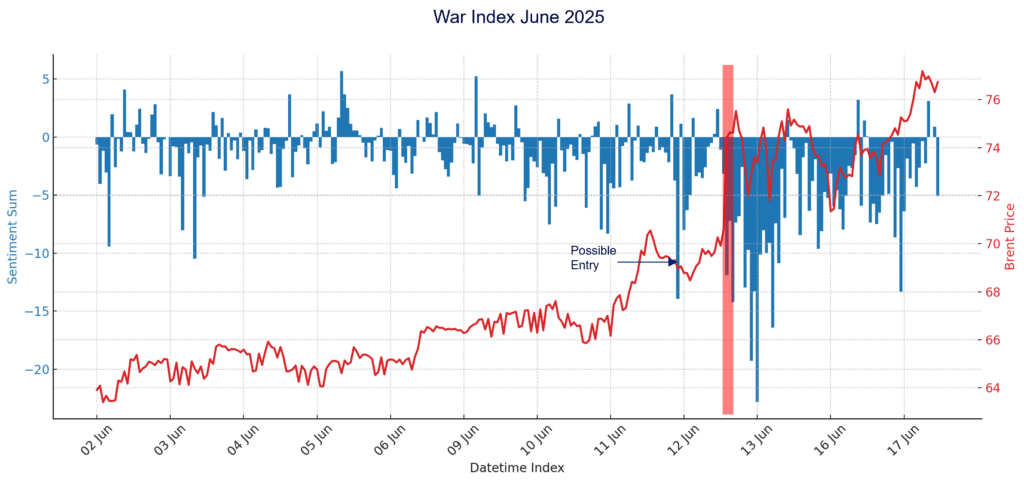
A practical example demonstrates the transformative potential of our AI-powered intelligence filtration. In June 2025, our War Sentiment Index began detecting unusual patterns in Middle Eastern media coverage on the evening of June 12th, forty-eight hours before significant Brent crude price action. At 08:14 the following morning, our algorithms identified the first signals of US-Israeli intent to strike Iran with Brent trading at $69 per barrel, whilst our sentiment scores showed significant negative spikes even as oil prices remained unchanged. By 21:00, as strike warnings escalated and pushed Brent to $70, our system had been providing real-time intelligence hours ahead of market pricing. When Israeli Air Force strike announcements broke simultaneously across major outlets at 00:07, oil spiked to $74 – but our clients had already received comprehensive intelligence detailing cross-asset implications.
The subsequent market reaction validated our AI system’s analysis, with one-year correlation data showing consistent predictive patterns where major sentiment spikes preceded significant oil movements. This Iran-related surge represented the highest concentration of war-related media coverage in twelve months, creating what our system classified as a “high confidence signal.” Institutional investors relying on traditional information sources found themselves reacting rather than anticipating these developments, whilst our clients benefited from the speed differential measured in hours rather than days. This case study illustrates the competitive advantage available to institutional investment teams that can identify narrative shifts before market consensus, transforming reactive asset allocation into proactive alpha generation.
The competitive edge: Intelligence as alpha generation
Forward-thinking institutional investing teams are already recognising that advanced information processing capability of the kind we offer at Permutable represents a sustainable competitive advantage in an increasingly commoditised asset management environment. Of course, the institutional investment landscape increasingly rewards firms that can demonstrate consistent alpha generation through superior market intelligence rather than simply efficient execution and it is this shift that elevates information processing capability from operational necessity to strategic advantage.
And it is this convergence of artificial intelligence, natural language processing, and market microstructure analysis has created unprecedented opportunities for institutional investors willing to embrace technological advancement of the kind we offer at Permutable. Ultimately, it will be such firms that successfully integrate these capabilities into their investment operations that will gain sustainable advantages that compound over time.
The transformation extends beyond individual portfolio performance to encompass broader client development opportunities. It goes without saying that institutional investment teams that consistently demonstrate use of superior market intelligence will attract higher-quality client relationships, command better fee structures, and develop reputations for investment excellence that generate long-term business value making the business case an obvious one.
Transform your institutional trading operations with AI-powered intelligence that identifies market-moving signals before they impact prices. Contact us at enquiries@permutable.ai to schedule a personalised demonstration tailored to your specific trading strategies and asset classes.