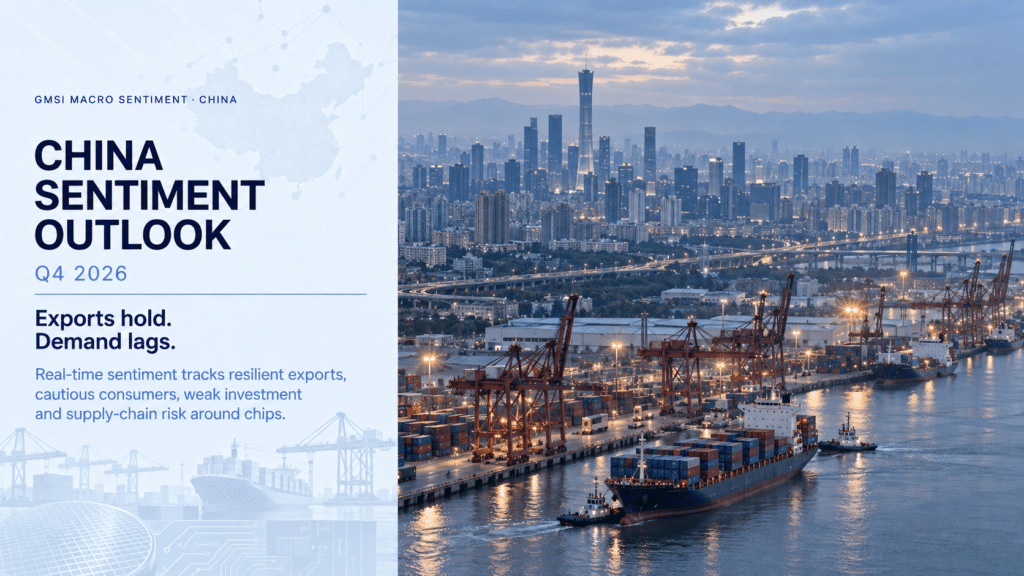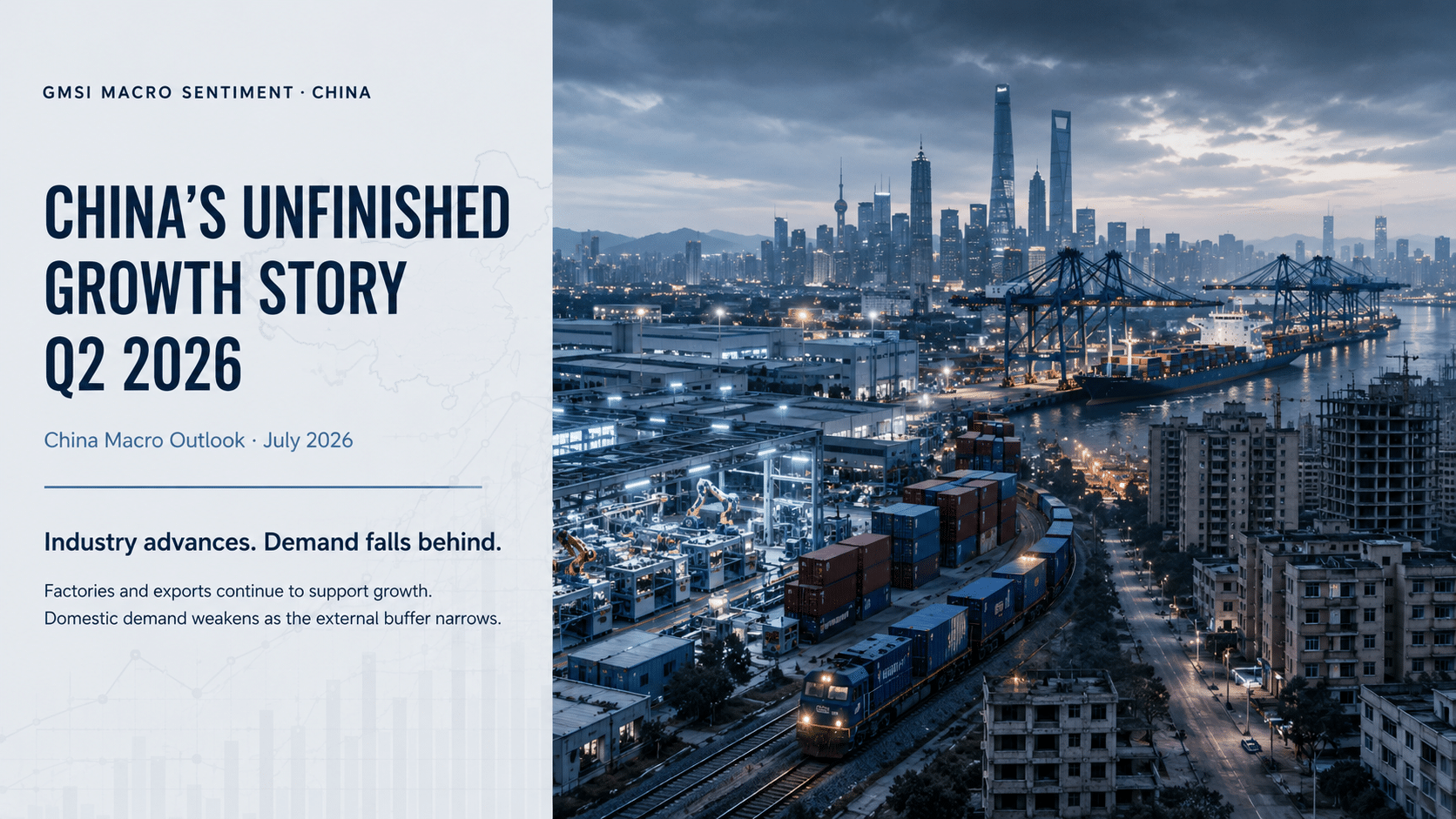
This report analyses why China’s 4.3% Q2 2026 growth masks a widening imbalance between resilient industrial output and weakening domestic demand. Using Permutable’s Global Macro Sentiment Indices, it examines expenditure, property, inflation, trade and industrial momentum. It is aimed at investors, economists, strategists, risk teams and institutions monitoring China’s growth outlook and cross-market implications across global portfolios and policy-sensitive markets.
China’s second-quarter data revealed an economy increasingly divided between its capacity to produce and its ability to generate demand at home.
GDP growth slowed to 4.3% year on year in the second quarter, leaving first-half growth at 4.7%. Industrial output remained comparatively resilient, while exports accelerated sharply in June. Domestic indicators were markedly weaker: retail sales increased only modestly, private investment contracted and property investment remained deeply negative.
Permutable’s Global Macro Sentiment Indices, or GMSI, show how this divergence developed across expenditure, housing, inflation, trade and industrial activity.
The signals do not attempt to predict the precise number attached to an official economic release. They structure the information surrounding each economic topic to show where pressure is building, where momentum is weakening and how changes are transmitting through the economy.
China has not run short of goods to produce. Its difficulty lies in finding enough domestic buyers willing or able to absorb those goods at the same pace.
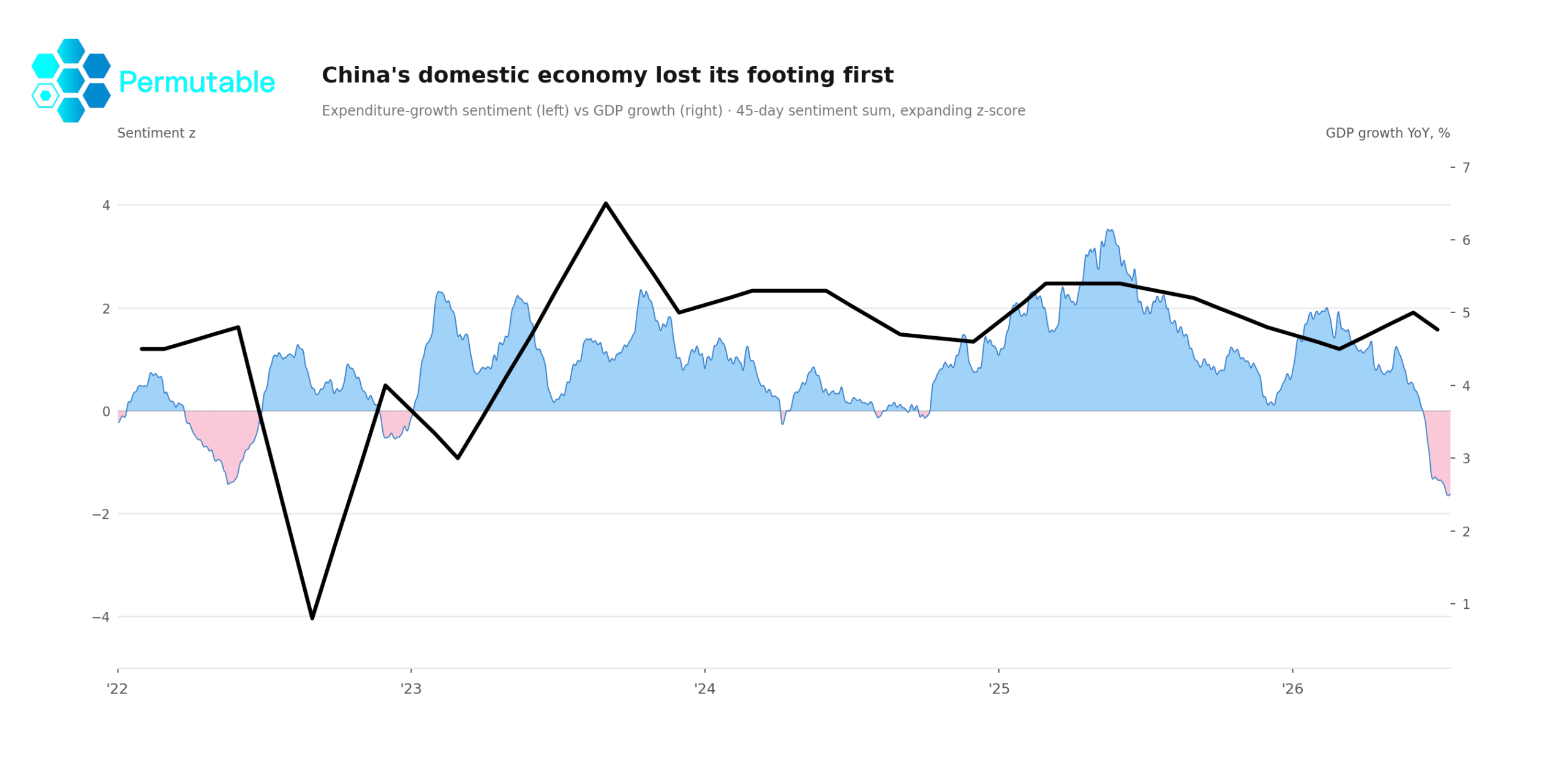
Permutable’s expenditure-growth sentiment signal deteriorated rapidly during the second quarter, falling to −1.7 standard deviations by 16 July. The decline placed the weakness primarily in spending and investment rather than in productive capacity.
Official data reflected the same imbalance. Retail sales returned to growth in June, but the improvement was insufficient to reverse the broader weakness across the first half. Private investment contracted more sharply than aggregate investment, while industrial production continued to expand.
One stronger month of consumption does not resolve the underlying pressure created by falling property values, uncertain income expectations and precautionary saving.
Property remains central to the transmission of credit, income and confidence through the Chinese economy.
Housing activity supports local-government revenue, construction employment, demand for materials and household wealth. When that channel weakens, the effect extends well beyond developers and housebuilding.
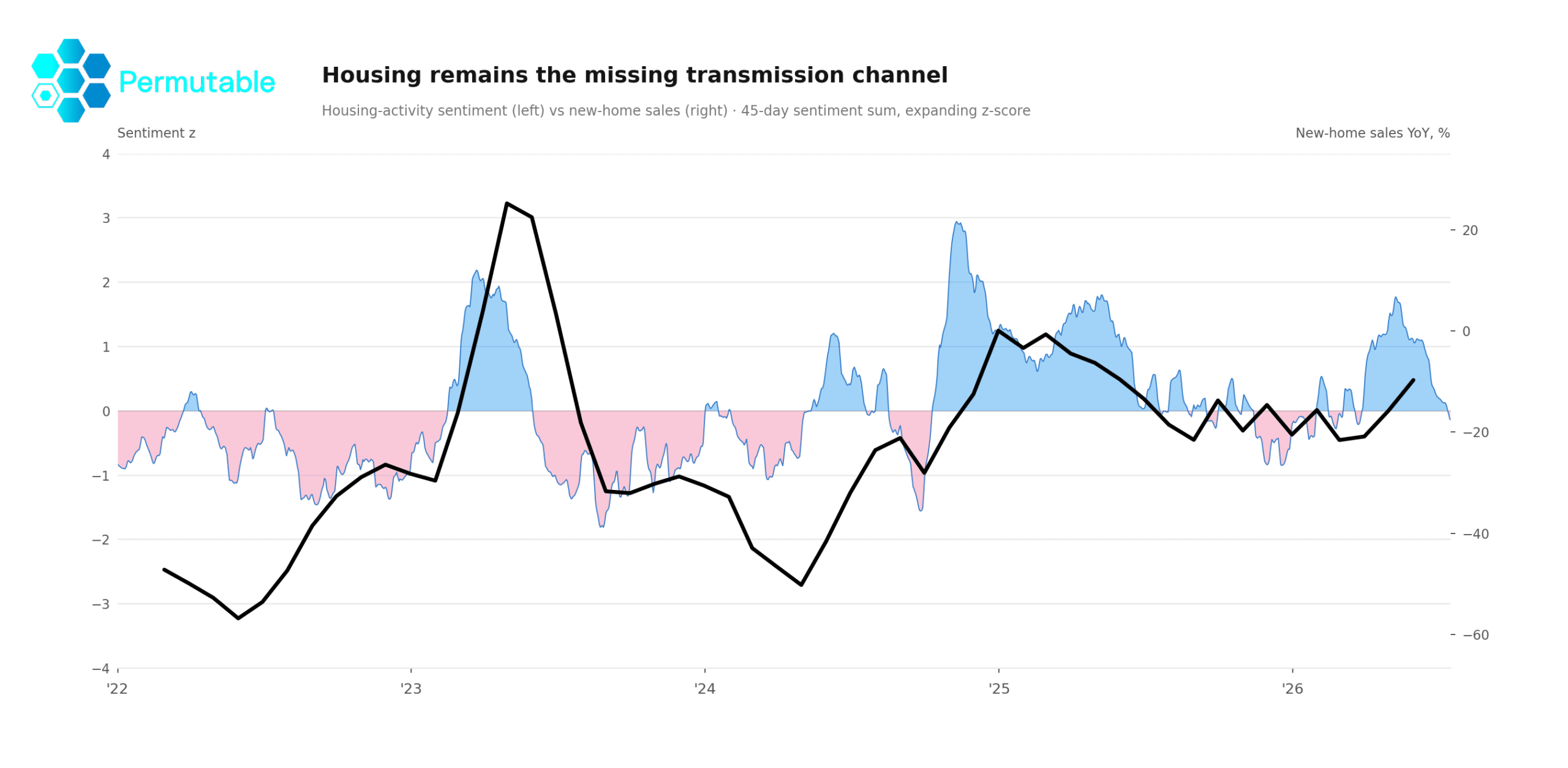
Permutable’s housing-activity sentiment signal staged a tentative revival during spring 2026, but the improvement faded back towards neutral. At the same time, new-home sales and property investment remained firmly negative.
Stabilisation may slow the decline, but it does not yet represent a durable recovery. Until households become more confident about the value of their largest asset, the incentive to save rather than spend is likely to remain powerful.
China’s price data provide another expression of the domestic-demand weakness.
The report shows input and producer-price pressure rising more quickly than consumer inflation. Imported energy and raw-material costs entered the industrial economy, but weak household demand limited companies’ ability to pass those costs through to consumers.
Permutable’s inflation sentiment climbed to +2.9 standard deviations in April as energy and producer-price pressure intensified. It subsequently reversed below neutral, indicating that the original cost shock had not developed into broad domestic reflation.
The result is a margin squeeze rather than a conventional consumer-inflation cycle, with smaller private firms particularly exposed.
China’s export performance has absorbed some of the production that the domestic economy could not.
Mechanical and electrical goods accounted for a large share of shipments, supported by overseas demand for semiconductors, computing equipment and advanced machinery.
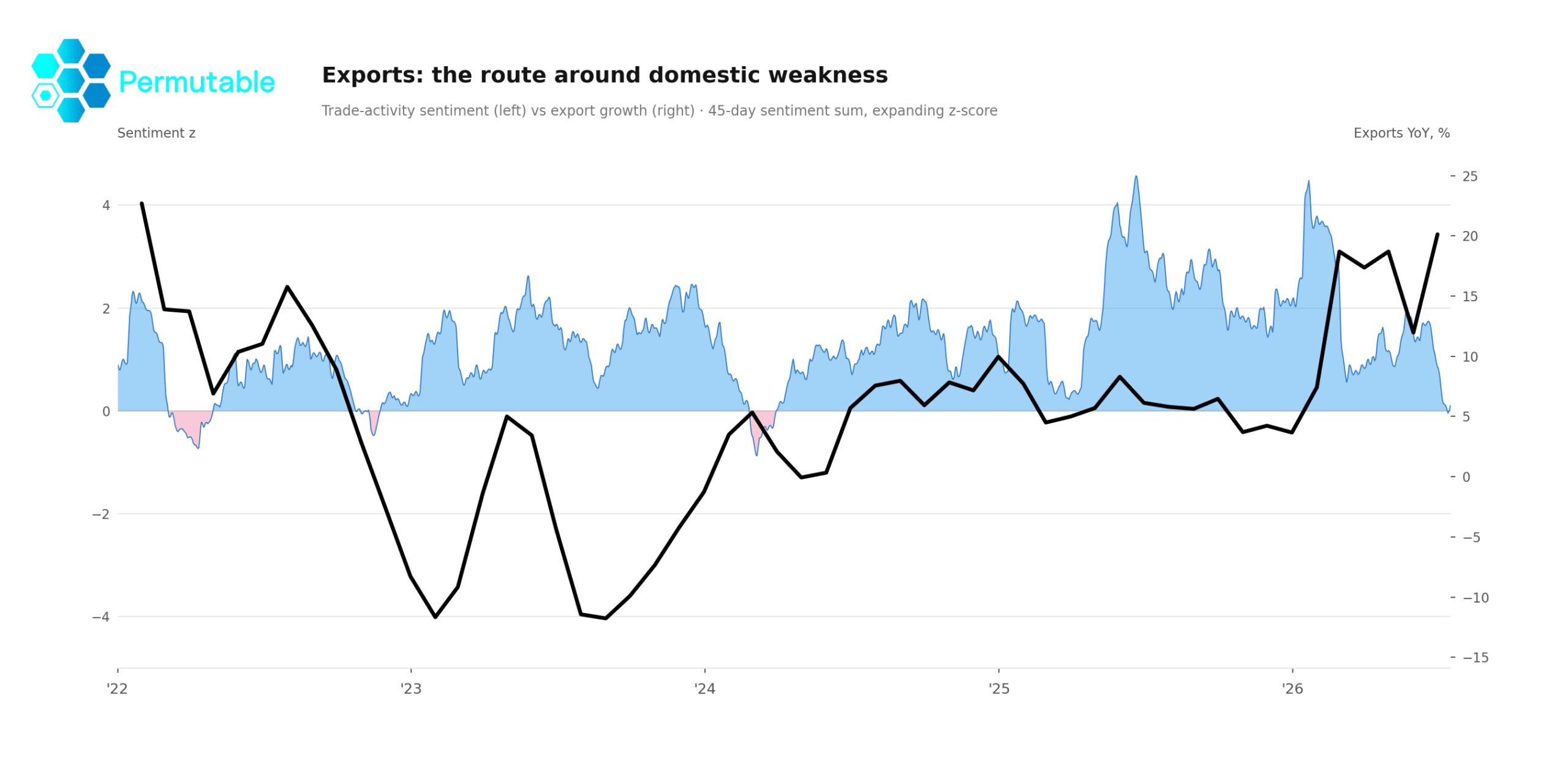
However, Permutable’s trade-activity sentiment signal weakened substantially even as the official export figures accelerated. The signal declined from +3.8 standard deviations in January to approximately neutral.
This divergence matters because reported customs figures reflect goods that have already been produced and shipped. The sentiment signal captures the developing information environment around future orders, trading conditions, tariffs and policy risk.
Some demand may also have been brought forward, supporting current exports at the expense of later quarters. Exports therefore provide a release valve for excess production, but they do not rebuild household confidence or domestic consumption.
Industrial production remained the strongest part of China’s activity data through the first half of the year.
High-technology manufacturing, equipment production, batteries, industrial robots and advanced manufacturing equipment continued to grow rapidly.
Yet Permutable’s 90-day industrial sentiment signal weakened to −0.2 standard deviations by mid-July. Current output remained firm, but the information environment surrounding future industrial conditions became less supportive.
China’s factories do not need to enter outright contraction for the wider growth model to weaken. They need only lose enough momentum that industry and exports can no longer compensate for the weakness already present in property, household spending and private investment.
Three signals should indicate whether China’s imbalance is beginning to ease or spread:
If both stabilise near neutral, the external buffer may continue to support growth. If they follow expenditure sentiment more deeply into negative territory, the slowdown is spreading into the sectors that previously contained it.
A recovery that remains above neutral would provide early evidence that the property channel is beginning to reopen. Another short-lived rebound would suggest that stabilisation has not yet become recovery.
A durable move back through its historical norm would be the clearest sign that productive activity is translating into household spending and domestic investment again.
Permutable’s base case in the report is a further gradual loss of momentum, with growth moving towards 4% by year-end unless the policy mix shifts more decisively towards households.
Each signal aggregates the relevant GMSI topic-level sentiment over a rolling window. A 45-day window is used for expenditure, housing, inflation and trade, while the slower-moving industrial signal uses a 90-day window.
Values are standardised using an expanding, no-look-ahead z-score calculated only from information available at each historical date. A reading of +1σ or −1σ indicates that the signal is one standard deviation above or below its own historical norm at that point.
The signals are used in this analysis for coincident monitoring, sequencing and comparison with official data. They are not presented as statistically identified leading indicators or standalone trading recommendations.
Access the complete nine-page analysis, including the expenditure, property, inflation, trade and industrial sentiment charts, methodology and second-half outlook.