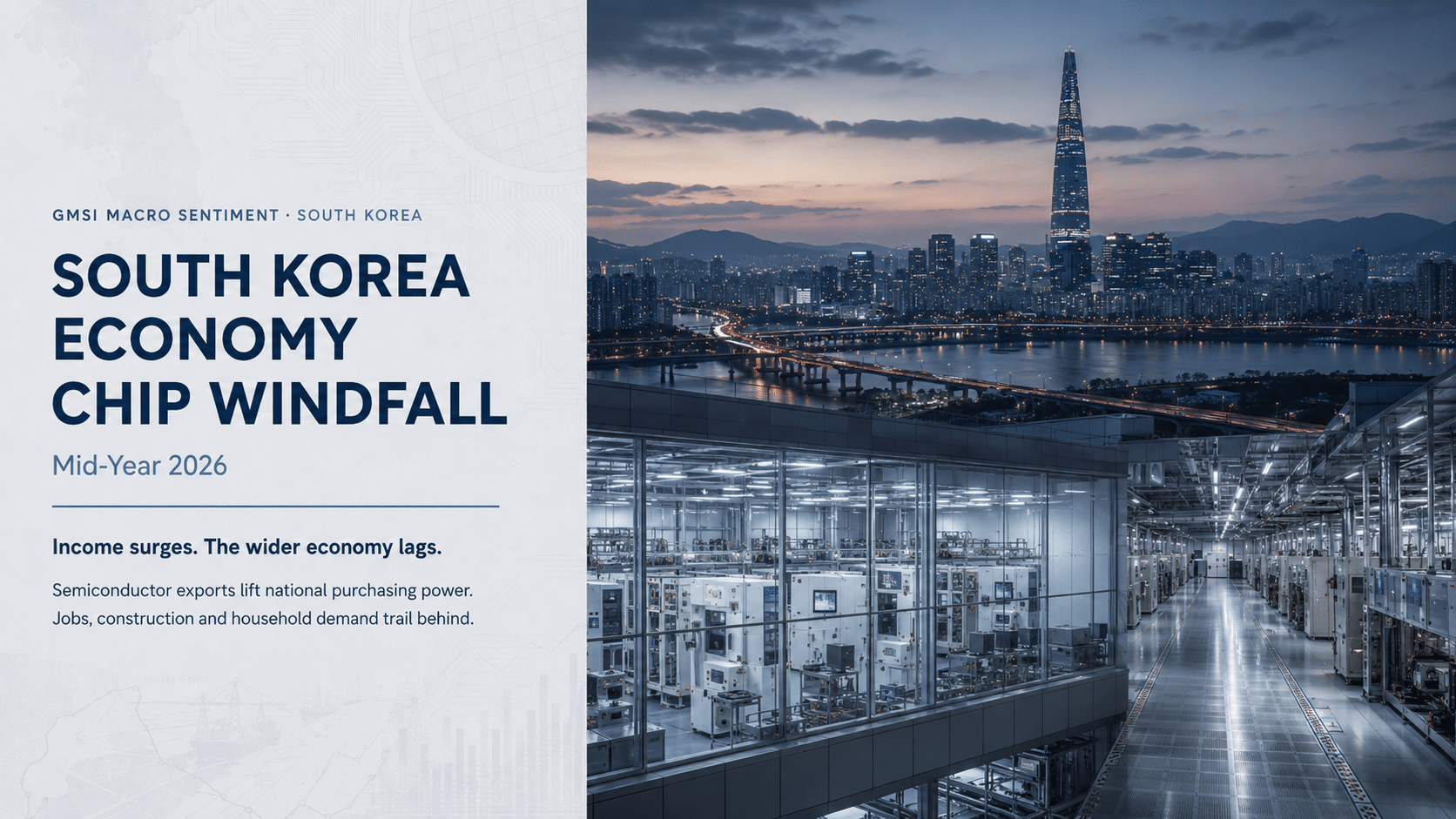
This report examines how the South Korea economy’s semiconductor boom lifted real domestic income by 15.6% in Q2 2026 without producing comparable gains in employment, construction or household demand. Using Permutable’s GMSI signals, it analyses growth, trade, consumption, inflation and monetary policy for investors, economists, strategists, risk teams and institutions assessing South Korea’s economic and market outlook
The South Korea economy entered the second half of 2026 with an unusually wide gap between national purchasing power and underlying domestic activity.
Real gross domestic income rose 15.6% year on year in Q2, its strongest increase since early 1988. Real GDP grew 3.7%, while private consumption increased 2.5% and the Bank of Korea’s industrial-production component contracted 0.9%.
South Korea’s GDP also expanded 0.6% quarter on quarter, exceeding consensus expectations and the central bank’s projection. Yet the national-income gain remained far larger than the improvement experienced across households, construction and employment.
Permutable’s Global Macro Sentiment Indices, or GMSI, show how the South Korea economy is developing across growth, trade, consumption, production, employment, inflation and monetary policy.
The signals do not attempt to predict the precise value of an official economic release. They structure the information surrounding each topic to show where pressure is strengthening, where momentum is fading and how changes are transmitting through the economy.
Permutable’s expenditure-growth sentiment reached +4.1z ahead of the release of South Korea’s second-quarter national accounts.
Private-consumption sentiment stood at +2.4z and policy-outlook sentiment at +3.8z. At the same time, employment sentiment had fallen to −2.4z, industrial sentiment to −0.5z and inflation sentiment to −1.0z.
The pattern points to a South Korea economy in which growth, spending and policy discussion strengthened even as the information environment surrounding production, jobs and prices became less supportive.
The late rise in expenditure-growth sentiment belongs to the opening of the third quarter, but it was visible before the 23 July GDP release. It should therefore be interpreted as the discussion entering the release rather than as the average signal for Q2 itself.
South Korea’s export boom was driven by both higher shipment volumes and a still larger increase in export prices.
June exports reached US$102.25 billion, the first monthly total above US$100 billion, with semiconductors accounting for US$44.82 billion. Export volumes increased by approximately 30% year on year, while export prices rose by almost 49% and the terms of trade improved by roughly 16%.
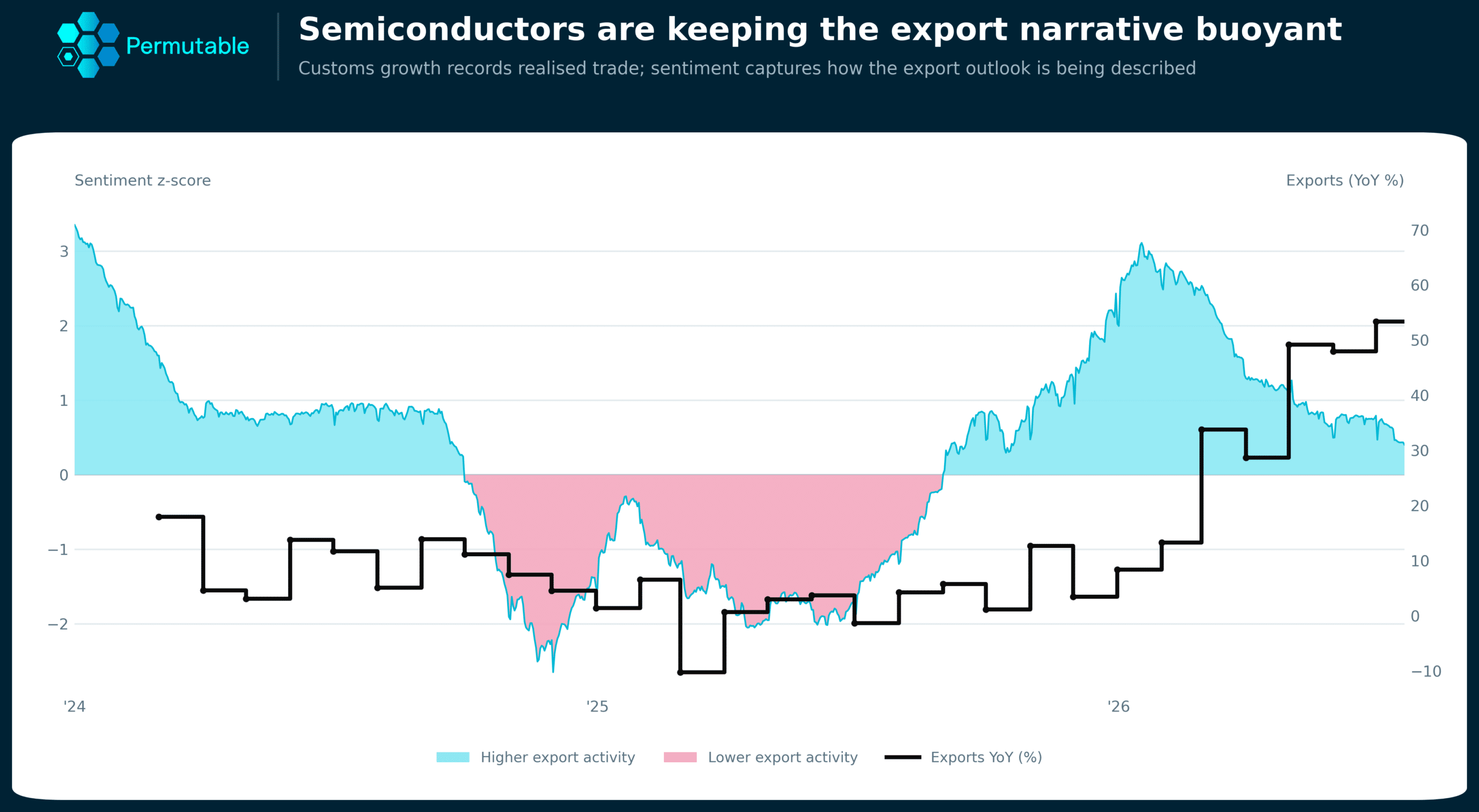
Customs exports rose 70.9% year on year in June. However, Permutable’s export sentiment eased from above +3z in February to +0.9z by 22 July.
The boom is firmly visible in the reported data, but the information environment surrounding future exports is no longer strengthening at the pace seen earlier in the year.
This leaves the South Korea economy increasingly dependent on semiconductor prices remaining firm rather than on another acceleration in external trade.
South Korea’s customs imports increased 30.1% year on year, while GMSI import sentiment declined to +0.2z.
Higher energy costs and a weak comparison period lifted the annual rate, but the sentiment signal offered less evidence of a broad acceleration in underlying import demand.
The distinction matters for the South Korea economy because a strong customs figure can reflect prices and base effects without indicating a comparable rise in household or business demand for imported goods.
With export sentiment also below its February peak, the second-half outlook may depend more on semiconductor pricing holding firm than on another broad acceleration in external trade.
Private consumption rose 0.4% quarter on quarter and 2.5% year on year in Q2.
Real spending growth has strengthened steadily from approximately 0.5% in the middle of 2025. Permutable’s private-consumption sentiment rose to +2.4z, while expenditure-growth sentiment reached +4.1z.
Households therefore entered the third quarter in better shape than they had a year earlier. However, the improvement remains modest compared with the 15.6% increase in real domestic income.
The central question for the South Korea economy is whether stronger wages and employment can sustain the improvement in spending once the semiconductor-price impulse begins to fade.
Consumption has improved, but the windfall has not yet become a broad household boom.
The strongest domestic gains remain concentrated close to the technology sector.
Intellectual-property investment rose 3.3% quarter on quarter, its fastest increase in more than 14 years, as companies increased research spending. Manufacturing output rose 1.2% and services output increased 1.1%.
Conditions were weaker in sectors with a broader employment base. Facilities investment rose only 0.2% after a 6.6% first-quarter increase. Construction investment fell 0.2%, construction output declined 1.9%, and manufacturing employment was approximately 97,000 lower than a year earlier.
Earlier South Korean export cycles in shipbuilding, steel and automobiles supported large workforces and extensive supplier networks. Memory-chip production is more capital-intensive. It can increase profits and national purchasing power rapidly without producing a comparable rise in employment or household income.
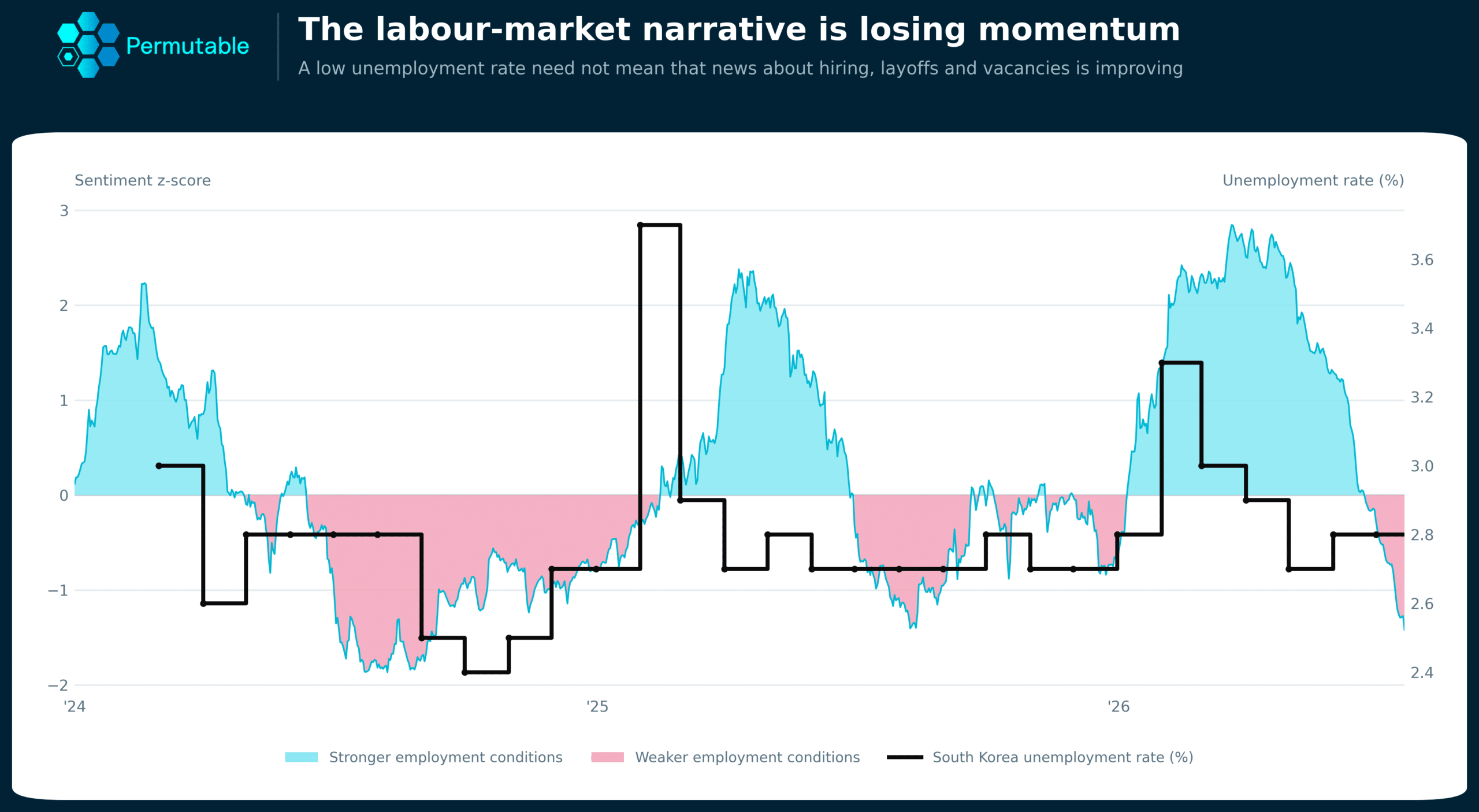
Permutable’s employment sentiment fell to −2.4z, the weakest reading in the GMSI panel. Industrial sentiment also moved below its prior historical norm.
The South Korea economy is benefiting from a technology boom, but its employment effects remain limited.
Headline consumer inflation reached 3.2% year on year in June, its highest level since late 2023. Core inflation remained lower at 2.5%.
The 70-basis-point gap is consistent with imported energy pressure rather than a broad acceleration in domestic demand.
Higher import costs also offset part of the semiconductor terms-of-trade gain received by the South Korea economy during the quarter.
Permutable’s inflation sentiment fell sharply after May and reached −1.0z by 22 July. Official CPI was still recording delayed pass-through from the earlier supply shock, while the intensity of inflation-related discussion had already weakened.
The inflation picture therefore reflects an imported cost shock rather than evidence that domestic demand is overheating.
The Bank of Korea raised its base rate by 25 basis points to 2.75% on 16 July, its first increase since 2023.
Stronger national income, higher headline inflation and financial-stability concerns supported the decision. However, the domestic case remained uneven: construction was contracting, manufacturing employment had weakened and core inflation remained at 2.5%.
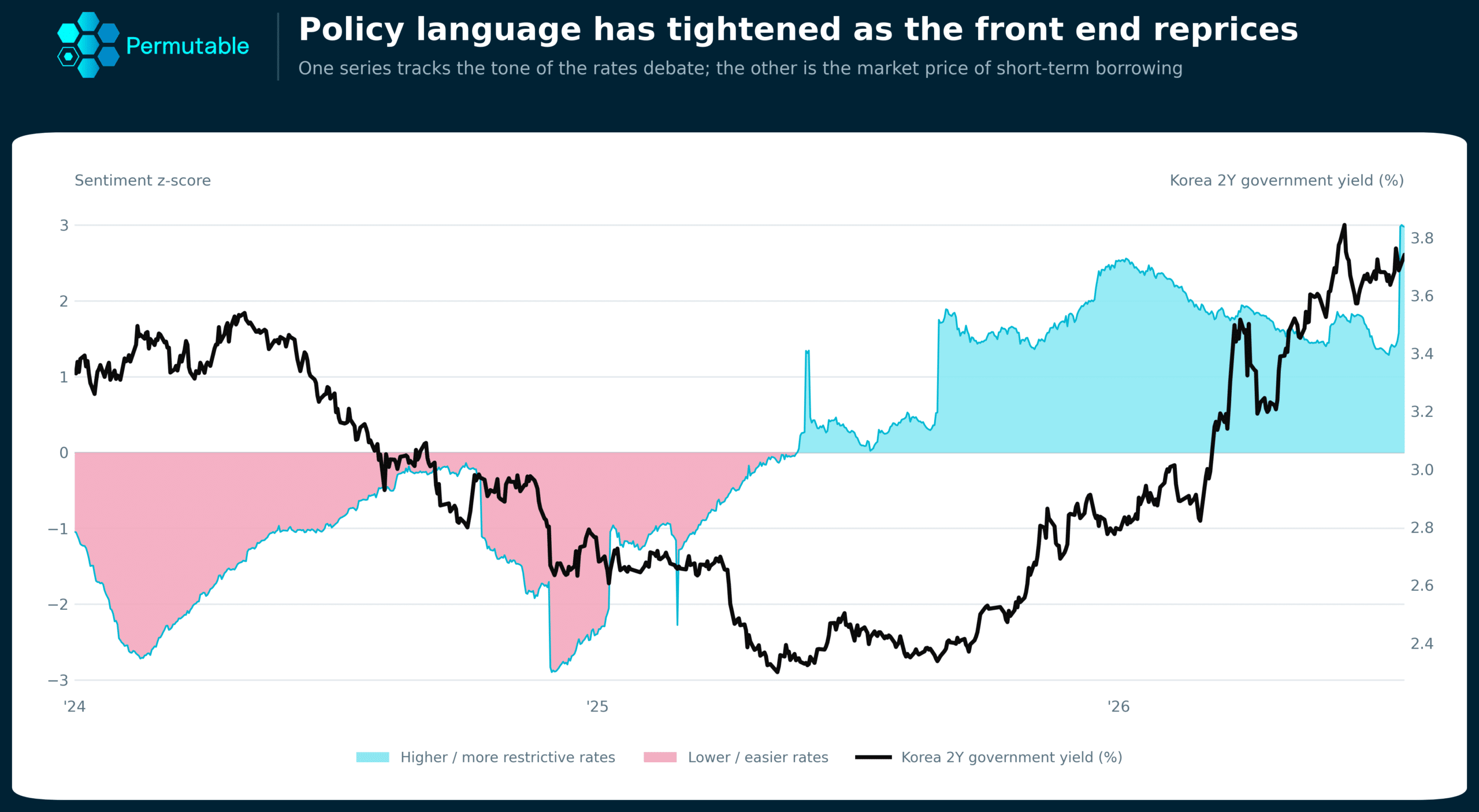
Permutable’s policy-outlook sentiment began rising in February and reached +3.8z before the decision. Interest-rate sentiment turned positive in late 2025 and stood at +1.9z.
Over the same period, South Korea’s two-year government yield climbed from approximately 2.3% to 3.741%. Markets gave greater weight to stronger income and policy expectations than to the uneven domestic expansion.
The report treats this as a directional relationship rather than a precise trading coefficient while earlier GMSI rates research is repeated using the current 45-day, point-in-time construction.
The second half will test whether South Korea’s semiconductor windfall begins to spread through the wider domestic economy or remains concentrated in technology and exports.
Faster wage growth, stable employment, renewed construction activity and further gains in household spending would indicate that export income is reaching more of the South Korea economy.
A decline in semiconductor prices before household incomes strengthen would erode the national-income gain before a broader domestic expansion had formed.
A renewed energy shock would lift headline inflation without strengthening domestic demand, leaving the Bank of Korea with a more difficult policy mix.
The won recovered from close to 1,560 per US dollar in June to 1,476 on 20 July, with exporter conversion and other flows providing much of the support.
Financial-stability sentiment fell to −1.0z. It describes the prevailing risk discussion rather than providing a directional signal for USD/KRW.
The key test is whether wages, employment, construction and consumption strengthen before semiconductor pricing loses momentum.
GMSI directional sentiment scores are calculated as 45-day sums and standardised using a prior-only expanding z-score with a minimum history of 365 days.
Each observation is measured against information available at the time and contains no look-ahead. The latest complete observation used in this report is dated 22 July 2026.
National-accounts data are drawn from the Bank of Korea, customs trade data from the Ministry of Trade, Industry and Resources, and inflation and labour-market data from Statistics Korea.
Associations between sentiment and official economic or market data should not be interpreted as evidence of causality.
Access the complete nine-page analysis of the South Korea economy, including semiconductor exports, GDP growth, household consumption, production, employment, inflation, monetary policy and the main risks for the second half of 2026.
27 Jul 2026
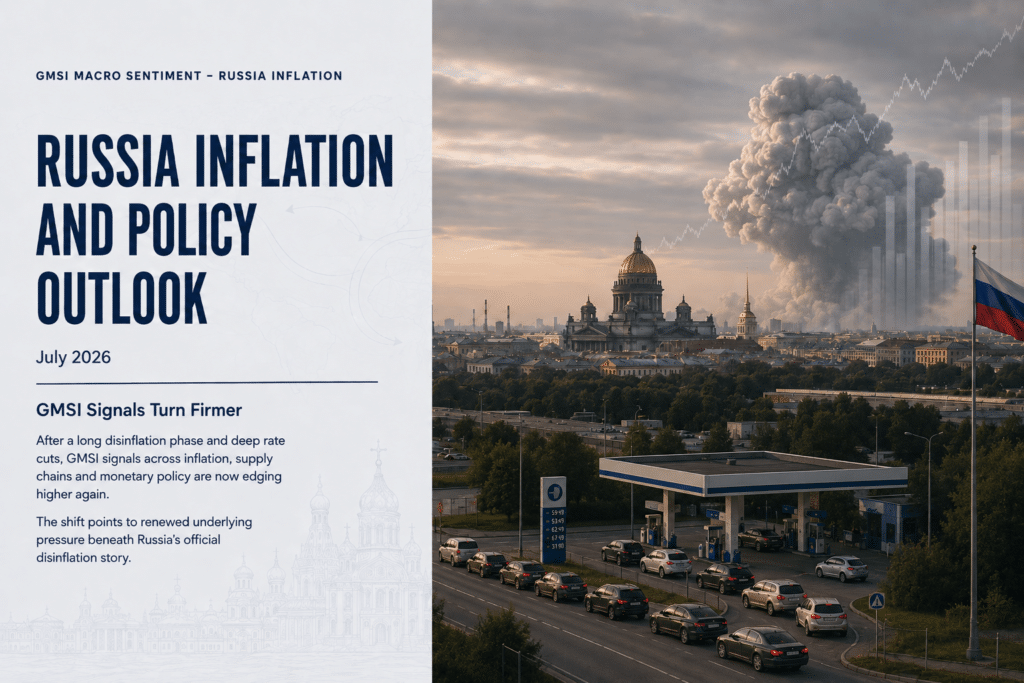
The tide turns on Russia inflation outlook as drone strikes spread from refineries to warehouses
Read more >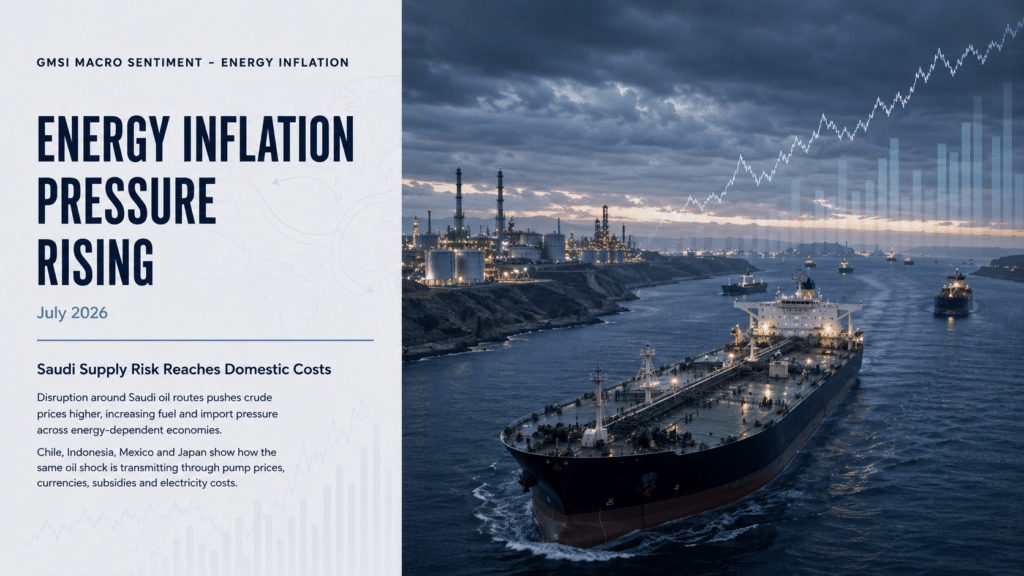
Analysis
27 Jul 2026
Saudi supply risk and import costs drive energy inflation sentiment higher
Read more >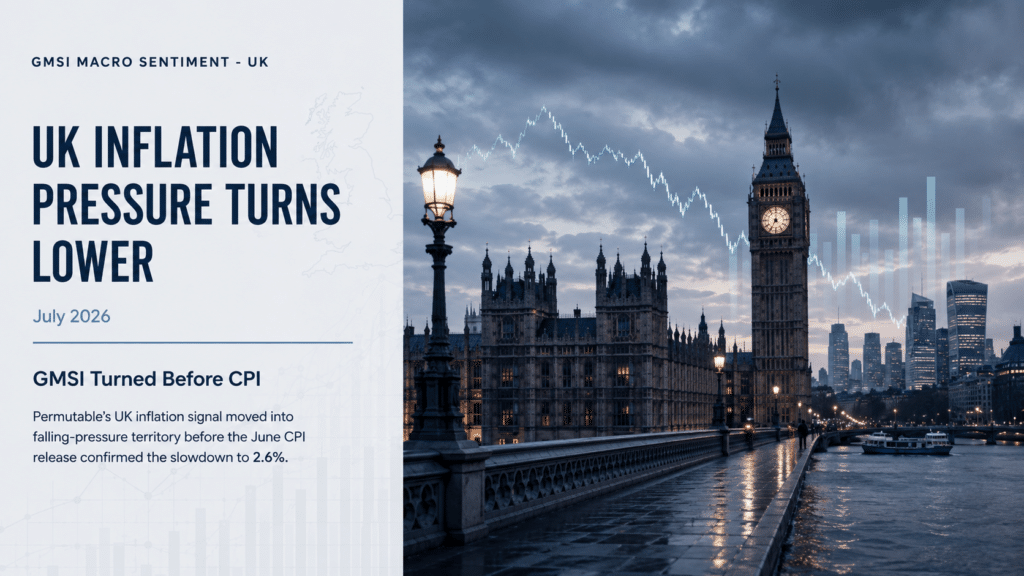
Analysis
22 Jul 2026
UK inflation fell to 2.6% after Permutable’s Global Macro Sentiment Indices saw it coming
Read more >