UK inflation fell to 2.6% after Permutable’s Global Macro Sentiment Indices saw it coming
22 Jul 2026
22 Jul 2026
This analysis explains how Permutable’s Global Macro Sentiment Indices identified falling UK inflation pressure before the June CPI release confirmed the slowdown. It is aimed at macro strategists, rates traders, economists, quantitative researchers and investment teams seeking earlier, point-in-time signals to complement official data, improve market timing and support discretionary or systematic inflation research across UK rates and currency markets.
Permutable’s Global Macro Sentiment Index was reading falling UK inflation pressure long before the official figures caught up. When the June print landed on 22 July, headline inflation had eased to 2.6%. Aggregate sentiment now sits well into negative territory, a sharp turn from the +1.2z peak it reached in early spring, when energy sentiment spiked alongside the US-Iran conflict.
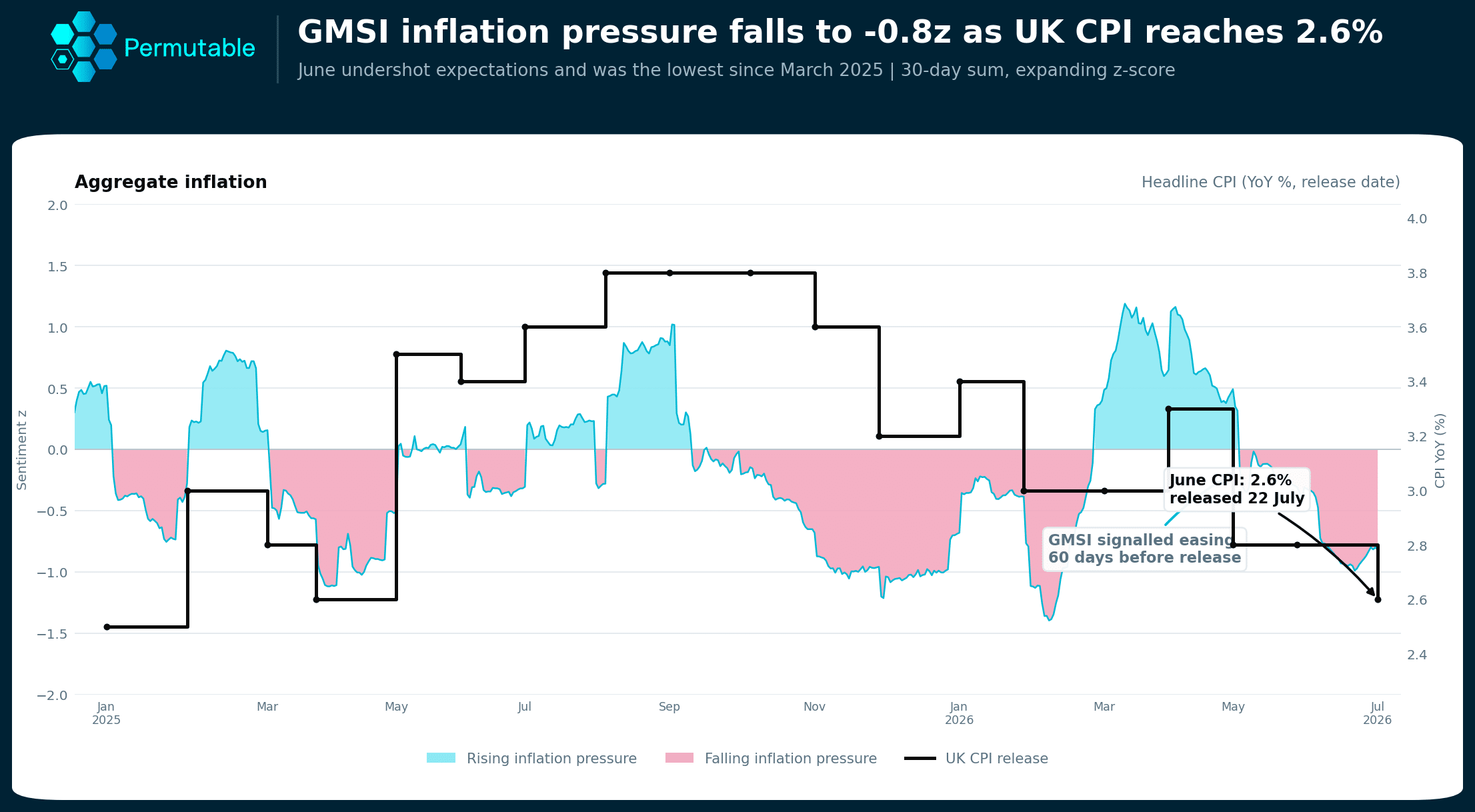
The chart tells the story in two colours. The cyan reading, rising inflation pressure, built through February and March, topped out just above one standard deviation, then rolled over. By May it had given way to light red, falling pressure, and has stayed there since. The CPI release, the black step line against the right axis, only caught up on 22 July, when the June figure printed at 2.6%. GMSI had turned negative a full two months before that.
The print came in below consensus, the lowest reading since March 2025. Cheaper food did most of the work, helped by summer clothing discounts that cut deeper than last year’s. Motor fuels made the single biggest downward contribution: pump prices fell as an earlier Middle East truce took the heat out of supply. Food and drink inflation cooled to 1.7%, its softest since August 2024, with sugar, jam, syrups and confectionery leading the way down.
Official inflation data is necessarily backward-looking. The June CPI figure described price changes that had already occurred and was not published until 22 July.
GMSI provides a different information layer. It structures macroeconomic reporting and commentary by:
Permutable’s Global Macro Sentiment Indices are updated hourly and are designed to provide historical and live inputs that institutional teams can transform, normalise and test within their own research processes. GMSI is a raw feature layer rather than a completed trading strategy or official inflation forecast.
For discretionary teams, the UK series can help identify the narratives driving a change in inflation pressure. For systematic teams, the same data can be used to construct and test features against rates, currencies, inflation markets or other economically relevant variables.
The value is not that every change will predict the next CPI figure. It is that the information flow can be measured before the corresponding official data is released.
The UK inflation outlook remains exposed to a renewed increase in energy costs.
Ofgem raised the energy price cap by 13% from 1 July to 30 September 2026, increasing the illustrative annual bill for a typical direct-debit household to £1,862. Because the change took effect after the June measurement period, its direct impact will begin to appear in subsequent inflation releases.
Energy-market risks have also increased again. Brent crude traded above $95 per barrel on 22 July as conflict in the Middle East intensified. Any assessment of the future inflation impact should distinguish between a temporary market spike and a sustained increase that passes through to fuel, transport, production and food costs.
The Bank of England’s next monetary-policy decision is scheduled for 30 July 2026. Bank Rate currently stands at 3.75%, while the Bank’s inflation target remains 2%.
As of 22 July, the GMSI aggregate signal remained at −0.8z and continued to indicate falling inflation pressure. It was not yet showing the broad build in rising pressure that would confirm a new inflationary regime.
The signals to monitor next are:
The chart should state the precise construction of the displayed GMSI feature, including:
GMSI measures the direction and intensity of macroeconomic narratives. It does not directly measure consumer prices, guarantee a lead over official data or constitute an investment recommendation.
Find out how Permutable’s point-in-time macro signals could support your institution’s research, trading, risk or portfolio workflows, and explore access to sample data for evaluation. Get in touch with our team to discuss your use case.

30 Sep 2026
The Hawkish Turn: G10 Central Bank Policy Outlook into Q4 2026
Read more >
Guide
30 Sep 2026
The complete guide to early macro regime sentiment signals for hedge funds and institutional investors
Read more >
Analysis
23 Sep 2026
How does the 2026 energy shock reach 2027? From shipping routes to policy rates
Read more >