Crude oil price forecast this week: Bearish pressures mount amid supply-demand imbalance

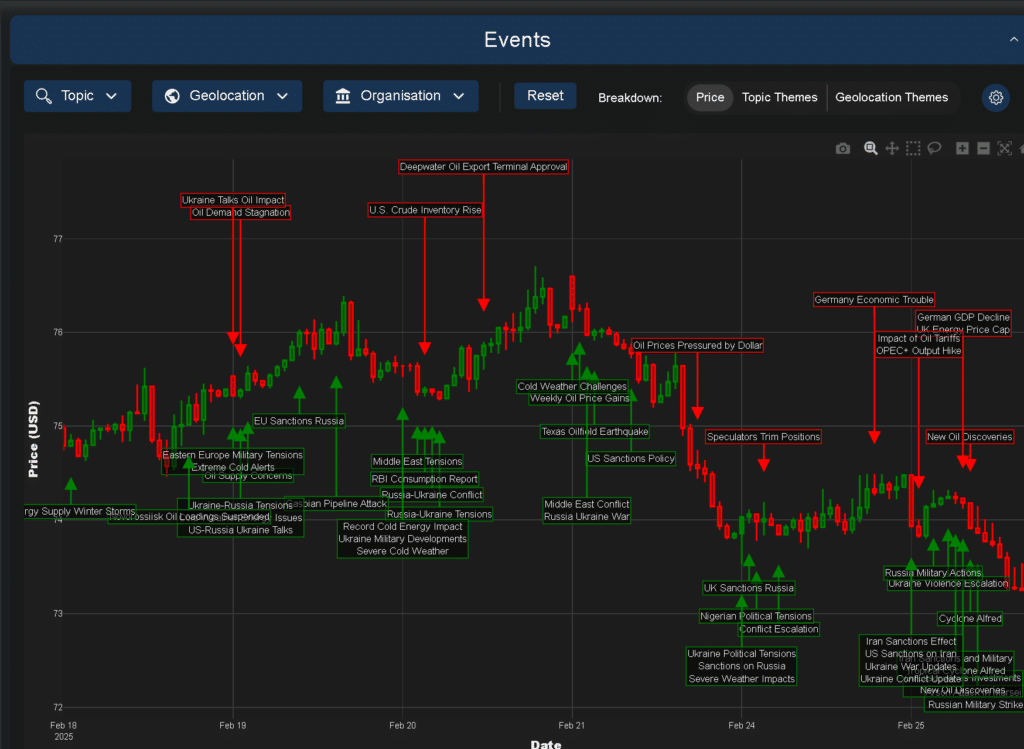
Understanding the complex interplay of factors affecting crude oil price forecast is become increasingly vital for energy traders and investors amid increasing geopolitical and supply-demand tensions. The latest insights surfaced by our Trading Co-Pilot are signalling a consistent bearish trend for Brent crude oil, with prices experiencing notable pressure throughout February, culminating in significant declines by month-end.

One cannot escape the reality that this latest crude oil price forecast has been dominated by supply-side pressures. Our Trading Co-Pilot processes vast amounts of market data allows us to identify how rising US crude inventories have combined with increased output from Iraq and Nigeria to create substantial downward pressure on prices. By February 25th, Brent crude had fallen to 73.26, reflecting the market’s growing concern about potential oversupply.
crude oil price forecast this week

Geopolitical crosscurrents: Mixed signals impacting crude oil price forecast

The financial and geopolitical forces shaping crude oil markets are sending mixed signals to traders. After a spell of modest gains around February 18th when prices closed at 74.89, the market experienced increasing volatility. This includes the significant impact of drone attacks reducing oil flow from the Caspian Pipeline Consortium by up to 40%, which initially supported prices before broader demand concerns reasserted themselves.

One of the really remarkable things over the last year is how quickly market sentiment can shift when geopolitical developments intersect with fundamental supply-demand dynamics. Fresh US sanctions against Iran and concerns over potential oil tariffs introduced additional uncertainty into our crude oil price forecast, yet these typically bullish factors failed to overcome the bearish momentum established by oversupply concerns.

Economic indicators turn crude oil price forecast bearish

Navigating the complex relationship between macroeconomic factors and energy markets is becoming increasingly challenging for energy traders. Part of the battle here is understanding how a stronger US dollar and weak economic news have contributed to the downward pressure reflected in our crude oil price forecast. The very significant upside is that our Trading Co-Pilot can quantify this impact, assigning an 85% confidence level to its bearish assessment based on current market dynamics.

By February 21st, these economic headwinds had pushed Brent crude to a low of 73.30, with our Trading Co-Pilot analysis indicating that trader sentiment had shifted decidedly negative. This includes the dramatic reduction in speculative bullish positions observed in market data, further confirming the bearish trajectory in our crude oil price forecast.

Supply-demand imbalance: The core driver behind our crude oil price forecast

The tactics used by successful traders often involve identifying the fundamental drivers behind price movements. But it is almost always the case that these relationships are complex and intertwined. In our crude oil price forecast, our Trading Co-Pilot’s analysis has identified that despite ongoing geopolitical tensions that would typically support prices, supply concerns have overwhelmingly dominated market sentiment.

In the previous era, traders might have expected geopolitical risk premiums to provide stronger price support. However, our crude oil price forecast has demonstrated that supply fundamentals were more prevalent in determining price direction. The rise of increased production from multiple regions, combined with inventory builds, has created persistent bearish pressure.

Our Trading Co-Pilot’s technical crude oil price forecast

The most frustrating thing about traditional market analysis is its tendency to provide conflicting signals without clear guidance. Our Trading Co-Pilot goes beyond mere observation to offer actionable insights in our crude oil price forecast. With Brent trading below key support levels at 73.26, our analysis suggests implementing a stop loss at approximately 74.34 (1.5% above current price) and targeting profits around 70.83 (3% below current price).

This approach provides a reward-to-risk ratio of 2:1, allowing traders to capitalise on the continued bearish momentum reflected in our crude oil price forecast while maintaining disciplined risk management. After a spell of volatility, this clear directional bias offers valuable perspective for navigating uncertain market conditions.

Looking Ahead: Factors influencing our crude oil price forecast

As our crude oil price forecast extends toward March, several key factors deserve continued attention. The financial and geopolitical forces currently pressuring prices could shift if OPEC+ signals potential production cuts in response to falling prices. However, the persistent theme of oversupply suggests any recovery may be limited without significant production discipline or unexpected supply disruptions.

It is a good example of how complex the energy markets have become that even substantial geopolitical tensions have failed to provide lasting price support. The tactics used by market participants now emphasize fundamental supply-demand balances over geopolitical risk premiums, marking an important evolution in how our crude oil price forecast is developed.

Navigating forward with our data-driven crude oil price forecast

The leap into the unknown always characterises energy trading, and that’s where our LLM-driven market intelligence comes in. Experience the power of our Trading Co-Pilot‘s capabilities for yourself with a personalised demonstration. See how our platform can help you identify trading opportunities before they become obvious to the broader market. 

Simply contact our team at enquiries@permutable.ai today or fill in the form below to schedule your complimentary session and discover how our AI-driven market sentiment analytics can enhance your trading decisions in these volatile energy markets. For qualified institutional traders and energy firms, we also offer limited trial access to experience the full capabilities of our platform.

Request demo/enterprise trial


Read more AI market sentiment analysis  

Agricultural commodities market sentiment this week

Energy market sentiment 26 Feb 2025

Gold market sentiment this week

Current forex market sentiment this week

Trump tariff plan: Impact on US Dollar and global markets
 

8 use cases for our AI-powered trading insights in energy markets

Energy markets are becoming increasingly complex to navigate and as they continue to evolve, those who are able to stay ahead of increasingly volatile market dynamics will be, in our opinion, those who embrace AI-powered trading insights for energy markets. While the AI race continues to develop at a unprecedented rate – within energy markets particularly – technological strides are already fundamentally changing how traders operate. And all this is thanks to AI’s ability to process vast amounts of market data in real-time, offering powerful visibility into market movements, correlations and emerging patterns. 

In this article we’ll take a brief look at some use cases of our AI-powered trading insights in energy markets, looking at how these can be using to predict price movements, reduce trading risk and unearth trade ideas.

1. Real-time market analysis

We think on of the most powerful applications of AI-powered trading insights in energy markets is in their ability to provide a 360 degree market view by simultaneously process multiple data streams. As an example, our Trading Co-Pilot platform analyses price movements, geopolitical events, and supply-demand dynamics in real-time, providing energy traders with comprehensive market intelligence, spotting trends before they become mainstream. Perhaps the most powerful aspect of this is that this analysis happens at a speed and scale impossible for even the best human traders and team of analysts to match.

Brent Crude Oil

2. Predictive risk management

Coming back to the critical aspect of trading risk management, our AI-powered insights offer a powerful approach to risk assessment. Indeed, we’ve seen even the most experienced traders benefit from our system’s ability to identify potential risks before they materially impact the market. Here, the hard truth is that the vast majority of traditional risk management systems simply cannot match this predictive capability that our system is able to offer.

3. Supply chain disruption monitoring 

At this point, it’s worth noting how our AI-powered trading insights for energy markets provide crucial early warnings about supply chain disruptions. For example, our platform continuously monitors news on global shipping movements, refinery operations, and production facilities, instantly alerting traders to potential disruptions reported on in the news and how that could impact market sentiment and dynamics. That said, this real-time monitoring capability represents just one aspect of our broader value proposition.

4. Geopolitical impact analysis

Perhaps then, we had better move onto just how vital it has become to understand how geopolitical events affect energy markets. Perhaps there is no guarantee, of course, that every political development will impact prices, but our AI systems excel at reducing noise and identifying which events truly matter. Contrary to common notions, not all political developments carry equal weight in energy markets. And it is our AI’s ability to decipher the most important events in terms of market impact through years of meticulously training which can provide some of the most powerful market insights available to energy traders. 

5. Weather pattern integration

How, then, does one incorporate weather patterns and their impacts into trading decisions? Well, our AI-powered trading insights for energy markets can process complex meteorological news, related sentiment and its potential impact on energy demand and supply. Even though energy traders now have access to more weather data than ever, the hard truth is that making sense of its impact on energy markets alongside a myriad of other market moving factors can be challenging to sat the least. However, the good news is that this is made light work of through our sophisticated AI analysis and the safe pair of hands it provides.

AI-Powered Trading Insights in Energy Markets European Gas

6. Regulatory compliance monitoring

At the same time, regulatory announcements can dramatically shift market dynamics. Here, our AI systems not only monitor these announcements in real-time but also assess their potential market impact before it materialises. This means traders using our system are given early indication and advance warning of how specific regulatory changes might affect different aspects of the energy markets as stories unfold, from production quotas to environmental compliance requirements and everything in-between.

7. Market sentiment analysis

The vast majority of traditional trading systems struggle to effectively capture market sentiment and this is something our Trading Co-Pilot excels.  Our AI-powered trading insights in energy markets provide analysis on various sentiment indicators, from social media to news reports, providing a comprehensive view of market psychology. Here, what truly sets our platform apart is its ability to contextualise sentiment data within broader market movements. For example, our AI systems can distinguish between temporary market noise and genuine sentiment shifts that could impact trading decisions. Perhaps more importantly, it’s able to analyse sentiment across multiple timeframes, from intraday movements to longer-term trends.

8. Price anomaly detection and market dislocation

While appreciating the complexity of energy markets, identifying price anomalies and market dislocations becomes increasingly key. Our AI-powered trading insights for energy markets excel at surfacing unusual price movements and market behaviour patterns that might indicate trading opportunities. For example, our Trading Co-Pilot platform can identify price disparities across different energy products and geographical regions, spotting potential arbitrage opportunities before they become widely apparent. The vast majority of these opportunities require quick action, making our real-time alerting capability particularly valuable. 

We are already seeing validation of our AI-powered trading insights from those energy trading houses who have already adopted them into their trading strategies. And so we know that, for energy markets, this represents more than just technological advancement. Instead, we believe that what we’re witnessing is a fundamental shift in how energy trading desks are operating. Some might say that this transformation is just beginning and in some ways it is – but we also believe the benefits are already clear.

To sum up, it’s clear to see that the starting point for successful energy trading has shifted to embracing these technological advances while maintaining human oversight.  And as we continue to see rapid technological change, we know that the key to success for energy trading desks will lie in their ability to combine AI capabilities like ours, alongside human expertise.

Experience the advantage of AI-powered trading insights in energy markets

Ready to transform your energy trading strategies with advanced AI analytics? Our Trading Co-Pilot is already helping leading energy firms navigate market complexity with unprecedented confidence and precision. And so, we would like to invite you to experience firsthand how our platform can enhance your trading operations through a personalised demonstration. 

Qualified organisations can access a complimentary enterprise trial, where you’ll discover how our AI-powered platform delivers real-time market intelligence, identifies emerging opportunities before they become apparent, provides early warning of market-moving events, and offers sophisticated sentiment analysis and price anomaly detection.

Contact us today at enquiries@permutable.ai to arrange a personalised demo or request a free enterprise trial, or simply fill in the form below. 

Request demo/enterprise trial


Oil and gas news: 7 key challenges for energy traders in 2025

energy The global energy landscape is experiencing unprecedented transformation, with oil and gas news dominated by complex challenges that are reshaping the industry. From geopolitical tensions to environmental pressures, energy traders are facing a volatile operating environment that demands innovative solutions like our Trading Co-Pilot which can predict price changes and market movements coupled with strategic adaptation.

Geopolitical instability dominates oil and gas news

Recent oil and gas news highlights how geopolitical tensions continue to send shockwaves through energy markets. Sanctions on major producers and regional conflicts create significant supply uncertainties. Furthermore, OPEC‘s evolving role and decisions regarding production quotas contribute to market unpredictability, forcing traders and operators to constantly reassess their positions.

Supply chain vulnerabilities expose market weaknesses

The latest oil and gas news reveals persistent supply chain fragilities. Unexpected refinery outages, shipping constraints, and infrastructure limitations create bottlenecks that ripple through global markets. These disruptions are particularly acute in key transportation corridors, where any interruption can trigger significant price movements and supply concerns.

Price volatility challenges traditional risk management

The oil and gas traders we work with consistently cite extreme price volatility as a primary concern in oil and gas news reports. It’s fair to say that the traditional tools for managing price risk are struggling to keep pace with market dynamics. Then there’s the interplay between different crude benchmarks, such as Brent and WTI, which adds another layer of complexity to hedging strategies.

Environmental regulations reshape market dynamics

Environmental compliance has emerged as a central theme in oil and gas news coverage. Stringent carbon emissions policies and the accelerating energy transition are forcing companies to reimagine their operational strategies. Meanwhile, carbon pricing mechanisms and renewable energy mandates are creating new cost pressures and market opportunities.

Storage and logistics present operational hurdles

The infrastructure supporting the oil and gas industry faces mounting pressures. Storage capacity constraints and logistics costs significantly impact market dynamics, particularly during periods of contango or backwardation. Recent oil and gas news highlights how these challenges affect both crude oil and natural gas markets.

Technology integration poses implementation challenges

While technological advancement offers solutions to many industry challenges, implementing new systems presents its own hurdles. The latest oil and gas news emphasises how companies struggle to effectively integrate artificial intelligence, machine learning, and other digital tools into their operations while maintaining cybersecurity and operational efficiency.

Market structure evolution creates uncertainty

The fundamental structure of energy markets is evolving rapidly. Traditional trading relationships and market mechanisms are being challenged by new participants, alternative energy sources, and changing consumer preferences. Recent oil and gas news indicates that traders must adapt to these structural changes while maintaining profitability.

Looking ahead, the oil and gas industry faces a turbulent period of transformation. Success will depend on the ability to navigate these challenges while embracing innovation and sustainability. As oil and gas news continues to highlight these evolving challenges, energy traders will need to remain agile and forward-thinking in their approach to risk management and strategic planning.

In response to these complex market challenges, Permutable AI’s Trading Co-Pilot offers a cutting-edge and powerful solution to help oil and gas traders make more informed decisions and manage risks effectively.

The need for real-time geopolitical risk intelligence

Our Trading Co-Pilot’s AI-driven 24/7 geopolitical risk monitoring works tirelessly to detect and analyse potential market disruptions. By monitoring supply chain disruptions, sanctions impacts, and OPEC policy developments in real-time, traders can anticipate market movements before they materialise. This early warning system provides crucial lead time for position adjustments and risk mitigation strategies.

Accessing advanced volatility forecasting

Through sophisticated LLMs, our Trading Co-Pilot predicts oil and gas price volatility with remarkable precision. This capability is particularly valuable during periods of market uncertainty, enabling traders to:

  • Anticipate price swings before they occur
  • Optimise position sizing based on predicted volatility levels
  • Adjust hedging strategies proactively rather than reactively

Sophisticated spread analysis

Our platform excels in identifying and analysing spreads between key benchmarks, including:

This comprehensive spread analysis enables traders to optimise their hedging strategies and identify arbitrage opportunities across different energy products.

Actionable trading intelligence

Our Trading Co-Pilot synthesizes multiple data streams to provide actionable intelligence, enabling traders to:

  • Execute better-informed trades based on AI-powered forecasts
  • Identify emerging market trends before they become widely recognized and surface new trade ideas
  • Optimise timing of market entries and exits

By leveraging these advanced capabilities, oil and gas traders can navigate market complexities with greater confidence and precision – in fact, those currently using it already do. We know from the feedback we’re receiving that our Trading Co-Pilot is already serving as an essential tool for managing price volatility, geopolitical risks, and regulatory challenges in today’s dynamic energy markets.

We’re seeing week on week how this comprehensive approach to market intelligence and risk management has been positioning traders to capitalise on opportunities while maintaining robust risk controls. And as markets continue to evolve, our Trading Co-Pilot’s adaptive AI technology ensures that traders remain ahead of market movements and well-positioned to succeed in increasingly challenging market conditions. It’s your turn next. 

Transform your energy trading strategy

Ready to improve your trading performance with our advanced AI analytics? Permutable AI’s Trading Co-Pilot is already helping leading energy firms navigate market complexity with unprecedented confidence and precision. We invite you to experience firsthand how our platform can transform your trading operations through a personalised demonstration.

Qualified organisations can access a complimentary enterprise trial, where you’ll discover how our AI-powered platform delivers real-time market intelligence, identifies emerging opportunities, and helps manage risk more effectively. Our team of energy market specialists will work alongside you to ensure you derive maximum value from our solution from day one.

Take the first step towards AI-powered trading excellence. Contact our team today at enquiries@permutable.ai or simply fill in the form below to schedule your personalised demonstration. Join the growing number of energy trading firms leveraging the power of AI to stay ahead in today’s dynamic markets.

Request a free trial/personalised demo


Brent Crude Oil market analysis 13 Feb 2025: Trading Insights from recent market movements

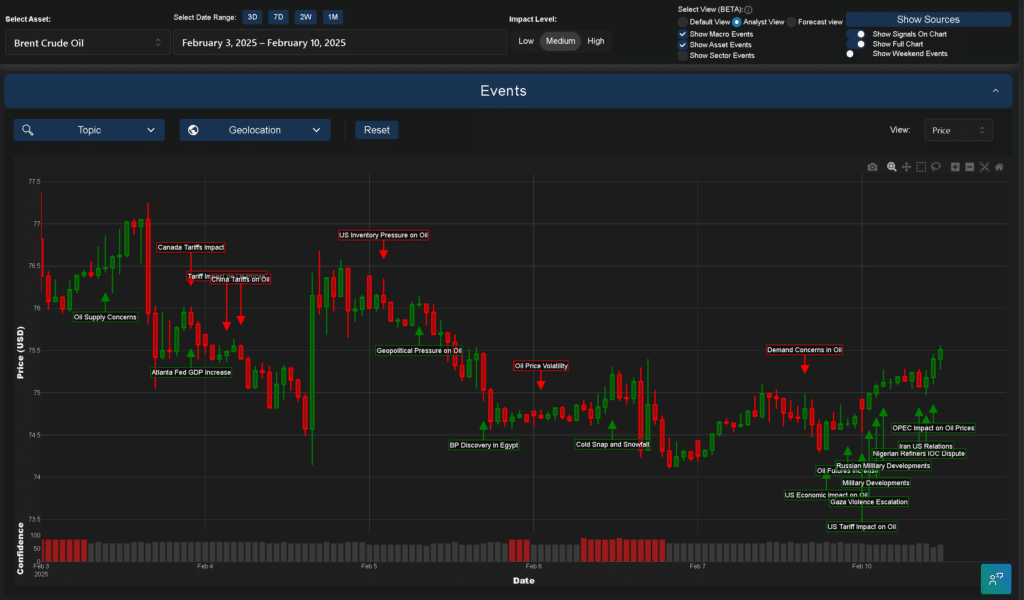
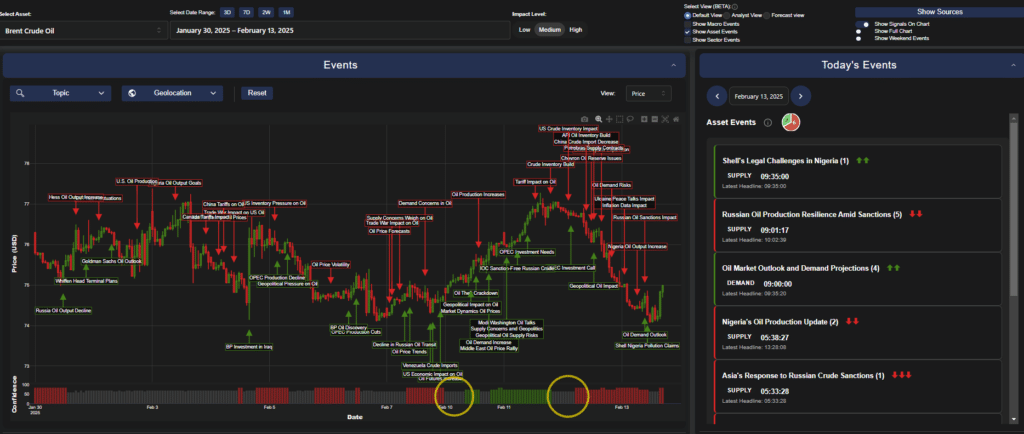
It was a week marked by significant price movements in Brent Crude oil markets, where our AI-driven Trading Co-Pilot  traced precisely what was happening in the market, providing key trading signals based on market sentiment. 

Here’s why this is and what we’ve seen:

Entering bullish sentiment

Date/Time: February 10, 2025, 08:00

Direction: Buy

Reasoning:

  • Geopolitical tensions in Ukraine and the Middle East raised concerns about potential supply disruptions, historically driving oil prices upward.
  • Nigeria’s announcement of increased output suggested higher supply, but market fears over instability and new US tariffs had a stronger immediate effect.
  • An observed price uptick on February 9, coupled with the Atlanta Fed’s positive GDP forecast, reinforced bullish sentiment.

Switching to bearish sentiment

Date/Time: February 12, 2025, 05:00

Direction: Sell

Cause of change:

  • A significant build in US crude inventories on February 11 shifted sentiment toward a bearish outlook.
  • Ongoing geopolitical frictions (sanctions on Iranian and Russian oil) continued, but the new inventory data and tariff impacts pushed prices down for three consecutive weeks.
  • These factors indicated sustained downward momentum, leading to a Sell decision.

This market analysis is powered by Permutable AI’s Trading Co-Pilot, providing energy traders with actionable insights for navigating the complex energy market ecosystem including Brent Crude oil, natural gas, middle distillates and more. Our platform’s integration of real-time data, geopolitical analysis, and market correlations enables more informed trading decisions in this volatile market environment.

Our Trading Co-Pilot continues to monitor these developments round the clock, providing real-time alerts and trading signals to help market participants navigate this dynamic environment effectively.

Improve your energy trading results

Ready to improve your energy trading results with our advanced real-time AI analytics? Our Trading Co-Pilot is already helping leading energy firms navigate market complexity with unprecedented confidence and precision. We invite you to experience firsthand how our platform can transform your trading operations through a personalised demonstration.

Qualified organisations can access a complimentary enterprise trial, where you’ll discover how our AI-powered platform delivers real-time market intelligence, identifies emerging opportunities and new trade ideas, and helps manage risk more effectively. Simply contact our team today at enquiries@permutable.ai or fill in the form below to schedule your personalised demonstration. Join the growing number of energy trading firms leveraging the power of AI to stay ahead in today’s dynamic markets.

Request enterprise trial/personalised demo


Commodity prices: Cross-asset analysis – mid-February 2025 outlook

As we move into mid February, the obvious pattern emerging across commodity markets is that of an intensifying impact of trade tensions and extreme weather events. There is no doubting that each commodity class is responding uniquely to these catalysts, creating a complex trading environment that demands sophisticated analysis. In this article, we take a look at the commodity prices outlook for this week, using analysis from our Trading Co-Pilot.

Energy markets 

Henry Hub natural gas

You can make the argument that this has been the most dramatic mover in terms of commodity prices, with a 9% surge on February 3rd reaching significant technical levels. The hardest part is distinguishing between weather-driven spikes and structural shifts. Severe winter storms across the Midwest and Northeast have created a significant uptick in energy demand, while critical supply shortfalls in southern regions reinforce bullish momentum. Current Henry Hub market dynamics suggest this strength could persist beyond the immediate weather impact. Regional supply constraints and increased demand for gas-fired power generation create a supportive backdrop for prices. The question is how long these conditions will maintain their influence over price action, particularly as we approach the shoulder season.

TTF natural gas

Then there is the challenge of European gas markets, where prices reflect multiple pressures. Slovakia’s increased imports and resumed Russian gas flows provided initial stability, but escalating Ukraine conflict creates persistent uncertainty. Critical gas needs in southern Ukraine add another layer of complexity to the supply picture. The market’s response to these developments has been notably volatile, with traders attempting to price in both immediate supply concerns and longer-term structural changes to European gas markets. Supply diversification efforts, including rare Australian shipments, indicate the market’s adaptation to new geopolitical realities.

Heating oil

Looking an the broader issue of commodity prices, one finds that the situation is little more complicated in heating oil markets, where tariffs on Canadian oil combine with extreme weather to drive prices higher. The fact that NYC landlords are switching to less clean heating oil due to high gas bills indicates a structural demand shift that could have lasting implications for the market. This transition in consumer behaviour, particularly in the Northeast, suggests a fundamental change in regional energy dynamics. The impact of tariffs extends beyond immediate price effects, potentially reshaping traditional supply routes and trading patterns. Storage levels and distribution challenges in key consumption areas add another layer of complexity to the current market structure.

Brent Crude

Of course,  recent cold snaps in the US have supported prices, countering earlier bearish sentiment. Meanwhile, ongoing military tensions in Ukraine and Middle East sanctions continue to influence supply concerns, despite rising inventories in key storage hubs. The market’s reaction to these conflicting signals has been notably measured, suggesting traders are carefully weighing immediate weather-driven demand against broader macroeconomic concerns. The interplay between OPEC+ output decisions and US inventory builds creates an additional dynamic that warrants close monitoring.

Metals market

Gold

The big recent news across commodity prices is that gold continues to see remarkable strength near $3,000. The game changer here has been combined monetary easing signals from central banks (RBI and BOE) alongside escalating geopolitical tensions. Safe-haven demand remains robust amid uncertain economic conditions. Technical analysis suggests the current price levels could establish new support zones, particularly if trade tensions escalate further. The correlation between gold prices and real yields continues to provide a helpful framework for understanding price movements, while physical demand from key Asian markets adds fundamental support.

Platinum

Here, we’re seeing the impact of China’s manufacturing slowdown (PMI at 50.1) combined with Anglo American Platinum’s profit decline. The automotive sector’s weakness, particularly in Germany, has created significant headwinds for demand, leading to the current bearish outlook. Supply-side dynamics, including potential production cuts and recycling rates, could provide some price support. However, the structural shift in automotive technology preferences continues to cast a shadow over longer-term demand prospects.

Palladium

The question here is whether positive US manufacturing data can offset European automotive weakness. This divergence in regional industrial activity creates a complex trading environment for a metal heavily dependent on automotive catalytic converter demand. Recent market behaviour suggests a delicate balance between supply constraints and demand concerns. While US economic resilience provides some support, the German industrial production drop signals potential weakness in a key consumption center. For now, the automotive sector’s ongoing transition toward electric vehicles adds another layer of uncertainty to longer-term demand projections.

Silver

Despite initial bullish signals from strong demand and positive drill results, inflation fears and trade tensions have created choppy trading conditions for silver. The metal’s dual role as both an industrial and precious metal continues to create complex price dynamics. While safe-haven demand provides some support during periods of market stress, industrial demand concerns and correlation with gold prices remain key drivers of market sentiment for silver.

Copper

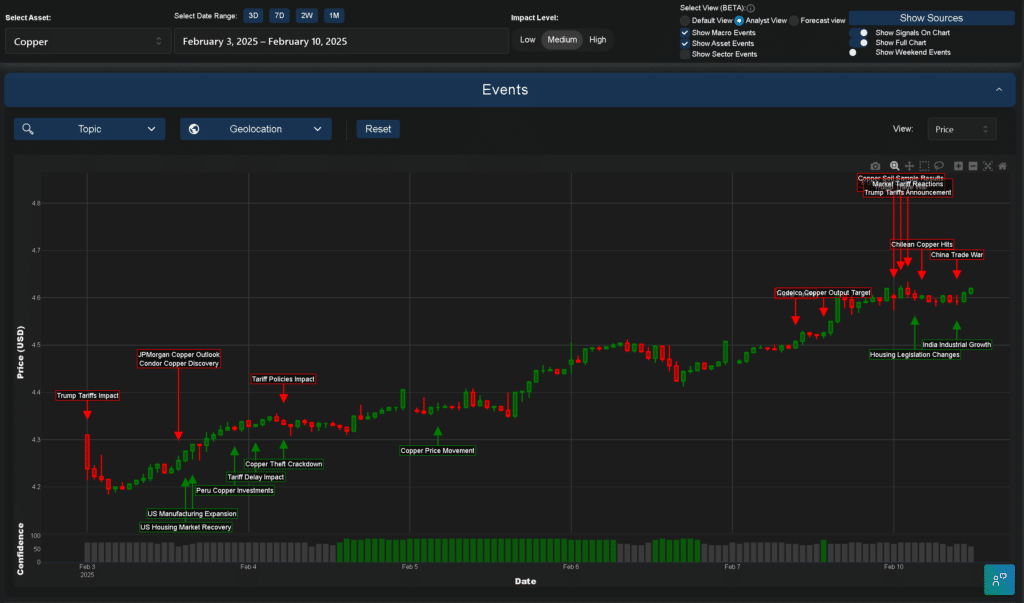
While housing market recovery provides some support, trade tensions create significant uncertainty for copper. Recent price movements reflect the market’s struggle to balance positive economic indicators against rising geopolitical risks. The broader implications of Trump’s reciprocal tariffs could fundamentally alter trading patterns in industrial metals. Concurrently, infrastructure development plans in key economies remain a potential catalyst for demand growth, but uncertainty around implementation and timing keeps market sentiment cautious.

copper commodity prices feb 2025

Agricultural markets 

Wheat

Initial bullish momentum in wheat markets driven by severe weather disruptions – drought in Argentina and flooding in Australia – has given way to bearish sentiment as of February 10th, with Chinese tariffs and fears of US retaliation creating significant headwinds. Growing Canadian stocks and increased local production suggest ample supply, while forecasts of declining global imports add further pressure. This alignment of negative factors suggests continued downward pressure on wheat prices in the near term, despite earlier weather-related supply concerns. 

Coffee 

We live in an age of highly volatile geopolitics and commodity prices, with coffee prices have reached record highs driven by fundamental supply fears and severe weather impacts. Arabica’s recent price action reflects both immediate supply constraints and longer-term structural changes in production patterns. Nestlé’s Indian market expansion signals growing demand in emerging markets, while weather-related supply disruptions continue to support prices. The potential for further supply chain disruptions, particularly in key growing regions, suggests continued price strength in the near term.

Corn

The present outlook for corn reflects complex crosscurrents in both supply and demand. Argentina’s severe drought has tightened supply expectations, while Mexico’s decision to rescind its ban on U.S. biotech corn provides some positive sentiment for traders. However, the broader impact of trade tensions and potential new tariffs creates significant headwinds. Fund positioning indicates some market confidence, but recent declines in Chicago corn futures suggest traders remain cautious amid these conflicting signals.

Cotton

Cotton markets are facing multiple challenges from both weather events and trade tensions. Queensland flooding and California’s adverse weather conditions raise significant concerns about agricultural productivity and potential supply shortages. The market’s recent rally gave way to more cautious sentiment as traders assessed the implications of new U.S. tariffs on China. These developments raise broader concerns about inflation impacts and potential demand destruction in key consumption markets.

Sugar

The sugar market presents a particularly nuanced picture amid current volatility. Once again, severe flooding in Queensland and ongoing drought challenges in Argentina have raised serious concerns about agricultural output and potential supply disruptions. While temporary support came from reduced Indian production and improved realisations for sugar companies, the stronger US dollar and projections of a global surplus create counterbalancing pressures. Recent developments suggest potential for recovery, but weather concerns and mixed economic indicators maintain market uncertainty.

Milling wheat

Markets have now  pushed to four-month high levels amid severe flooding in North Queensland and ongoing Ukraine-Russia supply disruptions. The impact of these weather events on global supply chains has been particularly acute given the already strained market conditions. The announcement of retaliatory tariffs by China and Trump’s reciprocal measures adds another layer of complexity to traditional trading patterns. While some weakness emerged towards the end of the week, the overall trend remains bullish as markets continue to price in supply risks and shifting trade flows.

Soybeans

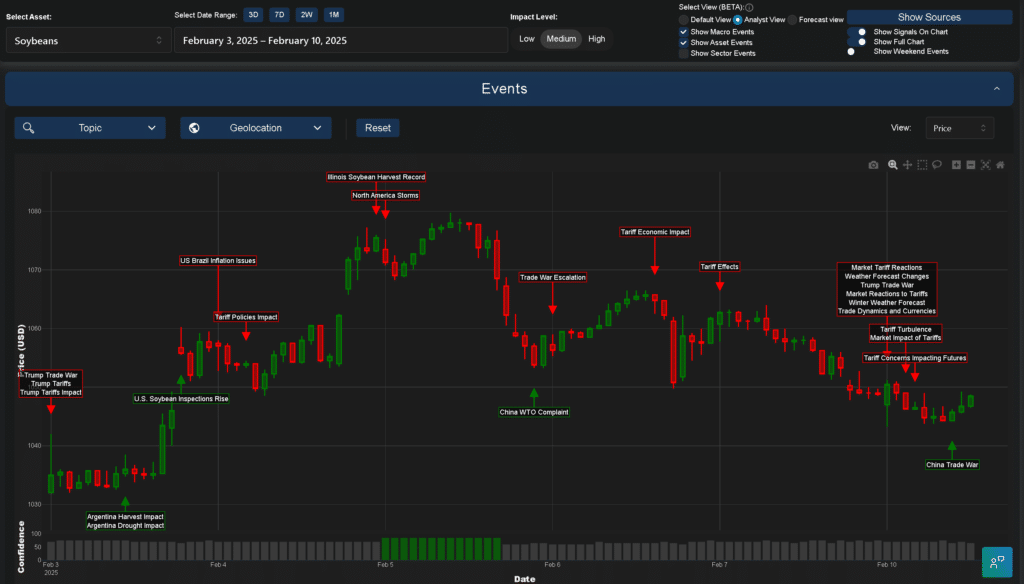
There are several areas where trade tensions impact is evident, none more so than soybeans. Recent tariff announcements have amplified bearish sentiment, with prices declining as traders anticipate further volatility and potential supply chain disruptions. This dovetails with weather-related concerns in Argentina and North America, creating a complex market dynamic. The combination of trade uncertainty and adverse weather conditions suggests continued pressure on prices, with particular attention needed on Chinese demand patterns and South American production levels.

Looking ahead on commodity prices 

If narratives shape politics, then current trade tensions suggest continued market volatility across commodity sectors. What this reveals is the increasing importance of real-time market intelligence in navigating these complex conditions. Commodity traders must remain vigilant to both immediate catalysts and longer-term structural shifts, particularly as weather patterns and geopolitical developments continue to drive price action.

The interconnectedness of commodity markets has never been more evident, with developments in one sector frequently creating spillover effects in others. Successful trading strategies will require careful monitoring of cross-commodity correlations by using tools like our Trading Co-Pilot and the ability to quickly adapt to changing market conditions.

Get ahead of commodity price movements

Our Trading Co-Pilot can enhance your commodity trading operations with real-time cross-asset insights. It works by analysing the complex interplay of weather events, trade policies, and supply chain dynamics as well as other market factors across energy, metals, and agricultural markets, helping you identify price movements before they emerge. Our enterprise solution offers real-time analysis of market-moving events, cross-commodity correlation insights, early warning signals for price movements, and comprehensive monitoring of supply chain announcements, weather impacts, and trade flows.

To arrange a demo or request a free enterprise trial get in touch with our team at enquiries@permutable.ai or simply fill in the form below to see how our AI-driven market intelligence can complement your existing trading strategies. We’re currently offering a 14-day trial for qualified institutional traders (subject to approval) to experience our next-generation market intelligence . Find out how it can start maximising your trading potential today.

Request demo/free trial


Henry Hub natural gas spot price analysis: Bullish signals emerge January 2025

In recent months, natural gas markets have become increasingly complex, with our Trading Co-Pilot platform identifying several significant developments affecting the Henry Hub natural gas spot price, pointing towards a generally bullish outlook. Many will think this optimism premature given recent volatility, yet ultimately, the data suggests a compelling story unfolding.

Market evolution and current dynamics 

Of course, the past week has shown notable demand surges, with our platform tracking several major infrastructure developments. In particular, Kinder Morgan’s new pipeline approval and ongoing exploration activities by ExxonMobil and Qatar Energy have emerged as significant positive indicators. It may well be true that these developments alone don’t guarantee Henry Hub natural gas spot price increases, but in contrast with previous market cycles, the infrastructure buildout comes at a crucial juncture.

Supply-demand complexities

Suffice to say, there is more than one way to skin a cat when it comes to analysing market dynamics, but clearly, the current situation presents a scathing challenge to traditional approaches. The EIA has been asserting rising wholesale power prices due to increased demand, and with it being recently reported that there’s been a significant drop in oil and gas rig counts, this actually strengthens the bullish case. 

Many are now believing that perhaps fears that production constraints might limit market growth have been overblown with the baton soon picked up again by major infrastructure projects. Though it is still early days, but the Transco pipeline approval reinstatement and new drilling activities in Cyprus suggest robust development pipeline. This will not be the same as previous infrastructure cycles – instead, we’re seeing more strategic, targeted expansions.

Weather patterns and market response

Thus far this Winter, weather has played a key role in Henry Hub natural gas spot price movements. In part, Goldman Sachs’ raised forecast for US gas prices reflects this reality, aligning with our platform’s detection of weather-related sentiment shifts. Rather, it is more like a perfect storm of factors affecting the Henry Hub natural gas spot price, as temperature forecasts increasingly drive market sentiment.

Our Trading Co-Pilot has detected a notable correlation between weather forecast updates and immediate price reactions, with even minor temperature revisions triggering significant market moves. This heightened sensitivity to weather patterns suggests that traders are positioning themselves more reactively to meteorological data than in previous seasons, creating both risks and opportunities for market participants.

Market implications and trading strategy 

So the question is, what does this all mean for traders? At its core, our Trading Co-Pilot‘s analysis suggests a favourable risk-reward setup for the Henry Hub natural gas spot price. So we will soon see whether the market validates this view, but with current prices at 3.17, our Trading Co-Pilot’s recommended strategy balances prudent risk management with upside potential.

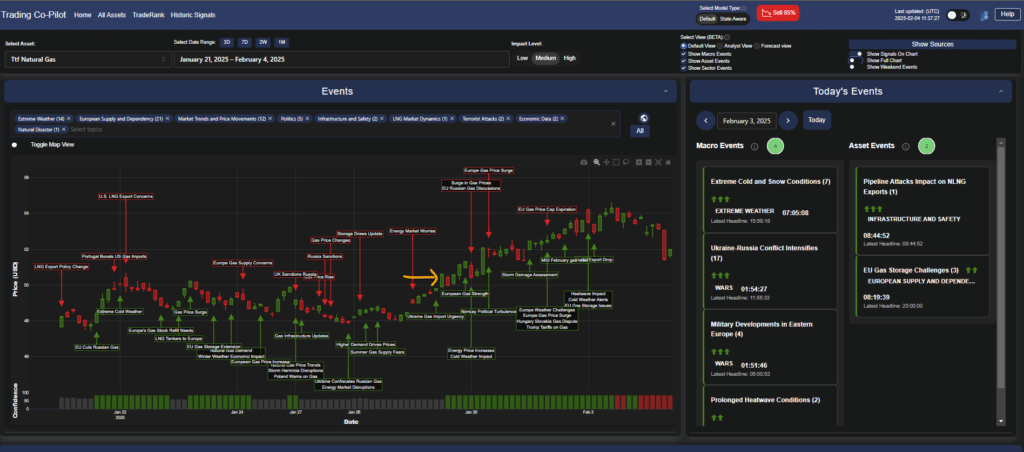
In short, this is a problem too complex for simple solutions, and is also a reflection of how complex global market dynamics have once again come back to the fore, – particularly with strengthening European gas markets suggesting a tightening supply environment. Ultimately, what is needed is careful monitoring of our identified timeline triggers. Thankfully, this is made easily accessible through our Trading Co-Pilot, exemplified by the chart above, with our platform continuing to monitor these developments in real-time, providing our users with actionable insights as market conditions evolve and careful analysis of multiple data streams.

We help traders navigate complex market dynamics 

Our Trading Co-Pilot platform delivers real-time insights across commodities markets, processing over 10,000 articles daily to identify market-moving events before they impact prices. Through advanced geolocation filtering, comprehensive sentiment tracking, and real-time event detection, we provide traders with the tools they need to make informed decisions in rapidly evolving markets.

If you’re interested in seeing how our market intelligence platform can enhance your trading strategy, we’d be delighted to show you a personalised demonstration of our capabilities for enterprise clients. Email enquiries@permutable.ai to schedule your enterprise demo, subject to approval or fill out the form below to learn more about how we’re transforming market intelligence for enterprise traders

Find out more


Trump’s first week in office: A look at initial impacts on commodity markets

Trump’s first week in office has made for choppy times across commodity markets, with executive orders and announcements coming fix and fast out of the Trump administration effecting energy, precious metals, and agricultural commodities alike. In these early days as the market adjusts to these new policy announcements, perhaps the hardest part is quantifying the immediate impact against the backdrop of existing market dynamics. In this article, we’ll take a whistlestop tour around the latest developments to have unfolded in the last week. 

Trump’s first week in office: Impact on energy markets

First, the obvious, let’s focus on energy markets, where orders from Trump’s first week in office targeted LNG export restrictions. The revival of LNG gas exports has sent ripples through global energy markets and traders are already positioning themselves for increased US LNG exports. Then there is the challenge of U.S. sanctions which has led to a significant reduction in Russian oil offers, directly impacting supply dynamics in the market and causing a scramble for oil supply leading to concerns about the end of cheap oil and rising prices.

Adding to market volatility, Trump’s direct call on OPEC to lower oil prices has already impacted market sentiment, triggering a notable drop in WTI prices. This intervention, characteristic of Trump’s hands-on approach to oil markets, has created additional uncertainty around crude oil price trajectories and OPEC’s potential response.

With European energy markets facing particular exposure, as well as these recent developments from Trump’s first week in office, Europe also continues to grapple with seasonal demand fluctuations and the ongoing need to rebuild storage levels. All eyes will be particularly focused on how this slew of policy changes and pressures might affect the already delicate balance between Russian pipeline gas, Europe’s storage woes, U.S. LNG imports, and Europe’s ambitious renewable energy targets.

Impact on metals 

Gold has been clearly responsive to Trump’s first week in office, increasing significantly this week amid policy uncertainty. Needless to say, this reflects the traditional safe-haven status of precious metals during periods of geopolitical turbulence. The present outlook for gold remains bullish as markets digest the implications of Trump’s trade stance.

But the game changer will be the impact on industrial metals. The Nifty Metal index’s 2% decline following Trump’s tariff threats on Chinese imports demonstrates immediate market sensitivity across silver. The truth is more complicated when examining copper prices, as Trump’s executive order on mining activities in the Boundary Waters region suggests potential supply increases.

Impact on agricultural commodities

For the avoidance of any doubt, agricultural commodities haven’t escaped the policy whirlwind. The question here is how Trump’s immigration policies will affect farm labour availability. As a result, we can be reasonably confident that wheat markets will face increased volatility as farmers grapple with potential workforce challenges going forward. 

Meanwhile, soybean prices showed sensitivity following Trump’s reiteration of tariff threats against China, impacting market sentiment. To add to this, the appointment of a USDA secretary who opposes ethanol and farm subsidies raised concerns about potential reductions in demand for soybeans, particularly as soybeans are a key ingredient in biofuel production. 

Looking ahead 

If experience tells us anything, we can be reasonably confident that these market movements in response to Trump’s first week in office are not purely speculative. In fact, everywhere you look across the commodity markets, there’s evidence of fundamental shifts in supply and demand expectations. To reclaim stability, markets will need time to adjust to the new policy landscape, assessing the lay of the land once the dust settles.

With several areas of policy uncertainty clouding market outlooks, what is needed is clarity on long-term trade policy directions. And then, there’s the interplay between different commodity sectors deserves attention, as policy changes in one area often create ripple effects across others. We’ll all be looking out to see how the potential impact on global trade flows if Trump’s first month maintains this pace of policy shifts. If narratives shape politics, then commodity markets are already pricing in expectations of significant change. It’s no new news that we live in an age of highly volatile geopolitics, and Trump’s first week in office has amplified this reality across commodity markets.

As for the longer-term implications, commodity traders will be closely monitoring how these initial policy moves might evolve into broader structural changes in global commodity trades. This is not to say that all impacts will be negative – some sectors may benefit from reduced regulation and new trade arrangements. But there is no doubting there will be a significant adjustment period ahead for global commodity markets.

Stay ahead of market-moving events with our Trading Co-Pilot

The commodity markets are evolving rapidly in response to Trump’s first week back in office, creating both risks and opportunities for traders. Our Trading Co-Pilot and API give you the edge needed to navigate these volatile markets with confidence. Access real-time policy impact analysis, and comprehensive market data integration through a single, powerful platform.

We’ve designed our solution to help you capitalise on emerging opportunities while managing risk in an increasingly complex trading environment. From LNG export policy shifts to sanctions-driven oil market dynamics, our platform keeps you ahead of market-moving developments. Experience the difference of trading with Al-driven insights yourself with a 30-day free enterprise trial of our premium features. Contact enquiries@permutable.ai to learn more about our enterprise solutions and start transforming your trading strategy today, or simply fill in the form below to get in touch.

Enquire now


European natural gas prices: A perfect storm of supply challenges and weather impacts

The alarm bells are ringing across European natural gas markets as we move into 2025, with prices displaying particular volatility in the last week. Insights from our Trading Co-Pilot reveal a complex interplay of factors and heightened sensitivity in the market. With that said, let us rattle through some of the key developments that have shaped this week’s trading European natural gas prices, where we’ve seen everything from weather-driven demand spikes to supply chain disruptions creating unique trading patterns – and of course the much talked about Trump LNG effect.

European natural gas price

Supply dynamics and market fragility

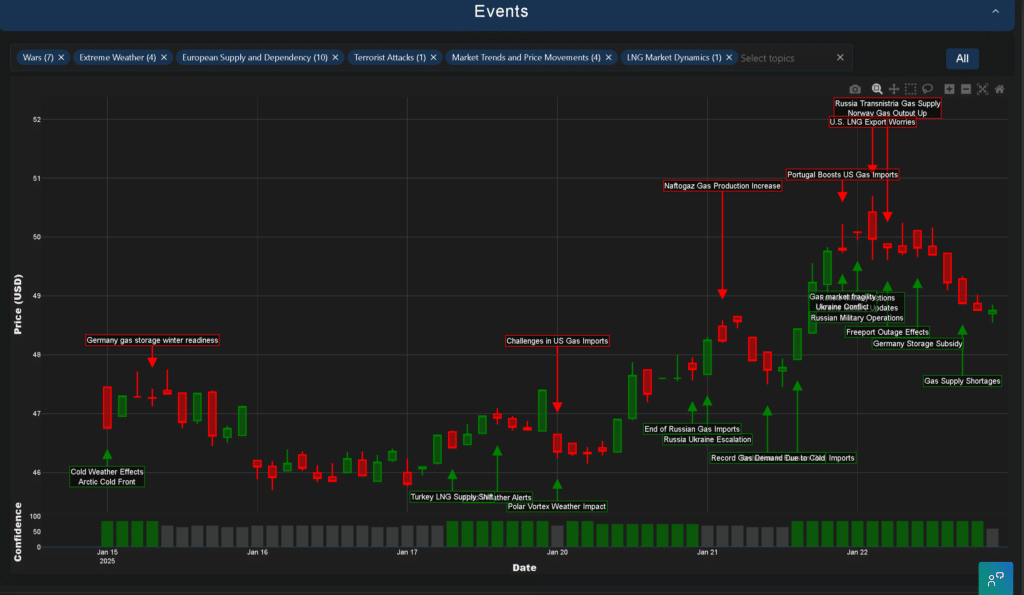
The point which becomes obvious pretty quickly is that European natural gas prices are being pulled in multiple directions, creating both risks and opportunities for TTF traders. According to sources, Europe may require over 100 additional gas cargoes to replenish its dwindling stocks, highlighting the fragility of current supply chains. Our Trading Co-Pilot’s analysis shows this news triggered a clear price movement, demonstrating the market’s acute sensitivity to supply-related headlines.

Not long ago, this might have seemed manageable, but the recent Freeport LNG outage has led to a surge in TTF natural gas prices, pushing the market into new territory. Our Trading Co-Pilot clearly shows the immediate price impact, with a notable spike following the announcement. Almost everyone we speak to in the industry now acknowledges that traditional supply-demand models need updating to account for this new market reality.

Weather and demand pressures

To add to this, extreme cold weather is expected to drive record gas demand. This concern has three components that our Trading Co-Pilot clearly illustrates: immediate supply pressure showing in rapid price movements, storage depletion rates accelerating beyond normal seasonal patterns, and increased price volatility during weather events. The trouble is, this comes at a time when European natural gas prices are already showing significant sensitivity to supply disruptions.

What’s clear is that cold weather effects, particularly the Arctic cold front, have created distinct trading patterns. What’s more is that the market response to these weather events has been notably more pronounced than in previous years, with particularly sharp reactions during the early morning hours when temperature forecasts are updated. The Polar Vortex impact has been especially notable, creating a new pattern of price behaviour that suggests weather premium is being built into the market at levels we haven’t seen before.

Geopolitical complexities and supply security

And that’s before we address the ongoing Russia-Ukraine conflict escalation. So what’s actually is going on here? Well, the EU has successfully reduced its imports of Russian gas by 75%, but this has created new market dynamics that are clearly visible in our data. It’s the same story on alternative supply sources – Portugal has shifted its gas sourcing away from Russia, increasing imports from the US and Nigeria, yet even now, these transitions are creating their own complex market patterns.

The crisis in supply security is forcing energy traders to develop new risk management strategies. In addition to that, the market has shown particular sensitivity to news about US LNG exports, with significant price movements within hours of major announcements from the new Trump administration.

Supply diversification and market innovation

Just as notably, Germany is considering a plan to subsidise gas storage refills, which could influence market dynamics and supply strategies. Our Trading Co-Pilot data showed an immediate positive market reaction to this news. And then there was the news that Norway’s gas output saw a slight increase in December to consider, though the market response was relatively muted, suggesting TTF traders will be more focused on longer-term supply solutions.

So when it emerged that Russia is preparing to supply gas to Transnistria through Türkiye starting in February, our data showed an interesting market reaction pattern. This method applies equally to understanding the impact of Germany’s storage subsidy plan and other policy initiatives, with clear price movement correlations visible in our data.

Forward-looking market implications

All this means that European natural gas prices are likely to remain volatile throughout the rest of the winter period, as we’ve previously reported on before. Initially, the market’s focus was on storage levels, but now for traders, the key metrics have expanded significantly. In this scenario, our data suggests we can expect continued price sensitivity, with potential for larger movements during extreme weather events or supply disruptions.

Of course, there’s a reason why the market is watching these developments so closely. As with most things in energy markets, the interplay between supply, demand, and geopolitical factors creates complex trading conditions. And yet perhaps the most interesting aspect is how the market is adapting to these new realities.

What we’ve found through our Trading Co-Pilot analysis is that it is the correlation of multiple data points and overlapping factors – whether it be weather patterns to storage levels, or geopolitical developments to infrastructure constraints – rather than single events that is causing price movements.  

Despite this challenging environment, the market is adapting to new realities. And while volatility in European natural gas prices may persist, the market is gradually developing new mechanisms for resilience. There is a definite sense that energy traders are becoming  more sophisticated in their approach to risk management and trading strategies, for for our clients, integrating our Trading Co-Pilot is becoming an important part of this.

The crisis in market stability has forced innovation in trading approaches, and that’s perhaps the silver lining in current conditions. Whether this narrative holds through 2025 remains to be seen, but one thing is certain: the European gas market continues to offer significant opportunities for the those leading the herd with our AI-powered market insights.

Ultimately, success in this market requires not just understanding individual events but comprehending how multiple factors interact to influence price movements. The data from our Trading Co-Pilot platform clearly demonstrates this evolution, showing precisely how successful traders are those who can integrate multiple data streams into their decision-making processes.

Experience our natural gas market intelligence first hand

Seeing these market dynamics play out in real-time can transform how you trade. Our Trading Co-Pilot platform doesn’t just track events – it helps you understand their interconnected impact on market movements before they happen. With features ranging from advanced event tracking to real-time market movement alerts, we’re offering tools that can bring a new level of sophistication to your Trading strategy.

After a successful first wave, we’re now opening up early access to our advanced market intelligence platform for select additional enterprise users. As part of this exclusive program, you’ll receive premium access to all features of our Trading Co-Pilot and direct support from our team. The past week’s volatility in European gas markets demonstrates why timing and insight matter – and so now is the time to join the growing community of energy traders who are already using our platform to stay ahead of market-moving events.

Ready to transform your trading strategy? Schedule a demo by emailing us at enquiries@permutable.ai or simply fill in the form below to get in touch.

*Early access program is limited to select enterprise clients and subject to qualification.

Enquire now


Trump lifts freeze on LNG export permits: A data-driven analysis of market impact

The recent news story that “Trump lifts freeze on LNG export permits” is dominating headlines, and with it presents a shift in energy market dynamics that extends far beyond immediate price impacts. Using our Trading Co-Pilot, we take a look at how markets are responding to this development, revealing patterns in trading behaviour and market sentiment that we know that our readers will find interesting to say the least. Read on get out latest insights below.

Trump lifts freeze on LNG export permits: Understanding the market response

The market’s reaction to Trump lifting the freeze on LNG export permits has been particularly noteworthy for its multifaceted nature. Our real-time event tracking shows multiple interconnected market movements, with sentiment indicators suggesting this could herald a fundamental shift in energy market dynamics rather than a temporary price adjustment. It is the complexity of these market movements highlights the importance of sophisticated analysis tools like our Trading Co-Pilot in understanding and anticipating market responses to major policy shifts.

Global supply dynamics

The decision to lift the freeze on LNG export permits arrives at a crucial juncture in global energy markets. The result? A fascinating convergence of supply-side developments, including Exxon’s significant Mediterranean discovery and Talos’s promising findings in the Gulf of Mexico. When combined with Trump’s LNG export permit announcement, these events create a rich tapestry of supply-side factors that energy traders will be paying attention to. And it is the interplay between these various elements that suggests a potential restructuring of global gas supply chains that could persist well beyond the immediate market reaction.

Price action analysis

Our Trading Co-Pilot‘s advanced tracking capabilities have identified substantial price movements correlating with this recent news. What’s particularly intriguing is how this development interacts with existing market pressures, including weather-driven demand fluctuations and storage level dynamics. It is our AI-driven platform‘s ability to isolate and analyse these correlations that provides valuable insights into the market’s processing of this significant policy shift, that perhaps might be harder for a human mind to piece together.

Infrastructure implications

And then, let’s talk about Kinder Morgan’s ambitious $3 billion pipeline expansion proposal, which takes on enhanced significance against the backdrop as Trump lifts freeze on LNG export permits. According to our Trading Co-Pilot’s event analysis, this could represent the beginning of a broader infrastructure development cycle aimed at supporting increased export capacity. The timing and scale of such infrastructure investments could very well play a vital role in determining the long-term impact of the export permit decision.

Reading the signals

Now let’s take a closer look at the interaction between Trump’s LNG export permit decision and broader market forces, which presents a fascinating study in market dynamics. Our AI-driven sentiment analysis reveals a nuanced picture of market impact across different temporal scales. In the immediate term, we’re observing strong directional movements as traders position themselves in response to the news. The medium-term outlook shows increased attention to infrastructure development plans, while long-term implications suggest potential structural changes in global gas trade patterns that could reshape market relationships for years to come.

Looking ahead

As Trump lifts freeze on LNG exports permits, we will be watching as the aftermath continues to unfold. But our data analysis highlights several crucial trends that should be kept firmly in mind. First, infrastructure development is likely to accelerate as energy traders position themselves to capitalise on new export opportunities. Second, the price discovery process remains active as traders work to fully incorporate the implications of this policy shift into their strategies. And lastly – and perhaps most significantly – there’s the increasing integration between previously distinct regional gas markets, suggesting a transformation in global energy trade patterns.

Practical implications for energy traders

For energy traders, navigating these evolving conditions will be keeping a watchful eye over several key areas. Needless to say, the importance of monitoring infrastructure development news has increased substantially, as these projects could significantly impact future supply chains. And then, there are the changes in regional price differentials which while potentially creating new trading opportunities may also introducing novel risks. Add to this that weather-related demand factors continue to play a crucial role, potentially amplified by increased export capacity. And last but not least, ongoing regulatory developments following the lifting of export permit freezes could further influence market dynamics, all making for a very interesting landscape going forward indeed.

Trump lifts freeze on LNG export permits – final thoughts

In sum, our Trading Co-Pilot’s analysis suggests this could all serve as a catalyst for fundamental changes in global gas markets. While some uncertainty remains regarding longer-term implications, the data clearly points to increased market activity and emerging trading opportunities. As these market dynamics continue to evolve, we’ll continue to support our clients with the real-time data-driven insights they need to make better trading decisions and spot opportunities that the human eye alone might miss. 

Ready to navigate market events like these using GenAI capabilities?

Experience how our Trading Co-Pilot LNG market intelligence feeds can transform your market analysis and trading decisions with real-time GenAI event tracking and sentiment analysis powered by AI agents. Our enterprise trial gives you full access to our market insights, showing you firsthand how market-moving events, sentiment analysis, and price movement correlations can enhance your trading strategy.

Our team will work closely with you to understand your specific needs, helping you to understand how our Trading Co-Pilot news intelligence feeds can be integrated seamlessly into your existing workflow.  To get started with an enterprise trial (subject to approval), simply email us at enquiries@permutable.ai or complete the form below to schedule a personalised demo. We’re looking forward to showing you how Trading Co-Pilot data feeds can enhance your market intelligence capabilities.

Request enterprise trial


7 ways to navigate energy markets volatility in 2025

There was a time when energy trading relied purely on instinct and experience, with traders poring over data and news feeds to make split-second decisions. Today, as we face unprecedented energy markets volatility, the landscape has transformed dramatically. It’s plain for all to see that the confluence of geopolitical tensions, rapid technological advancement, and the global energy transition has created a trading environment more complex than ever before, and this is a trend that’s here to stay.

So then, in this new era, successful trading requires a sophisticated blend of human expertise and technological innovation. In 2025 – much the same as in 2024 where we saw unprecedented market volatility – we will continue to witness more of the same. And this volatility that will be marked by swift price swings, intricate correlations between different market factors, and an ever-expanding web of influences that can impact trading outcomes. All this means that traditional approaches to market analysis and decision-making are no longer sufficient to capture the nuances of these dynamic markets.

And this is precisely where our advanced Trading Co-Pilot technology is becoming increasingly valuable. By leveraging artificial intelligence, machine learning, and real-time data analytics, our Trading Co-Pilot is already transforming how traders interact with data, identify opportunities, manage risks, and execute strategies. Now, the ability to process vast amounts of data, identify subtle market patterns, and generate actionable insights in real-time is served up to those energy traders in the know who are already using our tool and API to stay competitive in today’s energy markets.

Now that we stand at the beginning of 2025 (with plenty more energy markets volatility ahead of us) those moving the herd will be adopting technological tools like these alongside human expertise and it is this that will form the key differentiator between successful traders and the rest of the pack. Here we highlight seven ways our Trading Co-Pilot and Commodities API can be used to navigate energy markets volatility in 2025. 

1. Mastering market pressure points

It’s not new news that energy markets of today operate in an unprecedented geopolitical landscape. Regional conflicts, trade disputes, and shifting alliances are  creating ripple effects that span continents. Traditional pressure points like OPEC decisions and inventory reports are now intertwined with complex factors such as renewable energy adoption rates, carbon pricing mechanisms, and emerging market demand shifts. The speed at which these factors can impact markets has accelerated dramatically, with price swings occurring in minutes rather than days.

In volatile markets such as these, understanding pressure points is vital. Our Trading Co-Pilot platform employs sophisticated algorithms to analyse macro and fundamental factors driving price movements. Think real-time alerts that allow energy traders to spot supply chain disruptions, regulatory changes, and demand shifts before they impact prices. It is this continuous monitoring of key indicators that ensures that no critical market signals are missed.

2. Focus on specific themes

The energy landscape is experiencing a fundamental transformation. The interplay between traditional fossil fuels and renewable energy sources creates new market dynamics daily. Energy companies are pulling back from green energy projects as governments struggle to set clear pathways towards Net Zero goals, and then there’s  technological breakthroughs such as in energy storage and distribution – which can instantly alter market fundamentals. To add to that, emerging markets are developing their own energy ecosystems, adding layers of complexity to global trade flows.

In all of this, the struggle to find relevant information and filter out noise is real. Instead of drowning in data, our platform’s advanced taxonomy filters help traders focus on specific themes like geopolitical tensions, infrastructure or regulatory developments. It is this targeted approach which helps traders cut through complexity and focus on what truly matters in periods of energy markets volatility.

3. Ensure access to reliable data

The extent to which the democratisation of information has created a double-edged sword can not be argued against. While more data is available than ever before, the challenge of separating signal from noise has grown exponentially. Think about it – social media, instant news, and the proliferation of market commentary has all come together to create a veritable cacophony of information that can obscure rather than illuminate market dynamics. So what, you may ask? Well, quite simply, the cost of acting on unreliable data has never been higher.

For the avoidance of doubt, reliable data is the foundation of successful trading. That is an echo of why our platform maintains a comprehensive network of validated source links. One of the most valuable features here in terms of validating source data integrity is that each piece of data comes with a clear audit trail. And it is this that allows traders to verify information instantly and make confident decisions based on trusted sources during periods of energy markets volatility.

4. Harnessing global sentiment

It’s hard to argue against the fact that market psychology has taken on new dimensions in this digital age. In fact, one can say that sentiment can shift quicker than a New York minute across global markets, driven by an avalanche of social media trends, policy announcements, and changing consumer preferences. And it is this interconnectedness of global energy markets means that regional sentiment shifts can quickly cascade into global price movements. All of this means that understanding these sentiment patterns has become as key as analysing fundamental data.

And so, with market sentiment such a major driving force in price movements, suffice to say that the consequence of overlooking global perspectives can be costly to say the least. Cue our Trading Co-Pilot and Commodities API, which analyses market sentiment across multiple regions, providing early warning signs of energy markets volatility and helping traders spot opportunities others might miss.

5. Think about the story 

Now more than ever before, the modern energy market narrative’s complexity can be felt keenly. Given that a single event, such as a pipeline disruption or renewable energy policy shift can creates cascading effects across multiple market segments, the traditional approach of analysing markets through a single lens – whether technical, fundamental, or news-based – is no longer up to scratch. 

As we’ve already highlighted, today’s market movements are driven by intricate webs of interconnected factors, with prices being predicted by unpredictable and ever-moving forces. But what if you had a tool that could explain live stories with macro factors? This comprehensive approach combining real-time news analysis with economic indicators is exactly what our Trading Co-Pilot seeks to deliver, helping energy traders understand how various elements interact during periods of energy markets volatility. The key benefit of which is how its multi-layered analysis captures these complex narratives, providing traders with a deeper understanding of market dynamics.

6. Quantify weather impact 

Spoiler alert: Climate change has fundamentally altered the relationship between weather and energy markets. One can not dispute the fact that extreme weather events, once considered rare, have become regular market disruptors. This increasing fragility shaped by unprecedented frequency of hurricanes, polar vortexes, and heatwaves creates new patterns of energy demand and supply disruption. To add to this, the growing share of weather-dependent renewable energy in the global power mix has amplified the impact of meteorological conditions on market prices.

As you might expect given the above, there’s been a real shift in how weather affects energy markets. Here, the risk for traders who ignore weather patterns is significant. Our Trading Co-Pilot’s analysis quantifies how extreme weather events impact market behaviour, providing valuable insights for trading during energy markets volatility. This means that by integrating historical data with current patterns and future forecasts, energy traders can better anticipate and respond to weather-driven market movements.

7. Ensure a 360-degree market view

One thing we can be certain of is that the energy markets of 2025 will demand a much more holistic perspective. It’s clear that the traditional silos between energy commodities have blurred, with oil, gas, power, and renewable markets increasingly interconnected. Meanwhile, factors such as carbon markets, government policies, and technological innovation create complex feedback loops that affect multiple market segments simultaneously. No more so than now, success in this environment requires understanding not just individual market segments, but the entire energy ecosystem.

Little wonder that success in navigating energy markets volatility in 2025 will require more than just individual data points. Ultimately, we believe the points we’ve raised above will lead energy traders to put greater emphasis on how complex and varying market factors interact. Over and over again, our Trading Co-Pilot tirelessly integrates real-time events with macro-economic analysis in way that only a huge team of round the clock analysts could, creating a holistic view that helps traders navigate energy markets volatility with confidence. The upshot? Our ambition here is to create a comprehensive approach that ensures traders can see both the forest and the trees, understanding both micro-level market movements and macro-level trends.

Navigating energy markets volatility in 2024: Looking ahead

There’s been a real shift in the evolution of energy markets, and as this continues to accelerate driven by technological innovation, policy changes, and shifting global dynamics, success in this environment will require both sophisticated tools and the wisdom to use them effectively. It is out belief that while our Trading Co-Pilot provides powerful capabilities, it’s the combination of these tools with human expertise that will create true trading excellence and new opportunity.

To our mind, there is no question that the future of energy trading belongs to those who can effectively blend technological sophistication with market intuition. As we move forward on into 2025, the ability to quickly adapt to new market dynamics while maintaining a comprehensive understanding of traditional factors will become increasingly vital.

Request a demo/free enterprise trial of our Trading Co-Pilot and Commodities API

The complexity of today’s energy markets demands sophisticated tools and insights. Our Trading Co-Pilot and Commodities API are already helping energy traders across the globe make more informed decisions, and we’re excited to show you how they can transform your trading strategy as we move into 2025.

Would you like to experience our platform firsthand through a personalised demo? We’ll walk you through how our tools can address your specific trading needs, from leveraging real-time market insights to integrating our API with your existing systems. You’ll see practical examples of how traders are using our platform to stay ahead of market movements and make more confident decisions.

Prefer to explore at your own pace? Start a 30-day free enterprise trial with access to our complete suite of trading tools, including real-time market analytics, historical data analysis, and live market sentiment tracking. You’ll have the opportunity to experience firsthand how our platform can enhance your trading strategy and help you navigate market volatility with greater confidence.

Taking the next step is simple. Email us at enquiries@permutable.ai or fill in the form below to schedule your demonstration or begin your free trial. 

Request your demo or free trial today