This article provides a comprehensive framework for understanding geopolitics in today’s complex global environment, offering executives practical strategies and ‘best practices’ for navigating geopolitical risks and opportunities through expert analysis combined with AI-driven intelligence. This article is aimed at C-suite executives, board members, corporate strategists, and business leaders who need practical guidance on understanding geopolitics to make informed strategic decisions and build resilient operations in an increasingly interconnected and volatile global landscape.
In an era where businesses are feeling the impacts of geopolitical tensions across business strategy, corporate leaders face unprecedented challenges in navigating an increasingly complex global landscape. Understanding geopolitics in today’s world requires more than traditional analysis – it demands real-time intelligence combined with strategic expertise.
In response to this, at Permutable, we are partnering with Geopolitics, Incorporated to combine deep geopolitical expertise with cutting-edge artificial intelligence and real-time sentiment analysis. This partnership bridges the gap between raw data and strategic insight, delivering actionable intelligence that enables C-suite executives and boards to make informed decisions in real-time.
Our collaborative approach will change the way organizations understand and respond to geopolitical risks by:
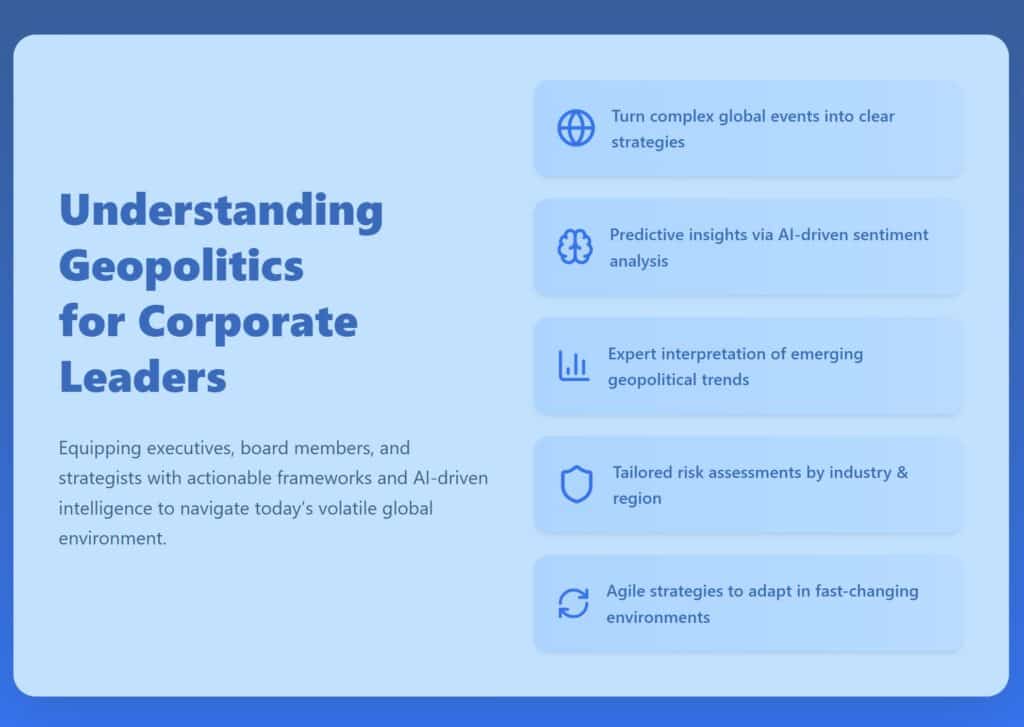
- Converting complex global events into clear strategic implications
- Providing predictive insights through AI-driven geopolitical sentiment analysis
- Offering immediate, expert interpretation of emerging geopolitical trends
- Delivering customized risk assessments tailored to specific industries and regions
We begin with this, our first insight on Understanding Geopolitics, designed to equip corporate leaders with the strategic framework needed to navigate today’s complex geopolitical landscape.
Table of Contents
ToggleUnderstanding Geopolitics: A Guide for Executives
Geopolitical tensions are higher today than they have been for decades, posing significant threats to businesses and investments worldwide. In today’s interconnected world, executives need to have a solid understanding of geopolitics in order to navigate the complexities of global affairs. Geopolitics refers to the study of how geography, politics, and economics intersect and influence international relations. Geopolitics helps us understand interstate cooperation, competition, and conflict in a geographic perspective. It is crucial for executives to grasp the impact of geopolitics on their business, as it can shape markets, trade policies, security concerns, but also value generation opportunities. To help you gain a better understanding of geopolitics, consider the following ‘best practices’:
1. Recognize the Interconnectedness
As events in Ukraine, the Middle East, Asia, and beyond demonstrate, global challenges are increasingly interlinked. Executives must understand that decisions made in one part of the world can have far-reaching consequences in another. For example, political instability in one country can disrupt supply chains and impact business operations globally. Geopolitics, Incorporated and Permutable AI help our clients see the bigger picture. We go beyond the “what” to the “so what” for corporate leaders and executives.
2. Stay Informed
Keeping up with current events and global trends is essential for executives. By staying informed, you can anticipate potential challenges and opportunities that may arise due to geopolitical factors. Subscribe to reputable geopolitical data intelligence services (like those offered by Permutable AI) and news sources, follow experts in the field, and attend conferences or seminars to stay updated. We also help our clients stay up to date on global developments at annual, semi-annual, and quarterly corporate conferences and off-sites, monthly Risk Pulse Reports as well as the provision of geostrategic “audits”.
3. Understand Regional Dynamics
Business Leaders should embed geopolitical analysis into their due diligence processes at the country, industry, and company level, and continuously monitor how geopolitical risks evolve as they engage with portfolio companies. Geopolitics is not a one-size-fits-all concept. Each region and industry have their own unique dynamics and power struggles. Executives should invest time in understanding the political, economic, and cultural factors that shape specific regions of interest, and in a manner that is anticipatory and prospective. This knowledge will help you make informed decisions and tailor your business strategies accordingly.
4. Analyse Risk and Opportunity
Geopolitical events can create both risks and opportunities for businesses. Executives should conduct thorough risk assessments to identify potential challenges and develop contingency plans. At the same time, and as the geometry of global trade changes, they should also be open to exploring new markets and partnerships that may arise due to geopolitical shifts. This risk analysis should be both quantitative and qualitative in nature.
5. Build a Diverse Network
Geopolitics is a complex field, and no single individual can have all the answers. Building a diverse network of experts, advisors, and peers can provide valuable insights and perspectives. Engage in discussions, attend industry events, and seek out mentors who can guide you through the intricacies of geopolitics. Experience in international affairs and security is crucial when considering external advisory services.
6. Embrace Adaptability
Geopolitical landscapes are constantly evolving, and executives must be adaptable to navigate these changes. Embrace a mindset of agility and flexibility, and be prepared to adjust your strategies as needed. Focus on the role that value drivers in geopolitics are having in your industry. This will help you stay ahead of the curve and seize opportunities in an ever-changing global environment. Resilience matters, as does effectiveness over efficiency.
Leadership plays a crucial role in how organizations navigate crises and uncertainty, including the ability to make decisions with limited information and without allowing past lessons to overly dictate future decisions. Understanding geopolitics is not an easy task, but it is a crucial skill for executives in today’s globalized world.
By recognizing the interconnectedness of global affairs, staying informed, understanding regional dynamics, analyzing risks and opportunities, building a diverse network, and embracing adaptability, executives can build corporate resilience and effectively navigate the complexities of geopolitics and drive their businesses towards success.
Access deeper strategic foresight with expert geopolitical analysis enhanced by real-time AI intelligence
Geopolitics, Incorporated, in partnership with Permutable AI, specializes in helping executives understand and navigate the impact of geopolitics on their businesses. Contact us to access geopolitical analysis from Geopolitics, Incorporated, enhanced by Permutable’s real-time intelligence, providing the strategic insights and data-driven clarity that modern leaders need. Contact the team at Geopolitics, Incorporated and Permutable AI to learn more about how this combined geopolitical expertise and AI-driven intelligence can unlock strategic opportunities for your business.
Be on the lookout for our first Co-Branded Risk Pulse Report, “Understanding the Crisis of Venezuela: Oil, Sanctions, and Great Power Relations” coming soon.
Understanding Geopolitics: Frequently Asked Questions (FAQ)
Q: What is geopolitics and why should business executives care about it?
A: Geopolitics is the study of how geography, politics, and economics intersect to influence international relations. Executives should care because geopolitical events can directly impact supply chains, market access, regulatory environments, and investment opportunities. In today’s interconnected world, political instability in one region can have far-reaching consequences for businesses operating globally.
Q: How can AI help with geopolitical analysis for businesses?
A: AI enhances geopolitical analysis by processing vast amounts of real-time data from multiple sources, identifying patterns and sentiment trends that humans might miss, and providing predictive insights about emerging risks and opportunities. Permutable AI’s platform combines this technological capability with expert human interpretation to deliver actionable intelligence.
Q: How often should businesses assess geopolitical risks?
A: Geopolitical risk assessment should be an ongoing process rather than a one-time exercise. The partnership offers various engagement models including annual corporate conferences, quarterly off-sites, monthly Risk Pulse Reports, and real-time monitoring capabilities to ensure businesses stay ahead of evolving risks.
Q: What industries are most affected by geopolitical tensions?
A: While all industries can be affected, sectors with global supply chains, significant international operations, or dependence on natural resources are particularly vulnerable. This includes manufacturing, energy, technology, financial services, and agriculture. However, geopolitical events can create opportunities as well as risks across all sectors.
Q: How do you measure and quantify geopolitical risk?
A: Geopolitical risk assessment combines both quantitative and qualitative analysis. This includes measuring economic indicators, political stability indices, trade flow data, and sentiment analysis, while also incorporating expert qualitative assessment of cultural, historical, and strategic factors that may not be immediately quantifiable.
Understanding Geopolitics: People Also Ask
How do geopolitical tensions affect global supply chains?
Geopolitical tensions can disrupt supply chains through sanctions, trade barriers, border closures, and infrastructure damage. Companies need to understand these risks to develop resilient supply chain strategies and identify alternative sourcing options before disruptions occur.
What are the early warning signs of geopolitical instability?
Early warning signs include changes in political leadership, economic stress indicators, social unrest, military buildups, diplomatic tensions, and shifts in international alliances. AI-driven sentiment analysis can help identify these signals before they escalate into major disruptions.
How can companies prepare for geopolitical uncertainty?
Companies should conduct regular risk assessments, diversify their geographic exposure, build flexible supply chains, maintain strong government relations, and invest in real-time intelligence capabilities to anticipate and respond quickly to geopolitical changes.
How do trade wars and sanctions impact business operations?
Trade wars and sanctions can affect businesses through increased tariffs, restricted market access, compliance requirements, supply chain disruptions, and currency fluctuations. Companies need to understand both direct and indirect impacts on their operations and financial performance.
What is the difference between country risk and geopolitical risk?
Country risk focuses on the economic and political stability of individual nations, while geopolitical risk examines broader international dynamics, including relationships between countries, regional conflicts, and global power shifts that can affect multiple markets simultaneously.