
This article explains how AI transforms high-volume China economic news into structured, real-time market sentiment signals. It’s written for portfolio managers, commodity traders, quant researchers, and strategists across finance and energy-linked sectors, as well as business leaders making sourcing, hedging, risk and investment planning decisions involving China and the China macroeconomic landscape.
Institutional participants monitoring China economy news face a persistent challenge: official statistics arrive regularly but increasingly fail to capture underlying fragility, sectoral divergences, and confidence dynamics that determine actual economic outcomes. At Permutable AI, our suite of China macro sentiment indices addresses this gap by transforming narrative content embedded in China economy news into quantifiable intelligence. Here are seven use cases demonstrating how institutional clients leverage these indices.
Table of Contents
Toggle1. Early warning system for property market deterioration
The challenge
Property data releases lag actual market conditions by weeks or months, leaving investors reactive rather than proactive when monitoring the economy of China’s most systemically important sector.
The solution
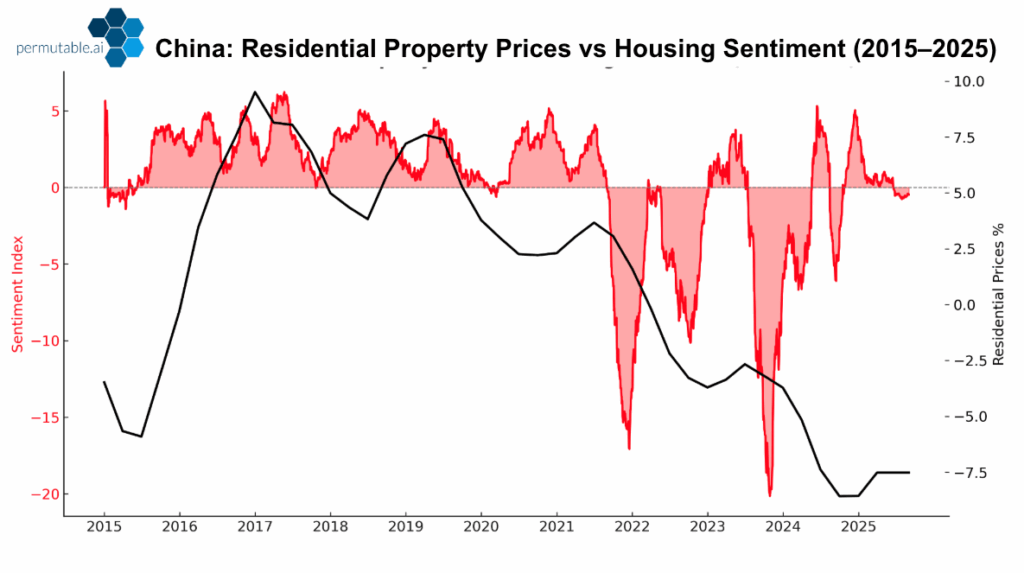
Our China Housing Sentiment Index remained firmly negative since early 2024, providing forward-looking signals of deteriorating confidence well before official data confirmed the trend. When H1 2025 statistics eventually showed real estate investment down 11% year-over-year, new starts down 16%, and completions falling 15%, sentiment indices had already captured this weakness months earlier.
Application
- Investment banks could use the Housing Sentiment Index to advise clients on property developer bond issuance risk before spreads widen.
- Energy companies might track property sentiment as a proxy for construction demand, influencing forecasts of electricity and fuel consumption.
- Manufacturing corporates could adjust output of construction-linked goods such as steel or cement based on sentiment deterioration.
- Hedge funds might take short positions in vulnerable property developers or implement relative value trades (short property vs. long infrastructure) when sentiment signals sectoral weakness ahead of official statistics.
Key advantage
Sentiment updates in near real-time as China economy news flows evolve, providing lead-time measured in weeks or months rather than reacting to backward-looking official releases. The index also captures episodic policy effectiveness – showing how mortgage easing or developer credit lines produce brief sentiment bounces before renewed weakness, helping distinguish genuine turning points from temporary respites.
2. Manufacturing quality-of-growth assessment
The challenge
Official manufacturing data shows robust industrial production growth, but surface-level China economy news fails to reveal whether expansion reflects genuine demand or state-directed output meeting targets.
The solution
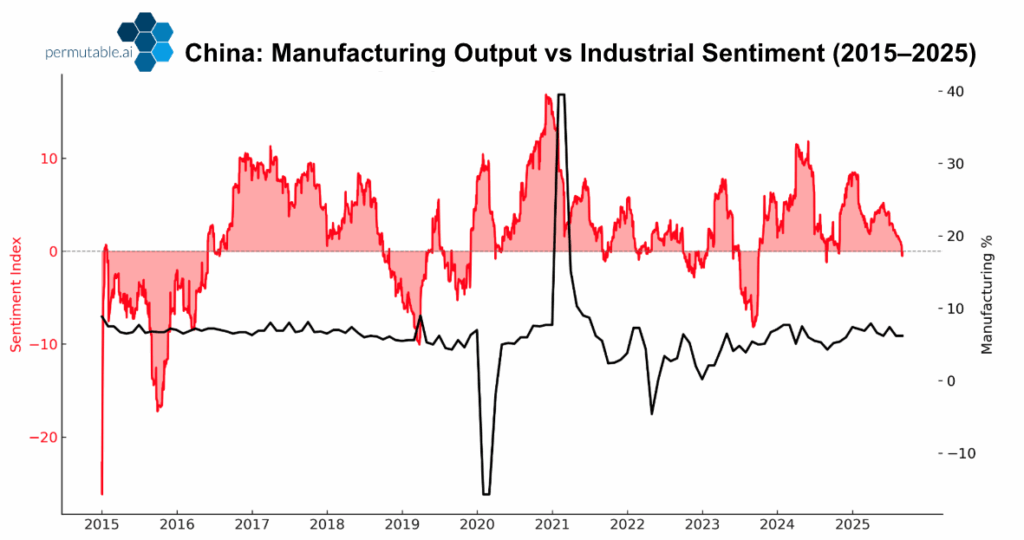
Our China Manufacturing Sentiment Index peaked in early 2024 then declined steadily through 2025 even as official production expanded 5.7% annually. This divergence captures a critical insight: current manufacturing strength appears brittle, reliant on subsidies and front-loading ahead of tariffs rather than sustainable end-demand.
Institutional application
Manufacturing corporates could use the Manufacturing Sentiment Index to evaluate whether output growth reflects genuine downstream demand or artificial state stimulus, informing production and inventory planning.
Investment banks might incorporate sentiment signals into equity research, differentiating between companies benefiting from sustainable demand versus those propped up by short-term subsidies.
Energy companies could use manufacturing sentiment as a leading indicator for industrial energy demand trends, allowing better forecasts of gas, coal, or electricity usage.
Key advantage
The sentiment index functions as a quality-of-growth indicator, distinguishing between output expansion driven by genuine demand versus production meeting state targets. For sector allocation decisions when tracking China economy today, this distinction between quantity and quality of growth proves essential for avoiding value traps.
3. Consumer confidence conviction measurement
The challenge
Retail sales figures can be temporarily manufactured through government subsidies and trade-in programmes, making it difficult to assess whether consumption recovery reflects genuine household confidence or policy-induced transactions.
The solution
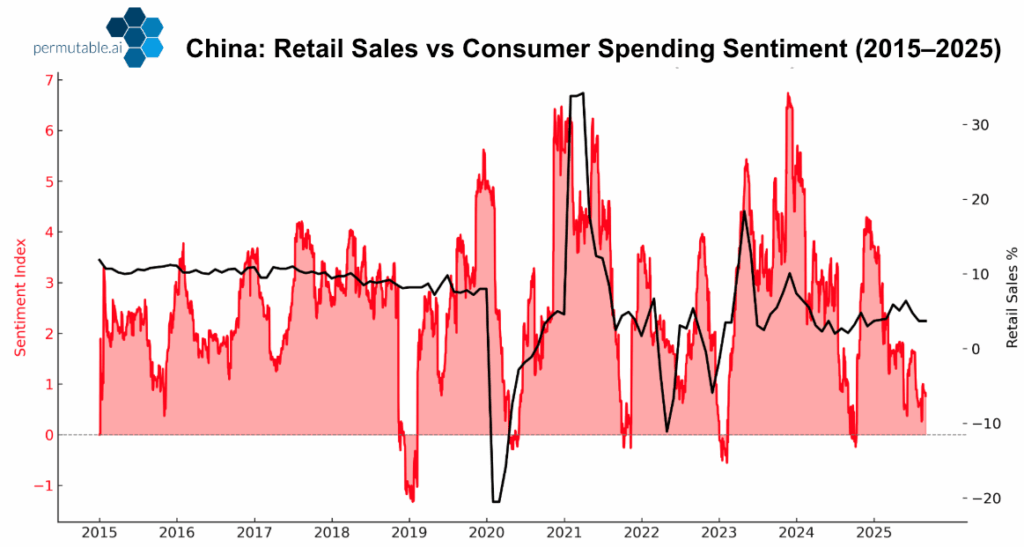
Our China Retail Sales Sentiment Index reveals households remain unconvinced by policy-manufactured consumption despite official sales gains in early 2025. Sentiment has been modestly positive since mid-2024 with holiday upticks but shows recent deterioration, capturing weak income expectations and limited wealth effects from depressed housing.
Institutional application
Consumer goods multinationals could use retail sentiment indices to calibrate China expansion plans, avoiding premature investment in capacity during fragile demand periods.
Investment banks might refine revenue forecasts for retail-focused companies, using sentiment data to distinguish between policy-driven spending and genuine confidence-led growth.
Energy companies could anticipate fuel demand fluctuations tied to household consumption patterns, such as transport fuel usage during retail slowdowns.
Key advantage
The index measures conviction behind transactions rather than just transaction volumes. For corporate strategists evaluating the economy of China’s consumer market, distinguishing between policy-induced sales and sustainable demand proves crucial for capital allocation decisions.
4. Policy effectiveness real-time evaluation
The challenge
Assessing whether government stimulus measures are changing underlying confidence or merely producing temporary statistical bounces requires monitoring beyond official data releases.
The solution
Permutable’s sentiment indices track policy announcement impacts in real-time, revealing whether measures generate sustained confidence improvements or episodic responses that quickly reverse. Beijing’s 81 billion yuan trade-in programme produced visible retail sentiment upticks during implementation but failed to shift underlying household caution.
Institutional application
Macro hedge funds could structure trades that exploit divergences between sectors directly supported by policy versus those reliant on consumer confidence.
Energy companies might evaluate the effectiveness of stimulus on industrial demand, particularly in heavy industries consuming oil, coal, and gas.
Investment banks could incorporate policy sentiment into equity research, advising clients on sectors likely to benefit from sustained policy support versus those exposed to fading household demand.
Consumer-facing corporates could use policy sentiment indices to assess whether household spending incentives are translating into durable consumption or just temporary lifts.
Key Advantage: Real-time policy impact assessment allows institutional participants to distinguish between measures that change trajectories versus those providing temporary lifts. This differentiation proves essential for forecasting sustainability when tracking China economy news flow.
5. GDP growth sustainability assessment
The challenge
Official GDP consistently hits 5% targets, but headline figures fail to reveal composition issues, sectoral imbalances, or confidence trajectories that determine growth sustainability.
The solution
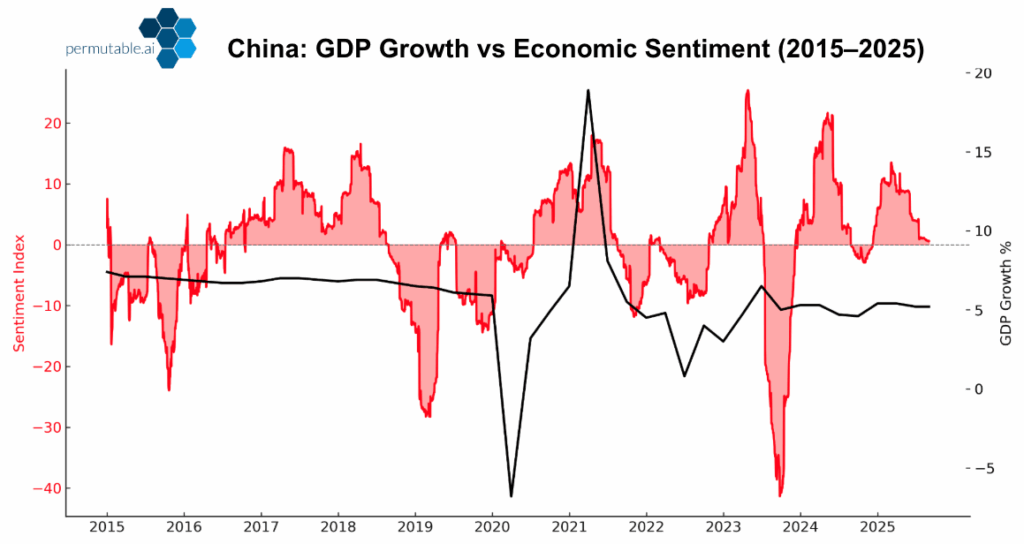
Our China GDP Sentiment Index reveals dramatic volatility beneath headline stability – swinging from optimism in early 2024 to sharp pessimism as tariff risks returned, recovering in early 2025 before recent deterioration. Current sentiment suggests renewed pessimism about the growth path even as official targets are met.
Institutional application
Sovereign wealth funds could use GDP sentiment volatility as a tactical signal to rebalance equity exposure, reducing risk when sentiment deteriorates despite strong official GDP.
Energy producers might monitor GDP sentiment to forecast shifts in national energy demand, particularly as GDP composition (manufacturing vs. consumption) influences fuel requirements differently.
Investment banks could advise clients on portfolio hedging strategies, using GDP sentiment indices as early warnings of volatility that headline GDP data may obscure.
Key advantage
The index captures what official China economy news obscures – that growth is being delivered but its composition (skewed toward state-supported manufacturing whilst consumption lags) erodes confidence in sustainability. Markets, firms, and households lose faith in recovery durability despite official assurances, a dynamic sentiment captures but GDP statistics mask.
6. Sector rotation leading indicator
The challenge
Official data shows sectoral performance retrospectively, but optimal portfolio allocation requires identifying inflection points as sentiment shifts before statistics confirm trends.
The solution
Cross-referencing multiple sentiment indices reveals sector rotation opportunities. When Housing Sentiment deteriorates whilst Manufacturing Sentiment stabilises, or when Retail Sentiment improves but GDP Sentiment weakens, these divergences signal portfolio rebalancing opportunities ahead of statistical confirmation.
Institutional application
Equity funds could rotate into consumer discretionary names when retail sentiment rises, even if official retail data still lags.
Energy companies might anticipate changes in sectoral fuel demand — e.g., industrial slowdown combined with consumer strength indicating a shift in power and fuel usage patterns.
Investment banks could apply sentiment signals to client sector rotation strategies, building thematic baskets accordingly.
Manufacturing corporates might use sectoral divergences to shift output priorities (e.g., scaling back construction-linked production as housing sentiment falls).
Hedge funds could structure long/short rotation trades across sectors, positioning ahead of consensus based on cross-sentiment divergences.
Key advantage
Sentiment divergences across sectors provide leading indicators for rotation strategies. Traditional approaches wait for statistical confirmation of sectoral trends, but sentiment-based allocation enables positioning ahead of consensus, capturing alpha during transition periods.
7. Trade policy impact quantification
The challenge
Export data arrives monthly but fails to capture evolving market expectations about tariff impacts, rerouting effectiveness, or structural shifts in trade relationships affecting the economy of China.
The solution
Our regional macro indices captured growing concern that China’s surplus output would meet escalating resistance abroad well before August data showed US-bound shipments collapsing 33%. The sentiment evolution revealed markets no longer assumed rerouting through ASEAN or Mexico could meaningfully soften tariff impacts – a critical expectation shift.
Institutional application
Investment banks might leverage these indices to forecast earnings impacts on exporters and advise on FX hedging strategies.
Energy companies could monitor trade sentiment as an early signal of disruptions in oil, gas, and LNG export flows to major trading partners, informing hedging and logistics.
Manufacturing corporates could anticipate demand disruption in export-linked industries and adjust production or sourcing accordingly.
Key advantage
Sentiment reveals expectation shifts around trade dynamics that official statistics cannot illuminate. For supply chain strategists monitoring China economy today, understanding that markets no longer expect rerouting solutions provides essential context that export figures alone miss.
Integration framework
Institutional clients can maximise value from our China macroeconomic sentiment indices through integrated analytical frameworks:
Layered analysis: Combining official statistics with sentiment indices reveals not just what happened but confidence trajectories and sustainability indicators.
Lead-time exploitation: Sentiment’s forward-looking nature enables defensive positioning or opportunity capture before official data confirms what markets already sense.
Quality assessment: Sentiment distinguishes between strong statistics masking fragility versus genuine strength, crucial for avoiding value traps in the economy of China.
Policy response prediction: Understanding confidence dynamics helps forecast where policymakers will direct support, enabling positioning ahead of announcement-driven moves.
Sentiment as competitive advantage
The economy of China delivers headline targets whilst underlying confidence deteriorates – a divergence that official statistics obscure but market participants must navigate. At Permutable AI, our macro sentiment indices transform China economy news from descriptive data into predictive intelligence, providing institutional participants with measurable competitive advantages.
These use cases demonstrate that sentiment analysis has evolved from supplementary insight to essential framework. In an environment where official data smooths edges and masks fragility, sentiment exposes strain, scepticism, and shifting conviction before traditional metrics confirm what informed participants already suspect.
To see how Permutable’s China macro sentiment indices work in practice across these use cases and transform China economy news into actionable intelligence, request a demo at enquiries@permutable.ai.
Frequently Asked Questions
Q1. Why should we use sentiment indices when we already monitor official Chinese statistics?
Official statistics are important, but they often lag real conditions and smooth volatility. Our sentiment indices are designed to complement—not replace—official data by capturing confidence dynamics and fragility in near real time. This provides institutional investors with a forward-looking edge rather than a backward-looking snapshot.
Q2. How reliable are sentiment indices compared to traditional data sources?
Our indices are built from broad-based China economy news flows, covering multiple sectors, regions, and actors. The methodology applies natural language processing and machine learning to extract signals with consistency. By tracking sentiment trajectories across sectors, investors gain a cross-validated view of market confidence that enhances reliability rather than relying on a single narrative source.
Q3. Aren’t sentiment signals too noisy or short-term to be useful for institutional investors?
Noise is a valid concern, which is why our models are engineered to identify structural shifts, not just headlines. The indices capture both short-lived reactions and longer-term confidence cycles, allowing investors to distinguish between episodic policy bumps and genuine inflection points. This helps reduce false positives and gives clarity to medium- and long-term positioning.
Q4. How do these indices integrate into existing investment processes?
We provide access through an intuitive dashboard, as well as data feeds that integrate into institutional workflows. The indices can sit alongside macroeconomic datasets, risk models, or internal research frameworks. Many clients use them to add an additional forward-looking lens when monitoring China’s property, manufacturing, consumer, and trade sectors.
Q5. What’s the unique value compared to traditional data providers?
Unlike providers that deliver raw or lagging data, Permutable offers context-rich intelligence. Our China macro sentiment indices:
Quantify confidence trajectories that statistics cannot show.
Provide lead-time measured in weeks or months before official releases.
Highlight sector divergences and policy effectiveness in real time.
This makes them a competitive advantage for institutional investors who need to anticipate rather than react.
Q6. How do we know these indices provide alpha?
The principle is proven: markets move on expectations, not just statistics. Our indices are designed to track those expectations and confidence dynamics as they evolve in China economy news. By using sentiment as an overlay, investors can improve timing, manage risk more effectively, and position ahead of consensus.
Q7. What if our firm already invests heavily in primary research?
Our sentiment indices don’t replace human expertise – they amplify it. They can flag areas where deeper research is needed, validate or challenge existing theses, and provide a broader contextual view across multiple sectors. This helps institutional teams allocate resources more efficiently and focus their analysis on the most material signals.
Q8. How can we evaluate whether these indices add value to our process?
We recommend a trial integration where your team monitors our sentiment indices alongside your existing data and decision-making framework. This allows you to test how the forward-looking insights align with outcomes and determine the degree of additional conviction and lead-time they provide.