
*This article summarises the five most significant geopolitical factors affecting energy market sentiment in April 2025, providing traders, portfolio managers and risk analysts with valuable insights into how regional conflicts, diplomatic negotiations, and economic developments are currently influencing price movements across crude oil, natural gas, and refined products.
As the month of April continues to unfold, energy markets continue to demonstrate notable sensitivity to global political developments. Our Trading Co-Pilot has identified several key geopolitical factors affecting energy market sentiment across the sector this month, with implications stretching across crude oil, natural gas, and refined products. This analysis examines the five most significant drivers behind recent price movements and offers insights into what traders might expect moving forward into the year.
Table of Contents
Toggle1. US airstrikes in Yemen escalate regional tensions
At the time this article went to print, oil prices had edged higher following US airstrikes on Yemen’s Ras Isa fuel port, which reportedly resulted in over 80 fatalities. This military action marked a significant escalation in the ongoing conflict and has raised immediate concerns about potential supply disruptions in the region.
Brent crude extended gains after the strikes, rallying from $66.14 to $68.05 on April 17th, while WTI crude similarly jumped to $63.75. As geopolitical tensions flared in the region, heating oil prices also reflected this anxiety, rising from \$2.08 to \$2.12 during the same period. The Yemen situation highlights how quickly regional conflicts can impact global energy prices, particularly when critical infrastructure comes under threat. According to data from our sentiment analysis, this is one of the most significant geopolitical factors affecting energy market prices this month
2. US-Iran nuclear negotiations heighten market uncertainty
The second round of nuclear negotiations between the US and Iran which at time of writing had just concluded in Rome has created notable market volatility as traders attempt to gauge potential outcomes and their impact on Iranian oil exports. This well-warranted yet hardline stance, coupled with hints of potential military action, created significant uncertainty in energy markets throughout the week.
Driven by concerns over supply disruptions if negotiations were to fail and sanctions intensified, gasoline prices opened at 2.01 and reached a high of 2.03 on April 14th before retreating. Traders cited the possibility of Iranian oil returning to markets in meaningful volumes – or being further restricted – as a key factor affecting their positioning.
3. Escalating military actions in Ukraine
In contrast to the Middle East developments, the Ukraine conflict continued to more significantly impact European natural gas prices, demonstrating how geopolitical factors affecting energy market dynamics can vary by region. TTF natural gas prices rallied from €34.30 to €35.57 on April 16th following reports of a major drone assault on Ukraine infrastructure.
As Russia reportedly downed dozens of Ukrainian drones while Ukraine continued strikes on Russian territory, the markets grew increasingly edgy about potential disruptions to natural gas flows through the remaining operational transit routes.
Market analysts pointed to the recent extension of Ukraine’s martial law and mobilisation for another 90 days as evidence that the conflict shows no signs of resolution. With European gas storage levels generally declining toward the end of the withdrawal season, this geopolitical uncertainty adds a risk premium that’s particularly visible in forward contracts.
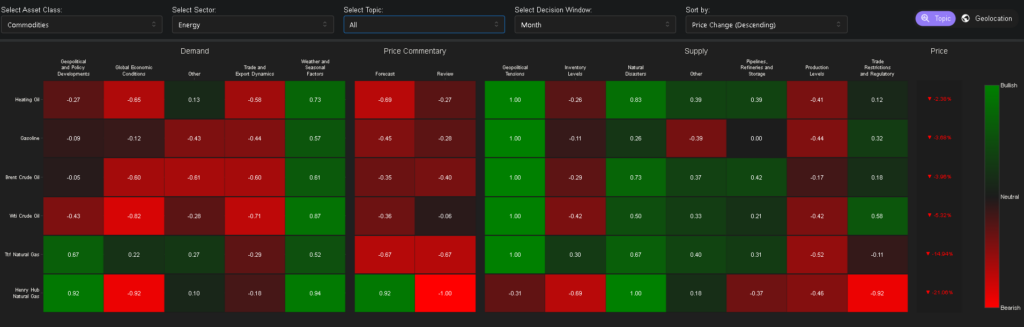
Above: Energy market sentiment taken from our Trading Co-Pilot’s Sector Analysis feature – an analysis of sector sentiment across geopolitical and policy developments, geopolitical tensions as well as other influencing factors
4. US–China trade relations
Amid otherwise bearish sentiment, WTI crude prices rose significantly mid-month, opening at $60.89 and closing at $62.23 on April 16th, as optimism grew around renewed trade “negotiations” between US and China.
This more positive sentiment was reinforced by China’s better-than-expected Q1 economic growth of 5.4%, which occurred even before the anticipated impacts of potential Trump tariff waivers. Following unexpected inventory builds in the US, this news provided welcomed support for energy markets that had been struggling with demand concerns.
Traders cited uncertainty over China’s demand recovery as a persistent theme, but the prospect of reduced trade tensions between the world’s two largest economies gave market participants reason for cautious optimism about future consumption patterns.
5. OPEC+ policy adjustments and market response
In response to OPEC+ output decisions and policy signals, oil markets demonstrated measured reactions throughout April. Among the geopolitical factors affecting energy market sentiment, OPEC+ policy adjustments remain particularly influential despite receiving less headline attention than military conflicts
Some analysts anticipate a rebound in crude prices if OPEC+ maintains production discipline amid the geopolitical uncertainties. With inventories running low in certain regions, further upside cannot be ruled out if the producer group responds assertively to price weakness.
Reflecting seasonal demand trends that typically strengthen heading into summer driving season, refined products showed more resilience than crude oil in certain trading sessions. This pattern suggests market participants are weighing short-term geopolitical risks against longer-term seasonal patterns.
Inform your energy trading decisions with our real-time geopolitical insights
Request a demo of our Trading Co-Pilot platform today and discover how our advanced sentiment analysis can help you navigate market volatility with confidence – also available via API and spreadsheet integration. Contact us at enquiries@permutable.ai to apply for a subscription or simply fill in the form below.