Gold sentiment: Why is the price of gold going up? A look at key factors 2025 update
Gold has always been a barometer for the global economy, with investors traditionally turning to the precious metal during periods of uncertainty. The recent outlook for gold has been one of rising prices. But what actually is going on here? Everywhere you look, the question persists: why is the price of gold going up? And how long can this last? The truth is more complicated than a simple explanation, but through our analysis and insights from our Trading Co-Pilot, we can be reasonably confident that several key factors are contributing to this surge.
Why is the price of gold going up?
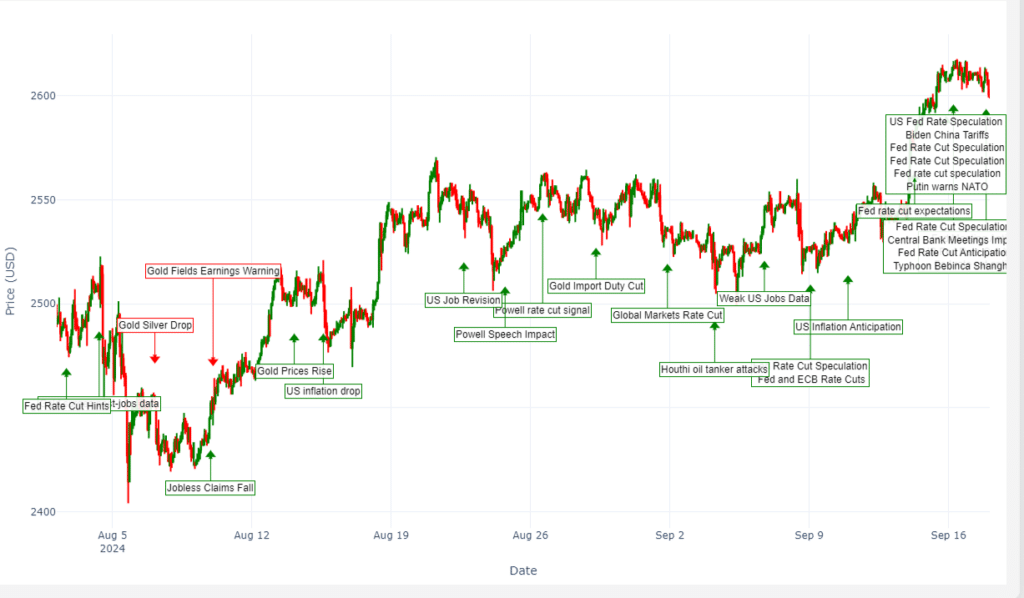
Above: Gold’s price movements: Data-driven insights from our Trading Co-Pilot
Inflation concerns
One of the most frequently cited reasons for gold’s price increase is inflation. We live in an age of highly volatile geopolitics, and the economic impact of post-pandemic recovery, supply chain disruptions, and increased government spending has fuelled inflationary pressures globally. As such, the crisis in rising inflation has seen central banks respond with aggressive monetary tightening measures, including interest rate hikes. And yet, perhaps, we can expect inflationary fears to persist for some time, given the unstable economic climate.
While core inflation numbers showed a slight decrease last week, many analysts argue that these figures can be misleading. The continued increase in government spending may be a more representative indicator of the economy’s health. This recent decrease in inflation has shifted market expectations from a 50 basis point rate cut to a more modest 25 point one. However, the underlying inflationary pressures remain a concern for many investors
Much of that is due to fears that monetary policies alone cannot temper inflation. The loss of trust in governments’ ability to manage economic volatility is driving more investors toward gold, a traditional hedge against inflation. In addition, the escalating costs of living are feeding into an ongoing uncertainty about the future. This method applies to both individual investors seeking a safe haven and institutional investors looking for stability.
Why is gold going up? Geopolitical uncertainty
You can’t argue with the fact that gold thrives in times of geopolitical unrest. This is especially true given that we live in a world of highly complex and rapidly changing global dynamics. The war in Ukraine, rising tensions in the South China Sea, and general instability across various regions all play a part in the price of gold. The hardest part is predicting how these events will unfold, but the truth is, gold provides a cushion for investors seeking refuge from volatile global markets.
As long as we rely on traditional safe havens like gold, we can expect its price to increase whenever there is uncertainty on the global stage. The present outlook for geopolitical stability is far from optimistic, which is likely to keep gold in demand for the foreseeable future.
Decline in bond yields
Another key factor driving the price of gold is the decline in bond yields. With real yields (adjusted for inflation) either low or negative, investors are increasingly looking for alternative stores of value. Defining what is classed as a “good” return has shifted over the past few years, especially as central banks have kept interest rates low for an extended period. This dynamic puts gold in an attractive position since it does not pay interest or dividends, but offers long-term value preservation, making it a more appealing investment compared to bonds.
In a way, this shift reflects broader market concerns about the ability of traditional investments to deliver the kinds of returns seen in the past. The keys to gold’s appeal lie in its historical track record of retaining value, especially when other asset classes underperform.
Why is gold going up: US dollar weakness
So why is gold coming up? The next question you should be asking is what about the US dollar? Gold and the US dollar typically have an inverse relationship. When the dollar weakens, gold prices tend to rise, and vice versa. Recently, the dollar has experienced bouts of weakness due to various factors, including trade deficits and changes in monetary policy.
Recent central bank decisions have further influenced the dollar’s strength and, consequently, gold prices. The European Central Bank’s recent rate cut, coupled with the anticipated Federal Reserve rate decision, have been key factors in shaping market expectations. These expectations have been building since Federal Reserve Chairman Jerome Powell’s speech in late August, signaling a potential shift in monetary policy. Such changes in interest rate policies often lead to fluctuations in currency strengths, impacting gold prices. As the US dollar potentially weakens in response to these rate cuts, we may see a corresponding rise in gold prices
Despite this, there are things that can be done to stabilise the dollar in the long run. However, the game changer will be how investors react to continued fluctuations in global currencies. Just as notably, gold serves as an alternative when confidence in fiat currencies, like the US dollar, wanes. We must therefore be ready to reject the argument being made that gold’s rise is merely temporary—it is tied to structural concerns about global currency values.
Gold as a hedge against economic volatility
If experience tells us anything, it’s that gold has always been viewed as a safe haven during times of economic turmoil. The present moment is no different. Increasingly, investors are turning to gold as a hedge against stock market volatility, political uncertainty, and inflationary pressures. In addition, economic instability caused by high debt levels, especially in developing countries, further supports gold’s ascent.
The keys to understanding gold’s current trajectory, therefore, is looking at both short-term market forces and long-term systemic challenges in the global economy. Ultimately, what is needed is a comprehensive view of how these elements converge to shape the price of gold.
Supply and demand dynamics
Another often-overlooked factor to consider when mulling over the question “Why is the price of gold going up” is the supply and demand for gold itself. Imagine too the impact of reduced mining outputs or increased demand from countries like China and India. For the avoidance of doubt, gold is still viewed as a tangible store of wealth in many cultures, which supports long-term demand. While central banks across the globe continue to increase their gold reserves, retail investors and sovereign wealth funds alike are also adding gold to their portfolios.
Gold market update 2025: New dynamics in play
As we move towards the end of 2025, the drivers behind gold’s price trajectory have shifted but remain anchored in the same structural themes of inflation, geopolitics, and currency volatility.

Persistent geopolitical risks
The conflicts in Ukraine, the Middle East, and across parts of Africa continue to inject uncertainty into global markets. Our Political Tension Index shows sustained high readings, with sentiment spikes closely correlated to upward moves in gold. Gold’s safe-haven role remains firmly intact, with each escalation reinforcing investor demand.
Central bank buying at record highs
2025 has seen central banks, particularly in Asia and the Middle East, accelerate gold reserve accumulation as a hedge against dollar exposure. This institutional demand provides an additional layer of support for prices beyond speculative trading flows.
Inflationary pressures remain sticky
While headline inflation has eased, core measures remain elevated. Investors are increasingly sceptical that rate adjustments alone will restore price stability, fuelling continued gold buying as a hedge against systemic risk.
US dollar dynamics
Our sentiment analysis shows that narratives around “currency debasement” and “rate divergence” are gaining traction, particularly following policy shifts by the Federal Reserve and European Central Bank. This has reinforced gold’s inverse correlation with the dollar, driving rallies whenever the greenback weakens.
Overall, the long-term trajectory of gold remains upwardly supported, underpinned by macro uncertainty and structural demand from central banks. Our intelligence confirms that gold remains not only a hedge but also a strategic asset class in 2025 portfolios.
Trading Co-Pilot exclusive access
Are you ready to be part of the future of trading? At Permutable AI, we’re extending an exclusive opportunity to a select group of corporate partners to gain access to our advanced Trading Co-Pilot, powered by cutting-edge machine learning for contextual understanding.
If your firm is ready to lead the way in AI-driven trading innovation, get in touch today to explore this limited opportunity and discover how our Trading Co-Pilot can transform your approach to the market by contacting us at enquiries@permutable.ai or fill in the form below.
FAQ
Q: Why is the price of gold going up in 2025?
A: Gold prices are rising due to persistent inflation concerns, geopolitical uncertainty in regions such as Ukraine and the Middle East, declining bond yields, and recent weakness in the US dollar. These combined forces are reinforcing gold’s role as a safe-haven asset.
Q: How do geopolitical tensions impact the price of gold?
A: Wars and political instability often drive investors toward gold as a hedge against volatility. For instance, ongoing conflicts and sanctions risk have created spikes in gold demand as investors look for protection from uncertainty in global markets.
Q: Is gold still a hedge against inflation?
A: Yes. Gold has historically acted as a hedge against inflation, and in today’s environment of rising government spending and persistent cost-of-living pressures, investors continue to view gold as a reliable store of value.
Q: What role does the US dollar play in gold’s price movements?
A: Gold typically has an inverse relationship with the US dollar. As the dollar weakens due to trade deficits or central bank policy shifts, gold becomes more attractive, pushing its price higher.
Q: Could gold prices decline in the near term?
A: Gold prices are likely to fluctuate in the short term, but structural drivers such as inflationary pressures, ongoing geopolitical risks, and strong central bank demand suggest that long-term momentum remains supportive.
People Also Ask
Why is gold considered a safe-haven asset?
Gold retains value when markets are volatile, making it a preferred hedge during inflation, geopolitical tensions, or economic instability.
What factors drive the price of gold up or down?
Key drivers include inflation rates, bond yields, currency strength (particularly the US dollar), central bank policy, and geopolitical events.
How do supply and demand affect gold prices?
Global gold supply constraints, such as reduced mining outputs, and rising demand from countries like China and India add upward pressure on prices.
Will gold continue to rise in 2025?
While short-term pullbacks are possible, structural drivers — from inflation to geopolitical risks — point to continued strength in gold prices through 2025.
How does Permutable AI track gold market sentiment?
Permutable’s Trading Co-Pilot uses real-time sentiment analysis to map news flows, inflation data, and geopolitical signals directly into trading scenarios, helping clients anticipate shifts in gold prices before markets react.