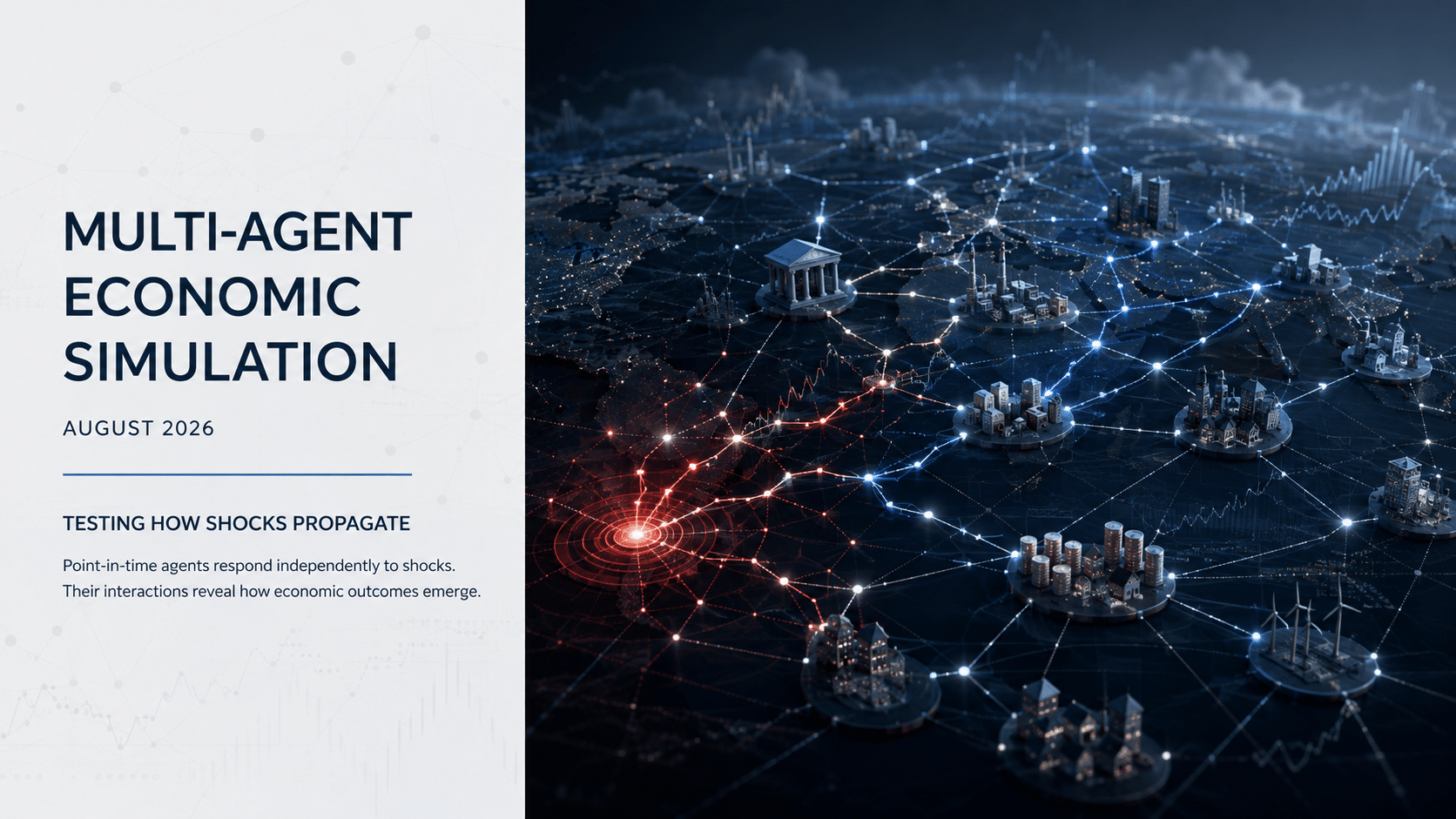
Permutable begins building multi-agent economic simulator to test how economic shocks propagate through markets
28 Aug 2026
28 Aug 2026
Permutable has begun building a multi-agent economic simulator to test how shocks propagate through markets and the wider economy. Using reconstructed point-in-time information, autonomous agents will respond to changing conditions and one another without access to future outcomes. Initial experiments will examine monetary policy, inflation, commodity and geopolitical shocks, with potential applications in institutional scenario analysis and rigorous stress testing.
Permutable has begun building a multi-agent economic simulation environment designed to test whether autonomous AI agents can reproduce how shocks propagate through markets and the wider economy.
Rather than asking a single model to forecast an economic variable or asset price, the project will place multiple agents inside a controlled environment where they can respond independently to changing information, market conditions and one another.
The first experiments will replay historical economic and market episodes using only information that would have been available at the time. This will allow our R&D team to compare simulated decisions and outcomes with what subsequently happened in the real world.
Our initial work will focus on areas including monetary-policy changes, inflation shocks, commodity disruptions and geopolitical events.
The central research question is deliberately demanding: can a system produce a useful economic outcome without having access to the outcome it is supposed to predict?
“If you want to claim that an AI system can simulate an economy, it has to be able to predict something it does not already know,” said Wilson Chan, Founder and CEO of Permutable.
“That means reconstructing the information environment properly, preventing future information from leaking into the simulation and understanding why agents behaved as they did. An accurate answer produced with hindsight is not a simulation.”
Economic forecasting typically attempts to estimate a particular outcome: inflation, growth, interest rates, asset prices or some combination of these. At Permutable, we plan to test a different approach using agentic AI.
Within the proposed environment, individual agents can represent different types of economic or market participants, each operating with a defined information set and responding according to its own objectives.
A change in the oil price, for example, may initially affect inflation expectations. Those expectations can influence central-bank policy, currencies, corporate costs, household spending and investor positioning. Each reaction can in turn affect the behaviour of other participants.
Our aim is to examine whether these second- and third-order effects can emerge from interactions between agents rather than being explicitly supplied to the model in advance, making the work closer to an experimental environment than a conventional prediction engine.
“Most market models start with the variables we think matter and then estimate the relationship between them,” Chan said. “We want to test what happens when different participants are allowed to react to the same information independently. The interesting question is whether a credible path from shock to outcome emerges from those interactions.”
A central problem in testing AI against historical markets is data leakage.
Modern language models may have been exposed during training to information about events they are subsequently asked to predict. Historical datasets can also be unintentionally revised using information that became available only later.
This is why we plan to build the simulation around our existing point-in-time data infrastructure which processes information from more than 250,000 sources a day across more than 70 languages, with macroeconomic coverage spanning more than 95 countries and historical datasets extending back more than a decade.
For each historical simulation, agents will be restricted to information available at that point in time.
The environment is intended to record the information each agent received, the decisions it made and the sequence of interactions that followed.
This provides a basis for assessing not just whether a simulation arrived at a broadly correct outcome, but whether it arrived there through a plausible economic process.
We plan to evaluate the simulation using controlled historical experiments.
For each episode, agents will operate using reconstructed point-in-time information sets. Their behaviour and resulting market or economic outcomes will then be compared with subsequent real-world developments.
The research will assess several questions:
We expect validation to be one of the hardest parts of the programme. Additionally, we do not regard a simulation reaching the correct end result as sufficient evidence that it has modelled the underlying economic process successfully.
“The path matters as much as the destination,” Chan said. “If oil moves, we need to understand which agents changed their behaviour, what information caused them to change it and how those decisions affected other parts of the system. Otherwise you simply have another black-box forecast.”
If the approach proves robust, we believe multi-agent simulation could complement existing tools used by investors and financial institutions for scenario analysis, stress testing and macroeconomic research.
A portfolio manager could, for example, examine how different groups of market participants respond to an unexpected central-bank decision.
A commodity investor could explore how a disruption to energy supply feeds through to inflation expectations, currencies, rates and corporate margins.
A risk team could test how different assumptions about consumer, corporate or policymaker behaviour alter the transmission of the same initial shock.
The system could also allow researchers to compare scenarios rather than rely on a single projected path. Rather than replacing conventional economic models, quantitative research or human judgement, the aim is to investigate whether it can provide an additional way of studying complex systems where interactions between participants are themselves important to the outcome.
The programme will be developed incrementally. The first phase will concentrate on tightly defined historical experiments using Permutable’s existing macroeconomic, commodities, FX, policy and market-intelligence datasets.
Later work will expand the number and variety of agents, introduce more complex interactions between economies and asset classes, and test whether results remain stable across different market regimes.
The long-term objective is not to claim that a synthetic economy can predict the future with certainty but to determine whether AI can provide a controlled environment in which researchers can test how different parts of the economic system might respond when conditions change – and then compare those simulations rigorously with what actually happens.
“The world economy is too complex to reduce to a single model or forecast,” Chan said. “But if we can build an environment where different actors respond independently, where every piece of information is controlled point-in-time and where every decision can be inspected, we may have a new way of studying how markets and economies behave under stress.”
If you are interested in how point-in-time multi-agent simulation could be applied to market scenarios, stress testing or macroeconomic research, we would welcome a conversation. Contact us at enquiries@permutable.ai to learn more or explore potential research collaboration.
A multi-agent economic simulator is a controlled environment in which autonomous agents represent different market or economic participants. Each agent responds independently to new information, changing conditions and the behaviour of other agents. The aim is to observe whether wider economic outcomes emerge from those interactions rather than being supplied to the system in advance.
A conventional forecast generally estimates a defined outcome, such as inflation, growth, interest rates or an asset price. Our approach focuses on the path between an initial shock and its consequences. It tests whether independently acting agents can reproduce the decisions, feedback loops and second-order effects through which that shock moves across markets and the economy.
Point-in-time data helps prevent agents from using information that was not available when a historical event occurred. For each experiment, we will reconstruct the information environment as it existed at the time. This allows us to distinguish genuine simulation from an apparently accurate result produced using hindsight, revised data or knowledge embedded in later information.
Agents may represent participants such as central banks, investors, companies, consumers or commodity-market actors. Each will operate with a defined objective and information set. The precise mix will depend on the experiment, allowing us to examine how different assumptions about behaviour alter the transmission of the same economic or market shock.
Our initial experiments will focus on tightly defined historical episodes involving monetary-policy changes, inflation shocks, commodity disruptions and geopolitical events. These provide observable real-world outcomes against which we can compare the agents’ decisions, the sequence of interactions and the resulting market or economic response.
Reaching the correct end result will not be enough. We will assess whether agents acted on information they could genuinely have known, whether plausible second-order effects emerged, whether results remain robust when assumptions change and whether the decision chain is economically interpretable. The path to the outcome matters as much as the outcome itself.
That is one of the central risks the research is designed to address. Language models may have encountered historical events during training, while economic datasets may contain subsequent revisions. We will use point-in-time controls, restricted information sets, alternative assumptions and comparative tests to examine whether results reflect credible agent behaviour rather than information leakage or memorised outcomes.
If the approach proves robust, it could complement existing scenario analysis, stress testing and macroeconomic research. Investors could examine how different participants might respond to a policy surprise, commodity disruption or geopolitical shock. Risk teams could compare several possible transmission paths instead of relying on one projected outcome or a fixed set of behavioural assumptions.
No. We see it as an additional research environment rather than a replacement for economic models, quantitative analysis or human judgement. Its potential value lies in studying systems where interactions between participants materially affect the outcome and in making the assumptions and decision chains behind a simulated scenario easier to inspect.
The programme will be developed in phases. We will begin with controlled historical experiments using our existing macroeconomic, commodity, FX, policy and market-intelligence datasets. Later phases will introduce a wider variety of agents, more complex interactions between markets and economies, and testing across different economic and market regimes.
Analysis
06 Oct 2026
Copper Sentiment Data for Institutional Commodities Desks: How Sentiment Flagged the 2026 Supply Squeeze Early
Read more >
30 Sep 2026
The Hawkish Turn: G10 Central Bank Policy Outlook into Q4 2026
Read more >
Guide
30 Sep 2026
The complete guide to early macro regime sentiment signals for hedge funds and institutional investors
Read more >