War Index: What wars are happening now 2025 update
Geopolitics has never been more deeply intertwined with global markets. Wars and conflicts are not only humanitarian crises but also key forces shaping commodity prices, energy markets, supply chains, and investor sentiment. In 2025, understanding what wars are happening now is no longer the remit of policymakers alone – it has become a strategic imperative for traders, investors, and business leaders.
At Permutable, our geopolitical feeds and Trading Co-Pilot are designed to decode these dynamics in real time. By combining sentiment analysis across global news flows with our proprietary War Index, we provide clarity on where risks are rising, how markets are likely to react, and where opportunities may lie amid volatility.
Using AI as a global conflict tracker
Our methodology remains rooted in large-scale data analysis. We track millions of news articles and reports daily to detect sentiment shifts and geopolitical signals. The outputs are visualised in our Trading Co-Pilot and indexed in our geopolitical risk feeds – turning a vast stream of unstructured data into clear, actionable intelligence.
For traders, this means our geopolitical data doesn’t just show where conflict is happening but also how markets are responding. When tensions escalate in the Middle East or Ukraine, for instance, our Trading Co-Pilot correlates this news sentiment with commodities such as crude oil, natural gas, wheat, and metals – highlighting potential breaks from current ranges before the wider market prices them in.

Above: Our Trading Co-Pilot detected how bullish LNG sentiment, fuelled by geopolitical tensions and policy shifts, translated into sustained price momentum – – signalling a regime change well before the market caught up.
What wars are happening now: 2025 conflict overview
Our latest geopolitical feed highlights several persistent flashpoints:
-
Middle East:
-
Israel-Palestine: The Gaza conflict continues to drive instability across the region, with knock-on effects for energy markets and shipping lanes.
-
Yemen: Ongoing conflict involving regional powers continues to threaten Red Sea trade routes.
-
-
Eastern Europe:
-
Ukraine: Now into its second decade, the war remains a major driver of global grain and energy market volatility, amplified by sanctions and NATO policy.
-
-
Africa:
-
Sudan: The fragile political transition remains overshadowed by active conflict in multiple regions.
-
Ethiopia: While the Tigray war has eased, unrest continues to threaten stability across the Horn of Africa.
-
Libya: Rival factions maintain a precarious stalemate, with oil output vulnerable to disruption.
-
The link between geopolitical risks and markets
Our War Index and Political Tension Index has shown particular value in recent months. For example:
-
In energy markets, our index captured spikes in sentiment following drone attacks on Russian export hubs and Houthi activity in the Red Sea. Our Trading Co-Pilot flagged these signals as short-term bullish for crude oil and LNG, even as structural oversupply capped medium-term rallies.
-
In agriculture, heightened tensions in Ukraine drove sentiment around “export bans” and “grain corridor risks.” Our geopolitical feeds linked these directly to wheat futures volatility, helping desks adjust positioning.
-
In FX markets, rising conflict sentiment around tariffs and sanctions shifted flows into the US dollar and Japanese yen. Our clients used these insights to refine forex sentiment models and hedge exposure.
This integration of geopolitical intelligence into market analysis is where we provide our clients with real value. We don’t just report on what wars are happening now – we map how sentiment from these conflicts flows into asset classes in real time. Here, our Trading Co-Pilot translates geopolitical signals into trading scenarios.
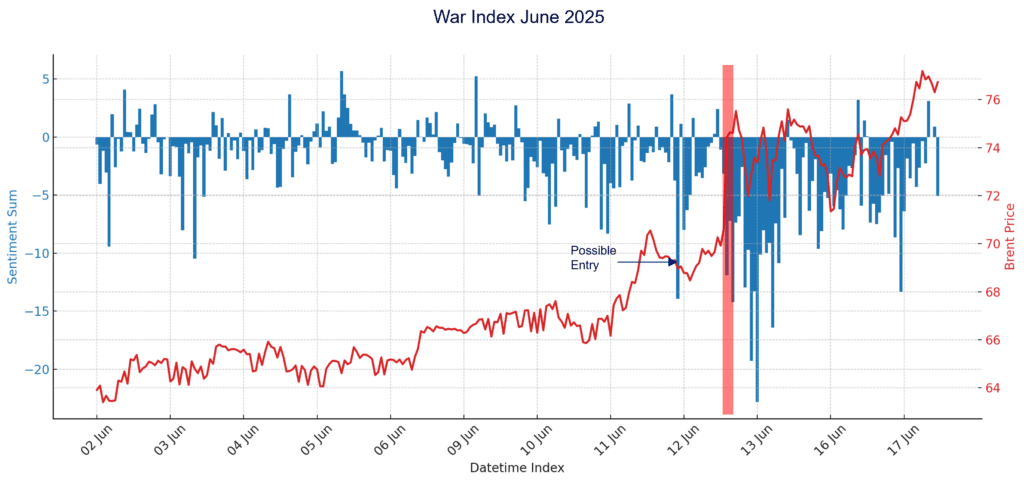
Above: Our War Index revealed how geopolitical tensions in June 2025 drove Brent crude higher, pinpointing possible entry opportunities as conflict-related sentiment translated directly into market volatility.
The future of AI-driven geopolitical analysis
Looking forward, we are expanding our world events datasets and continually refining our macro models to act as early warning systems. By training on historical patterns of sentiment escalation and policy responses, we are building predictive capabilities that help clients prepare for volatility before it hits the headlines. In 2025, and on into 2026. conflicts will remain central to global market dynamics. Understanding what wars are happening now is only the first step. The real advantage lies in anticipating how these conflicts shape commodities, currencies, equities, and investor sentiment.
At Permutable, our geopolitical feeds and Trading Co-Pilot give institutional traders, asset managers, and corporates the clarity they need to navigate volatility with confidence.
Contact us at enquiries@permutable.ai to see how our intelligence platform can support your strategy.
FAQ
Q: Why are wars and conflicts important to financial markets?
A: Wars and conflicts disrupt supply chains, drive energy and commodity price volatility, and shift investor sentiment. In 2025, conflicts in regions such as the Middle East, Eastern Europe, and Africa remain central to market risk, influencing energy markets, agricultural and metal commodities.
Q: How does Permutable AI track wars and geopolitical risks?
A: We use large-scale AI-driven sentiment analysis to process millions of global news articles daily. The data is distilled into our War Index and Political Tension Index, which track sentiment intensity and link geopolitical risks directly to asset classes.
Q: What is the Permutable AI’s Trading Co-Pilot?
A: The Trading Co-Pilot is our real-time intelligence platform that translates geopolitical sentiment into trading scenarios. It provides base, bullish, and bearish cases across multiple time horizons, helping traders anticipate volatility before it impacts markets.
Q: Can AI predict geopolitical risk?
A: While no model can forecast conflicts with certainty, our AI identifies early signals of sentiment escalation and policy shifts. By learning from historical patterns, our models act as an early warning system for institutional traders and risk managers.
Q: Who uses Permutable AI’s geopolitical feeds?
A: Institutional quantitative and systematic traders, asset managers, investment banks, and corporates use our geopolitical feeds to understand how wars and political tensions affect commodities, currencies, equities, and investor sentiment.
People Also Ask
How do wars affect commodity prices and energy markets?
Wars create supply disruptions, increase risk premiums, and drive volatility in commodities such as crude oil, natural gas, wheat, and metals. For example, drone strikes or shipping blockages can trigger sharp moves in oil and LNG, even when underlying supply remains strong.
What is a geopolitical risk index?
A geopolitical risk index measures sentiment and risk signals from news and data relating to wars, sanctions, and political instability. Permutable AI’s War Index and Political Tension Index capture these signals in real time, linking them directly to market outcomes.
Why is geopolitical sentiment analysis important for traders?
Geopolitical sentiment analysis allows traders to anticipate how conflicts will influence asset classes. By mapping war-related sentiment into trading signals, Permutable AI’s Trading Co-Pilot helps identify bullish or bearish scenarios for commodities, FX, and equities before markets fully price them in.