UK housing market: how sentiment saw Britain’s housing slowdown coming

In this insight, we explore the story surrounding the slowdown in the UK housing market through the lens of sentiment, looking at the sequence and timing of events and how the Global Macro Sentiment Indices (GMSI) could have seen it coming early. Housing is where much of Britain’s household wealth, debt and confidence is concentrated. It is also slow to report on itself. Mortgage approvals arrive after the decisions they record, and completed-sale house price indices arrive later still. By the time the evidence is formally assembled, the market may already have moved on. Point in time sentiment captures the narrative while it is forming, allowing us to get a real time read on how the story has unfolded in 2026 and where it is still running ahead of the numbers.

A shock that travelled from energy to the front door
UK housing market: inflation to prices

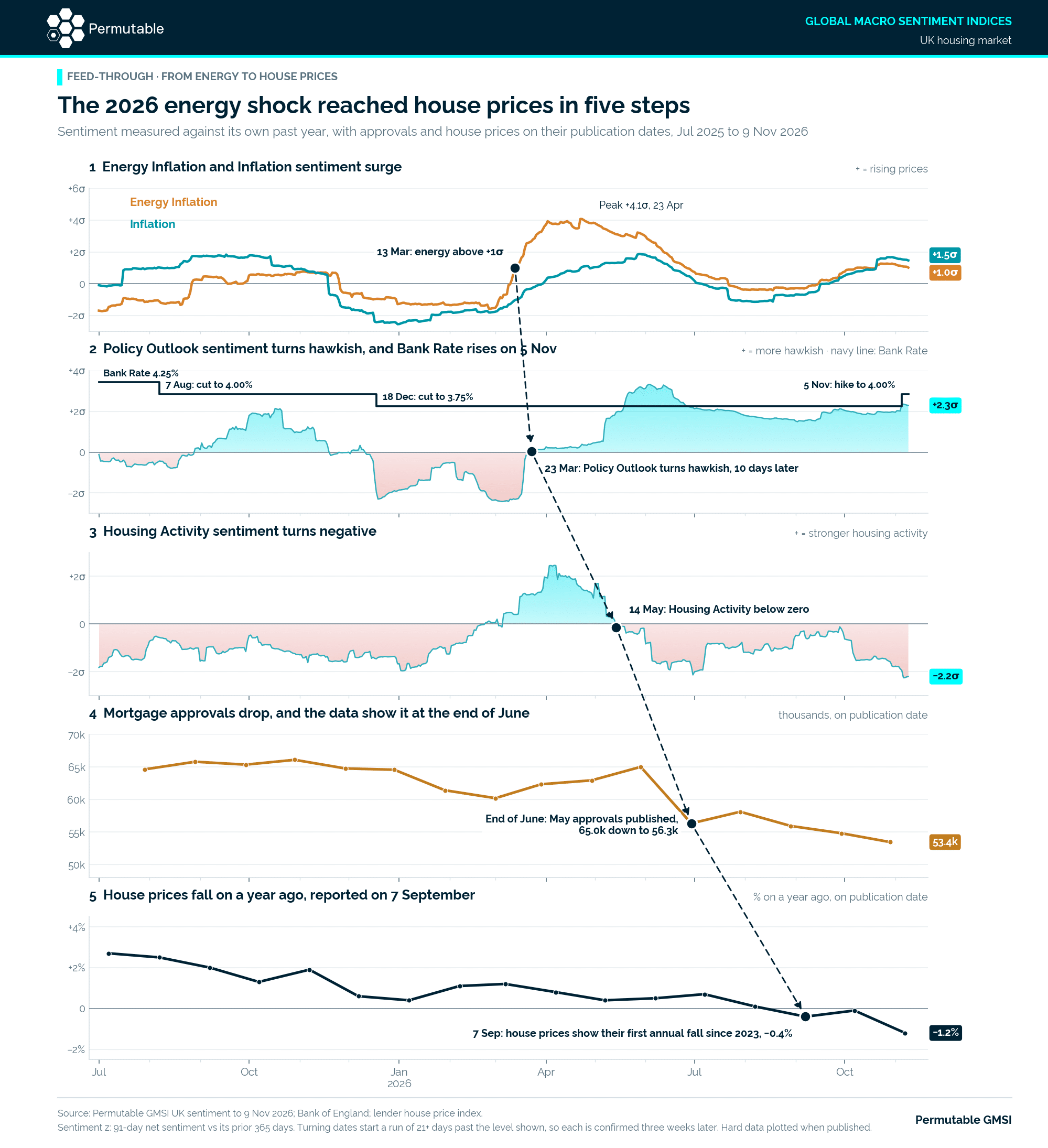
The sequence began, with the price of energy. In mid-March, Energy Inflation sentiment, which rises when the narrative points to higher energy prices, began a surge that would carry it to its strongest reading since the autumn of 2021, following the US-Iran conflict. Broader Inflation sentiment followed at a more measured pace, as the rise in energy costs worked its way into the wider price outlook.

The policy outlook responded swiftly. In early March, Policy Outlook sentiment, which reads positive when expectations turn more hawkish, was firmly negative, and the market still anticipated further easing after December’s cut. Within ten days of the energy shock it had crossed into hawkish territory, and it has stayed there ever since. Bank Rate itself did not move until November. For more than seven months, the narrative did the tightening on the Bank’s behalf.

Housing absorbed the blow for a time. Housing Activity sentiment, positive when the market points to stronger activity, enjoyed a buoyant spring before rolling over in mid-May, a turn that was confirmed in early June. At that moment the official record still looked reassuring, with the latest mortgage approvals at their strongest level of the year. The numbers then caught up in sequence what the sentiment had already seen coming. The fall in approvals was published at the end of June, around a month later, and the first annual decline in house prices since 2023 was reported in early September, roughly a quarter later. By the time the slowdown was formally on the record, the sentiment had long since confirmed the market backdrop.

Turning market narratives into a measurable signal
UK housing market - sentiment vs leading indicator

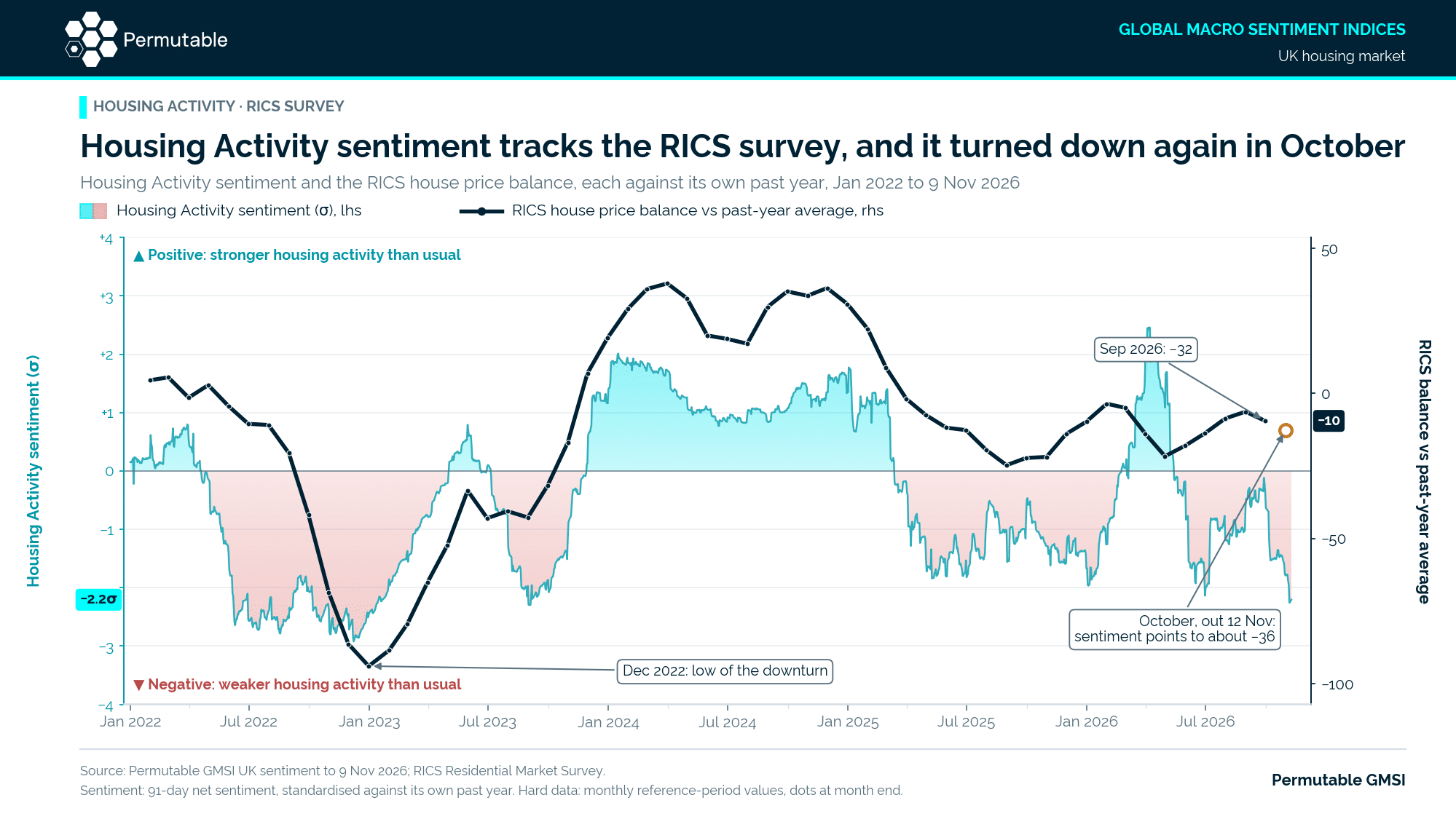
A narrative is only valuable if it measures something real, and the evidence here proves the point. Over the past decade, Housing Activity sentiment has moved in close step with the RICS monthly survey, the leading read of the market, and with Bank of England mortgage approvals. Since 2022 it has called the direction of approvals in around three months out of four, typically a month before the official figure is published.

Housing Activity sentiment fell sharply through the month and now stands at its weakest since September 2023, which points to a further deterioration in the RICS price balance, from −32 in September to around −36 when forecast using sentiment, when the survey is released on 12 November. The Budget offered no reprieve. Housing Activity sentiment continued to slide after the Chancellor’s support for first-time buyers on 28 October, while Interest Rates sentiment climbed into the Bank’s first rate rise since 2023. Help with a deposit, it seems, is of limited comfort while the cost of servicing the loan continues to rise.

The squeeze moves from buyers to renters
UK housing market - buyers to renters

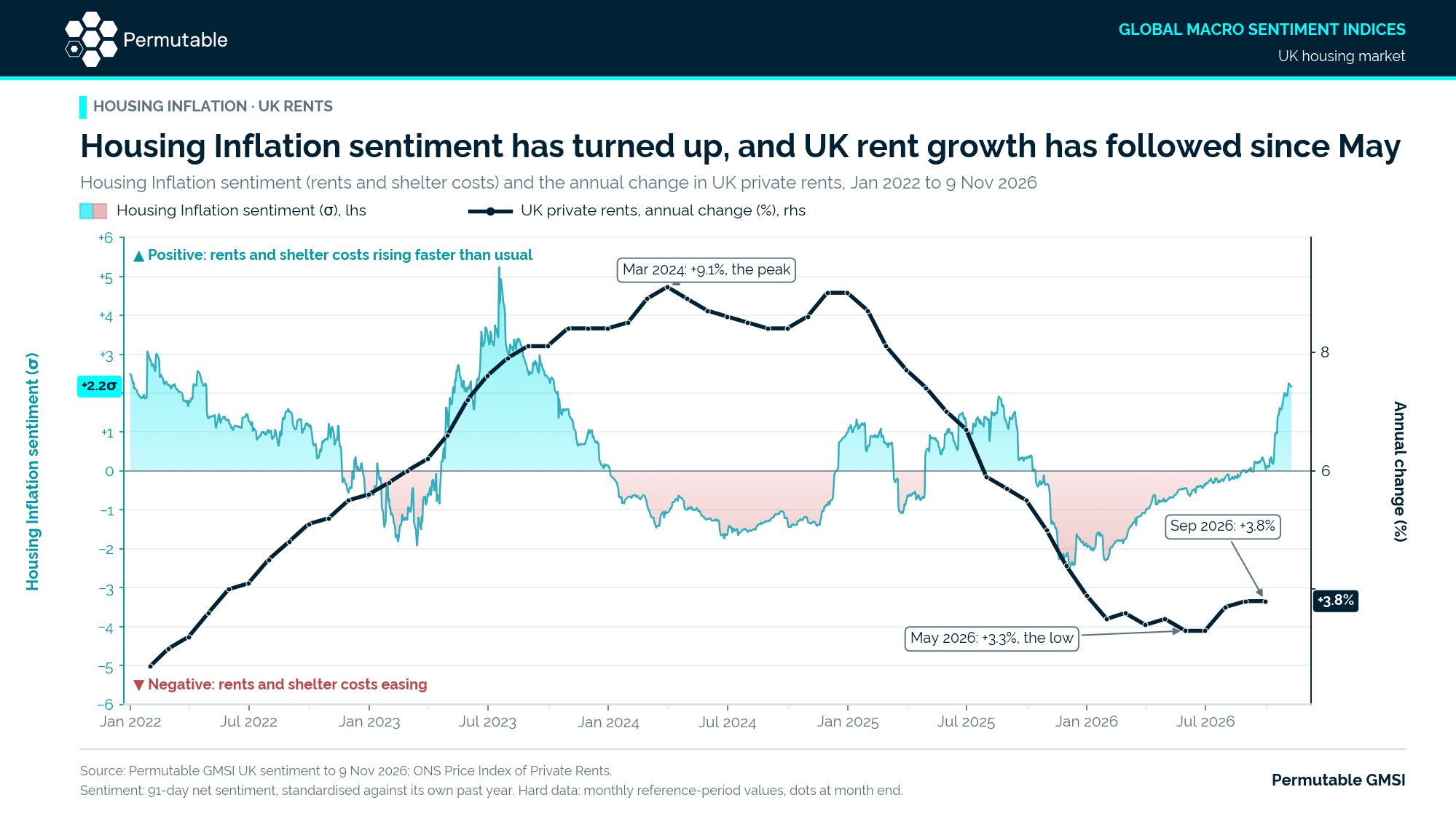
A slowdown in the UK housing market has not delivered more affordable housing options. With typical two-year fixed mortgage rates nearing 6%, and the monthly repayment on an average home rising almost entirely because of borrowing costs, many would-be buyers have chosen to remain tenants. Housing Inflation sentiment, which tracks the rents and shelter costs that households face and rises when those costs are climbing, has swung from deeply negative at the start of the year to firmly positive. Official rent growth turned in tandem in May, after more than two years of moderation.

This is the less advertised consequence of a rate-driven slowdown. Would-be buyers can wait for better terms, but tenants cannot defer the rent. With a further rise in tax on rental income due from next April, the supply of rented homes faces additional pressure just as demand for them strengthens.

Turning noise into conviction

The value of the GMSI in this case study lies not in a single reading, but in the ability to construct multiple indices that connect the story. Energy, policy, rates, housing and rents were measured systematically, using the same method every day, with each interpreted in its own economic direction. This produces an orthogonal view of the economy, built from the narratives shaping market expectations rather than the prices and activity eventually recorded in official statistics. It turns the noise of daily market chatter into a sequence of regime shifts that could be followed from one theme to the next, and into a signal clear enough to support conviction rather than speculation. That matters well beyond housing. The same narratives shape growth and inflation expectations, guide the path of policy rates and set the risk premium on sterling assets. Tracking them live places analysts at the forefront of the economic pulse, rather than in the queue for the next official release.

What comes next

The latest GMSI readings offer little prospect of near-term relief for the UK housing market. Policy Outlook and Interest Rates sentiment remain firmly hawkish, while Housing Activity sentiment has fallen to its weakest level in more than three years. Housing Inflation sentiment, meanwhile, continues to rise, suggesting that weaker activity has yet to ease concerns over housing costs.

That combination points to softer survey data arriving this week, a further decline in mortgage approvals when the October figures are published in early December, and continued firmness in rents into the new year. The first genuine sign of relief is most likely to come from the Policy Outlook sentiment. A sustained turn away from hawkish expectations would ease mortgage pricing, and on the evidence of 2026, the GMSI would register that shift well before the housing data does.

Explore the data behind the analysis
Permutable macro data catalogue banner

Want to monitor where the next turn in UK housing market appears next? Explore Permutable’s Global Macro Sentiment Indices in our Data Discovery catalogue to find datasets for tracking the UK policy outlook, housing activity and inflation by subtopic in your own research.

Explore data catalogue

Real-time data intelligence use cases of our datasets in 2024

To say that real-time data intelligence has become the buzzword of the day is one of the biggest understatements of today’s global business ecosystem. The reality is that real-time data intelligence is no longer a mere luxury; but an outright necessity. For businesses looking to stay ahead of the curve, understanding the broader economic landscape, anticipating market shifts, and making informed decisions has never been so important. They are, in fact, the key to success.  This is something we are very well versed on at Permutable AI – our real-time data intelligence tools equip organisations with hugely powerful insights needed to navigate the complexities of the global market. In this article here, we will delve into the transformative uses of our real-time data intelligence across several critical aspects: Macro datasets, World events, company Intelligence, and supply Chain Intelligence.

MACRO DATASETS

Understanding macroeconomic trends is fundamental for any business looking to make strategic decisions. Our Macro datasets offer powerful insights into global economic indicators, geopolitical events, and policy developments. These datasets provide a macro-level perspective, enabling businesses to anticipate market movements and adjust strategies accordingly.

Imagine having the ability to access real-time and historical data on key economic indicators such as GDP growth rates, inflation, and employment figures? This is the level of insight our Macro datasets offer, giving businesses the edge they need to stay ahead of economic cycles and make informed decisions with confidence. What we’ve found is that by analysing trends in consumer spending and inflation, companies can better forecast demand and adjust their production or investment strategies. The keys to successful macroeconomic analysis lie in the depth and accuracy of the data, all of which suggests a more nuanced understanding of market dynamics.

Our Macro datasets include analysis of geopolitical events and policy changes, providing businesses with a deeper understanding of the factors influencing market dynamics (more on that below). This might be a trade policy shift, a major election, or a geopolitical conflict. In each instance, having access to this information helps businesses navigate uncertainties and seize opportunities. Much of that is due to the real-time nature of our award-winning data which is refreshed half hourly, allowing for immediate adjustments to strategies with the very latest, up-to-date data. 

WORLD EVENTS

The impact of world events on global markets and economies in an increasingly volatile world cannot be overstated. Think about the impact of extreme weather events and pandemics, or wars and economic shifts. They are often seismic. Thus, staying informed about these developments is crucial for businesses. Our real-time data intelligence tools offer unparalleled insights into these critical world events, helping businesses understand their potential impact and plan accordingly.

For example, our platform provides comprehensive coverage of central bank policies and monetary decisions. Understanding the implications of stimulus packages, interest rate changes, and quantitative easing measures allows businesses to anticipate shifts in financial markets and adjust their strategies proactively. We can expect significant market movements based on these policies, and yet perhaps the subtler impacts often go unnoticed without such detailed analysis.

Insights into economic data such as housing trends, inflation rates, and consumer spending patterns are vital for businesses across various sectors. By keeping abreast of these developments, companies can make data-driven decisions that align with current economic conditions. Despite this, it’s important to continuously update and verify the data to maintain accuracy.

COMPANY INTELLIGENCE

In the competitive business landscape, having access to real-time company intelligence is a game-changer. Our platform provides detailed information and analysis on companies worldwide, covering aspects such as business performance, environmental, social, and governance (ESG) factors, net zero targets, and competitive positioning.

In a world of corporate smokescreens, it can often be hard to decipher what is actually going on. But here’s the bottom line. The key is to understand a company’s financial health is actually to track its ESG initiatives, and comprehend its market position in real-time through this particular lens. This level of intelligence is invaluable for strategic planning and investment decisions. Investors can use this data to identify companies with strong ESG commitments, aligning their investments with sustainability goals. Increasingly, businesses are prioritising ESG factors, making this data critical for informed decision-making.

Quite simply, our company intelligence tools enable businesses to monitor competitors, identify potential partners, and explore new market opportunities. By leveraging data-driven insights, companies can make informed decisions that drive growth and innovation. Just as notably, understanding the competitive landscape helps in positioning and strategic initiatives.

GEOPOLITICAL RISK INTELLIGENCE

Geopolitical tensions have never been so high, which means that understanding and anticipating risks has become essential for businesses operating on a global scale. Our Geopolitical Risk Intelligence tools provide detailed insights into the complex landscape of international relations, political instability, and global events that can impact markets and business operations.

Our platform continuously monitors global developments, offering real-time updates on significant geopolitical events such as elections, conflicts, and policy changes. What we’ve found is that this level of awareness allows businesses to proactively manage risks, ensuring they can respond swiftly to emerging threats. For instance, the loss of trust in government institutions during political crises can have far-reaching implications for market stability and investor confidence.

Our tools use advanced algorithms to analyse news articles, and government reports, providing a comprehensive view of the geopolitical environment in real-time, but also providing a look back at historical trends. This valuable method can be applied to all sectors, from finance to manufacturing, helping businesses make informed decisions that safeguard their interests. Just as notably, our geopolitical intelligence can support strategic planning, enabling companies to navigate uncertainties with confidence and resilience.

SUPPLY CHAIN INTELLIGENCE

One thing we have learnt all too well in recent years is that supply chains are the backbone of global trade. As a result, their efficient management is critical for business success. Our Supply Chain Intelligence tools provide comprehensive visibility into supply chain networks, helping businesses identify potential risks and implement proactive management strategies.

Through supply chain network analysis and adverse data tracking, our platform enhances the transparency of supply chain operations. Businesses can monitor supplier performance, track disruptions, and assess the impact of external factors such as geopolitical events or natural disasters on their supply chains. The crisis in various regions often highlights the fragility of supply chains, underscoring the importance of robust risk management.

If a key supplier is located in a region prone to political instability, our tools can provide early warnings and suggest alternative sources. This method applies to both local and international suppliers, ensuring continuity of operations. This level of insight enables businesses to mitigate risks, avoid disruptions, and maintain the continuity of their operations.

CONCLUSION

Real-time data intelligence is indispensable for businesses looking to thrive in a dynamic global environment. At Permutable AI, our suite of intelligence tools—spanning Macro Datasets, World Events, Company Intelligence, and Supply Chain Intelligence—empowers businesses to make informed, strategic decisions. By leveraging our comprehensive big data analytics, businesses can navigate uncertainties, seize opportunities, and drive sustainable growth.

Whether you’re looking to gain macro-level insights, stay ahead of global developments, make informed business decisions, or enhance supply chain transparency, Permutable AI has the tools and expertise to support your goals. Explore our solutions today and take the first step towards a more informed and resilient future.


REQUEST FREE TRIAL