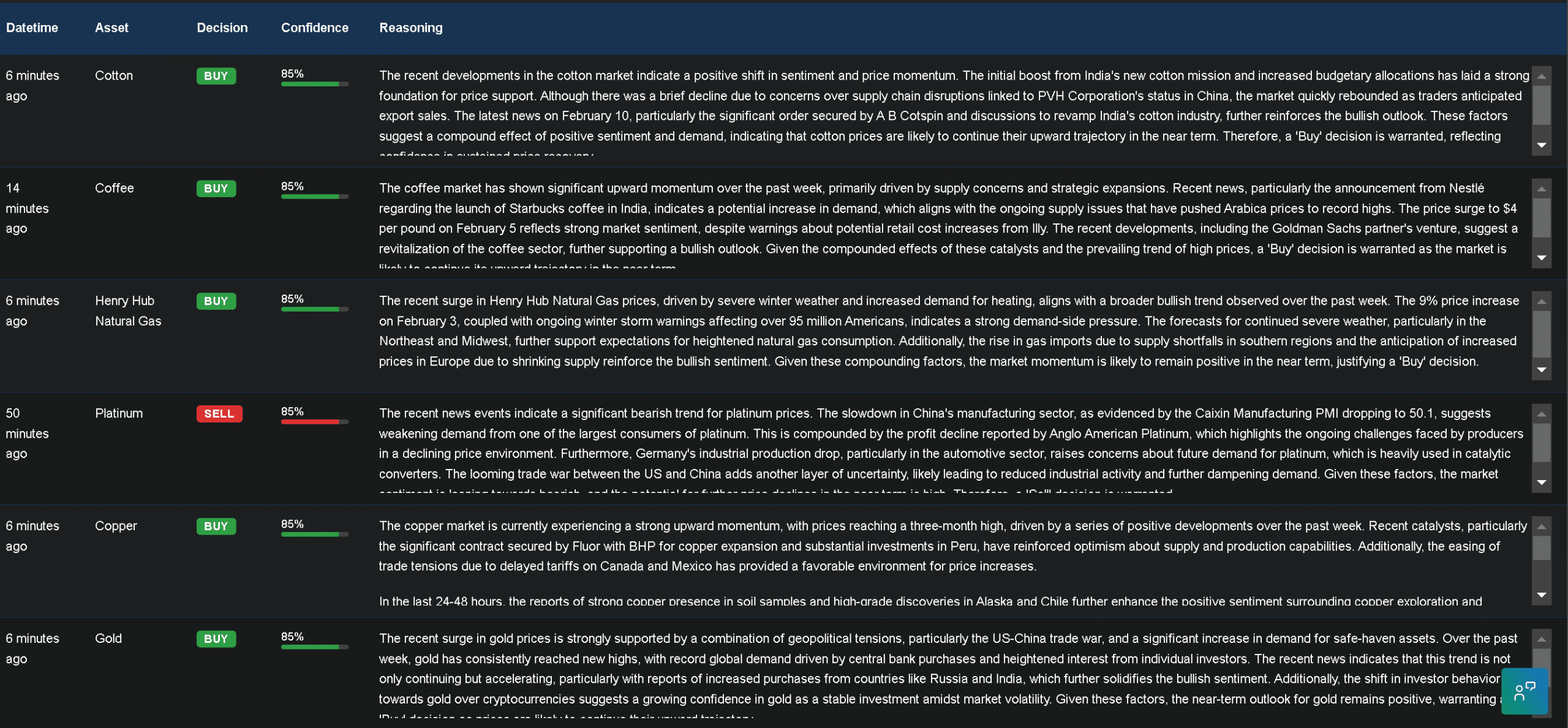
This article explores how heightened commodity market volatility over the last six months is reshaping modern hedging strategies. It examines the growing role of AI-driven market intelligence, real-time news analysis, geopolitical risk monitoring, and event impact assessment in commodity trading. Aimed at commodity traders, risk managers, hedge teams, energy firms, and institutional market participants navigating increasingly complex global markets.
2026 update: Over the past six months, commodity markets have entered one of their most volatile periods in recent years. Oil markets have swung sharply on shifting expectations around OPEC+ production cuts, shipping disruption, and renewed geopolitical tensions across the Middle East. Natural gas markets have remained highly reactive to weather uncertainty, LNG supply concerns, and fluctuating industrial demand. Meanwhile, gold has repeatedly surged to record highs amid persistent inflation concerns, central bank buying, and uncertainty surrounding global monetary policy.
The result is a market environment where traditional hedging strategies built primarily on historical pricing behaviour are increasingly struggling to keep pace with rapidly evolving macroeconomic and geopolitical developments. In this new landscape, real-time market intelligence has become increasingly powerful.
Rather than reacting to volatility after it appears in price action, commodity traders and hedging teams are now seeking ways to identify emerging market stress earlier – before volatility becomes fully reflected across futures curves and cross-asset correlations.
This is where AI-driven real-time market intelligence is beginning to fundamentally reshape commodity hedging.
Commodity markets are now reacting to global events with unprecedented speed. Over the last six months alone, markets have been repeatedly repriced by:
What makes this environment particularly challenging is that volatility is no longer driven solely by supply and demand fundamentals. Instead, markets increasingly move on rapidly evolving narratives and changing macro expectations.
This creates a major challenge for commodity hedging strategies that rely too heavily on delayed analysis or static models.
Our Trading Co-Pilot intelligence layer addresses this challenge by continuously analysing global news flow, macroeconomic developments, and market-moving events in real time. By processing vast quantities of structured and unstructured market information simultaneously, the platform helps identify emerging volatility drivers before they fully materialise in price behaviour.
The past six months have demonstrated how quickly commodity markets can reprice. Brent crude oil has experienced sharp swings driven by conflicting expectations around demand destruction and supply tightening. European gas markets have remained vulnerable to storage concerns and geopolitical uncertainty. Agricultural commodities have reacted aggressively to extreme weather events and export restrictions. Precious metals have surged amid rising expectations of monetary easing and broader market instability.
In many cases, markets have moved before traditional indicators have had time to adjust. This has exposed a growing weakness in conventional hedging approaches that depend primarily on historical correlations, lagging economic indicators, or delayed discretionary analysis.
Modern commodity markets require continuous monitoring of geopolitical developments, cross-market contagion, macroeconomic regime shifts and event-driven volatility. Here, AI-driven market intelligence allows traders and risk teams to process these signals at scale and in real time.
When commodity markets react within seconds to breaking developments, the ability to process news flow rapidly becomes a significant competitive advantage. Our Trading Co-Pilot intelligence layer analyses thousands of global news sources simultaneously, identifying developments with potential market impact across energy, metals, agriculture, and macro markets.
This includes:
The advantage of AI-driven analysis is not simply speed. It is the ability to continuously connect seemingly unrelated developments across regions and asset classes. Over the last six months, this has become increasingly important as commodity volatility has become deeply interconnected with broader macroeconomic sentiment and global political risk.
Periods of heightened volatility often reveal important shifts in market behaviour. Modern AI systems can now analyse trading activity with far greater granularity than was previously possible, identifying changes in positioning, volatility regimes, and behavioural patterns across markets. This becomes especially valuable during periods of uncertainty when historical relationships begin to break down.
The last six months have repeatedly demonstrated how quickly sentiment and positioning can reverse across commodity markets. Sharp repositioning by institutional traders, sudden changes in volatility expectations, and rapid reactions to geopolitical headlines have all contributed to increasingly unstable market conditions.
AI-powered trading pattern analysis helps commodity hedgers better understand how market participants are reacting in real time, enabling more adaptive hedge positioning and improved risk management.
One of the defining features of the current commodity environment is the increasing fragmentation of global markets. Regional political tensions, diverging economic outlooks, and shifting trade relationships are creating increasingly localised market reactions.
Energy markets, for example, are no longer responding purely to global supply-demand balances. Instead, regional infrastructure constraints, sanctions, shipping risks, and geopolitical alliances are playing a growing role in price formation. This creates both risks and opportunities for commodity hedging.
AI systems capable of analysing regional developments and geographic risk patterns can provide significantly greater visibility into how local disruptions may influence broader global pricing dynamics. In today’s market, understanding regional divergence has become just as important as understanding global fundamentals.
Perhaps the biggest shift in commodity markets over the past six months has been the acceleration of event-driven volatility. Markets now react almost instantly to geopolitical tensions, policy announcements, inflation data as well as central bank decisions, shipping disruptions and supply chain events.
This means that effective hedging increasingly depends on the ability to assess market impact in real time. Our Trading Co-Pilot intelligence layer continuously analyses evolving events as they unfold, helping traders and risk teams understand how specific developments may affect commodity prices, volatility, and market correlations.
Rather than relying solely on historical precedent, AI-driven systems can dynamically evaluate changing market conditions and provide earlier warning signals during periods of heightened uncertainty.
The past six months have highlighted a structural shift in commodity markets. Volatility is becoming more persistent, geopolitical risk is becoming more influential, and macroeconomic uncertainty is increasingly driving short-term market behaviour.
As a result, commodity hedging is evolving beyond traditional price-based models toward more adaptive, intelligence-driven approaches. Here, AI-driven market intelligence is no longer simply an enhancement to commodity trading workflows. Increasingly, it is becoming a core requirement for navigating modern markets effectively.
Organisations that combine disciplined risk management with real-time market intelligence will likely be best positioned to respond to increasingly complex commodity market conditions in the years ahead.
Discover how our intelligence helps commodity traders and risk teams navigate volatile markets with real-time macro and market intelligence. Our platform continuously analyses global news flow, geopolitical developments, macroeconomic shifts, and market-moving events to help identify emerging risks and trading opportunities earlier.
With cross-asset intelligence, real-time event impact analysis, and AI-driven market monitoring, our enterprise solution is designed to support faster, more informed hedging decisions in rapidly changing commodity markets.
Contact the team at enquiries@permutable.ai or request a personalised demo to see how AI-driven market intelligence can strengthen your commodity hedging strategy.
AI-driven market intelligence uses artificial intelligence to analyse global news flow, macroeconomic developments, geopolitical events, and trading activity in real time to help traders identify emerging risks and opportunities faster.
Commodity markets have experienced increased volatility due to geopolitical tensions, inflation uncertainty, changing central bank policy expectations, supply chain disruption, shipping risks, and fluctuating global demand.
AI can improve hedging strategies by helping traders monitor market-moving events in real time, identify volatility drivers earlier, detect changing market behaviour, and respond more quickly to rapidly evolving conditions.
Energy markets such as crude oil and natural gas have been particularly sensitive to geopolitical developments, although metals, agricultural commodities, and precious metals have also experienced heightened volatility.
Real-time event impact analysis uses AI systems to assess how breaking news, economic releases, policy announcements, and geopolitical developments may affect commodity prices and market volatility as events unfold.
AI-powered commodity intelligence platforms are designed for commodity traders, hedge funds, energy firms, procurement teams, risk managers, institutional investors, and trading houses seeking faster and more informed market decision-making.
Traditional models often rely heavily on historical price behaviour and lagging indicators, making them less effective during periods of rapid geopolitical change and event-driven market volatility.
Permutable’s intelligence helps traders monitor global markets in real time through AI-driven analysis of macroeconomic developments, geopolitical events, news flow, and cross-asset market intelligence to support faster trading and hedging decisions.