Commodity hedging: How AI-driven intelligence is improving risk management

This article explores how heightened commodity market volatility over the last six months is reshaping modern hedging strategies. It examines the growing role of AI-driven market intelligence, real-time news analysis, geopolitical risk monitoring, and event impact assessment in commodity trading. Aimed at commodity traders, risk managers, hedge teams, energy firms, and institutional market participants navigating increasingly complex global markets. 

2026 update: Over the past six months, commodity markets have entered one of their most volatile periods in recent years. Oil markets have swung sharply on shifting expectations around OPEC+ production cuts, shipping disruption, and renewed geopolitical tensions across the Middle East. Natural gas markets have remained highly reactive to weather uncertainty, LNG supply concerns, and fluctuating industrial demand. Meanwhile, gold has repeatedly surged to record highs amid persistent inflation concerns, central bank buying, and uncertainty surrounding global monetary policy.

The result is a market environment where traditional hedging strategies built primarily on historical pricing behaviour are increasingly struggling to keep pace with rapidly evolving macroeconomic and geopolitical developments. In this new landscape, real-time market intelligence has become increasingly powerful.

Rather than reacting to volatility after it appears in price action, commodity traders and hedging teams are now seeking ways to identify emerging market stress earlier – before volatility becomes fully reflected across futures curves and cross-asset correlations.

This is where AI-driven real-time market intelligence is beginning to fundamentally reshape commodity hedging.

The rise of event-driven commodity markets

Commodity markets are now reacting to global events with unprecedented speed. Over the last six months alone, markets have been repeatedly repriced by:

  • escalating geopolitical tensions
  • changing tariff expectations
  • shipping and logistics disruption
  • central bank commentary
  • inflation surprises
  • energy supply uncertainty
  • and shifting demand forecasts from China and the US

What makes this environment particularly challenging is that volatility is no longer driven solely by supply and demand fundamentals. Instead, markets increasingly move on rapidly evolving narratives and changing macro expectations.

This creates a major challenge for commodity hedging strategies that rely too heavily on delayed analysis or static models.

Our Trading Co-Pilot intelligence layer addresses this challenge by continuously analysing global news flow, macroeconomic developments, and market-moving events in real time. By processing vast quantities of structured and unstructured market information simultaneously, the platform helps identify emerging volatility drivers before they fully materialise in price behaviour.

Why traditional hedging models are under pressure

The past six months have demonstrated how quickly commodity markets can reprice. Brent crude oil has experienced sharp swings driven by conflicting expectations around demand destruction and supply tightening. European gas markets have remained vulnerable to storage concerns and geopolitical uncertainty. Agricultural commodities have reacted aggressively to extreme weather events and export restrictions. Precious metals have surged amid rising expectations of monetary easing and broader market instability.

In many cases, markets have moved before traditional indicators have had time to adjust. This has exposed a growing weakness in conventional hedging approaches that depend primarily on historical correlations, lagging economic indicators, or delayed discretionary analysis.

Modern commodity markets require continuous monitoring of geopolitical developments, cross-market contagion, macroeconomic regime shifts and event-driven volatility. Here, AI-driven market intelligence allows traders and risk teams to process these signals at scale and in real time.

Real-time news flow analysis and market impact

When commodity markets react within seconds to breaking developments, the ability to process news flow rapidly becomes a significant competitive advantage. Our Trading Co-Pilot intelligence layer analyses thousands of global news sources simultaneously, identifying developments with potential market impact across energy, metals, agriculture, and macro markets.

This includes:

  • geopolitical escalation
  • sanctions and export restrictions
  • central bank policy developments
  • shipping disruption
  • inventory data
  • weather-related risks
  • and macroeconomic releases

The advantage of AI-driven analysis is not simply speed. It is the ability to continuously connect seemingly unrelated developments across regions and asset classes. Over the last six months, this has become increasingly important as commodity volatility has become deeply interconnected with broader macroeconomic sentiment and global political risk.

Trading pattern recognition in volatile markets

Periods of heightened volatility often reveal important shifts in market behaviour. Modern AI systems can now analyse trading activity with far greater granularity than was previously possible, identifying changes in positioning, volatility regimes, and behavioural patterns across markets. This becomes especially valuable during periods of uncertainty when historical relationships begin to break down.

The last six months have repeatedly demonstrated how quickly sentiment and positioning can reverse across commodity markets. Sharp repositioning by institutional traders, sudden changes in volatility expectations, and rapid reactions to geopolitical headlines have all contributed to increasingly unstable market conditions.

AI-powered trading pattern analysis helps commodity hedgers better understand how market participants are reacting in real time, enabling more adaptive hedge positioning and improved risk management.

Geographic risk and regional market fragmentation

One of the defining features of the current commodity environment is the increasing fragmentation of global markets. Regional political tensions, diverging economic outlooks, and shifting trade relationships are creating increasingly localised market reactions.

Energy markets, for example, are no longer responding purely to global supply-demand balances. Instead, regional infrastructure constraints, sanctions, shipping risks, and geopolitical alliances are playing a growing role in price formation. This creates both risks and opportunities for commodity hedging.

AI systems capable of analysing regional developments and geographic risk patterns can provide significantly greater visibility into how local disruptions may influence broader global pricing dynamics. In today’s market, understanding regional divergence has become just as important as understanding global fundamentals.

Real-time event impact assessment

Perhaps the biggest shift in commodity markets over the past six months has been the acceleration of event-driven volatility. Markets now react almost instantly to geopolitical tensions, policy announcements, inflation data as well as central bank decisions, shipping disruptions and supply chain events. 

This means that effective hedging increasingly depends on the ability to assess market impact in real time. Our Trading Co-Pilot intelligence layer continuously analyses evolving events as they unfold, helping traders and risk teams understand how specific developments may affect commodity prices, volatility, and market correlations.

Rather than relying solely on historical precedent, AI-driven systems can dynamically evaluate changing market conditions and provide earlier warning signals during periods of heightened uncertainty.

Looking ahead: the future of commodity hedging

The past six months have highlighted a structural shift in commodity markets. Volatility is becoming more persistent, geopolitical risk is becoming more influential, and macroeconomic uncertainty is increasingly driving short-term market behaviour.

As a result, commodity hedging is evolving beyond traditional price-based models toward more adaptive, intelligence-driven approaches. Here, AI-driven market intelligence is no longer simply an enhancement to commodity trading workflows. Increasingly, it is becoming a core requirement for navigating modern markets effectively.

Organisations that combine disciplined risk management with real-time market intelligence will likely be best positioned to respond to increasingly complex commodity market conditions in the years ahead.

Enhance your commodity hedging with real-time market intelligence

Discover how our intelligence helps commodity traders and risk teams navigate volatile markets with real-time macro and market intelligence. Our platform continuously analyses global news flow, geopolitical developments, macroeconomic shifts, and market-moving events to help identify emerging risks and trading opportunities earlier.

With cross-asset intelligence, real-time event impact analysis, and AI-driven market monitoring, our enterprise solution is designed to support faster, more informed hedging decisions in rapidly changing commodity markets.

Contact the team at enquiries@permutable.ai or request a personalised demo to see how AI-driven market intelligence can strengthen your commodity hedging strategy.

Book a demo/request a free trial


What is AI-driven market intelligence in commodity trading?

AI-driven market intelligence uses artificial intelligence to analyse global news flow, macroeconomic developments, geopolitical events, and trading activity in real time to help traders identify emerging risks and opportunities faster.

Why has commodity market volatility increased recently?

Commodity markets have experienced increased volatility due to geopolitical tensions, inflation uncertainty, changing central bank policy expectations, supply chain disruption, shipping risks, and fluctuating global demand.

How can AI improve commodity hedging strategies?

AI can improve hedging strategies by helping traders monitor market-moving events in real time, identify volatility drivers earlier, detect changing market behaviour, and respond more quickly to rapidly evolving conditions.

Which commodity markets are most affected by geopolitical risk?

Energy markets such as crude oil and natural gas have been particularly sensitive to geopolitical developments, although metals, agricultural commodities, and precious metals have also experienced heightened volatility.

What is real-time event impact analysis?

Real-time event impact analysis uses AI systems to assess how breaking news, economic releases, policy announcements, and geopolitical developments may affect commodity prices and market volatility as events unfold.

Who should use AI-powered commodity intelligence platforms?

AI-powered commodity intelligence platforms are designed for commodity traders, hedge funds, energy firms, procurement teams, risk managers, institutional investors, and trading houses seeking faster and more informed market decision-making.

Why are traditional commodity hedging models under pressure?

Traditional models often rely heavily on historical price behaviour and lagging indicators, making them less effective during periods of rapid geopolitical change and event-driven market volatility.

How does Permutable’s intelligence support commodity traders?

Permutable’s intelligence helps traders monitor global markets in real time through AI-driven analysis of macroeconomic developments, geopolitical events, news flow, and cross-asset market intelligence to support faster trading and hedging decisions.

Commodity prices: Cross-asset analysis – mid-February 2025 outlook

As we move into mid February, the obvious pattern emerging across commodity markets is that of an intensifying impact of trade tensions and extreme weather events. There is no doubting that each commodity class is responding uniquely to these catalysts, creating a complex trading environment that demands sophisticated analysis. In this article, we take a look at the commodity prices outlook for this week, using analysis from our Trading Co-Pilot.

Energy markets 

Henry Hub natural gas

You can make the argument that this has been the most dramatic mover in terms of commodity prices, with a 9% surge on February 3rd reaching significant technical levels. The hardest part is distinguishing between weather-driven spikes and structural shifts. Severe winter storms across the Midwest and Northeast have created a significant uptick in energy demand, while critical supply shortfalls in southern regions reinforce bullish momentum. Current Henry Hub market dynamics suggest this strength could persist beyond the immediate weather impact. Regional supply constraints and increased demand for gas-fired power generation create a supportive backdrop for prices. The question is how long these conditions will maintain their influence over price action, particularly as we approach the shoulder season.

TTF natural gas

Then there is the challenge of European gas markets, where prices reflect multiple pressures. Slovakia’s increased imports and resumed Russian gas flows provided initial stability, but escalating Ukraine conflict creates persistent uncertainty. Critical gas needs in southern Ukraine add another layer of complexity to the supply picture. The market’s response to these developments has been notably volatile, with traders attempting to price in both immediate supply concerns and longer-term structural changes to European gas markets. Supply diversification efforts, including rare Australian shipments, indicate the market’s adaptation to new geopolitical realities.

Heating oil

Looking an the broader issue of commodity prices, one finds that the situation is little more complicated in heating oil markets, where tariffs on Canadian oil combine with extreme weather to drive prices higher. The fact that NYC landlords are switching to less clean heating oil due to high gas bills indicates a structural demand shift that could have lasting implications for the market. This transition in consumer behaviour, particularly in the Northeast, suggests a fundamental change in regional energy dynamics. The impact of tariffs extends beyond immediate price effects, potentially reshaping traditional supply routes and trading patterns. Storage levels and distribution challenges in key consumption areas add another layer of complexity to the current market structure.

Brent Crude

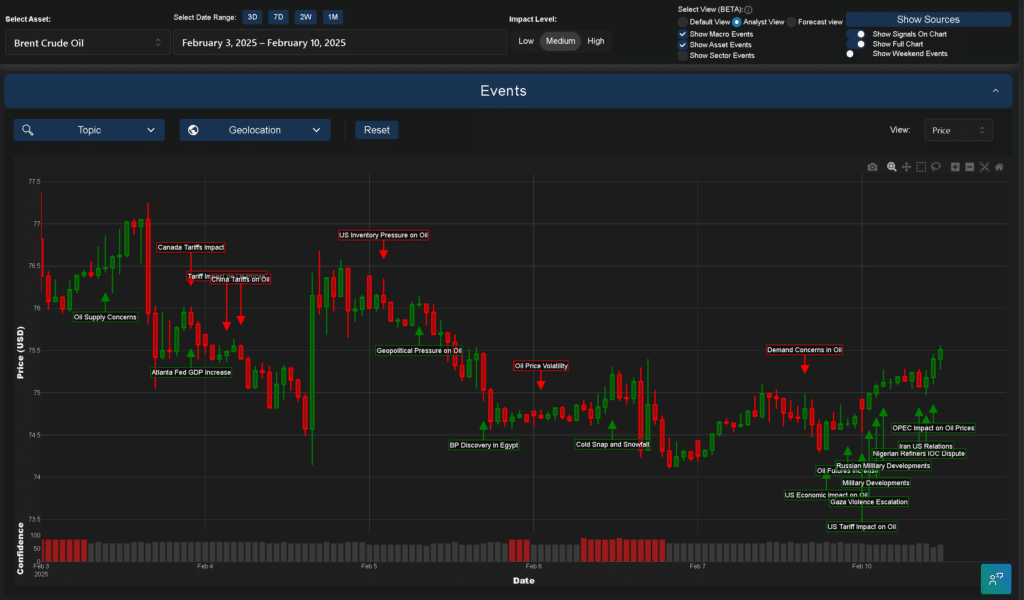
Of course,  recent cold snaps in the US have supported prices, countering earlier bearish sentiment. Meanwhile, ongoing military tensions in Ukraine and Middle East sanctions continue to influence supply concerns, despite rising inventories in key storage hubs. The market’s reaction to these conflicting signals has been notably measured, suggesting traders are carefully weighing immediate weather-driven demand against broader macroeconomic concerns. The interplay between OPEC+ output decisions and US inventory builds creates an additional dynamic that warrants close monitoring.
Metals market

Gold

The big recent news across commodity prices is that gold continues to see remarkable strength near $3,000. The game changer here has been combined monetary easing signals from central banks (RBI and BOE) alongside escalating geopolitical tensions. Safe-haven demand remains robust amid uncertain economic conditions. Technical analysis suggests the current price levels could establish new support zones, particularly if trade tensions escalate further. The correlation between gold prices and real yields continues to provide a helpful framework for understanding price movements, while physical demand from key Asian markets adds fundamental support.

Platinum

Here, we’re seeing the impact of China’s manufacturing slowdown (PMI at 50.1) combined with Anglo American Platinum’s profit decline. The automotive sector’s weakness, particularly in Germany, has created significant headwinds for demand, leading to the current bearish outlook. Supply-side dynamics, including potential production cuts and recycling rates, could provide some price support. However, the structural shift in automotive technology preferences continues to cast a shadow over longer-term demand prospects.

Palladium

The question here is whether positive US manufacturing data can offset European automotive weakness. This divergence in regional industrial activity creates a complex trading environment for a metal heavily dependent on automotive catalytic converter demand. Recent market behaviour suggests a delicate balance between supply constraints and demand concerns. While US economic resilience provides some support, the German industrial production drop signals potential weakness in a key consumption center. For now, the automotive sector’s ongoing transition toward electric vehicles adds another layer of uncertainty to longer-term demand projections.

Silver

Despite initial bullish signals from strong demand and positive drill results, inflation fears and trade tensions have created choppy trading conditions for silver. The metal’s dual role as both an industrial and precious metal continues to create complex price dynamics. While safe-haven demand provides some support during periods of market stress, industrial demand concerns and correlation with gold prices remain key drivers of market sentiment for silver.

Copper

While housing market recovery provides some support, trade tensions create significant uncertainty for copper. Recent price movements reflect the market’s struggle to balance positive economic indicators against rising geopolitical risks. The broader implications of Trump’s reciprocal tariffs could fundamentally alter trading patterns in industrial metals. Concurrently, infrastructure development plans in key economies remain a potential catalyst for demand growth, but uncertainty around implementation and timing keeps market sentiment cautious.
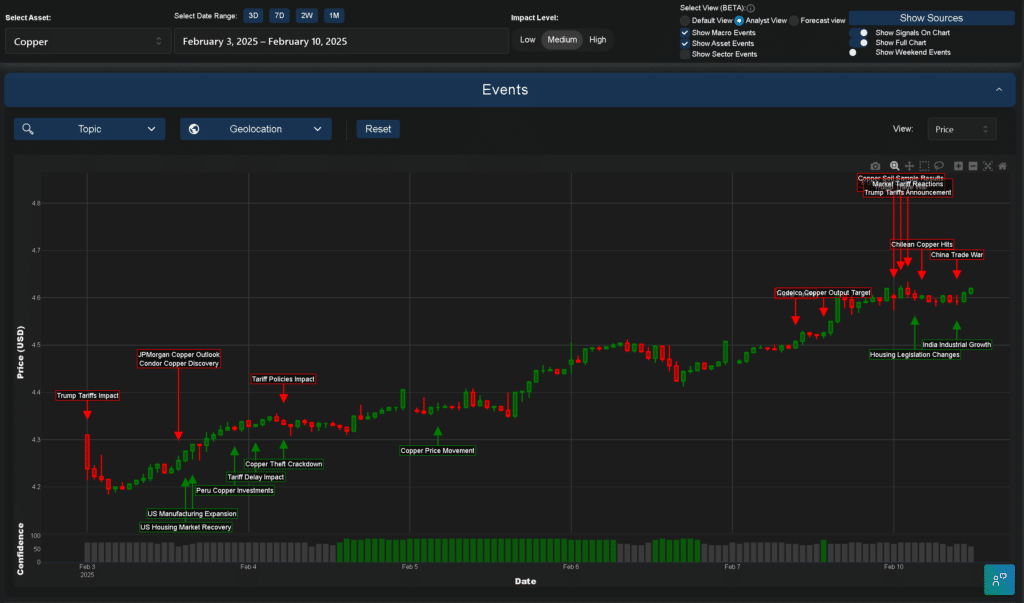
copper commodity prices feb 2025

Agricultural markets 

Wheat

Initial bullish momentum in wheat markets driven by severe weather disruptions – drought in Argentina and flooding in Australia – has given way to bearish sentiment as of February 10th, with Chinese tariffs and fears of US retaliation creating significant headwinds. Growing Canadian stocks and increased local production suggest ample supply, while forecasts of declining global imports add further pressure. This alignment of negative factors suggests continued downward pressure on wheat prices in the near term, despite earlier weather-related supply concerns. 

Coffee 

We live in an age of highly volatile geopolitics and commodity prices, with coffee prices have reached record highs driven by fundamental supply fears and severe weather impacts. Arabica’s recent price action reflects both immediate supply constraints and longer-term structural changes in production patterns. Nestlé’s Indian market expansion signals growing demand in emerging markets, while weather-related supply disruptions continue to support prices. The potential for further supply chain disruptions, particularly in key growing regions, suggests continued price strength in the near term.

Corn

The present outlook for corn reflects complex crosscurrents in both supply and demand. Argentina’s severe drought has tightened supply expectations, while Mexico’s decision to rescind its ban on U.S. biotech corn provides some positive sentiment for traders. However, the broader impact of trade tensions and potential new tariffs creates significant headwinds. Fund positioning indicates some market confidence, but recent declines in Chicago corn futures suggest traders remain cautious amid these conflicting signals.

Cotton

Cotton markets are facing multiple challenges from both weather events and trade tensions. Queensland flooding and California’s adverse weather conditions raise significant concerns about agricultural productivity and potential supply shortages. The market’s recent rally gave way to more cautious sentiment as traders assessed the implications of new U.S. tariffs on China. These developments raise broader concerns about inflation impacts and potential demand destruction in key consumption markets.

Sugar

The sugar market presents a particularly nuanced picture amid current volatility. Once again, severe flooding in Queensland and ongoing drought challenges in Argentina have raised serious concerns about agricultural output and potential supply disruptions. While temporary support came from reduced Indian production and improved realisations for sugar companies, the stronger US dollar and projections of a global surplus create counterbalancing pressures. Recent developments suggest potential for recovery, but weather concerns and mixed economic indicators maintain market uncertainty.

Milling wheat

Markets have now  pushed to four-month high levels amid severe flooding in North Queensland and ongoing Ukraine-Russia supply disruptions. The impact of these weather events on global supply chains has been particularly acute given the already strained market conditions. The announcement of retaliatory tariffs by China and Trump’s reciprocal measures adds another layer of complexity to traditional trading patterns. While some weakness emerged towards the end of the week, the overall trend remains bullish as markets continue to price in supply risks and shifting trade flows.

Soybeans

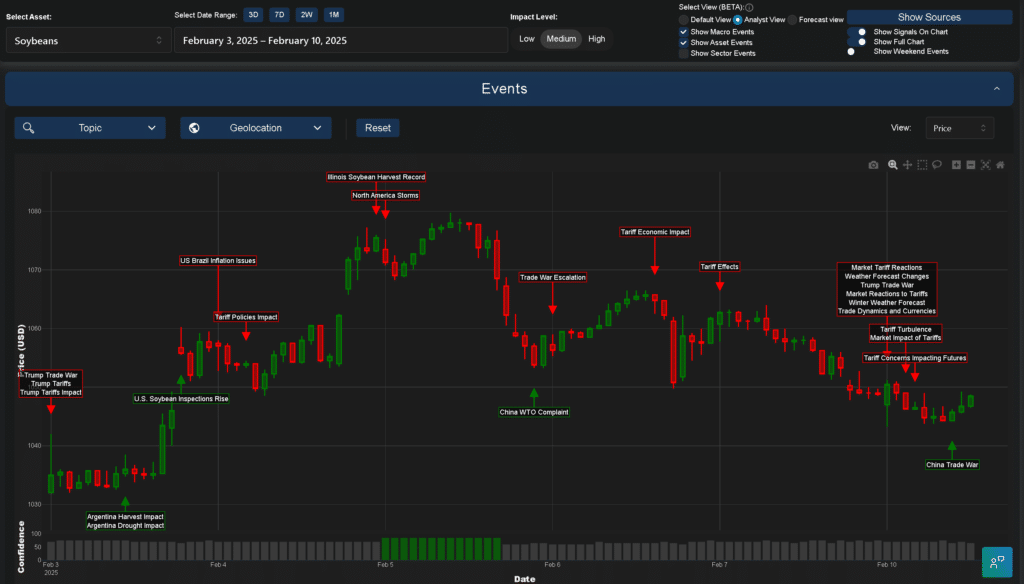
There are several areas where trade tensions impact is evident, none more so than soybeans. Recent tariff announcements have amplified bearish sentiment, with prices declining as traders anticipate further volatility and potential supply chain disruptions. This dovetails with weather-related concerns in Argentina and North America, creating a complex market dynamic. The combination of trade uncertainty and adverse weather conditions suggests continued pressure on prices, with particular attention needed on Chinese demand patterns and South American production levels.
Looking ahead on commodity prices 

If narratives shape politics, then current trade tensions suggest continued market volatility across commodity sectors. What this reveals is the increasing importance of real-time market intelligence in navigating these complex conditions. Commodity traders must remain vigilant to both immediate catalysts and longer-term structural shifts, particularly as weather patterns and geopolitical developments continue to drive price action.

The interconnectedness of commodity markets has never been more evident, with developments in one sector frequently creating spillover effects in others. Successful trading strategies will require careful monitoring of cross-commodity correlations by using tools like our Trading Co-Pilot and the ability to quickly adapt to changing market conditions.

Get ahead of commodity price movements

Our Trading Co-Pilot can enhance your commodity trading operations with real-time cross-asset insights. It works by analysing the complex interplay of weather events, trade policies, and supply chain dynamics as well as other market factors across energy, metals, and agricultural markets, helping you identify price movements before they emerge. Our enterprise solution offers real-time analysis of market-moving events, cross-commodity correlation insights, early warning signals for price movements, and comprehensive monitoring of supply chain announcements, weather impacts, and trade flows.

To arrange a demo or request a free enterprise trial get in touch with our team at enquiries@permutable.ai or simply fill in the form below to see how our AI-driven market intelligence can complement your existing trading strategies. We’re currently offering a 14-day trial for qualified institutional traders (subject to approval) to experience our next-generation market intelligence . Find out how it can start maximising your trading potential today.

Request demo/free trial

How proposed Trump Tariffs affect oil prices: Essential market analysis 2024/2025

There has been plenty of talk around how the proposed Trump Tariffs affect oil prices. So, first off, let’s start with the obvious – the Trump administration’s proposal of a 25% tariff on oil imports from Mexico and Canada presents a significant shift in North American energy relations. It’s clear that these proposed tariffs are going to be a wild card for the markets in 2025,  and insights from our Trading Co-Pilot news analysis reinforcing this view with clear volatility in response to this announcement, with cross-border flow analytics highlighting potential supply chain disruptions. The trouble is, this policy arrives at a particularly sensitive time for global energy markets. With U.S. crude oil stockpiles already showing declines and OPEC+ delaying planned production increases, the timing of this will only serve to rub salt on the wound of potential market disruptions already on the horizon.

How proposed Trump Tariffs affect oil prices: Immediate market response 

What is particularly interesting is the extent to which markets have already begun pricing in potential disruptions. Analysts warn that Trump’s threats to Canada could disrupt oil markets and inflate oil prices, potentially raising fuel costs significantly. Meanwhile, word is that commodity traders are adjusting positions, leading to increased market volatility.

Historical context and present implications

Enter the complex historical precedent of trade disputes affecting energy markets. In the wake of previous tariff implementations, markets typically experience multiple phases of adjustment. The problem is, despite historical patterns, this proposal comes amid unique circumstances including record U.S. oil output and shifting global supply chains.

How proposed Trump Tariffs affect oil prices and regional supply chains

Needless to say, North American energy integration has been a cornerstone of regional energy security. But the main reason for this is the efficiency gained through cross-border energy trade. This shift represents potential disruption to well-established supply networks, particularly affecting refineries optimised for specific crude grades.

Market volatility and price predictions

But while immediate oil market reactions show concern through price volatility, and while some analysts predict severe disruptions, it is important to remember that oil markets are able to demonstrate remarkable adaptability. And that’s not all – existing stockpiles and strategic reserves could help buffer immediate price shocks.

How proposed Trump Tariffs affect oil prices: Global market implications

With a wary eye on international reactions, it is hard to argue against the potential ripple effects across global energy trade. It is tempting to overstate the consequences of such policies, but nonetheless, the reality is that U.S. policy shifts often trigger global market realignments. However, perhaps the silver lining in all of this is the potential for an acceleration of industry transformation. In light of recent developments, there will doubtless be significant investments in alternative sources and technologies. 

How proposed Trump Tariffs affect oil prices: Looking forward

So what, if any, implications do these have for long-term market stability? Safe to say, this is a tough environment in which to make predictions, Which means if the tariffs are implemented, we must be prepared for multiple scenarios. The news that Macquarie strategists are predicting significant drops in U.S. crude inventories adds another layer of complexity. All of which points to the same outcome – an era appears to be ending in terms of unfettered North American energy trade. Everywhere one looks in this new status quo, signs point to industry restructuring.

History’s pages are turning as the industry faces these latest challenges. If all of this is deemed to be the new normal, there will almost certainly be a period of significant adjustment ahead, with potential opportunities emerging alongside challenges in this complex interplay of policy, market forces and industry adaptation. 

And so, we’ll likely see heightened volatility as markets adjust to potential new realities. However, the resilience and adaptability of the energy sector suggest that while this latest sequence of events will prove challenging, these changes could very well accelerate positive industry transformation through innovation and efficiency improvements.

Stay ahead of oil market movements with our Trading Co-Pilot and API

Our Trading Co-Pilot gives you real-time market intelligence helping your decision-making with comprehensive analytics that cut through market noise, delivering actionable insights when you need them most.  Transform your trading strategy with an enterprise trial of our Trading Co-Pilot and Commodities API. Contact us at enquiries@permutable.ai or fill in the form below to arrange your personalised platform demonstration. Join leading energy traders and institutions who are already using our Trading Co-Pilot and Commodities API to navigate market complexity with confidence.

Request a demo


The impact of weather on commodity prices: Unveiling the connection

The impact of weather on commodity prices can be seen across various sectors including but not limited to agriculture, energy, and mining. The relationship between weather events and commodity prices is complex, with both direct and indirect effects. In this article, we will delve into the connection between weather and commodity prices, exploring how different types of weather events influence the prices of agricultural, energy, and metal commodities. We will also discuss the importance of weather forecasting for commodity traders and strategies for mitigating risks associated with weather-related price fluctuations.

The impact of weather on commodity prices: Agriculture 

Agricultural commodities are highly susceptible to weather conditions, as they directly depend on factors like rainfall, temperature, and sunlight. Droughts and floods can substantially impact crop yields, leading to fluctuations in commodity prices. For example, a prolonged drought can cause a decrease in grain production, resulting in a shortage of supply and a subsequent increase in prices.

Conversely, excessive rainfall can lead to waterlogging and crop diseases, further affecting agricultural commodities. Additionally, extreme weather events such as hurricanes and cyclones can cause physical damage to crops, leading to supply disruptions and price volatility. Therefore, the relationship between weather and agricultural commodity prices is intertwined, making it crucial for traders and investors to monitor meteorological patterns and anticipate potential price movements.

The impact of weather on commodity prices: Energy

Weather conditions have a direct impact on energy commodities, especially those related to natural gas, crude oil, and electricity. For instance, extremely cold winters can increase the demand for heating, leading to a surge in natural gas prices. Similarly, hot summers can prompt higher electricity consumption, driving up prices in regions heavily reliant on air conditioning.

In addition to seasonal variations, severe weather events like hurricanes and storms can disrupt offshore oil and gas production, causing supply disruptions and subsequent price spikes. Furthermore, weather conditions can affect transportation infrastructure, hindering the distribution of energy commodities. Therefore, weather forecasting becomes crucial for energy traders, enabling them to make informed decisions and manage risks associated with weather-related price fluctuations.

The impact of weather on commodity prices: Metal and mining commodities

While the connection between weather and metal commodities may not be as direct as in agriculture or energy, it still plays a significant role. Weather events can impact mining operations, affecting the supply of metals such as gold, silver, copper, and iron ore. For example, heavy rainfall can lead to landslides and flooding, disrupting mining activities and causing production delays.

Extreme weather conditions can also impact transportation routes, making it challenging to deliver metal commodities to market. Moreover, weather-related events can influence demand for certain metals. For instance, an increase in construction activity during warm weather may drive up the demand for steel, impacting its price. Therefore, weather conditions must be considered by traders and investors in the metal and mining sectors to anticipate potential price fluctuations and manage risk effectively.

The role of weather in determining commodity supply and demand

Weather is a crucial factor in determining both commodity supply and demand. As we have discussed earlier, extreme weather events can disrupt production and transportation, leading to supply shortages and subsequent price increases. On the other hand, favorable weather conditions can result in abundant harvests or increased energy production, leading to an oversupply and downward pressure on prices.

Weather also influences consumer demand for certain commodities. For instance, during hot weather, the demand for beverages like soft drinks and beer tends to increase, impacting the prices of commodities such as sugar, corn, and barley. Similarly, cold weather can lead to higher demand for heating fuels like natural gas and heating oil. Therefore, accurately forecasting weather patterns becomes essential for traders and investors to anticipate changes in commodity supply and demand dynamics.

Weather forecasting and its importance for commodity traders

Accurate and timely weather forecasting is critical for commodity traders as it helps them make informed decisions and manage risks associated with price fluctuations. With advancements in technology, weather forecasting has become more precise, providing traders with valuable insights into potential weather-related impacts on commodity markets.

By analysing weather patterns, commodity traders can anticipate supply disruptions, identify opportunities for price arbitrage, and adjust their trading strategies accordingly. For example, if a weather forecast predicts a heatwave in a specific region, traders can anticipate increased demand for cooling commodities like electricity or natural gas and position themselves accordingly.

Moreover, weather forecasting allows traders to monitor the progress of planting and harvesting seasons, thereby gaining insights into potential impacts on agricultural commodities. This information helps traders to anticipate price movements and adjust their positions accordingly, mitigating potential risks.

Examples of notable weather events and their impact on commodity prices

Over the years, several notable weather events have had a significant impact on commodity prices. The 2012 drought in the United States, for instance, caused a severe reduction in corn and soybean yields, leading to a surge in prices. This event highlighted the vulnerability of agricultural commodities to weather extremes, emphasising the need for effective risk management strategies.

Similarly, the 2017 hurricane season in the Atlantic disrupted oil and gas production in the Gulf of Mexico, causing supply shortages and price volatility in energy markets. The impact of these weather events serves as a reminder of the interconnectedness between weather patterns and commodity prices, urging traders and investors to closely monitor meteorological developments.

Strategies for mitigating risks associated with the impact of weather on commodity prices

To mitigate risks associated with weather-related price fluctuations, commodity traders can employ various strategies. One approach is to diversify their portfolios by investing in a range of commodities across different sectors. This helps to offset potential losses caused by adverse weather conditions in a specific commodity or sector.

Another strategy is to hedge against weather-related risks by using derivative instruments such as futures contracts or options. For example, an agricultural trader can use futures contracts to lock in prices for crops, protecting against potential price declines resulting from unfavorable weather conditions.

Additionally, commodity traders can use advanced weather forecasting models and data analytics to gain a competitive edge. By leveraging these tools, traders can anticipate weather-related price movements more accurately, enabling them to execute trades at optimal times and manage risk effectively.

The future of weather forecasting and its implications for commodity markets

The future of weather forecasting holds immense potential for the commodity markets. Advancements in technology, such as improved satellite imagery, machine learning algorithms, and big data analytics, are enhancing the accuracy and timeliness of weather predictions.

With these advancements, commodity traders can expect more precise and reliable weather forecasts, enabling them to make more informed trading decisions. This will help them better navigate the risks associated with weather-related price fluctuations and capitalise on emerging opportunities.

Moreover, the integration of weather data with other relevant information, such as market trends and geopolitical developments, will provide traders with a holistic view of the commodity markets. This integrated approach will further enhance their ability to anticipate price movements, manage risks, and optimise trading strategies.

Adding to the insights on how weather influences commodity prices, leveraging high-quality data sets is crucial for deepening our understanding and refining predictive models. Permutable AI has compiled extensive datasets encompassing extreme heat and cold weather, as well as natural disasters from global news sources spanning from 2018 to the present. This comprehensive collection offers a treasure trove of information that can be instrumental for analysts and traders alike.

The impact of weather on commodity prices: Permutable AI’s data sets

Adding to the insights on how weather influences commodity prices, leveraging high-quality data sets is crucial for deepening our understanding and refining predictive models. Permutable AI has compiled extensive datasets encompassing extreme heat and cold weather, as well as natural disasters from global news sources spanning from 2018 to the present. This comprehensive collection offers rich information that can be instrumental for analysts and traders alike.

Enhanced weather forecasting accuracy: By analysing detailed historical data on extreme weather events and natural disasters, forecasters can refine their predictive models, leading to more accurate and timely forecasts. This improvement is critical for commodities trading, where the timing of buying and selling can significantly impact profitability.

Better risk assessment and management: Access to Permutable AI’s extensive datasets allows traders to perform more nuanced risk assessments. For instance, understanding the frequency and impact of past extreme weather events on specific commodities can guide more informed decisions on risk management strategies, such as insurance and hedging options.

Informed strategic planning: Companies and investors can use insights derived from historical weather data to plan more effectively for future scenarios. This could involve adjusting supply chain logistics, modifying storage solutions, or even rethinking investment portfolios to better align with anticipated changes in commodity availability and pricing driven by weather trends.

Dynamic pricing models: With a comprehensive view of how past weather events have affected commodity prices, traders can develop dynamic pricing models that more accurately reflect the probability of future weather impacts. This capability allows for more strategic buying and selling decisions, optimising financial outcomes.

Sector-specific analyses: Different commodities react differently to specific weather conditions. For example, agricultural commodities like wheat and corn are directly affected by rainfall and temperature, while metals and energy commodities may be more influenced by natural disasters disrupting production or logistics. By tapping into diverse data sets, analysts can tailor their market forecasts and strategies to the specific characteristics of each commodity sector.

Incorporating Permutable AI’s datasets into commodity trading strategies offers a competitive edge by enabling more precise forecasts, improved risk management, and better-informed strategic decisions. This approach not only mitigates the risks associated with weather-related price fluctuations but also exploits opportunities arising from these variations, thereby maximising the potential for profit in volatile markets.

weather on commodity prices
impact of weather on commodities

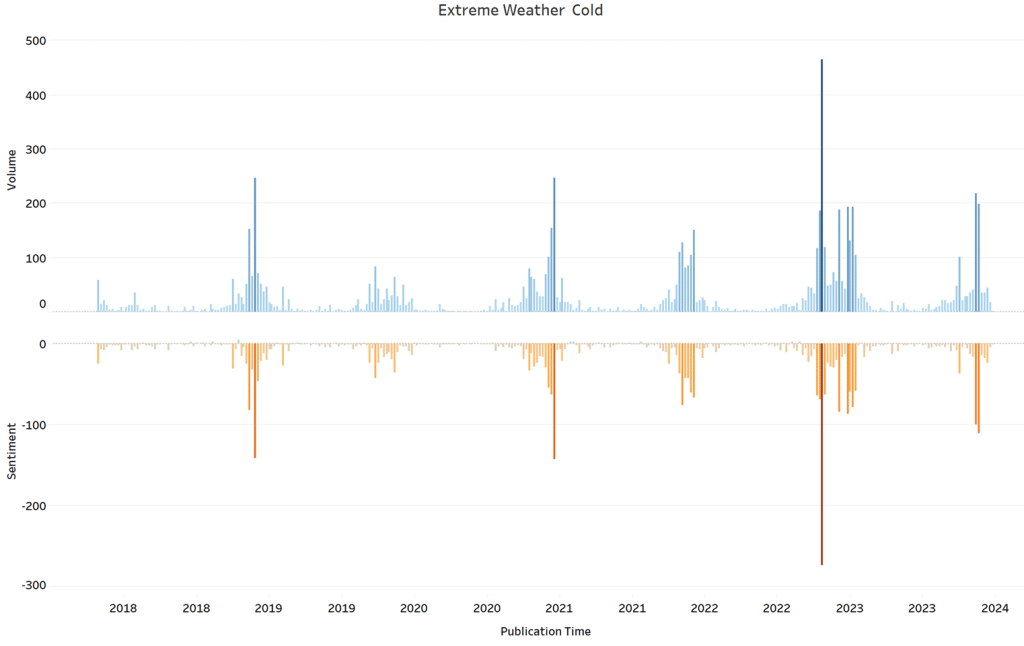
The impact of extreme weather on commodity prices: Our data sets at work

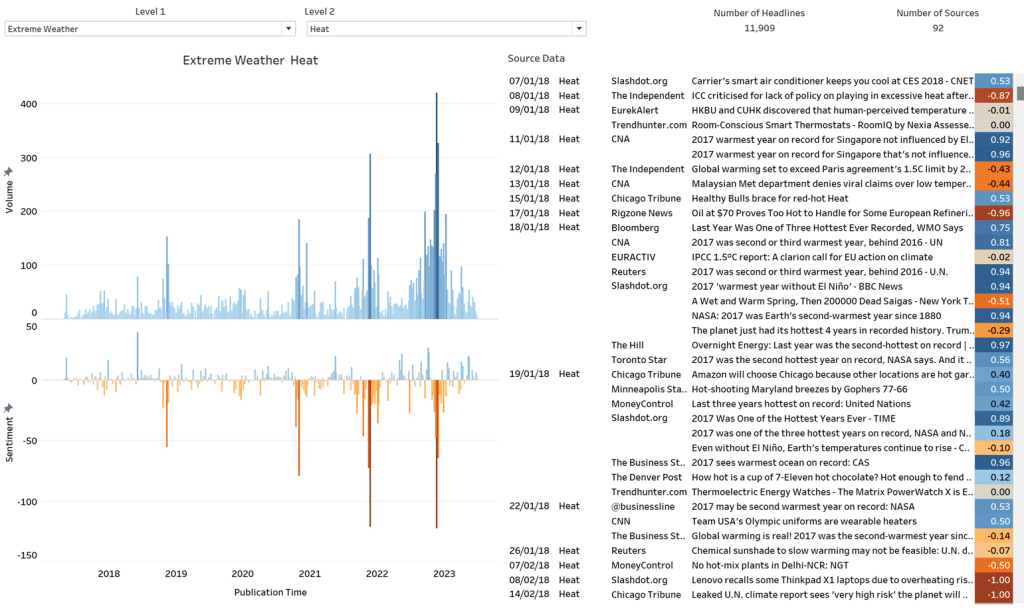
The graphs we have generated above from our data provides a  visual analysis of the volume and sentiment of publications related to extreme cold weather events from 2018 to 2024. The X-axis, representing publication time, reveals the ebb and flow of media attention to cold weather phenomena over the years, with significant peaks and troughs corresponding to the occurrence and impact of these events. The Y-axis on the left measures the volume of publications, which shows notable spikes, particularly around the years 2021 through 2024, suggesting an increased frequency of events or heightened media focus during this period. 

These spikes in publication volume could correlate with actual meteorological data indicating an uptick in extreme cold weather occurrences, or they might reflect a growing public or scientific concern about climate variability and its effects. Overlaying the publication volume, the sentiment analysis depicted by the line graph offers insights into the public or editorial tone of the coverage. Sentiment scores plunge deeply into negative territory at various points, especially pronounced in 2019 and between 2021 and 2022. 

These negative sentiment dips could indicate the severe impacts of cold weather events on communities, economies, and infrastructures, eliciting responses ranging from policy discussions to humanitarian concerns in the media narrative. The sentiment analysis serves not only as a gauge of the severity of the cold weather events as perceived by the media but also as a reflection of societal reactions to these extreme conditions. Overall, the graph serves as a stark reminder of the increasing attention and concern regarding extreme weather patterns, and possibly, a call to action for preparedness and resilience in the face of such natural challenges and how this must be accounted for in trading strategies.

Understanding and navigating the weather-commodity price connection

Weather plays a crucial role in shaping commodity prices across various sectors. The connection between weather events and commodity prices is complex, with both direct and indirect effects. By understanding how weather impacts agricultural, energy, and metal commodities, traders and investors can better navigate the risks associated with price fluctuations.

Weather forecasting is of paramount importance for commodity traders, helping them anticipate potential disruptions, identify opportunities, and adjust their trading strategies accordingly. Moreover, employing risk mitigation strategies such as diversification and hedging can help mitigate the impact of adverse weather conditions on commodity portfolios.

As technology continues to advance, weather forecasting is expected to become more accurate and precise. We expect that this will empower commodity traders with valuable insights, enabling better-informed decisions and surfacing emerging opportunities in the dynamic and interconnected world of weather and commodity markets.

Find out more

Access the precision of our comprehensive datasets on extreme weather and natural disasters. Enhance your commodity trading strategies by incorporating detailed historical data and predictive insights. To find out more simply enquiries@permutable.ai or fill in the form below to get in touch.