
What is commodities sentiment analysis?
01 Apr 2026
01 Apr 2026
Commodities sentiment analysis is the process of analysing news, data, and market narratives to measure how positive or negative sentiment is towards commodities such as oil, gold, natural gas, and agricultural products. It helps traders and analysts understand how markets are interpreting events in real time and anticipate price movements before they are fully reflected in traditional data.
In modern markets, prices are shaped not only by supply and demand, but by perception. Expectations around growth, inflation, geopolitics, and policy all influence how commodities are priced. Commodities sentiment analysis provides a structured way to quantify that perception and turn it into actionable intelligence.
Commodity markets are uniquely sensitive to narrative shifts. Oil reacts to geopolitical risk and demand expectations. Gold responds to macro uncertainty and monetary policy signals. Agricultural markets move on weather patterns, trade policy, and supply chain disruptions.
Traditional data remains essential, but it often arrives after the market has already started moving. Sentiment analysis helps bridge that gap by capturing how new information is being interpreted as it emerges.
For example, at Permutable AI our data shows that deteriorating sentiment around global growth can begin weighing on crude oil prices before official demand revisions are released. Similarly, positive sentiment around gold often strengthens during periods of rising recession risk or uncertainty around interest rates, reinforcing its role as a safe haven.
Commodities sentiment analysis combines large-scale data processing with advanced natural language understanding to extract signal from unstructured information.
It begins with the continuous ingestion of global content. This includes financial news, market commentary, institutional research, and geopolitical reporting. Each piece of content is analysed for tone, context, and relevance to specific commodities.
The next stage is sentiment scoring. Instead of assigning a single score to an entire article, at Permutable, we use more advanced systems that assess sentiment at the level of individual entities. A single report might be positive for gold, negative for industrial demand, and neutral for oil. Capturing this nuance is essential for accurate analysis.
Entity-level modelling is particularly important in commodities markets because multiple drivers often interact. Inflation concerns may support gold while weighing on growth-sensitive commodities. A geopolitical event may be bullish for oil while disrupting agricultural exports.
This is where Permutable AI’s multi-entity sentiment modelling provides a meaningful advantage. By analysing how different narratives evolve across commodities and macro drivers, it enables a more precise understanding of market dynamics.
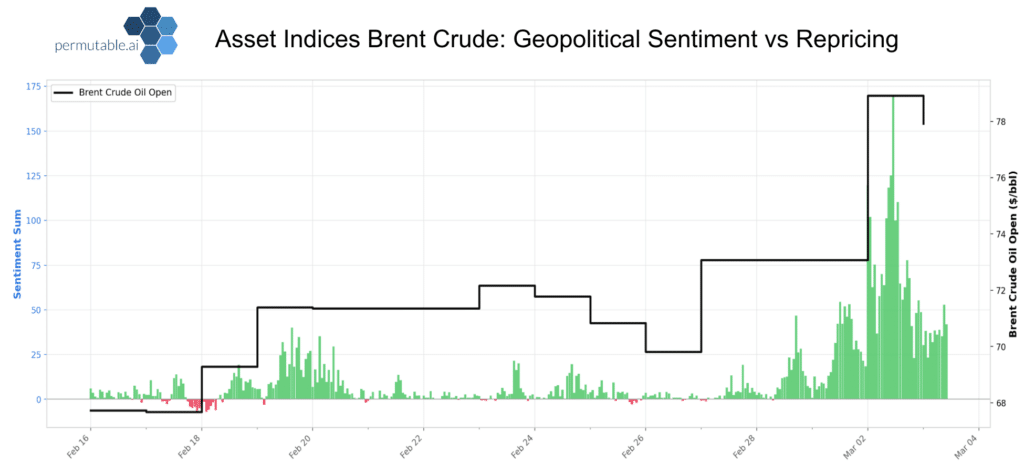
Above: Permutable AI data shows how shifts in geopolitical sentiment directly influence Brent crude oil price movements. Periods of rising positive sentiment, particularly in early March, align with sharp upward repricing in oil markets, highlighting how narrative-driven signals can precede and amplify commodity price trends.
The primary value of commodities sentiment analysis lies in identifying direction, momentum, and inflection points in market narratives.
Direction reflects whether sentiment around a commodity is improving or deteriorating. Momentum shows how quickly that sentiment is changing. Inflection points indicate when a dominant narrative begins to shift.
At Permutable AI, our insights have demonstrated that these shifts often precede price movements. In crude oil markets, increasing negative sentiment linked to weakening demand expectations has historically emerged before downward price adjustments. In gold, sentiment tends to strengthen as macro uncertainty rises, particularly during periods of policy ambiguity or economic stress.
Natural gas provides another example. Price volatility in gas markets is often driven by supply conditions, weather forecasts, and storage expectations. Sentiment analysis helps identify whether market focus is shifting towards scarcity risk, demand surges, or regulatory intervention. Understanding that narrative context is powerful for interpreting price behaviour.
Commodities sentiment analysis does not replace traditional analysis, but it enhances it by adding a forward-looking layer.
Traditional analysis relies on structured data such as inventories, production levels, and economic indicators. These inputs are essential, but they are often lagging or released at fixed intervals.
Sentiment analysis captures how markets react to new information in real time. It reflects expectations, uncertainty, and narrative intensity before they are fully expressed in hard data.
For traders and analysts, the combination of both approaches is powerful. Fundamentals explain what is happening. Sentiment explains how the market feels about it, and often where it may move next.
At Permutable, our commodities sentiment data highlights how narrative-driven signals can provide early insights across different markets.
In crude oil, sentiment tied to global growth expectations plays a central role. When narratives around economic slowdown intensify, sentiment often weakens before demand data confirms the trend. This can signal downside risk ahead of broader market recognition.
In gold, sentiment is closely linked to macro uncertainty. During periods of heightened concern around inflation, interest rates, or financial stability, positive sentiment tends to increase as investors seek defensive positioning.
In agricultural markets such as wheat or soybeans, sentiment often reflects weather risk, export restrictions, and supply chain disruptions. A sustained increase in negative sentiment linked to adverse weather conditions can indicate tightening supply expectations before official crop reports are released.
These examples illustrate how sentiment provides context that complements traditional data, helping market participants understand not just what is happening, but why.
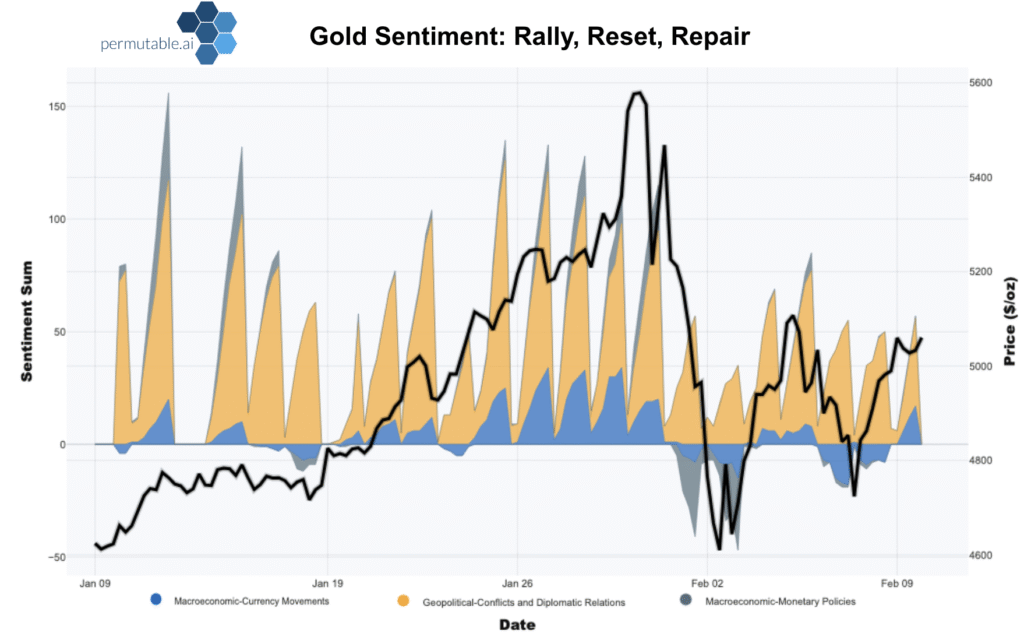
Above: Permutable AI data illustrates how gold sentiment is shaped by macroeconomic factors, geopolitical conflict, and monetary policy narratives. The chart highlights distinct phases of rally, reset, and recovery, where shifts in sentiment across these drivers closely align with changes in gold prices, reinforcing gold’s sensitivity to macro uncertainty and safe haven demand.
Commodities sentiment analysis supports a range of practical applications across trading, risk management, and research.
It can be used to identify emerging risks around existing positions, particularly when negative sentiment begins to build before price adjustments occur. It can also help confirm whether a market narrative is strengthening, providing greater conviction in directional views.
For macro analysis, sentiment offers a way to track which themes are dominating global attention. This is particularly useful in cross-asset strategies, where shifts in inflation expectations or geopolitical risk can impact multiple commodities simultaneously.
Permutable AI’s Trading Co-Pilot intelligence layer integrates these signals directly into workflows, enabling users to move from reactive analysis to proactive decision making.
While powerful, commodities sentiment analysis should be used with care and context. Not all information carries equal weight, and markets can sometimes react to factors that are not immediately visible in sentiment data.
Noise is an inherent challenge. High volumes of coverage do not always indicate meaningful shifts. This is why our robust models prioritise source credibility, relevance, and consistency of narrative over simple mention counts.
There are also periods when sentiment and price diverge. Liquidity conditions, positioning, and technical factors can temporarily override narrative signals. For this reason, sentiment analysis is most effective when combined with other forms of analysis.
It is used to measure how market narratives influence commodities such as oil, gold, and natural gas, helping traders identify emerging trends, risks, and opportunities before they are fully reflected in price data.
It can be highly effective when based on high-quality data and robust modelling. However, it should be used alongside fundamental and technical analysis to provide a complete market view.
Energy markets such as oil and gas, precious metals like gold, and agricultural commodities are all highly influenced by narrative and therefore benefit significantly from sentiment analysis.
Commodities sentiment analysis transforms unstructured information into measurable insight, providing a clearer view of how markets interpret global events. In an environment where narratives can move prices before data confirms the trend, this capability offers a meaningful edge.
By combining sentiment with traditional analysis, market participants can better understand not only what is happening across commodities, but how those developments are being priced in real time. As data volumes grow and markets become more reactive, this approach is increasingly central to modern trading strategies.

20 Oct 2026
Permutable launches data catalogue for macroeconomic, commodity and geopolitical sentiment intelligence
Read more >
16 Oct 2026
Permutable wins AI Innovation of the Year: Europe at the Euromoney Markets Awards 2026
Read more >
Analysis
16 Oct 2026
Gold outlook 2026: Why US rates outweigh geopolitical risk
Read more >