
Spotting macro regime shifts early: lessons from Japan, Turkey and Brazil
06 Aug 2026
06 Aug 2026
This analysis explains how investors can identify macro regime shifts before official data fully confirms them. Using Permutable signals from Japan, Turkey and Brazil, it examines persistent JGB repricing, transitions into and out of high-inflation environments, and changes in central-bank reaction functions. It is written for macro portfolio managers, rates and FX desks, economists, strategists and systematic researchers globally today.
Macro regime shifts rarely arrive with a clean announcement. By the time an inflation regime, policy cycle or rates repricing is obvious in official data, much of the market adjustment may already have taken place. The harder task for investors is to identify when the relationship between data, policy language and asset prices has begun to change – and whether that change is likely to persist.
Japan, Turkey and Brazil show three different versions of the same problem. In Japan, cooling monetary-policy sentiment has not been matched by a return to the old JGB yield range. In Turkey, falling headline inflation is not enough to prove that the high-inflation process has broken. In Brazil, the key signal is not the level of the SELIC rate, but whether the central-bank reaction function is shifting from one policy narrative to another.
This article uses Permutable’s Global Macro Sentiment Indices to examine how regime shifts can be detected earlier through the interaction of narrative strength, breadth, persistence and market confirmation. The aim is not to treat sentiment as a standalone forecast, but to show how point-in-time macro signals can help investors distinguish temporary noise from a more durable change in the process driving inflation, policy and asset prices.
In the case of Japan, monetary-policy narrative has cooled sharply from its 2025 peak. The JGB market has not followed it back.
Permutable’s Japan policy-outlook sentiment measure had fallen from the extreme hawkish readings reached around the Bank of Japan’s third rate increase. Yet the 10-year JGB yield continued towards 2.5 per cent rather than returning to the range that prevailed under yield curve control.
That divergence is the signal. It suggests the market is no longer treating the exit from ultra-loose policy as a temporary adjustment. It is pricing a different monetary regime.
Macro shifts are often recognised too late because analysis focuses on levels rather than relationships. A high inflation print, a rate increase or a sharp bond move may be important, but none establishes a new regime alone. The regime changes when the process connecting inflation, policy and asset prices changes – and stays changed.
This is consistent with James Hamilton’s regime-switching framework, which treats major economic breaks as changes in the process generating the data rather than ordinary fluctuations around a stable trend.
For years, Japan’s rates market was organised around a clear policy anchor. Negative short-term rates, large-scale JGB purchases and yield curve control constrained borrowing costs and suppressed the long end.
In March 2024, the Bank of Japan ended negative interest rates and yield curve control. It shifted to a framework in which the short-term interest rate once again became the primary policy instrument.
The chart shows that the transition occurred in stages.
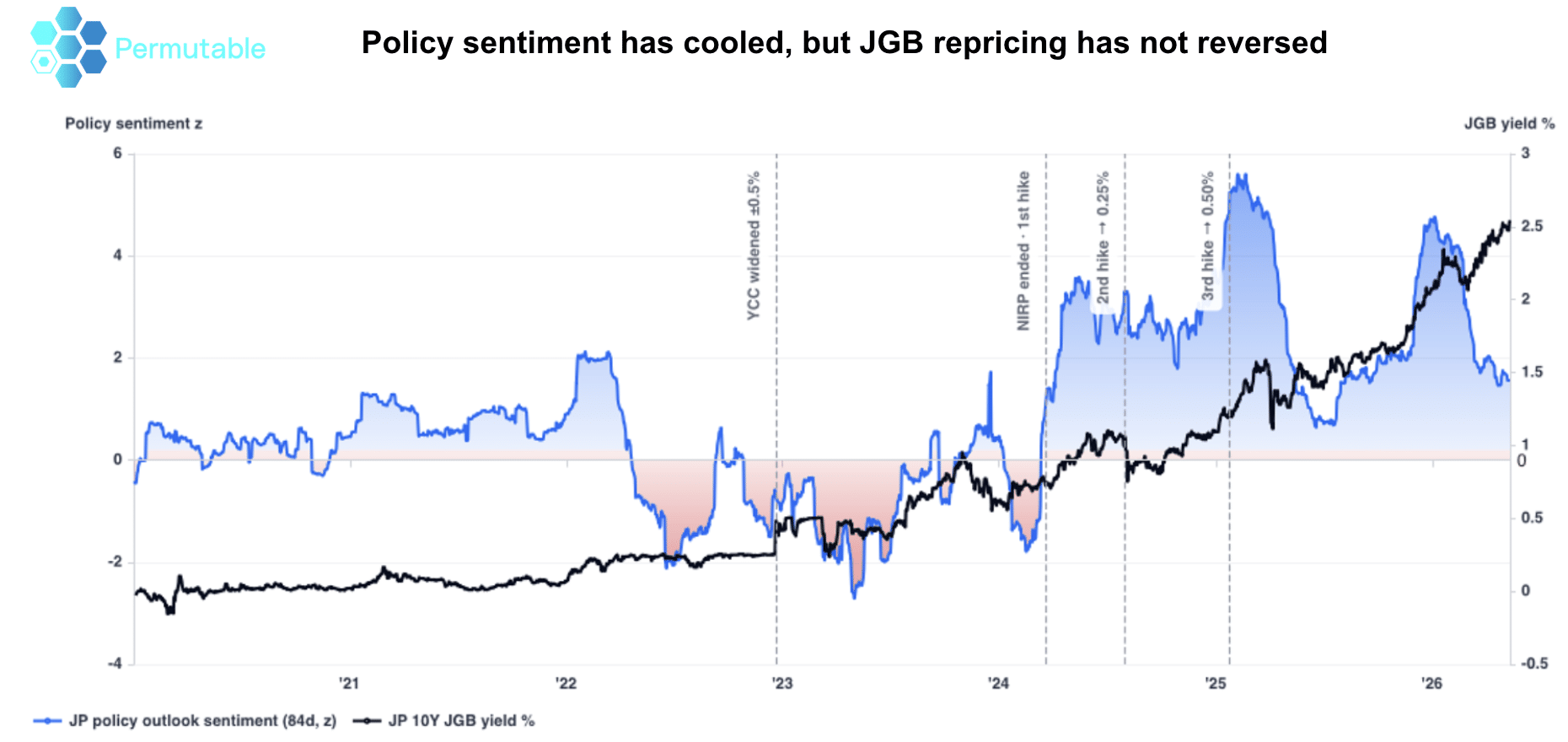
Policy sentiment was mostly positive through 2020 and 2021 without producing a durable break higher in yields. It weakened during 2022 and 2023, even as the Bank allowed greater flexibility around the 10-year yield target. The decisive change came around the end of negative rates in early 2024. Policy sentiment moved sharply higher and remained elevated through subsequent rate increases.
The peak itself is not the strongest evidence of regime change. What followed is more revealing.
Policy sentiment has since fallen from close to five standard deviations at its extreme to around 1.5 on the latest reading. The 10-year JGB yield had not returned to its pre-normalisation range. It continued to rise.
That is the difference between a cyclical policy signal and a structural repricing. A cyclical signal should reverse as the immediate hawkish impulse fades. A regime shift leaves behind a new market-clearing level because investors have changed their assumptions about inflation persistence, the equilibrium rate, policy tolerance or the supply of duration.
The chart can’t identify which of those explanations is dominant – nor should it be read as proof that policy sentiment caused the move in yields. However, it does show that cooling policy language has not restored the old relationship between the narrative and the curve.
For a rates desk, the relevant question is therefore not whether the Bank sounds less hawkish than it did at the peak but what evidence would be required for the market to price the old regime again.
A sustained collapse in inflation and wage pressure, a clear dovish shift in Bank communication and a reversal across the curve would weaken the regime interpretation. So far, the chart shows cooling sentiment without that market reversal.
Turkey demonstrates why the same distinction is key in inflation analysis.
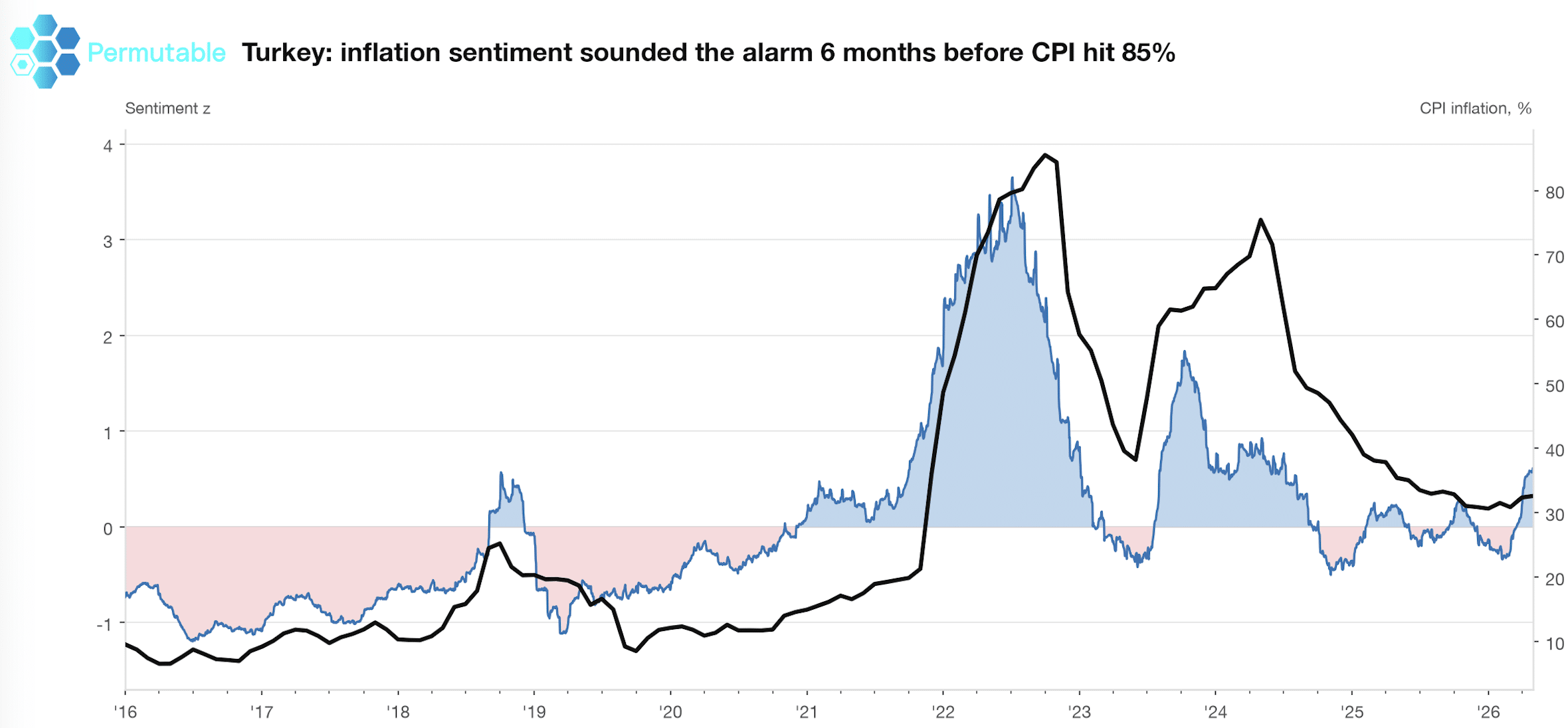
Permutable’s Turkey inflation signal helps differentiate between an economy remaining inside a high-inflation regime and one beginning to leave it. Annual CPI can fall because of base effects while the forces sustaining inflation remain active.
Currency weakness, wage resets, administered-price increases and household expectations can continue reinforcing one another after headline inflation has peaked. A lower annual rate is therefore not sufficient evidence of a durable transition.
A turn becomes more credible when several channels change together. Local reporting begins to indicate weaker pass-through. Pricing pressure loses breadth. Demand softens. Policy credibility improves. Inflation sentiment falls and remains lower rather than rebounding after one favourable release.
The investment question is not simply whether inflation has declined, but whether the system producing inflation has changed.
Our analysis of Turkey, Brazil and Nigeria applies this regime-based approach to emerging-market inflation, separating changes in headline data from changes in the underlying inflation process.
Brazil offers a policy-cycle version of the same problem.
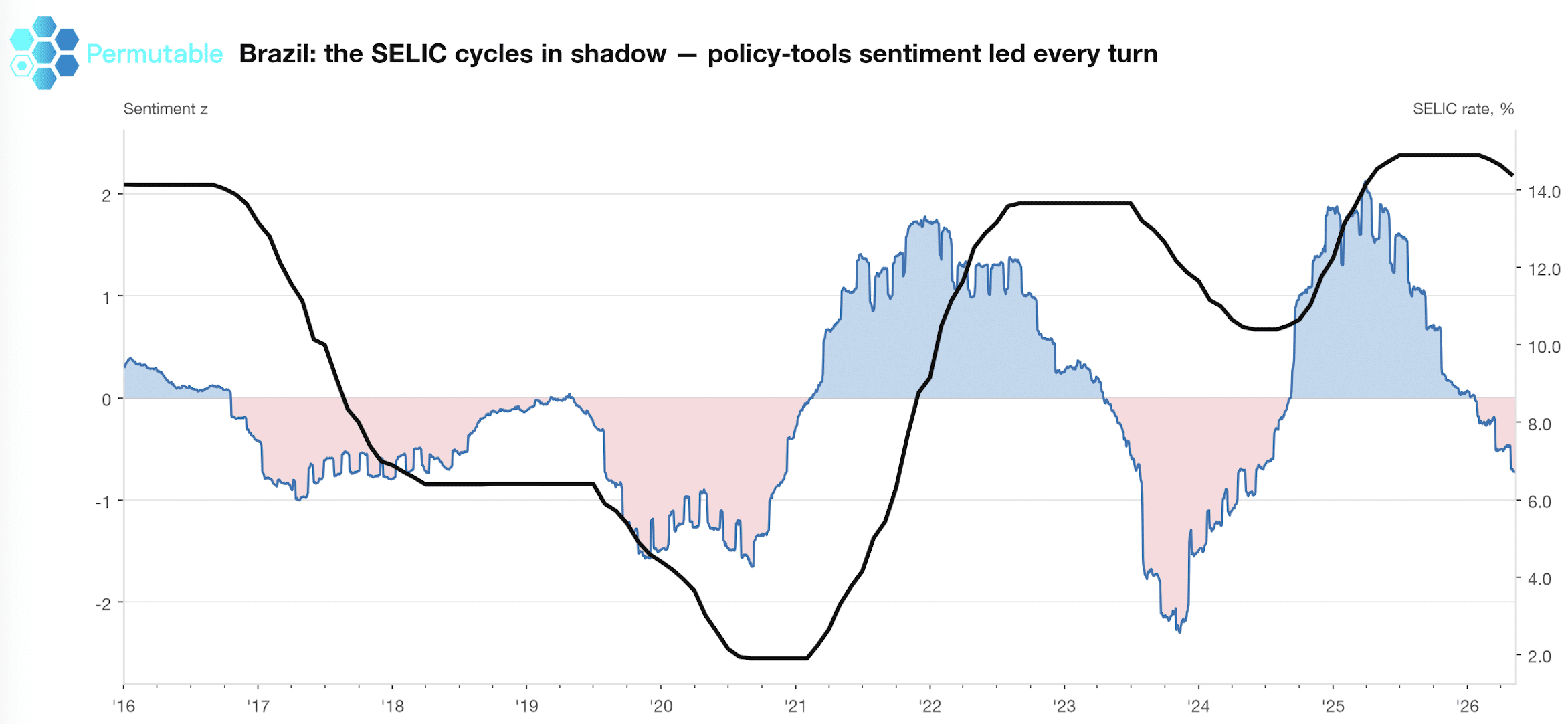
Permutable’s Brazil policy sentiment has alternated between hawkish and dovish phases as the balance between inflation, growth, fiscal risk and the scope for easing has changed. The turning points are key because they show when one policy narrative is losing control and another is becoming dominant.
This is not the same as predicting the next SELIC decision.
A central bank can continue cutting rates within a relatively hawkish environment if its communication stresses limited room to ease, fiscal uncertainty or renewed inflation risk. Equally, a high nominal rate can coexist with a genuinely dovish transition when the debate moves towards a sustained easing cycle.
The regime signal lies in the reaction function – how policymakers are likely to respond to the same incoming data – rather than in the current level of the policy rate.
For rates and FX investors, that distinction can help separate a temporary repricing around one meeting from a broader change in the expected direction, pace and limits of the policy cycle.
Across Japan, Turkey and Brazil, four tests are key:
– Direction – has the signal moved decisively away from its previous range?
– Breadth – is the change visible across multiple drivers, sources and parts of the economy?
– Persistence – does it survive beyond one release, policy meeting or market shock?
– Confirmation – is the shift also becoming visible in market pricing, forecast revisions or hard data?
News-based indicators are most useful as an early information layer, not as stand-alone trade instructions. ECB research has found that newspaper sentiment contains timely economic information that can materially improve euro-area GDP nowcasts. New York Fed research similarly demonstrates the value of synthesising large, mixed-frequency datasets as new information arrives.
Historical testing must also be conducted on a point-in-time basis. Revised economic series and retrospectively reconstructed narratives can make turning points appear far cleaner than they were to investors at the time.
Permutable’s Global Macro Sentiment Indices provide country- and topic-level signals, distinguish domestic from international narratives and preserve the point-in-time history required for systematic testing. Their interpretation can be strengthened through formal regime-detection methods, including Markov-switching or hidden Markov models, which estimate whether sentiment is operating within a low-pressure, transitional or high-pressure state.
In the Japan chart, the 84-day z-score measures the current policy-outlook reading relative to its recent distribution. A regime model can assess whether that movement represents a temporary deviation or a more persistent change in the underlying narrative. For genuine point-in-time testing, the classification should rely on filtered regime probabilities calculated using only information available on each date, rather than smoothed probabilities estimated with the benefit of later observations.
The signal therefore captures the strength, direction and persistence of the policy narrative, while the regime classification provides a systematic test of whether its behaviour has materially changed. Neither should be interpreted as a forecast of the next Bank of Japan decision, proof of causality or, in isolation, a trading signal.
Use Permutable’s Global Macro Sentiment Indices to track changes in inflation, growth and monetary-policy narratives across more than 95 economies.
Point-in-time history supports regime modelling, historical testing and systematic research without hindsight, while continuously updated signals help investors assess whether an emerging change is broadening, persisting and gaining confirmation across markets and official data.
Explore how GMSI can support regime classification, rates and FX research, macro nowcasting and cross-country analysis

30 Sep 2026
The Hawkish Turn: G10 Central Bank Policy Outlook into Q4 2026
Read more >
Guide
30 Sep 2026
The complete guide to early macro regime sentiment signals for hedge funds and institutional investors
Read more >
Analysis
23 Sep 2026
How does the 2026 energy shock reach 2027? From shipping routes to policy rates
Read more >