
This use case article aimed at institutional traders, asset managers, and risk teams looking to understand how our advanced energy indices and AI-driven tools can convert fast-moving energy market news into tangible trading advantages.
The pace and volume of energy market news have never been greater. Market headlines on OPEC+ decisions, geopolitical disputes, sanctions, and pipeline outages often move markets within minutes. Yet, for institutional traders, the challenge is not access to information but the ability to filter, interpret, and act on it with confidence.
This is where Permutable’s suite of 462 energy market intelligence indices provides a decisive edge. By systematically capturing fundamentals, sentiment, and live developments, our indices translate the often-chaotic flow of energy market news into structured insights that traders can use for real-world decision-making.
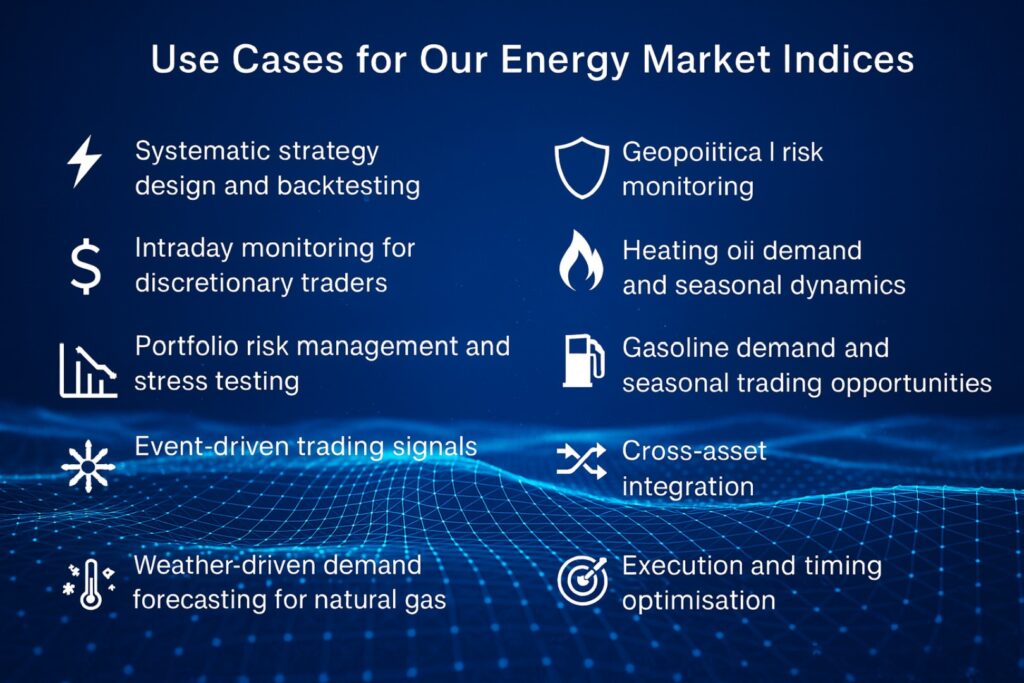
Table of Contents
Toggle1. Systematic strategy design and backtesting
Quantitative teams can use our indices to convert years of energy market news into robust historical datasets for strategy design. For example, a hedge fund might test how oil prices historically reacted to OPEC+ quota changes during times of global economic weakness. By integrating both fundamentals and sentiment-driven indices, the strategy would capture not just the “what” of supply changes, but also the “how” of market reaction. This allows quants to design models that are more resilient to the surprises embedded in energy market news, and to deploy systematic strategies grounded in both data and behaviour.
2. Intraday monitoring for discretionary traders
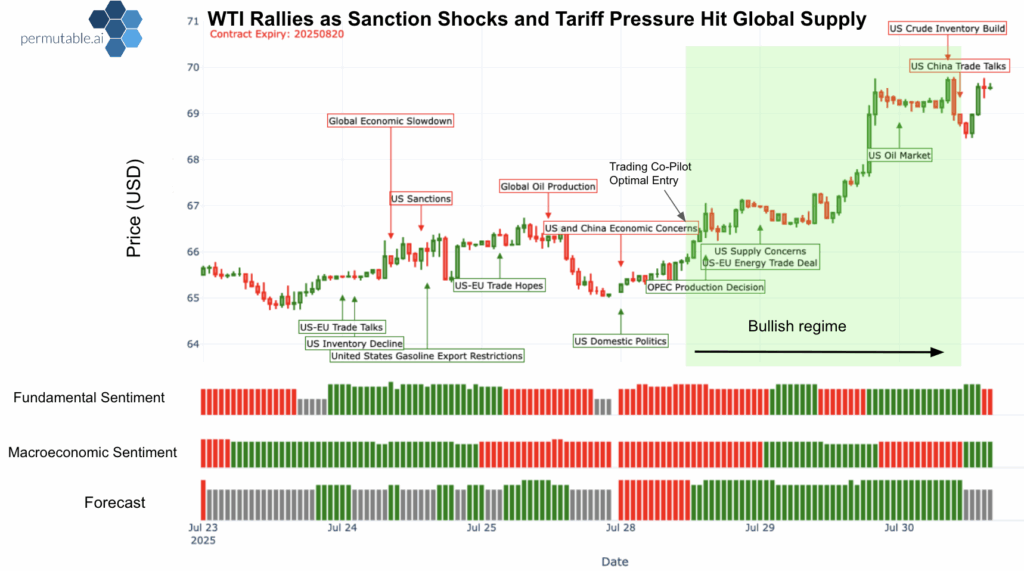
For portfolio managers, the challenge often lies in real-time interpretation. Energy market news moves quickly, and discretionary traders can easily miss early signals. Our live dashboards provide intraday visibility, with AI-driven alerts flagging anomalies such as sudden spikes in sentiment around sanctions or refinery outages. Imagine a discretionary oil trader who sees bullish sentiment accelerating through the lends of our energy indices as reports of Middle East tensions escalate. Rather than waiting for the futures curve to adjust, the trader gains confidence to take a position earlier, capturing the upside before consensus shifts.
3. Portfolio risk management and stress testing
Risk teams face a different problem: quantifying how energy market news could impact portfolio exposures. Using our indices, they can stress-test positions against scenarios such as pipeline attacks, hurricane disruptions, or sanctions. For instance, a risk manager overseeing a commodities portfolio could model the effect of renewed Venezuelan sanctions by combining supply-side indices with sentiment readings from global media. This scenario planning enables teams to hedge more precisely and mitigate downside before losses accumulate.
4. Cross-regional arbitrage and benchmark analysis
Energy market news is rarely confined to a single region. Sanctions on Russia ripple into Europe’s natural gas market, while LNG cargoes in Asia influence US export flows. Our indices provide regional intelligence across Europe, North America, and Asia, enabling traders to identify dislocations. An arbitrage desk, for example, might use our indices to compare sentiment across Brent, WTI, and LNG. If sentiment in Asia spikes on LNG demand news while US indices remain flat, the desk could anticipate spread movements and position for convergence.
5. Event-driven trading signals
Institutional traders know that energy market news around OPEC+ meetings, hurricanes, or industrial action can drive sudden repricing. The difficulty is distinguishing between short-lived noise and price-moving events. Our indices capture the build-up of sentiment before events, the inflection point during them, and the aftermath. Consider a trader preparing for an OPEC+ meeting. Our sentiment indices may detect rising bullish momentum in news flow two days before the announcement, flagging that consensus is shifting towards supply restraint. By entering ahead of the headline, the trader positions with a timing edge.
6. Weather-driven demand forecasting for natural gas
Our natural gas feeds integrate sentiment and fundamentals around weather volatility, storage levels, and geopolitical supply risks — all of which can move markets rapidly. For example, during periods of extreme heat or cold, sentiment spikes in our indices capture early signals of higher demand for gas-fired power or heating. Coupled with storage pressure updates and LNG supply news, these signals allow traders to anticipate tightening in TTF or Henry Hub contracts before prices react.

7. Geopolitical risk monitoring
Energy market news is deeply intertwined with geopolitics. Our indices quantify the risk premia embedded in headlines, from Middle East conflicts to sanctions in Russia. By converting unstructured news into risk scores, institutional traders can make faster hedging decisions. Take the Strait of Hormuz as an example. If our indices detect a surge in sentiment around naval activity, a trader can hedge Brent exposure immediately, avoiding the scramble that often follows once prices spike.
8. Heating oil demand and seasonal market dynamics
9. Gasoline demand, and seasonal trading opportunities
Our gasoline feeds provide institutional traders with real-time intelligence on one of the most demand-sensitive refined products, where seasonal driving trends, refining activity, and policy shifts all play critical roles. By tracking sentiment around refinery outages, export flows, and summer driving demand, our indices highlight opportunities to anticipate tightening supply or rising consumption before they are reflected in prices. Our feeds capture policy risks such as changes to fuel standards or subsidies, enabling traders and risk teams to adjust exposure accordingly. This combination of fundamentals and sentiment transforms gasoline market volatility into actionable trading and hedging opportunities.
10. Cross-asset integration
Energy market news rarely stops at the boundaries of energy itself; its effects ripple across the financial system, influencing currencies, metals, inflation, and interest rates. A sudden oil price shock, for example, can strengthen commodity-linked currencies such as the Canadian dollar, or accelerate inflation expectations that move bond yields higher. By linking our indices into broader macro portfolios, institutional traders can capture these second-order effects and position more effectively across asset classes. A macro hedge fund, for instance, might use our sentiment indices to detect a bullish build-up in oil before it filters into inflation data, enabling them to adjust exposure in inflation-linked bonds or short sovereign debt ahead of consensus. Similarly, correlations with gold and industrial metals can be tracked to refine commodity baskets. In short, our indices allow institutions to view energy not in isolation, but as a critical driver of cross-asset dynamics.
11. Execution and timing optimisation
In volatile markets, timing can mean the difference between alpha generation and underperformance. Energy market news often sparks sudden price swings, many of which prove to be false breakouts that catch out traders entering too early or too late. Our indices address this by monitoring short-term sentiment accelerations and decelerations, allowing institutions to distinguish between noise and momentum that is likely to sustain. Real-time sentiment feeds can be integrated directly into execution algorithms, ensuring that trades are only triggered when conviction is confirmed by both sentiment and fundamentals. For example, a discretionary trader might plan to go long Brent on signs of tightening supply but delay execution until our indices flag rising bullish sentiment across global media flows, improving entry levels. This reduces slippage, avoids unnecessary churn, and sharpens execution quality. Ultimately, our indices provide a framework for turning volatile intraday signals into disciplined, higher-probability trade execution.
| Use Case | Summary |
|---|---|
| 1. Systematic strategy design and backtesting | Convert years of energy market news into structured datasets for quants to backtest strategies that capture both fundamentals and sentiment-driven behaviour. |
| 2. Intraday monitoring for discretionary traders | AI-driven dashboards flag sentiment anomalies in real time, helping traders act quickly on refinery outages, sanctions, or geopolitical shocks. |
| 3. Portfolio risk management and stress testing | Stress-test portfolios against pipeline attacks, hurricanes, or sanctions by integrating supply-side and sentiment indices into risk models. |
| 4. Cross-regional arbitrage and benchmark analysis | Compare sentiment across Europe, North America, and Asia to identify dislocations in Brent, WTI, and LNG benchmarks for arbitrage opportunities. |
| 5. Event-driven trading signals | Track sentiment build-up before OPEC+ meetings, hurricanes, or strikes to anticipate price shifts and enter trades with a timing advantage. |
| 6. Weather-driven demand forecasting for natural gas | Detect sentiment spikes around extreme heat or cold, storage levels, and LNG supply risks to anticipate tightening in TTF or Henry Hub contracts. |
| 7. Geopolitical risk monitoring | Quantify risk premia from conflicts, sanctions, or chokepoint disruptions, allowing faster hedging decisions before prices move. |
| 8. Heating oil demand and seasonal dynamics | Track cold weather signals, storage pressures, and logistics risks to anticipate tightening balances and hedge seasonal heating oil exposure. |
| 9. Gasoline demand and seasonal trading opportunities | Monitor refinery outages, driving demand, and policy changes to capture supply-demand imbalances and profit from volatility in gasoline cracks. |
| 10. Cross-asset integration | Link energy sentiment to FX, metals, inflation, and rates, enabling macro funds to capture second-order effects and anticipate cross-asset spillovers. |
| 11. Execution and timing optimisation | Use short-term sentiment accelerations to refine entry and exit points, reduce slippage, and improve execution quality in volatile conditions. |
Final thoughts
In a world where energy market news arrives faster than ever, the ability to interpret and act decisively has become a differentiator for institutional traders. Permutable’s energy market intelligence indices transform the noise of daily headlines into structured, predictive signals.
Whether for systematic strategy design, discretionary decision-making, risk management, or cross-asset integration, these indices provide the clarity and confidence required to navigate the complexity of global energy markets. For institutional investors, the lesson is clear: turning energy market news into actionable intelligence is no longer optional – it is essential for outperformance in 2026 and beyond.
Ready to see the difference our real-time intelligence can make?
Our energy market indices are now available for institutional clients worldwide. To explore how our data can sharpen your strategies, strengthen risk management, and uncover new trading opportunities, get in touch with our team today to request a trial at enquiries@permutable.ai.
Energy Indices FAQ
1. How do Permutable’s energy indices differ from traditional energy market data feeds?
Traditional feeds focus on fundamentals such as price, production, and inventory. Permutable’s indices integrate these with sentiment, media flow, and geopolitical signals in real time. This creates a multi-dimensional view of the market that helps institutions anticipate moves rather than react to them.
2. Can systematic funds integrate your indices directly into their models?
Yes. All indices are available via API, enabling quant teams to run historical backtests, factor modelling, and live integration into systematic trading strategies. Our datasets are designed to be machine-readable, making them straightforward to deploy in automated pipelines.
3. How do these indices support discretionary traders and energy desks?
Discretionary traders can use our dashboards to monitor live sentiment, receive anomaly alerts, and spot narrative accelerations that precede price moves. This helps energy desks capture opportunities from energy market news while avoiding being caught in false breakouts.
4. Are your indices global in coverage?
Yes. The suite spans oil, natural gas, and LNG markets across Europe, North America, and Asia, providing cross-regional visibility. This is particularly valuable for arbitrage desks and global macro funds looking to exploit dislocations between benchmarks such as Brent, WTI, TTF, and JKM.
5. How do asset managers use the indices for risk management?
Risk managers can stress-test portfolios against geopolitical shocks, extreme weather events, or policy changes by applying sentiment scenarios. For example, they can quantify the potential impact of sanctions or refinery outages on their holdings before such risks are priced into markets.
6. How frequently are the indices updated?
Our indices run on intraday updates aligned with live energy market news flows. This allows institutions to react quickly to sentiment spikes and macro signals, providing an advantage over slower-moving traditional datasets.
7. Can these tools improve execution quality?
Yes. Execution algorithms can be configured to use short-term sentiment accelerations from our indices to optimise timing. By avoiding trades during false breakouts and waiting for conviction signals, institutions reduce slippage and improve fill quality.
8. How do the indices support cross-asset strategies?
Energy market shocks often spill into FX, fixed income, and metals. Our indices enable macro funds to detect these second-order effects — for example, rising oil sentiment leading to inflation expectations and shifts in bond yields — allowing institutions to position across asset classes.
9. Do the indices capture long-term structural themes like energy transition?
Yes. Our analytics track sentiment around climate policy, carbon taxes, and renewable adoption, providing early warning of structural demand shifts. Asset managers use this intelligence to refine longer-horizon energy and commodities strategies.
10. How can institutions trial the platform?
We provide demonstrations and trial access through our institutional partnerships team. This allows trading desks, quant teams, and asset managers to explore how our indices can integrate into their workflows before full deployment.