Oil market sentiment analysis: turning narrative flow into signals
07 Jun 2026
07 Jun 2026
This article explains why oil market sentiment analysis matters for trading desks, hedge funds, commodity analysts and institutional investors. It explores how geopolitical risk, supply disruption, OPEC signalling, demand expectations and cross-asset macro narratives can be transformed into structured, explainable signals that help market participants identify crude oil repricing risks before they become consensus.
A crude rally can start long before balances tighten on paper. By the time weekly inventory data, refinery runs and export schedules confirm the move, the market has often already repriced the narrative. That is why oil market sentiment analysis matters on trading desks. It captures how geopolitical risk, supply disruption language, OPEC signalling, freight stress and demand expectations are being processed in real time, before the fundamental picture is fully agreed.
For market participants however, the challenge is not access to information. It is interpretation at speed. Crude and refined products trade against a dense stream of headlines, policy statements, broker research, tanker intelligence, macro data and cross-asset moves. The signal is rarely in any single article. It sits in the aggregate tone, the rate of narrative change, the persistence of specific themes and the market regimes in which those themes begin to matter more.
At its best, oil market sentiment analysis is not a crude count of positive and negative words. That approach is too shallow for professional use. Oil markets react to context, source quality, timing and transmission channels. A bullish headline on supply is not equivalent to a bullish headline on demand. A ministerial comment during an OPEC+ meeting carries different weight from commentary by a sell-side analyst. Language around shipping insurance in the Red Sea can matter more for prompt Brent than a generic growth forecast issued on a quiet session.
A useful sentiment framework therefore measures several layers at once. First, it classifies the topic – supply, demand, inventories, geopolitics, sanctions, outages, refining, freight, policy or macro spillover. Second, it scores directional bias. Third, it assesses relevance, novelty and likely market impact. Finally, it tracks whether a narrative is accelerating, fading or moving across assets.
That last point is where many models fail. Oil rarely trades in isolation. Dollar strength, rates repricing, Chinese growth expectations and broader risk sentiment can all alter how the same oil headline is received. A supply outage during a recession scare may produce a different price response from the same outage in a tight physical market. Sentiment analysis must therefore be linked to regime detection, not treated as a static overlay.
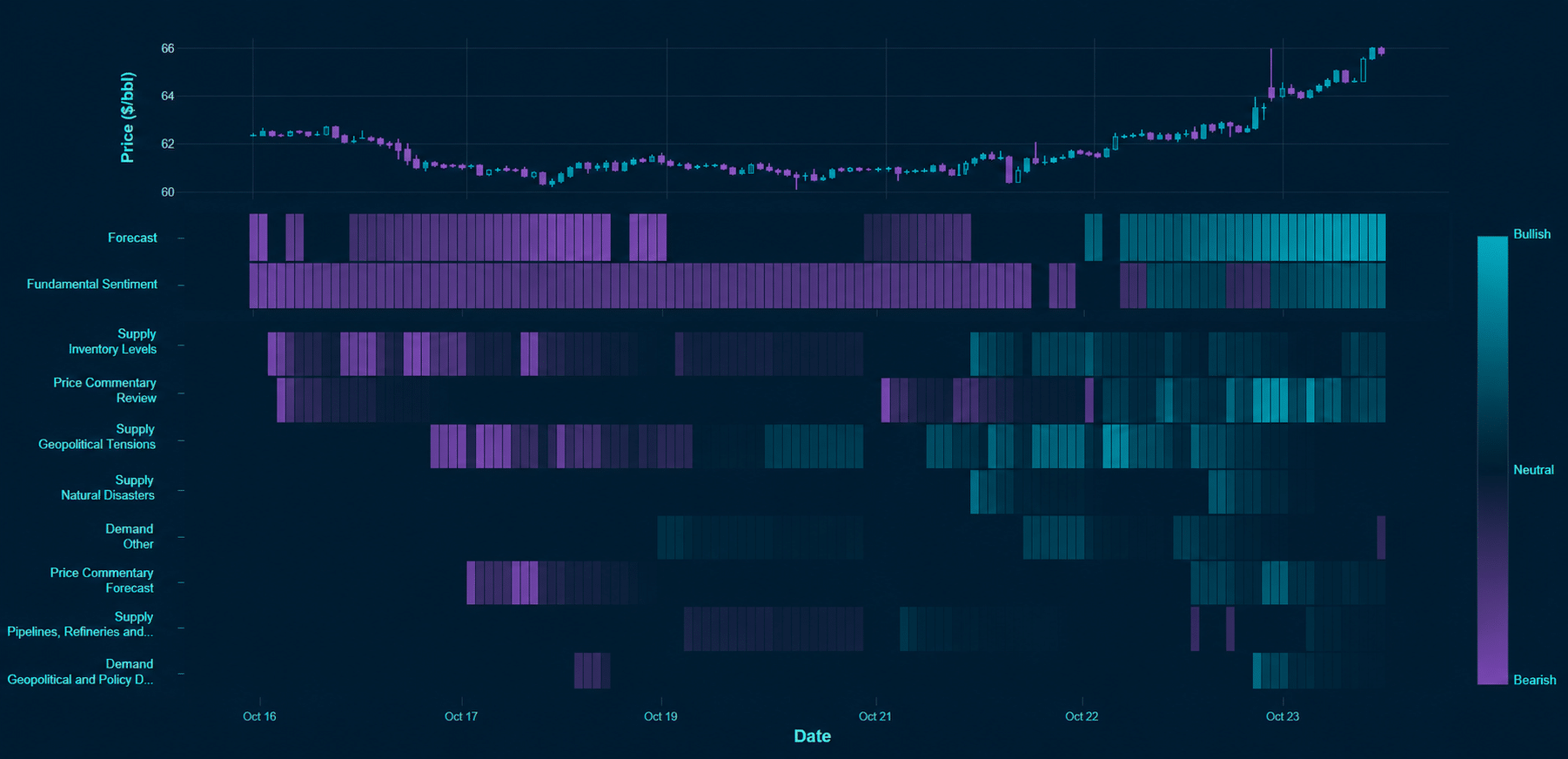
Above: Permutable’s oil market sentiment analysis maps bullish, neutral and bearish narrative signals across supply, demand, geopolitical risk, inventories and price commentary, helping traders see which themes are moving alongside crude price action.
The oil market is reflexive. Traders do not wait for a complete dataset if the forward narrative is changing. When participants begin to believe that spare capacity is thinner than assumed, that sanctions enforcement is tightening, or that product cracks are signalling stronger demand, they reposition ahead of full statistical confirmation.
This is why sentiment often proves most valuable around inflection points. In stable conditions, the incremental value of headline interpretation may be modest because the market is already anchored around a clear balance view. When conditions change quickly, however, narrative flow becomes a leading indicator of repricing. The desk that can detect a meaningful shift in tone across trusted sources has an information advantage over the desk still reading each development manually.
There is also an asymmetry in how narratives move oil. Supply shocks tend to hit quickly, while demand narratives may build more gradually through mobility data, industrial indicators and central bank expectations. A strong oil market sentiment analysis framework reflects that asymmetry. It should treat sudden escalation language around production or transit risk differently from a slow improvement in demand commentary.
Most trading teams already consume immense amounts of content. The issue here is not coverage. It is how to structure unstructured inputs into something that can be researched, monitored and traded. Oil headlines arrive from official statements, wire copy, policy releases, ship tracking commentary, earnings calls and specialist publications. Much of it is repetitive. Some of it is market moving. A small portion changes positioning.
A production-grade sentiment system needs to solve for noise first. Duplicate headlines, recycled commentary and low-credibility opinion inflate false confidence. Source calibration matters. So does entity resolution. If a report references Libya, OPEC+, Mediterranean loadings and European refiners in the same piece, the model must identify which entities are central to the signal and which are peripheral context.
Timing matters just as much. Institutional users need event detection and sentiment scoring with minimal delay, but speed without explainability creates another problem. Traders and risk managers need to know why a signal changed. If bearishness in crude rises sharply, is that because recession language is intensifying, because a ceasefire premium is being removed, or because inventory concern is broadening across multiple regions? Without that decomposition, sentiment is difficult to trust and harder to integrate into a live process.
The most effective use of oil market sentiment analysis is not as a standalone black box. It works when embedded into an existing research and execution stack. For discretionary macro and commodity teams, sentiment can sharpen situational awareness. It highlights which narratives deserve attention now, not in two hours when the market has already moved.
For systematic teams, the use case is more explicit. Sentiment can be converted into features for short-horizon prediction, event studies, volatility forecasting or regime classification. The key is disciplined feature engineering. Raw scores are rarely enough. More useful inputs include changes in sentiment over rolling windows, divergence between supply and demand narratives, source-weighted indices and cross-asset sentiment spreads between oil and rates, FX or equities.
There are practical trade-offs. Very short-horizon sentiment signals may decay quickly and can be sensitive to execution costs. Longer-horizon signals may be more stable but risk overlapping with information already captured in price and curve structure. The right calibration depends on the strategy. A discretionary Brent trader, a CTA researcher and a corporate risk desk will not use the same threshold or horizon.
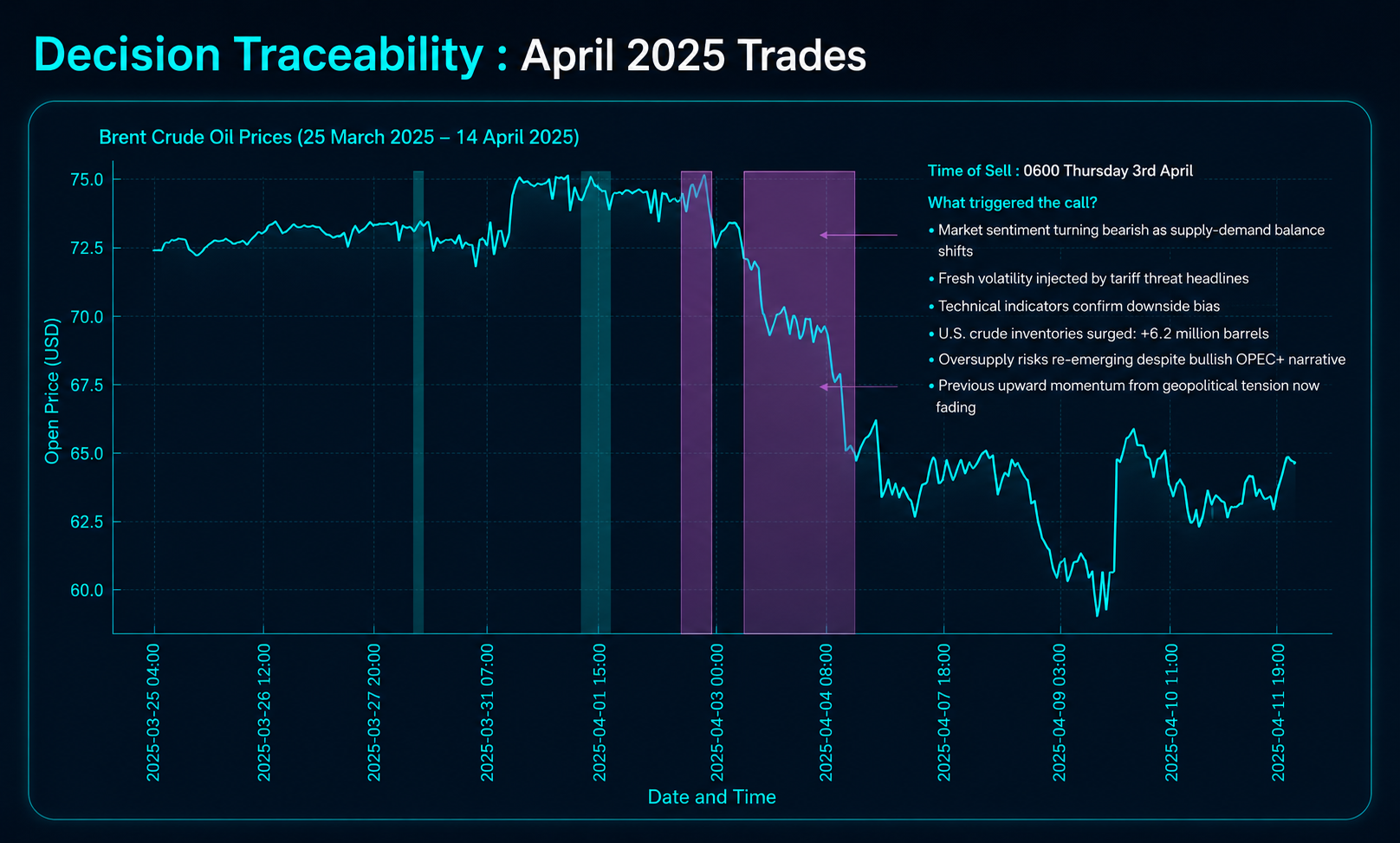
Above: Decision traceability shows how Permutable’s oil market sentiment signals can support trading workflows by linking price moves to bearish sentiment shifts, supply-demand balance changes, inventory data and volatility triggers.
There are several market conditions where sentiment tends to earn its place. Geopolitical episodes are the obvious example, but not the only one. During OPEC+ communications windows, language analysis around compliance, voluntary cuts and future intent can help distinguish symbolic messaging from genuinely market-moving guidance.
Physical dislocation is another area. Refinery outages, shipping bottlenecks, sanctions updates and regional product tightness often surface first as fragmented narrative signals before they are visible in consolidated data. In these periods, a structured sentiment layer can improve prompt market read-through.
Macro transition periods are equally important. Oil increasingly trades as both a commodity and a macro barometer. If central bank rhetoric, Chinese stimulus expectations and risk appetite are shifting simultaneously, sentiment analysis can help isolate whether crude weakness is being driven by oil-specific fundamentals or by a broader macro de-risking impulse.
This distinction matters for positioning. An oil-specific bearish signal may invite relative value opportunities across the curve or against products. A macro-led bearish signal may require a different response, especially if correlations across assets are rising.
Institutional adoption depends on auditability. If a portfolio manager is asked why a signal flipped from supportive to bearish overnight, the answer cannot be “the model said so”. The underlying drivers need to be visible: which themes strengthened, which entities were implicated, which sources carried the score and how unusual the shift was relative to history.
This is where modern market intelligence platforms have an edge over generic natural language processing stacks. They are built around market taxonomy, event detection and workflow integration rather than generic sentiment labels. For a desk using AI-generated signals in production, explainability is part of signal quality, not an afterthought. Permutable AI’s approach is directionally aligned with this institutional requirement: speed is necessary, but transparent market context is what makes data deployable.
Sentiment is powerful, but it is not a substitute for balances, positioning data, options pricing or market microstructure. It can tell you that concern around supply is intensifying. It cannot, on its own, tell you whether that concern is already fully reflected in the curve, whether physical traders are fading the move, or whether liquidity conditions will distort the next price reaction.
There is also a crowding risk. If too many desks respond to the same headline clusters in the same way, the edge compresses. That is why differentiation increasingly comes from model design, source breadth, latency, explainability and the ability to connect sentiment with cross-asset context.
The strongest frameworks treat sentiment as one layer in a broader decision architecture. It helps answer three practical questions: what narrative is strengthening, how fast is it spreading, and in which market regime is it most likely to matter? When those answers are available in machine-consumable form, research cycles shorten and execution decisions improve.
This is where Permutable’s approach is designed to add value. Rather than treating oil market sentiment as a generic news score, Permutable structures narrative flow into explainable signals that can be monitored, tested and integrated into existing research, trading and risk workflows.
Our sentiment intelligence is built to help teams identify which market narratives are gaining traction, where the pressure is coming from, and whether that signal is isolated or spreading across related macro, commodities and geopolitical themes.
For discretionary teams, this supports faster interpretation of market-moving narratives without relying solely on manual headline reading. For systematic teams, it provides structured, point-in-time signals that can be tested alongside prices, fundamentals and positioning data. For risk teams, it offers a way to monitor emerging stress across supply, demand, policy and geopolitical channels before the narrative becomes consensus.
Oil will remain a narrative-driven market because uncertainty is structural, not episodic. Supply policy, geopolitics, freight, demand elasticity and macro repricing all interact too quickly for manual interpretation alone. The desks that perform best are not the ones reading more headlines. They are the ones turning narrative flow into structured, explainable signals before the rest of the market treats the story as consensus.
The practical edge is simple: if your process can distinguish noise from regime-changing sentiment early enough, you are no longer reacting to the oil market narrative. With our intelligence, teams can start building that edge into the way they research, monitor and respond to oil market risk.