
This is a complete guide to market sentiment indicators for institutional investors. Learn what they are, how they work, the different types available, and why Permutable AI’s next-generation sentiment indicator suite gives hedge funds, systematic macro traders, and asset managers the edge in volatile global markets.
Nowhere is the power of sentiment more visible than in commodity markets. During 2025, energy markets continued to display hypersensitivity to shifts in discourse. For example, earlier this year market sentiment indicators around LNG shipping disruptions highlighted rising risks well before prices spiked, providing advance notice to funds managing commodity exposures. Then, across the precious metals complex, our indicators picked up the build-up of central bank credibility concerns long before gold broke above $3,500.
Looking to foreign exchange markets, sentiment is equally critical. Currency values often react to perceptions of policy direction as much as to actual policy. Here, our sentiment indicators detected intensifying rhetoric around tariff retaliation in Asia, signalling potential volatility in the yuan before official announcements were made.
Sovereign debt markets also respond powerfully to sentiment. In the UK, for example, sentiment surrounding government fiscal credibility deteriorated in early 2025. Our anomaly detection and sentiment indicators registered this decline before the sharp rise in long-dated gilt yields, offering institutional investors an invaluable early warning.
In this article, we will present a complete guide to market sentiment indicators for institutional investors. Learn what they are, how they work, the different types available, and why our own next-generation sentiment indicator suite gives hedge funds, systematic macro traders, and asset managers the edge in volatile global markets.
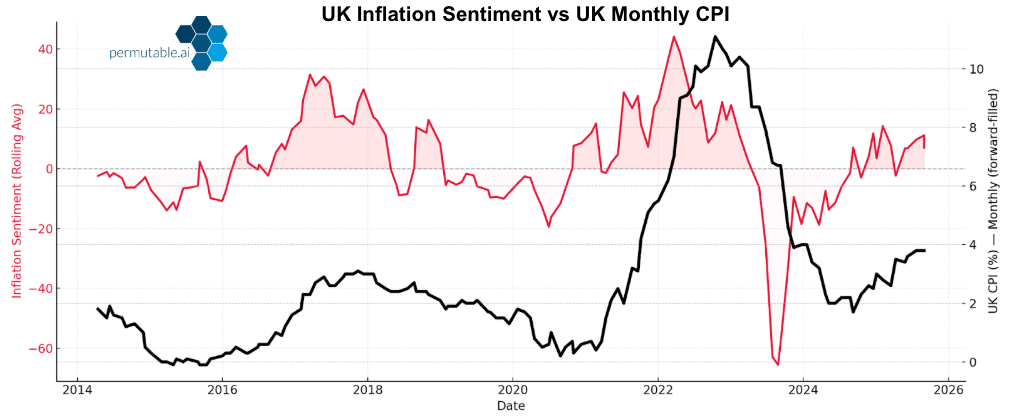
Above: Time-series chart showing Permutable AI’s UK inflation sentiment indicator alongside forward-filled monthly UK CPI inflation, illustrating how media-derived market sentiment signals relate to changes in realised inflation over time

Above: Annotated chart showing LNG prices alongside machine-readable macroeconomic and fundamental sentiment signals, illustrating a sustained bullish regime supported by supply disruptions, geopolitical developments, and global LNG project and export dynamics identified using Permutable AI’s multi-entity sentiment intelligence.
Table of Contents
ToggleHow market sentiment indicators work in practice
Market sentiment indicators can be constructed in several different ways. Price-based indicators are the most traditional, derived directly from ratios such as put-to-call or volatility indices like the VIX. They are simple to interpret and widely used, but their weakness is that they are essentially reactive, reflecting shifts that have already occurred.
Text-based sentiment indicators, by contrast, interpret unstructured information such as news articles, policy speeches, and corporate announcements to quantify changes in tone or focus. Using natural language processing, these indicators convert qualitative narratives into quantifiable data that can be acted upon programmatically.
The most effective approaches are often blended. By combining text-based insights with market-derived signals, investors can build a more robust view of investor psychology and market direction. In practice, a blended sentiment indicator might capture a sudden increase in negative news coverage about energy supply disruptions, while simultaneously observing widening spreads in energy futures markets. Together, these signals provide a powerful case for action.
One of the most compelling aspects of modern sentiment indicators is their ability to function as leading, rather than lagging, signals. For example, a market sentiment indicator for gold may capture rising bullish sentiment in response to growing uncertainty about central bank credibility. This can occur days or even weeks before the price of gold itself breaks out. Similarly, sentiment indicators around oil might detect an intensifying narrative around OPEC production targets or geopolitical risks, providing advance warning of market repricing.

Above: Annotated chart showing gold prices alongside machine-readable fundamental, sector, and macroeconomic sentiment signals, illustrating a sustained bullish regime driven by monetary policy uncertainty, central bank demand, geopolitical tensions, and shifts in US dollar dynamics identified using Permutable AI’s multi-entity sentiment analysis.
Why market sentiment indicators are crucial for institutional investors
For institutional investors managing multi-asset portfolios, sentiment indicators have become indispensable. Their first and most obvious role is in identifying turning points in market regimes. Markets move in cycles – inflationary to disinflationary, risk-on to risk-off – and the most profitable opportunities often lie in recognising when one regime is ending and another is beginning. Sentiment indicators can highlight these shifts earlier than official macroeconomic data, offering investors a crucial head start.
Sentiment indicators also enhance risk management by acting as early warning systems. A sudden change in sentiment towards sovereign debt sustainability, for instance, might foreshadow a sell-off in government bonds well before spreads begin to widen. Similarly, negative narratives around global trade flows can provide portfolio managers with the chance to rebalance exposures before volatility spikes.
A further advantage lies in systematic model building. Backtestable sentiment datasets allow quants to validate strategies against long-term historical records, helping ensure robustness and reducing the risk of overfitting. When used as uncorrelated signals alongside price or fundamental data, sentiment indicators can significantly strengthen the consistency of systematic returns.
Finally, market sentiment indicators should not be viewed in isolation. Their greatest strength is realised when combined with traditional macroeconomic metrics. By overlaying real-time sentiment with data such as CPI releases, employment figures, or balance of payments statistics, investors can create a more comprehensive and dynamic picture of market conditions.
Building market sentiment indicators with AI
Artificial intelligence has transformed the landscape of sentiment analysis. Natural language processing enables machines to read and interpret global news and policy releases in multiple languages at scale. Anomaly detection then highlights where discourse deviates sharply from historical baselines, often signalling the emergence of a new regime.
At Permutable, our sentiment indicators are built with entity-level granularity. This means investors can compare sentiment around the Federal Reserve with that surrounding the European Central Bank, or assess how OPEC narratives diverge from general oil market discourse. The result is an explainable, transparent, and actionable set of indicators rather than a black box.
Retail versus institutional sentiment indicators
Retail sentiment tools such as the CNN Fear & Greed Index offer a simple snapshot for equity investors. However, they are narrow in scope, equity-biased, and largely lagging. Institutional-grade sentiment indicators, by contrast, must be cross-asset, global in scope, and machine-readable. They must provide historical depth for backtesting, offer transparency on signal construction, and be integrated easily into trading systems. At Permutable, our sentiment intelligence suite is designed from the ground up to meet all of these institutional needs.
Challenges with traditional sentiment indicators
Despite their widespread use, many traditional sentiment measures fall short. Noise can drown out genuine signals, narrow regional focus leaves global investors exposed, and delays in survey-based data render them less useful in fast-moving markets. Furthermore, black-box models that fail to explain their outputs can erode confidence among institutional users. AI-driven sentiment indicators directly address these challenges by providing faster, broader, and explainable insights.
Use cases for systematic and discretionary traders
The application of market sentiment indicators extends across trading styles and functions. For systematic traders, sentiment data can be ingested directly into quantitative models. For example, an FX desk might feed real-time sentiment scores into an algorithm designed to capture currency volatility, while a commodities desk might use sentiment signals around oil, LNG, or metals as predictive factors in futures models. With years of historical data available, these signals can also be backtested extensively to ensure reliability.
Discretionary traders benefit in a different way. They can use platforms such as our Trading Co-Pilot to visualise sentiment spikes in real time. This allows portfolio managers to quickly gauge when narratives are accelerating or fading, and to adjust positions accordingly. Seeing sentiment shifts displayed in a clear, intuitive dashboard turns abstract signals into actionable conviction.
Risk managers also find clear value in sentiment intelligence. By monitoring sentiment anomalies across regions, sectors, or asset classes, they can stress-test portfolios against emerging risks. For instance, a sudden deterioration in sentiment around European energy policy could inform scenario analysis, helping institutions prepare for downside shocks.
Permutable AI’s market sentiment indicator suite
As recently featured in Hedge Fund Alpha, we offer a next-generation sentiment intelligence suite built specifically for institutional investors. Our market sentiment indicators are designed to detect turning points earlier, capture anomalies with precision, and deliver data in a format that traders and analysts can use immediately.
Through real-time anomaly detection, the market sentiment indicators suite highlights emerging regime shifts the moment they occur. By applying entity-level granularity, investors can monitor sentiment around central banks, governments, commodities, currencies alongside a comprehensive taxonomy of drivers, enabling targeted strategies. With a deep backtestable history, our sentiment indicators can be validated against years of price data, giving systematic traders the confidence to integrate them directly into quantitative models. Transparency is built into the system, with every sentiment score traceable back to its underlying content source.
Delivery is flexible. For systematic funds, sentiment indicator feeds are available via API in machine-readable formats ready to plug into Python, R, or Matlab workflows. For discretionary managers, our Trading Co-Pilot dashboard provides intuitive visualisations of sentiment anomalies, allowing portfolio managers to act decisively without delving into raw data. The result is a suite that combines speed, accuracy, and clarity in a way that is unmatched by traditional sentiment providers.

Above:: Annotated price chart showing silver prices alongside machine-readable fundamental, sector, and macroeconomic sentiment signals, illustrating a sustained bullish regime identified by Permutable AI’s Trading Co-Pilot intelligence layer during a silver price surge
Future of market sentiment indicators
The evolution of sentiment analysis is accelerating. Artificial intelligence and machine learning continue to increase coverage and accuracy, with cross-asset integration ensuring that sentiment indicators are no longer siloed, but instead provide a coherent view across equities, bonds, FX, and commodities. Most importantly, real-time intelligence is becoming the new standard, with lagging survey data now serving as secondary confirmation rather than the primary source. And at Permutable, we’re leading the charge by delivering institutional-grade sentiment indicators that bridge the gap between raw global data and actionable market intelligence.
Market sentiment indicators: Final thoughts
Market sentiment indicators are now a vital part of modern investment strategy. They provide the foresight to detect regime shifts early, the discipline to manage risks effectively, and the evidence to build robust quantitative models. The question for institutional investors is no longer whether to use sentiment indicators, but which providers can deliver real value.
At Permutable, our market sentiment indicator suite transforms unstructured global information into structured, backtestable, and real-time intelligence. For systematic traders, this means cleaner model inputs and more consistent returns. For discretionary managers, it means actionable dashboards that highlight changes before they are visible in traditional macro data. In today’s fragmented and fast-moving world, where macro events can shift markets within hours, having the right sentiment indicators is not a luxury – it is an absolute necessity.
Book a demo today and discover how our next-generation sentiment intelligence can turn global events into your competitive advantage. Email enquiries@permutable.ai to book your walk through.
Frequently asked questions about market sentiment indicators
What is a market sentiment indicator?
A market sentiment indicator is a measure of how investors and market participants feel about financial markets at a given moment in time. While traditional indicators often rely on surveys or price-derived measures, modern approaches such as our suite use natural language processing and anomaly detection to interpret news, policy announcements, and global discourse in real time.
How do market sentiment indicators work?
Market sentiment indicators work by capturing data that reflects investor confidence, fear, or optimism. Survey-based tools rely on questionnaires, while price-derived indicators measure activity in derivatives or credit markets. AI-driven sentiment indicators, like those from Permutable, analyse vast volumes of unstructured global data and convert them into quantifiable, backtestable signals that investors can use directly.
Why are market sentiment indicators important for institutional investors?
Market sentiment indicators are important because they help institutional investors anticipate turning points before traditional macroeconomic data catches up. They also improve risk management by providing early warnings of regime shifts and allow systematic funds to enhance their quantitative models with uncorrelated, explainable data.
What are the main types of market sentiment indicators?
The three main types of sentiment indicators are survey-based, market-derived, and AI-driven. Surveys measure expectations directly, market-derived tools reflect behaviour in securities markets, and AI-driven indicators analyse global narratives in real time. Among these, AI-driven sentiment indicators provide the most timely and comprehensive view, especially for cross-asset investors.
How are Permutable’s market sentiment indicators different?
Permutable’s market sentiment indicator suite goes beyond generic tools by combining real-time anomaly detection with entity-level granularity. This allows investors to monitor sentiment not just by asset class, but by specific institutions, commodities, or regions. The suite is fully backtestable, API-ready for systematic workflows, and available through the Trading Co-Pilot dashboard for discretionary managers.
Who uses market sentiment indicators?
Market sentiment indicators are widely used by hedge funds, systematic macro traders, asset managers, and risk officers. They are particularly valuable for institutions that need to anticipate shifts in commodities, currencies, and sovereign debt, as well as for those managing diversified global portfolios.
Can market sentiment indicators be backtested?
Yes. Our market sentiment indicators are provided with multi-year historical data, enabling investors to backtest signals against asset price movements. This allows quants to validate strategies before implementation and ensures that the indicators can be used confidently in systematic trading models.