Germany economy insights: Understanding global perception through sentiment analysis

It’s a fact that how people see a country’s economy depends on more than just its policies and performance. The way news reports on it plays a big role too which is what is currently happening with regards to the Germany economy with media speculation around whether the country will once again be the sick man of Europe. At Permutable AI, we’ve built smart tools to measure and analyse these opinions through AI-driven sentiment analysis. These tools and our data intelligence give businesses, investors and government officials key insights into how the world views their actions and economic situation.

Our recent sentiment analysis about Germany’s economy from June 5, 2024, to August 29, 2024, gives a clear picture of how the world sees the fourth-biggest economy. This study isn’t just for researchers; it has real-world effects for people in global markets international trade, or economic policy. We’ll look into the main findings of our analysis and what they mean for Germany, the European economy as well as world economy implications. 

How sentiment shapes economic analysis

Before we get into the details of what we discovered through our news sentiment analysis, let’s talk about why sentiment analysis matters so much in today’s economic scene. The usual economic signs—how fast the economy’s growing how many people are out of work, and how prices are changing—are still key, but they don’t tell the whole story. Sentiment analysis adds another piece to the puzzle. It captures the mood and views that drive how markets act, sway decisions about investing from other countries, and help shape government policies.

Our sentiment analysis doesn’t just count words or link positive and negative terms. Our cutting-edge systems take into account context how often topics appear, and how strong the sentiment is in news stories. This gives us a detailed picture of how people view economic events. As a result, we can forecast market trends, evaluate how economic policies might affect things, and provide valuable insights that you can use right away.

Germany economy sentiment around economic data

Germany economy sentiment: Key findings

When we looked at news sentiment around the Germany economy over the last three months, we saw a mix of feelings that was very revealing. The overall sentiment oscillated, with some hopeful periods balanced by times of worry about trade issues. Let’s take a closer look at what we discovered:

Germany economy and mixed sentiment around employment

Our sentiment analysis reveals varied opinions. A decrease in sentiment shows concern around the expected 2% drop in Germany’s working-age population by 2045. But Germany’s active steps to tackle labour shortages, like making working in Germany more appealing, was met with positive sentiment.   Overall, our sentiment analysis shows the world approves of Germany’s efforts, which suggests people recognise the country’s dedication to keeping a strong job market despite population challenges.
 
Germany economy global sentiment around employment and labour market

Trade worries about Germany economy lead to negative views

Our analysis found major drops in sentiment around trade issues. News that “Foreign trade volume in Germany shows declines in exports, imports in May” caused a clear dip in people’s outlook. Germany’s economy has deep ties to global trade. As the world’s third-biggest exporter, any hints of weak trade volumes worry people. The negative sentiment around falling trade volumes in May shows worldwide concern about Germany’s ability to weather possible trade problems.

For global companies and investors, this highlights the need to keep a close eye on Germany’s trade flows. Our sentiment analysis suggests that further drops in trade could make worries worse, leading to more careful investment choices and a new look at risks in German markets.

Germany economy and sentiment around economic doubt 

The ups and downs in sentiment during the time we looked at match the shaky economy that’s been a big part of 2024. Times when sentiment was more positive thanks to brighter economic news often came before drops in sentiment when bad reports came out.

These sentiment swings show a bigger picture of a world economy that’s hard to predict. Things like global conflicts, supply chain disruptions and  and fluctuating prices of raw materials have all added to this uncertainty. For Germany, keeping a steady and upbeat economic mood in the face of these tough spots is key to make sure investors stay confident and the economy stays stable.

What our sentiment data means for economic strategy and the Germany economy 

What we found from looking at the sentiment in the media has several big takeaways for businesses, investors, and policymakers alike.

1. Using positive sentiment to boost economic growth

While the world still looks upon the European country’s efforts to strengthen its labour market and tackle challenges head on, Germany should use this feeling of relative goodwill about its job market to make itself more appealing to talent from around the world.  Surely, then, the government must think about creating specific immigration rules and perks to bring in skilled workers. But also, companies might look into teaming up and coming up with hiring plans that tap into this.

2. Tackling trade worries head-on

Most importantly, Germany needs to deal with the worries about how well it’s doing in trade, as perceived by the rest of the world. There is some low hanging fruit to be had in making trade deals stronger, or putting money into areas that don’t get hit as hard when global trade is impacted by global forces. By facing these concerns head-on , Germany can lower the chances of negative sentiment towards its economy and its association implications.

3. Quick thinking helps handle uncertain times

Against all that, when the economy gets shaky, you need to think on your feet as a leading economy. Companies and leaders should be ready to change plans fast using up-to-the-minute sentiment data to guide their choices. By keeping an eye on global news sentiment, there are opportunities to spot risks and grab chances as they surface, rather than reading it in yesterday’s news when it’s already too late.

We help you understand the economic mood

Here at Permutable AI, we take pride in giving our clients top-notch, real-time, AI-driven insights about the economy and world events. We’ve built our sentiment analysis tools to give you a clear, fact-based picture of how people see economic events worldwide.

If you’re a business wanting to grow in new markets, an investor trying to make improve your portfolio, or a policymaker aiming to boost economic stability, our real-time news sentiment insights can give you an advantage. By using our cutting-edge AI tools and core datasets, you can keep up to date with global shifts and make sure your plans are based on the latest and most correct info out there. For an idea of what you may be missing drop us a line to enquiries@permutable.ai or get in touch by filling in the contact form below.

Get in touch


Further reading

Looking for more global insights? Why not read our articles on:

How countries of Europe view each other’s economy according to GDP

How the UK’s economy is perceived in Europe

How France’s political situation is viewed

An analysis of sentiment around the UK property market recovery

How the world views Russia in terms of wars, politics and the economy

An analysis of global perceptions towards the Germany economy

Analysis: Our US data today reveals diverse regional concerns and economic uncertainty

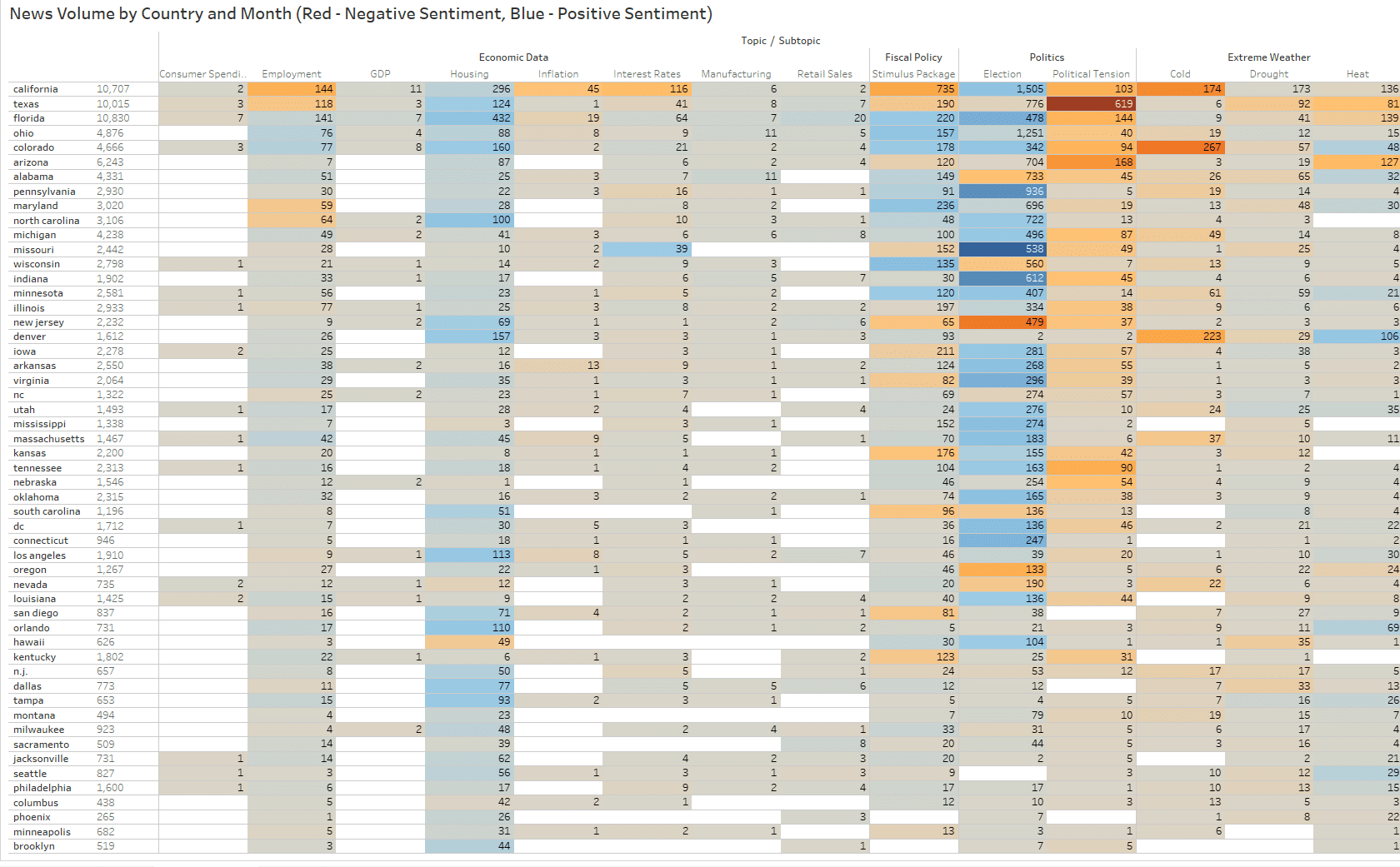
In an era defined by its relentless news cycle, the diversity and volume of our news sentiment US data today is an interesting reflection of the day-to-day happenings. It also gives a fascinating glimpse into the regional and national psyche. This sentiment analysis chart from our United States data shows a detailed breakdown of news coverage across various states and topics, revealing patterns that highlight both shared concerns and distinct regional issues. Let’s take a closer look at what’s going on here.

California, Texas and Florida dominate 

First, the data shows an unsurprisingly high volume of news in major states such as California, Texas, and Florida. These states, known for their large populations and significant economic influence, dominate media coverage, especially in areas relating to the economy and politics. The breadth of coverage in these regions reflects their crucial role in shaping national policy and economic trends.

But while economic topics like consumer spending, employment, and housing feature prominently across several states, with both positive and negative sentiments attached, in California and Texas, for instance, our US data today is substantial across these categories. This isn’t just because of ongoing public and media interest in the economic health of these states; the mixed sentiments may suggest varying degrees of recovery or distress related to ongoing economic challenges such as inflation, interest rates, and the housing market’s stability.

A closer look at variation in sentiment

The reality is that this variation in sentiment could be indicative of the broader national economic uncertainty. While some regions show signs of robust economic activity and optimism, others continue to struggle with job losses and a sluggish housing market. Our US data today is particularly interesting to observe as the U.S. attempts to navigate post-pandemic economic waters, where the pace of recovery has been anything but uniform.

In stark contrast, politics, as expected, remains a hotbed of engagement and, often, contention. The coverage of elections and political tensions is intense in politically pivotal states. The sentiment analysis underscores the divided nature of current American political discourse, evidenced by the volume of news and the mixed sentiments it engenders. States like California and Texas are not just political battlegrounds but also barometers of national political mood, where every policy change or political event can generate significant media buzz.

As for environmental concerns, particularly drought and heat, they are prominently featured in states known for their susceptibility to these challenges. California’s coverage under drought conditions, marked by a preponderance of negative sentiment, points to the ongoing concerns over climate change effects and water scarcity. These concerns also shape the policy frameworks and local economies of these regions.

But look how news related to stimulus packages generally carries a positive sentiment, reflecting public approval or optimism towards governmental economic interventions. This positive reception can be seen as a testament to the crucial role these packages play in sustaining households and businesses through economic disruptions. Our US data today highlights the importance of these policies in public and media narratives during economic recovery phases.

More than just numbers and charts

Today, this sentiment analysis provided our insights is a lot more than just numbers and charts; it’s also gives a snapshot of the narrative of American life in its various shades. From economic struggles and successes to political unrest and environmental crises, our US data today reflects the pulse of a nation grappling with numerous challenges and opportunities. Understanding these patterns is helpful for businesses and policymakers alike. But what about the general public, whose perceptions and realities are shaped significantly by what the news chooses to highlight and how it is presented?

For now, our analysis is reminder of the ever-evolving nature of news and its impact on public perception and policy. It is a tool for understanding not just where America stands today, but also where it may be heading in the turbulent times ahead. As we continue to track and analyse our US data today and everyday, one thing remains clear: the path to a more informed and engaged public discourse goes through understanding these diverse and complex media narratives.

All this means that as we delve deeper into the nuances of regional news sentiment, we are in a position to gain valuable insights into the collective American experience—insights that are essential for anyone involved in shaping the future of this vibrant and diverse land of opportunity. 

Explore more US data 

This glimpse into our US data today paints a vivid picture, but it’s just the beginning. Imagine the power of exploring these regional narratives in real-time, with interactive maps and customizable dashboards. That’s we can help with.  Request your free trial today of our US data and see how our comprehensive platform empowers you to track sentiment shifts across all 50 states, allowing you to identify emerging trends and understand public opinion on critical issues, as well as being able to drill down by region, industry or topic to gain granular insights that inform your business or investment decisions. Explore how our data can help you uncover hidden patterns and correlations and make data-driven predictions by getting in touch below. 


EXPLORE NOW