Germany economy insights: Understanding global perception through sentiment analysis

It’s a fact that how people see a country’s economy depends on more than just its policies and performance. The way news reports on it plays a big role too which is what is currently happening with regards to the Germany economy with media speculation around whether the country will once again be the sick man of Europe. At Permutable AI, we’ve built smart tools to measure and analyse these opinions through AI-driven sentiment analysis. These tools and our data intelligence give businesses, investors and government officials key insights into how the world views their actions and economic situation.

Our recent sentiment analysis about Germany’s economy from June 5, 2024, to August 29, 2024, gives a clear picture of how the world sees the fourth-biggest economy. This study isn’t just for researchers; it has real-world effects for people in global markets international trade, or economic policy. We’ll look into the main findings of our analysis and what they mean for Germany, the European economy as well as world economy implications. 

How sentiment shapes economic analysis

Before we get into the details of what we discovered through our news sentiment analysis, let’s talk about why sentiment analysis matters so much in today’s economic scene. The usual economic signs—how fast the economy’s growing how many people are out of work, and how prices are changing—are still key, but they don’t tell the whole story. Sentiment analysis adds another piece to the puzzle. It captures the mood and views that drive how markets act, sway decisions about investing from other countries, and help shape government policies.

Our sentiment analysis doesn’t just count words or link positive and negative terms. Our cutting-edge systems take into account context how often topics appear, and how strong the sentiment is in news stories. This gives us a detailed picture of how people view economic events. As a result, we can forecast market trends, evaluate how economic policies might affect things, and provide valuable insights that you can use right away.

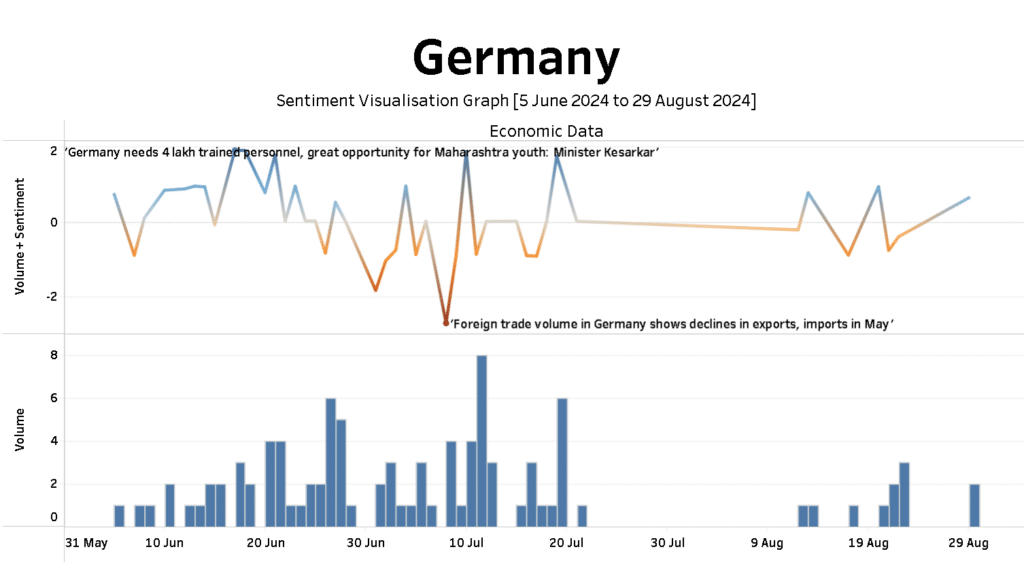
Germany economy sentiment around economic data

Germany economy sentiment: Key findings

When we looked at news sentiment around the Germany economy over the last three months, we saw a mix of feelings that was very revealing. The overall sentiment oscillated, with some hopeful periods balanced by times of worry about trade issues. Let’s take a closer look at what we discovered:

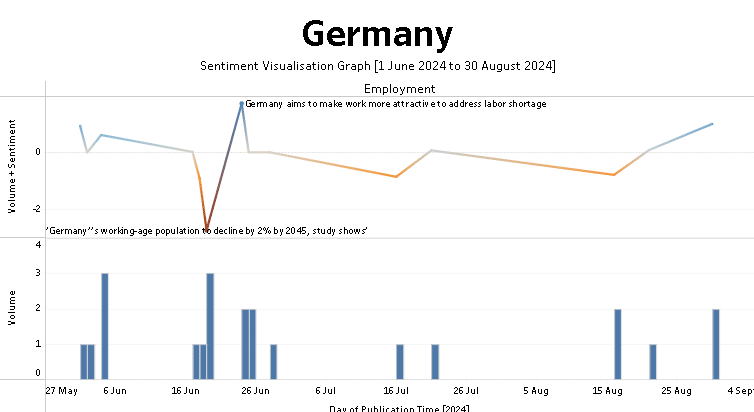
Germany economy and mixed sentiment around employment

Our sentiment analysis reveals varied opinions. A decrease in sentiment shows concern around the expected 2% drop in Germany’s working-age population by 2045. But Germany’s active steps to tackle labour shortages, like making working in Germany more appealing, was met with positive sentiment.   Overall, our sentiment analysis shows the world approves of Germany’s efforts, which suggests people recognise the country’s dedication to keeping a strong job market despite population challenges.
 
Germany economy global sentiment around employment and labour market

Trade worries about Germany economy lead to negative views

Our analysis found major drops in sentiment around trade issues. News that “Foreign trade volume in Germany shows declines in exports, imports in May” caused a clear dip in people’s outlook. Germany’s economy has deep ties to global trade. As the world’s third-biggest exporter, any hints of weak trade volumes worry people. The negative sentiment around falling trade volumes in May shows worldwide concern about Germany’s ability to weather possible trade problems.

For global companies and investors, this highlights the need to keep a close eye on Germany’s trade flows. Our sentiment analysis suggests that further drops in trade could make worries worse, leading to more careful investment choices and a new look at risks in German markets.

Germany economy and sentiment around economic doubt 

The ups and downs in sentiment during the time we looked at match the shaky economy that’s been a big part of 2024. Times when sentiment was more positive thanks to brighter economic news often came before drops in sentiment when bad reports came out.

These sentiment swings show a bigger picture of a world economy that’s hard to predict. Things like global conflicts, supply chain disruptions and  and fluctuating prices of raw materials have all added to this uncertainty. For Germany, keeping a steady and upbeat economic mood in the face of these tough spots is key to make sure investors stay confident and the economy stays stable.

What our sentiment data means for economic strategy and the Germany economy 

What we found from looking at the sentiment in the media has several big takeaways for businesses, investors, and policymakers alike.

1. Using positive sentiment to boost economic growth

While the world still looks upon the European country’s efforts to strengthen its labour market and tackle challenges head on, Germany should use this feeling of relative goodwill about its job market to make itself more appealing to talent from around the world.  Surely, then, the government must think about creating specific immigration rules and perks to bring in skilled workers. But also, companies might look into teaming up and coming up with hiring plans that tap into this.

2. Tackling trade worries head-on

Most importantly, Germany needs to deal with the worries about how well it’s doing in trade, as perceived by the rest of the world. There is some low hanging fruit to be had in making trade deals stronger, or putting money into areas that don’t get hit as hard when global trade is impacted by global forces. By facing these concerns head-on , Germany can lower the chances of negative sentiment towards its economy and its association implications.

3. Quick thinking helps handle uncertain times

Against all that, when the economy gets shaky, you need to think on your feet as a leading economy. Companies and leaders should be ready to change plans fast using up-to-the-minute sentiment data to guide their choices. By keeping an eye on global news sentiment, there are opportunities to spot risks and grab chances as they surface, rather than reading it in yesterday’s news when it’s already too late.

We help you understand the economic mood

Here at Permutable AI, we take pride in giving our clients top-notch, real-time, AI-driven insights about the economy and world events. We’ve built our sentiment analysis tools to give you a clear, fact-based picture of how people see economic events worldwide.

If you’re a business wanting to grow in new markets, an investor trying to make improve your portfolio, or a policymaker aiming to boost economic stability, our real-time news sentiment insights can give you an advantage. By using our cutting-edge AI tools and core datasets, you can keep up to date with global shifts and make sure your plans are based on the latest and most correct info out there. For an idea of what you may be missing drop us a line to enquiries@permutable.ai or get in touch by filling in the contact form below.

Get in touch


Further reading

Looking for more global insights? Why not read our articles on:

How countries of Europe view each other’s economy according to GDP

How the UK’s economy is perceived in Europe

How France’s political situation is viewed

An analysis of sentiment around the UK property market recovery

How the world views Russia in terms of wars, politics and the economy

An analysis of global perceptions towards the Germany economy

Why geopolitics is important to international business in 2024

Geopolitics, the study of how geography, economics, and politics intersect to shape the world, has become increasingly important. This field looks at the complex relationships between countries, regions, and international organizations and how these interactions influence power, resource distribution, and global decision-making. In our fast-changing world, understanding the impact of geopolitics is crucial for businesses, policymakers, and individuals. Geopolitical factors impact everything from trade agreements and investments to the stability of supply chains and access to critical resources. And we mustn’t forget how quickly these factors can change. In this article, we’ll take a closer look at why geopolitics is important to international business in today’s complex world. 

Why geopolitics is important to business and the role of geopolitics in today’s world

Geopolitics shapes the global economic and political environment. It examines how a region’s physical characteristics, like resources, climate, and location, influence power dynamics and strategic interests. Additionally, geopolitics explores historical and cultural factors, such as colonial legacies, ethnic tensions, and ideological differences, which contribute to conflicts and alliances.

By understanding geopolitical forces, businesses and organizations can better anticipate and navigate global challenges and opportunities. This knowledge helps businesses identify risks, tap into emerging markets, and make more informed strategic decisions. At the moment, the importance of this understanding cannot be overstated.

How geopolitical risks impact businesses

Geopolitical risks are a major concern for businesses today. Factors like political instability, trade disputes, and international conflicts can disrupt supply chains, affect market access, and cause financial volatility. Companies that don’t account for these risks may face unexpected challenges that hurt their competitiveness and profitability. First, the obvious impact is on supply chains.

To manage these risks, businesses need a deep understanding of the geopolitical landscape. This involves thorough risk assessments, diversifying supply chains, and maintaining flexible business strategies to adapt to changing circumstances.

Measuring and assessing geopolitical risk

Assessing geopolitical risk is complex. Organizations use both quantitative and qualitative data to evaluate the impact of geopolitical factors. This includes analyzing economic indicators, political stability indexes, and expert assessments of global trends. The facts and numbers are clear enough when we look at historical data, but the truth is more complicated when predicting future risks.

One common approach to measuring geopolitical risk is using risk assessment frameworks, which assign numerical values to various factors based on their likelihood and impact. These frameworks help businesses prioritize risk management efforts and allocate resources effectively.

Emerging geopolitical risks in 2024

These days, we can see some new geopolitical risks bubbling up across the globe at a rapid rate. This year, it is expected that businesses will face major geopolitical risks including:

The continuation of geopolitical risks between major powers 

Trade, investments and global cooperation can be adversely affected thus heightening the state of instability through the strained relationships between China, USA plus Russia. On that basis, firms need to know how they are poised for such shifts occurring.

Regional conflicts and instabilities

Many of the ongoing crises witnessed are likely to keep posing a threat to supply chains and cause strain on energy markets worldwide due to regional wars that have not been resolved. Of course, there is also the significant concern that these wars may escalate further at any given time. 

Technology competition and cyber risk

The world might is likely to witness a rise in geopolitical tensions and emerging threats as nations scramble for leadership in AI, quantum computing and cyber warfare. However; keeping pace with these fast changing technologies is extremely challenging as nations vie for tech supremacy. 

Climate change and the associated resource dearth

Scarcity of resources as well as climate change impacts such as severe weather patterns run the risk of fuelling more international disputes making it hard for companies to operate without friction from governments and other long-term implications.

Why geopolitics is important to international business

It is evident that geopolitical risks play a crucial role in influencing business operations, financial performance, and long term viability. Some of the ways that geopolitical risks can affect businesses include:

Supply chain disruption

Political uncertainties and trade wrangles can interfere with the smooth movement of goods leading to a slow down and extra costs in the process of shipment. Companies are increasingly diversifying their supply chain to mitigate these risks by securing alternative sources of supply.

Market access and investment barriers

Market access restrictions make it difficult for business expansion through foreign direct investment (FDI) which also fuels geopolitical tensions. What happens in the market whether there is a likelihood of it becoming stable again remains unclear hence companies should be on the lookout for both risks and opportunities.

Regulatory compliance risk

Sanctions from global policies based on political changes and the introduction of new rules’ can result in a compliance and legal nightmare. This gives a flavour of  how complicated regulatory environments are becoming.

Strategies for managing geopolitical risks

Managing geopolitical risks calls for proactive measures among companies including:

Regular risk assessments

Businesses need to ensure they always update geopolitical risk assessments  and be aware of how these might impact their operations. One can never play down the importance of carrying out regular reviews, particularly when geopolitical risks are involved.

Diversification of suppliers and markets

Flexibility is essential in dealing with geopolitical uncertainty. Businesses can adopt tactics such as multi-sourcing, which involves diversifying suppliers across multiple geographical regions. This technique reduces reliance on a single source and provides alternatives in the event of an interruption.

Engaging with policymakers and industry groups

Work together with government entities as well as organizations in the same industry field that regulate policies to be up to speed with what is required from such governing bodies and industry groups. This kind of connectivity enables anticipation over amendments to existing regulations across the globe. 

Investing in geopolitical intelligence and analysis

Permutable AI’s Geopolitical Risk Intelligence allows our partners to make informed decisions concerning what is happening in regards to geopolitical risk in real-time.  In a fast-paced environment where things change in split seconds, our Geopolitical Risk Intelligence tool uses advanced artificial intelligence as well as machine learning algorithms which analyze enormous volumes of data obtained from various media including news sources and social networking sites among others so that users can get instant insight about current sentiments shaping up globally.

Key elements and advantages

Our tool is able to scan through the web every 30 minutes for up-to-the-minute details on geopolitical incidences reported on in the news across up to 12,000 sources and across half a million articles day,  giving a whole, unbiased pictures regarding different areas of geopolitical risk enabling timely response by companies.

The next iteration of our tool will include forecasting capabilities, using advanced technologies including neural network systems to recognize patterns that point out ‘red flags’ during its predictions process. Interestingly, these models are capable of predicting key developments only by looking at a few data patterns based on vast amounts of information  to predict future potential geopolitical risks as they start bubbling up.  

Why geopolitics is important to business: Conclusion 

Understanding and managing geopolitical risks has never been more crucial in our contemporary world setting. However, failing to do so may lead to unpredicted challenges for some businesses while others may thrive on identifying as well as mitigating risks. The strategic decision-making process of organizations must be improved to reflect these turbulent times, with a focus on operational resilience. 

If experience tells us anything, it’s that proactive management of geopolitical risks can make a significant difference. We can be reasonably confident that with the right insights and strategies, businesses can navigate these challenges more effectively. Imagine, too, the potential for growth when businesses are well-prepared for geopolitical shifts. Just to make it absolutely crystal clear: there are real and sizeable risks inherent in geopolitics. The private sector must prepare itself for today’s highly volatile geopolitics through active risk management and real-time intelligence.

Harness AI-driven insights for proactive geopolitical risk management

Ready to see how AI-driven geopolitical risk intelligence can transform your decision-making? Contact us for a demo of our AI-driven news sentiment analysis which is available through our Trading Co-Pilot subscription, or to request a free trial. You can also access top-line geopolitical insights through our Real-Time Geopolitical Insights & AI Market Sentiment Analysis Dashboard which is publicly available to view. 

Request demo

Permutable AI releases ranking of worst companies facing political risk in 2024

Our latest AI-driven sentiment analysis of companies facing political risk shows what a turbulent world now means for businesses. For corporations, the world is intricate. Consequently; negotiating through the ever moving parts of politics can be tough for enterprises. This is because sometimes political events happen unexpectedly and they usually affect everything from procurement processes right up to how consumers feel about products and services provided by organizations.

An insight into some of the companies facing political risk is given by our AI-driven news sentiment analysis. Our analysis relies on artificial intelligence to find out organizations that stand out due to negative sentiment driven by political uncertainties. It does so by examining huge amounts of information looking at more than half a million articles each day across up to 12,000 sources so as to measure what public perception looks like in relation to this particular concern. 

Worst companies facing political risk: Our findings from news sentiment analysis 

Let’s take a closer look at the findings. Gazprom tops the list because, ultimately, it used gas as part of its political strategies while  engaged in Ukraine conflicts. At the same time, despite its popularity level; Apples reputation has fallen due to ongoing privacy issues and the the associated politics of privacy policies. Our findings also unearth financial scandals an lack of controls characterised by Credit Suisse’s operations.

Our analysis also singles out major tech companies. Google’s parent company, Alphabet is perceived to be quite monopolistic in its operations and has faced various criticisms on how it handles data. Such is also the case with Facebook/Meta whose privacy breaches keep attracting much criticism including allegations surrounding their alleged political bias.

Ranking


Company Name

Sector

Data Sources

Average Sentiment

Positive Data Points

Negative Data Points

Negative Score

1

Gazprom

Oil & Gas

262

-0.35

982

2109

-1075.70

2

Apple 

Computers

225

-0.60

321

1403

-1038.71

3

Credit Suisse 

Banks

120

-0.68

109

621

-499.97

4

Alphabet

Internet

135

-0.61

114

505

-376.53

5

Nvidia 

Semiconductors

112

-0.52

143

472

-321.01

6

Moody’s 

Commercial Services

84

-0.49

112

351

-226.73

7

McDonald’s 

Retail

181

-0.30

233

447

-204.37

8

Facebook 

Internet

100

-0.68

43

239

-191.33

9

British American Tobacco 

Agriculture

66

-0.47

93

261

-165.58

10

Uniper 

Electric

68

-0.38

124

284

-154.78

Politics and profits 

According to Wilson Chan, our CEO: “These findings underline an important aspect within which organisations must conduct their political interactions.” He further emphasizes that, “Being politically savvy in today’s global economy is not just about following the rules; it also involves defining paths consistent with both corporate principles and societal demands”. These findings are important for businesses of various sizes, allowing them to understand how their interaction with politics impacts public perception. In terms of reputation risk management, companies can leverage these insights to proactively mitigate potential reputational damage.

It’s a reasonable argument that businesses should take this sentiment analysis into account when interpreting public opinion on political matters and do the following:

  • Introduce policies that are in tandem with the community’s beliefs: Even amid political turmoil, organisations that highly regard environmental consciousness, fair employment treatments, and moral data handling are likely to receive positive reception.
  • Employ straightforward running strategies that involve consistent talking: Honesty in matters related to political participation results in credibility as well as enabling them to keep potential negative assumptions under control.
  • Do away with any unforeseen issues: By taking a more proactive approach to risk mitigation – for example, by using our real-time sentiment analysis tracking tools – they can be alerted to and respond to any reputational risks before, putting measures in place before they become too significant to handle. 
  • Determine the impact of political campaigns impact: Frequent monitoring of the popular mood enables such companies to know  how effective their political policies are and tweak where necessary.

The facts are clear enough. Our analysis of the worst companies facing political risk using our AI-driven new sentiment analysis highlights the significance of adopting a strategic view on political engagement. To avoid political and reputational risks, global market players should –  particularly in today’s turbulent world economy –  be politically savvy and forward-looking.

Find out more about our company political risk data sets, available as part of our ESG intelligence data, or request more granular data by contacting us at enquiries@permutable.ai

Geopolitical risk data: Exploring key uses in 2024 and beyond

To say the world has become an increasingly volatile place to do business is no exaggeration. With that being the case, it’s absolutely no wonder that geopolitical risk data has become the unsung hero of many of today’s critical decisions. From assessing the stability of a country to predicting the impact of social unrest, geopolitical risk data provides a treasure trove of insights for businesses, investors, and policymakers. The fact is that thanks to the advancements in technology such a LLM transformers – which is the foundation of what we use at Permutable AI – this data revolution means that the provision of real-time in-depth geopolitical risk sentiment analysis can make or break strategic decisions.

Why geopolitical risk data matters

One thing above all is certain. understanding geopolitical risks isn’t just an option in the current business climate; it’s a necessity. Imagine you’re a business executive eyeing an expansion into a new market. Geopolitical risk data can shed light on the political, economic, and social dynamics at play, helping you make informed decisions. It’s like having a crystal ball that highlights potential pitfalls and opportunities.

Take, for example, Permutable AI’s geopolitical risk sentiment analysis. By tapping analysing vast amount of news data related to geopolitical risk in real-time data, we’re able to provide businesses with actionable insights that can guide everything from market entry strategies to supply chain adjustments. The point is, this isn’t just about avoiding risks; it’s about seizing opportunities that others might miss.

The power of informed decision-making

Business is harder than ever and competition is fierce. But geopolitical risk data can give decision-makers competitive edge in several ways. For instance, our geopolitical analysis digs into the political and economic factors that could impact operations, giving businesses a clearer picture of the landscape. 

Needless to say, identifying potential risks is half the battle. Armed with this knowledge, companies can develop strategies to manage and mitigate these risks. Whether it’s diversifying supply chains or adjusting market entry plans, geopolitical risk data is invaluable. Additionally, in the fast-paced business world, staying ahead of the curve is crucial. Companies that effectively leverage geopolitical risk data can anticipate market changes and identify new opportunities before their competitors.

Real-world applications of geopolitical risk data

Risk assessment and mitigation for international businesses

When it comes to businesses operating internationally, geopolitical risk data is a game-changer. It can help to identify potential risks and develop strategies to manage them. For instance, our data and analysis can highlight political instability or economic downturns in specific regions, allowing companies to adjust their strategies accordingly. The key here is a proactive approach, which not only ensures business continuity but also protects investments and assets.

Investment decision-making

We know from our clients that investors rely heavily on geopolitical risk data to make informed decisions. By evaluating the stability and growth potential of different markets, they can allocate their capital more wisely. Our sentiment analysis helps investors makes strides when assessing the risks and rewards associated with various opportunities, leading to higher risk-adjusted returns. Not only that, it also enables companies to stay ahead of regulatory changes and adapt to evolving geopolitical landscapes.

Supply chain management

There’s no question that in today’s global supply chain network, understanding geopolitical risks is crucial. First and foremost, geopolitical risk data can map and assess risks associated with supply chains, such as trade disputes or natural disasters. Ultimately, geopolitical risk insights provide organizations with valuable information to help diversify and optimize supply chains, ensuring resilience and continuity. Additionally, this data helps companies identify potential bottlenecks and develop contingency plans to mitigate disruptions effectively.

Insurance underwriting and risk assessment

For insurers, accurately pricing risks is vital. So where does geopolitical risk data come into play? This type of data allows them to understand the risks associated with different regions and industries. In this case, geopolitical risk data helps insurers develop tailored products and enhance their overall risk management strategies, ensuring they are well-prepared for any eventuality. It also enables insurers to improve their portfolio diversification and make more informed decisions about reinsurance arrangements.

Government and policy-making

Increasingly, governments and policymakers are also benefitting from geopolitical risk data, aiding in national security assessments, economic policy formulation, and disaster preparedness. That means governments can develop more effective policies and allocate resources more efficiently. It also supports international cooperation and diplomacy efforts by providing a clearer understanding of global dynamics and potential threats.

Corporate Social Responsibility initiatives 

There’s no question that geopolitical risk data can significantly impact how companies design and implement their CSR initiatives. First and foremost, understanding the social and political dynamics of a region allows companies to tailor their CSR efforts to address local needs more effectively. For example, our data can highlight areas where environmental or social issues are particularly pressing, enabling businesses to focus their resources where they can make the most significant impact. This not only benefits the community but also enhances the company’s reputation and stakeholder relations.

Crisis management and emergency response planning

In an era where crises can bubble up unexpectedly – from political upheavals to natural disasters – having robust emergency response plans is essential. Geopolitical risk data provides critical insights into potential crisis hotspots and helps organizations prepare for various scenarios. As a result, companies using this data can develop comprehensive crisis management strategies, ensuring they are ready to respond swiftly and effectively when a crisis occurs. Case in point – our real-time geopolitical data and analysis can be particularly valuable in monitoring developing situations and providing up-to-date information to guide response efforts.

Key considerations when using geopolitical risk data

While the benefits of geopolitical risk data are clear, it’s crucial to use this data judiciously. First and foremost, ensure the data is sourced from reputable and credible providers like Permutable AI, known for their accurate and insightful analysis. It’s also vital that the data is regularly updated to reflect the latest developments and changes in the global landscape.

Interpreting geopolitical risk data within the broader context of the relevant region, industry, or organization is essential. This means considering historical trends, cultural nuances, and socio-political factors that might influence the data. A holistic approach to interpretation leads to more accurate assessments and strategic decisions. Combining quantitative data, such as economic indicators and political stability indexes, with qualitative insights like expert analysis and on-the-ground intelligence provides a more comprehensive understanding of geopolitical risks. This mixed-methods approach can uncover deeper insights and nuances that numbers alone might miss.

Transparency and objectivity in the data are also crucial. Look for providers that offer clear and unbiased assessments, as data influenced by biases or political agendas can skew analysis. An objective provider ensures that the data is presented without undue bias, offering a clear and accurate picture of the risks. Additionally, regular monitoring and updating of geopolitical risk assessments are vital because geopolitical landscapes can change rapidly. This ensures that decisions and strategies remain relevant and effective, allowing for adaptation to new information and trends, which is key to maintaining a proactive stance in risk management.

Finally, integrating geopolitical risk data into broader strategic planning processes ensures that it informs all aspects of decision-making. This integration helps align risk management strategies with overall business or policy objectives, maximizing the value of the data and making it a powerful tool for navigating the complexities of the global landscape.

Navigating the global landscape

In today’s complex world, effectively managing geopolitical risks is crucial. The bottom line is this: by leveraging geopolitical risk data, organizations, investors, and policymakers can make strategic decisions that mitigate threats and capitalize on opportunities. Companies like Permutable AI are leading the way, developing the tools needed to surface geopolitical insights in real-time in the ever-changing global landscape. 

Ready to see how AI-driven geopolitical risk intelligence can transform your decision-making? Contact us for a demo of our AI-driven news sentiment analysis which is available through our Trading Co-Pilot subscription, or to request a free trial. You can also access top-line geopolitical insights through our Real-Time Geopolitical Insights & AI Market Sentiment Analysis Dashboard which is publicly available to view. 

Request demo

Gaining competitive advantage with geopolitical data analysis in 2024

In an increasingly interconnected and volatile global landscape, the ability to harness real-time geopolitical data has become a crucial asset for businesses, governments, and decision-makers. This article explores the power of real-time geopolitical data analysis, delving into the significance of this emerging field and the hidden insights it can uncover.

Why is real-time geopolitical data analysis vital in this turbulent world?

The world is in a constant state of flux, with events and dynamics in one region having far-reaching implications across the globe. Traditional geopolitical analysis, reliant on historical data and retrospective assessments, often falls short in providing the agility and responsiveness required to navigate today’s complex and rapidly evolving landscape. Enter real-time geopolitical data analysis – a transformative approach that leverages the wealth of information available in the digital age to gain a more comprehensive and up-to-date understanding of global affairs.

Real-time geopolitical data analysis involves the collection, aggregation, and interpretation of a vast array of data sources, including news articles, social media, satellite imagery, and government reports, among others. By processing and analysing this data in near-real-time, decision-makers can identify emerging geopolitical trends, detect potential flashpoints, and anticipate the ripple effects of geopolitical events with greater precision.

Understanding the significance of real-time data in geopolitics

In the fast-paced world of geopolitics, the ability to make informed decisions quickly can mean the difference between success and failure. Traditional geopolitical analysis, which often relies on historical data and retrospective assessments, can be slow to adapt to the rapidly changing global landscape. Real-time data analysis, on the other hand, provides a more dynamic and responsive approach, enabling decision-makers to stay ahead of the curve.

By tapping into the wealth of real-time data available, businesses and governments can gain a more comprehensive understanding of the geopolitical landscape, identify emerging threats and opportunities, and make more informed strategic decisions. This agility is particularly crucial in an era of heightened uncertainty, where geopolitical events can have immediate and far-reaching consequences.

How real-time data analysis can uncover hidden insights

The power of real-time geopolitical data analysis lies in its ability to uncover hidden insights that may otherwise go unnoticed. By processing and analysing vast amounts of data from multiple sources, these advanced analytical techniques can identify patterns, trends, and correlations that traditional methods may overlook.

For example, real-time monitoring of local news sources can provide valuable insights into the sentiments and concerns of populations in different regions, which can inform decision-making on issues such as trade, diplomacy, and security. Similarly, the analysis of satellite imagery and sensor data can reveal changes in military deployments, infrastructure development, or environmental conditions that may have significant geopolitical implications.

By integrating these diverse data sources and applying sophisticated algorithms and machine learning models, real-time geopolitical data analysis can uncover hidden connections, anticipate potential flashpoints, and enable more proactive and informed decision-making.

The role of technology in real-time geopolitical data analysis

The rise of real-time geopolitical data has been driven in large part by advancements in technology, particularly in the fields of data processing, artificial intelligence, and cloud computing. These technological innovations which is at the heart of what we do at Permutable AI have enabled the collection, aggregation, and analysis of vast amounts of data at unprecedented speeds and scale.

Advanced data processing and storage capabilities, powered by cloud-based infrastructure, allow for the efficient handling of the massive volumes of data generated from various sources. Meanwhile, sophisticated algorithms and machine learning models can identify patterns, trends, and anomalies in this data, transforming it into actionable insights.

Additionally, the proliferation of mobile devices, social media, and sensor networks has led to an exponential increase in the availability of real-time data, further enhancing the potential of geopolitical data analysis. As these technological capabilities continue to evolve, the field of real-time geopolitical data analysis is poised to become an increasingly indispensable tool for businesses, governments, and decision-makers.

Examples of hidden insights revealed through real-time geopolitical data analysis

The power of real-time geopolitical data analysis has been demonstrated in numerous real-life scenarios, where hidden insights have been uncovered and leveraged to inform critical decision-making.

Election monitoring

Election monitoring is pivotal in regions with political volatility. Observing elections in countries like Turkey, Brazil, and Nigeria can predict shifts in foreign policy, economic reforms, and potential civil unrest. Understanding pre-election sentiments and post-election reactions in these regions can provide insights into governance changes that might influence international investments and diplomatic ties.

Trade policy changes

Trade policy changes are significant, especially in relationships like those between the USA and China. Monitoring adjustments in trade policies, such as new tariffs, helps businesses and investors anticipate market fluctuations, supply chain disruptions, and shifts in pricing structures. This information is crucial for companies to adapt their operational and financial strategies to mitigate potential adverse effects.

Civil unrest and protests

Civil unrest and protests require constant vigilance. Places like Hong Kong, France, and Lebanon often experience public dissent, which can pose risks to corporate assets, personnel, and operations. By tracking local news and social media for signs of unrest, corporations can develop contingency plans, enhance security measures, and make informed decisions regarding their activities in these areas.

Terrorism and security threats

Terrorism and security threats in regions such as the Middle East, North Africa, and South Asia necessitate careful monitoring. Assessing incidents of terrorism and governmental responses provides critical data for security planning and risk management. This monitoring is indispensable for industries like tourism, aviation, and international shipping, which are directly impacted by regional security issues.

These examples illustrate the transformative power of real-time geopolitical data analysis, showcasing its ability to uncover hidden insights and provide decision-makers with the agility and responsiveness required to navigate the complex and ever-changing global landscape.

Benefits of incorporating real-time data analysis in geopolitical decision-making

Incorporating real-time geopolitical data analysis into decision-making processes offers substantial benefits across various sectors, enhancing the effectiveness of strategies in dynamic global contexts. Here’s a deeper look at each of these advantages:

Enhanced situational awareness

Real-time data analysis allows decision-makers to continuously monitor global activities and trends, providing a comprehensive view of the geopolitical landscape. This constant flow of information helps leaders stay ahead of developments, anticipate potential issues, and react to events as they unfold. For instance, a government might use real-time data to track regional conflicts and adjust foreign policy or humanitarian aid in response.

Improved risk mitigation

With access to real-time data, organizations can swiftly identify and analyze emerging risks, from economic instability to political upheaval or natural disasters. This proactive approach enables them to devise preemptive strategies to mitigate these risks before they escalate, safeguarding assets and operations. Businesses, for example, can adjust their supply chain strategies in anticipation of potential disruptions caused by political unrest or trade embargoes.

Informed strategic planning

Real-time insights are crucial for aligning organizational strategies with the fluid geopolitical environment. By understanding the current state of global affairs, companies and governments can make strategic decisions that capitalize on opportunities and avoid areas of potential conflict. For example, a multinational corporation might use real-time analysis to decide on opening a new office in a region showing stable economic and political indicators.

Enhanced competitive advantage

Organizations that leverage real-time geopolitical data can gain a significant edge over competitors who rely on outdated information. This advantage comes from making informed, timely decisions that allow organizations to quickly adapt to global changes and seize opportunities that others may overlook. In highly competitive markets, this can be the difference between leading the market or falling behind.

Increased agility and responsiveness

The ability to process and act on real-time data enhances an organization’s agility, enabling rapid responses to unexpected geopolitical shifts. This responsiveness is critical in managing crises or taking advantage of sudden changes in the business environment, such as regulatory changes or market openings due to geopolitical agreements.

Improved collaboration and coordination

Real-time data leads to better collaboration and coordination among various stakeholders, including government agencies, international organizations, and corporate departments. Shared real-time insights ensure that all parties are on the same page, which is crucial for coherent and unified responses to global events and challenges.

As the world becomes increasingly interconnected and the pace of change accelerates, the value of real-time geopolitical data analysis grows. Businesses, governments, and policymakers who effectively integrate this tool into their decision-making processes are better equipped to navigate the complexities of the global landscape, ensuring they remain resilient and proactive in the face of international challenges.

Challenges and limitations of real-time data analysis in geopolitics

While real-time geopolitical data analysis offers significant benefits, several challenges and limitations need careful consideration to effectively leverage its capabilities. Here’s an in-depth look at these issues:

Data quality and reliability

One of the primary concerns in real-time data analysis is the variable quality, accuracy, and reliability of the data sources. This inconsistency can result in biased or misleading insights, which can misguide decision-making processes. To combat this, organizations need to establish rigorous data validation processes that help verify and cross-reference data before it is used to make any significant decisions, something we ourselves have achieved through our work which we discuss in greater detail here.

Technological limitations

Real-time analysis requires robust technological infrastructure, including high-performance computing capabilities and sophisticated algorithms like those we have developed at Permutable AI. Organizations lacking these resources may find it challenging to process and analyze large volumes of data effectively. Overcoming these limitations typically requires substantial investments in technology and analytics platforms, which might not be feasible for all, especially smaller entities or those in less developed regions.

Interpretation and context

Extracting actionable insights from real-time data also requires a deep understanding of the geopolitical context. Analysts must interpret the data within the complex framework of local and international political, economic, and cultural dynamics. Without a nuanced understanding of these factors, there is a risk of data misinterpretation, which could lead to inappropriate or detrimental decisions.

Uncertainty and volatility

The geopolitical landscape is inherently dynamic, with rapid changes that can soon render data analyses obsolete. This volatility complicates decision-making based solely on real-time data. To mitigate this, organizations should complement real-time analysis with predictive models and scenario planning to better anticipate and adapt to potential future developments.

Integration with traditional analysis

 Integrating real-time data with traditional geopolitical analysis poses another significant challenge. It requires not only new tools and skills but also a shift in organizational culture to value data-driven insights alongside traditional analytical methods. Achieving a balance between the immediacy of real-time data and the depth of traditional research is crucial for a comprehensive understanding of geopolitical risks.

To navigate these challenges effectively, organizations must adopt a multifaceted strategy that includes investing in advanced analytics infrastructure, prioritizing data ethics, enhancing decision-makers’ data literacy, and maintaining an adaptable approach. This enables the integration of real-time data insights with in-depth geopolitical analysis, ensuring organizations can fully harness the potential of real-time analysis while minimizing associated risks.

Permutable AI’s real-time geopolitical data analysis

At Permutable, our AI-driven geopolitical data data analysis, offers unparalleled access to real-time, unbiased data. Our platform conducts meticulous sentiment analysis that spans a wide array of critical dimensions—global elections, conflicts, political tensions, terrorism, and national security—all through an impartial lens. This robust framework ensures that our clients receive a clear, unfiltered view of global dynamics, enabling them to make informed decisions without the cloud of bias.

Leveraging our objective data and geopolitical data analysis can significantly influence and shape your strategic initiatives. Our actionable insights serve as invaluable resources, empowering you to refine and enhance strategies for your clients and stakeholders. By integrating our data into your decision-making processes, you can ensure that your strategies are informed by the most current and comprehensive intelligence available.

Slide 2 HeadingLorem ipsum dolor sit amet consectetur adipiscing elit dolorClick HereSlide 2 HeadingLorem ipsum dolor sit amet consectetur adipiscing elit dolorClick HereSlide 3 HeadingLorem ipsum dolor sit amet consectetur adipiscing elit dolorClick Here
Previous slide
Next slide

How businesses and governments can leverage real-time geopolitical data analysis for competitive advantage

Businesses and governments can use real-time geopolitical data analysis to navigate the complexities of the global landscape, achieving notable strategic advantages. Here are detailed ways these organizations can capitalize on this powerful resource:

Proactive risk management

Organizations can stay ahead of potential challenges by continuously monitoring a wide range of real-time data sources. This constant vigilance helps in early identification of emerging risks such as political instability, regulatory shifts, or disruptions in the supply chain. By recognizing these risks early, organizations can swiftly implement strategies to mitigate impact, safeguarding assets and maintaining stable operations. This proactive approach not only minimizes the exposure to risks but also reduces the potential financial and operational impacts.

Informed strategic planning

Real-time data analysis serves as a critical tool in strategic planning by providing ongoing insights into the geopolitical environment. This information allows organizations to align their strategic objectives with the dynamic geopolitical landscape, enabling them to seize emerging opportunities and adapt to changes effectively. As a result, organizations can make forward-looking decisions that are rooted in current realities, ensuring relevancy and competitiveness in their strategic initiatives.

Enhanced market intelligence

In today’s fast-paced market environments, having up-to-date intelligence is crucial. Real-time geopolitical data analysis offers businesses critical insights into market trends, consumer behaviours, and competitive dynamics. Armed with this information, companies can fine-tune their market strategies, adjust product offerings, and tailor marketing campaigns to better meet the needs of the market and stay ahead of competitors.

Improved policy and decision-making

For governments and policymakers, real-time data analysis is invaluable for crafting timely and effective policies. By integrating up-to-the-minute data into their decision-making processes, these entities can respond to geopolitical events with precision and agility. This capability is essential for addressing issues that require immediate attention, such as crisis response, regulatory changes, or diplomatic initiatives, ensuring that policies are both relevant and effective.

Strengthened stakeholder engagement

Real-time insights facilitate more informed and meaningful interactions with stakeholders. By sharing up-to-date, accurate information, organizations can build trust and develop stronger relationships with partners, investors, customers, and regulatory bodies. This enhanced engagement supports better alignment of goals, more collaborative approaches to challenges, and improved satisfaction among stakeholders.

Increased operational efficiency

Real-time data analysis enables organizations to quickly identify and address operational challenges. Whether it’s streamlining supply chains, optimizing resource allocation, or adjusting to market demands, the ability to act swiftly can significantly enhance operational efficiency. This heightened responsiveness not only helps in maintaining smooth operations but also strengthens the organization’s resilience against external pressures and disruptions.

To effectively leverage real-time geopolitical data analysis for competitive advantage, organisations must invest in the necessary technological infrastructure, develop the required analytical capabilities, and foster a culture of data-driven decision-making. By embracing this transformative approach, businesses and governments can navigate the complexities of the global landscape with greater agility and confidence, positioning themselves for long-term success.

Final thoughts: The future of real-time geopolitical data analysis

As the world becomes increasingly interconnected and volatile, the importance of real-time geopolitical data analysis will only continue to grow. This transformative field, driven by advancements in technology and the exponential growth of available data, is poised to redefine how businesses, governments, and decision-makers navigate the global landscape.

Looking ahead, the future of real-time geopolitical data analysis is likely to be characterised by several key trends including increased integration of advanced technologies, expansion of data sources, and improvements in data quality and reliability. It promises to redefine how global dynamics are navigated by enabling more nuanced, informed, and timely decisions that can shape the future of the global landscape. As this field continues to evolve, its adoption is expected to expand, providing powerful insights that can be a critical differentiator for businesses, governments, and decision-makers worldwide.

To stay ahead of the curve and capitalise on the transformative power of real-time geopolitical data analysis, explore our cutting-edge solutions and services. Contact us today to learn how we can help your organisation navigate the complexities of the global landscape and gain a competitive edge.

As the world continues to evolve at an accelerated pace, the ability to harness real-time geopolitical data analysis will be a critical differentiator for businesses, governments, and decision-makers seeking to thrive in the 21st century. By embracing this transformative approach, organisations can unlock hidden insights, anticipate emerging trends, and make more informed, agile, and impactful decisions – ultimately shaping the future of the global landscape.

Discover the power of informed decision-making 

Unlock a world of opportunities with Permutable AI’s real-time geopolitical data feeds. Experience firsthand how our comprehensive, unbiased insights can transform your strategic initiatives. Get in touch today to start your free trial and see how our advanced analytics can give you the edge in navigating complex global landscapes.

Ready to see how AI-driven geopolitical risk intelligence can transform your decision-making? Contact us for a demo of our AI-driven news sentiment analysis which is available through our Trading Co-Pilot subscription, or to request a free trial. You can also access top-line geopolitical insights through our Real-Time Geopolitical Insights & AI Market Sentiment Analysis Dashboard which is publicly available to view. 

Request demo
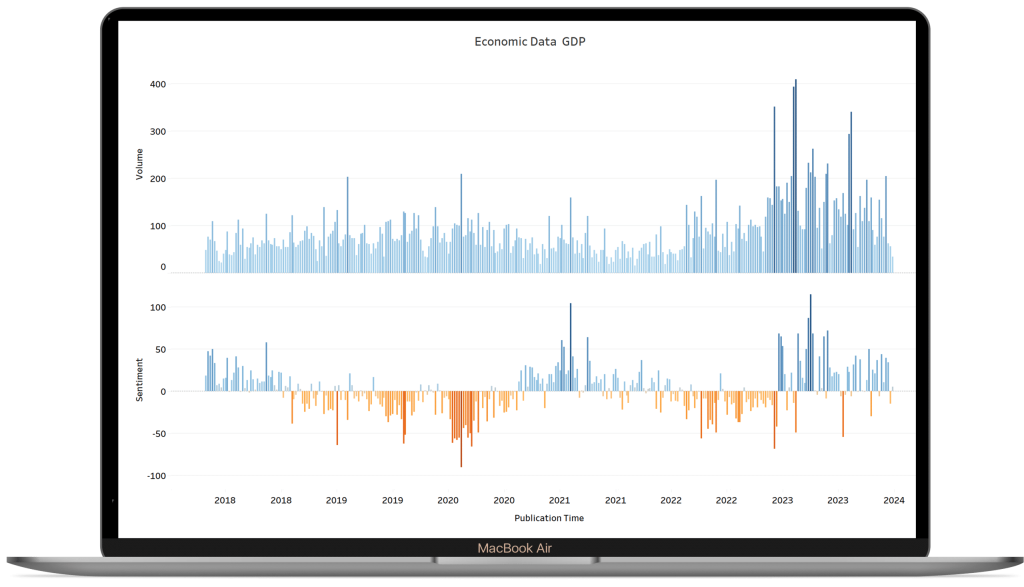

Unlocking the power of economic sentiment data to drive strategic business planning in 2024 and beyond

In today’s fast-paced and ever-changing business environment, staying ahead of the competition requires more than just market research and financial analysis. To truly understand the dynamics of the market and make informed business decisions, companies are turning to economic sentiment data. Economic sentiment data provides a valuable insight into the overall mood and outlook of consumers, businesses, and investors, offering a unique perspective on the state of the economy. This article will explore the importance of economic sentiment data in business planning and provide a comprehensive guide on how to harness its power of this type of economic data.

Understanding the importance of economic sentiment data in business planning

Economic sentiment data plays a crucial role in business planning as it provides a real-time snapshot of the economic landscape. By monitoring the sentiment of consumers, businesses can gain valuable insights into their purchasing behavior, confidence levels, and future intentions. This form of data intelligence can help companies identify emerging trends, evaluate market demand, and adjust their strategic direction accordingly. Additionally, economic sentiment data can also provide early warning signs of economic downturns or recessions, allowing businesses to prepare and mitigate potential risks.

To truly understand the importance of economic sentiment data, consider the following scenario: a retail company is planning to launch a new product line targeting millennials. By analysing economic sentiment data, the company discovers that millennials are increasingly concerned about the environmental impact of consumer goods. Armed with this information, the company can tailor its marketing strategy to emphasise the sustainability and eco-friendliness of their products, thereby gaining a competitive edge in the market.

The role of economic sentiment data in strategic business planning

Economic sentiment data serves as a critical input in strategic business planning. By incorporating this data into the decision-making process, companies can align their strategies with the prevailing economic conditions and consumer sentiment. For instance, if economic sentiment data indicates a positive outlook and high consumer confidence, a company may decide to invest in expansion or launch new products to capitalise on the favourable market conditions. On the other hand, if economic sentiment data reveals a negative outlook and low consumer confidence, a company may opt for a more conservative approach, focusing on cost-cutting measures and risk mitigation.

Additionally, economic sentiment data can also help businesses identify untapped opportunities and emerging markets. By analysing the sentiment of consumers and businesses in different regions or industries, companies can identify potential growth areas and tailor their strategies accordingly. For example, if economic sentiment data suggests that there is a growing demand for sustainable and eco-friendly products, a company may decide to develop and market such products to meet the needs of environmentally conscious consumers.

Key indicators to consider when using economic sentiment data

When using economic sentiment data for strategic business planning, it is essential to consider key indicators that provide meaningful insights into the state of the economy and consumer sentiment. Some of the key indicators to consider include:

Consumer spending: Understanding patterns and trends in consumer expenditure provides valuable insights into consumer confidence and purchasing behaviour, crucial for assessing market demand and shaping business strategies.

Employment: Monitoring employment figures offers insights into the health of the labour market, indicating potential changes in consumer spending power, business conditions, and overall economic stability.

GDP: Gross Domestic Product serves as a broad measure of economic health, reflecting the total value of goods and services produced within a country. Analyzing GDP trends helps businesses gauge the overall economic performance and anticipate market conditions.

Inflation: Keeping track of inflation rates is essential for assessing changes in purchasing power and pricing dynamics. High inflation may impact consumer behaviour and business costs, influencing strategic decisions such as pricing strategies and resource allocation.

Business confidence: Assessing business sentiment and confidence levels provides indications of corporate outlook and investment intentions. High levels of business confidence often correlate with increased economic activity and growth opportunities.

Stock market performance: Monitoring stock market indices and trends can offer insights into investor sentiment and market expectations. Changes in stock prices and trading volumes may reflect broader economic trends and influence business planning decisions.

By incorporating these key indicators into economic sentiment analysis, businesses can gain a comprehensive understanding of the economic environment, enabling them to make informed decisions and adapt their strategies to prevailing market conditions.

By considering these key facets of data intelligence businesses can gain a comprehensive understanding of the economic landscape and make informed decisions based on the prevailing sentiment.

Slide 2 HeadingLorem ipsum dolor sit amet consectetur adipiscing elit dolorClick HereSlide 2 HeadingLorem ipsum dolor sit amet consectetur adipiscing elit dolorClick HereSlide 3 HeadingLorem ipsum dolor sit amet consectetur adipiscing elit dolorClick HereSlide HeadingLorem ipsum dolor sit amet, consectetur adipiscing elit. Ut elit tellus, luctus nec ullamcorper mattis, pulvinar dapibus leo.Click Here
Previous slide
Next slide

Above: Permutable AI’s economic datasets used to track macroeconomic sentiment and gain a competitive edge.


EXPLORE DATASETS

Common challenges and how to overcome them when using economic sentiment data

While economic sentiment data is a valuable tool for strategic business planning, there are some common challenges that businesses may face when using this data. These challenges include:

Data quality and reliability: Ensuring the quality and reliability of economic sentiment data can be challenging, especially when relying on surveys or social media data. To overcome this challenge, it is important to use rigorous sampling techniques, validate the data against other sources, and employ statistical methods to identify outliers or anomalies.

Data interpretation: Analysing economic sentiment data requires expertise in statistical analysis and data interpretation. To overcome this challenge, consider engaging data analysts or hiring professionals with experience in econometrics and data analysis. Additionally, investing in training and development programs for employees can help improve data literacy within the organization.

Data privacy and ethics: Collecting and analysing economic sentiment data raises ethical and privacy concerns, especially when dealing with personal information or sensitive topics. To address this challenge, ensure compliance with data protection regulations, obtain informed consent from survey participants, and anonymise or aggregate data whenever possible.

Data integration: Integrating economic sentiment data with other internal and external datasets can be complex and time-consuming. To overcome this challenge, consider investing in data management systems or data integration platforms that streamline the process and ensure data consistency and accuracy.

By being aware of these challenges and implementing appropriate strategies, businesses can maximise the value of economic sentiment data and overcome obstacles in its utilization.

Tips for incorporating economic sentiment data into your strategic business planning process

To effectively incorporate economic sentiment data into your strategic business planning process, consider the following tips:

  1. Define clear objectives: Clearly define your business objectives and identify the specific questions you want to answer using economic sentiment data. This will help guide your data collection efforts and ensure that you gather the right information to inform your strategic decisions.

  2. Choose the right data sources: Select data sources that are relevant to your industry, target audience, and geographical location. Consider a combination of official economic indicators, sentiment surveys, and social media data to gain a comprehensive understanding of consumer sentiment and market trends.

  3. Invest in data analytics: Invest in data analytics tools and expertise to effectively analyze and interpret economic sentiment data. This may involve hiring data analysts, upskilling existing employees, or partnering with external data analytics firms.

  4. Monitor trends and changes: Continuously monitor economic sentiment data to identify emerging trends, shifts in consumer behavior, and changes in market conditions. Regularly review and update your strategic plans based on the latest insights to stay ahead of the competition.

  5. Collaborate across departments: Foster collaboration between different departments within your organization to ensure that economic sentiment data is integrated into the decision-making process. Encourage cross-functional teams to share insights and collaborate on strategic initiatives.

  6. Evaluate the impact: Regularly evaluate the impact of incorporating economic sentiment data into your strategic business planning process. Measure the effectiveness of your decisions and assess whether the data has contributed to improved performance and competitive advantage.

These tips are a a sound starting point for effectively leveraging economic sentiment data to drive strategic business planning and achieve business success.

Harnessing the power of economic sentiment data for business success

In today’s data-driven world, economic sentiment data has become an invaluable tool for businesses seeking to gain a competitive edge. By understanding the importance of economic sentiment data in business planning, learning how to collect and analyze this data effectively, and incorporating it into the strategic decision-making process, companies can unlock its power and drive business success.

By monitoring key indicators, leveraging tools and resources, and learning from successful case studies, businesses can make informed decisions based on the prevailing economic conditions and consumer sentiment. While there may be challenges along the way, by overcoming these obstacles and following best practices, businesses can harness the power of economic sentiment data to drive strategic business planning and position themselves for long-term success.

Unlock the potential of economic sentiment data with Permutable AI’s free trial

Are you ready to harness the power of economic sentiment data to gain a competitive edge in today’s fast-paced business environment? Start your free trial of Permutable AI’s economic data intelligence today. Our data intelligence feeds provides valuable insights into consumer, business, and investor sentiment, empowering you to make informed decisions and drive business success. 


REQUEST FREE TRIAL

How data intelligence serves as a powerful political risk barometer

In today’s fast-paced and interconnected world, politics plays a crucial role in shaping the global landscape. Understanding and assessing political risk has become essential for businesses, investors, and policymakers alike. This is where data intelligence and the collection, analysis and interpreting of vast amounts of data – provide invaluable insights for informed decision-making. In the realm of politics, data intelligence serves as a powerful tool for assessing and predicting political risks.

Political risk assessment involves evaluating the potential impact of political factors on various aspects such as investments, operations, and market conditions. It helps businesses and investors identify and mitigate potential risks, thereby safeguarding their interests. Traditionally, political risk assessment relied on subjective analysis and expert opinions. However, with the advent of geopolitical data intelligence, a more data-driven and objective approach has emerged.

The importance of political risk assessment

Political risk assessment is crucial for businesses and investors operating in today’s globalized economy. Political factors such as changes in government policies, social unrest, and geopolitical tensions can significantly impact business operations and investments. Failing to anticipate and mitigate these risks can lead to financial losses and reputational damage. Therefore, a comprehensive understanding of political risks is vital for making informed decisions and developing effective risk management strategies.

Data intelligence plays a pivotal role in political risk assessment by providing a wealth of information and insights. By analysing various data sources such as news articles, social media posts, economic indicators, and historical data, data intelligence enables analysts to identify trends, patterns, and potential risks. It empowers decision-makers with actionable intelligence, helping them navigate the complex and volatile political landscape.

How data intelligence serves as a powerful political risk barometer

Data intelligence serves as a powerful political risk barometer by providing real-time and comprehensive insights into political dynamics. It enables analysts to monitor and assess political risks on an ongoing basis, allowing for timely responses and proactive risk management. By collecting and analysing vast amounts of data, data intelligence platforms can identify emerging risks, track political developments, and predict potential outcomes.

One of the key advantages of data intelligence in political risk assessment is its ability to provide a holistic view of the political landscape. It aggregates data from various sources and analyzes it using advanced algorithms and machine learning techniques. This multidimensional approach helps in uncovering hidden patterns, correlations, and interdependencies that may not be apparent through traditional analysis methods. As a result, decision-makers can gain a more nuanced understanding of political risks and make informed decisions based on data-driven insights.

The use of big data in political risk analysis

The use of big data has revolutionized political risk analysis. Big data refers to the vast volume, velocity, and variety of data generated from various sources such as social media, news articles, government reports, and financial data. Analysing big data allows for a more comprehensive and dynamic assessment of political risks.

Big data analysis in political risk assessment involves collecting and processing massive amounts of data in real-time or near real-time. Advanced technologies such as natural language processing, sentiment analysis, and network analysis are used to extract valuable insights from unstructured data sources. These insights can then be used to identify emerging risks, assess public sentiment, and predict political outcomes.

Key indicators and metrics for political risk assessment

When it comes to political risk assessment, identifying key indicators and metrics is crucial. These indicators help in monitoring and evaluating the political landscape, enabling analysts to assess the potential risks and their impact. Some of the key indicators and metrics used in political risk assessment include:

  1. Economic indicators: Economic factors such as GDP growth, inflation rates, and unemployment rates can provide insights into the stability and performance of a country’s economy. Changes in these indicators can indicate potential political risks.

  2. Social indicators: Social factors such as social unrest, protests, and public sentiment can signal underlying political tensions. Monitoring social indicators helps in assessing the level of political stability and the potential for social upheaval.

  3. Regulatory indicators: Regulatory factors such as changes in government policies, regulations, and legal frameworks can have a significant impact on businesses and investments. Tracking regulatory indicators helps in identifying potential risks and adapting to changing political environments.

  4. Geopolitical indicators: Geopolitical factors such as international conflicts, diplomatic relations, and trade policies can affect the political stability of a country. Analysing geopolitical indicators helps in understanding the potential risks arising from global events and their impact on the local political landscape.

By monitoring and analysing these key indicators and metrics, analysts can assess the political risks and their potential impact on businesses and investments.

GDP data intelligence

Above: Our economic news sentiment data intelligence


REQUEST FREE TRIAL

Case studies: Examples of data intelligence in political risk analysis

To understand the practical application of data intelligence in political risk analysis, let’s explore some case studies:

  1. Brexit: The referendum on the United Kingdom’s membership in the European Union was a significant political event with far-reaching implications. Data intelligence helped analysts track public sentiment, media coverage, and economic indicators to assess the potential risks and outcomes of Brexit. This enabled businesses to develop contingency plans and adapt to the changing political landscape.

  2. US Presidential Election: Data intelligence played a crucial role in analysing and predicting the outcome of the US Presidential Election. By analysing news articles, polling data, and social media conversations data intelligence providers accurately predicted the election results. This information helped businesses and investors anticipate potential policy changes and their impact on the economy.

These case studies demonstrate the power of data intelligence in political risk analysis and its ability to provide valuable insights for decision-making.

Challenges and limitations of using data intelligence for political risk assessment

While data intelligence offers significant advantages in political risk assessment, it is not without its challenges and limitations. Some of the key challenges include:

  1. Data quality and reliability: The accuracy and reliability of data are crucial for meaningful analysis. Data from various sources may vary in quality, relevance, and bias. Ensuring data quality and addressing biases are essential for obtaining accurate insights.

  2. Data privacy and security: Data intelligence involves collecting and analysing vast amounts of data, raising concerns about privacy and security. Safeguarding sensitive information and complying with data protection regulations are essential to maintain trust and credibility.

  3. Complexity and interpretation: Analysing large volumes of data can be complex and challenging. Interpreting the results and extracting meaningful insights require expertise in data analysis and domain knowledge. Ensuring the right skills and expertise are available is crucial for effective data intelligence.

  4. Unforeseen events and black swans: Data intelligence relies on historical data and patterns to predict future outcomes. However, unforeseen events and black swan events, such as natural disasters or political crises, can significantly impact political risks. Accounting for these uncertainties is a challenge in data-driven political risk assessment.

Despite these challenges, data intelligence continues to evolve and improve, offering valuable insights for political risk assessment.

The future of data intelligence in political risk analysis

The future of data intelligence in political risk analysis looks promising. With advancements in technology, such as artificial intelligence and machine learning, data intelligence platforms are becoming more sophisticated and powerful. These platforms can process larger volumes of data, analyze complex patterns, and provide more accurate predictions.

Furthermore, the integration of various data sources, such as satellite imagery, internet of things (IoT) data, and financial data, will enhance the capabilities of data intelligence in political risk analysis. This integration will provide a more holistic view of political risks and enable decision-makers to make more informed and proactive decisions.

As data intelligence continues to evolve, it will become an indispensable tool for businesses, investors, and policymakers in navigating the complex and uncertain world of politics.

Permutable’s political data intelligence: Tracking global sentiment

Permutable AI’s data feeds provide a deep understanding of global political dynamics by providing real-time insights into sentiment around elections and tensions in every country worldwide. Our innovative data feed aggregates and analyses data from diverse sources across 5000 sources and 500,000 articles across 120 countries daily to offer a comprehensive and unbiased view of the political landscape.

Election monitoring

Our data feeds provide a real-time overview of elections across the globe, offering valuable insights into public sentiment, voter behaviour, information on key electoral issues, and potential outcomes. This enables stakeholders, including businesses, investors, and policymakers, to anticipate political shifts and adapt their strategies accordingly.

Global tensions analysis

In addition to election monitoring, our data intelligence tracks geopolitical tensions in every country, helping stakeholders navigate complex international relations, identifying emerging conflicts, evaluating their severity, and assessing their potential impact on global stability. This allows decision-makers to proactively address geopolitical risks and safeguard their interests.

Unbiased insights

One of the key strengths of Permutable’s data intelligence is its commitment to providing unbiased insights. By leveraging advanced algorithms and machine learning techniques, the platform analyses vast amounts of data without bias or prejudice. This ensures that stakeholders receive accurate, objective information, free from subjective interpretation or manipulation. As a result, decision-makers can make informed choices based on reliable data, enhancing their ability to navigate the complex and rapidly evolving political landscape.

Complete view of global politics

By combining election monitoring and global tensions analysis, Permutable’s data intelligence feeds offer a comprehensive view of global politics. Whether it’s tracking electoral campaigns in emerging democracies or monitoring diplomatic tensions between major powers, the platform provides stakeholders with the information they need to understand and respond to political developments worldwide. This holistic approach enables businesses, investors, and policymakers to make strategic decisions with confidence, even in the face of uncertainty and volatility.

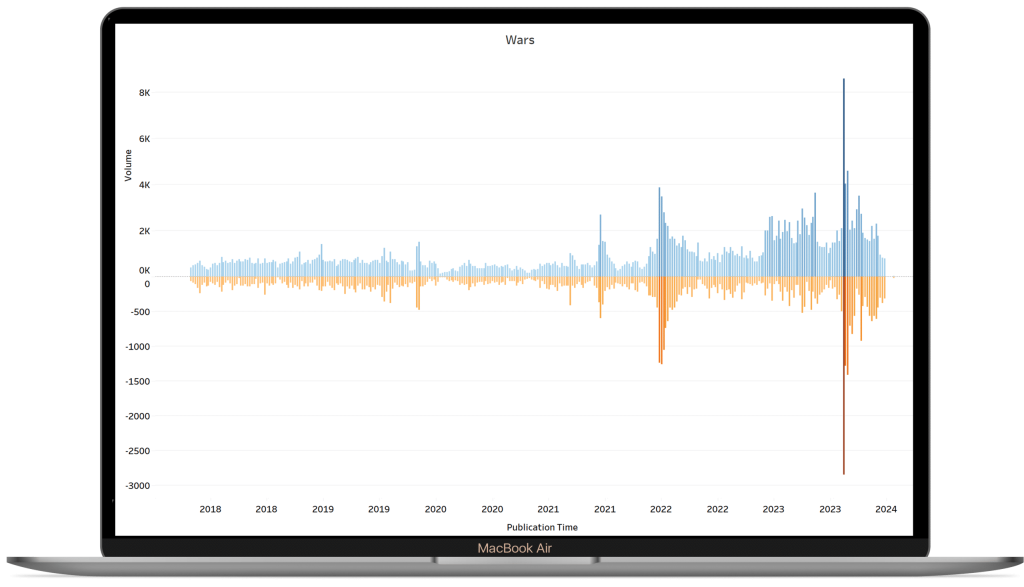
global wars data intelligence

REQUEST FREE TRIAL

Above: Our Global Conflict news sentiment dataset

Data intelligence as a political risk barometer: Final thoughts

Data intelligence has emerged as a powerful tool in political risk assessment, providing valuable insights into the complex and volatile world of politics. By analysing vast amounts of data, data intelligence platforms enable decision-makers to assess, monitor, and predict political risks. Despite its challenges and limitations, data intelligence continues to evolve and improve, offering more accurate and comprehensive insights for political risk analysis.

As businesses, investors, and policymakers navigate the global landscape, harnessing the power of data intelligence will be crucial for making informed decisions and managing political risks effectively. By unlocking the insights hidden in data, data intelligence serves as a powerful political risk barometer, enabling proactive risk management and safeguarding interests.

Find out more

Ready to harness the power of Permutable’s data intelligence for determining political risk? Whether you’re seeking real-time insights into global sentiment around elections, tracking geopolitical tensions, or exploring our comprehensive data feeds, we’re here to help. To find out more about our data intelligence feeds and how it can benefit your organisation visit our dedicated data intelligence hub or request a free trial below.


REQUEST FREE TRIAL

Join our Political Intelligence BETA Testing Program

political data intelligence

.Unlock unparalleled insights into global political trends and developments with Permutable AI’s Political Intelligence BETA Program. Gain complimentary access to our state-of-the-art REAL TIME political data sentiment analysis tool and stay ahead of the competition. Join now to explore unbiased data, influence strategic initiatives, and gain a competitive advantage in today’s complex geopolitical landscape. Sign up today for early access and be among the first to leverage the power of our advanced analytics. Don’t miss this exclusive opportunity to shape the future of political intelligence. 


FIND OUR MORE