US inflation trends are proving stubborn – our Global Macro Sentiment Indices maps the pressure beneath them

This article examines how US inflation trends are complicating the case for a Federal Reserve rate cut in 2026. Using Permutable’s forthcoming Global Macr0 Sentiment Indices inflation sentiment series, it explores pressure across energy, services and household-facing prices. It is aimed at macro analysts, traders, investors, economists and policy watchers tracking inflation persistence and Fed policy risks.

US inflation trends are showing that disinflation remains uneven. While US inflation is below its recent peaks, Permutable’s Global Macro Sentiment Indices series suggest pressure is rebuilding across energy, services and household-facing prices, raising the bar for a Federal Reserve rate cut in 2026. The case for a Fed cut in 2026 rests on US inflation trends becoming less persistent, not merely lower than before.

Our forthcoming Global Macro Sentiment Indices – which tracks market and media sentiment signals across macro themes, commodities and inflation-linked categories – shows pressure rebuilding across energy, services and household-facing prices, making the easing path less straightforward.

The difficulty for policymakers is that the latest inflation signal is moving in the wrong direction for a simple easing narrative. US-Iran escalation has pushed energy risk back into the macro picture just as underlying inflation has failed to give the Fed enough comfort. In isolation, an oil shock can be treated as temporary. But when services remain sticky and household-facing prices are still visible, energy becomes harder to ignore.

The Fed cannot solve an oil shock. Its policy problem is whether it can cut rates while that shock is leaning against the disinflation path.

Why this matters for institutional investors

For institutional investors, the key implication is that the Fed-cut trade depends less on a single soft inflation print and more on whether disinflation broadens across energy, services and household-facing prices.

That matters across rates, FX, commodities and equities. If inflation persistence remains visible in GMSI signals, expectations for policy easing may need to adjust. A higher-for-longer path would affect duration exposure, dollar positioning, commodity risk premia and equity sectors sensitive to discount rates.

The central question is no longer whether inflation is lower than it was. It is whether US inflation trends are broad enough, durable enough and benign enough to allow policymakers to ease without undermining inflation credibility.

Permutable’s Global Macro Sentiment Indices shows where the pressure is building

Permutable’s Global Macro Sentiment Indices US inflation sentiment series show the policy problem forming beneath the headline.

Aggregate inflation sentiment has rebuilt into the hard-data move. Energy is the clearest acceleration. Services remain the persistence risk. Food keeps the shock visible to households. That mix matters for the 2026 policy outlook because the Fed does not need inflation to reaccelerate sharply to delay easing. It only needs insufficient evidence that US inflation trends are returning sustainably to target.

In that sense, GMSI is not simply tracking whether inflation is high or low. It is mapping where inflation pressure is becoming more visible across the categories that matter for policy, markets and household expectations.
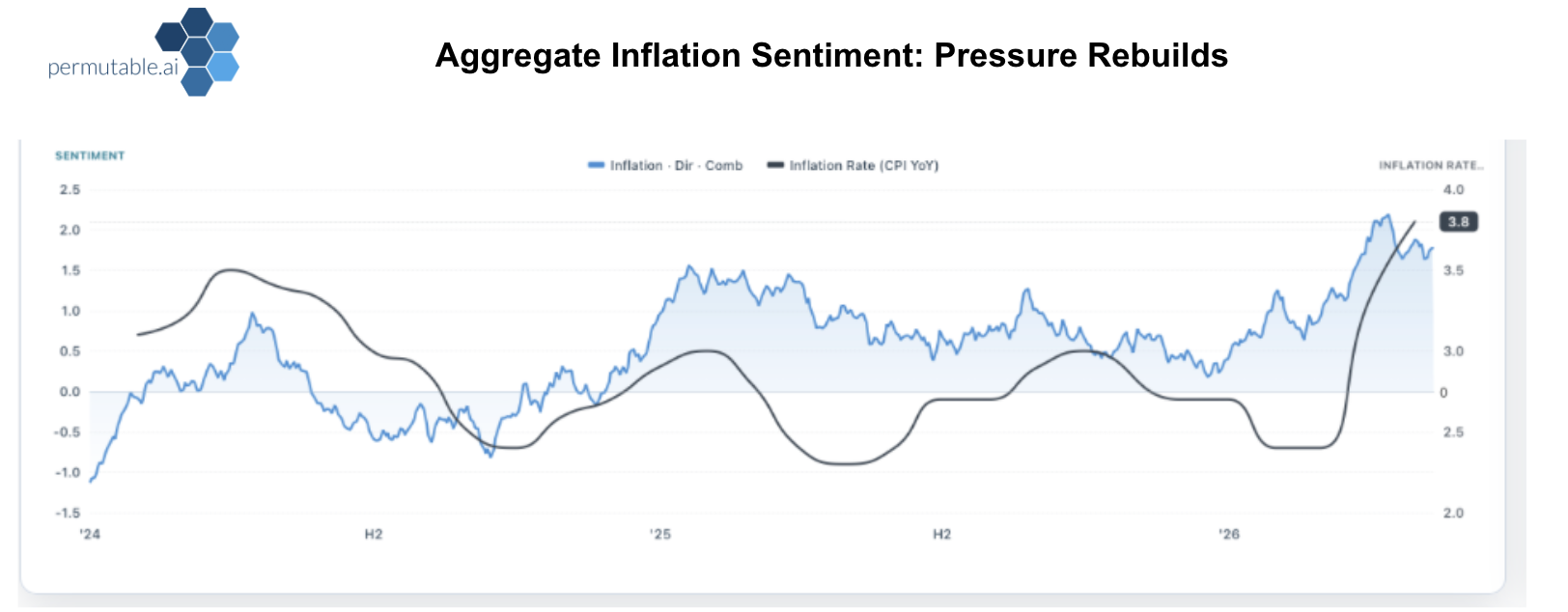
Chart showing Permutable’s aggregate inflation sentiment signal rising into 2026 alongside the US CPI inflation rate, highlighting rebuilding inflation pressure across broader US inflation trends.

Above: Aggregate inflation sentiment, taken from Permutable’s Global Macro Sentiment Indices shows that overall inflation pressure is rebuilding into 2026, alongside a higher US CPI inflation rate. The signal highlights why the Fed’s easing path depends on broad, durable disinflation rather than a single soft inflation print.

Energy is the timing problem

Energy sentiment is the sharpest mover in the GMSI charts, rising as oil and Gulf supply risks move back into view. For policy, the timing is the problem. Energy is rising before the rest of the inflation basket has cooled enough. The channel runs through fuel, freight, input costs and fertiliser.

A temporary energy shock need not change the long-run inflation outlook. But it can still delay a cut if it arrives while the Fed is waiting for confirmation that disinflation is durable. For investors, this makes energy more than a commodity story. It becomes a macro timing risk, especially if oil-linked pressure feeds into breakevens, inflation expectations or central bank communication.
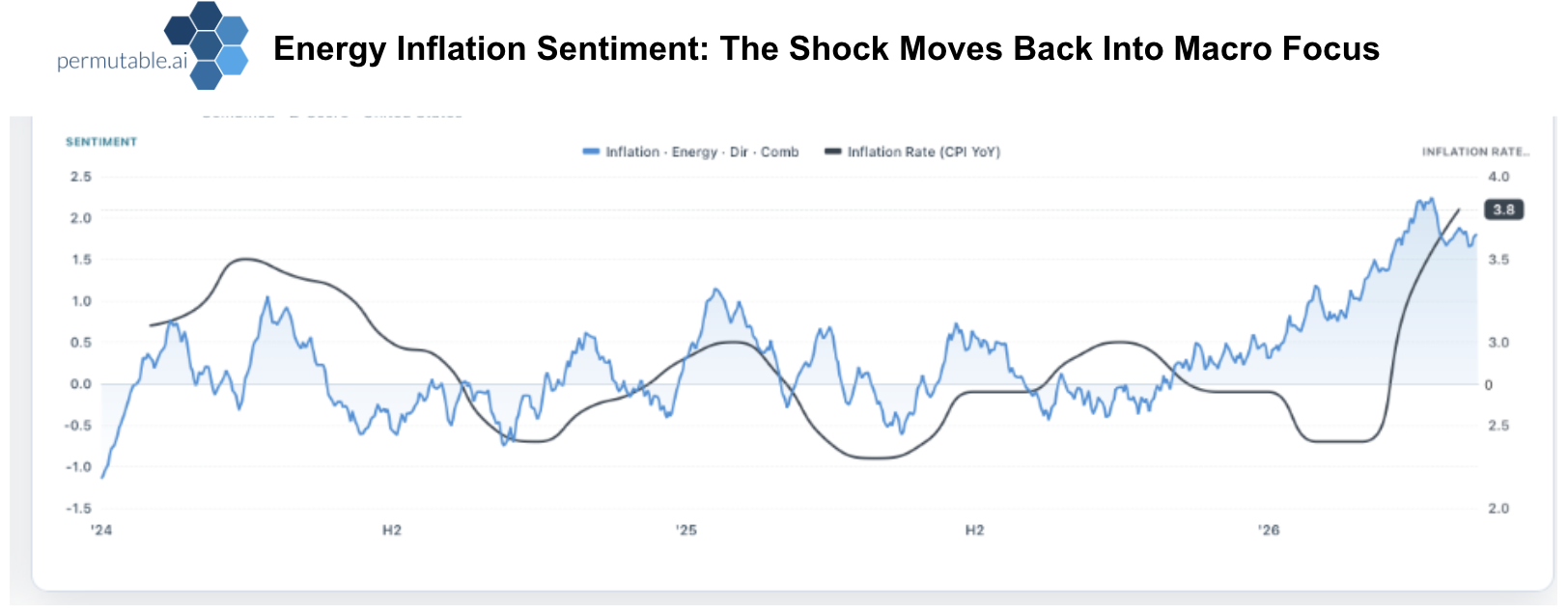
Chart showing Permutable’s energy inflation sentiment signal rising into 2026 alongside the US CPI inflation rate, highlighting renewed energy pressure within broader US inflation trends.

Above: Energy inflation sentiment, taken from Permutable’s Global Macro Sentiment Indices shows energy-related inflation pressure moving back into macro focus, with sentiment rising sharply into 2026 as the US CPI inflation rate also trends higher. The signal highlights why energy remains a key timing risk for the Fed’s easing path.

Services are the constraint

Services sentiment is less dramatic than energy, but more important for the Fed. Our GMSI signal points to a firmer services picture into 2026, after the 2025 softness. That is the part of inflation policymakers have least room to dismiss. Services reflect domestic price pressure, wage dynamics and persistence.

A cut in 2026 becomes easier if services soften. It becomes harder if energy rises while services remain firm. For institutional investors, services inflation is therefore the constraint on the easing narrative. Energy may provide the shock, but services determine whether the Fed can look through it.
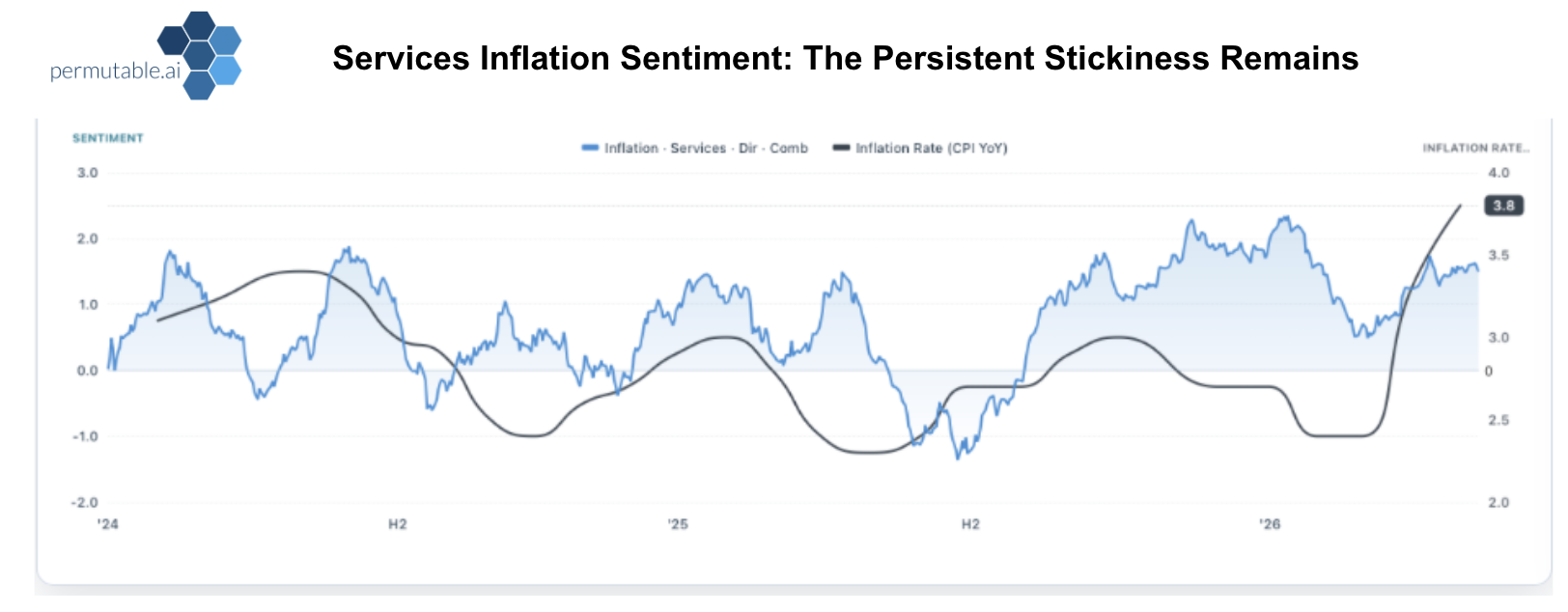
US inflation trends: Chart showing Permutable’s services inflation sentiment signal remaining elevated into 2026 alongside the US CPI inflation rate, highlighting persistent services stickiness within broader US inflation trends.

Above: Services inflation sentiment, taken from Permutable’s Global Macro Sentiment Indices shows that services-related inflation pressure remains elevated into 2026, even as the wider inflation outlook shifts. The signal highlights why services stickiness remains a key constraint on the Fed’s ability to ease policy.

Food keeps inflation politically visible

Food sentiment is not the main acceleration in our GMSI charts, but it remains positive and stable. That matters because food is where energy and fertiliser costs can move into household expectations. Voters and consumers experience inflation through petrol, food and bills, not through core measures.

For the Fed, household visibility matters because it can slow the rebuilding of inflation credibility. A shock that reaches households is harder to treat as noise as it weighs on expectations. For markets, food-linked inflation pressure can also matter because it affects consumer confidence, real-income expectations and the political backdrop for monetary policy.
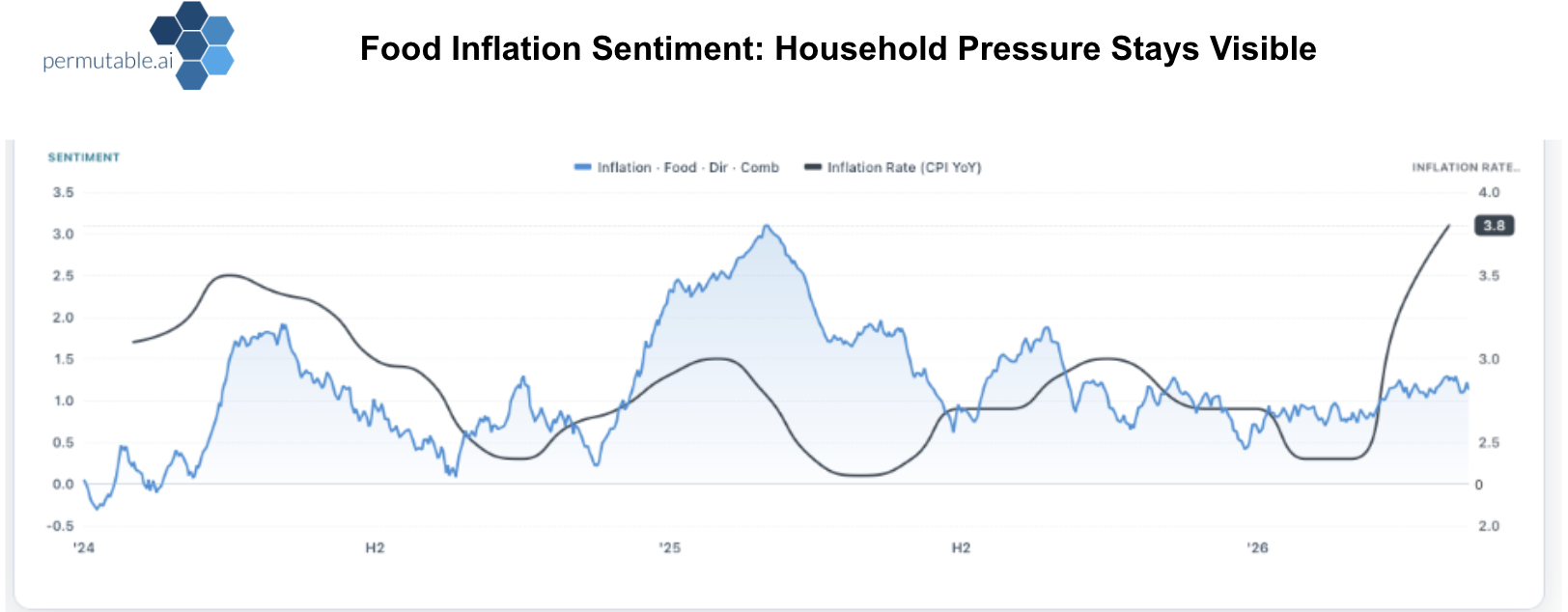
Chart showing Permutable’s food inflation sentiment signal remaining positive into 2026 alongside the US CPI inflation rate, highlighting visible household price pressure within broader US inflation trends.

Above: Food inflation sentiment, taken from Permutable’s Global Macro Sentiment Indices shows that food-related inflation pressure remains visible into 2026, even as the wider inflation outlook shifts. The signal highlights why household-facing price pressure remains important for the Fed’s inflation credibility and easing path.

The Fed-cut threshold has risen

The easing story is not entirely off the table. But the threshold for a 2026 cut has risen. The Fed now needs evidence that energy pressure is fading, services inflation is cooling, and household-facing inflation is not rebuilding expectations. A soft print buys time, not permission.

The Fed can cut in 2026 if the inflation signal turns decisively lower. Permutable’s GMSI is showing why that bar has become higher: the pressure is no longer confined to one volatile component. It is rotating through energy, services and food in a way that makes the policy outlook less forgiving.

The 2026 Fed outlook is no longer just about whether inflation is lower than it was. It is about whether US inflation trends are broad enough, durable enough and able to let policymakers ease without harming growth. Oil risk may still prove temporary. But temporary shocks can still matter when they arrive at the wrong point in the cycle.

Be first to access Global Macro Sentiment Indices

Permutable’s upcoming Global Macro Sentiment Indices have been built for teams that need macro signals they can test, monitor and integrate into their own investment, research or risk process.

Whether you are tracking inflation persistence, policy credibility, fiscal strain, political risk or supply-chain stress, Global Macro Sentiment Indices help identify where macro pressure is building, how it is spreading and when it may begin to matter for markets.

How teams can use GMSI

Custom macro indices

Build sentiment indices around a country, region, theme, policy cycle or risk regime, allowing teams to monitor the signals most relevant to their exposures.

Macro regime tracking

Track how inflation pressure, policy credibility, fiscal strain, political risk and supply-chain stress are evolving across countries and regions before the story is fully reflected in official data.

Point-in-time research data

Constructed without future look-ahead, GMSI provides historically accurate signals suitable for research, testing and model development.

API access and integration

Available via API for direct integration into trading, research and risk management workflows, with flexible coverage and delivery options.

For discretionary teams, the value is understanding what is changing, where it began and whether it is spreading. For systematic teams, GMSI provides a structured, testable macro signal that can be integrated across asset classes.

Register your interest to receive early access to the Global Macro Sentiment Indices and upcoming product updates.

FAQ: US inflation trends, Permutable’s Global Macro Sentiment Indices and the Fed outlook

What are the main US inflation trends for 2026?

The main US inflation trends for 2026 are uneven disinflation, renewed energy pressure, persistent services inflation and continued household sensitivity to food and fuel costs. Together, these signals suggest that inflation may be lower than previous peaks but not yet benign enough to make the Fed’s easing path straightforward.

Why does energy matter for the Fed outlook?

Energy matters because it affects fuel, freight, input costs and inflation expectations. The Fed may look through a temporary oil shock, but if energy pressure rises while services inflation remains firm, it becomes harder for policymakers to justify cutting rates.

Why are services prices important for inflation persistence?

Services prices are important because they tend to reflect domestic inflation pressure, wage dynamics and underlying demand. Unlike energy, services inflation is harder for policymakers to dismiss as temporary. Persistent services inflation can therefore keep the Fed cautious even if headline inflation softens.

Could sticky inflation delay a Fed rate cut in 2026?

Yes. Sticky inflation could delay a Fed rate cut in 2026 if policymakers do not see enough evidence that inflation is returning sustainably to target. The Fed does not need inflation to surge again to delay easing; it only needs the disinflation path to look insufficiently durable.

How does Permutable’s Global Macro Sentiment Indices  help track inflation pressure?

Permutable’s Global Macro Sentiment Indices helps track inflation pressure by analysing sentiment signals across macro themes, commodities and inflation-linked categories. It complements hard data by showing where market and media attention is building around inflation risks, including energy, services and household-facing prices.
7 strategic use cases of our China economy news intelligence

This article explains how AI transforms high-volume China economic news into structured, real-time market sentiment signals. It’s written for portfolio managers, commodity traders, quant researchers, and strategists across finance and energy-linked sectors, as well as business leaders making sourcing, hedging, risk and investment planning decisions involving China and the China macroeconomic landscape.

Institutional participants monitoring China economy news face a persistent challenge: official statistics arrive regularly but increasingly fail to capture underlying fragility, sectoral divergences, and confidence dynamics that determine actual economic outcomes. At Permutable AI, our suite of China macro sentiment indices addresses this gap by transforming narrative content embedded in China economy news into quantifiable intelligence. Here are seven use cases demonstrating how institutional clients leverage these indices.

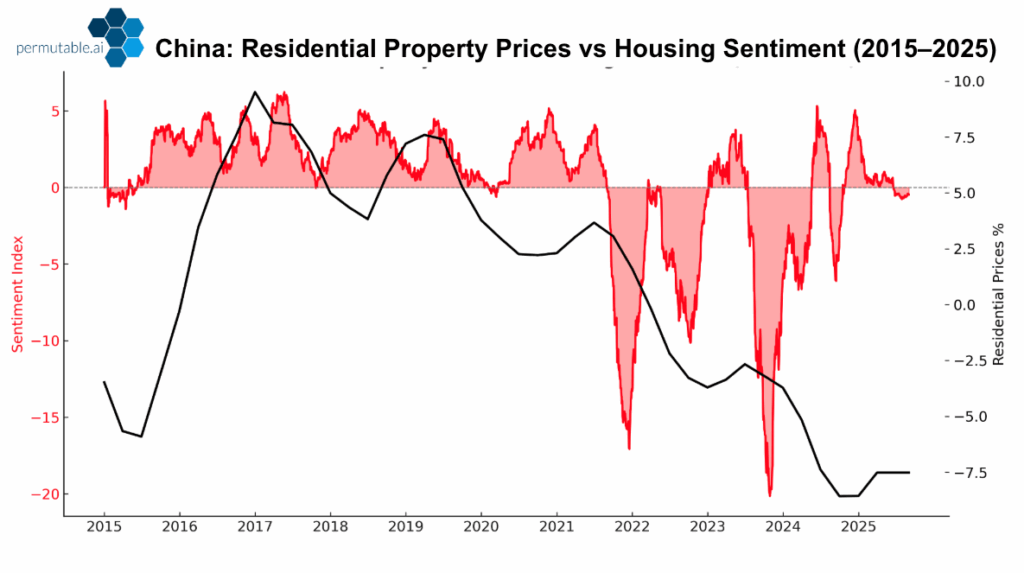
1. Early warning system for property market deterioration

The challenge

Property data releases lag actual market conditions by weeks or months, leaving investors reactive rather than proactive when monitoring the economy of China’s most systemically important sector.

The solution

Our China Housing Sentiment Index remained firmly negative since early 2024, providing forward-looking signals of deteriorating confidence well before official data confirmed the trend. When H1 2025 statistics eventually showed real estate investment down 11% year-over-year, new starts down 16%, and completions falling 15%, sentiment indices had already captured this weakness months earlier.

Application

  • Investment banks could use the Housing Sentiment Index to advise clients on property developer bond issuance risk before spreads widen.
  • Energy companies might track property sentiment as a proxy for construction demand, influencing forecasts of electricity and fuel consumption.
  • Manufacturing corporates could adjust output of construction-linked goods such as steel or cement based on sentiment deterioration.
  • Hedge funds might take short positions in vulnerable property developers or implement relative value trades (short property vs. long infrastructure) when sentiment signals sectoral weakness ahead of official statistics.

Key advantage

Sentiment updates in near real-time as China economy news flows evolve, providing lead-time measured in weeks or months rather than reacting to backward-looking official releases. The index also captures episodic policy effectiveness – showing how mortgage easing or developer credit lines produce brief sentiment bounces before renewed weakness, helping distinguish genuine turning points from temporary respites.

China Residential Property Market

2. Manufacturing quality-of-growth assessment

The challenge

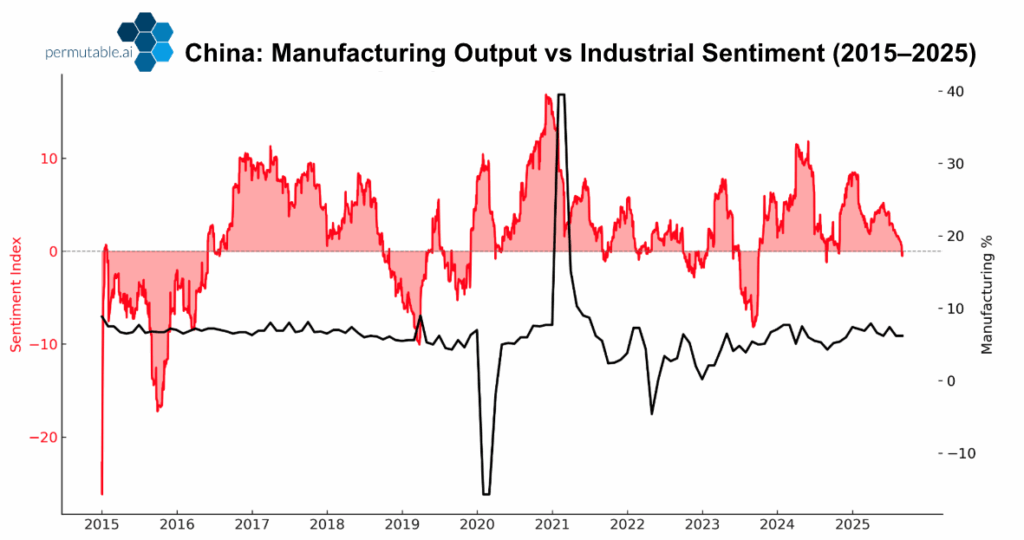
Official manufacturing data shows robust industrial production growth, but surface-level China economy news fails to reveal whether expansion reflects genuine demand or state-directed output meeting targets.

The solution

Our China Manufacturing Sentiment Index peaked in early 2024 then declined steadily through 2025 even as official production expanded 5.7% annually. This divergence captures a critical insight: current manufacturing strength appears brittle, reliant on subsidies and front-loading ahead of tariffs rather than sustainable end-demand.

Institutional application

  • Manufacturing corporates could use the Manufacturing Sentiment Index to evaluate whether output growth reflects genuine downstream demand or artificial state stimulus, informing production and inventory planning.

  • Investment banks might incorporate sentiment signals into equity research, differentiating between companies benefiting from sustainable demand versus those propped up by short-term subsidies.

  • Energy companies could use manufacturing sentiment as a leading indicator for industrial energy demand trends, allowing better forecasts of gas, coal, or electricity usage.

Key advantage

The sentiment index functions as a quality-of-growth indicator, distinguishing between output expansion driven by genuine demand versus production meeting state targets. For sector allocation decisions when tracking China economy today, this distinction between quantity and quality of growth proves essential for avoiding value traps.

China Manufacturing Data

3. Consumer confidence conviction measurement

The challenge

Retail sales figures can be temporarily manufactured through government subsidies and trade-in programmes, making it difficult to assess whether consumption recovery reflects genuine household confidence or policy-induced transactions.

The solution

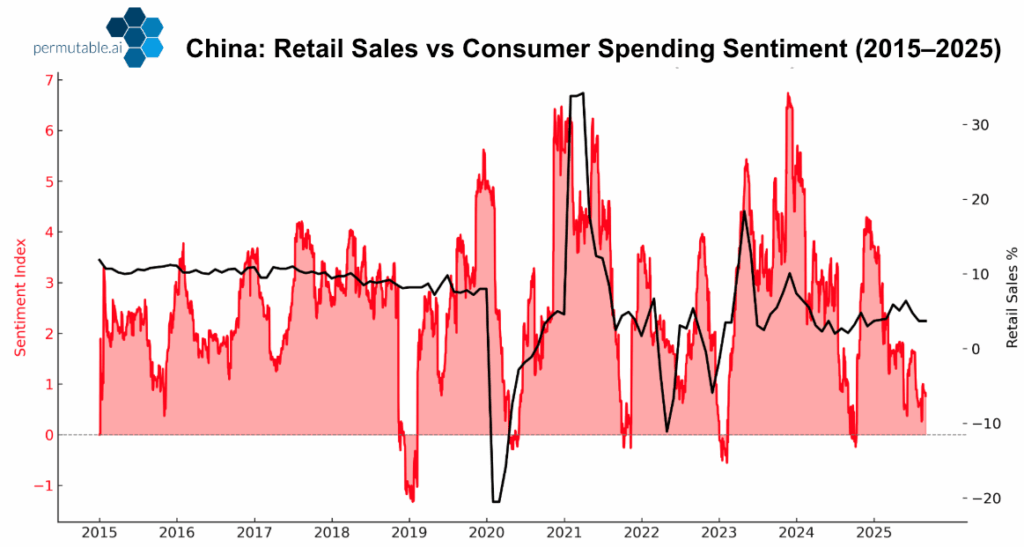
Our China Retail Sales Sentiment Index reveals households remain unconvinced by policy-manufactured consumption despite official sales gains in early 2025. Sentiment has been modestly positive since mid-2024 with holiday upticks but shows recent deterioration, capturing weak income expectations and limited wealth effects from depressed housing.

Institutional application

  • Consumer goods multinationals could use retail sentiment indices to calibrate China expansion plans, avoiding premature investment in capacity during fragile demand periods.

  • Investment banks might refine revenue forecasts for retail-focused companies, using sentiment data to distinguish between policy-driven spending and genuine confidence-led growth.

  • Energy companies could anticipate fuel demand fluctuations tied to household consumption patterns, such as transport fuel usage during retail slowdowns.

Key advantage

The index measures conviction behind transactions rather than just transaction volumes. For corporate strategists evaluating the economy of China’s consumer market, distinguishing between policy-induced sales and sustainable demand proves crucial for capital allocation decisions.

China Retail Sales Consumer Confidence Data

4. Policy effectiveness real-time evaluation

The challenge

Assessing whether government stimulus measures are changing underlying confidence or merely producing temporary statistical bounces requires monitoring beyond official data releases.

The solution

Permutable’s sentiment indices track policy announcement impacts in real-time, revealing whether measures generate sustained confidence improvements or episodic responses that quickly reverse. Beijing’s 81 billion yuan trade-in programme produced visible retail sentiment upticks during implementation but failed to shift underlying household caution.

Institutional application

  • Macro hedge funds could structure trades that exploit divergences between sectors directly supported by policy versus those reliant on consumer confidence.

  • Energy companies might evaluate the effectiveness of stimulus on industrial demand, particularly in heavy industries consuming oil, coal, and gas.

  • Investment banks could incorporate policy sentiment into equity research, advising clients on sectors likely to benefit from sustained policy support versus those exposed to fading household demand.

  • Consumer-facing corporates could use policy sentiment indices to assess whether household spending incentives are translating into durable consumption or just temporary lifts.

Key Advantage: Real-time policy impact assessment allows institutional participants to distinguish between measures that change trajectories versus those providing temporary lifts. This differentiation proves essential for forecasting sustainability when tracking China economy news flow.

5. GDP growth sustainability assessment

The challenge

Official GDP consistently hits 5% targets, but headline figures fail to reveal composition issues, sectoral imbalances, or confidence trajectories that determine growth sustainability.

The solution

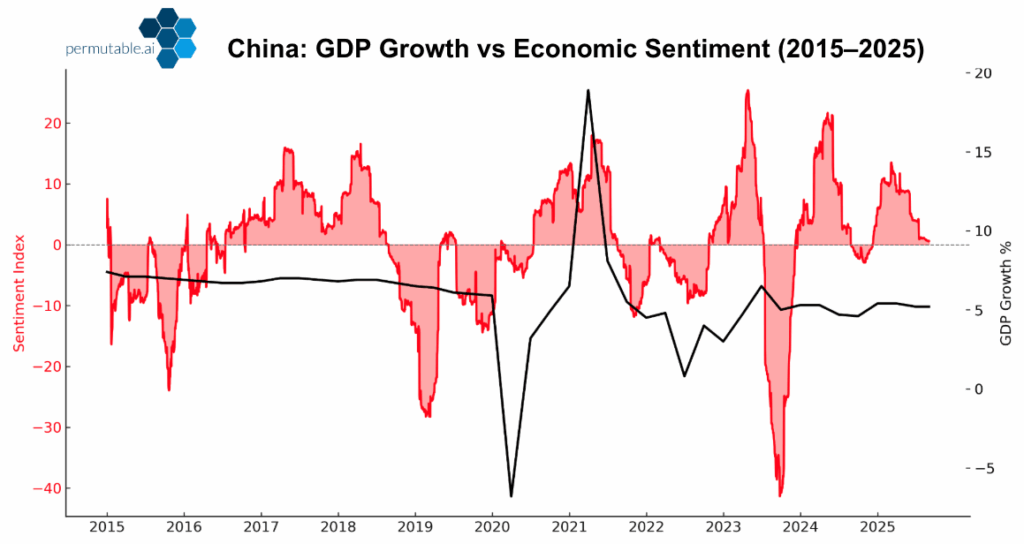
Our China GDP Sentiment Index reveals dramatic volatility beneath headline stability – swinging from optimism in early 2024 to sharp pessimism as tariff risks returned, recovering in early 2025 before recent deterioration. Current sentiment suggests renewed pessimism about the growth path even as official targets are met.

Institutional application

  • Sovereign wealth funds could use GDP sentiment volatility as a tactical signal to rebalance equity exposure, reducing risk when sentiment deteriorates despite strong official GDP.

  • Energy producers might monitor GDP sentiment to forecast shifts in national energy demand, particularly as GDP composition (manufacturing vs. consumption) influences fuel requirements differently.

  • Investment banks could advise clients on portfolio hedging strategies, using GDP sentiment indices as early warnings of volatility that headline GDP data may obscure.

Key advantage

The index captures what official China economy news obscures – that growth is being delivered but its composition (skewed toward state-supported manufacturing whilst consumption lags) erodes confidence in sustainability. Markets, firms, and households lose faith in recovery durability despite official assurances, a dynamic sentiment captures but GDP statistics mask.

China GDP data

6. Sector rotation leading indicator

The challenge

Official data shows sectoral performance retrospectively, but optimal portfolio allocation requires identifying inflection points as sentiment shifts before statistics confirm trends.

The solution

Cross-referencing multiple sentiment indices reveals sector rotation opportunities. When Housing Sentiment deteriorates whilst Manufacturing Sentiment stabilises, or when Retail Sentiment improves but GDP Sentiment weakens, these divergences signal portfolio rebalancing opportunities ahead of statistical confirmation.

Institutional application

  • Equity funds could rotate into consumer discretionary names when retail sentiment rises, even if official retail data still lags.

  • Energy companies might anticipate changes in sectoral fuel demand — e.g., industrial slowdown combined with consumer strength indicating a shift in power and fuel usage patterns.

  • Investment banks could apply sentiment signals to client sector rotation strategies, building thematic baskets accordingly.

  • Manufacturing corporates might use sectoral divergences to shift output priorities (e.g., scaling back construction-linked production as housing sentiment falls).

  • Hedge funds could structure long/short rotation trades across sectors, positioning ahead of consensus based on cross-sentiment divergences.

Key advantage

Sentiment divergences across sectors provide leading indicators for rotation strategies. Traditional approaches wait for statistical confirmation of sectoral trends, but sentiment-based allocation enables positioning ahead of consensus, capturing alpha during transition periods.

7. Trade policy impact quantification

The challenge

Export data arrives monthly but fails to capture evolving market expectations about tariff impacts, rerouting effectiveness, or structural shifts in trade relationships affecting the economy of China.

The solution

Our regional macro indices captured growing concern that China’s surplus output would meet escalating resistance abroad well before August data showed US-bound shipments collapsing 33%. The sentiment evolution revealed markets no longer assumed rerouting through ASEAN or Mexico could meaningfully soften tariff impacts – a critical expectation shift.

Institutional application

  • Investment banks might leverage these indices to forecast earnings impacts on exporters and advise on FX hedging strategies.

  • Energy companies could monitor trade sentiment as an early signal of disruptions in oil, gas, and LNG export flows to major trading partners, informing hedging and logistics.

  • Manufacturing corporates could anticipate demand disruption in export-linked industries and adjust production or sourcing accordingly.

Key advantage

Sentiment reveals expectation shifts around trade dynamics that official statistics cannot illuminate. For supply chain strategists monitoring China economy today, understanding that markets no longer expect rerouting solutions provides essential context that export figures alone miss.

Integration framework

Institutional clients can maximise value from our China macroeconomic sentiment indices through integrated analytical frameworks:

Layered analysis: Combining official statistics with sentiment indices reveals not just what happened but confidence trajectories and sustainability indicators.

Lead-time exploitation: Sentiment’s forward-looking nature enables defensive positioning or opportunity capture before official data confirms what markets already sense.

Quality assessment: Sentiment distinguishes between strong statistics masking fragility versus genuine strength, crucial for avoiding value traps in the economy of China.

Policy response prediction: Understanding confidence dynamics helps forecast where policymakers will direct support, enabling positioning ahead of announcement-driven moves.

Sentiment as competitive advantage

The economy of China delivers headline targets whilst underlying confidence deteriorates – a divergence that official statistics obscure but market participants must navigate. At Permutable AI, our macro sentiment indices transform China economy news from descriptive data into predictive intelligence, providing institutional participants with measurable competitive advantages.

These use cases demonstrate that sentiment analysis has evolved from supplementary insight to essential framework. In an environment where official data smooths edges and masks fragility, sentiment exposes strain, scepticism, and shifting conviction before traditional metrics confirm what informed participants already suspect.

To see how Permutable’s China macro sentiment indices work in practice across these use cases and transform China economy news into actionable intelligence, request a demo at enquiries@permutable.ai.

Frequently Asked Questions

Q1. Why should we use sentiment indices when we already monitor official Chinese statistics?

Official statistics are important, but they often lag real conditions and smooth volatility. Our sentiment indices are designed to complement—not replace—official data by capturing confidence dynamics and fragility in near real time. This provides institutional investors with a forward-looking edge rather than a backward-looking snapshot.


Q2. How reliable are sentiment indices compared to traditional data sources?

Our indices are built from broad-based China economy news flows, covering multiple sectors, regions, and actors. The methodology applies natural language processing and machine learning to extract signals with consistency. By tracking sentiment trajectories across sectors, investors gain a cross-validated view of market confidence that enhances reliability rather than relying on a single narrative source.


Q3. Aren’t sentiment signals too noisy or short-term to be useful for institutional investors?

Noise is a valid concern, which is why our models are engineered to identify structural shifts, not just headlines. The indices capture both short-lived reactions and longer-term confidence cycles, allowing investors to distinguish between episodic policy bumps and genuine inflection points. This helps reduce false positives and gives clarity to medium- and long-term positioning.


Q4. How do these indices integrate into existing investment processes?

We provide access through an intuitive dashboard, as well as data feeds that integrate into institutional workflows. The indices can sit alongside macroeconomic datasets, risk models, or internal research frameworks. Many clients use them to add an additional forward-looking lens when monitoring China’s property, manufacturing, consumer, and trade sectors.


Q5. What’s the unique value compared to traditional data providers?

Unlike providers that deliver raw or lagging data, Permutable offers context-rich intelligence. Our China macro sentiment indices:

  • Quantify confidence trajectories that statistics cannot show.

  • Provide lead-time measured in weeks or months before official releases.

  • Highlight sector divergences and policy effectiveness in real time.

  • This makes them a competitive advantage for institutional investors who need to anticipate rather than react.


Q6. How do we know these indices provide alpha?

The principle is proven: markets move on expectations, not just statistics. Our indices are designed to track those expectations and confidence dynamics as they evolve in China economy news. By using sentiment as an overlay, investors can improve timing, manage risk more effectively, and position ahead of consensus.


Q7. What if our firm already invests heavily in primary research?

Our sentiment indices don’t replace human expertise – they amplify it. They can flag areas where deeper research is needed, validate or challenge existing theses, and provide a broader contextual view across multiple sectors. This helps institutional teams allocate resources more efficiently and focus their analysis on the most material signals.


Q8. How can we evaluate whether these indices add value to our process?

We recommend a trial integration where your team monitors our sentiment indices alongside your existing data and decision-making framework. This allows you to test how the forward-looking insights align with outcomes and determine the degree of additional conviction and lead-time they provide.

Global partnerships drive and expansion of Permutable AI market intelligence across financial, commodities, and energy sectors

This article announces the expansion of our Permutable AI’s global partnerships programme – a milestone in scaling Permutable AI market intelligence globally. It’s aimed at institutional partners, fintech innovators, and technology leaders interested in how adaptive, explainable AI is transforming market intelligence across financial, commodities, and energy sectors.

We’re proud to announce the official launch of our strategic partnerships programme, a key step in scaling Permutable AI market intelligence globally. Through these collaborations, we’re accelerating the deployment of our adaptive, explainable AI systems and vertical large language models – bringing real-time intelligence to financial, commodities, and energy markets. This expansion represents not only growth for us as a company but also a shared vision with our partners: to transform how institutions interpret, anticipate, and act on global events in real time.


Permutable AI market intelligence: Building a world model for markets and beyond

Our proprietary vertical LLM architecture sits at the heart of our market intelligence. It continuously learns from financial, macroeconomic, and geopolitical data – turning complex global signals into clear, actionable insights.

As our Founder and CEO Wilson Chan explains:

“Our vision at Permutable AI is to build a world model for capital markets and beyond. Through these partnerships, we’re taking Permutable AI market intelligence to a global audience – helping institutions anticipate, not just react to, market change as it happens.”

By embedding our technology and AI-driven data feeds directly into trading, analytics, and enterprise systems, we’re enabling partners to access live intelligence seamlessly within their existing workflows. No new infrastructure. No disruption – just deeper insight delivered in real time.


Collaborating to scale adaptive intelligence

Our expanding ecosystem of partners spans fintech platforms, institutional data providers, and enterprise analytics systems. Each collaboration helps extend the reach of Permutable AI market intelligence to organisations that rely on speed, context, and foresight.

As our Chief Commercial Officer Mike Brisley puts it:

“Our platform and distribution partners are instrumental in scaling our intelligence globally. Together, we’re replacing legacy analytics with adaptive, reasoning-driven systems that evolve with the markets – giving financial players the clarity and agility they need to stay ahead.”

Through these partnerships, we’re co-creating intelligence. Together, we’re developing domain-specific systems that enhance portfolio analysis, risk management, forecasting, and strategic decision-making across sectors.


Why Permutable AI market intelligence stands apart

At Permutable, we believe that enterprise AI must be trustworthy, explainable, and context-aware. Unlike general-purpose AI tools, Permutable AI market intelligence is purpose-built for specific domains, designed to reason within the data environments that matter most to institutional clients.

Our systems are continuously learning – adapting to shifting macroeconomic and market dynamics. This makes them uniquely capable of delivering actionable insights with full transparency and accountability.

“Enterprises are moving from experimental AI to operational AI,” says Wilson Chan. “That means they need models that can justify their reasoning, adapt in real time, and integrate seamlessly into enterprise decision-making. That’s exactly what our vertical LLM framework delivers.”


Permutable AI market intelligence: Turning global data into foresight

In a data-saturated world, we help our partners turn information into foresight. Permutable AI market intelligence empowers analysts and traders to:

  • Detect emerging sentiment and macroeconomic trends early.

  • Integrate live geopolitical and financial data into their strategies.

  • Replace static, fragmented systems with adaptive, explainable AI tools.

Mike Brisley summarises it best:

“We’re helping partners turn global data overload into foresight. When markets move fast, our intelligence moves faster – providing the transparency and reasoning that give our clients confidence in every decision.”


A shared commitment to innovation 

This expansion is built on shared goals and shared value. Each partnership strengthens our mission to redefine how organisations understand the world in real time – and how AI can power more responsible, data-informed decisions.

Together, we’re shaping a future where our market intelligence becomes an essential layer of enterprise infrastructure: adaptive, explainable, and built to evolve with the world.

Explore strategic partnership opportunities

We’re always looking to collaborate with forward-thinking institutions, data providers, and platform partners who share our vision for adaptive, explainable intelligence. If you’re interested in exploring a strategic partnership with us – or want to learn how our partners are already integrating Permutable AI market intelligence into their systems – we’d love to hear from you.

Get in touch with our partnerships team or visit our Strategic Partners page to find out more.

AI-powered analysis investor psychology market sentiment shifts: The new frontier for institutional trading strategies

This article explores how AI-powered analysis investor psychology market sentiment shifts are reshaping trading strategies for institutional investors. It draws on examples from commodities and precious metals to demonstrate the role of Permutable AI’s datasets and Trading Co-Pilot.

For decades, markets have been understood through the twin lenses of fundamentals and technicals. Traders examined supply and demand balances, interest rates, corporate earnings, and chart patterns to guide decisions. Yet, increasingly, these tools alone no longer provide the full picture. In volatile global markets, investor psychology has become the invisible force shaping outcomes.

Institutional investors now recognise that the way narratives develop and shift across news flows can drive price action well before fundamentals are fully reflected. A sudden government shutdown in Washington, a rumour of accelerated OPEC+ production increases, or a change in seasonal weather forecasts for Europe can instantly reset expectations across metals and energy markets. The challenge is not understanding that psychology matters but detecting these transitions as they happen, at the speed of information.

This is precisely where AI-powered analysis investor psychology market sentiment shifts has begun to redefine the institutional trading playbook. At Permutable, our Trading Co-Pilot intelligence suiteprocesses vast streams of global information and identifies the subtle changes in sentiment that mark the turning points. For investors tasked with navigating uncertainty, this is proving to be a decisive advantage.


Understanding the AI edge 

Traditional measures of sentiment such as surveys, positioning reports, or sentiment indices offer limited guidance because they lag behind real-time events. By the time they are published, the market has often already moved on. What is needed is a system capable of scanning the full breadth of financial narratives and extracting early signals of change.

At Permutable, our approach is built on advanced natural language processing applied to millions of data points, from breaking news and analyst commentary to supply reports and policy announcements. Here, AI-powered analysis investor psychology market sentiment shifts can be surfaced as they emerge.

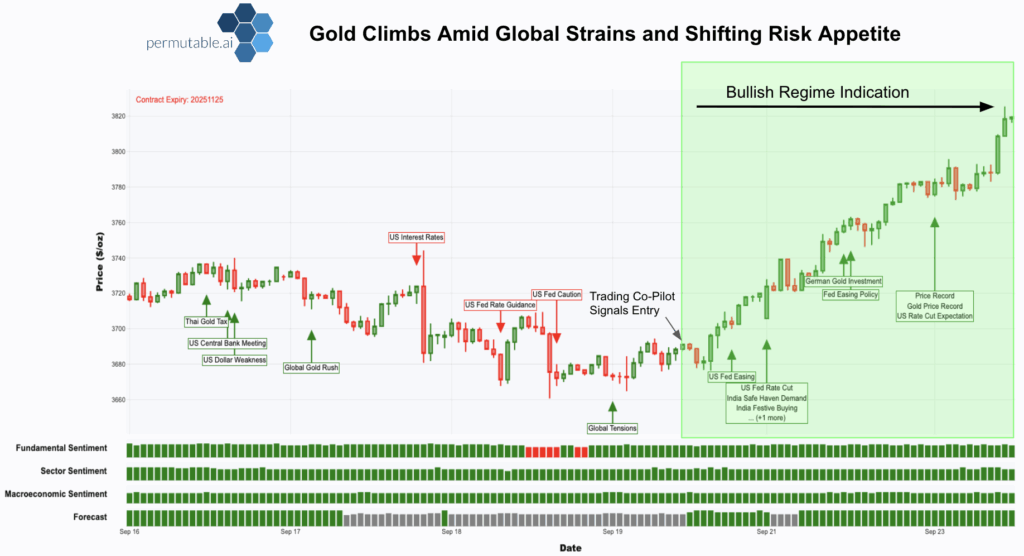
An illustrative case came during September’s surge in gold. Initially, the prevailing view among traders was that gold had become overbought, with technical conditions stretched. Yet within hours of growing speculation about a US government shutdown, our algorithms began to detect a reversal. Mentions of fiscal dysfunction, dollar weakness, and safe-haven flows started to dominate headlines. The narrative had shifted. Prices soon followed, breaking through the $3,900 mark. Institutions relying only on technical analysis would have seen an overbought signal; those tracking investor psychology through our system saw the beginnings of a fresh rally.

AI-powered analysis investor psychology market sentiment shifts: Gold

Precious metals: When psychology overrides fundamentals

The precious metals complex offers some of the clearest examples of how psychology can drive divergence within a single asset class. Gold and silver are heavily influenced by safe-haven demand, while platinum and palladium tend to respond more closely to industrial expectations. This makes the ability to monitor sentiment shifts especially valuable.

Our precious metals datasets capture these nuances in real time. In the same week that gold climbed to historic highs, silver followed with its own rally towards $47, supported by both ETF inflows and physical demand in India. Platinum advanced not because of surging consumption but because supply scarcity narratives dominated, with geopolitical tensions and mining disruptions shaping investor psychology. Palladium, in contrast, struggled as headlines about declining automotive demand overpowered any safe-haven appeal.

For institutional investors, this divergence illustrates the importance of tracking not just prices but the stories that underpin them. Ai-powered analysis investor psychology market sentiment shifts across precious metals help identify where correlations are likely to hold and where they may break down. A strategy built on this awareness allows for more precise allocation across the complex rather than broad exposure that risks being blindsided by sentiment divergence.


Energy Commodities: Oversupply versus volatility

If precious metals showcase psychology in divergence, energy commodities reveal its rhythm in volatility. LNG markets in particular have demonstrated how rapidly sentiment can pivot between optimism and caution, driven by alternating narratives of expansion, export records, and supply strain.

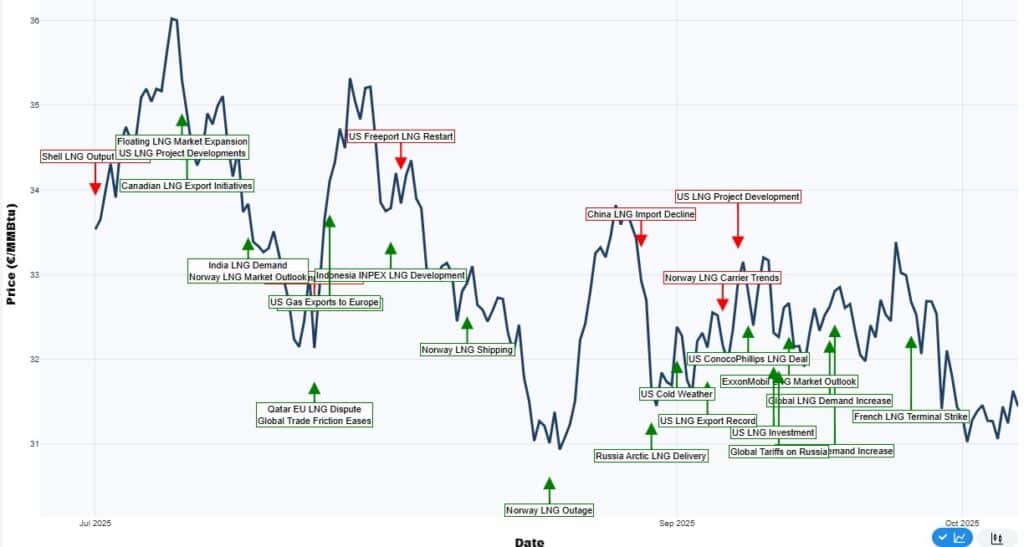
From July through October 2025, European TTF prices fluctuated sharply as traders weighed new production capacity against intermittent disruptions. Early optimism around US and Canadian LNG project developments and floating market expansion lifted sentiment before a renewed wave of oversupply concerns took hold. As India’s demand recovery and Indonesia’s INPEX development spurred short-lived rallies, prices retraced on the back of US Freeport restart headlines and fresh export flows into Europe.

By late August, temporary relief arrived as Qatar trade friction eased and Norwegian outages underpinned mild gains, but bearish pressure soon returned amid China’s import decline and Norway LNG carrier trends signalling weaker utilisation. Into September, volatility intensified as cold weather in the US and record export milestones alternated with terminal strikes and tariff disputes, keeping traders whipsawed between supply confidence and geopolitical unease.

Overall, the data illustrate that while fundamentals such as weather and storage remain relevant, investor psychology – reflected through shifting narratives of scarcity and oversupply – continues to dominate LNG market behaviour.


At Permutable AI’s, our real-time energy sentiment datasets quantify these transitions with precision, identifying when optimism over expansion yields to caution over saturation. By tracking tone and topic evolution across thousands of energy and policy headlines, institutional investors can anticipate the turning points when narratives of glut or tightness take control of trading flows – and position ahead of price.

AI-powered analysis investor psychology market sentiment shifts: LNG

Why institutions need AI-powered sentiment analysis

The institutional trading environment is defined by two competing pressures: the demand for alpha and the need for tighter risk management. Both depend on an ability to anticipate rather than react.

By applying ai-powered analysis investor psychology market sentiment shifts, institutions can detect turning points earlier than their peers, reducing drawdowns when sentiment turns negative and capturing opportunity when psychology flips bullish. This provides a more dynamic way to allocate across asset classes and to adjust exposure as narratives evolve.

The integration of these insights into workflows is straightforward. Our Trading Co-Pilot suite delivers sentiment intelligence via dashboards, APIs, and alerts, enabling both systematic and discretionary traders to incorporate psychological signals directly into their decision-making.


The Permutable edge 

At Permutable, we combine advanced technology with deep domain expertise. Our datasets are built around the factors that matter most for institutional commodities and metals trading, from OPEC+ announcements and inventory draws to ETF flows and geopolitical flashpoints. Our Trading Co-Pilot is tailored to the needs of hedge funds, asset managers, and investment banks who require speed, accuracy and institutional reliability.

Our in-house analysts work continuously to validate models against real-world outcomes, ensuring that AI-powered analysis investor psychology market sentiment shifts surfaced are not theoretical abstractions but actionable signals. It is this blend of technology, expertise, and authority that sets us apart in the field of sentiment intelligence.


Looking ahead

The coming year will likely bring more of the shocks and uncertainties that have made sentiment intelligence indispensable. Fiscal risks in the United States, energy supply realignments in Europe, and ongoing geopolitical tensions in the Middle East are all potential triggers for new sentiment regimes.

In such an environment, institutions cannot afford to be late in recognising how psychology is shifting. It is precisely at times like these that AI-powered analysis investor psychology market sentiment shifts can provide the edge, enabling traders to navigate volatility with confidence.

Explore our datasets page or contact enquiries@permutable.ai for institutional access.

Permutable expands into industrial metal markets amid global trade fragmentation and rising institutional demand

We’re proud to announce the expansion of our commodity intelligence coverage to include industrial metal markets, extending our real-time, AI-driven analytics across steel, aluminium, copper, lithium, iron, lead, tin, zinc, nickel, and uranium. This development builds on our existing intelligence suite across energy, agriculture, and precious metals, reflecting both rising institutional demand and the increasing strategic importance of industrial metals in global manufacturing, infrastructure investment, and the energy transition.


Navigating a fractured global trade environment

The decision to expand into industrial metal intelligence comes at a time of heightened geopolitical instability and trade fragmentation. A clear shift away from global cooperation toward protectionist, national-interest-focused policies is creating uncertainty across commodities markets.

The introduction of aggressive U.S. tariffs is disrupting long-standing trade routes, distorting price signals, and forcing market participants to find new, often less efficient, supply chains. At the same time, U.S.–China strategic competition remains a defining feature of this volatility. China’s dominance in metals processing and its increasing use of export controls on critical minerals are prompting other nations to seek alternative, secure supply sources – a costly and complex process that is reshaping global metals markets.

Compounding these pressures is a backdrop of weakening global demand, with fears of a wider economic slowdown and China’s struggling property sector – a traditional powerhouse of steel and copper consumption – acting as a major drag on sentiment and prices.


AI-powered foresight for industrial metal markets

Against this backdrop, our proprietary AI-driven detection system delivers the clarity and foresight institutions need to navigate these evolving conditions. By analysing over 50,000 verified news articles and market events daily, our platform detects early indicators of supply disruptions, macroeconomic shifts, and geopolitical developments before markets react.

Our Trading Co-Pilot platform and enterprise-grade API provide clients with a unified cross-commodity view that includes industrial metals, enabling faster and more informed trading, risk management, and research decisions.

Industrial Metal Market Intelligence
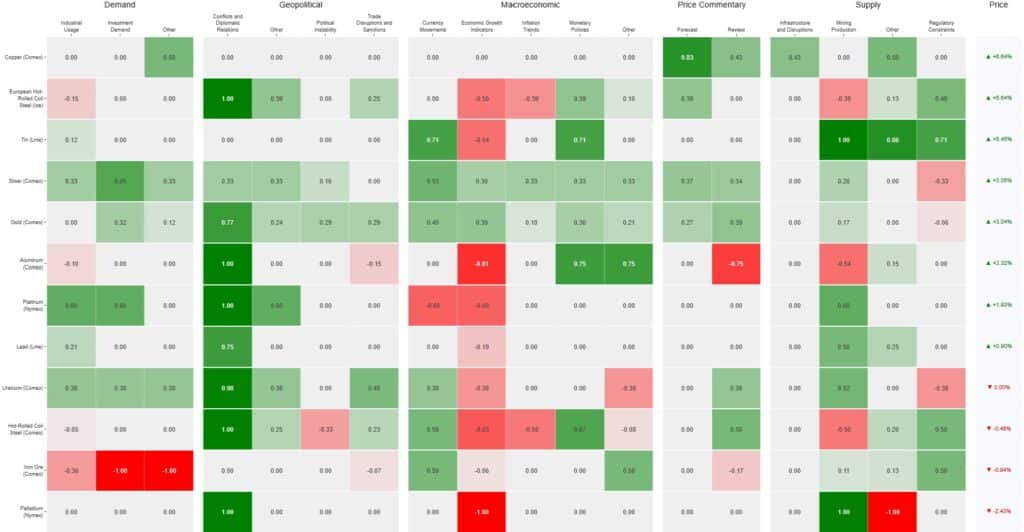
Industrial metals sector wide drivers as visualised by our Trading Co-Pilot
steel markets intelligence
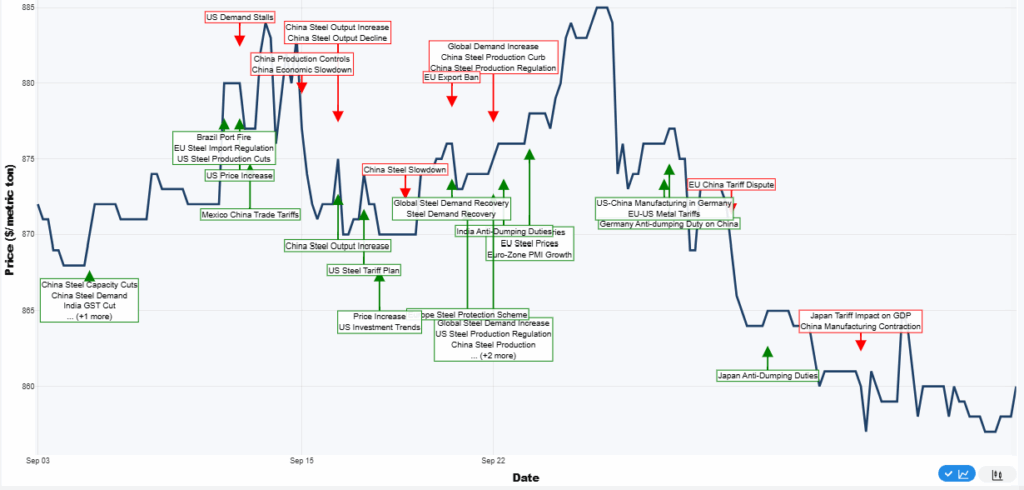
Charting market sentiment price drivers of the steel market visualised by our Trading Co-Pilot

Wilson Chan, Founder and CEO of Permutable AI, commented:

“Industrial metals are now sitting at the crossroads of global policy, supply chain resilience, and the energy transition. Geopolitical instability and the fragmentation of trade are changing how these markets function.

The combination of protectionist policies, tariffs, and the U.S.–China strategic rivalry has created a more complex, less predictable landscape. Our AI-driven intelligence helps institutions make sense of this uncertainty – transforming overwhelming global data into the foresight they need to act with conviction.”


Jack Watson, Market Analyst at Permutable, added:

“The industrial metal market has become a barometer for global economic health and political tension. With weaker demand forecasts, tariffs distorting prices, and shifting supply chains, volatility has become the new normal.

Our AI platform captures these fast-moving narratives as they happen – from Chinese export policy changes to disruptions in copper or nickel supply — and translates them into actionable, explainable signals for traders and analysts.”


Building the future of market intelligence

Industrial metals are at the heart of the world’s biggest transitions – from the electrification of transport to renewable infrastructure. By expanding our coverage, we’re giving institutions a new lens through which to interpret market shifts, integrating macro context, sentiment analytics, and predictive intelligence.

Discover how our real-time industrial metal intelligence can help your team anticipate global shifts and act with confidence. Request a demo by contacting us at enquiries@permutable.ai.

Permutable to showcase AI-driven trading intelligence at Quant Strats 2025

We’re delighted to announce that we will be attending Quant Strats 2025 next week – Europe’s leading quantitative finance event, bringing together over 600 quants, portfolio managers, data scientists, academics, and regulators driving innovation in data-led and systematic investing.

As pioneers in AI trading intelligence, we’re excited to connect with peers and industry leaders to share how our global datasets and analytics solutions are helping traders, analysts, and portfolio managers navigate markets with unprecedented clarity and foresight.


Redefining market understanding through AI trading intelligence

At Permutable, our goal is to make complex markets more understandable and predictable. By combining advanced machine learning, natural language processing, and macro and asset level data intelligence, we enable institutional investors to interpret global signals, market sentiment, and economic shifts in real time.

Our AI trading intelligence transforms millions of unstructured data points – from news, media, and economic indicators -into actionable insights that reveal what’s truly driving markets.

“The trading world is moving towards a new era where real-time context is the ultimate competitive advantage,” says Wilson Chan, our Founder and CEO. “At Quant Strats 2025, we’re proud to demonstrate how our AI models and asset and macro datasets empower professionals to cut through noise, interpret events in context, and identify trading opportunities before they unfold.”


Showcasing Trading Co-Pilot and global macro and asset satasets

At Quant Strats 2025, we’ll be showcasing both our flagship platform – Trading Co-Pilot – and our comprehensive macro and asset datasets, which underpin our intelligence technology and power our clients’ trading strategies.

Trading Co-Pilot

Our Trading Co-Pilot gives traders and portfolio managers an edge by combining AI, sentiment analytics, and macroeconomic intelligence. It provides:

Macro and asset datasets

We’ll also be demonstrating our macro and asset datasets, designed to deliver breadth and depth of market intelligence across multiple asset classes. These include:

Our datasets combine structured and unstructured data with predictive modelling – giving institutional investors the ability to uncover relationships between macro indicators, geopolitical events, and asset movements.

“Quant Strats is an excellent platform to show how our data and AI models combine to deliver powerful, contextual insights,” says Mike Brisley, Chief Commercial Officer. “By bringing together macro datasets, asset-level coverage, and predictive analytics, we’re helping the institutional investor community anticipate shifts and act with greater precision and confidence.”


Partnering with the quantitative finance community

Quant Strats 2025 provides an ideal opportunity to connect with peers and partners across quantitative research, AI innovation, and data science. We’re looking forward to discussions on:

  • The expanding role of machine learning and predictive analytics in trading

  • Leveraging macro and alternative datasets for forecasting

  • Enhancing strategy through sentiment analysis and real-time data

  • Building transparency and trust in AI-driven decision-making

By engaging with thought leaders and data innovators, we aim to help shape how AI continues to transform the quantitative finance landscape.


Meet us at Quant Strats 2025

If you’re attending Quant Strats 2025, come and meet our team to discover how we turn global data into trading intelligence.

Experience firsthand how our Trading Co-Pilot and macro and asset datasets deliver actionable insights across commodities, energy, metals, agriculture, and currencies – supporting faster, more confident, and more data-informed decisions in an increasingly complex market environment.


Join us at Quant Strats 2025 (we’ll be near the F1 Simulator!) – and discover how AI trading intelligence and macro datasets are transforming the way the world understands and acts on market insight.

Top 10 providers of crude oil market intelligence 2025

This article is designed for institutional energy traders, portfolio managers, analysts, and data-driven investors seeking to understand the evolving landscape of crude oil market intelligence – from established providers to next-generation AI-driven platforms like Permutable AI. It compares leading global intelligence solutions, outlining their strengths, limitations, and the emerging technologies reshaping how crude oil market signals are captured and acted upon.

In today’s energy markets, crude oil market intelligence is more than just data – it’s an edge. Volatile prices, geopolitical shifts, and supply disruptions demand insight that is not only accurate but also instantaneous.

In this article, we round up the top 10 providers of crude oil market intelligence, comparing their strengths and limitations, and explores how our AI-driven crude oil market intelligence represents the next evolution in energy analytics – delivering real-time, AI-powered, and sentiment-driven intelligence for the modern trader.

Why traditional news platforms alone are no longer enough

Of course, platforms such as Bloomberg L.P., Reuters and S&P Global Platts remain essential tools for professional traders. They provide authoritative reporting, pricing and market context that every desk relies on.

However, they were designed primarily for human consumption. Traders still need to search, filter and interpret information manually, which creates friction at exactly the moment speed matters most.

At Permutable AI, we complement these platforms by acting as an intelligence layer on top. Rather than replacing trusted sources, we automatically monitor them alongside thousands of others, extract the relevant signals and surface only what is likely to impact price. The result is the same breadth of coverage, but delivered as prioritised, structured insight instead of information overload.

1. Permutable AI: The future of crude oil market intelligence

At Permutable, we believe the next generation of crude oil market intelligence will be defined by speed, context, and comprehension. Traditional market data tells you what has happened – we tell you why it’s happening, as it happens.

Our technology transforms crude oil market complexity into a competitive trading edge. Processing over 50,000 news articles and market events daily, our proprietary AI continuously analyses global petroleum data, delivering real-time, actionable insights across Brent Crude, WTI Crude, Heating Oil, RBOB Gasoline, and Gas Oil.

Our automated narrative intelligence engine scans thousands of verified sources per minute to detect supply disruptions, demand shifts, refinery events, and market structure changes – providing traders with instant visibility on what’s driving prices and sentiment. These high-frequency signals allow institutional traders to anticipate volatility, quantify market mood, and execute with precision – often before the wider market reacts.

Brent Crude

Crude oil market insights and trends

Real-time market intelligence for institutional traders

Permutable’s intelligence engine combines macroeconomic context, sentiment analysis, and high-speed event processing to deliver verified insight in milliseconds. Covering everything from OPEC+ policy shifts to refinery maintenance patterns and currency correlations, we help traders uncover hidden relationships that drive price action.


Automated market intelligence

Gain instant analysis from thousands of verified global sources, with real-time summaries highlighting emerging narratives, geopolitical tensions, and operational risks such as sanctions, outages, or refinery incidents.


Forecasting & scenario modelling

Access six-month predictive projections with dynamic confidence intervals to anticipate structural shifts in crude markets. Traders can stress-test strategies, quantify macro risk, and prepare for potential outcomes before they materialise.


Quantitative integration

Our structured data and sentiment signals are available via Permutable’s Co-Pilot API, enabling seamless integration into institutional trading systems for model calibration, backtesting, and automated strategy development.


Five key crude oil market intelligence pillars

Our automated analysis engine continuously monitors and interprets five core market domains in real time:

  1. Supply Dynamics — OPEC+ output, strategic reserves, refinery operations.

  2. Demand Intelligence — transportation fuels, industrial consumption, seasonal trends.

  3. Geopolitical Risk — sanctions, regional conflicts, and trade flow disruptions.

  4. Refinery Analytics — crack spreads, maintenance schedules, product yields.

  5. Price Discovery — futures, physical differentials, and arbitrage opportunities.

By combining these pillars with live sentiment detection, we provide an integrated intelligence layer that helps institutional traders detect, quantify, and act on market-moving signals.

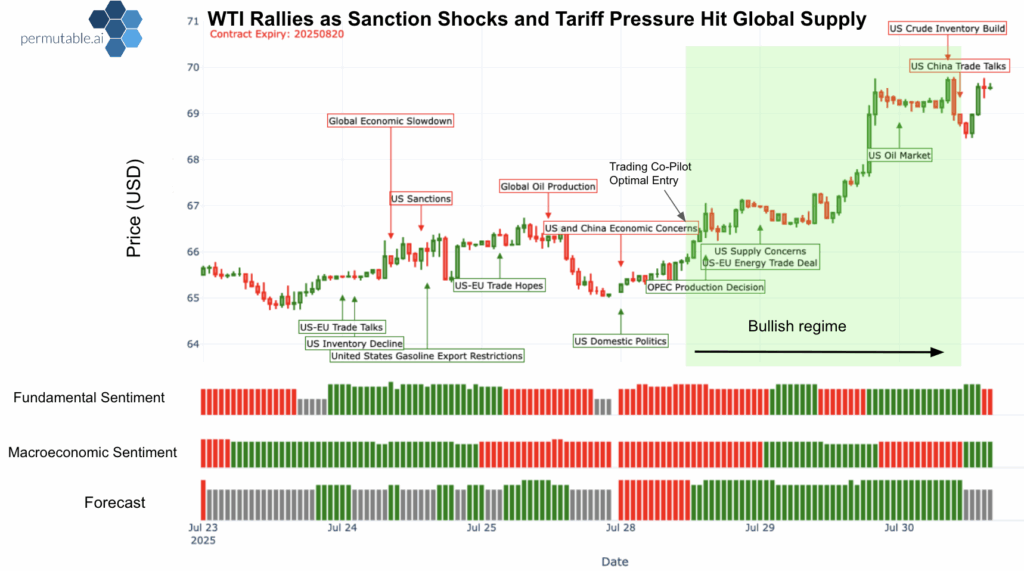
WTI oil

Implementation use cases

  • Real-Time Market Commentary – Automated executive summaries and weekly market roundups from thousands of sources.

  • High-Volume Event Processing – Live detection of supply disruptions, geopolitical tensions, and sentiment swings.

  • Automated Forecasting – Six-month forecasting models with probability-weighted price projections and scenario analysis.

  • High-Frequency Data Feeds – Granular, real-time demand/supply factor analysis and story signal detection for model inputs.

All data is accessible through our Co-Pilot API, offering millisecond-latency delivery, webhook support, and compatibility with Python, R, and Java.


Available crude oil and distillate intelligence

Permutable provides continuous, real-time coverage of:

  • Brent Crude – Global benchmark crude.

  • WTI Crude – US benchmark crude.

  • Heating Oil – Distillate fuel tracking demand cycles and refinery yield changes.

  • RBOB Gasoline – Reformulated gasoline blendstock for seasonal and demand monitoring.

  • Gas Oil – European diesel benchmark for industrial and freight sectors.

Institutional users can access intelligence feeds, sentiment indicators, and forecasting dashboards across all of these assets — turning data noise into actionable trading clarity.


Pros:

  • Real-time, AI-driven intelligence rather than lagging data.

  • Integrated macro, sentiment, and asset-level signals in one platform.

  • Cross-asset correlation for predictive market context.

  • Transparent, explainable AI models for institutional adoption.

Cons:

  • As a next-generation entrant, historical data depth is still expanding compared to legacy providers.


In essence, Permutable delivers what traditional providers can’t: instantaneous crude oil market intelligence that merges global macro events, sentiment, and quantitative data into one unified analytical lens.

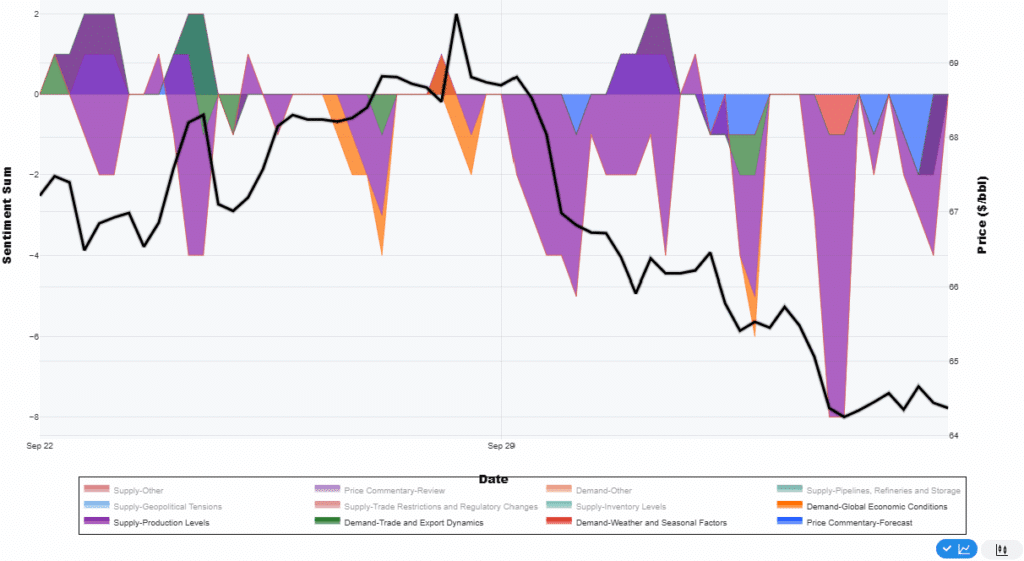
Crude oil market brent drivers

2. S&P Global Commodity Insights (Platts)

Overview

S&P Global Commodity Insights, still widely recognised as Platts, remains one of the most influential names in global energy data. Its price assessments for Brent and WTI set the standard for physical and derivatives trading, underpinning contracts and financial instruments worldwide.

Pros

  • Established global benchmark for crude oil pricing and spreads.
  • Extensive coverage of both physical and paper markets.
  • Deep integration into risk management and regulatory frameworks, making it indispensable for compliance and valuation.

Cons

  • Data reflects market movements after they occur rather than in real time.
  • Minimal use of sentiment, narrative, or AI analytics for predictive insight.

Best for

Institutions and traders relying on benchmark pricing, compliance, or valuation models rather than forward-looking intelligence.

3. Argus Media

Overview

Argus Media is a highly regarded independent price reporting agency (PRA) with global coverage across energy commodities, refined products, petrochemicals, and freight. Its reports are widely used for physical trading, contract settlement, and regional analysis.

Pros

  • Exceptional commodity breadth and regional market detail.
  • Long-standing reputation for independence and transparent methodology.
  • Detailed analytical coverage of pricing structures and logistical constraints.

Cons

  • Primarily focused on price discovery and validation, not predictive modelling.
  • Data access and licensing costs can make it less practical for smaller or emerging firms.

Best for

Physical traders, refiners, and procurement teams needing validated market structure data to manage operations and contract negotiations.

4. Energy Intelligence (Oil Market Intelligence)

Overview

Energy Intelligence, through its renowned Oil Market Intelligence (OMI) publication, offers long-form, contextual insights into global supply-demand balances, policy developments, and strategic movements within OPEC and non-OPEC producers.

Pros

  • Deep editorial experience and policy-level perspective on market drivers.
  • Valuable for understanding the political, regulatory, and geopolitical dimensions of oil markets.
  • Long historical track record builds trust and continuity among institutional readers.

Cons

Best for

Strategists and policy analysts who prioritise context, commentary, and geopolitical interpretation over high-frequency data.

5. Rystad Energy

Overview

Rystad Energy, headquartered in Norway, has become a cornerstone for upstream modelling, production forecasts, and transition analytics. Known for its technical rigour, Rystad’s data underpins many institutional and governmental outlooks.

Pros

  • Comprehensive production, reserves, and project-level data.
  • Strong in scenario planning and energy transition forecasting.
  • Integrates supply-side fundamentals with macroeconomic assumptions.

Cons

  • Focused on long-term fundamentals, with less emphasis on market sentiment or intraday dynamics.
  • Subscription and data licensing can be cost-intensive.

Best for

Institutional investors, research teams, and policymakers needing strategic energy modelling rather than short-term trading intelligence.

6. Enverus

Overview

Enverus (formerly Drillinginfo) specialises in operational, production, and investment analytics, blending financial, satellite, and geospatial data to map energy flows and supply dynamics — particularly in the North American market.

Pros

  • Excellent upstream visibility and production analytics.
  • Strong focus on financial and operational integration for E&P companies.
  • Valuable for assessing asset performance and investment opportunities.

Cons

  • Primarily North America-centric, with less focus on global crude and macro conditions.
  • Does not incorporate real-time sentiment or behavioural analytics.

Best for

Energy producers, investors, and analysts focused on North American supply fundamentals and operational intelligence.

7. Energy Aspects

Overview

Energy Aspects is a boutique research house delivering data-backed commentary on oil, gas, and power markets. Its research is widely followed by hedge funds, traders, and institutional investors seeking nuanced market interpretation.

Pros

  • High-quality research and forecasting, rooted in strong fundamental analysis.
  • Sharp macro and policy insight that contextualises price action.
  • Provides timely commentary on emerging structural shifts.

Cons

Best for

Funds and strategists seeking human expertise paired with fundamental depth, rather than high-frequency automation.

8. IHS Markit (part of S&P Global)

Overview

IHS Markit, now fully part of S&P Global, offers extensive macroeconomic, industrial, and energy analytics, used by governments and corporates for long-term planning and forecasting.

Pros

  • Vast historical datasets and economic indicators spanning decades.
  • Robust scenario modelling tools for energy and industrial sectors.
  • Strong foundation for policy, ESG, and transition strategy analysis.

Cons

  • Slow update cycles and limited responsiveness to fast-changing market events.
  • Not built for real-time decision-making or short-term trading.

Best for

Economists, regulators, and long-horizon investors conducting strategic scenario modelling or macro-level planning.

9. Industrial Info Resources (IIR)

Overview

Industrial Info Resources (IIR) provides detailed project-level intelligence across refining, petrochemicals, and upstream developments — tracking capacity expansions and maintenance globally.

Pros

  • Valuable for understanding physical infrastructure and capacity trends.
  • Insightful visibility into project timing, outages, and maintenance schedules.
  • Supports operational and planning decisions for industrial participants.

Cons

  • Lacks the real-time speed or sentiment awareness traders require.
  • Data delivery cycles can feel static or backward-looking in volatile markets.

Best for

Operations, logistics, and engineering teams requiring granular project tracking and infrastructure intelligence.

10. BTU Analytics (FactSet)

Overview

BTU Analytics, now integrated into FactSet, focuses on US oil, gas, and power markets with a fundamentals-first approach. It serves institutional clients needing clear, concise energy data and regional insight.

Pros

  • Solid fundamentals-based research with actionable implications.
  • Well-structured institutional-grade analysis and forecasts.
  • Integrated into FactSet’

    Crude oil market intelligence FAQ

    Q1. How can institutional traders trust AI-driven market intelligence?

    AI intelligence is only as good as the data and validation behind it. At Permutable, our models are trained on verified, high-frequency global data and benchmarked against traditional market indicators. Every insight is explainable and auditable, ensuring transparency that aligns with institutional compliance standards.

    Q2. What’s the advantage of real-time crude oil market intelligence compared with traditional reports?

    Traditional reports tell you what happened – often days or weeks later. Real-time intelligence shows you what’s happening now and where momentum is building. For traders, that means identifying market shifts and volatility triggers before they show up in price action, improving timing, precision, and risk management.

    Q3. How can new intelligence platforms integrate with existing trading systems?

    Our Trading Co-Pilot API and sentiment datasets are built for seamless institutional integration. Structured in standard data formats (JSON, CSV, REST API), our signals can be calibrated for backtesting, automated trading, or research models with minimal configuration.

    Q4. What if our firm already uses providers like S&P Global or Argus?

    Out intelligence complements – rather than replaces – existing intelligence sources. While traditional data covers fundamentals and benchmarks, our AI models enhance that foundation with sentiment, macro, and behavioural insights. The result is a more complete, real-time view of market dynamics.

    Q5. How do we overcome internal resistance to adopting AI-based intelligence?

    Adoption often hinges on demonstrable accuracy and usability and having key internal champions who understand how exceptional the potential of using these types of systems can be. Our explainable AI models provide full visibility into why signals are generated, allowing teams to validate outputs against known data. Early pilot programmes typically showcase tangible performance improvements, easing organisational buy-in.

    Q6. Can real-time sentiment analysis really impact crude oil trading strategies?

    Absolutely. Market sentiment influences positioning, liquidity, and volatility – especially around policy decisions, OPEC statements, and macro events. Our models quantify these sentiment shifts before they’re reflected in market prices, offering traders a measurable predictive edge.

    Q7. What’s the implementation timeline for institutional users?

    Institutional clients can typically begin accessing real-time feeds within days. Our onboarding team assists with API setup, dashboard access, and custom signal calibration, ensuring smooth integration into existing workflows.

    Q8. How does Permutable ensure data reliability?

    We aggregate from over 50,000 verified news and event sources daily, applying automated verification and filtering algorithms to remove duplication, misinformation, and noise. The result is high-quality, context-rich data you can trust — at machine speed.

    Q9. What level of customisation is available for institutional clients?

    We offer flexible delivery modes – from pre-configured dashboards and alerts to fully integrated API access. Institutions can tailor data granularity, sentiment factors, and frequency to match specific trading or research objectives.


    Q10. How can we see Permutable’s crude oil intelligence in action?

    We provide tailored demos and trial access for institutional teams. Contact enquiries@permutable.ai to request a walkthrough of our Trading Co-Pilot, live dashboards, and API integration capabilities.

7 key global economic trends Q4 2025: Navigating deceleration, AI disruption, and geopolitical realignment

This quarterly analysis examines the latest global economic trends through institutional-grade research, aimed at portfolio managers, corporate strategists, and policy advisors seeking actionable insights into the evolving macro landscape.

As we enter the final quarter of 2025, the global economic trends shaping institutional decision-making have become markedly more complex. Our analysis of sentiment across major financial institutions, central banks, and multilateral organisations reveals a macro environment characterised by slower growth, persistent inflation asymmetries, and accelerating technological disruption – all unfolding against a backdrop of intensifying geopolitical fragmentation.

The confluence of these forces demands that institutional investors and corporate strategists move beyond traditional cyclical frameworks toward more nuanced, multi-dimensional analytical approaches. This quarterly assessment distils the latest economic trends into actionable insights for navigating Q4 2025’s unprecedented combination of deceleration, innovation, and structural realignment.

7 global economic trends for Q4 2025

1. Growth deceleration without collapse: The new norm

The most significant of the recent economic trends is the broad-based deceleration across developed and many emerging economies. With weaker growth expected across most regions in the second half of 2025, whilst Morgan Stanley forecasts global growth at approximately 2.9% for the full year, decelerating to just 2.5% on a Q4-to-Q4 basis. The OECD echoes this subdued outlook, projecting 2.9% growth for both 2025 and 2026 – a notable downshift from the 3.3% registered in 2024.

What distinguishes current global economic trends from previous slowdown episodes is the absence of acute financial stress or systemic credit events. Corporate balance sheets remain relatively robust compared to past downturns, providing resilience buffers that should prevent deceleration from cascading into outright recession in most major economies. However, this very stability creates its own challenges: policymakers and market participants must navigate a slow-growth environment without the clarity that crisis conditions typically provide.

For institutional portfolios, this deceleration regime suggests a shift from broad beta exposure toward alpha generation through sector and geographic selectivity. The days of rising-tide growth lifting all boats appear increasingly distant as we progress through Q4.

2. Monetary policy’s delicate Balancing Act

Central bank policy trajectories represent another crucial dimension of global economic trends heading into year-end. The disinflation process has advanced significantly across advanced economies, yet progress remains uneven and inflation exhibits concerning stickiness in certain regions and categories.

This heterogeneity forces central banks into an uncomfortable balancing act: maintaining sufficiently restrictive policy to anchor inflation expectations whilst avoiding excessive tightening that could tip economies into recession. In the United States, emerging labour market softness may provide the Federal Reserve with scope to begin rate cuts in Q4, a view held by institutions including BlackRock. However, other jurisdictions face different trade-offs, with some central banks likely to maintain tightening bias or delay easing depending on domestic inflation dynamics and currency pressures.

The latest economic trends in monetary policy suggest increasing divergence across central banks – a departure from the synchronised tightening cycle that characterised 2022-2023. This divergence will amplify currency volatility and create complex cross-border capital flow dynamics that institutional investors must actively manage rather than passively accommodate.

3. Trade fragmentation and supply-chain reconfiguration

Elevated tariff pressures and trade policy uncertainty continue to feature prominently amongst recent economic trends, with McKinsey and EY identifying these factors as persistent headwinds to both growth and trade flows. Notably, the front-running effects that characterised earlier periods—firms accelerating orders ahead of anticipated tariff changes – are now unwinding, creating additional drag on trade volumes.

More structurally significant is the ongoing realignment of trade relationships and supply-chain architectures. The European Union’s engagement with Mercosur, Mexico, Indonesia, and India reflects a broader pattern of economies seeking new trade alliances to reduce dependence on single large markets. Simultaneously, reshoring and nearshoring initiatives continue accelerating, particularly in sectors deemed strategically critical.

These shifts represent not merely cyclical adjustments but fundamental reconfigurations of global economic geography. Firms and investors must recognise that supply-chain decisions increasingly balance cost efficiency against resilience and geopolitical risk – a calculation that produces markedly different optimal configurations than prevailed during the pre-2020 globalisation era.

4. Artificial intelligence: Productivity wildcard

Perhaps the most transformative amongst global economic trends is the accelerating investment in artificial intelligence, computing infrastructure, and advanced digital technologies. Major institutions including BNP Paribas identify AI-driven productivity gains as a key factor underpinning economic resilience despite cyclical headwinds.

The scale of investment flowing into data centres, AI model development, and related infrastructure represents a genuine economic force rather than mere speculative froth. These investments have the potential to offset cyclical weakness through productivity enhancements and new business model creation – effects that may become increasingly visible in Q4 data.

However, the benefits of AI-driven transformation remain highly unevenly distributed across countries, sectors, and individual firms. This dispersion creates both opportunities and risks: organisations successfully leveraging AI capabilities may achieve dramatic competitive advantages, whilst those lagging face potential obsolescence. For portfolio managers, this bifurcation demands increasingly granular sector and company-level analysis rather than broad thematic exposure.

Regulatory challenges around data sovereignty, algorithmic transparency, and competition policy add additional complexity to AI-related global economic trends, with different jurisdictions adopting divergent approaches that will shape which firms and regions capture the technology’s economic benefits.

5. Geographic divergence and emerging market dynamics

The latest economic trends reveal increasingly pronounced performance divergences across geographies. India continues to stand out as a bright spot, with strong domestic demand and investment underpinning robust growth trajectories. Conversely, China faces ongoing headwinds in traditional sectors like real estate and industrial output, though its new economy segments – technology and services – provide partial offsets.

This geographic heterogeneity extends beyond the China-India contrast. Some emerging markets will benefit from commodity cycles, nearshoring opportunities, or demographic advantages, whilst others struggle with capital flow volatility, currency depreciation pressures, and elevated debt burdens. The one-size-fits-all emerging markets allocation approach appears increasingly obsolete in this differentiated landscape.

For developed economies, the divergence manifests differently but remains significant. Labour market dynamics, housing sector adjustments, and fiscal policy stances vary markedly across advanced economies, producing distinct cyclical trajectories that demand country-specific analysis.

6. Financial conditions and risk appetite

The evolution of global financial conditions – credit spreads, lending availability, and risk premia – represents a critical variable for Q4 economic outcomes. Tighter credit conditions and elevated risk aversion could amplify downside risks, whilst any signals of central bank easing might support risk asset valuations despite growth deceleration.

BlackRock’s expectation that US labour market softening could enable Federal Reserve rate cuts supporting equity markets into Q4 exemplifies the complex interplay between real economy developments and financial market dynamics. However, elevated volatility seems likely to persist regardless of the specific policy path, as markets navigate the transition from the previous high-growth, high-inflation regime toward a more subdued but uncertain equilibrium.

7. Geopolitical and policy wildcards

No assessment of global economic trends would be complete without acknowledging geopolitical tail risks. US-China strategic competition, regional conflicts, and shifting alliance structures create potential disruptions to trade, energy, and capital flows. Fiscal policy shifts in major economies – whether toward stimulus or austerity – could materially alter growth trajectories. Regulatory changes around technology, climate, and trade add further uncertainty.

The energy transition imperative remains a structural force, with sustained pressure for clean energy investment competing for capital even as energy price volatility has moderated relative to recent peaks. Climate risk increasingly feeds into both economic forecasts and investment decisions, adding another dimension to the complex matrix of factors shaping recent economic trends.

Navigating Q4: Strategic implications

For institutional decision-makers, the global economic trends outlined above demand several strategic adjustments. First, growth assumptions must incorporate deceleration without defaulting to recession scenarios – a nuanced positioning that requires active risk management. Second, geographic and sector selectivity becomes paramount given pronounced performance divergences. Third, AI-related disruption demands granular bottom-up analysis to identify genuine productivity beneficiaries versus speculative positioning.

Finally, geopolitical and policy uncertainties require robust scenario planning rather than single-point forecasts. The combination of slower growth, technological disruption, and structural realignment creates a challenging but opportunity-rich environment for sophisticated institutional participants willing to move beyond conventional frameworks.

Stay ahead of the cycle with our macroeconomic intelligence 

At Permutable, our Trading Co-Pilot and macroeconomic data feeds empower institutional investors with real-time sentiment intelligence, global news monitoring, and predictive analytics that cut through noise to surface what really moves markets. Whether you are navigating Q4’s growth deceleration, assessing the implications of diverging central bank paths, or quantifying AI-driven disruption, our intelligence suite provides the edge you need to anticipate risks and capture opportunities before consensus shifts.

Request a demo of our Trading Co-Pilot and macroeconomic feeds at enquiries@permutable.ai to gain actionable insights, portfolio-ready intelligence, and a forward-looking perspective trusted by leading institutional investors worldwide.

Energy commodity trends Q4 2025: Seasonal patterns, supply constraints, and geopolitical risk shape energy complex

This quarterly analysis examines commodity trends across energy markets through the lens of Permutable’s Trading Co-Pilot, aimed at portfolio managers, energy traders, and corporate strategists seeking actionable insights into evolving supply-demand dynamics.

As we enter the two months of 2025, commodity trends across the energy complex reveal a market environment fundamentally shaped by the interplay of seasonal demand patterns, persistent supply-side constraints, and elevated geopolitical risk premiums. Our Trading Co-Pilot‘s analysis of sentiment and fundamental drivers across crude oil, natural gas, liquefied natural gas, and refined products markets identifies several dominant themes that will likely define commodity market performance through year-end.

The overarching narrative emerging from current commodity trends is one of fragmentation rather than convergence. Unlike previous periods when energy markets moved in relative lockstep, the final quarter of 2025 presents distinct supply-demand dynamics across different segments of the energy complex. This divergence creates both opportunities and challenges for institutional participants seeking to navigate what has become an increasingly nuanced commodity landscape.

Crude Oil: Balancing Geopolitical Risk Against Supply Discipline

Commodity trends in crude oil markets Q4 reflect a delicate equilibrium between geopolitical supply disruption risks and fundamental supply-demand balances. Brent crude’s trajectory throughout 2025 exemplifies this tension, with early-year strength driven by OPEC+ production discipline giving way to mid-year weakness as output increases and rising inventories weighed on sentiment, before partial recovery on softer dollar conditions and intermittent Chinese demand signals.

The current environment sees crude markets navigating between $65 and $75 per barrel ranges, with sentiment oscillating based on drone attack risks targeting Russian and Ukrainian energy infrastructure, Black Sea shipping disruptions, and evolving OPEC+ policy signals. What distinguishes current commodity trends from previous cycles is the persistence of these geopolitical risk premiums despite relatively balanced fundamental supply-demand conditions.

In Q4, commodity trends in crude oil will likely be shaped by several key variables. Winter demand patterns historically provide seasonal support, particularly if Chinese economic stimulus measures translate into tangible consumption increases. OPEC+ production policy remains the critical swing factor, with any significant supply increases capable of overwhelming demand-side improvements. The group’s messaging and actual production behaviour will be crucial in determining whether crude markets maintain their current equilibrium or break decisively in either direction.

The interplay between North American production trends and global supply balances adds further complexity. Rising US rig counts and restored Iraqi-Turkish pipeline flows represent supply-side headwinds that could pressure markets absent offsetting demand strength or voluntary OPEC+ restraint. This dynamic underscores how commodity trends increasingly reflect sophisticated multi-variable optimisation rather than simple supply-demand mechanics.

Natural Gas: Weather-Dependent Volatility Meets Structural Oversupply

Commodity trends in natural gas markets present perhaps the most weather-dependent outlook across the energy complex in Q4. Henry Hub’s dramatic journey from above $5.78 in Q1 2025 to below $3.00 during summer oversupply episodes illustrates the extreme volatility that characterises this market, with current stabilisation around $3.17 reflecting the tension between elevated storage levels and approaching heating season demand.

The structural narrative dominating commodity trends in natural gas centres on persistent oversupply conditions driven by record production levels. This fundamental backdrop creates a bearish bias that only severe winter weather can overcome sustainably. The magnitude of any Q4 rally will therefore depend critically on temperature deviations from seasonal norms across key demand centres, with mild winter scenarios keeping prices range-bound whilst severe cold snaps could trigger sharp upward moves.

European natural gas markets, as reflected in TTF pricing, show similar seasonal sensitivity but with greater geopolitical complexity. Recent breakouts near €33 driven by Central European cold snaps and downgraded Russian export outlooks demonstrate how commodity trends in this market remain acutely sensitive to supply disruption narratives alongside fundamental weather-driven demand patterns.

The LNG market adds another dimension to natural gas commodity trends, with seasonal heating demand in Europe and Asia providing natural support, whilst new project commissioning and export capacity expansions create supply-side pressures. Record US exports through facilities like Freeport alongside LNG Canada project progress indicate that supply growth continues outpacing demand expansion on an annual basis, even as seasonal patterns create quarterly fluctuations.

For Q4 specifically, commodity trends in natural gas will likely exhibit heightened volatility around weather forecast updates and storage injection/withdrawal reports. The winter heating season represents natural gas markets‘ moment of truth, when theoretical oversupply meets actual demand realisation. Geopolitical disruptions to pipeline flows or LNG terminal operations could introduce additional volatility beyond weather-driven dynamics.

Refined Products: Seasonal Maintenance and Demand Dynamics

Commodity trends in refined products markets in Q4 reflect the typical seasonal patterns of autumn refinery maintenance transitioning into winter demand for heating fuels, with geopolitical supply disruptions adding complexity to fundamental seasonal dynamics.

Distillate markets, as exemplified by NY Harbor ULSD, have exhibited pronounced volatility throughout 2025 driven by episodic supply disruptions across Libya, Russia, and various pipeline systems. Current positioning suggests the market in Q4 with moderate speculative length and technical support levels that should provide downside protection, whilst Gulf Coast refinery maintenance schedules and early heating demand provide natural seasonal tailwinds.

The commodity trends trajectory for distillates will likely depend heavily on several factors: the severity and duration of refinery maintenance activities, which reduce product output precisely when seasonal demand begins increasing; the pace of heating oil and diesel demand as temperatures decline across the northern hemisphere; and any supply-side disruptions from geopolitical events or operational issues at major production facilities.

Gasoline markets present different commodity trends dynamics, with RBOB exhibiting cyclical swings throughout 2025 before ending September near $1.98 amid persistent product stock draws and hurricane threat premiums. The seasonal pattern for gasoline typically sees weakening fundamentals into year-end as driving activity declines, but this year’s trajectory may prove more complex given supply-side constraints and inventory dynamics.

Hurricane risks remain relevant, with historical patterns showing October can still produce significant storm activity affecting Gulf Coast refining operations. The combination of hurricane risk, refinery maintenance schedules, and evolving inventory levels creates a commodity trends outlook where refined products could exhibit greater strength relative to crude oil, as refining margin dynamics respond to supply-demand imbalances.

Supply-Side Constraints as Persistent Theme

Across all segments of the energy complex, commodity trends for Q4 2025 are characterised by supply-side constraints that prevent significant price weakness despite demand concerns. Whether examining OPEC+ production discipline in crude markets, pipeline and export infrastructure limitations in natural gas, or refinery capacity constraints in products, supply-side factors provide consistent price support.

This supply-constrained environment differs markedly from previous cycles where demand weakness translated more directly into price declines. Current commodity trends reflect structural underinvestment in production capacity across multiple energy sectors following the 2020 downturn, creating supply inelasticity that makes markets more responsive to marginal demand changes or supply disruptions.

The geopolitical dimension of supply constraints deserves particular emphasis. Drone attacks on energy infrastructure, sanctions affecting Russian energy flows, shipping disruptions through critical maritime chokepoints, and trade policy uncertainty all contribute to risk premiums embedded in current commodity valuations. These geopolitical factors add volatility and upside skew to commodity trends that fundamental supply-demand analysis alone would not predict.

Seasonal Patterns in a Structurally Different Market

Whilst seasonal patterns remain relevant to commodity trends, their expression in Q4 2025 occurs within a structurally different market environment than prevailed in previous cycles. Winter demand for heating fuels provides natural seasonal support, but the magnitude of any rally depends critically on weather outcomes and supply responses.

Historical volatility patterns suggest commodity markets entering Q4 with wider-than-typical confidence ranges reflecting elevated uncertainty around multiple variables. The probability-weighted forecasts emerging from our Trading Co-Pilot analysis indicate markets expecting modest upside biases across most energy commodities, but with significant scenario divergence depending on weather, geopolitical events, and policy decisions.

Strategic Implications for Q4 Navigation

For institutional participants, commodity trends in Q4 demand several strategic considerations. First, seasonal positioning must account for supply-side constraints that could amplify typical winter demand effects. Second, geopolitical event risk requires robust hedging strategies rather than directional bets. Third, cross-commodity spread opportunities may offer better risk-adjusted returns than outright directional exposure given the fragmented nature of current commodity trends.

Weather derivatives and volatility products become increasingly relevant tools as commodity trends exhibit greater sensitivity to temperature outcomes. The range of plausible scenarios across energy commodities remains unusually wide, suggesting that position sizing and risk management deserve particular attention as we progress through the quarter.

The integration of fundamental analysis with sentiment tracking and geopolitical risk assessment represents the optimal approach for navigating current commodity trends. Markets are pricing complex interactions between seasonal patterns, supply constraints, and event risks that require sophisticated multi-dimensional analytical frameworks rather than simple supply-demand projections.

This assessment of commodity trends is powered by our Trading Co-Pilot’s sentiment and fundamental analysis across energy markets. For access to our real-time commodity sentiment tracking capabilities, contact enquiries@permutable.ai.

Predicting market movements through advanced sentiment analysis

This article explores how advanced narrative intelligence and real-time AI-driven sentiment analysis are transforming the way professional traders and systematic investors approach predicting market movements.

When Brent crude spiked from $69 to $74 in June 2025, traditional analysts were still parsing Middle Eastern headlines whilst our War Sentiment Index had already flagged the narrative shift hours earlier. This isn’t an isolated incident – story signals have fundamentally changed the game, enabling systematic traders to position ahead of market consensus rather than react to price action that’s already occurred.

Understanding story signals

Story signals essentially capture the narrative momentum that drives market behaviour through our sophisticated proprietary algorithms that process vast amounts of unstructured data across thousands of media sources simultaneously. Unlike traditional analysis that relies on historical price data, our story signals identify the underlying narrative forces that eventually translate into trading decisions by market participants.

The power of our approach lies in capturing the informational edge that exists in the temporal gap between when news breaks and when markets fully digest its implications. Our systematic framework processes linguistic patterns, source credibility, and cross-reference validation at speeds impossible for human analysts, transforming market prediction from reactive analysis to proactive strategy implementation.

The four pillars of our story signal detection for predicting market movements

Effective market prediction through story signals relies on understanding four distinct signal categories that our algorithms continuously monitor across global media sources.

Breakout Signals occur when previously dormant stories suddenly capture widespread media attention, often indicating the beginning of significant price movements as market awareness shifts dramatically. The recent platinum surge above $1,268 in June 2025 exemplifies this pattern perfectly. Our Trading Co-Pilot detected unusual narrative momentum building around platinum supply constraints and geopolitical risks hours before the metal broke through resistance at $1,089.50. Our system issued a “strong bullish” sentiment alert during early Asian trading, providing our subscribers with critical positioning advantages before prices accelerated from $1,127.20 to $1,222.50.

Volume Build-up Signals represent the gradual accumulation of narrative momentum around particular themes or asset classes. Unlike sudden breakout spikes, volume build-up creates sustained pressure that enables long-term trend prediction. The euro’s strengthening trend demonstrated this signal type in action. As ECB officials maintained hawkish tones while the Federal Reserve showed dovish tendencies, our Trading Co-Pilot systems tracked the building narrative around monetary policy divergence. This volume build-up preceded EUR/USD’s surge above $1.1570 to levels not seen since late 2021, with the single currency benefiting from systematic capital flows as investors repositioned for central bank policy differences.

EUR/GBP Surge: Sterling Weakness Drives Euro to Multi-Month Highs

Above: Tracking macroeconomic sentiment: The EUR/GBP rally in June 2025 was preceded by sustained positive sentiment and narrative signals – enabling traders to anticipate the euro’s climb amid UK economic weakness and ECB policy updates.

Direction Shift Signals identify when established narratives begin changing course, providing critical intelligence for anticipating price reversals before technical indicators suggest trend changes. The recent shift in oil market sentiment surrounding Middle Eastern tensions illustrates this pattern. Initially, markets had become somewhat complacent about regional risks, but our War Sentiment Index detected early signals of changing narrative tone. On June 12th, our algorithms began detecting unusual patterns in media coverage of Iran-Israel tensions, with sentiment scores showing significant negative spikes hours before Brent crude moved from $69 to $74 following escalating strike warnings.

Persistence Signals measure the staying power of existing narratives, helping traders distinguish between temporary noise and stories with genuine long-term market impact. The sustained euro strength against sterling demonstrates our persistence signal effectiveness. EUR/GBP’s ascent to 0.85 was driven by persistent negative narratives around UK economic performance, with our Trading Co-Pilot tracking consistent bearish sentiment following Britain’s -0.3% GDP contraction in April 2025. The persistence of negative UK economic stories, combined with eurozone resilience narratives, created sustained pressure that traditional technical analysis struggled to quantify.

Real-world performance: Our systematic advantages in action

The effectiveness of our story signal technology extends across multiple asset classes and market conditions, with documented success providing systematic traders with measurable competitive advantages.

Precious Metals Intelligence: The platinum market surge in June 2025 showcases our story signals’ precision in commodity markets. Our Trading Co-Pilot identified the two-stage rally before price action confirmed the moves, capturing demand surge narratives in May and squeeze dynamics in June. When platinum opened sharply higher at $1,268.90 following intensified Russian drone attacks on Kyiv, our system had already signalled bullish sentiment shifts, enabling our subscribers to position ahead of safe-haven buying flows.

Currency Market Prediction: The euro’s remarkable strength against major currencies demonstrates our story signals’ effectiveness in foreign exchange markets. Our Trading Co-Pilot‘s sentiment analysis captured the shift from bearish to bullish conditions across EUR/USD and EUR/GBP, identifying macro data impacts and central bank rhetoric changes before markets moved. Our system correctly anticipated EUR/USD’s sustained upward trajectory past 1.16, whilst simultaneously tracking the narrative divergence that drove EUR/GBP higher as UK growth fears intensified.

Energy Market Intelligence: Oil markets provided perhaps the most dramatic demonstration of our story signals’ predictive power. Our War Sentiment Index, one of 22 proprietary macro indices we’ve developed, detected escalating Middle Eastern tensions hours before Brent crude spiked from $69 to $74. Our system processed thousands of articles in real-time, assigning sentiment scores and evaluating source credibility to create high-confidence signals that traditional geopolitical analysis could never match for speed and accuracy.

Iran oil price surge war sentiment

Above: Early warning in action: Our War Sentiment Index flagged negative sentiment spikes hours before Brent crude surged from $69 to over $74 on June 13, 2025 – providing a clear possible entry point well ahead of market consensus.

Integration with systematic trading strategies

The competitive advantage in modern systematic trading increasingly depends on information processing speed and accuracy, precisely where our story signals excel. Our algorithms can detect narrative shifts within minutes of emergence, providing systematic traders with significantly improved entry and exit timing capabilities.

The quantitative nature of our signals integrates seamlessly with existing algorithmic trading systems, providing an additional intelligence layer that enhances rather than replaces traditional technical and fundamental analysis approaches. This allows for positioning ahead of market consensus rather than following it, providing edge in trading operations

During volatile periods, such as the recent Iran-Israel escalation, our story signals provided our clients with actionable intelligence hours before markets fully priced in geopolitical risks. Traditional analysis would have required manual processing of news flows, expert interpretation, and risk assessment – processes that consume valuable time whilst opportunities disappear.

Macro strategy applications

Macro strategists face unique challenges in connecting global narratives with specific asset class implications across interconnected markets. Our story signals excel in this environment through multi-asset correlation analysis that helps strategists understand how geopolitical tensions, central bank communications, or economic policy shifts create ripple effects across different instruments and regions.

The recent convergence of multiple macro themes demonstrates this capability. European monetary policy divergence, Middle Eastern geopolitical tensions, and commodity supply constraints created complex cross-asset relationships that traditional analysis struggled to quantify systematically. Our story signals provide the framework for identifying which narratives deserved immediate attention versus those representing temporary noise, enabling more efficient allocation of analytical resources.

Meanwhile, the correlation between our War Sentiment Index and Brent crude over the past year reveals patterns impossible to detect through manual analysis, with major sentiment spikes consistently preceding significant oil price movements. 

The evolving competitive landscape

Financial markets have fundamentally changed, with information velocity and complexity reaching levels that traditional analysis cannot adequately address. Our story signals represent the natural evolution of market intelligence, combining artificial intelligence capabilities with deep understanding of market psychology and behaviour patterns.

What we are seeing is that this transformation is becoming indispensable to our clients as markets grow increasingly efficient and competitive, with early adopters of our story signal technology are already seeing significant advantages.

The question facing professional traders and institutions is not whether AI-driven sentiment analysis will become standard practice, but how quickly these capabilities can be integrated before competitors gain systematic advantages. Every day, commodity and currency markets experience inflection points that separate profitable positions from missed opportunities, and without real-time sentiment detection, significant alpha potential remains uncaptured.

Looking forward

As the sophistication of modern markets continues evolving, the demand for equally sophisticated analytical tools grows correspondingly. At Permutable, we’re building tools for today’s markets – are preparing traders for tomorrow’s complexity. We believe that the integration of real-time narrative intelligence with systematic trading strategies represents the next evolutionary step in professional market analysis.

Discover how our narrative intelligence and Sentiment Analysis API can enhance your ability to predict market movements and gain the competitive edge that separates successful systematic traders from the rest. Email us at enquiries@permutable.ai to request a demo.