This article provides a comprehensive analysis of the most critical breaking geo political issues 2025 at time of writing and their profound impact on global markets, providing institutional investors with strategic insights for navigating unprecedented political risk. It is aimed at institutional investors, portfolio and macro strategists, risk managers, commodities and energy traders, and global research teams seeking to anticipate and capitalise on geopolitical developments before they reach market consensus.
The landscape of global geopolitical risk has fundamentally shifted in 2025, presenting institutional investors with a complex web of interconnected tensions that demand sophisticated analytical capabilities and real-time intelligence. The rising wave of geo political issues are not merely isolated incidents but part of a broader realignment of global power structures that will continue to shape market dynamics for years to come. The traditional approach of reactive positioning – waiting for geopolitical events to unfold before adjusting portfolios – has proven increasingly inadequate in an environment where milliseconds can determine the difference between capturing alpha and experiencing significant losses.
For institutional investors, the challenge extends beyond simply identifying potential flashpoints to understanding their interconnected nature and cascading effects across multiple asset classes, regions, and time horizons. The sophisticated investor recognises that effective macro research in today’s environment requires not just awareness of these tensions but the ability to process vast streams of real-time intelligence, identify subtle shifts in sentiment and positioning, and translate these insights into actionable investment strategies before market consensus emerges.
The evolving trade relationship between the United States and China continues to represent one of the most significant geo political issues in 2025, with implications extending far beyond bilateral trade flows. The complexity of this relationship has deepened as both nations navigate technological competition, supply chain reorganisation, and strategic alliance building. For institutional investors, understanding these dynamics requires monitoring not only official government communications but also corporate earnings calls, supply chain disruptions, and shifting patterns in global manufacturing and technology investment.
The alliance dimension adds another layer of complexity, as US partnerships with Japan, South Korea, Australia, and European nations create ripple effects that impact everything from semiconductor markets to rare earth metal pricing. Importantly, sophisticated macro research capabilities enables investors to track sentiment shifts across multiple jurisdictions simultaneously, providing early warning signals for policy changes that may not be immediately apparent through traditional diplomatic channels. The ability to process and analyse these diverse information streams in real-time through technologies such as our provides powerful advantages for positioning in technology sector equities, emerging market currencies, and commodity futures.
The ongoing tensions between Iran and Israel have evolved into a broader regional confrontation with profound implications for global energy markets and Middle Eastern stability. The Strait of Hormuz, through which approximately 20% of global oil passes, remains a critical chokepoint that demands constant monitoring by energy traders and macro strategists. The sophistication required to analyse this situation extends beyond simple conflict monitoring to encompass complex supply chain analysis, regional alliance dynamics, and the potential for proxy conflicts across multiple theatres.
For institutional investors, the challenge lies in understanding how these regional tensions translate into global market impacts. Oil price volatility, safe-haven flows into precious metals and government bonds, and currency fluctuations in energy-dependent economies all require sophisticated analytical capabilities that can process information from diverse sources whilst identifying patterns and connections that may not be immediately apparent. It is here that real-time sentiment analysis of government communications, military positioning, and diplomatic initiatives provides distinct competitive advantage, providing crucial early warning signals for potential escalation or de-escalation scenarios.
The persistent tensions along the India-Pakistan border represent a significant source of regional instability with global implications for technology outsourcing, manufacturing supply chains, and emerging market investment flows. The nuclear dimension of this relationship adds layers of complexity that require sophisticated risk assessment capabilities beyond traditional geopolitical analysis. For institutional investors with exposure to South Asian markets, understanding these dynamics requires monitoring not only official government communications but also military movements, diplomatic initiatives, and public sentiment across both nations.
The economic implications extend far beyond the immediate region, with potential disruptions to global technology supply chains, pharmaceutical manufacturing, and textile production. Macro research capabilities that can track sentiment shifts in this context provide essential insights for investors seeking to position themselves appropriately in emerging market equities, currency markets, and sector-specific exposures that may be affected by escalating tensions.
The evolving relationship between Turkey and Israel, particularly in the context of Syrian developments, represents a complex geopolitical dynamic with implications for NATO cohesion, regional stability, and energy transit routes. The multifaceted nature of this situation requires advanced analytical capabilities that can process information from diverse sources whilst understanding the historical context and strategic implications of various policy positions.
For institutional investors, the challenge lies in understanding how these regional dynamics translate into broader market impacts. Currency volatility in the Turkish lira, implications for European energy security, and potential disruptions to trade routes all require sophisticated analytical frameworks that can identify subtle connections between seemingly unrelated developments. The ability to track sentiment across multiple stakeholders and jurisdictions provides obvious advantages for positioning in emerging market currencies, energy sector equities, and regional bond markets.
The emerging strategic coordination between China, Russia, Iran, and North Korea – otherwise known as “The Axis of Upheaval” – represents a concerning fundamental shift in global power dynamics with far-reaching implications for international trade, financial markets, and security architecture. Understanding this complex relationship requires analytical capabilities that can process information from diverse sources whilst identifying patterns and connections that may not be immediately apparent through traditional diplomatic channels.
For institutional investors, the implications extend across multiple asset classes and regions. Sanctions regimes, trade route disruptions, technology transfer restrictions, and commodity price volatility all require sophisticated risk assessment capabilities that can anticipate policy changes and market reactions before they are reflected in asset prices. Here, the ability to track sentiment and positioning across multiple jurisdictions provides essential early warning signals for potential market disruptions or investment opportunities.
The expansion of Chinese naval presence in the Tasman Sea represents a significant development with implications for regional security architecture, trade routes, and alliance dynamics between Australia, New Zealand, and their Pacific partners. Understanding the strategic implications of this development requires analytical capabilities that can process information from diverse sources whilst assessing the potential for escalation or accommodation.
For institutional investors, the implications extend beyond immediate regional concerns to encompass broader questions about global trade routes, commodity exports, and currency stability in the Pacific region. The ability to track sentiment and positioning across multiple stakeholders provides crucial insights for positioning in commodity markets, regional currencies, and sector-specific exposures that may be affected by evolving strategic dynamics.
The ongoing conflict in Ukraine continues to represent one of the most significant sources of geopolitical risk in 2025, with implications extending far beyond the immediate theatre of operations. The potential for proxy conflicts, alliance testing, and economic disruption requires sophisticated analytical capabilities that can process vast amounts of information whilst identifying patterns and connections across multiple dimensions of international relations.
For institutional investors, the challenge lies in understanding how this conflict continues to shape global markets through energy price volatility, supply chain disruptions, defence sector investment, and safe-haven flows. The ability to track sentiment and positioning across multiple stakeholders provides essential insights for positioning in energy markets, defence sector equities, and European regional investments alike that may be affected by evolving conflict dynamics.
The cumulative effect of these geo political issues in 2025 has created an environment of heightened market volatility that demands sophisticated risk management capabilities and strategic positioning. Traditional approaches to portfolio construction and risk assessment have proven inadequate in an environment where geopolitical developments can trigger rapid shifts in asset prices, currency values, and commodity markets within hours or even minutes of initial reports.
The interconnected nature of modern financial markets means that geopolitical developments in one region can quickly propagate across multiple asset classes and geographic regions. Central bank policy responses, safe-haven flows, and inflation expectations all become interconnected variables that require comprehensive analytical frameworks capable of processing vast amounts of information whilst identifying subtle patterns and relationships that may not be immediately apparent.
For institutional investors, the challenge extends beyond simply identifying potential risks to understanding their potential market impacts and developing appropriate hedging strategies. The ability to integrate real-time geopolitical intelligence into existing risk management frameworks provides crucial advantages for maintaining portfolio stability whilst identifying opportunities for alpha generation during periods of heightened volatility.
Our advanced geopolitical sentiment provides institutional investors with the sophisticated analytical capabilities required to navigate these complex dynamics effectively.
Above: Our real-time geopolitical and macro sentiment intelligence identified a bullish LNG regime before price momentum took off. From early entry post-project disruption to accurately tracking the market’s response to EU sanctions, pipeline expansions, and force majeure developments, Our system flagged the bullish shift in fundamentals and macro tone — well ahead of the crowd.
Our real-time sentiment analysis enables investors to track developments, providing early warning signals for potential escalation or de-escalation scenarios before they are reflected in market prices. Importantly, the integration of historical data spanning multiple years enables sophisticated backtesting and scenario analysis that can help investors understand how their strategies might perform under various geopolitical conditions.
Above: This chart reveals how our geopolitical sentiment data tracked a deepening negative tone surrounding Iran–Israel tensions before Brent crude broke out. With a clear sentiment trough marking the possible entry, investors using our signal analytics gained valuable early warning before the oil rally began to price in risk premium.
In terms of macro research, the ability to feed real-time sentiment data directly into trading algorithms and risk management systems represents a fundamental shift in how institutional investors can respond to evolving geopolitical conditions using our data. This integration enables dynamic adjustment of portfolio exposures based on real-time developments rather than static risk parameters or delayed market reactions.
Above: Our Political Tension Index captures 12 months of shifting geopolitical risk, from the US shutdown threat and Canada tariff war to the Trump-Musk fallout. The green zone highlights a brief diplomatic reprieve – rapidly followed by re-escalation. For institutional clients, this index offers a quantifiable edge in forecasting how political narratives translate into market volatility across FX, commodities, and safe-haven assets.
The bottom line here is that the top geo political issues 2025 weave a complex and delicate landscape of risk requiring sophisticated analytical capabilities that can process vast amounts of information whilst identifying actionable insights for institutional investors. Ultimately, the institutions that successfully leverage these advanced capabilities will find themselves with substantial competitive advantages in an increasingly complex global environment. Why? Simply because the future of geopolitical risk management lies not in replacing human expertise but in augmenting it with powerful analytical tools that can process information at scales and speeds that would be impossible through traditional methods.
As global tensions continue to evolve and intensify, the ability to anticipate and respond to geo political issues before they reach market consensus will become increasingly valuable for institutional investors seeking to maintain competitive advantages whilst managing portfolio risks effectively. The question for institutional investors is not whether to adopt these advanced capabilities but how quickly they can be integrated into existing investment processes to capture the substantial opportunities they represent.
Transform geopolitical chaos into alpha generation – discover how our real-time geopolitical intelligence turns breaking tensions into strategic advantage before they hit market consensus. Contact our enterprise team at enquiries@permutable.ai to see how institutional leaders are using our advanced analytics to navigate 2025’s most volatile geopolitical landscape.
In this new world order of financial markets, we have been seeing first hand both through our own activities and those of our clients how powerful market sentiment indicators can be for navigating market volatility. The hard truth found in the blur of the last few weeks in global markets is that traditional indicators often lag behind the rapid shifts in investor psychology that drive price action. In this new reality, there is no shying away from the fact that emotion, rather than pure fundamentals, is steering market movements with unprecedented force.
When you consider how markets are reacting faster to narratives than fundamentals, the importance of tracking sentiment becomes crystal clear. For instance, U.S. equities and oil surged immediately after de-escalation comments around Middle East tensions – long before any material changes happened on the ground. This reactivity demonstrates that market sentiment now often precedes price movements.
In recent weeks, retail and algorithmic flows have become heavily headline-driven. A single tweet or soundbite from a central bank, government leader, or media outlet can now spike or sink markets within minutes. The exponential speed at which information travels and influences trading decisions means market sentiment indicators provide vital early warnings.
Anyone will know that the most glaring prospect facing markets today is geopolitical uncertainty. What has been unfolding before our eyes are multiple flashpoints – from the Red Sea to the Taiwan Strait to Ukraine and the Trump Tariff rollercoaster – that are constantly evolving. These events often drive fear-based moves long before they’re reflected in traditional economic indicators or yields.
Here, our market sentiment engine aggregates and quantifies tension levels across leading international news sources in near real time—offering early signals before markets fully price in risk. As we stand in front of the revolving doors of time, this type of intelligence provides powerful foresight.
Let us not forget that bond yields and traditional macro indicators often react too slowly in fast-moving geopolitical crises. During the recent oil price dip, sentiment indicators flagged softening rhetoric in the Middle East days before futures markets began correcting.
This exact type of sentiment signal becomes a better risk proxy than long-duration data that lags behind current global dynamics. The future is in the balance, and it’s hard to say how this current period of volatility will play out. But those relying solely on traditional indicators may find themselves consistently behind the curve.
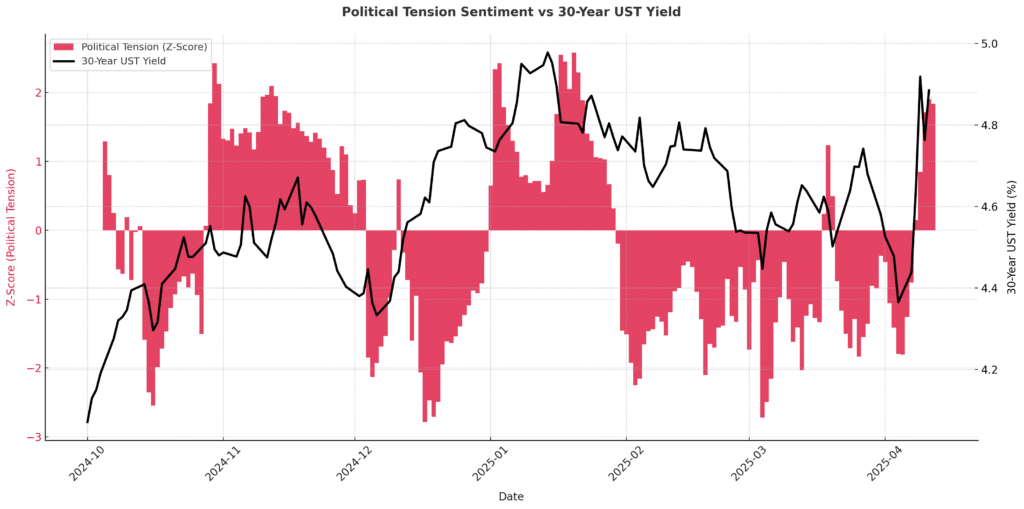
Above: Our Alternative Political Risk Indicator: Permutable Geopolitical Indicator (PGI): We are introducing a proprietary alternative to the traditional 30-year U.S. Treasury yield as a gauge for political risk.
The danger of this shift is that markets today swing heavily on perceived “risk-on vs. risk-off” moves based on geopolitical fear or relief. It’s hard to keep up with the firehose of information, but tracking market sentiment indicators provides a dynamic view of global risk appetite, capturing emotional tone shifts that influence investor behaviour.
Experts say this draws a clear line between reactive and proactive investment strategies, and by focusing on market sentiment indicators, this allows investors to anticipate shifts between flight to safety and high-beta risk-taking before they become widely apparent.
Our conversations here at Permutable often return to the cracks appearing in traditional market analysis, with crypto, commodities, and equities all showing increased correlation with news sentiment and social media tone. For example, our sentiment engine detected surging bullish sentiment before certain assets rallied on speculative headlines – purely sentiment-driven trading that traditional metrics missed entirely.
And this is why the question of incorporating sentiment analysis has become so powerful. Quite simply, the extremely rapid diffusion of information means market narratives are forming and shifting more quickly than ever before.
As we write this, it should now be obvious that within the era of Trump 2.0, policy uncertainty has reached unprecedented levels. This rightly causes worries about market stability, as presidential rhetoric and policy shifts can trigger immediate market reactions.
Reaching even deeper into sentiment analysis allows investors to gauge market reactions to policy announcements before they’re fully implemented. The Trumpian backlash against certain sectors and the boost to others can be anticipated through careful monitoring of sentiment indicators, providing an powerful layer of insight.
As we navigate today’s challenges, one thing is for certain – the new regime in markets requires new tools. As Trump continues to flex and confuse with America turning away from international order in various ways, this is creating unique market conditions where sentiment often trumps fundamentals as. We can clearly see that global trust will continue to be challenged as the world strives to recalibrate, and we can expect the hosepipe of information to continue to flow at an overwhelming rate.
While traditional indicators may have served us well in the past in this new era fed by tariff tantrums, characterised by rapidly evolving markets, market sentiment indicators offer a powerful advantage to relying solely on lagging indicator.
And so, in light of the above, in a world where market movements are increasingly driven by emotion rather than fundamentals, can you afford to navigate today’s volatile investment landscape without the insights provided by robust market sentiment indicators?
Discover how Permutable AI’s market sentiment indicators can transform your investment approach in this new era of volatility. Book a demonstration today to see how our sentiment analysis technology can give you the edge in anticipating market movements before they occur. Simply email enquiries@permutable.ai to learn more about implementing our market sentiment indicators into your strategy or fill in the form below.
Energy markets are becoming increasingly complex to navigate and as they continue to evolve, those who are able to stay ahead of increasingly volatile market dynamics will be, in our opinion, those who embrace AI-powered trading insights for energy markets. While the AI race continues to develop at a unprecedented rate – within energy markets particularly – technological strides are already fundamentally changing how traders operate. And all this is thanks to AI’s ability to process vast amounts of market data in real-time, offering powerful visibility into market movements, correlations and emerging patterns.
In this article we’ll take a brief look at some use cases of our AI-powered trading insights in energy markets, looking at how these can be using to predict price movements, reduce trading risk and unearth trade ideas.
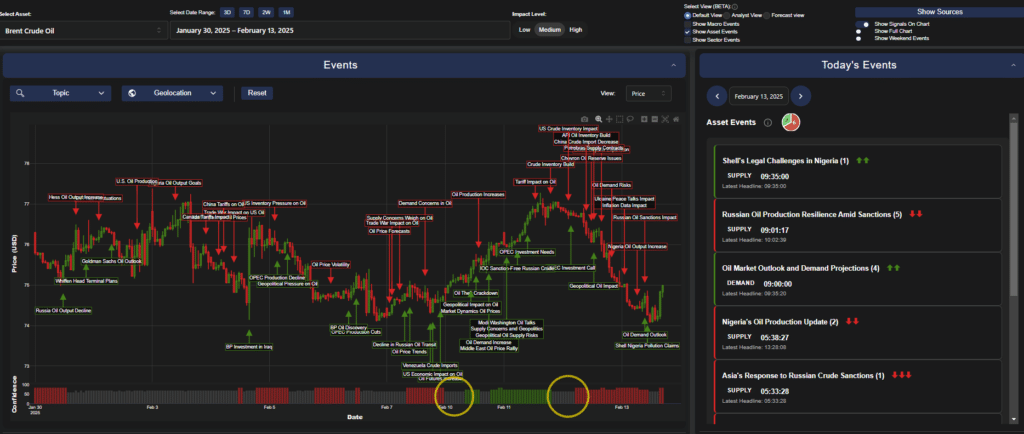
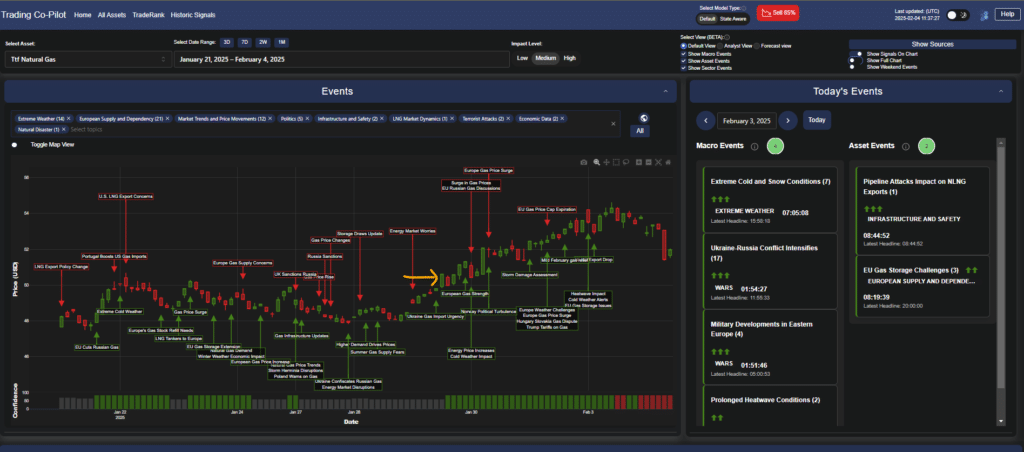
We think on of the most powerful applications of AI-powered trading insights in energy markets is in their ability to provide a 360 degree market view by simultaneously process multiple data streams. As an example, our Trading Co-Pilot platform analyses price movements, geopolitical events, and supply-demand dynamics in real-time, providing energy traders with comprehensive market intelligence, spotting trends before they become mainstream. Perhaps the most powerful aspect of this is that this analysis happens at a speed and scale impossible for even the best human traders and team of analysts to match.
Coming back to the critical aspect of trading risk management, our AI-powered insights offer a powerful approach to risk assessment. Indeed, we’ve seen even the most experienced traders benefit from our system’s ability to identify potential risks before they materially impact the market. Here, the hard truth is that the vast majority of traditional risk management systems simply cannot match this predictive capability that our system is able to offer.
At this point, it’s worth noting how our AI-powered trading insights for energy markets provide crucial early warnings about supply chain disruptions. For example, our platform continuously monitors news on global shipping movements, refinery operations, and production facilities, instantly alerting traders to potential disruptions reported on in the news and how that could impact market sentiment and dynamics. That said, this real-time monitoring capability represents just one aspect of our broader value proposition.
Perhaps then, we had better move onto just how vital it has become to understand how geopolitical events affect energy markets. Perhaps there is no guarantee, of course, that every political development will impact prices, but our AI systems excel at reducing noise and identifying which events truly matter. Contrary to common notions, not all political developments carry equal weight in energy markets. And it is our AI’s ability to decipher the most important events in terms of market impact through years of meticulously training which can provide some of the most powerful market insights available to energy traders.
How, then, does one incorporate weather patterns and their impacts into trading decisions? Well, our AI-powered trading insights for energy markets can process complex meteorological news, related sentiment and its potential impact on energy demand and supply. Even though energy traders now have access to more weather data than ever, the hard truth is that making sense of its impact on energy markets alongside a myriad of other market moving factors can be challenging to sat the least. However, the good news is that this is made light work of through our sophisticated AI analysis and the safe pair of hands it provides.
At the same time, regulatory announcements can dramatically shift market dynamics. Here, our AI systems not only monitor these announcements in real-time but also assess their potential market impact before it materialises. This means traders using our system are given early indication and advance warning of how specific regulatory changes might affect different aspects of the energy markets as stories unfold, from production quotas to environmental compliance requirements and everything in-between.
The vast majority of traditional trading systems struggle to effectively capture market sentiment and this is something our Trading Co-Pilot excels. Our AI-powered trading insights in energy markets provide analysis on various sentiment indicators, from social media to news reports, providing a comprehensive view of market psychology. Here, what truly sets our platform apart is its ability to contextualise sentiment data within broader market movements. For example, our AI systems can distinguish between temporary market noise and genuine sentiment shifts that could impact trading decisions. Perhaps more importantly, it’s able to analyse sentiment across multiple timeframes, from intraday movements to longer-term trends.
While appreciating the complexity of energy markets, identifying price anomalies and market dislocations becomes increasingly key. Our AI-powered trading insights for energy markets excel at surfacing unusual price movements and market behaviour patterns that might indicate trading opportunities. For example, our Trading Co-Pilot platform can identify price disparities across different energy products and geographical regions, spotting potential arbitrage opportunities before they become widely apparent. The vast majority of these opportunities require quick action, making our real-time alerting capability particularly valuable.
We are already seeing validation of our AI-powered trading insights from those energy trading houses who have already adopted them into their trading strategies. And so we know that, for energy markets, this represents more than just technological advancement. Instead, we believe that what we’re witnessing is a fundamental shift in how energy trading desks are operating. Some might say that this transformation is just beginning and in some ways it is – but we also believe the benefits are already clear.
To sum up, it’s clear to see that the starting point for successful energy trading has shifted to embracing these technological advances while maintaining human oversight. And as we continue to see rapid technological change, we know that the key to success for energy trading desks will lie in their ability to combine AI capabilities like ours, alongside human expertise.
Ready to transform your energy trading strategies with advanced AI analytics? Our Trading Co-Pilot is already helping leading energy firms navigate market complexity with unprecedented confidence and precision. And so, we would like to invite you to experience firsthand how our platform can enhance your trading operations through a personalised demonstration.
Qualified organisations can access a complimentary enterprise trial, where you’ll discover how our AI-powered platform delivers real-time market intelligence, identifies emerging opportunities before they become apparent, provides early warning of market-moving events, and offers sophisticated sentiment analysis and price anomaly detection.
Contact us today at enquiries@permutable.ai to arrange a personalised demo or request a free enterprise trial, or simply fill in the form below.
Let’s start with the obvious challenge facing hedge funds and trading houses today – which is that of unprecedented levels of market volatility. In the current landscape, there is no doubting that traditional risk management approaches are struggling to keep pace with today’s rapidly evolving markets. With commodity markets that have never been more complex, the hardest part is managing the confluence of factors – from wars and supply chain disruptions to OPEC decisions and extreme weather events – that can trigger sudden price movements. Of course, there are things that can be done to mitigate these risks, but the game changer we believe will be how AI-driven solutions can process and act on real-time commodity intelligence.
For the avoidance of doubt, it’s fair to say that traditional models relying solely on historical data and delayed market reports increasingly fall short. Ultimately, the speed of modern markets demands more sophisticated approaches to risk management which can capture sudden market shifts before they impact portfolio values.
Which begs the question – how to move from reactive to proactive risk management? When it comes to traditional approaches, you can’t argue with the fact that they remain important foundational tools. However, everywhere you look, markets are moving faster than human analysts can process. All of which makes AI-driven trading solutions not just beneficial but essential for modern risk management, thanks to their ability to identify potential market movements before they occur. The present outlook for trading technology suggests increased reliance on real-time commodity intelligence to track geopolitical, macroeconomic, and environmental factors.
If experience tells us anything it’s that early warning systems are crucial. Moving beyond traditional monitoring approaches which are no by and large insufficient, to reclaim strength in this area, traders need sophisticated alert systems covering everything from OPEC production cuts to supply chain bottlenecks. What is absolutely clear is that the benefits far outweigh the costs both in real-terms and also as per the time and effort it takes to integrate them into already existing systems, with several key areas where AI solutions provide clear advantages:
In periods of extreme market volatility, traditional risk metrics often lag behind price movements. By processing market data every 15 minutes, our Trading Co-Pilot provides an instant assessment of portfolio risk exposure. Our system analyses multiple data streams simultaneously, from price movements to news flow, helping traders identify emerging risks before they impact positions.
Beyond simple trend analysis, today’s AI systems are able to identify complex patterns across multiple data sources. In times of market volatility, they can detect subtle signals that precede major moves, from changes in trading volume patterns to shifts in market sentiment, allows trading houses to anticipate potential market movements rather than merely reacting to them. As seen in our recent crude oil tracking module, our system detected early signals of price movements related to Middle East tensions, allowing traders to adjust positions ahead of market shifts.
Modern alert systems are key for managing market volatility, going far beyond simple price triggers. They monitor multiple factors simultaneously – from weather patterns affecting commodity production to geopolitical developments that could impact prices. These systems can be customised to specific portfolio needs and risk tolerances. Our Trading Co-Pilot provides customised alerts on major market events, from OPEC production cuts to supply chain bottlenecks. For instance, our system recently helped traders navigate coffee market volatility by providing early warnings about weather-related supply disruptions in key growing regions.
During periods of high market volatility, AI systems can process vast amounts of news, social media, and market commentary in real-time. They can detect subtle shifts in market sentiment before they manifest in price movements. This includes analysis of corporate communications, regulatory statements, and expert commentary that might signal emerging trends. As an example, our own Trading Co-Pilot processes over 500 million articles from verified sources providing real-time sentiment analysis during periods of high market volatility. Recently, our platform recently helped traders navigate gold market movements by identifying shifting sentiment patterns ahead of central bank decisions.
With market volatility increasingly driven by supply chain disruptions, comprehensive monitoring is essential. AI systems track everything from news concerning port congestion and shipping routes to alerts on production disruptions and inventory levels, helping identify potential issues before they impact market prices. And it is this that recently helped energy traders using our commodity intelligence anticipate European gas price movements by monitoring critical supply developments in key regions.
In volatile commodity markets, weather patterns can significantly impact prices. Advanced AI systems are able to monitor news on global weather patterns and assess their potential market impact. This includes tracking extreme weather events, seasonal patterns, and long-term climate trends that could affect production and demand. Permutable’s platform incorporates weather pattern analysis into its trading signals, particularly crucial for agricultural and energy commodities. And here again, our Trading Co-Pilot’s analysis of extreme weather events helped traders navigate volatility in natural gas markets during severe winter storms.
In today’s highly volatile markets, geopolitical events can have immediate price impacts. AI systems are able to monitor global developments, assess their potential market impact, and help firms adjust their risk exposure accordingly – all in real-time. And yes, this includes analysis of trade policies, sanctions, political stability, and international relations. A recent use case for our commodity intelligence can be seen here in the surfacing of early warnings about trade policy impacts on soybean markets and the analysis of effects of geopolitical tensions on oil prices.
We think you’ll agree the potential for AI in navigating market volatility and strengthening risk management strategies through real-time commodity intelligence is extremely powerful. But perhaps what is perhaps even more powerful is where this technology can take us in future. We live in an age of highly volatile geopolitics, making sophisticated risk management through granular and real-time commodity intelligence more crucial than ever, and we believe that the future of trading will belong to those who can effectively combine human expertise with AI-driven analysis.
Discover how our Trading Co-Pilot can enhance your trading operations with comprehensive commodity intelligence updated every 15 minutes. Our platform processes vast amounts of data across energy, metals, and agricultural markets, helping you identify opportunities and manage risk in today’s volatile environment. From real-time sentiment analysis to early warning signals for market movements, our solution provides the insights you need to stay ahead of rapidly evolving markets.
Contact our team at enquiries@permutable.ai or schedule your personalised demo or fill in the form below to see how our AI-driven commodity intelligence can complement your existing trading strategies. We’re currently offering a 14-day trial for qualified institutional traders. Let us show you how combining human expertise with advanced AI analytics can transform your approach to market volatility.
In a world where commodity and currency markets are increasingly interlinked, managing FX exposure has become critical for trading firms. Today, the complexity of global markets demands a sophisticated approach to FX risk management that goes beyond traditional hedging strategies. Even before the most recent market turbulence, commodity firms were grappling with currency risk. In this article we’ll take a look at the seven ways FX risk management shapes commodity trading success in 2025.
Consider a European trader buying US crude oil: while the trader might perfectly predict oil price movements, an adverse EUR/USD swing could erase their entire profit margin. Today, successful commodity traders recognise that currency movements can have as much impact on profitability as commodity price swings. For example, a 2% movement in EUR/USD can translate to a $140,000 difference on a typical crude oil cargo worth $70 million.
Even before the most recent market turbulence, commodity firms were grappling with FX risk across complex supply chains. Take the case of an LNG trader buying from Qatar and selling to Japan – they’re managing exposures in USD, EUR, and JPY simultaneously. Fundamentally, it is about protecting profit margins while maintaining trading flexibility. This could mean that a major trading house could potentially save over $2 million by implementing sophisticated FX options trading strategies that protect their margins while maintaining upside potential.
Not long before, commodity traders could focus primarily on physical market dynamics – those were the good old days. Consider how the Russian-Ukraine conflict affected both wheat prices and ruble volatility – it’s no wonder that traders who monitored both aspects captured significant opportunities. All of this means that the appetite for sophisticated FX risk management has grown exponentially. For instance, traders monitoring both EUR/USD movements and TTF gas prices have identified profitable arbitrage opportunities during recent market volatility.
And yet despite this, our sources tell us that many commodity firms still treat FX risk as secondary to their core business. Consider a metals trader focusing solely on copper prices while ignoring CNH exposure – a 3% move in the Chinese yuan could wipe out their entire trading margin. The logic for this approach is outdated in today’s interconnected markets. For example, a trading house, could very well reduce their hedging costs by 40% by combining commodity and FX options strategies, protecting against both price and currency risks simultaneously. Rather than viewing FX management as an additional cost centre, progressive firms are discovering that proper currency hedging can actually improve overall profitability.
And so, unwittingly, some firms expose themselves to significant FX risk by focusing solely on commodity prices. For instance, an energy trader could lose $5 million on a profitable gas trade due to unhedged currency exposure. But then, imagine using artificial intelligence to predict currency impacts on commodity positions . This would very well lead to potentially millions in savings by spotting currency-commodity correlations that won’t be visible through traditional analysis. Here’s the rub: modern systems like that of our Trading Co-Pilot can process thousands of data points simultaneously, spotting patterns that human traders might miss.
It’s safe to say that the age of uncertainty is well and truly upon us, and let’s admit that this has not happened in a vacuum. Take the recent Middle East tensions – they affected not just oil prices but also regional currency stability. The world is increasingly splintered, making currency risk management more complex than ever. Worryingly so. This could very well mean that a major trading house could have, say, 30% of their commodity trading profits eroded by currency movements. Real-world solutions like our Trading Co-Pilot now include continuous monitoring of multiple currency pairs helping to provide real-time visibility on events affecting currency movements.
Given that no more so than now has FX risk management been so crucial, successful firms are those that treat currency risk as integral to their trading strategy. For example, this could be a European energy trader saving €2 million by implementing integrated FX-commodity hedging strategies during volatile market periods. Of course, some blame increased market complexity for these challenges, but it’s not an unreasonable concern that firms embracing integrated FX risk management are more likely to outperform their peers, and this is why it should be made a priority.
And all of this is why we are excited to be rolling out FX across our Trading Co-Pilot platform, helping commodity trading firms to identify and capitalise on market opportunities. Our platform will continuously processes market data across both currency and commodity markets, providing real-time alerts and actionable intelligence that helps traders stay ahead of market moves.
If you’d like to experience how Trading Co-Pilot can transform your approach to FX risk and commodity trading, why not request a 4-week trial of our Trading Co-Pilot across both FX and your traded assets. During your trial, you’ll have access to our full suite of features, including real-time market monitoring, advanced analytics, and integrated risk management tools. Our team of experts will work closely with you to ensure you maximise the platform’s capabilities for your specific trading needs.
Contact us today at enquiries@permutable.ai to begin your trial, or simply fill in the form below to learn more about how Trading Co-Pilot can enhance your trading operations. A member of our team will reach out within 24 hours to discuss your specific requirements and guide you through the next steps
Join the leading commodity trading firms already using Trading Co-Pilot to navigate market complexity with confidence. The future of integrated trading intelligence is here – don’t get left behind.
Today, there is a broad consensus that FX options trading has become the cornerstone of modern currency trading strategies. Overall, traded volumes in FX options have risen 58% year-on-year, according to the US Federal Reserve’s latest FX survey. Meanwhile, FX has become a thriving asset class for banks’ quantitative investment strategy.
With markets experiencing unprecedented volatility in 2024 – which is expected to continue on into 2025 – the acceleration of global events from central bank decisions to geopolitical tensions has created a trading environment where sophisticated options strategies have become essential rather than optional. The truth of the matter is that traders who previously relied solely on directional bets are now finding themselves exposed to increased risk without the protective layers that options provide.
As conundrums go, today’s currency markets present a perfect storm of challenges. This is magnified by the 24-hour nature of FX markets, where news from Asia can trigger immediate reactions in European trading sessions, creating compound effects across multiple time zones. The logic goes that traditional risk management approaches struggle to keep pace with this new reality, where currency correlations shift rapidly and market sentiment can turn on a dime. Successful traders are those who can navigate these interconnected markets while maintaining sophisticated hedging strategies.
With artificial intelligence transforming FX options trading through pattern recognition and predictive analytics, modern trading platforms now offer extensive capabilities in real-time volatility surface analysis, delivering instant insights that were previously impossible to obtain. Dynamic hedging recommendations have become increasingly sophisticated, incorporating cross-currency correlation insights that help traders identify opportunities across multiple markets. Meanwhile, advanced risk monitoring systems now operate continuously, while sentiment analysis spans multiple time zones to provide a truly global perspective.
Of course, the vulnerability caused by relying solely on spot trading has become increasingly apparent in today’s markets. Yet in terms of sophisticated options strategies, ultimately, this is what will separate the market leaders from followers. During volatile periods, attention will turn to how traders can protect their positions while maintaining upside potential. The answer will fall to those who can effectively combine traditional options expertise with AI-powered market intelligence.
As the threat of geopolitical risk evolves, institutional investors face unprecedented challenges in managing currency exposure. The logic is that while traditional hedging strategies remain important, FX options trading provides essential flexibility and protection. Dynamic delta hedging has become a cornerstone of modern risk management, allowing traders to adjust their exposure in real-time as market conditions change. Meanwhile, correlation trading across currency pairs has emerged as a key source of alpha, with event-driven options positions helping to manage specific risk scenarios.
Insiders say successful traders in 2025 will need to master both traditional options theory and modern trading technology, with which we wholeheartedly agree. And with that, we’re excited to announce that we will be expanding our Trading Co-Pilot coverage to address these evolving FX market challenges. Our platform combines advanced AI technology with comprehensive market data to provide real-time insights across major currency pairs. Traders using our system benefit from continuous market monitoring and actionable intelligence that helps them stay ahead of market moves.
Our platform uses our proprietary GenAI model and encompasses real-time analysis of economic indicators, central bank policy impacts, global market sentiment shifts, cross-currency correlations, geopolitical event analysis and natural disaster impacts. And it is this comprehensive approach that ensures traders can identify opportunities while maintaining robust risk management protocols.
Be one of the first to experience how our Trading Co-Pilot can enhance your FX trading capabilities with our comprehensive 4-week enterprise trial where you’ll get full access to our platform’s features and see firsthand how AI-powered market intelligence can transform your trading approach. Simply complete the form below to begin your journey to request a demo. Alternatively, contact us directly at enquiries@permutable.ai to discuss how we can support your trading needs.
A shift of historical significance is under way in the world of commodities trading. The integration of artificial intelligence is transforming how market analysis and risk management are approached, and how trading strategies are executed. Many of our readers may remember a time when commodities trading relied heavily on human intuition and manual data analysis. Today, AI in commodities trading is reshaping the landscape, offering unprecedented insights and capabilities. At Permutable, we’re proud to be at the forefront of this transformation with our Trading Co-Pilot. Let’s explore the top 10 ways AI is transforming commodities trading.
Why is this significant? The commodities market, known for its volatility and complexity, has always presented unique challenges to traders. Problems arise when traditional methods fail to capture the nuanced interplay of global events, supply chains, and market sentiment in a timely fashion. You can perhaps see the challenge in predicting the impact of a natural disaster on crop yields or anticipating shifts in energy demand here.
What’s remarkable is that AI algorithms, like those powering our Trading Co-Pilot, can now process vast amounts of data from diverse sources, including weather patterns, geopolitical events, and economic indicators, to provide more accurate price forecasts. Even small fluctuations in predictions can lead to significant advantages in trading decisions.
The evidence of AI’s transformative power in risk management is becoming increasingly clear. AI systems, including our Trading Co-Pilot, can continuously monitor market conditions, assess potential risks, and automatically adjust trading strategies to mitigate losses. And you see the same root cause behind many of these advancements: the ability of AI to process vast amounts of data at speeds impossible for human traders.
So why are more companies not jumping on this bandwagon? The answer lies in the complexity of implementation and the need for specialised expertise – and then there’s those that prefer to keep to the old way of doing things as opposed to reaping the benefits of new technologies and advancements. Nonetheless, high-frequency trading firms have now for some time been leveraging AI to execute trades at unprecedented speeds, capitalising on minute price discrepancies across different markets.
This point offers a deep lesson in the importance of real-time information processing. When seeking to ascertain market sentiment, AI can analyse news articles, social media posts, and other textual data sources to gauge public opinion and predict its impact on commodity prices. Our Trading Co-Pilot’s natural language processing capabilities allow it to sift through vast amounts of textual data, providing traders with timely insights.
This is clearly an important moment in the evolution of trading strategies. Many of the traditional approaches are being enhanced or replaced by AI-driven algorithms. The discovery that machine learning models can adapt to changing market conditions in real-time has led to more robust and flexible trading strategies.
What’s remarkable is that AI can now detect intricate trading pattern formations that are often imperceptible to the human eye. Even on the most chaotic trading days, AI-powered trading pattern detection can uncover hidden opportunities and risks.
At Permutable AI, we’ve achieved a breakthrough that’s transforming the landscape of commodities trading. The evidence of this is clear: in 2020, we solved a one-shot learning classification problem to recognise trading pattern formations—a capability that remains unmatched by modern charting services. This discovery has led to the development of our R2 system, a powerful solution that deploys real-time, lightweight machine learning models across a cloud-based web server matrix.
At Permutable, we’ve developed our Trading Co-Pilot as a response to the growing need for intelligent, AI-driven trading assistance. This tool exemplifies how AI in commodities trading can be harnessed to provide real-time market insights, risk assessments, and trading recommendations across these ten transformative areas.
In turn, this has led to a growing demand for professionals who understand both the intricacies of commodities markets and the potential of AI technologies. What we’re seeing from commodities traders who are already using our Trading Co-Pilot is that our data scientists with domain expertise in commodities who have worked on developing this cutting edge tool are becoming as valuable as traditional traders. What’s incredibly exciting is that our team at Permutable reflects this shift, combining expertise in both AI and commodities trading.
There is a step-change happening and its thanks to the implementation of AI in commodities trading – which is now well underway – offering unprecedented opportunities for those willing to embrace this technology. From enhanced market analysis to sophisticated risk management strategies, AI is transforming every aspect of the trading process..
As we continue to explore the possibilities of AI in commodities trading, one thing is clear: those who adapt to this new paradigm will be best positioned to succeed in the ever-evolving world of commodities trading. With tools like our Trading Co-Pilot and our newly released API for commodities trading, traders can navigate this new landscape with confidence.
Interested in testing out our Trading Co-Pilot. Email enquiries@permutable.ai or fill in the form below and we’ll get back to you.
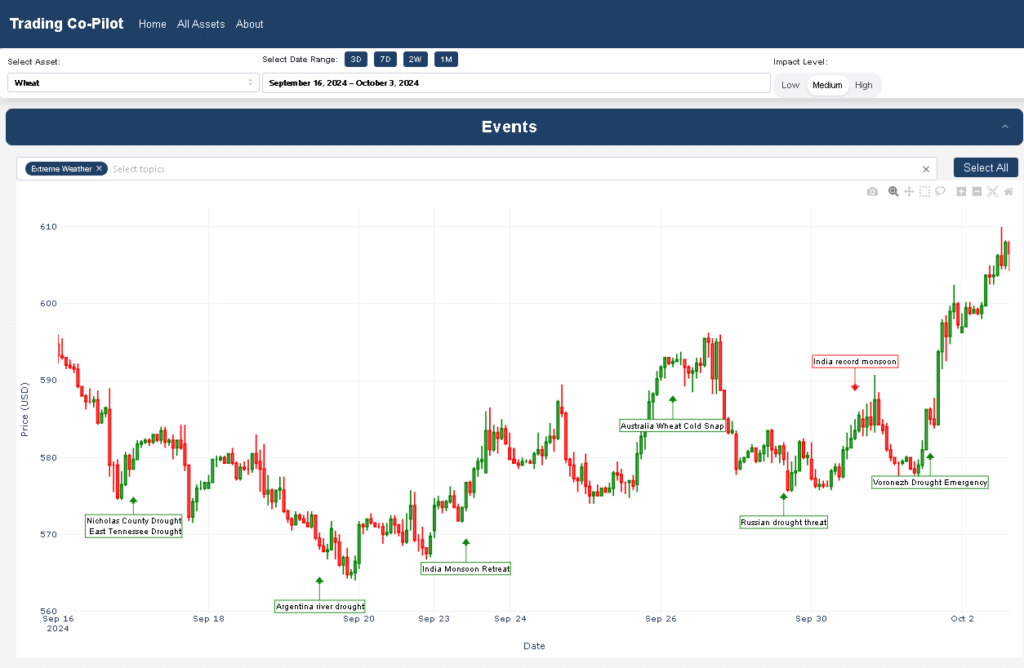
Extreme weather events are driving agricultural prices higher, and one asset class which is particularly affected by this is wheat. Our data, as surfaced by our Trading Co-Pilot makes this abundantly clear and offers an insightful look at how extreme weather events across the globe can significantly influence wheat prices. By examining the events log and the corresponding price chart, we can discern clear patterns of how various weather phenomena affect the wheat market. In this article, we’ll break down key observations specific weather events and their impacts, and take a wider view of how all of this affects price movements.
Above: Extreme weather events affect on wheat prices – insights from our Trading Co-Pilot
Looking at wheat, our Trading Co-Pilot showed considerable volatility throughout September into October 2024 with key changes in price around extreme weather events, but of course, geopolitical factors also come into play at certain junctures (but that’s another article!). All in all, this volatility highlights the sensitivity of wheat prices to external factors, particularly extreme weather events. The rapid fluctuations within this relatively short timeframe highlight the challenges faced by traders and analysts in predicting and responding to market movements.
Weather events affecting wheat prices are not confined to a single region but span across continents, including Australia, India, Europe, and the Americas. This global impact demonstrates the interconnected nature of the wheat market and emphasises the need for a comprehensive, worldwide approach to weather monitoring and analysis. Events occurring in one part of the world can have ripple effects on wheat prices globally, illustrating the complexity of modern agricultural commodity markets.
Unsurprisingly, most prevalent weather events impacting wheat prices are droughts and excessive rainfall, with occasional mentions of cold snaps. These events can significantly affect wheat production at various stages of crop development. Droughts can lead to reduced yields or crop failures, while excessive rainfall can damage crops, delay harvests, or create conditions favorable for disease. Cold snaps, particularly if they occur at critical growth stages, can also severely impact wheat production. The variety of impactful weather events highlights the need for diverse and comprehensive weather monitoring systems.
Droughts were reported in Nicholas County, East Tennessee, Europe and South American rivers. These events generally corresponded with upward price movements. The widespread nature of these drought conditions across multiple wheat-producing and consuming regions likely contributed to significant concerns about global wheat supply, driving prices upward.
India’s monsoon season began to retreat, having delivered surplus rains. Interestingly, this event corresponded with an increase in white prices. Then later again, prices increased as India experiences a record monsoon season. This seemingly contradictory price movement could be due to complex factors. The initial retreat might have raised concerns about potential water scarcity for future crops, while the record monsoon later could have sparked worries about flood damage or delayed harvests. These events highlight the intricate impact of weather on crop expectations and market sentiment.
A cold snap in southern Australia negatively impacted the wheat crop, leading to an upward movement in wheat prices around this date. This event demonstrates how unexpected weather conditions in major wheat-producing regions can quickly influence global markets. The price increase likely reflects market concerns about potential reductions in Australian wheat supply, which is significant given Australia’s position as a major wheat exporter.
Droughts and cold snaps generally exert upward pressure on wheat prices as shown in the above snapshot taken from our Trading Co-Pilot. This is likely due to their potential to reduce crop yields and overall supply. The consistent nature of this upward pressure across different regions and time periods underscores the significant threat that these weather events pose to wheat production globally.
While drought conditions consistently drive prices up, the impact of rainfall is more nuanced. The heavy rainfall in India led to a price spike, possibly due to immediate concerns about crop damage. Conversely, the monsoon retreat in India, associated with surplus rains, led to a price dip, which may be due to positive long-term effects on crop yield. These contrasting effects highlight the complexity of rainfall’s impact on wheat prices and the importance of considering both short-term and long-term consequences of weather events.
The above visual suggests that the cumulative effect of multiple weather events can amplify price movements. For instance, the concurrent droughts in Europe and South America around September 11 corresponded with a significant price increase. This observation emphasises the importance of considering the global context of weather events rather than viewing them in isolation.
Some price movements appear to lag behind the reported weather events, suggesting that the market takes time to fully assess and react to the potential impacts on wheat supply and demand. This delay in market reaction highlights the complexity of interpreting weather data and its potential effects on wheat production and prices, underscoring the value of advanced analytical tools in providing timely insights.
Our analysis of extreme weather events and their impact on wheat prices, as revealed by our Trading Co-Pilot, highlights the intricate relationship between global climate patterns and agricultural commodities. One thing is absolutely crystal clear – the data demonstrates that wheat prices are highly sensitive to a wide range of extreme weather events, from droughts and excessive rainfall to cold snaps and long-term climate patterns like La Niña.
And so, these extreme weather events create a complex web of influences on the global wheat market. With that, the resulting price volatility presents both challenges and opportunities for traders, analysts, and policymakers alike. It highlights the critical need for sophisticated tools that can monitor, analyse, and predict the potential impacts of weather events on wheat prices in real-time – as our Trading Co-Pilot is able to do.
As we write, climate change continues to intensify extreme weather events worldwide, the ability to quickly interpret and act on this data will become increasingly valuable. The upshot? Those who can effectively navigate these weather-driven market fluctuations will be better positioned to make informed decisions in an increasingly unpredictable global commodities market.
Don’t let unpredictable weather events catch you off guard. With real-time data analysis and AI-driven insights, our Trading Co-Pilot helps you stay ahead of market movements triggered by global weather patterns.
Experience the power of data-driven decision making with:
Request a free demo of our Trading Co-Pilot today and see how we can help you turn weather volatility into trading opportunity. Email us at enquiries@permutable.ai or fill in the form below.
You can also access top-line geopolitical insights through our Real-Time Geopolitical Insights & AI Market Sentiment Analysis Dashboard which is publicly available to view. One of the biggest developments in today’s global economy is the challenges companies face from geopolitical shifts and growing rivalry among major world powers like the US, China, and Russia. The Great Power Competition goes beyond military strength and affects key areas such as trade, tech, and investment. As these countries compete for strategic control, businesses must create strong risk management plans to handle this tricky situation. This article looks at how great power competition affects corporate strategy and how advanced analytics like our geopolitical data can help companies stay on top of these global changes.
It’s inevitable that the Great Power Competition has become a key feature of the 21st-century geopolitical scene. As countries like the US, China, and Russia fight for global influence, their actions shake up the global economy. Trade wars, tariffs, sanctions, and rule changes are just some of the ways these powers try to assert control often causing big problems in international trade and investment.
The problem is, for big companies working in many countries, these dynamics create big risks. Let’s start with the issue of tariffs between the US and China, which have raised costs for businesses that rely on cross-border supply chains. Then there is are the sanctions against Russia which have made Western companies working there rethink their plans often leading them to sell off assets or change how they operate.
In this environment, the obvious point here is that companies can’t just sit back. They need to manage the risks that come with geopolitical instability. With that in mind, they need to understand the immediate effects of policy changes and also predict future developments. As a result, a well-planned risk management strategy will help businesses reduce potential losses and, in some cases even use geopolitical shifts to gain an edge over competitors.
At Permutable, we are lucky to work with a collection of seasoned geopolitical analysts. Their advice on how to navigate the risks presented by the Great Power Competition is summarised below.
One of the best ways to handle geopolitical risk is to spread out supply chains. Companies that depend on making or buying from one country in unstable regions, face big risks. By getting supplies from different places around the world, businesses can reduce their risk of problems caused by tariffs, trade limits, or political instability.
Planning for different scenarios is a crucial tool in managing geopolitical risk. It involves coming up with several possible ways geopolitical events might unfold and figuring out how they could affect business operations. By getting ready for a range of outcomes, companies can better position themselves to respond and to unexpected events.
For companies working in high-risk areas, insurance against political risk can provide protection against losses caused by political instability such as property seizure, currency problems, or violent conflict. While this insurance can be expensive, it’s often worth it for businesses facing big geopolitical risks.
Companies can reduce geopolitical risks by taking part in public policy discussions and pushing for rules that support stable and predictable business environments. This involvement can include lobbying, joining industry groups, or teaming up with other businesses to influence policy decisions that affect the global market.
A fast-changing geopolitical scene calls for quick changes. Companies must stay nimble ready to shift their plans as new events unfold. This might mean moving investments breaking into new markets, or even changing how they do business to fit the new geopolitical reality.
In today’s digital age, companies can access seemingly infinite amounts of data to shape their risk plans. But the sheer amount of info can be too much, and finding useful insights is tough. This is where our AI-driven geopolitical data solutions step in. We use top-notch artificial intelligence to analyse geopolitical events and trends in real-time. By crunching vast amounts of data from news, social media, and government sources, we’re able to spots patterns and predicts risks with high accuracy.
Here’s how our geopolitical data is a game-changer in boosting a company’s risk management:
In a world where geopolitical changes happen fast and without warning, staying informed is key. Permutable AI keeps a constant eye on geopolitical events letting companies know right away about changes that could affect their work. Whether it’s new tariffs, a sudden flare-up in a regional conflict, or a major policy change, businesses get instant alerts and can act .
Beyond just reporting current events, our algorithms can predict future geopolitical trends. By looking at past data and current signs, the AI can forecast potential risks and chances giving businesses a leg up. For example, if the AI thinks trade tensions between two countries might get worse, companies can change their supply chains or protect themselves against possible money losses.
Our tools can also fit into a company’s planning process. By giving detailed risk checks based on many factors, from economic signs to political feelings, the AI can help businesses create more accurate and complete plans. This leads to better-informed choices and stronger strategies.
Every business has its own risk factors based on its industry where it operates, and how it works. We offers insights tailored to each company’s specific needs. This ensures the info provided is useful and actionable letting businesses focus on the risks that matter most to them.
By giving a clear, data-driven view of the geopolitical scene, we are able to support our clients to make smart decisions. This is valuable in high-stakes situations where delays or wrong calls can lead to big losses.
In a time of big power rivalries, businesses need strong risk management plans to navigate the complex and ever-changing geopolitical scene. The stakes are high, and the risks are real, but with the right tools and strategies, companies can not protect themselves from possible losses but also grab chances that come from geopolitical shifts. Our geopolitical data solutions mark a big step forward in risk management. By providing real-time monitoring, future forecasting, and custom insights, this technology gives businesses the edge they need to navigate the complexities of the Great Power Competition.
Don’t let geopolitical risks catch your business off guard. Equip your team with the tools and insights needed to navigate the complexities of the Great Power Competition. Discover how Permutable AI’s cutting-edge geopolitical data solutions can help you stay ahead of global shifts and turn risks into opportunities. Take the first step towards stronger risk management today. Simply send an email to enquiries@permutable.ai to learn more, or fill in the form below. You can also access top-line geopolitical insights through our Real-Time Geopolitical Insights & AI Market Sentiment Analysis Dashboard which is publicly available to view.
It is worth remembering that today’s complex global economy, geopolitical risk in investments is a crucial factor for investors to consider in order to gain competitive advantage. Let’s explore how world events can impact your portfolio and what you can do to manage geopolitical risk in investments.
Gone are the days when domestic markets operated in isolation. Now, a political decision in Washington or Beijing can send ripples through stock exchanges worldwide. As investors, we must broaden our horizons and consider how geopolitical risk in investments might affect our financial decisions.
Recent events, from trade disputes to regional conflicts, have demonstrated how geopolitical tensions can swiftly impact markets. Take the ongoing situation in Ukraine, for instance. Its effects on energy prices and supply chains have been felt far beyond Eastern Europe, influencing portfolios and highlighting the importance of considering geopolitical risk in investments.
So, how can investors navigate this complex landscape? It starts with staying informed about geopolitical risk in investments. While you needn’t become an expert in international relations, a basic understanding of global affairs and their potential impact on investments can prove invaluable. Pay attention to major economic indicators, political developments, and international agreements that could affect markets.
Evaluating geopolitical risk in investments involves considering various factors:
By evaluating these elements, investors can better understand potential risks and opportunities in different markets.
One of the most effective strategies for managing geopolitical risk in investments is diversification. By spreading investments across different regions, sectors, and asset classes, you can potentially mitigate the impact of localized geopolitical events on your overall portfolio.
Some sectors are particularly vulnerable to geopolitical shifts. Energy stocks, for example, often react strongly to events in oil-producing regions. Technology companies can be caught in the crossfire of trade disputes. Understanding these sensitivities can help you anticipate potential market movements and manage geopolitical risk in investments more effectively.
While geopolitical events can create market turbulence, they can also present opportunities for astute investors. During periods of uncertainty, quality assets may become undervalued, offering potential for long-term gains. However, timing such moves requires careful consideration of geopolitical risk in investments and a strong stomach for risk.
In the face of geopolitical uncertainty, it’s crucial to maintain a long-term perspective. While short-term volatility can be unnerving, history shows that markets tend to recover and grow over time. Avoid knee-jerk reactions to headlines and focus on your long-term investment goals, always keeping an eye on geopolitical risk in investments.
Consider employing risk management tools such as stop-loss orders or options to protect your portfolio. These can help limit potential losses if geopolitical events cause sudden market shifts, providing another layer of protection against geopolitical risk in investments.
At Permutable, our AI-driven geopolitical data data analysis, offers unparalleled access to real-time, unbiased data. Our platform conducts meticulous sentiment analysis that spans a wide array of critical dimensions—global elections, conflicts, political tensions, terrorism, and national security—all through an impartial lens. This robust framework ensures that our clients receive a clear, unfiltered view of global dynamics, enabling them to make informed decisions without the cloud of bias.
Leveraging our geopolitical data analysis can significantly influence and shape your strategic investment strategies. Our actionable insights serve as invaluable resources, empowering you to refine and enhance strategies for your clients and stakeholders. By integrating our data into your decision-making processes, you can ensure that your strategies are informed by the most current and comprehensive intelligence available.
While geopolitical risk in investments adds a layer of complexity to investing, it needn’t be a source of paralysis. By staying informed, diversifying your portfolio, and maintaining a long-term perspective, you can navigate the choppy waters of global finance with greater confidence.
Remember, in the world of investing, knowledge truly is power. Keep abreast of global developments, understand their potential impact, and position your portfolio accordingly. With careful consideration and strategic planning, you can turn awareness of geopolitical risk in investments into a valuable tool in your investment arsenal.
Ready to see how AI-driven geopolitical risk intelligence can transform your decision-making? Contact us for a personalized demo of our AI-driven news sentiment analysis which is available through our Trading Co-Pilot subscription, or to request a free trial. You can also access top-line geopolitical insights through our Real-Time Geopolitical Insights & AI Market Sentiment Analysis Dashboard which is publicly available to view.