Market volatility: 7 ways AI-driven commodity intelligence is transforming risk management
Let’s start with the obvious challenge facing hedge funds and trading houses today – which is that of  unprecedented levels of market volatility.  In the current landscape, there is no doubting that traditional risk management approaches are struggling to keep pace with today’s rapidly evolving markets. With commodity markets that have never been more complex, the hardest part is managing the confluence of factors – from wars and supply chain disruptions to OPEC decisions and extreme weather events – that can trigger sudden price movements. Of course, there are things that can be done to mitigate these risks, but the game changer we believe will be how AI-driven solutions can process and act on real-time commodity intelligence.

Beyond historical data to real-time commodity intelligence and predictive analytics

For the avoidance of doubt, it’s fair to say that traditional models relying solely on historical data and delayed market reports increasingly fall short. Ultimately, the speed of modern markets demands more sophisticated approaches to risk management which can capture sudden market shifts before they impact portfolio values.

Which begs the question – how to move from reactive to proactive risk management? When it comes to traditional approaches, you can’t argue with the fact that they remain important foundational tools. However, everywhere you look, markets are moving faster than human analysts can process. All of which makes AI-driven trading solutions not just beneficial but essential for modern risk management, thanks to their ability to identify potential market movements before they occur. The present outlook for trading technology suggests increased reliance on real-time commodity intelligence to track geopolitical, macroeconomic, and environmental factors.

Enter custom alerts and risk monitoring

If experience tells us anything it’s that early warning systems are crucial. Moving beyond traditional monitoring approaches which are no by and large insufficient, to reclaim strength in this area, traders need sophisticated alert systems covering everything from OPEC production cuts to supply chain bottlenecks.  What is absolutely clear is that the benefits far outweigh the costs both in real-terms and also as per the time and effort it takes to integrate them into already existing systems, with several key areas where AI solutions provide clear advantages:

Real-time risk assessment

In periods of extreme market volatility, traditional risk metrics often lag behind price movements. By processing market data every 15 minutes, our Trading Co-Pilot provides an instant assessment of portfolio risk exposure. Our system analyses multiple data streams simultaneously, from price movements to news flow, helping traders identify emerging risks before they impact positions.

Predictive analytics for volatility management

Beyond simple trend analysis, today’s AI systems are able to identify complex patterns across multiple data sources. In times of market volatility, they can detect subtle signals that precede major moves, from changes in trading volume patterns to shifts in market sentiment, allows trading houses to anticipate potential market movements rather than merely reacting to them. As seen in our recent crude oil tracking module, our system detected early signals of price movements related to Middle East tensions, allowing traders to adjust positions ahead of market shifts.

Custom alert systems

Modern alert systems are key for managing market volatility, going far beyond simple price triggers. They monitor multiple factors simultaneously – from weather patterns affecting commodity production to geopolitical developments that could impact prices. These systems can be customised to specific portfolio needs and risk tolerances. Our Trading Co-Pilot  provides customised alerts on major market events, from OPEC production cuts to supply chain bottlenecks. For instance, our system recently helped traders navigate coffee market volatility by providing early warnings about weather-related supply disruptions in key growing regions.

Market sentiment analysis

During periods of high market volatility, AI systems can process vast amounts of news, social media, and market commentary in real-time. They can detect subtle shifts in market sentiment before they manifest in price movements. This includes analysis of corporate communications, regulatory statements, and expert commentary that might signal emerging trends. As an example, our own Trading Co-Pilot processes over 500 million articles from verified sources providing real-time sentiment analysis during periods of high market volatility. Recently, our platform recently helped traders navigate gold market movements by identifying shifting sentiment patterns ahead of central bank decisions.

Supply chain monitoring

With market volatility increasingly driven by supply chain disruptions, comprehensive monitoring is essential. AI systems track everything from news concerning port congestion and shipping routes to alerts on production disruptions and inventory levels, helping identify potential issues before they impact market prices. And it is this that recently helped energy traders using our commodity intelligence anticipate European gas price movements by monitoring critical supply developments in key regions.

Weather impact tracking

In volatile commodity markets, weather patterns can significantly impact prices. Advanced AI systems are able to monitor news on global weather patterns and assess their potential market impact. This includes tracking extreme weather events, seasonal patterns, and long-term climate trends that could affect production and demand. Permutable’s platform incorporates weather pattern analysis into its trading signals, particularly crucial for agricultural and energy commodities. And here again, our Trading Co-Pilot’s analysis of extreme weather events helped traders navigate volatility in natural gas markets during severe winter storms.

Geopolitical risk assessment

In today’s highly volatile markets, geopolitical events can have immediate price impacts. AI systems are able to monitor global developments, assess their potential market impact, and help firms adjust their risk exposure accordingly – all in real-time. And yes, this includes analysis of trade policies, sanctions, political stability, and international relations. A recent use case for our commodity intelligence can be seen here in the surfacing of early warnings about trade policy impacts on soybean markets and the analysis of effects of geopolitical tensions on oil prices.

We think you’ll agree the potential for AI in navigating market volatility and strengthening risk management strategies through real-time commodity intelligence is extremely powerful. But perhaps what is perhaps even more powerful is where this technology can take us in future. We live in an age of highly volatile geopolitics, making sophisticated risk management through granular and real-time commodity intelligence more crucial than ever, and we believe that the future of trading will belong to those who can effectively combine human expertise with AI-driven analysis.

Experience the advantage of AI-driven commodity intelligence

Discover how our Trading Co-Pilot can enhance your trading operations with comprehensive commodity intelligence updated every 15 minutes. Our platform processes vast amounts of data across energy, metals, and agricultural markets, helping you identify opportunities and manage risk in today’s volatile environment. From real-time sentiment analysis to early warning signals for market movements, our solution provides the insights you need to stay ahead of rapidly evolving markets.

Contact our team at enquiries@permutable.ai or schedule your personalised demo or fill in the form below to see how our AI-driven commodity intelligence can complement your existing trading strategies. We’re currently offering a 14-day trial for qualified institutional traders. Let us show you how combining human expertise with advanced AI analytics can transform your approach to market volatility.

Request demo


The transformative effects of Data as a Service (DaaS) on financial markets in 2024 and beyond

Today’s quick financial world needs trustworthy, up-to-the-minute data. Data as a Service (DaaS) has become a game-changer in financial markets. It gives unmatched access to top-notch data in many areas. From trading plans to risk control and ESG investing, DaaS is causing a revolution in how money firms work and choose what to do. This article looks at how DaaS affects financial markets in many ways. It shows how DaaS plays a key role in trading, risk control managing investments, and the money side of using data.

Data as a Service: Transforming trading strategies with real-time data

One of the biggest perks of DaaS in financial markets is how it provides real-time data, which plays a key role in successful trading strategies. Take high-frequency trading (HFT) as an example – it depends on real-time data to carry out trades in just milliseconds. DaaS gives traders access to the latest market info helping them to make quick and smart choices that can result in big profits.

What’s more, DaaS has an influence on algorithmic trading where complex algorithms analyse data to spot trading opportunities and carry out trades. The edge in competition gained through DaaS shows in the speed and accuracy of trades allowing firms to outdo those using traditional data sources. This access to real-time data makes sure traders are always ahead of the game making DaaS a must-have tool for modern trading strategies.

Boosting risk management through Data as a Service 

DaaS has a big influence on risk management too. The financial world is always changing, and keeping risks in check is key for banks and other money-related businesses to stay alive and do well. DaaS gives up-to-date and correct info to help risk managers spot possible problems and act to avoid them.

Let’s say a bank uses DaaS to keep an eye on what’s happening in the market and how the economy’s doing. This helps them see trouble coming before it hits. DaaS also lets risk managers look at all kinds of data, like stuff from the past and what’s going on right now in the market. With all this info, they can build better ways to figure out risks and get better at guessing what might happen next.

Also, the integration of DaaS into risk management systems has an impact on transparency and compliance. As regulatory requirements get stricter financial institutions need to ensure they can access reliable data to meet these standards. DaaS helps institutions stay compliant by offering accurate and current data, which lowers the risk of breaking regulations and facing penalties.

Predictive analytics and how Data as a Service influences forecasting market trends 

Predictive analytics has become essential in financial markets allowing institutions to forecast market trends and make choices based on data. DaaS plays a key part in making predictive analytics possible by supplying the data needed to train machine learning models and other tools for analysis.

DaaS gives financial firms access to loads of data such as market sentiment economic indicators, and past performance records. This data goldmine helps analysts spot patterns and trends that might not jump out at first glance. By using DaaS, companies can boost their forecasting accuracy, which leads to smarter investment choices and better financial results.

Take market volatility prediction, for example. DaaS can analyse sentiment data from breaking news stories to help with this. By grasping how market players feel about certain assets or economic conditions, banks and investment firms can tweak their game plans. They might cash in on good vibes or protect themselves against possible downturns.

ESG investing and Data as a Service: Pushing responsible investments

Although ESG investing may have declined in popularity in recent times, for those investors who still care about ethics, DaaS plays a key role in ESG investing by giving access to data that helps evaluate how companies perform on ESG issues.

DaaS platforms provide full ESG datasets, with details on carbon emissions and net zero initiatives, how workers are treated, and how companies are run. Investors can use this info to check companies against ESG standards making sure their investments match their beliefs. Also, DaaS lets investors keep track of ongoing ESG performance helping them decide whether to keep, buy more, or sell their shares in specific companies.

The openness DaaS provides plays a key role in rebuilding confidence in ESG investing. As officials and interested parties call for more company accountability, getting accurate and trustworthy ESG information is crucial. DaaS helps investors make sense of the tricky ESG scene making it simpler to spot companies that care about sustainable methods.

How Data as a Service is shaping modern portfolio management 

Managing a portfolio is tough work that needs to strike the right balance between risk and payoff. DaaS has caused a shake-up in portfolio management by offering flexible asset placement and custom-made plans based on up-to-the-minute data.

DaaS lets portfolio managers keep an eye on asset performance and tweak their allocations as the market changes. This up-to-the-minute approach to managing portfolios offers more flexibility and responsiveness helping to boost returns while cutting down on risk.

What’s more, DaaS makes it possible to bring AI and machine learning into portfolio management. By crunching huge datasets, AI algorithms can pinpoint the best asset allocations and investment strategies that fit each investor’s likes and risk comfort level. This tailor-made approach to managing portfolios is doable thanks to the data-rich setting that DaaS creates.

The economics of Data as a Service: Balancing cost and value

While DaaS offers clear advantages, banks and financial firms must also think about the costs of using this approach. Setting up DaaS comes with expenses such as fees to subscribe to data services and the tools needed to handle and study data and it is worth looking at more reasonable providers like ourselves rather than going with the market leaders who have been around for years and charge a hefty amount to use their data services. In any case,  the long-term worth of DaaS often makes up for these costs.

The real value of DaaS stems from its power to boost decision-making and make operations run smoother. By giving access to top-notch, up-to-the-minute data, DaaS allows financial firms to make smarter choices, cut down on risks, and fine-tune how they invest. As time goes on, these perks can lead to big savings and higher profits.

What’s more, DaaS has an impact on scalability giving institutions the ability to access more data as they need it. This adaptability makes sure that companies can adjust to shifts in market conditions and regulatory demands without spending too much.

Explore Permutable AI’s data intelligence solutions

Curious about how our data intelligence solutions can transform your trading strategies, risk management, and investment decisions? Discover our cutting-edge AI-driven platforms that harness the power of real-time data to give you a competitive edge in the financial markets. Contact us today to learn more about how we can support your journey towards smarter, data-driven financial decisions by simply emailing enquiries@permutable.ai or filling out the form below.

Get in touch


Powerful insights from the CEO of a leading market intelligence company 2024 edition

Our CEO and Founder, was recently invited onto Disruptive Live‘s AI Show, where he and host Emily Barrett, AI Lead for Lenovo, discussed innovation in AI. If you didn’t have a chance to watch it then you can catch up here. But in the meantime, we’ve taken 5 powerful insights from Wilson’s experience at the helm of our leading market intelligence company, serving them up for you here in this article

Seeing the world through an unbiased lens as a market intelligence company

In the interview, Wilson quips that being a leading market intelligence company is a bit like being a global detective. Why is this? We dig through mountains of news from every corner of the world to piece together what’s really going on. Contrary to popular belief, this isn’t just about collecting data (although we do have a pretty impressive data moat under our belts and you can find out about some of the use cases of our data intelligence here). The reality is it’s about cutting through the noise to reveal global truths.

For now, information overload and potential bias is everywhere. All of this means our role in deciphering what’s truly going on has never been more crucial. This isn’t just about aggregating news. First and foremost, we’re analyzing it and cross-referencing it, but above all we’re distilling it into actionable intelligence. All of this means using our AI algorithms to detect subtle nuances in language, identify potential biases, and corroborate information across multiple sources. Imagine having a team high-level analysts working round the clock, but with the added advantage of processing power that can handle millions of data points simultaneously. This is the kind of advantage we’re able to deliver.

But perhaps most important of all, it’s not just about what’s being said, it’s also what’s not being said. It can also be about detecting when a topic is suspiciously absent from certain news sources, or when there’s a sudden shift in narrative across multiple outlets. In this scenario, we can paint a truly comprehensive picture of global events, free from the distortions of any single perspective.

Which brings us to the end result, which is a clear, unbiased view of the world that our clients come to us for and trust us with – the kind of insights that  enable them to make informed decisions and find competitive edge. 

AI is the trader’s new best friend

A while ago we put out an article about whether AI will replace traders. The reality is, once upon a time, getting your hands on solid intel was like striking gold. Now, with AI in our toolkit, our team is able to sift through more information than an army of analysts. It’s like having a superpower.

But right now, it’s not about replacing traders, but about enhancing their capabilities. AI is akin to a research assistant that never sleeps.  Its key advantage is that it processes vast amounts of data 24/7.  Where it really shines is in its capability of tackling patterns and anomalies that human eyes might often miss, analyzing market sentiment from public sources, parsing through earnings reports in seconds. Where it really makes strides is in predicting market movements based on historical data and current trends. All of which allows plays a vital role in helping traders to focus on what they do best – making strategic decisions and managing risk.

The real magic happens when human intuition meets AI-powered insights. In short, a seasoned trader’s gut feeling – honed by years of experience – can be combined with AI’s data-crunching abilities. This marrying of the two has the potential to create a formidable force in the market like never before. It’s a big splash –  like having a co-pilot who never sleeps. Imagine its powerful ability to constantly scan the horizon for opportunities and potential pitfalls. One thing is for certain, with the landscape changing, the most successful traders won’t be those who resist AI, but those who learn to dance with it, leveraging its strengths to enhance their own decision-making processes. That’s why the future of trading isn’t man vs. machine – it’s man and machine, working in harmony to navigate the complex waters of global markets.

How we map the corporate jungle as a market intelligence company

You will be forgiven for almost spilling your coffee when we mention that we track over a million companies. It’s like creating a family tree for every business out there. The level of detail we go into is mind-boggling – suppliers, customers, competitors, the works. But it’s more than just a static picture; it’s a living, breathing ecosystem that we monitor in real-time.

Imagine having a birds-eye view of the entire corporate world, where you can zoom in on any company and instantly see its connections, influences, and vulnerabilities. That’s what our corporate mapping achieves. We don’t just look at financial statements and press releases; we analyze media sentiments, track supply chain risks, and even monitor regulatory changes that might impact a company’s operations. This holistic approach allows us to predict market movements before they happen, identify emerging competitors, and spot potential acquisition targets or partnership opportunities. It’s like having a corporate GPS that not only shows you where a company is now, but where it’s likely to go in the future. In today’s fast-paced business environment, this level of insight isn’t just valuable – it’s absolutely critical for anyone looking to stay ahead of the curve.

Turning back the clock with data

Think of us as time travelers. We’ve squirreled away years of data that you can’t find anywhere else now. It’s not just about looking back, though – this treasure trove also helps us peek into the future of markets. It’s like having a supercharged crystal ball, one that doesn’t just show fuzzy images of the future, but provides clear, data-driven insights into market trends and potential disruptions.

This early adoption has given us a significant edge. While others are still grappling with the basics of AI implementation, we’re fine-tuning our models and pushing the boundaries of what’s possible. Our AI doesn’t just process information; it connects dots across vast datasets, identifying patterns and correlations that would be impossible for human analysts to spot alone. It’s this combination of cutting-edge technology and years of accumulated expertise that allows us to offer unparalleled insights to our clients, helping them navigate the increasingly complex global business landscape with confidence.

Find out more

If you’re ready to an early adopter and gain competitive by working with an AI-driven market intelligence company like Permutable, we’d love to from you. 

Access crucial insights giving you the competitive edge needed in today’s fast-paced business world. As a global market intelligence company, our cutting-edge AI technology, combined with years of accumulated data and expertise, can give you the edge you need to make informed decisions and navigate the complex global business landscape with confidence.

Whether you’re a trader looking to augment your skills, a company seeking to understand your place in the corporate ecosystem, or a decision-maker in need of unbiased global insights, we’re here to help.

Take the first step towards transforming your approach to market intelligence by working with a leading market intelligence company. Contact us today for a personalized demo of our AI-driven solutions to explore how we can work together to unlock the full potential of your business strategies.

Don’t just react to the market—anticipate it. Reach out now and discover the difference that truly intelligent market insights can make by dropping a line to enquries@permutable.ai or filling the form below.

Get in touch


How to track news shocks and uncertainty in real-time and their impact on the markets in 2024 & beyond

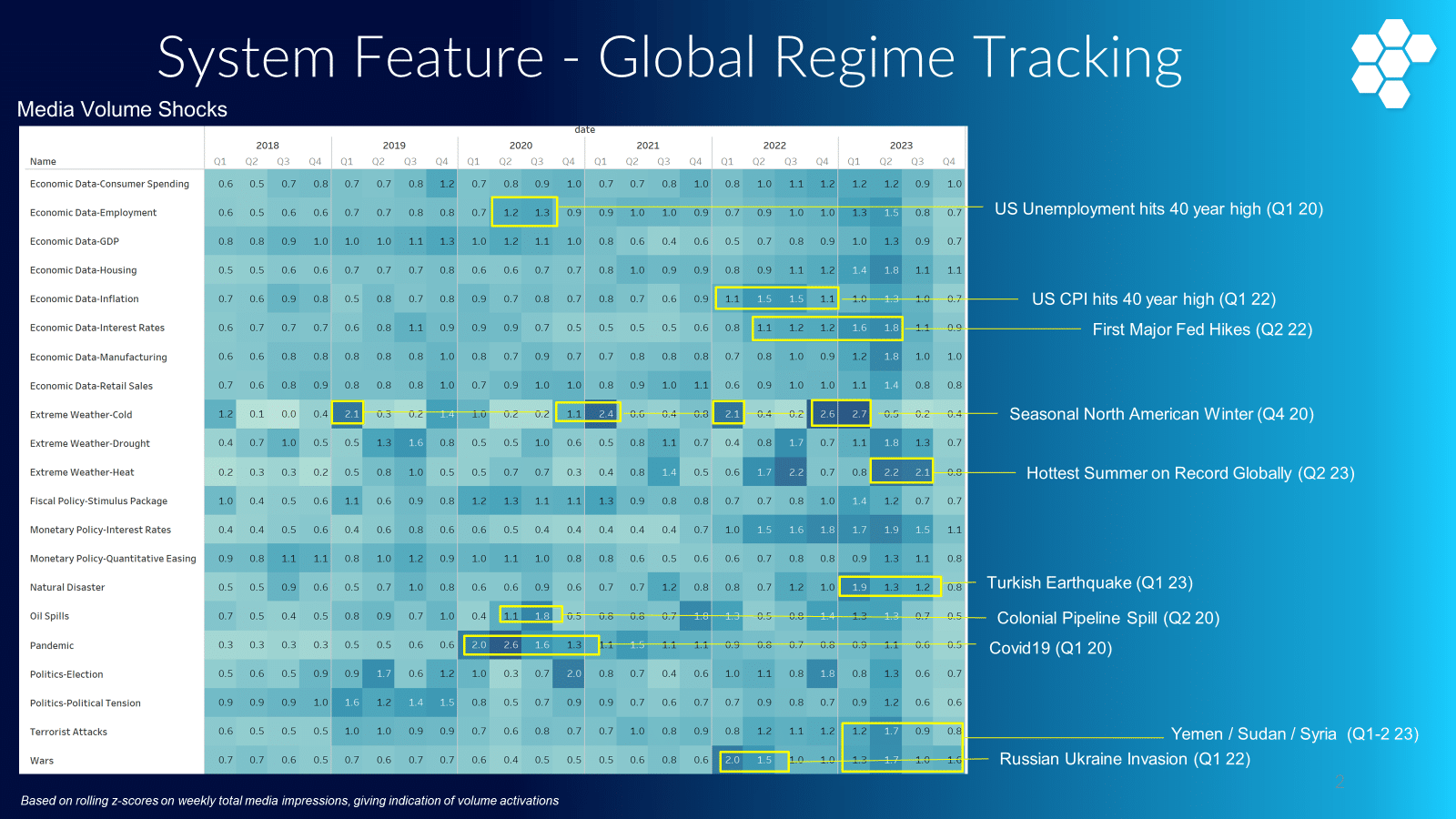
The ability to track and analyze news coverage in real-time is invaluable for businesses, policymakers, and analysts alike. Understanding how different events influence news volume can offer deep insights into public sentiment, economic impacts, and strategic decision-making. Permutable AI’s Global Regime Tracking system, as illustrated in the heatmap above, provides a comprehensive visualization of how various events have driven news attention from 2018 to 2023. This article explores the importance and implications of such real-time monitoring, with a specific focus on the insights gleaned from our news shocks and uncertainty heatmap.

Understanding our news shocks and uncertainty heatmap: An overview

The heatmap titled above tracks news shocks and uncertainty across several categories over a period of six years. The categories include economic data (such as consumer spending, employment, and GDP), extreme weather events (cold, drought, heat), fiscal and monetary policies, natural disasters, oil spills, pandemics, political events, terrorist attacks, and wars. The intensity of news coverage is represented by different shades of blue, with darker shades indicating higher news volume.

Key insights from our news shocks and uncertainty heatmap

Economic data

Economic indicators often serve as primary drivers of news coverage, especially during times of crisis or significant change. For instance, the heatmap highlights:

  • US unemployment hits 40-year high (Q1 2020): During this period, there was a significant spike in news coverage related to employment data, coinciding with the onset of the COVID-19 pandemic, which led to unprecedented job losses.
  • US CPI hits 40-year high (Q1 2022): The spike in news attention around consumer price index data reflects growing concerns over inflation, which was exacerbated by supply chain disruptions and economic recovery post-pandemic.

These spikes in news coverage underscore the public’s heightened interest in economic conditions, especially during periods of instability.

Extreme weather events

Climate change and extreme weather events are becoming increasingly prominent in news coverage. The news shocks and uncertainty heatmap captures:

  • Seasonal North American winter (Q4 2020) and the hottest summer on record globally (Q2 2023): These periods saw significant news attention due to extreme weather conditions, highlighting the growing concern and impact of climate change on daily life and economic activities.

Significant global events

Certain global events have caused substantial news volume shocks, reflecting their widespread impact:

  • COVID-19 pandemic (Q1 2020): The pandemic led to a massive surge in news coverage across various categories, including health, economic data, and political responses. The unprecedented nature of the pandemic and its global impact made it a focal point of news attention.
  • Russian Ukraine invasion (Q1 2022): This event triggered extensive news coverage, reflecting the geopolitical tensions and global ramifications of the conflict. The invasion not only dominated political news but also impacted economic and security discussions worldwide.

Natural disasters and crises

Natural disasters and crises often lead to spikes in news volume due to their immediate and dramatic impact on communities and economies:

  • Turkish Earthquake (Q1 2023): The earthquake in Turkey garnered significant news attention, highlighting the immediate human and economic toll of natural disasters.
  • Colonial Pipeline spill (Q2 2020): This event caused a notable spike in news coverage related to environmental issues and the energy sector, underscoring the environmental and economic implications of such incidents.

The importance of real-time news monitoring

Real-time monitoring of news shocks and uncertainty is crucial for several reasons. Here’s an in-depth look at how it impacts proactive crisis management, informed decision-making, public sentiment analysis, and strategic planning.

Proactive crisis management

Understanding news coverage trends allows organizations to respond promptly to crises. In today’s fast-paced media environment, a delay in addressing negative news can result in significant reputational damage. By identifying spikes in news attention early, companies can deploy strategic communication plans to manage public perception effectively. This involves quickly disseminating accurate information, addressing misinformation, and demonstrating the organization’s commitment to resolving the issue. For example, if a company detects a sudden surge in negative coverage related to a product recall, it can immediately issue statements, engage with affected customers, and outline the steps being taken to rectify the problem. This proactive approach not only helps in mitigating immediate damage but also strengthens the company’s long-term reputation for transparency and accountability.

Informed decision-making

Real-time data provides insights that are critical for decision-makers. When there is a surge in news coverage around economic indicators, such as an unexpected rise in unemployment rates or a sudden spike in inflation, it signals to businesses and policymakers the need for timely intervention or strategic adjustments. For instance, a central bank might decide to alter interest rates in response to real-time data showing increased news coverage of economic instability. Similarly, a company might shift its investment strategy or operational focus if it notices a significant rise in news discussing industry-specific risks or opportunities. Having access to real-time news monitoring enables decision-makers to base their strategies on the most current information available, reducing the lag between recognizing a trend and responding to it.

Public sentiment analysis

News volume shocks often reflect broader public sentiment. By analyzing these trends, organizations can gain a deeper understanding of public concerns and priorities. This is particularly important for businesses and governments aiming to engage with their audiences in a meaningful and empathetic way. For instance, a sudden increase in news coverage about climate change might indicate growing public concern over environmental issues. Companies can respond by highlighting their sustainability initiatives, while governments might accelerate policy measures to address climate-related challenges. By staying attuned to the nuances of public sentiment through real-time news monitoring, organizations can tailor their messaging and actions to better align with the values and expectations of their stakeholders.

Strategic planning

Anticipating news trends based on historical data can significantly enhance strategic planning. Organizations that recognize patterns in news coverage can prepare more effectively for future media engagement and operational responses. For example, certain seasons or events might consistently attract heightened attention to specific issues, such as extreme weather events during hurricane season or increased political coverage during election cycles. By understanding these patterns, companies can develop strategic plans that anticipate media coverage spikes and prepare appropriate responses in advance. This might involve ramping up customer service support, preparing detailed communication plans, or adjusting marketing strategies to better align with expected public interest. Strategic planning informed by real-time news monitoring ensures that organizations are not caught off guard by predictable news shocks and can respond more efficiently and effectively.

Future developments in AI for monitoring news shocks and uncertainty

As AI technology evolves, its applications in monitoring news shocks and uncertainty will become even more sophisticated. At Permutable AI, we are committed to advancing our capabilities to provide more comprehensive and actionable insights. Here’s what we envision for the future of AI in this field:

Predictive Analytics

In the future, AI will not only track current news volume but also predict future news shocks by analyzing patterns and historical data. In fact, this is something our team is already working on.  We are currently working to leverage our advanced machine learning algorithms to identify early indicators of potential news shocks. This capability will enable organizations to prepare proactively for upcoming trends and potential crises. For example, by analyzing historical data on market reactions to economic announcements, our system could forecast how similar future events might impact market sentiment and investor behaviour. This predictive power will allow businesses to strategize and mitigate risks well in advance, ensuring they remain agile and responsive in a rapidly changing news landscape.

Enhanced transparency tools

Transparency is key to building trust with stakeholders. We are currently working to finetune our real-time insights into a company’s news coverage and public perception. These enhanced transparency tools will enable organizations to share detailed, real-time reports with their investors, customers, and regulatory bodies, showcasing their commitment to openness and accountability. For instance, companies will be able to generate dynamic dashboards that track their media presence and public sentiment in real-time, allowing stakeholders to monitor how news events are influencing public perception. This level of transparency will foster greater trust and confidence in the organization’s ability to manage its reputation and respond to emerging issues effectively.

Deep sentiment analysis

We are continuously refining our advanced AI models to detect nuances in sentiment, offering deeper insights into public reactions and concerns. Current sentiment analysis techniques can identify whether news coverage is positive, negative, or neutral, but future models will delve even deeper into the subtleties of language. By understanding emotions such as anger, joy, fear, and surprise, our AI will provide a more comprehensive view of public discourse. This will help businesses and policymakers understand the underlying emotions driving news coverage and public sentiment, allowing for more empathetic and targeted responses. For example, if a sudden spike in negative sentiment is detected around a particular issue, companies can quickly address the concerns with tailored communications that resonate emotionally with their audience.

Integration with other data sources

To provide a holistic view of the factors influencing public opinion and market movements, we plans to integrate news monitoring with other data sources such as social media and other data streams. By combining diverse data streams, our AI systems will offer a more comprehensive analysis of how various factors interact to shape public sentiment and market behaviour. For example, a significant event might be discussed not only in news articles but also across social media platforms, influencing market trends and public opinion simultaneously. Our integrated approach will enable organizations to see the bigger picture, understanding the interconnectedness of different data sources and making more informed decisions based on a complete view of the information landscape.

Monitoring news shocks and uncertainty: Final thoughts 

At Permutable AI, our Global Regime Tracking system, with its real-time monitoring of news shocks and uncertainty, represents a significant advancement in the field of business intelligence and ethical monitoring. By providing a clear visualization of how various events influence news coverage, this tool empowers businesses, policymakers, and analysts to navigate the complexities of the modern media landscape proactively and effectively. This not only protects corporate reputation but also fosters a culture of integrity and accountability.

For more information on how Permutable AI can help your business with real-time news monitoring and ethical practices, get in touch to arrange an exploratory call. 


GET IN TOUCH