In this article we examine how US sanctions on Iran have moved Brent crude prices, using our point-in-time sentiment indices. Between February and August 2026 the premium moved off the possibility of lost barrels and onto the price of finding somewhere to put them. Permutable’s geopolitical sentiment indices caught the handover.
Washington called it the harshest economic campaign ever mounted against an adversary. Brent fell anyway, settling at $89.40 on 25 August, 4.7% below where it sat on 20 August. The announcement named no countries and set no dates.
Our energy market sentiment indices had the shape of it first. They score the global information flow around Brent into separate sentiment themes, so the question is never how much Iran is in the news, but which part of the Iran story the market is being asked to price. Global Trade & Sanctions turned bullish into the escalation, while Geopolitics & Conflict and Physical Supply went the other way and outweighed it.
Iran risk is rotating back towards sanctions

Iran GMSI pressure, 30-day point-in-time z-scores, against Brent CO1 | January to August 2026
The chart runs two macro directional Iran sentiment themes from the Global Macro Sentiment Indices against the CO1 close, standardised on the preceding 36 months. Positive is bullish for Brent, negative bearish, and each value carries only what was known on the day.
A sanctions listing counts for Brent only when it raises the odds that a cargo stops being lifted. Most do something smaller: they move the barrel to a different buyer at a worse price.
Trade-Tariffs and Sanctions moved first, reaching +4.6z on 7 February, three weeks before open conflict and following the 25 February OFAC action. Geopolitics-Tension took over, peaking at +6.8z on 20 March as Brent approached $110. The spring bid sat on that one theme, which is why it drained once the shooting stopped.
The 7 April ceasefire reversed the balance without flushing out the pressure. Sanctions rebuilt to +3.8z by 11 May. Both themes eased after the 15 June truce extension, then turned up again once the accord ended on 8 July.
By 24 August, Trade-Tariffs and Sanctions had risen to while Geopolitics-Tension kept sliding. The Brent panel beneath says the same thing in price: the premium that unwound through late June has rebuilt, and it has rebuilt on the economic leg.
The change since March is one of channel rather than intensity. Pressure now travels through Iran’s access to buyers, banks and shipping, rather than through an immediate threat to production or to passage through Hormuz. That matters for how long it lasts. A ceasefire can strip an escalation premium out inside a week, while a sanctions premium takes weeks to draft and months to unwind.
Markets are pricing trade enforcement, not an immediate supply shock

Energy-risk value indices and Brent CO1 close, aligned panels | 29 May to 25 August 2026
Between early July and early August the three drivers rose together. Brent moved from about $72 to a peak near $101 as the market rebuilt a broad Iran risk premium, with no single theme doing the pulling.
Since the 20 August escalation they have separated. Global Trade & Sanctions is at +1.71, Geopolitics & Conflict at −0.94, Physical Supply at −1.20. This is the first time since July’s repricing began that sanctions pressure has risen while the geopolitical and supply signals have fallen. The panels move contemporaneously and are not presented as evidence of a predictive lead.
A bid held up by one driver is easier to walk away from than one held up by three.
Two workings at play sit behind the recent pullback.
The near-term outlook for Hormuz has improved on the corridor framework, not on the traffic. Iran and Oman have set out a temporary joint corridor and a de-mining programme, and with no secondary sanctions in force the risk of a material interruption to Iranian flows has receded. Transits themselves remain depressed, down to a handful of commodity vessels a day against a ten-day average nearer fifteen, with a slice of what remains running dark. The market is pricing the framework rather than the tape.
Emergency releases have provided a second cushion, and it is thinning. US strategic reserves stand at 289.7mn barrels, the lowest since 1982 and around 41% of authorised capacity, so the stock draw that absorbed the spring shock is a weaker option now.
Our view is that the market is right to look past the traffic numbers while the corridor talks hold, and wrong from the moment a round fails. On the evidence to date it is pricing greater friction around trade, not an imminent shortage of crude.
China takes the large majority of Iranian crude and receives around two-thirds of everything leaving Hormuz. Independent refiners handle most of that barrel and roughly a quarter of Chinese refining capacity, which makes them the constituency a serious campaign has to reach. Nothing announced so far reaches them.
Estimated Chinese imports have fallen to roughly 0.53mn barrels/day in August from 1.57mn in February. Handle that with care, because a fall in observed volume looks identical to a fall in observable volume. Relabelled cargoes, ship-to-ship transfers and dark tonnage all remove barrels from the data without removing them from the market. Iran has also met tighter restrictions with steeper discounts, and a discount is a reason for an independent refiner to lift more.
Two readings fit. If Chinese buyers have stepped back, barrels are leaving the balance and supply pressure should build within weeks. If they have gone dark at a wider discount, nothing has left the market and the sanctions leg is a toll on the trade rather than a constraint on it.
Energy-inflation pressure and Brent across the Iran risk cycle

GMSI energy-inflation sentiment, prior-only expanding z-score, against Brent CO1 | February to August 2026
In March, US energy-inflation pressure reached +9.8z and Iran’s +12z as Brent approached $110. July’s rally lifted both back to about +2.2z, but by 24 August they had fallen to −0.03z and −0.18z with Brent at $92.17, and the price has eased further since.
Rates face less pressure than in March. The latest measures have not produced a sustained move in bond durations. What has gone is the marginal push, which is the part that moves expectations. The level effect of Brent well above where it started the year has not reversed with sentiment.
FX exposure remains exposure dependent. Higher crude weigh’s on India’s terms of trade, while Turkey, Pakistan and Egypt have less room to absorb imported energy costs. Those risks would build if Brent and Physical Supply turned higher together.
Secondary measures would need to name their targets. Chinese independent refiners, settlement banks or insurers, with dates attached, would change purchasing decisions instead of shipping arrangements. We are sceptical it goes that far. Penalties on major buyers carry costs Washington has flinched from before, and Mr Trump’s habit of announcing more than he imposes is now priced in as an assumption.
The physical market would then have to confirm it, through falling Iranian exports, a narrowing discount on Iranian crude, tighter freight, backwardation, or crack spreads that stop behaving. Those move on behaviour rather than on reporting volume, which is what makes them the test that settles the China question.
Energy-inflation pressure would have to rebuild last, carrying into rates, currencies and policy expectations.
Until then, sanctions are changing the routes and costs attached to Iranian oil more than the amount of crude available. A cargo can be entirely available and still short of a home.
Iran risk has moved back towards economic coercion.
Oil pressure has split: Global Trade & Sanctions is rising while Geopolitics & Conflict and Physical Supply fall.
Macro transmission remains weak, with energy-inflation pressure close to zero and Brent moving lower as central banks see through some what perodic high energy prices.
The value of using the GMSI and the asset indices is in showing where the underlying pressure sits, the hand over of driver and whether it is reaching supply or inflation.
A Brent move built on Trade & Sanctions does not last like one built on lost production or a blocked route. Trade & Sanctions reprices counterparties and differentials. Physical Supply reprices availability, and availability is the one that reaches breakevens, currencies and policy expectations with any reliability.
Permutable’s Energy Indices pull those drivers apart inside the Brent information flow, while GMSI carries the same structure across 95+ economies and 70+ macro topics. Both datasets hold 11+ years of point-in-time history and reach you through API or Excel, as well as an accessible developer platform, for use alongside discretionary or systematic research.
The first principle of understanding GBPJPY movements lies in recognising the complex interplay between two major economies at crucial policy junctures. For several years, both nations have followed divergent monetary paths, but recent developments suggest a potential convergence that’s dramatically impacting the currency pair. In this article we’ll look at developments across one of the most volatile currency pairs, taken from our Trading Co-Pilot, where we are gearing up to a roll out of FX on our market intelligence platform.
Let’s start with the fact that the Bank of Japan’s monetary policy is undergoing its most significant transformation in decades. There is evidence of fundamental change as the BOJ raised rates to 0.5%, making it one of the most substantial policy shifts since 2008. This is obviously a pivotal moment for FX traders, with more than just rate differentials at stake. The BOJ’s planned balance sheet reduction of nearly $500 billion through quantitative tightening measures signals a fundamental shift in Japanese monetary policy that could support long-term yen strength, suggesting this may be just the beginning of a longer-term policy normalisation cycle.
It is the story of contrasting economic narratives. While Japan emerges out of the doldrums of deflation, the UK faces mounting challenges. Only after this week’s data releases did the full picture emerge, showing UK consumer confidence hitting its lowest level in over a year. This contrasts with Japan’s gradual but steady economic recovery. The compound effects are particularly visible in employment markets, where UK firms report the largest decline in output and profit since the pandemic.
Market sentiment towards GBPJPY reflects these divergent economic trajectories, whilst technical aspects show no signs of abating volatility. The consequences of these movements are far-reaching, particularly given the pair’s sensitivity to risk sentiment. Trading volumes suggest institutional investors are actively repositioning their portfolios in response to these shifts. Meanwhile, our event analysis has identified a notable increase in correlation between GBPJPY movements and global risk sentiment indicators, suggesting the pair could become increasingly sensitive to broader market dynamics beyond purely bilateral economic factors
What many observers have found surprising is the pace of the BOJ’s policy evolution, especially considering Japan’s corporate service inflation reaching 2.9%. Part of this attitude has developed from years of ultra-loose monetary policy. Beyond the immediate rate decision, the UK’s projected population growth of five million by 2032 due to migration presents a complex economic variable that could influence long-term GBPJPY trends. Though the current situation has unique characteristics given the global monetary policy environment, previously similar policy transitions have typically led to sustained currency trends.
However, we are not out of the woods yet with GBPJPY volatility. The acceleration of Japan’s policy normalisation, combined with UK economic uncertainty, creates an important reminder that currency markets can shift rapidly. A range of factors, from interest rate differentials to economic growth trajectories, continues to influence the pair’s direction, and particular attention should be paid to signs of BOJ policy normalisation acceleration and UK employment figures.
The compound effects of the above factors require a sophisticated approach to risk management, and so far, analysts reckon that the pair’s direction will heavily depend on both central banks’ next moves and economic performance indicators. This is magnified by the current global economic environment and shifting monetary policy landscapes. Ultimately, the answer will fall to several key factors in the coming weeks, but traders who maintain disciplined risk management and stay informed of both economies’ developments will be best positioned to navigate these challenging markets – and for that, there is the FX roll out on our Trading Co-Pilot.
As we prepare for the FX roll-out on our Trading Co-Pilot platform, our mission is to bring the same level of comprehensive market intelligence we’ve delivered in commodities markets to currency trading. Our platform processes over 10,000 articles daily, providing real-time event detection and analysis that helps traders stay ahead of market-moving developments.
Want to be among the first to experience our FX capabilities? We’re currently accepting registrations from enterprise clients for early access to our beta testing programme. Our platform offers real-time currency market event detection, advanced geolocation filtering, cross-asset correlation analysis, customisable event alerts, and comprehensive macro monitoring.
Contact us at enquiries@permutable.ai to learn more about how we can help you navigate FX market complexity together or fill in the form below to register interest.
Today, there is a broad consensus that FX options trading has become the cornerstone of modern currency trading strategies. Overall, traded volumes in FX options have risen 58% year-on-year, according to the US Federal Reserve’s latest FX survey. Meanwhile, FX has become a thriving asset class for banks’ quantitative investment strategy.
With markets experiencing unprecedented volatility in 2024 – which is expected to continue on into 2025 – the acceleration of global events from central bank decisions to geopolitical tensions has created a trading environment where sophisticated options strategies have become essential rather than optional. The truth of the matter is that traders who previously relied solely on directional bets are now finding themselves exposed to increased risk without the protective layers that options provide.
As conundrums go, today’s currency markets present a perfect storm of challenges. This is magnified by the 24-hour nature of FX markets, where news from Asia can trigger immediate reactions in European trading sessions, creating compound effects across multiple time zones. The logic goes that traditional risk management approaches struggle to keep pace with this new reality, where currency correlations shift rapidly and market sentiment can turn on a dime. Successful traders are those who can navigate these interconnected markets while maintaining sophisticated hedging strategies.
With artificial intelligence transforming FX options trading through pattern recognition and predictive analytics, modern trading platforms now offer extensive capabilities in real-time volatility surface analysis, delivering instant insights that were previously impossible to obtain. Dynamic hedging recommendations have become increasingly sophisticated, incorporating cross-currency correlation insights that help traders identify opportunities across multiple markets. Meanwhile, advanced risk monitoring systems now operate continuously, while sentiment analysis spans multiple time zones to provide a truly global perspective.
Of course, the vulnerability caused by relying solely on spot trading has become increasingly apparent in today’s markets. Yet in terms of sophisticated options strategies, ultimately, this is what will separate the market leaders from followers. During volatile periods, attention will turn to how traders can protect their positions while maintaining upside potential. The answer will fall to those who can effectively combine traditional options expertise with AI-powered market intelligence.
As the threat of geopolitical risk evolves, institutional investors face unprecedented challenges in managing currency exposure. The logic is that while traditional hedging strategies remain important, FX options trading provides essential flexibility and protection. Dynamic delta hedging has become a cornerstone of modern risk management, allowing traders to adjust their exposure in real-time as market conditions change. Meanwhile, correlation trading across currency pairs has emerged as a key source of alpha, with event-driven options positions helping to manage specific risk scenarios.
Insiders say successful traders in 2025 will need to master both traditional options theory and modern trading technology, with which we wholeheartedly agree. And with that, we’re excited to announce that we will be expanding our Trading Co-Pilot coverage to address these evolving FX market challenges. Our platform combines advanced AI technology with comprehensive market data to provide real-time insights across major currency pairs. Traders using our system benefit from continuous market monitoring and actionable intelligence that helps them stay ahead of market moves.
Our platform uses our proprietary GenAI model and encompasses real-time analysis of economic indicators, central bank policy impacts, global market sentiment shifts, cross-currency correlations, geopolitical event analysis and natural disaster impacts. And it is this comprehensive approach that ensures traders can identify opportunities while maintaining robust risk management protocols.
Be one of the first to experience how our Trading Co-Pilot can enhance your FX trading capabilities with our comprehensive 4-week enterprise trial where you’ll get full access to our platform’s features and see firsthand how AI-powered market intelligence can transform your trading approach. Simply complete the form below to begin your journey to request a demo. Alternatively, contact us directly at enquiries@permutable.ai to discuss how we can support your trading needs.
As markets reopen today for the new year, many will be asking the question “is gold a good investment for 2025?“. Well, there was a time when investing in gold was straightforward – buy during uncertainty, sell during stability. However today, the landscape has fundamentally changed. It is a volatile market where prices are predicted by unpredictable and ever-moving forces, making traditional investment strategies increasingly complex. The questions around whether gold is a good investment have become more nuanced, and will be one to watch in terms of commodity trading trends for 2025.
The struggle to make sense of gold’s place in a modern portfolio has intensified as digital assets like crypto and new investment vehhttps://permutable.ai/why-is-the-price-of-gold-going-up/icles compete for safe-haven status. Ultimately, this evolution in thinking about whether gold is a good investment reflects broader changes in global financial markets. In this article, we’ll answer the questions is gold a good investment for 2025 with insights from our Trading Co-Pilot. So read on to find out whether the gold rally is set to continue.
First, we’re seeing unprecedented central bank buying that’s reshaping market fundamentals. The ambition here is clear: countries are diversifying away from traditional reserve currencies. This activity will include continued accumulation through 2025, with central banks already having purchased record amounts in recent years.
Second, retail investor interest has surged amid economic uncertainties. Together with institutional buying, this has created a robust support level for gold prices. As shown with recent market data, the correlation between economic uncertainty and gold’s appeal as a safe-haven asset remains strong, suggesting gold is a good investment for those seeking portfolio stability.
There isn’t any doubt about it: monetary policy decisions continue to influence gold prices significantly. As per our Trading Co-Pilot‘s analysis, the Federal Reserve’s stance on interest rates will remain a crucial driver through 2025. The consequence of potential rate cuts could provide substantial support for gold prices, as lower rates typically make gold a more attractive investment.
Either way, inflation concerns persist across major economies. It appears that once again, investors are turning to gold as an inflation hedge. The revelation that several major economies are struggling to meet their inflation targets provides additional support for considering whether gold is a good investment for wealth preservation.
And then there is the questions about the impact of global tensions on investment decisions. No more so than now, with multiple geopolitical hotspots creating market uncertainty. That is an echo of historical patterns where gold has traditionally performed well during periods of international tension.
And guess what, the complexity of current geopolitical relationships suggests these tensions won’t resolve quickly. This is nothing new in the gold market, but the interconnectedness of modern financial systems means that geopolitical events have more immediate and pronounced effects on whether gold is a good investment than ever before.
The risk for investors lies in timing their entry points, with technical indicators suggesting key support levels around $2,040. Which explains why professional traders are closely monitoring price action near these levels. Instead of relying solely on technical analysis, successful investors are increasingly incorporating multiple data points into their decision-making process.
Later, these technical levels may prove crucial in determining whether gold is a good investment for short-term traders. Despite recent volatility, the overall trend remains supportive, with higher lows establishing a robust price floor. Yet look at the volume patterns: they suggest institutional investors continue to accumulate during price dips.
The consequence of current market conditions suggests a balanced approach to gold investment. But the alleged risks of gold investment – such as its lack of yield – need to be weighed against its portfolio diversification benefits and historical role as a store of value.
From our point of view, gold’s trajectory in 2025 depends heavily on several key macroeconomic factors. Now that the fragility of traditional financial systems has been exposed through recent banking sector stresses, gold’s appeal as a safe-haven asset has strengthened. Little wonder that investment flows into gold-backed ETFs have remained steady.
Over and over again, market cycles have demonstrated gold’s resilience during periods of economic uncertainty. Given that historical performance patterns often rhyme, if not repeat, our analysis suggests maintaining some gold exposure could be prudent. But the alleged simplicity of gold investment decisions masks the complexity of timing and position sizing.
Despite short-term price fluctuations, the fundamental case for gold remains strong. It’s plain to see that economic uncertainties could persist through 2025, potentially supporting gold prices. However, investors should remember that position sizing and timing are the linchpin of any successful gold investment strategy.
Want to enhance your precious metals trading strategy with AI-driven insights? We’re offering qualified enterprise trading teams a complimentary one-month trial of our Trading Co-Pilot platform. Experience how leading trading houses are using our advanced AI analytics to identify opportunities and manage risk in the gold market. Our platform provides real-time market analysis, predictive insights, and comprehensive sentiment analysis specifically calibrated for precious metals trading.
Request your enterprise trial today by emailing enquiries@permutable.ai or filling in the form below. Available for qualified enterprise trading teams. Subject to approval.
DISCLAIMER
The information contained in this article is for informational purposes only and should not be considered as financial or investment advice. While the insights presented are derived from our Trading Co-Pilot platform’s analysis of market data, they represent a point-in-time assessment and should not be relied upon as the sole basis for any investment decisions. Markets are inherently risky, and past performance is not indicative of future results. The price of gold and other precious metals can be volatile and can be affected by numerous factors outside of our control.
Trading in precious metals carries significant risk, and you should carefully consider your investment objectives, level of experience, and risk appetite before making any investment decisions. We recommend consulting with qualified financial advisors who can provide guidance tailored to your specific circumstances. Permutable AI and its employees do not accept any liability for any loss or damage, including without limitation to, any loss of profit, which may arise directly or indirectly from use of or reliance on such information.
Here’s a hard truth: trading, in our view, represents one of the most challenging activities in the financial sector. Initially, the uninitiated among us may view trading as a straightforward path to wealth. But while the mechanics of placing trades might seem simple, the reality is that trading is hard in ways that most never anticipate. Why is trading hard? Here, we lay down the reasons warts and all in this article:
In stark contrast to popular belief, trading isn’t just about following price charts. So what is it actually about then? Each day, traders must process information from a seemingly endless number of news sources. To put this in context, our Trading Co-Pilot processes over 120,000 sources, across 20,000 news articles EVERY HOUR – something that only a team of analysts working 24/7 could possibly dream of achieving. The crisis in information management means that answering the question “why is trading hard” starts with understanding this overwhelming data deluge and the challenges it presents.
All of which suggests a deeper challenge: at any given moment, there could be in the region of 20-50 significant events affecting an asset’s price. As with most things in markets, context is crucial. For example, interpreting whether geopolitical events like Israel’s response to Iran will impact Crude prices requires deep understanding of multiple factors. This method applies across all asset classes, demonstrating why trading is hard even for seasoned professionals.
And so then, what about a trader’s potential to beat the market? Here’s another inconvenient truth – the majority of traders fail to outperform market indices. Much of that is due to the cognitive demands of processing vast quantities of information while managing emotional responses to market movements. This isn’t just because of psychological factors – it’s the same story on dealing with conflicting data points and market narratives.
The loss of trust in traditional trading methods isn’t surprising when you consider the scale of modern market complexity. Today, even the most experienced traders can face what we call the “analysis paralysis paradox” – where more information often leads to poorer decision-making. You get a sense that something’s fundamentally broken when entire teams of analysts and economists struggle to process market events effectively.
As with most things in trading, the solution isn’t necessarily more data – it’s better data processing. What we’ve found is that successful traders don’t just need access to information; they need intelligent systems that can contextualise and prioritise it. This means understanding which 20-50 events truly matter among the thousands that don’t and are just noise, all in real-time.
Just as notably, the evolving nature of market dynamics has transformed what effective trading looks like. Initially, technical and fundamental analysis seemed sufficient. But look how markets have changed – in this scenario of interconnected global events, traditional approaches often fall short. For now, the most successful traders are those who can harness both human insight and technological capabilities. The concern for people relying solely on conventional methods is that they’re fighting yesterday’s battles with outdated tools.
All of these points highlight why modern trading requires a fundamentally different approach. That sounds daunting, but it’s precisely why we’ve developed our Trading Co-Pilot to bridge this gap, transforming vast datasets into actionable insights. These remarkable patterns we’ve observed in successful trading operations all point to one conclusion: the future belongs to those who can effectively combine human expertise with AI-powered analysis.
And so, despite this complexity, there’s hope. The keys to managing these challenges lie in combining human expertise with advanced technology. And yet perhaps the most exciting development is how AI can now surface critical events as they happen, providing contextual insights into potential price impacts. What we’ve found is that unlocking the potential means leveraging AI to process billions of historical events and real-time data points. The result of this is our Trading Co-Pilot which scans:
As long as we rely on human analysis alone, the fundamental reasons why trading is hard will persist. Which brings us the solution: our Trading Co-Pilot, which provides comprehensive, real-time market analysis through an intuitive interface, transforming complex data into actionable insights. The loss of trust in traditional analysis methods has created an opportunity for innovation. As markets grow more complex, the question isn’t whether to embrace AI-powered solutions – it’s how quickly you can integrate them into your trading strategy.
Want to transform your trading process? Discover how our AI-powered Trading Co-Pilot and newly release API for commodities trading can help you navigate market complexity with confidence:
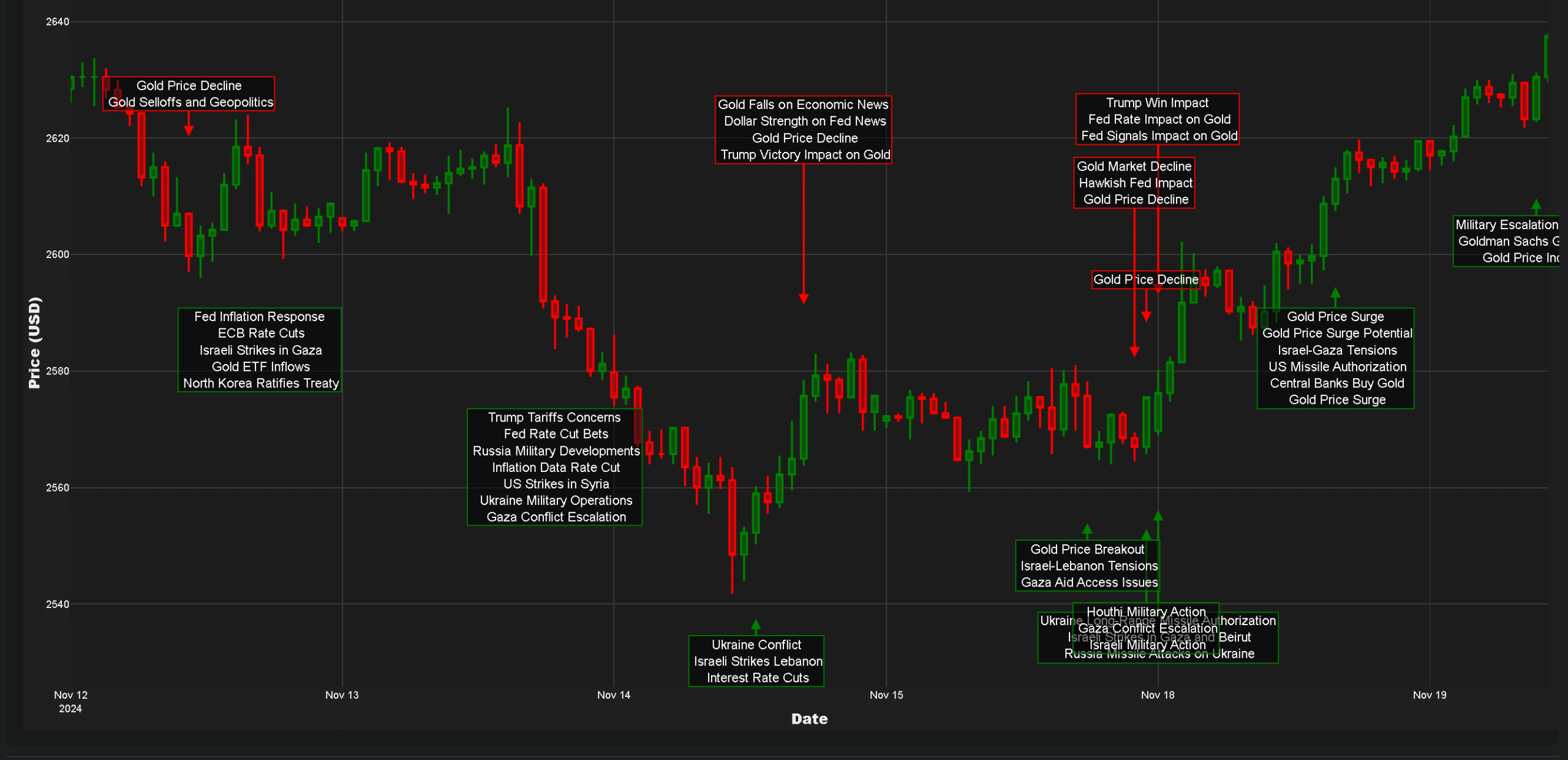
The prospect of significant changes in the gold market has materialised, and our Trading Co-Pilot‘s insights have identified a complex series of technical breakdowns following Trump’s victory. Indeed, from looking at our AI-driven analysis of the latest gold market news, we’re witnessing a fascinating repositioning of traditional safe-haven assets.
Speaking of which, our AI detected an immediate bearish divergence post-election as it was unfolding, with gold market news dominated by a substantial selloff. With the precious metal dropping nearly 7% earlier this month, testing critical support levels around $2,550. One explanation, supported by our Trading Co-Pilot’s correlation analysis, is the significant capital rotation towards cryptocurrencies, evidenced by the iShares bitcoin ETF surpassing its gold counterpart in size.
Meanwhile, sentiment analysis of corporate performance has painted a more nuanced picture in the gold market news. Consider the case of Kinross Gold, which exceeded Q3 estimates, while Hudbay Minerals reported record gold production in Manitoba. More broadly, our AI analysis indicates multiple mining companies demonstrated resilience despite market turbulence.
The clue to this can be found in our Trading Co-Pilot‘s pricing analysis where cross-border arbitrage taking advantage of gold trading cheaper in India compared to the UAE, Qatar, and Singapore. This isn’t the only such example of market dislocation; with premium rates in Asia reaching a four-month peak as price drops attract more customers. By our estimate, based on real-time arbitrage calculations, these opportunities present significant trading possibilities.
Then came the Goldman Sachs analysis, which aligns with several of our Trading Co-Pilot’s long-term projections. Our AI models support their “buy” recommendation, particularly considering the anticipated Federal Reserve rate cuts in 2025 and increasing central bank purchases.
But alongside a weakening dollar and stalling rally, our geopolitical risk indicators are flashing warning signals. Want to understand why? The key problem, according to Trading Co-Pilot analysis, is that global tensions, including China’s rise and Putin’s ambitions, continue to influence safe-haven demand. Above all, though, our algorithms suggest the market is entering a critical consolidation phase.
We know that many people think that gold’s November dip signals a longer-term bearish trend, and our momentum indicators currently support this view. However, the good news is that our Trading Co-Pilot had identified several potential reversal signals even before most people were becoming aware of that fact. To put this in perspective, despite the recent turbulence in gold market news, our technical analysis shows prices bouncing off the 100-day moving average, suggesting potential support formation.
Returning to where we began, our AI analysis indicates the Trump victory has fundamentally reshaped market dynamics. But on that front, our institutional flow indicators suggest major players aren’t abandoning gold entirely. Instead, they’re strategically repositioning portfolios, which our Trading Co-Pilot interprets as potential accumulation at lower levels.
In short, our Trading Co-Pilot‘s comprehensive analysis of the gold market news landscape presents a complex picture of challenges and opportunities. The problem is that traditional correlations are breaking down, particularly regarding safe-haven dynamics. Adding insult to injury, our crypto-gold correlation metrics show the cryptocurrency sector’s growing prominence has introduced new competition for investment flows.
Looking ahead, our Trading Co-Pilot suggest monitoring Federal Reserve policy, geopolitical developments, and institutional buying patterns will be crucial. There is also the question of whether our identified resistance level around $2,600 will hold. Another core principle from our analysis is the importance of watching regional price differentials, which our Trading Co-Pilot flags as leading indicators of smart money flow.
We invite you to think back to previous market cycles – our historical pattern recognition shows gold has demonstrated remarkable resilience during periods of political and economic uncertainty. The fundamental story of gold remains unchanged according to our Trading Co-Pilot insights: it serves as a store of value and hedge against uncertainty. Indeed, as we are entering the age of increased geopolitical tensions and economic recalibration, our Trading Co-Pilot suggests gold’s role in investment portfolios may become even more significant.
Want to harness the same AI insights that spotted these market movements in real-time? Request your personalised Trading Co-Pilot demo to access live gold market analysis and buy/sell signals. Explore our Trading Co-Pilot‘s capabilities or email enquiries@permutable.ai to request a demo or simply fill in the form below to understand how you can transform your gold trading strategy with our award-winning AI platform.
You would be hard-pressed to find a more intricate market situation than current natural gas markets signaling complex winter ahead. Let’s examine how our Trading Co-Pilot’s AI analysis of natural gas market news has uncovered several important patterns suggesting we are entering a new market interesting and potentially volatile phase in the natural gas market.
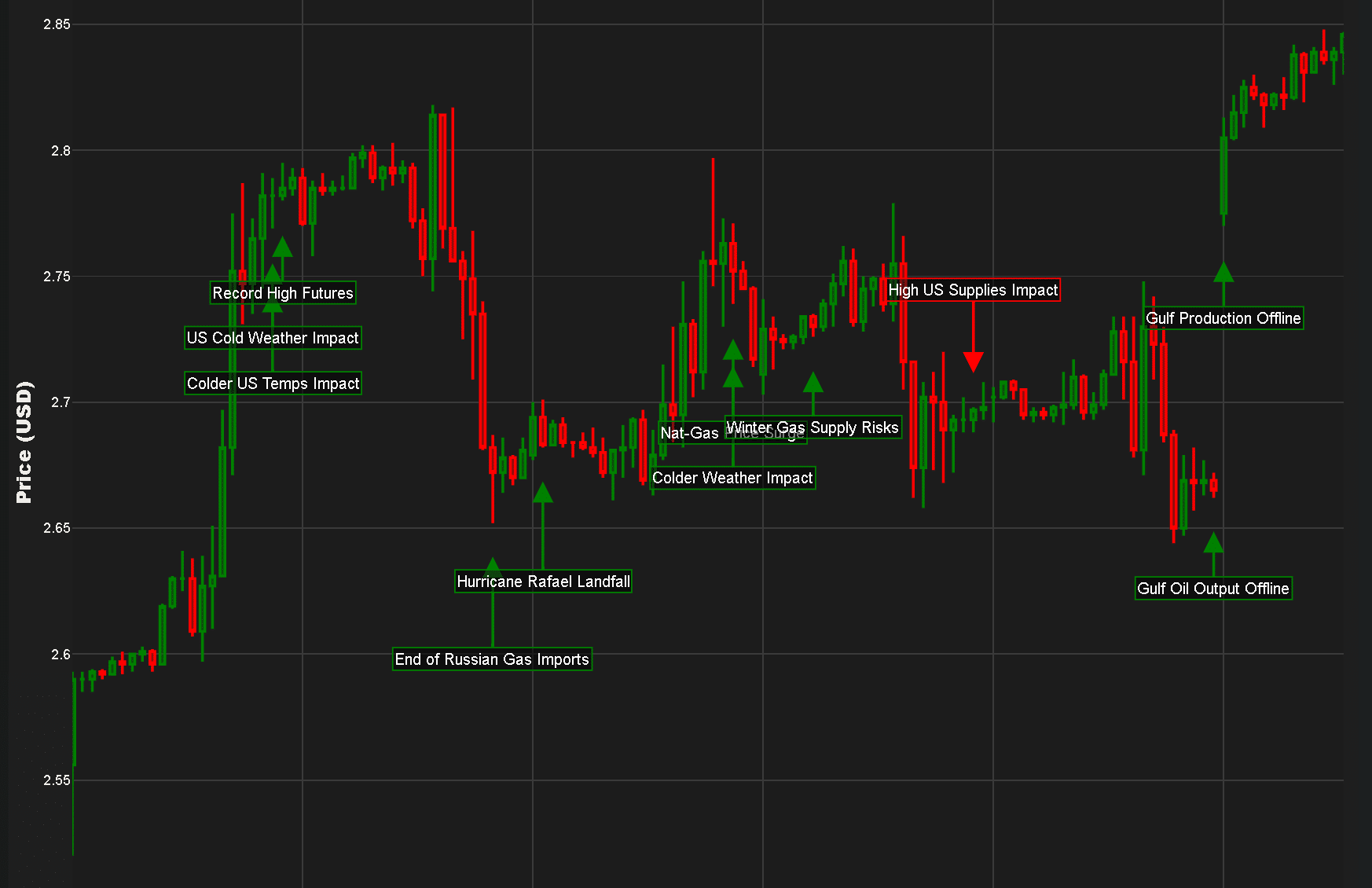
Some time ago, traditional analysis might have focused solely on temperature forecasts. Instead, our Trading Co-Pilot has detected a more nuanced picture. While mild autumn temperatures initially exerted downward pressure, Hurricane Rafael’s Category 3 impact on the Gulf Coast created unexpected supply disruptions. More broadly, when over 16% of US Gulf natural gas production remained offline, the market faced immediate supply constraints.
The aforementioned isn’t the only example of complex market forces at play. The problem is that Gulf disruptions are coinciding with infrastructure constraints. More to the point, with the reports of supply disruptions, this caused cascading effects across energy markets, with combined factors creating a supply squeeze that perhaps many traders hadn’t factored into their analyses.
For those looking for the answer to why it’s likely to be a complex Winter ahead for global natural gas markets, the answer to this can be found in recent developments in European natural gas markets. Few now believe that European energy dependence on Russian gas will return to previous levels. Indeed, from looking at the new EU energy commissioner’s commitment to eliminating Russian gas reliance, coupled with ADNOC’s new LNG supply deal with Germany, this means that new demand patterns are emerging.
Let’s examine what else our Trading Co-Pilot has highlighted. There is also the question of price action, which has shown recovery signs while remaining below key resistance levels. Meanwhile, the daily and weekly charts present mixed signals that require careful interpretation. Above all, though, what sets our Trading Co-Pilot’s analysis apart is the ability to synthesize these multiple factors simultaneously.
Sure, some people think that individual market factors can be analysed in isolation, but to us, this is a fool’s game. Case in point – Australia’s East coast facing a gas crisis and Nigeria reporting low funding for domestic gas projects, the global supply picture becomes increasingly complex. Talk about a perfect storm of factors converging.
Before we look ahead, we invite you to think back to previous market shifts. Not only do current conditions mirror historical patterns, but they also present unique characteristics that our Trading Co-Pilot has identified. Think of that in the context of approaching upcoming winter demands, geopolitical pressures, and the fact that 2024 is projected to be the hottest year on record. Some might say it’s hard to get a handle on how these factors might play out without comprehensive AI analysis.
In short, while traditional analysts might focus on individual factors, we believe it’s crucial to take a holistic view of market dynamics. Our Trading Co-Pilot suggests watching natural gas market news in real-time for specific trigger points that could shift market sentiment. The key problem is that traditional analysis often misses these longer-term structural shifts or delivers it too late, which is precisely where our real-time AI-powered analysis proves invaluable.
What you’ve just read is just a snapshot of our Trading Co-Pilot‘s analytical capabilities. Whilst others are still catching up on the headlines, our AI is already analysing the next market-moving signals in natural gas in real-time. In an environment where every minute counts, having real-time intelligence can make the difference between profitable trading decisions and missed opportunities.
Our Trading Co-Pilot delivers instant analysis of breaking news impact, clear buy/sell signals backed by AI, and an early warning system for market shifts. From technical breakdowns to weather pattern impact assessment and real-time supply-demand dynamics, our AI processes it all instantly, giving you a clear edge in these volatile markets.
We’re opening limited places for our next cohort of enterprise trial users. Join leading energy traders who are already using our AI to cut through market noise, spot opportunities early, manage risk effectively, and make truly data-driven decisions. This winter’s natural gas markets are signalling complexity ahead – don’t trade them blind – get in touch to request a 2-week free trial for qualified corporate traders by getting in touch with us at enquiries@permutable.ai or filling in the form below.
Let’s start with a simple truth: predicting market trends and volatility has always been a bit of a dark art. For years, traders and investors have relied on a mix of experience, intuition, and traditional statistical models to navigate the choppy waters of financial markets. And it isn’t just about making profits; it’s about managing risk and maintaining stability in our global economic system. But then machine learning came along and changed everything.
You might say that we’ve been doing alright with the old methods. After all, markets have functioned for centuries without the aid of artificial intelligence since it came on the scene way back in the 1970s (see our lookback at the evolution of AI in financial markets for more on that) . Yet here’s the rub: as markets become increasingly complex and interconnected, traditional methods are struggling to keep pace. Enter machine learning, the x factor that’s changing the game of predicting market trends and volatility.
The problem isn’t that the old models of market analysis don’t work exactly; it’s that they’re not equipped to handle the sheer volume and velocity of data in today’s markets. Machine learning algorithms, on the other hand, thrive on big data. They can process vast amounts of information, identify patterns that humans might miss, and make predictions with a level of accuracy and timeliness that was once thought impossible.
You may say: but does machine learning really make that much of a difference in predicting market trends and volatility? The short answer is yes, and the evidence is compelling. Studies have shown – and we have also seen firsthand with our own work – that machine learning models consistently outperform traditional statistical methods in this arena. This striking difference hints at a fundamental shift in how we understand and interact with financial markets.
For starters, machine learning models can analyse a broader range of data sources when predicting market trends and volatility. They’re not limited to historical price and volume data; they can incorporate news sentiment, social media trends and macroeconomic indicators to gauge economic activity. This holistic approach provides a more finely-tuned understanding of the factors driving market dynamics.
Here’s something else we know to be true. Machine learning models are far better at capturing non-linear relationships in financial data. Traditional models often assume linear relationships between variables, which can lead to oversimplification. Machine learning algorithms, particularly deep learning models, can identify complex, non-linear patterns and in particular, relational patterns, that more accurately reflect the intricacies of real-world markets and the entities that comprise them.
Now let’s raise a bone of contention which is often cited in relation to the adaptability of these models. Financial markets are dynamic, with patterns and relationships that evolve over time. Machine learning models can be designed to continuously learn and adapt, and in our experience, must be constantly fine-tuned to ensure they remain relevant even as market conditions change. This adaptability is crucial in today’s fast-paced, ever-changing financial landscape.
Of course, it’s notable that machine learning isn’t just improving the accuracy of predicting market trends and volatility; it’s also changing how we think about these concepts. By identifying subtle patterns and correlations, these models are helping us develop a more granular understanding of market dynamics. And it is this deeper insight can lead to more effective risk management strategies and more efficient markets overall.
All of this signals that we’re on the cusp of a significant shift in financial market analysis. The integration of machine learning into predicting market trends – as demonstrated in our own Trading Co-Pilot – and volatility is not just an incremental improvement; it’s a significant step change that’s reshaping the field.
Nonetheless, it’s important to approach this technology with a balanced perspective. Machine learning is a powerful tool, but it’s not infallible. It’s important to remember that unless expertly trained and fine-tuned, models can be biased, overfitted, or simply wrong. The key is to use machine learning as a complement to human expertise, not a replacement for it.
We have seen time and time again how the hybrid approach can be undeniably powerful – in fact, we see this on a daily basis with our clients who are using our Trading Co-Pilot as well as throughout using it ourselves internally to execute trades. For instance, while machine learning models excel at identifying patterns in data, they lack the contextual understanding and intuition that experienced traders bring to the table. A model might flag a pattern as indicative of increased volatility, but a human analyst might recognise it as a temporary anomaly based on their broader understanding of market dynamics. It’s really when the two combine that the magic happens.
Again and again, we see the same pattern: the most effective approaches combine the strengths of machine learning with human insight. This hybrid approach allows us to leverage the processing power and pattern recognition capabilities of AI while still benefiting from human judgement and contextual understanding in predicting market trends and volatility.
In short, the role of machine learning in predicting market trends and volatility is nothing short of transformative. It’s providing us with new tools to understand and navigate the complexities of financial markets. As we look to the future, it’s clear that machine learning will play an increasingly important role in predicting market trends and volatility. One thing is cleat, those who can effectively harness this x factor will have a significant advantage.
Are you ready to embrace the future of predicting market trends? Permutable AI’s Trading Co-Pilot, powered by advanced machine learning, provides real-time insights and context-aware strategies. Harness AI to analyse global sentiment and market events, giving your firm the edge with more precise, risk-aware trading decisions. Contact us at enquiries@permutable.ai or via the form below to explore how our Trading Co-Pilot can transform your trading approach.
Get in touch to register your interest to see how our Trading Co-Pilot can help you make smarter trading decisions, faster.
Perhaps it seems like a tall tale to some, but our vision is that artificial intelligence can transform the way we approach trading and market analysis. It started with our mission to build an AI/ML autonomous trading system, which evolved into the development of our Trading Co-Pilot – the AI tool for trading which we believe will reshaping the landscape of financial markets.
Of course, over the past few years, we’ve witnessed a huge surge in the application of AI in financial markets yet many solutions fall short of truly enhancing human capabilities. Our motto is simple: let’s radically improve decision time and quality, leading to increased P&L for trading desks.
Internally, we had been toying with the idea of an AI-powered trading assistant for some time. Against the odds, our team of experts with backgrounds in financial services and AI/ML set out to create something truly transformative and it was a long time in the making. Initial attempts provided a boost to our confidence as we knew we were onto something exciting, but we knew we needed to go further to have something that was ready to go-to-market with.
And so, as our startup painstakingly developed an AI tool for trading that uses all global news sources to understand the world’s sentiment about an asset. This little (or not so little) guy can swim through oceans of data, extracting valuable real-time insights that enhance the capabilities of human analysts and traders. Our philosophy here is this: there is an edge in the world’s perception of an asset versus its current price. In many ways, this premise has guided our entire approach to developing our AI tool for trading – and if you are a corporate trader, now it can be in your hands also.
The first step in our journey was creating a dashboard to explain how our machine was making its decisions. Which makes this transparency crucial – we believe that for an AI tool for trading to be truly effective, it must work in harmony with human traders, not replace them. As debates rage over the role of AI in finance, we’ve taken a clear stance. Our AI tool for trading, evolved into a Trading Co-Pilot, enabling human traders to make better decisions by providing them with unparalleled market intelligence updated every 30 seconds, right round the clock.
Endless hours of development have gone into ensuring our AI tool for trading can accurately capture and analyse global sentiment. The lessons learnt along the way include the importance of diverse yet high-quality data sources, addressing bias and the need for continuous fine-tuning of our algorithms.
Fundamentally, markets are inherently complex and dynamic. Political and economic crises come and go, but our AI tool for trading is designed to adapt and provide valuable insights regardless of market conditions. We believe that less frenzy and more simplicity is needed in the world of trading, and that’s exactly what we’re striving for with our Trading Co-Pilot.
One element is clear: our AI tool for trading is not about replacing human traders but empowering them. By providing comprehensive market analysis and sentiment insights through our Trading Co-Pilot, we’re enabling traders to make more informed decisions faster than ever before.
Some of the present chatter in the industry focuses on fully autonomous trading systems. While we’ve developed capabilities in this area, we believe the real power lies in the synergy between human intuition and machine intelligence. Our AI tool for trading processes vast amounts of global news and market data, providing traders with a clear picture of market sentiment. This capability is particularly crucial in today’s fast-paced markets, where information flows at an unprecedented rate.
As we continue to refine our AI tool for trading, we’re constantly exploring new ways to enhance our offering, always with the goal of providing more value to our users and this is made possible by our early-stage users who are providing us with a continuous feedback loop. Ultimately, the future of trading is undoubtedly intertwined with AI, and we’re proud to be at the forefront of this transformation. We firmly believe that our team’s expertise in both finance and AI positions us uniquely to develop tools that truly understand and address the needs of traders.
In a world where market dynamics can shift in the blink of an eye and trading losses can be eye-watering, tools like our AI-powered Trading Co-Pilot are becoming increasingly crucial. By leveraging the power of global sentiment analysis, our AI tool for trading enables traders to stay ahead of market movements and make more informed decisions.
Experience the power of our AI tool for trading for yourself. Whether you’re trading commodities, equities, or cryptocurrencies, our Trading Co-Pilot can provide you with unparalleled insights and a competitive edge. To learn more about how our AI tool for trading and our newly launched API for commodities can enhance your trading strategies, contact us at enquiries@permutable.ai or fill in the form below.
In the ever-complex financial markets, finding and keeping your edge is the holy grail. At Permutable AI, our innovations have been at the very heart of a trend that is reshaping the way traders and financial analysts approach market data: natural language processing (NLP). This powerful subset of artificial intelligence is transforming how we interpret and act on financial information, and we’re excited to share our latest insights on the rise of natural language processing in trading and how its transforming the landscape entirely.
Natural Language Processing, at its core, is about teaching machines to understand, interpret, and generate human language. In the context of trading, this technology is opening up new frontiers in data analysis and decision-making. But while the concept might sound straightforward, the implications for the financial industry are profound and far-reaching.
Initially, NLP in finance was primarily used for simple tasks like categorising news articles or extracting basic information from financial reports. Now, nearly a decade into its application in the financial sector, NLP has evolved into a sophisticated tool capable of nuanced sentiment analysis, real-time market mood assessment, and even predictive modeling based on textual data.
One of the most powerful applications of natural language processing in trading is sentiment analysis. By analysing vast amounts of textual data from news articles, social media posts, and financial reports, NLP algorithms can gauge market sentiment with unprecedented accuracy. This isn’t just about determining whether sentiment is positive or negative; modern NLP models can detect subtle nuances and context that might escape human analysts.
For instance, a company announcement might appear positive at first glance, but deeper sentiment analysis could reveal underlying concerns that only emerge through a careful examination of word choice or context. This enables traders to make more informed decisions, as they can gauge the true sentiment driving market movements, giving them a valuable edge in rapidly changing environments.
In today’s fast-paced markets, being the first to act on breaking news can make all the difference. NLP-powered news aggregation and curation tools can process thousands of news sources in real-time, identifying relevant information and potential market-moving events faster than any human could. Instead of wading through endless streams of information, traders can rely on NLP systems to curate and filter only the most impactful news, allowing for swift decision-making.
Our Trading Co-Pilot is a perfect example of this, leveraging NLP to deliver immediate insights from news reports across the globe. Whether it’s political developments, corporate earnings, or economic data, NLP ensures traders stay ahead of the curve, responding to critical events with precision.
Quarterly earnings calls are essential for traders and investors seeking insights into a company’s future performance. However, manually analysing these calls can be both time-consuming and subject to human bias, particularly when it comes to interpreting subtle shifts in tone or language. NLP algorithms can transcribe and process earnings calls in real-time, analysing the content to detect underlying sentiments, such as cautious optimism or hidden concerns, that might not be apparent in written reports.
Notably, NLP can spot changes in language patterns or word choices that may signal a company’s future strategy or challenges. This analysis allows traders to act more quickly and with greater confidence, armed with insights gleaned from the tone and delivery of executives during these critical communications. By cutting through the noise and delivering unbiased interpretations, NLP streamlines the decision-making process, giving traders the edge they need in high-stakes financial markets.
While natural language processing in trading holds huge potential, it comes with its own set of challenges and considerations. First and perhaps one of the most critical issues is data quality. As with any machine learning model, the saying “garbage in, garbage out” applies. NLP models rely heavily on the data they are trained on, and if that data is incomplete, noisy, or biased, the results can be misleading or outright inaccurate. Financial data, especially text-based data like news reports or earnings calls, can often be riddled with errors, inconsistencies, and subjective biases, making the task of training accurate models even more challenging. Ensuring the highest possible quality of input data—through filtering, cleaning, and curating – is absolutely essential to achieving meaningful results.
Another key challenge is the need for domain-specific NLP models like the in-house ones we have built and trained here at Permutable. Financial markets use a highly specialised language filled with jargon, acronyms, and terminology that isn’t common in everyday text. For example, words like “hawkish,” “bearish,” or “dovish” have very specific meanings in a financial context but can confuse generic NLP models trained on broader language data. This is why many off-the-shelf NLP models often struggle to deliver precise insights when applied to financial texts. Building models that are specifically trained on financial data is critical for understanding the subtleties and nuances of market language. These finance-specific models must also stay updated to keep pace with the ever-evolving financial terminology and market dynamics.
Then there’s the increasingly important issue is model interpretability. As NLP models become more advanced and complex, they often behave like “black boxes,” producing results without easily explainable reasoning. This presents a significant problem in the trading world, particularly in regulated markets where decision-making processes need to be transparent, explainable, and auditable. For instance, a model might recommend a trade based on a sentiment shift in a CEO’s earnings call, but understanding the exact reasoning behind that recommendation—whether it’s the tone, phrasing, or specific words used – is often unclear. This lack of interpretability not only raises concerns for traders who need to trust the model’s output but also for regulators who require a clear audit trail of decisions made based on AI-driven tools.
Lastly, there’s the challenge of keeping models up to date. Financial markets are constantly evolving, influenced by new events, technologies, regulations, and market participants. NLP models that are trained on older datasets may quickly become outdated, producing results that are no longer relevant. Continuous model retraining with fresh, high-quality data is crucial to ensure that NLP applications remain accurate and effective in fast-moving market conditions. Additionally, this constant need for model refinement and retraining increases the resource intensity and complexity of maintaining state-of-the-art NLP solutions in trading.
At Permutable AI, we see the future of NLP in trading as a key driver of innovation and accuracy. We predict that the next frontier of NLP will involve deeper integrations with other AI technologies, such as computer vision. Imagine combining the power of NLP with visual data analysis – this could mean that traders could analyse satellite images of shipping routes or factory production lines alongside textual financial reports, allowing for a far more comprehensive understanding of market trends. This cross-disciplinary AI synergy could uncover insights that would otherwise go unnoticed, enhancing decision-making in ways traditional methods can’t.
Now, let’s take another exciting development is the rise of multilingual NLP models. Financial markets are global, and having the ability to analyse news, social media, and reports in multiple languages will give traders a significant edge. These multi-language models not only translate content but will also capture subtle cultural nuances and local market sentiment, which often drive market behaviours. For instance, a trader using multilingual NLP might detect an emerging trend in China or Brazil faster than competitors limited to English-language data. The integration of this global perspective will become increasingly vital as markets continue to become more interconnected.
Predictive modeling is another transformative area that is already unfolding for NLP in trading and can be seen in our Trading Co-Pilot. By analysing vast historical datasets of financial news, earnings reports, and market commentary, NLP models can correlate linguistic patterns with market movements to forecast future trends. This goes beyond traditional technical analysis, allowing traders to spot emerging risks or opportunities before they become apparent through standard market indicators. The use of textual data to anticipate future price movements is nothing short of game-changing, and offers an unprecedented edge that can drastically alter trading strategies.
As exciting as these developments are, it’s important to remember that NLP is a tool, not a magic solution. Successfully integrating NLP into your trading strategy requires a deep understanding of both the technology and the financial markets. At Permutable AI, we’ve been at the forefront of applying NLP to financial data analysis. Our experiences have taught us that the most successful applications of this technology come from combining cutting-edge NLP models with domain expertise and rigorous testing.
For those looking to stay ahead in this rapidly evolving field, continuous learning and experimentation are key. We encourage traders and analysts to familiarise themselves with NLP concepts and to start small, perhaps by experimenting with sentiment analysis on a limited dataset before scaling up to more complex applications. Or, by using our Trading Co-Pilot that simply does it all for you.
Understanding and effectively leveraging natural language processing in trading can be a complex. But thankfully, that’s where our Trading Co-Pilot comes in. This state-of-the-art tool incorporates advanced NLP techniques to provide real-time insights and trading signals based on textual data analysis. If you’re interested in experiencing the power of NLP-driven trading insights and gaining a competitive edge in the market, why not get in touch to request a personalised demo or free trial? Simply email us at enquiries@permutable.ai or fill in the form below to get in touch.